Biological Forum – An International Journal 6(2): 115-126(2014) 
ISSN No. (Print): 0975-1130 
ISSN No. (Online): 2249-3239 
Floristic Diversity along an Altitudinal Gradients in Hango Valley of 
Cold Desert in District Kinnaur, Himachal Pradesh 
R.K. Verma 
Himalayan Forest Research Institute, 
Conifer Campus, Panthaghati, Shimla, (HP) 
(Corresponding author: R.K. Verma) 
(Received 08 April 2014, Accepted 30 May, 2014) 
ABSTRACT: Cold deserts-a unique ecosystem in itself, lies in the lap of Himalayas, which is quite fragile and 
sensitive. The biotic pressure on this particular ecosystem as exerted by increasing human and cattle 
population coupled with over exploitation has resulted in its ecological degradation. Accordingly, a study was 
conducted to understand the floristic diversity along an altitudinal gradient with elevations varying from 
3400m to 5000m above msl in Hango valley falling in cold desert area of district Kinnaur, Himachal Pradesh. 
Total number of plant species was 130 belonging to 41 families and 101 genera. The dominant families were 
Asteraceae, Polygonaceae, Ranunculaceae, Lamiaceae and Umbelliferae. Number of tree species at 3400- 
3800m elevation was 3 with the dominance of Salix alba. The number of shrubs species were 9, 5, 3 and 2 with 
the dominance of Rosa webbiana, Cotoneaster microphyllus, Juniperus indica and Rhododendron anthopogon 
in the elevations of 3400-3800m, 3800-4200m, 4200-4600m and 4600-5000m respectively. The number of herb 
species were 73, 63, 36 and 30 at 3400-3800m, 3800-4200m, 4200-4600 and 4600-5000m elevation respectively. 
Heracleum candicans was dominant at 3400-3800m elevation and Bergenia stracheyi was dominant herbs at 
3800-4200m, 4200-4600m and 4600-5000m elevation on the basis of Importance Value Index. The distribution 
pattern of most the plant species was contiguous in all the altitudinal ranges. Index of diversity for herb 
species in different elevation ranges was 3.82, 3.51, 3.20 and 3.18. The richness and evenness index was 
comparatively more in lower altitudinal ranges than higher altitudinal ranges indicating that species are 
evenly distributed in lower elevations. Index of similarity calculated for shrub and herb species indicating 
more dissimilarity of species between different altitudes. Out of 62 medicinal plant species recorded from the 
area, 18 species i.e. Aconitum violaceum, Arnebia euchroma, Bergenia stracheyi, Dactylorhiza hatagirea, 
Ephedra gerardiana, Ferula jaschkeana, Hippophae rhamnoides, Hyoscyamus niger, Hyssopus officinalis, 
Juniperus polycarpos, Meconopsis aculeata, Pleurospermum candollei, Rheum webbianum, Rhodiola 
heterodonta, Rhododendron anthopogon, Rhododendron campanulatum, Saussurea obvallata and Saussurea 
gossypiphora fall in the category of threatened plants. The better conservation of natural resources can be 
done through promotion of community based conservation, in-situ conservation through the establishment of 
nature reserves, ex-situ conservation through tissue culture, developing cultivation technologies and nurseries 
of medicinal plants and conducting of regular training on the procedure of medicinal plants collection and 
processing among the end users. 
Key Words: Floristic diversity, Dominance, Altitudinal gradients, Distribution pattern 
INTRODUCTION 
considered exclusively endemic to the Himalayas. 
The cold deserts in India occur in Ladakh region of 
The diverse climate and the varied environmental 
Jammu & Kashmir, Spiti valley of Lahaul and Spiti 
conditions prevailing in Himalayas support diverse 
district and Pooh sub division of Kinnaur district of 
habitat and ecosystems with equally diverse life 
Himachal Pradesh. The total area under cold deserts 
forms. Himalayas are one of the largest and youngest 
in Himachal Pradesh is about 11,000 sq.km., out of 
mountain chains in the world and cover roughly 10% 
which 3,400 sq.km. area is in Kinnaur district. 
of India total land surface. Variations in terms of its 
Human pressure on natural ecosystems is 
size, climate and altitudinal ranges have created 
intensifying, some being incompatible with survival 
environments those are unique and characteristic to 
of certain species of plants. In cold desert areas, 
this region only. It provides an important habitat to 
continuous removal of plant species for various uses 
the flora and fauna including 9,000 species of 
and overgrazing by migratory livestock have resulted 
angiosperms and hence, is considered as the hot spot 
in desertification and loss of biodiversity. 
of biodiversity. There are about 3,470 species
Verma 116 
If these naturally occurring plant resources are not 
timely conserved then they may soon become extinct. 
In cold desert this genetic erosion coupled with soil 
erosion may retard prospects of future economic 
development and welfare of the people. The 
assessment of plant wealth in this harsh cold arid belt 
may provide a key for its conservation. Keeping these 
aspects in view, a study was undertaken to know the 
plant diversity in Hango valley of cold desert in 
Kinnaur district of Himachal Pradesh. 
MATERIALS AND METHODS 
The present study was conducted in Hango valley of 
cold desert area of Pooh sub division of district 
Kinnaur, Himachal Pradesh during, 2008 at an 
elevation of 3400m to 5000m. The study site was 
situated 31o49'35.4" to 31o48'30.2" N latitude and 78o 
31'99.8" to 78o33'83.0" E longitudes. The whole area 
of the valley was divided into four altitudes i.e. 3400- 
3800m, 3800-4200m, 4200-4600m and 4600-5000m 
for conducting the phyto-sociological study. Quadrats 
were laid out in stratified random manner along the 
altitudinal transects. Quadrats of size 10mx10m, 
3mx3m amd 1mx1m laid out randomly for 
enumerating trees, shrubs and herbs + regeneration 
respectively. A total of 20, 30 and 40 quadrats for 
tree, shrub and herb respectively were laid out in 
each altitudinal gradient. The seedlings were 
considered as herb while saplings as shrubs. The 
vegetation data was analysed for density, frequency 
and abundance according to formulae given by Curtis 
and McIntosh (1950). The relative values of density, 
frequency and dominance were summed to get 
Importance Value Index (IVI) of individual species. 
The abundance to frequency ratio (A/F) of different 
species was determined for eliciting the distribution 
pattern. This ratio indicates regular (<0.025), random 
(0.025 to 0.050) and contiguous (>0.050) distribution 
(Curtis and Cottam, 1956). The plant species 
diversity was calculated by using Shannon-Wiener 
diversity Index (H) (Shannon-Wiener, 1963). 
S 
H = - Σ (Ni/N) ln (Ni/N) 
i = 1 
Concentration of dominance (C) was measured by 
Simpson’s Index (Simpson, 1949). 
S 
C = Σ (Ni/N)2 
i = 1 
Where Ni = importance value of species i and N= 
total importance value of all the species in both the 
indices. 
Index of similarity and dissimilarity between 
different altitudes were calculated by using following 
formula (Misra, 1989). 
Index of similarity, S = 2C / A+B 
Where A= number of species in community A, B = 
number of species in community B, C = number of 
species common to both communities. 
Index of dissimilarity = 1-S 
Richness Index was estimated as per Margalef (1958) 
i .e. R = S-1/ln N 
Evenness Index was calculated as per Hill (1973) i. e. 
E = H/ ln S 
Where S = total number of species, N= total number 
of individuals of all the species, H = Index of 
diversity. 
RESULTS AND DISCUSSION 
At elevation of 3400-3800m total number of tree 
species was 3 (Table 1) with the dominance of Salix 
alba followed by Populus alba and Juniperus 
polycarpos in term of density and frequency. For a 
particular species higher frequency indicates its more 
frequent distribution at a particular site. The value of 
abundance was maximum for Juniperus polycarpos 
followed by Salix alba and Populus alba. Importance 
Value Index is the most important parameter to 
understand the community organization in relation to 
the comparative ability. Salix alba recorded highest 
value of IVI (155.95) followed by Populus alba 
(125.04) and Juniperus polycarpos (19.01). The 
distribution pattern of Juniperus polycarpos was 
contiguous whereas for Populus alba and Salix alba 
it was random. The contiguous distribution is the 
commonest pattern in nature, random distribution is 
found in very uniform environment. The general 
preponderance of contiguous distribution in 
vegetation has been reported by several workers 
(Kershaw, 1973; Singh and Yadava, 1974; 
Kunhikannan et al., 1998). 
Among the 9 species of shrubs including saplings 
(Table 2), Rosa webbiana was dominant species 
having maximum density and frequency. This was 
followed by Salix alba, Astragalus rhizanthus and 
Hippophae rhamnoides in term of density. The value 
of abundance was maximum for Salix alba followed 
Rosa webbiana, Ribes alpestre and Myricaria 
germanica. Rosa webbiana recorded highest value 
IVI (71.17) followed by Hippophae rhamnoides 
(68.56), Myricaria germanica (37.98) and Salix alba 
(34.63). The distribution pattern of all the species 
was contiguous. In case of herbs, total number of 
species was 73 at 3400-3800 m elevation (Table 3). 
Mentha longifolia was dominant herb followed by 
Arenaria festucoides, Heracleum candicans and 
Arnebia guttata in term of density.
Verma 117 
Table 1: Distribution of tree species in Hango valley of district Kinnaur at 3400-3800m elevation. 
S. 
Species Density 
Frequ-ency(%) 
Abun-dance 
A/F IVI 
No. 
(ha-1) 
1. Juniperus polycarpos C. Koch 30.00 10.00 3.00 0.300 19.01 
2. Populus alba Linn. 165.00 65.00 2.54 0.039 125.04 
3. Salix alba Linn. 235.00 90.00 2.61 0.029 155.95 
Table 2: Distribution of shrub species in Hango valley of district Kinnaur at 3400-3800m elevation. 
S. No. Species Density 
(ha-1) 
Frequ-ency 
(%) 
Abund-ance 
A/F IVI 
1. Astralagus rhizanthus Royle ex. Benth 3370.37 40.00 7.58 0.190 34.50 
2. Cotoneaster microphyllus Wall ex. 
Lindl. 
1148.15 16.67 6.20 0.372 19.13 
3. Hippophae rhamnoides Linn. 2222.22 33.33 6.00 0.180 68.56 
4. Juniperus polycarpos * C. Koch 74.07 3.33 2.00 0.600 2.91 
5. Lonicera spinosa Jacq. 1851.85 23.33 7.14 0.306 21.10 
6. Myricaria germanica (L.) Desv. 1185.19 13.33 8.00 0.600 37.98 
7. Ribes alpestre Wall. ex. Decne 1000.00 10.00 9.00 0.900 10.01 
8. Rosa webbiana Wall. ex. Royle 7481.48 63.33 10.63 0.168 71.17 
9. Salix alba * Linn. 4185.19 16.67 22.60 1.356 34.63 
*Sapling 
Table 3: Distribution of herbs species in Hango valley of district Kinnaur at 3400-3800m elevation. 
S. No. Species Density 
(m-2) 
Frequ-ency 
(%) 
Abund-ance 
A/F IVI 
1. Aconogonum tortuosum D. Don Hara 0.63 10.00 6.25 0.625 3.21 
2. Anaphalis triplinervis (Sims ) C. 
B.Clarke 
0.30 10.00 3.00 0.300 1.99 
3. Anemone obtusiloba D.Don 0.23 10.00 2.25 0.225 1.67 
4. Anemone rivularis Buch- Ham ex. DC. 3.00 20.00 15.00 0.750 10.49 
5. Arenaria festucoides Benth 3.33 30.00 11.08 0.369 11.25 
6. Arnebia euchroma (Royle ex. Benth) 
I.M.Johnston 
0.30 10.00 3.00 0.300 2.72 
7. Arnebia guttata Bunge 1.25 12.50 10.00 0.800 6.20 
8. Astragalus dracunculus L. Tarragon 0.85 12.50 6.80 0.544 6.59 
9. Astragalus rhizanthus Royle ex. 
Benth 
0.48 12.50 3.80 0.304 4.51 
10. Bupleurum falcatum Linn. 0.10 2.50 4.00 1.600 0.63 
11. Bupleurum tenue Buch-Ham ex D.Don 0.63 20.00 3.13 0.156 3.78 
12. Cannabis sativa L. Hemp 0.10 2.50 4.00 1.600 1.79 
13. Capparis spinosa Linn. 0.05 2.50 2.00 0.800 0.44 
14. Chenopodium album Linn. 0.20 7.50 2.67 0.356 2.08 
15. Chenopodium ambrosisoides Linn. 0.08 2.50 3.00 1.200 0.54 
16. Chenopodium foliolosum (Moench) 
Asch 
0.15 7.50 2.00 0.267 1.51
Verma 118 
17. Aconogonum tortuosum D. Don Hara 0.63 10.00 6.25 0.625 3.21 
18. Anaphalis triplinervis (Sims ) C. 
B.Clarke 
0.30 10.00 3.00 0.300 1.99 
19. Anemone obtusiloba D.Don 0.23 10.00 2.25 0.225 1.67 
20. Anemone rivularis Buch- Ham ex. DC. 3.00 20.00 15.00 0.750 10.49 
21. Arenaria festucoides Benth 3.33 30.00 11.08 0.369 11.25 
22. Arnebia euchroma (Royle ex. Benth) 
I.M.Johnston 
0.30 10.00 3.00 0.300 2.72 
23. Arnebia guttata Bunge 1.25 12.50 10.00 0.800 6.20 
24. Astragalus dracunculus L. Tarragon 0.85 12.50 6.80 0.544 6.59 
25. Astragalus rhizanthus Royle ex. 
Benth 
0.48 12.50 3.80 0.304 4.51 
26. Bupleurum falcatum Linn. 0.10 2.50 4.00 1.600 0.63 
27. Bupleurum tenue Buch-Ham ex D.Don 0.63 20.00 3.13 0.156 3.78 
28. Cannabis sativa L. Hemp 0.10 2.50 4.00 1.600 1.79 
29. Capparis spinosa Linn. 0.05 2.50 2.00 0.800 0.44 
30. Chenopodium album Linn. 0.20 7.50 2.67 0.356 2.08 
31. Chenopodium ambrosisoides Linn. 0.08 2.50 3.00 1.200 0.54 
32. Chenopodium foliolosum (Moench) 
Asch 
0.15 7.50 2.00 0.267 1.51 
33. Cirsium wallichi DC. 0.48 27.50 1.73 0.063 6.77 
34. Clematis orientalis Linn. 0.18 10.00 1.75 0.175 
35. Conyza stricta Willd. 0.50 20.00 2.50 0.125 3.53 
36. Corydalis govaniana Wall. 0.15 7.50 2.00 0.267 2.16 
37. Cynoglossum furcatum Wall ex Roxb. 0.93 42.50 2.18 0.051 7.02 
38. Dactylorhiza hatagirea D.Don 0.10 2.50 4.00 1.600 0.61 
39. Echinops cornigerus DC. 0.28 10.00 2.75 0.275 3.97 
40. Ephedra gerardiana Wall. ex. Stapf. 1.20 7.50 16.00 2.133 19.72 
41. Epilobium hirsutum Linn. 0.58 12.50 4.60 0.368 3.30 
42. Epilobium laxum Royle 0.45 7.50 6.00 0.800 2.02 
43. Equisetum arvense Linn. 0.58 7.50 7.67 1.022 2.47 
44. Eremenus himalaicus Baker 0.35 12.50 2.80 0.224 3.71 
45. Erigeron alpines Linn. 0.28 10.00 2.75 0.275 1.82 
46. Fagopyrum dibotrys D.Don Hara 0.53 20.00 2.63 0.131 4.42 
47. Ferula jaeschkeana Vatke 0.23 10.00 2.25 0.225 3.15 
48. Galium aparine Linn. 0.43 10.00 4.25 0.425 2.12 
49. Galium asperuloides Edgew 0.78 12.50 6.20 0.496 3.26 
50. Gentiana ornate G.Don Griseb 0.08 2.50 3.00 1.200 0.55 
51. Gentiana tubiflora G.Don. Griseb 0.18 10.00 1.75 0.175 1.51 
52. Geranium pratense Linn. 0.53 17.50 3.00 0.171 3.37 
53. Heracleum candicans Wall. Ex. DC. 1.38 62.50 2.20 0.035 33.11 
54. Hippophae rhamnoides Linn. 0.20 10.00 2.00 0.200 1.81 
55. Hyoscyamus niger Linn. 0.10 2.50 4.00 1.600 1.02 
56. Hyssopus officinalis Linn. 2.25 22.50 10.00 0.444 9.57 
57. Lactuca dissecta D.Don 0.55 17.50 3.14 0.180 3.26 
58. Leontopodium jacotianum P. Beauv 0.20 7.50 2.67 0.356 1.37
Verma 119 
59. Lomatogonium carinthiacum (Wulfen) 
Reichb 
0.23 10.00 2.25 0.225 1.89 
60. Lotus corniculata Linn. 0.28 7.50 3.67 0.489 1.55 
61. Malva rotundifolia Linn. 0.48 10.00 4.75 0.475 2.54 
62. Medicago falcata Linn. 0.10 2.50 4.00 1.600 0.55 
63. Melilotus alba Med. ex. Desr. 1.28 27.50 4.64 0.169 6.55 
64. Mentha longiflolia (L.) Hud. 3.93 40.00 9.81 0.245 17.79 
65. Nepeta erecta Royle ex.Benth 1.00 20.00 5.00 0.250 5.02 
66. Nepeta podostachys Benth. 0.13 7.50 1.67 0.222 1.21 
67. Oxyria digyna (L.) Hill. 0.88 17.50 5.00 0.286 4.28 
68. Phlomis bracteosa Royle ex. Benth 0.18 10.00 1.75 0.175 1.84 
69. Pimpinella diversifolia DC. 0.10 2.50 4.00 1.600 0.56 
70. Plantago lanceolata Linn. 1.00 27.50 3.64 0.132 5.91 
71. Polygonum polystachya Wall. 
ex.Lehm. 
0.48 10.00 4.75 0.475 6.66 
72. Potentilla argyrophylla Wall. ex 
Lehm. 
0.10 2.50 4.00 1.600 0.71 
73. Primula denticulata Smith 0.20 7.50 2.67 0.356 1.49 
74. Ranunculus laetus Wall. .ex. D. Don 0.20 10.00 2.00 0.200 1.59 
75. Rheum webbiana Royle 0.05 2.50 2.00 0.800 1.15 
76. Rubia cordifolia Hook. f. 0.03 2.50 1.00 0.400 0.35 
77. Rumex nepalensis Sprengel 0.48 22.50 2.11 0.094 12.05 
78. Salix alba Linn. 0.05 2.50 2.00 0.800 0.49 
79. Salvia glutinosa FBI 0.23 7.50 3.00 0.400 1.87 
80. Saussurea albescens Hook. f. ex. 
Thoms. ex. Clarke 
0.93 10.00 9.25 0.925 3.96 
81. Scorzonera virgata DC. 0.25 12.50 2.00 0.160 2.01 
82. Senecio chrysanthemoides DC. 1.00 20.00 5.00 0.250 5.07 
83. Sibbaldia parviflora Edgew 0.25 2.50 10.00 4.000 0.96 
84. Silene viscosa (L.) Pers. 0.30 10.00 3.00 0.300 1.87 
85. Taraxacum officinale Wigg. 0.38 22.50 1.67 0.074 3.39 
86. Thallictrum cultratum Wallich 1.00 37.50 2.67 0.071 7.59 
87. Thymus linearis Benth ex. Benth 0.30 2.50 12.00 4.800 0.99 
88. Urtica dioica Linn. 0.98 10.00 9.75 0.975 4.63 
89. Verbascum thapsus Linn. 0.30 27.50 1.09 0.040 6.78 
The value of abundance was maximum for Ephedra 
gerardiana followed by Anemone rivularis, Thymus 
linearis and Arenaria festucoides. Heracleum 
candicans recorded highest value of IVI (33.11) 
followed by Ephedra gerardiana (19.72), Mentha 
longifolia (17.79) and Rumex nepalensis (12.05). The 
ratio of abundance to frequency indicates that 
distribution pattern of all species except Heracleum 
candicans and Verbascum thapsus was contiguous. 
At 3800-4200m elevation, total number of shrub 
species was 5 (Table 4). Caragyna brevispina was 
dominant species followed by Astragalus rhizanthus 
with respect to density and abundance. On the basis 
of IVI, Cotoneaster microphyllus recorded highest 
value (100.50) followed by Caragyna brevispina 
(78.94), Astragalus rhizanthus (53.70) and Lonicera 
spinosa (37.22). The distribution pattern of all the 
species was contiguous. 
The number of herb species was 63 (Table 5) at 
elevation of 3800-4200m and Arenaria griffithii was 
dominant species followed by Bergenia stracheyi, 
Anemone obtusiloba and Gentiana ornata with 
respect to density. The value of abundance was 
maximum for Arenaria griffithii followed by 
Bergenia stracheyi, Gentiana ornata and Anemone 
obtusiloba. Bergenia stracheyi recorded highest 
value of IVI (50.34) followed by Anemone obtusiloba 
(26.39), Arenaria griffithii (23.57) and Anaphalis
Verma 120 
contorta (15.17). The distribution pattern of all 
species except Meconopsis acuneata was contiguous. 
At elevation 4200-4600m, total number of shrub 
species was 3 (Table 6). Juniperus indica was 
dominant species followed by Lonicera spinosa and 
Rhododendron anthopogon in term of density, 
frequency and abundance. Juniperus indica recorded 
highest value of IVI (190.27) followed by 
Rhododendron anthopogon (62.08) and Lonicera 
spinosa (47.66). The distribution pattern of all the 
species was contiguous. 
In case of herbs, total number of species was 36 
(Table 7) with the dominance of Bistorta affinis 
followed by Bergenia stracheyi, Arenaria festucoides 
and Potentilla parviflora in term of density. The 
value of frequency was maximum for Potentilla 
parviflora followed by Bistorta affinis and Bergenia 
stracheyi where as the value of abundance was 
maximum for Thymus linears followed by Arenaria 
festucoides, Androsace sarmentosa and Bergenia 
stracheyi. The distribution pattern of all the species 
except Rheum webbianum was contiguous. 
At elevation 4600-5000m, total number of species 
was 2 (Table 8) with the dominance of 
Rhododendron anthopogon followed by Juniperus 
indica in term of density, frequency, abundance and 
IVI. The distribution pattern of both the species was 
contiguous. 
Table 4: Distribution of shrub species in Hango valley of district Kinnaur at 3800-4200m elevation. 
S. No. Species Density 
(ha-1) 
Frequ-ency 
(%) 
Abund 
ance 
A/F IVI 
1. Astralagus rhizanthus Royle ex. Benth 3888.89 30.00 11.67 0.389 53.70 
2. Caragana brevispina Royle 6111.11 30.00 18.33 0.611 78.94 
3. Cotoneaster microphyllus Wall. ex. 
Lindley 
3333.33 40.00 7.50 0.188 100.50 
4. Lonicera spinosa Jacq. 2333.33 20.00 10.50 0.525 37.22 
5. Rosa webbiana Wall. ex. 
Royle 
1666.67 20.00 7.50 0.375 29.64 
Table 5: Distribution of herb species in Hango valley of district Kinnaur at 3800-4200m elevation. 
S. No. Species Density 
(m-2) 
Frequ-ency 
(%) 
Abun-dance 
A/F IVI 
1. Aconitum violaceum Jacq. ex. Stapf. 0.20 10.00 2.00 0.200 1.80 
2. Anaphalis contorta (D.Don) Hook. f. 3.03 35.00 8.64 0.247 14.17 
3. Anaphalis triplinervis (Sims) C.B.Clarke 0.43 10.00 4.25 0.425 2.49 
4. Androsace sarmentosaWall. 0.25 15.00 1.67 0.111 2.61 
5. Anemone obtusiloba D.Don 4.08 37.50 10.87 0.290 25.39 
6. Aquilegia fragrans Benth.B G.Goteborg 0.30 5.00 6.00 1.200 1.71 
7. Arenaria griffithii Boiss 6.88 52.50 13.10 0.249 22.57 
8. Arenaria serpyllifolia Linn. 1.20 12.50 9.60 0.768 4.29 
9. Arenebia euchroma Royle ex. Benth 
I.M.Johnston 
0.50 12.50 4.00 0.320 4.59 
10. Arnebia guttata Bunge. 0.60 7.50 8.00 1.067 3.63 
11. Aster flaccidus Bunge 0.23 10.00 2.25 0.225 1.82 
12. Astralagus rhizanthus Royle ex. Benth 0.88 20.00 4.38 0.219 8.85 
13. Bergenia stracheyi (Hook.f.& Thoms) 
Engl. 
4.55 37.50 12.13 0.324 49.34 
14. Bistorta affinis (D.Don) Greene 0.25 12.50 2.00 0.160 2.35 
15. Campanula latiflolia Linn. 0.18 7.50 2.33 0.311 1.33 
16. Chenopodium foliolosum (Moench) Asch 0.20 10.00 2.00 0.200 2.23 
17. Cirsium wallichi DC. 0.15 5.00 3.00 0.600 1.97 
18. Convolvulus arvensis Linn. 0.23 5.00 4.50 0.900 1.33
Verma 121 
19. Conyza stricta Willd. 0.28 10.00 2.75 0.275 1.99 
20. Corydalis crassissima Camb. 0.43 7.50 5.67 0.756 
21. Cynoglossum furcatum Wall ex. Roxb. 0.10 2.50 4.00 1.600 0.58 
22. Delphinium viscosum Hook. f.& Thom. 0.58 10.00 5.75 0.575 4.44 
23. Dianthus angulatus Royle 0.28 5.00 5.50 1.100 1.95 
24. Ephedra gerardiana Wall. ex.Stapf. 0.13 10.00 1.25 0.125 3.45 
25. Epilobium latifolium Linn. 0.03 2.50 1.00 0.400 0.39 
26. Epilobium laxum Royle 0.40 10.00 4.00 0.400 2.55 
27. Euphorbia stracheyi Boiss 0.55 10.00 5.50 0.550 2.98 
28. Ferula jaeschkeana Vatke 0.28 12.50 2.20 0.176 3.12 
29. Galium asperuloides Edgew 0.28 7.50 3.67 0.489 1.55 
30. Galium verum Linn. 0.48 10.00 4.75 0.475 2.28 
31. Gentiana ornate (G.Don.) Griseb 3.60 30.00 12.00 0.400 13.47 
32. Gentiana tubiflora (G.Don ) Griseb 0.13 7.50 1.67 0.222 1.28 
33. Gentinella moorcroftiana Wall. ex. G. 
Don 
0.30 10.00 3.00 0.300 1.91 
34. Geranium pretense Linn. 2.48 60.00 4.13 0.069 13.08 
35. Hyssopus officinalis Linn. 0.63 12.50 5.00 0.400 3.16 
36. Lactuca longifolia DC. 0.05 2.50 2.00 0.800 0.48 
37. 
Leontopodium jacotianum P. Beauv. 
0.13 5.00 2.50 0.500 1.05 
38. Lomatogonium carinthiacum (Wulfen) 
Reichb. 
0.10 7.50 1.33 0.178 1.21 
39. Meconopsis acuneata Royle 0.15 32.50 0.46 0.014 4.65 
40. Melilotus alba Med.ex.Desr. 0.10 2.50 4.00 1.600 0.59 
41. Nepeta erecta Royle ex. Benth 0.80 22.50 3.56 0.158 5.03 
42. 
Orobanche alba Stephen ex. Willd. 
1.50 7.50 20.00 2.667 11.02 
43. Oxyria digyna (L.) Hill. 0.05 2.50 2.00 0.800 0.44 
44. 
Oxytropis lapponica (Wahlemb) Gay 
0.45 15.00 3.00 0.200 3.20 
45. 
Parnessia nubicola Wallich ex. Royle 
0.48 7.50 6.33 0.844 2.18 
46. Pedicularis longifolia Rudolph 0.15 5.00 3.00 0.600 1.29 
47. 
Plantago tibetica Hook f.& Thomas 
0.45 12.50 3.60 0.288 2.92 
48. Pleurospermum candollei (DC) C. B. 
Clarke 
0.15 10.00 1.50 0.150 2.11 
49. Polygonum polystachya Wall ex. Lehm 0.65 22.50 2.89 0.128 11.35 
50. Potentilla parviflora Willd. 0.90 30.00 3.00 0.100 8.22 
51. Ranunculus hirtellus Royle ex.D.Don 0.15 7.50 2.00 0.267 1.30 
52. Rheum webbianum Royle 0.10 5.00 2.00 0.400 2.63 
53. 
Rhodiola heterodonta Hook f. & Thoms. 
0.25 7.50 3.33 0.444 2.01 
54. Salvia nubicola SW. 0.55 7.50 7.33 0.978 3.53 
55. Saxifraga mucronulata Royle 0.33 10.00 3.25 0.325 2.11 
56. Sedum ewersii Ledeb. 0.08 5.00 1.50 0.300 0.83
Verma 122 
57. Sibbaldia parviflora Edgew 0.25 12.50 2.00 0.160 2.54 
58. Tanacetum tibeticum Hook f. Thoms ex. 
C.B.Clarke 
0.40 15.00 2.67 0.178 3.07 
59. Taraxacum officinale Wigg. 0.20 10.00 2.00 0.200 1.75 
60. Thymus linearis Benth ex. Benth 0.40 20.00 2.00 0.100 3.34 
61. Trifolium minus Linn. 0.50 10.00 5.00 0.500 2.50 
62. Urtica dioica Linn. 0.30 5.00 6.00 1.200 3.39 
63. Verbascum thapsus Linn. 0.08 7.50 1.00 0.133 2.01 
Table 6: Distribution of shrub species in Hango valley of district Kinnaur at 4200-4600m elevation. 
S. No. Species Density (ha-1) Frequ-ency 
(%) 
Abund 
ance 
A/F IVI 
1. Juniperus indica Bertol 6666.67 66.67 9.00 0.135 190.27 
2. Rhododendron anthopogon D.Don 1481.48 33.33 4.00 0.120 62.08 
3. Lonicera spinosa Jacq. 1851.85 33.33 5.00 0.150 47.66 
Table 7: Distribution of herbs species in Hango valley of district Kinnaur at 4200- 4600m elevation. 
S. No. Species Density 
(m-2) 
Frequ-ency 
(%) 
Abund 
ance 
A/F IVI 
1. Aconogonum tortuosum D. Don. Hara 0.40 5.00 8.00 1.600 2.02 
2. Anaphalis triplinervis (Sims) C. B.Clarke 1.05 15.00 7.00 0.467 4.68 
3. Anaphalis contorta (D.Don) Hook. f. 2.90 45.00 6.44 0.143 14.00 
4. Androsace mucronifolia Watt.& Eremurus 1.40 25.00 5.60 0.224 6.89 
5. Androsace sarmentosa Wall. 1.15 10.00 11.50 1.150 4.84 
6. Arenaria festucoides Benth 3.75 30.00 12.50 0.417 12.88 
7. Bergenia stracheyi (Hook f. & Thoms) 
Engl. 
4.85 45.00 10.78 0.240 50.39 
8. Bistorta affinis (D.Don.)Greene 4.90 50.00 9.80 0.196 19.04 
9. Cassiope fastigiata Wall. ( D. Don.) 0.90 10.00 9.00 0.900 4.51 
10. Delphinium brunonianum Royle 0.85 20.00 4.25 0.213 7.38 
11. Delphinium viscosum Hook.&Thom. 0.45 20.00 2.25 0.113 4.92 
12. Ephedra gerardiana Wall. ex. Stapf. 0.20 5.00 4.00 0.800 4.18 
13. Gentiana tubiflora (G.Don.) Griseb 0.70 15.00 4.67 0.311 4.45 
14. Gentinella moorcroftiana Wall ex G.Don 0.15 5.00 3.00 0.600 1.02 
15. Geranium pretense Linn. 0.35 10.00 3.50 0.350 2.34 
16. Lactuca macrorhiza Royle Hook. f. 0.10 5.00 2.00 0.400 0.92 
17. Lomatogonium carinthianum 
( Wulfen) Reichb 
0.30 12.50 2.40 0.192 2.47 
18. Oxyria digyna (L.) Hill. 0.35 10.00 3.50 0.350 2.29 
19. Phlomis bracteosa Royle ex. Benth 0.40 22.50 1.78 0.079 4.94 
20. Pleurospermum candollei (DC.) C. 
B.Clarke 
0.15 15.00 1.00 0.067 2.86 
21. Polygonum polystachya Wall ex. Meissn 1.20 40.00 3.00 0.075 21.22 
22. Potentilla parviflora Willd. 3.30 75.00 4.40 0.059 18.34
Verma 123 
23. Primula denticulata Smith. 1.20 25.00 4.80 0.192 7.54 
24. Rheum webbiana Royle 0.40 35.00 1.14 0.033 12.53 
25. Rhodiola heterodonta Hook f.& Thomson 0.50 15.00 3.33 0.222 4.19 
26. Salix alba Linn. 0.70 10.00 7.00 0.700 4.66 
27. Saussurea roylea (DC.) Sch. Bip. 1.90 40.00 4.75 0.119 13.91 
28. Saussurea graminifolia Wall ex DC. 0.25 12.50 2.00 0.160 3.20 
29. Saxifraga stenophylla Royle 0.20 5.00 4.00 0.800 1.35 
30. Sedum ewersii Ledeb 0.10 5.00 2.00 0.400 0.97 
31. Selinum tenuifolium Wall ex. C. B. Clarke 0.70 15.00 4.67 0.311 8.38 
32. Sibbaldia parviflora Edgew 0.95 20.00 4.75 0.238 5.27 
33. Tanacetum tibetica Hook f. Thomas ex. 
C.B.Clarke 
0.90 25.00 3.60 0.144 6.15 
34. Thymus linearis Benth ex. Benth 2.90 20.00 14.50 0.725 9.55 
35. Verbascum thapsus Linn. 0.50 17.50 2.86 0.163 13.76 
36. Waldheimia glabra (Decne) Regel 1.85 20.00 9.25 0.463 9.66 
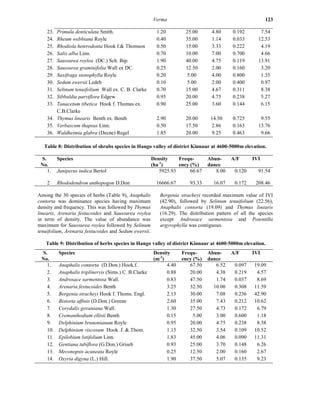
Table 8: Distribution of shrubs species in Hango valley of district Kinnaur at 4600-5000m elevation. 
S. 
No. 
Species Density 
(ha-1) 
Frequ-ency 
(%) 
Abun-dance 
A/F IVI 
1. Juniperus indica Bertol 5925.93 66.67 8.00 0.120 91.54 
2 Rhododendron anthopogon D.Don 16666.67 93.33 16.07 0.172 208.46 
Among the 30 species of herbs (Table 9), Anaphalis 
contorta was dominance species having maximum 
density and frequency. This was followed by Thymus 
linearis, Arenaria festucoides and Saussurea roylea 
in term of density. The value of abundance was 
maximum for Saussurea roylea followed by Selinum 
tenuifolium, Arenaria festucoides and Sedum ewersii. 
Bergenia stracheyi recorded maximum value of IVI 
(42.90), followed by Selinum tenuifolium (22.56), 
Anaphalis contorta (19.09) and Thymus linearis 
(16.29). The distribution pattern of all the species 
except Androsace sarmentosa and Potentilla 
argyrophylla was contiguous. 
Table 9: Distribution of herbs species in Hango valley of district Kinnaur at 4600-5000m elevation. 
S. 
Species Density 
Frequ-ency 
Abun-dance 
A/F IVI 
No. 
(m-2) 
(%) 
1. Anaphalis contorta (D.Don.) Hook.f. 4.40 67.50 6.52 0.097 19.09 
2. Anaphalis triplinervis (Sims.) C. B.Clarke 0.88 20.00 4.38 0.219 4.57 
3. Androsace sarmentosa Wall. 0.83 47.50 1.74 0.037 8.69 
4. Arenaria festucoides Benth 3.25 32.50 10.00 0.308 11.59 
5. Bergenia stracheyi Hook f. Thoms. Engl. 2.13 30.00 7.08 0.236 42.90 
6. Bistorta affinis (D.Don.) Greene 2.60 35.00 7.43 0.212 10.62 
7. Corydalis govaniana Wall. 1.30 27.50 4.73 0.172 6.79 
8. Cremanthodium ellisii Benth 0.15 5.00 3.00 0.600 1.18 
9. Delphinium brunonianum Royle 0.95 20.00 4.75 0.238 8.38 
10. Delphinium viscosum Hook .f. &.Thom. 1.15 32.50 3.54 0.109 10.52 
11. Epilobium lotifolium Linn. 1.83 45.00 4.06 0.090 11.31 
12. Gentiana tubiflora (G.Don.) Griseb 0.93 25.00 3.70 0.148 6.26 
13. Meconopsis acuneata Royle 0.25 12.50 2.00 0.160 2.67 
14. Oxyria digyna (L.) Hill. 1.90 37.50 5.07 0.135 9.23
Verma 124 
15. Polygonum polystachya Wall.ex Lehm. 0.53 17.50 3.00 0.171 8.49 
16. Potentilla argyrophylla Wall. ex. Lehm. 1.35 62.50 2.16 0.035 14.10 
17. Potentilla parviflora Willd. 1.83 50.00 3.65 0.073 10.51 
18. Primula denticulata Smith 0.65 22.50 2.89 0.128 4.88 
19. Rhodiola heterodonta Hook f. Thomson 0.85 25.00 3.40 0.136 6.57 
20. Salvia nubicola SW. 0.88 22.50 3.89 0.173 6.22 
21. Saussurea obovallata (DC.) Edgew 0.75 10.00 7.50 0.750 10.05 
22. Saussurea roylea (DC.) Sch. Bip. 2.80 17.50 16.00 0.914 12.76 
23. Saussurea gossypiphora D. Don. 0.30 20.00 1.50 0.075 5.15 
24. Saxifraga stenophylla Royle 0.70 17.50 4.00 0.229 4.37 
25. Sedum ewersii Ledeb 1.23 15.00 8.17 0.544 5.49 
26. Selinum tenuifolium Wall ex C.B.Clarke 2.45 22.50 10.89 0.484 22.56 
27. Stellaria media Linn. 0.88 17.50 5.00 0.286 4.37 
28. Tanacetum tibeticum Hook f. Thoms 
ex.C.B.Clarke 
0.70 17.50 4.00 0.229 7.20 
29. Thymus linearis Benth ex Benth 4.18 55.00 7.59 0.138 16.29 
30. Waldheimia glabra (Decne) Regel 1.40 17.50 8.00 0.457 7.18 
In the present study tree cover was observed only at 
low elevation whereas shrub sratum was observed at 
all the elevation ranges. The number of shrub and 
herb species was more at low elevation as compared 
to higher elevational ranges.The value of 
concentration of dominance (C), index of diversity 
(H), richness index (R) and evenness index (E) for 
trees, shrubs and herbs at different altitudes was 
given in Table 10. The higher the value of 
concentration of dominance, the greater is the 
homogenous nature of the community and vice- versa 
(Kohli et al., 2004). The lower value of dominance 
shows that dominance of plants is shared by many 
species. The diversity indices and richness index was 
more in lower elevation indicating higher diversity of 
the species. The species diversity is regulated by long 
term factors like community stability and 
evolutionary time as heterogeneity of both macro and 
micro environment affects the diversification among 
different communities. The higher values of index of 
diversity indicate the variability in the type of species 
and heterogeneity in the communities, whereas, the 
lesser values point to the homogeneity in the 
community. The evenness index was comparatively 
more in lower altitudinal ranges than higher 
altitudinal ranges indicating that species are evenly 
distributed in lower elevations. 
Table 10: Concentration of Dominance (C), Diversity index (H), Richness index (R) and Evenness index 
(E) for trees, shrubs and herbs at different elevations in Hango valley of district Kinnaur. 
Altitude Plant 
Category 
Concentration of 
Dominance (C) 
Diversity 
Index (H) 
Richness 
Index (R ) 
Evenness 
Index (E) 
3400-3800m Tree 0.447 0.879 0.45 0.80 
Shrub 0.161 1.958 1.25 0.89 
Herb 0.033 3.817 9.69 0.89 
3800-4200m Shrub 0.238 1.513 0.65 0.94 
Herb 0.054 3.505 8.28 0.85 
4200-4600m Shrub 0.470 0.907 0.36 0.83 
Herb 0.058 3.203 4.69 0.89 
4600-5000m Shrub 0.575 0.615 0.16 0.88 
Herb 0.052 3.181 3.88 0.93
Verma 125 
Table 11: Index of similarity and dissimilarity for herb species at different altitudes in Hango valley of 
district Kinnaur. 
Altitudes 3800-4200m 4200-4600m 4600-5000m 
3400-3800m 0.43 (0.57) 0.29(0.71) 0.19(0.81) 
3800-4200m - 0.44(0.56) 0.34(0.66) 
4200-4600m - 0.64(0.36) 
Note: Values in parenthesis are index of dissimilarity. 
Index of similarity for shrubs between 3400-3800m 
and 3800-4200m, between 3400-3800m and 4200- 
4600m, between 3400-3800m and 4600-5000m, 
between 3800-4200mm and 4200-4600mm, between 
3800-4200m and 4600-5000m and between 4200- 
4600m and 4600-5000m was 0.57, 0.17, 0.0, 0.25, 
0.0 and 0.80 respectively whereas, index of 
dissimilarity for the same was 0.43, 0.83, 1.0, 0.75, 
1.0 and 0.20 respectively. This indicating less 
similarity of species between these elevations. Index 
of similarity for herb species between different 
altitudes was low as given in Table 11. This 
indicating more dissimilarity of species between 
different altitudes. The nature of plant community at 
a place is determined by the species that grow and 
develop in such environment. The differences in the 
species composition from altitude to altitude is 
mostly due to micro environment changes (Mishra et 
al; 1997). 
Plants of Medicinal Value: The important plants of 
medicinal value found in the Hango valley of cold 
desert area in Kinnaur district were compiled 
following Chopra et al (1956), Kirtikar and Basu 
(1987) and Kala (2002). These include, Aconitum 
violaceum, Aconogonum tortuosum, Anaphalis 
triplinervis, Anemone obtusiloba, Aster flaccidus, 
Astragalus rizanthus, Arnebia euchroma, Arnebia 
guttata, Cannabis sativa, Capparis spinosa, Clematis 
oriantalis, Bistorta affinis, Bergenia stracheyi, 
Bupleurum falcatum, Cassiope fastigiata, 
Chenopodium album, Chenopodium foliosum, 
Corydalis govaniana, Dactylorhiza hatagirea, 
Delphinium brunonianum, Ephedra gerardiana, 
Echinops cornigerus, Erigeron alpinus, Euphorbia 
stracheyi, Ferula jaeschkeana, Galium aparine, 
Gentinella moorcrogtiana, Plantago tibetica, 
Hippophae rhamnoides, Hyoscyamus niger, 
Hyssopus officinalis, Juniperus polycapos, Lactuca 
dissecta, Lactuca macrorhiza, Meconopsis aculeata, 
Mentha longifolia, Nepeta erecta, Nepeta 
podostachys, Oxyria digyna, Oxytropis laponica, 
Phlomis bracteosa, Pleurospermum candollei, 
Polygonum polystachya, Potentilla argyrophylla, 
Primula denticulata, Plantago lanceolata, 
Ranunculus laetus, Ranunculus hirtellus, Rheum 
webbianum, Rhodiola heterodonta, Rhododendron 
anthopogon, Rosa webbiana, Rumex nepalensis, 
Saussurea obvallata, Saussurea gossypiphora, Sedum 
ewersii, Selinum tenuifolium, Taraxacum officinale, 
Thymus linearis, Urtica dioica, Verbascum thapsus 
and Waldheimia glabra. 
Threatened Plants: Out of 62 medicinal plant 
species recorded from the area, 18 species i.e. 
Aconitum violaceum, Arnebia euchroma, Bergenia 
stracheyi, Dactylorhiza hatagirea, Ephedra 
gerardiana, Ferula jaschkeana, Hippophae 
rhamnoides, Hyoscyamus niger, Hyssopus officinalis, 
Juniperus polycarpos, Meconopsis aculeata, 
Pleurospermum candollei, Rheum webbianum, 
Rhodiola heterodonta, Rhododendron anthopogon, 
Rhododendron campanulatum, Saussurea obvallata 
and Saussurea gossypiphora fall in the category of 
threatened plants when compared with the available 
literature like Red Data Book and CAMP Report 
(Ved et al, 2003). 
The habitat of most of the plant species have shrunk 
due to expansion of human population and 
environmental degradation primarily due to heavy 
live stock grazing, uncontrolled and unscientific 
harvest of species, unregulated tourism and 
construction of roads etc. The better conservation of 
natural resources can be done by inclusion of a 
section on the plant conservation especially of rare 
and endangered medicinal plants in the wild life 
protection act, promotion of community based 
conservation, in-situ conservation through the 
establishment of nature reserves, ex-situ conservation 
through tissue culture, developing cultivation 
technologies and nurseries of medicinal plants and 
conducting of regular training on the procedure of 
medicinal plants collection, processing among the 
local people, traders and real stake holders.
Verma 126 
REFERENCES 
Chopra, R.N., Nayar, S.L. and Chopra, I.C. (1956). 
Glossary of Indian Medicinal Plants. CSIR, 
New Delhi. 330 p. 
Curtis, J.T. and Cottam, G. (1956). Plant Ecology 
Work Book: Laboratory Field Reference 
Manual. Burgess Publishing Co., 
Minnesota. 193p. 
Curtis, J.T. and McIntosh, R.P. (1950). The 
interrelations of certain analytic and 
synthetic phytosociological characters. 
Ecology, 31: 434-455. 
Hill, M.O. (1973). Diversity and its evenness, a 
unifying notation and its consequences. 
Ecology, 54: 427-432. 
Kala, C. P. (2002). Medicinal plants of Indian trans- 
Himalaya. Bisen Singh Mehendra Pal Singh, 
New Connaught Place , Dehradun (India). 
200p. 
Kershaw, K.A. (1973). Quantitative and Dynamic 
Plant Ecology. Edward Arnold Ltd., 
London, 308p. 
Kirtikar, K.R. and Basu, B.D. (1987). Indian 
Medicinal Plants. International Book 
Distributors, Rajpur Road, Dehradun. Vol. 
I-IV, 2791 p. 
Kohli, R.K., Dogra, K.S., Batish, D.R. and Singh, 
H.P. (2004). Impact of invasive plants on the 
structure and composition of natural 
vegetation of Northwestern Indian 
Himalayas. Weed Technology, 18: 1296- 
1300. 
Kunhikannan, C., Verma, Ram K., Verma, Raj K., 
Khatri, P.K. and Totey, N.G. (1998). 
Ground flora, soil microflora and fauna 
diversity under plantation ecosystem in 
bhata land of Bilaspur, Madhya Pradesh. 
Environment and Ecology, 16(3): 539-548. 
Margalef, R. (1958). Temporal succession and spatial 
heterogeneity in phyto-plankton.In: A. A. 
Buzzati-Traverso. (Ed.). Perspective in 
Marine Biology. University of California 
Press, Berkeley. Pp. 323-347. 
Mishra, D., Mishra, T.K. and Banerjee, S.K. (1997). 
Comparative phyto-sociological and soil 
physico-chemical aspects between 
managed and unmanaged lateritic land. 
Annals of Forestry, 5(1): 16-25. 
Misra, K.C. (1989). Manual of Plant Ecology. 3rd 
(ed). Oxford & IBH publishing Co., Pvt. 
Ltd., New Delhi. 193p. 
Shannon, C.E. and Wiener, W. (1963). The 
Mathematical Theory of Communication. 
Univ. of Illinois Press. Urbana, U.S.A. 
Simpson, E.H. (1949). Measurement of diversity. 
Nature, 163: 688. 
Singh, J.S. and Yadava, P.S. (1974). Seasonal 
variation in composition, plant biomass and 
net primary productivity of a tropical 
grassland at Kurukshetra, India. Ecology 
Monograph, 44: 357-375. 
Ved, D.K., Kinhal, G.A., Ravikumar, K., 
Prabhakaran, V., Ghate, U., Sankar, R.V., 
Indresha, J.H. 2003. Conservation 
Assessment and Management Prioritisation 
for the Medicinal Plants of J & K, H.P. and 
Uttaranchal. p. 206. Workshop held at 
HFRI, Shimla on August 22-25. FRLHT, 
Bangalore, India.

dr rk verma

  • 1.
    Biological Forum –An International Journal 6(2): 115-126(2014) ISSN No. (Print): 0975-1130 ISSN No. (Online): 2249-3239 Floristic Diversity along an Altitudinal Gradients in Hango Valley of Cold Desert in District Kinnaur, Himachal Pradesh R.K. Verma Himalayan Forest Research Institute, Conifer Campus, Panthaghati, Shimla, (HP) (Corresponding author: R.K. Verma) (Received 08 April 2014, Accepted 30 May, 2014) ABSTRACT: Cold deserts-a unique ecosystem in itself, lies in the lap of Himalayas, which is quite fragile and sensitive. The biotic pressure on this particular ecosystem as exerted by increasing human and cattle population coupled with over exploitation has resulted in its ecological degradation. Accordingly, a study was conducted to understand the floristic diversity along an altitudinal gradient with elevations varying from 3400m to 5000m above msl in Hango valley falling in cold desert area of district Kinnaur, Himachal Pradesh. Total number of plant species was 130 belonging to 41 families and 101 genera. The dominant families were Asteraceae, Polygonaceae, Ranunculaceae, Lamiaceae and Umbelliferae. Number of tree species at 3400- 3800m elevation was 3 with the dominance of Salix alba. The number of shrubs species were 9, 5, 3 and 2 with the dominance of Rosa webbiana, Cotoneaster microphyllus, Juniperus indica and Rhododendron anthopogon in the elevations of 3400-3800m, 3800-4200m, 4200-4600m and 4600-5000m respectively. The number of herb species were 73, 63, 36 and 30 at 3400-3800m, 3800-4200m, 4200-4600 and 4600-5000m elevation respectively. Heracleum candicans was dominant at 3400-3800m elevation and Bergenia stracheyi was dominant herbs at 3800-4200m, 4200-4600m and 4600-5000m elevation on the basis of Importance Value Index. The distribution pattern of most the plant species was contiguous in all the altitudinal ranges. Index of diversity for herb species in different elevation ranges was 3.82, 3.51, 3.20 and 3.18. The richness and evenness index was comparatively more in lower altitudinal ranges than higher altitudinal ranges indicating that species are evenly distributed in lower elevations. Index of similarity calculated for shrub and herb species indicating more dissimilarity of species between different altitudes. Out of 62 medicinal plant species recorded from the area, 18 species i.e. Aconitum violaceum, Arnebia euchroma, Bergenia stracheyi, Dactylorhiza hatagirea, Ephedra gerardiana, Ferula jaschkeana, Hippophae rhamnoides, Hyoscyamus niger, Hyssopus officinalis, Juniperus polycarpos, Meconopsis aculeata, Pleurospermum candollei, Rheum webbianum, Rhodiola heterodonta, Rhododendron anthopogon, Rhododendron campanulatum, Saussurea obvallata and Saussurea gossypiphora fall in the category of threatened plants. The better conservation of natural resources can be done through promotion of community based conservation, in-situ conservation through the establishment of nature reserves, ex-situ conservation through tissue culture, developing cultivation technologies and nurseries of medicinal plants and conducting of regular training on the procedure of medicinal plants collection and processing among the end users. Key Words: Floristic diversity, Dominance, Altitudinal gradients, Distribution pattern INTRODUCTION considered exclusively endemic to the Himalayas. The cold deserts in India occur in Ladakh region of The diverse climate and the varied environmental Jammu & Kashmir, Spiti valley of Lahaul and Spiti conditions prevailing in Himalayas support diverse district and Pooh sub division of Kinnaur district of habitat and ecosystems with equally diverse life Himachal Pradesh. The total area under cold deserts forms. Himalayas are one of the largest and youngest in Himachal Pradesh is about 11,000 sq.km., out of mountain chains in the world and cover roughly 10% which 3,400 sq.km. area is in Kinnaur district. of India total land surface. Variations in terms of its Human pressure on natural ecosystems is size, climate and altitudinal ranges have created intensifying, some being incompatible with survival environments those are unique and characteristic to of certain species of plants. In cold desert areas, this region only. It provides an important habitat to continuous removal of plant species for various uses the flora and fauna including 9,000 species of and overgrazing by migratory livestock have resulted angiosperms and hence, is considered as the hot spot in desertification and loss of biodiversity. of biodiversity. There are about 3,470 species
  • 2.
    Verma 116 Ifthese naturally occurring plant resources are not timely conserved then they may soon become extinct. In cold desert this genetic erosion coupled with soil erosion may retard prospects of future economic development and welfare of the people. The assessment of plant wealth in this harsh cold arid belt may provide a key for its conservation. Keeping these aspects in view, a study was undertaken to know the plant diversity in Hango valley of cold desert in Kinnaur district of Himachal Pradesh. MATERIALS AND METHODS The present study was conducted in Hango valley of cold desert area of Pooh sub division of district Kinnaur, Himachal Pradesh during, 2008 at an elevation of 3400m to 5000m. The study site was situated 31o49'35.4" to 31o48'30.2" N latitude and 78o 31'99.8" to 78o33'83.0" E longitudes. The whole area of the valley was divided into four altitudes i.e. 3400- 3800m, 3800-4200m, 4200-4600m and 4600-5000m for conducting the phyto-sociological study. Quadrats were laid out in stratified random manner along the altitudinal transects. Quadrats of size 10mx10m, 3mx3m amd 1mx1m laid out randomly for enumerating trees, shrubs and herbs + regeneration respectively. A total of 20, 30 and 40 quadrats for tree, shrub and herb respectively were laid out in each altitudinal gradient. The seedlings were considered as herb while saplings as shrubs. The vegetation data was analysed for density, frequency and abundance according to formulae given by Curtis and McIntosh (1950). The relative values of density, frequency and dominance were summed to get Importance Value Index (IVI) of individual species. The abundance to frequency ratio (A/F) of different species was determined for eliciting the distribution pattern. This ratio indicates regular (<0.025), random (0.025 to 0.050) and contiguous (>0.050) distribution (Curtis and Cottam, 1956). The plant species diversity was calculated by using Shannon-Wiener diversity Index (H) (Shannon-Wiener, 1963). S H = - Σ (Ni/N) ln (Ni/N) i = 1 Concentration of dominance (C) was measured by Simpson’s Index (Simpson, 1949). S C = Σ (Ni/N)2 i = 1 Where Ni = importance value of species i and N= total importance value of all the species in both the indices. Index of similarity and dissimilarity between different altitudes were calculated by using following formula (Misra, 1989). Index of similarity, S = 2C / A+B Where A= number of species in community A, B = number of species in community B, C = number of species common to both communities. Index of dissimilarity = 1-S Richness Index was estimated as per Margalef (1958) i .e. R = S-1/ln N Evenness Index was calculated as per Hill (1973) i. e. E = H/ ln S Where S = total number of species, N= total number of individuals of all the species, H = Index of diversity. RESULTS AND DISCUSSION At elevation of 3400-3800m total number of tree species was 3 (Table 1) with the dominance of Salix alba followed by Populus alba and Juniperus polycarpos in term of density and frequency. For a particular species higher frequency indicates its more frequent distribution at a particular site. The value of abundance was maximum for Juniperus polycarpos followed by Salix alba and Populus alba. Importance Value Index is the most important parameter to understand the community organization in relation to the comparative ability. Salix alba recorded highest value of IVI (155.95) followed by Populus alba (125.04) and Juniperus polycarpos (19.01). The distribution pattern of Juniperus polycarpos was contiguous whereas for Populus alba and Salix alba it was random. The contiguous distribution is the commonest pattern in nature, random distribution is found in very uniform environment. The general preponderance of contiguous distribution in vegetation has been reported by several workers (Kershaw, 1973; Singh and Yadava, 1974; Kunhikannan et al., 1998). Among the 9 species of shrubs including saplings (Table 2), Rosa webbiana was dominant species having maximum density and frequency. This was followed by Salix alba, Astragalus rhizanthus and Hippophae rhamnoides in term of density. The value of abundance was maximum for Salix alba followed Rosa webbiana, Ribes alpestre and Myricaria germanica. Rosa webbiana recorded highest value IVI (71.17) followed by Hippophae rhamnoides (68.56), Myricaria germanica (37.98) and Salix alba (34.63). The distribution pattern of all the species was contiguous. In case of herbs, total number of species was 73 at 3400-3800 m elevation (Table 3). Mentha longifolia was dominant herb followed by Arenaria festucoides, Heracleum candicans and Arnebia guttata in term of density.
  • 3.
    Verma 117 Table1: Distribution of tree species in Hango valley of district Kinnaur at 3400-3800m elevation. S. Species Density Frequ-ency(%) Abun-dance A/F IVI No. (ha-1) 1. Juniperus polycarpos C. Koch 30.00 10.00 3.00 0.300 19.01 2. Populus alba Linn. 165.00 65.00 2.54 0.039 125.04 3. Salix alba Linn. 235.00 90.00 2.61 0.029 155.95 Table 2: Distribution of shrub species in Hango valley of district Kinnaur at 3400-3800m elevation. S. No. Species Density (ha-1) Frequ-ency (%) Abund-ance A/F IVI 1. Astralagus rhizanthus Royle ex. Benth 3370.37 40.00 7.58 0.190 34.50 2. Cotoneaster microphyllus Wall ex. Lindl. 1148.15 16.67 6.20 0.372 19.13 3. Hippophae rhamnoides Linn. 2222.22 33.33 6.00 0.180 68.56 4. Juniperus polycarpos * C. Koch 74.07 3.33 2.00 0.600 2.91 5. Lonicera spinosa Jacq. 1851.85 23.33 7.14 0.306 21.10 6. Myricaria germanica (L.) Desv. 1185.19 13.33 8.00 0.600 37.98 7. Ribes alpestre Wall. ex. Decne 1000.00 10.00 9.00 0.900 10.01 8. Rosa webbiana Wall. ex. Royle 7481.48 63.33 10.63 0.168 71.17 9. Salix alba * Linn. 4185.19 16.67 22.60 1.356 34.63 *Sapling Table 3: Distribution of herbs species in Hango valley of district Kinnaur at 3400-3800m elevation. S. No. Species Density (m-2) Frequ-ency (%) Abund-ance A/F IVI 1. Aconogonum tortuosum D. Don Hara 0.63 10.00 6.25 0.625 3.21 2. Anaphalis triplinervis (Sims ) C. B.Clarke 0.30 10.00 3.00 0.300 1.99 3. Anemone obtusiloba D.Don 0.23 10.00 2.25 0.225 1.67 4. Anemone rivularis Buch- Ham ex. DC. 3.00 20.00 15.00 0.750 10.49 5. Arenaria festucoides Benth 3.33 30.00 11.08 0.369 11.25 6. Arnebia euchroma (Royle ex. Benth) I.M.Johnston 0.30 10.00 3.00 0.300 2.72 7. Arnebia guttata Bunge 1.25 12.50 10.00 0.800 6.20 8. Astragalus dracunculus L. Tarragon 0.85 12.50 6.80 0.544 6.59 9. Astragalus rhizanthus Royle ex. Benth 0.48 12.50 3.80 0.304 4.51 10. Bupleurum falcatum Linn. 0.10 2.50 4.00 1.600 0.63 11. Bupleurum tenue Buch-Ham ex D.Don 0.63 20.00 3.13 0.156 3.78 12. Cannabis sativa L. Hemp 0.10 2.50 4.00 1.600 1.79 13. Capparis spinosa Linn. 0.05 2.50 2.00 0.800 0.44 14. Chenopodium album Linn. 0.20 7.50 2.67 0.356 2.08 15. Chenopodium ambrosisoides Linn. 0.08 2.50 3.00 1.200 0.54 16. Chenopodium foliolosum (Moench) Asch 0.15 7.50 2.00 0.267 1.51
  • 4.
    Verma 118 17.Aconogonum tortuosum D. Don Hara 0.63 10.00 6.25 0.625 3.21 18. Anaphalis triplinervis (Sims ) C. B.Clarke 0.30 10.00 3.00 0.300 1.99 19. Anemone obtusiloba D.Don 0.23 10.00 2.25 0.225 1.67 20. Anemone rivularis Buch- Ham ex. DC. 3.00 20.00 15.00 0.750 10.49 21. Arenaria festucoides Benth 3.33 30.00 11.08 0.369 11.25 22. Arnebia euchroma (Royle ex. Benth) I.M.Johnston 0.30 10.00 3.00 0.300 2.72 23. Arnebia guttata Bunge 1.25 12.50 10.00 0.800 6.20 24. Astragalus dracunculus L. Tarragon 0.85 12.50 6.80 0.544 6.59 25. Astragalus rhizanthus Royle ex. Benth 0.48 12.50 3.80 0.304 4.51 26. Bupleurum falcatum Linn. 0.10 2.50 4.00 1.600 0.63 27. Bupleurum tenue Buch-Ham ex D.Don 0.63 20.00 3.13 0.156 3.78 28. Cannabis sativa L. Hemp 0.10 2.50 4.00 1.600 1.79 29. Capparis spinosa Linn. 0.05 2.50 2.00 0.800 0.44 30. Chenopodium album Linn. 0.20 7.50 2.67 0.356 2.08 31. Chenopodium ambrosisoides Linn. 0.08 2.50 3.00 1.200 0.54 32. Chenopodium foliolosum (Moench) Asch 0.15 7.50 2.00 0.267 1.51 33. Cirsium wallichi DC. 0.48 27.50 1.73 0.063 6.77 34. Clematis orientalis Linn. 0.18 10.00 1.75 0.175 35. Conyza stricta Willd. 0.50 20.00 2.50 0.125 3.53 36. Corydalis govaniana Wall. 0.15 7.50 2.00 0.267 2.16 37. Cynoglossum furcatum Wall ex Roxb. 0.93 42.50 2.18 0.051 7.02 38. Dactylorhiza hatagirea D.Don 0.10 2.50 4.00 1.600 0.61 39. Echinops cornigerus DC. 0.28 10.00 2.75 0.275 3.97 40. Ephedra gerardiana Wall. ex. Stapf. 1.20 7.50 16.00 2.133 19.72 41. Epilobium hirsutum Linn. 0.58 12.50 4.60 0.368 3.30 42. Epilobium laxum Royle 0.45 7.50 6.00 0.800 2.02 43. Equisetum arvense Linn. 0.58 7.50 7.67 1.022 2.47 44. Eremenus himalaicus Baker 0.35 12.50 2.80 0.224 3.71 45. Erigeron alpines Linn. 0.28 10.00 2.75 0.275 1.82 46. Fagopyrum dibotrys D.Don Hara 0.53 20.00 2.63 0.131 4.42 47. Ferula jaeschkeana Vatke 0.23 10.00 2.25 0.225 3.15 48. Galium aparine Linn. 0.43 10.00 4.25 0.425 2.12 49. Galium asperuloides Edgew 0.78 12.50 6.20 0.496 3.26 50. Gentiana ornate G.Don Griseb 0.08 2.50 3.00 1.200 0.55 51. Gentiana tubiflora G.Don. Griseb 0.18 10.00 1.75 0.175 1.51 52. Geranium pratense Linn. 0.53 17.50 3.00 0.171 3.37 53. Heracleum candicans Wall. Ex. DC. 1.38 62.50 2.20 0.035 33.11 54. Hippophae rhamnoides Linn. 0.20 10.00 2.00 0.200 1.81 55. Hyoscyamus niger Linn. 0.10 2.50 4.00 1.600 1.02 56. Hyssopus officinalis Linn. 2.25 22.50 10.00 0.444 9.57 57. Lactuca dissecta D.Don 0.55 17.50 3.14 0.180 3.26 58. Leontopodium jacotianum P. Beauv 0.20 7.50 2.67 0.356 1.37
  • 5.
    Verma 119 59.Lomatogonium carinthiacum (Wulfen) Reichb 0.23 10.00 2.25 0.225 1.89 60. Lotus corniculata Linn. 0.28 7.50 3.67 0.489 1.55 61. Malva rotundifolia Linn. 0.48 10.00 4.75 0.475 2.54 62. Medicago falcata Linn. 0.10 2.50 4.00 1.600 0.55 63. Melilotus alba Med. ex. Desr. 1.28 27.50 4.64 0.169 6.55 64. Mentha longiflolia (L.) Hud. 3.93 40.00 9.81 0.245 17.79 65. Nepeta erecta Royle ex.Benth 1.00 20.00 5.00 0.250 5.02 66. Nepeta podostachys Benth. 0.13 7.50 1.67 0.222 1.21 67. Oxyria digyna (L.) Hill. 0.88 17.50 5.00 0.286 4.28 68. Phlomis bracteosa Royle ex. Benth 0.18 10.00 1.75 0.175 1.84 69. Pimpinella diversifolia DC. 0.10 2.50 4.00 1.600 0.56 70. Plantago lanceolata Linn. 1.00 27.50 3.64 0.132 5.91 71. Polygonum polystachya Wall. ex.Lehm. 0.48 10.00 4.75 0.475 6.66 72. Potentilla argyrophylla Wall. ex Lehm. 0.10 2.50 4.00 1.600 0.71 73. Primula denticulata Smith 0.20 7.50 2.67 0.356 1.49 74. Ranunculus laetus Wall. .ex. D. Don 0.20 10.00 2.00 0.200 1.59 75. Rheum webbiana Royle 0.05 2.50 2.00 0.800 1.15 76. Rubia cordifolia Hook. f. 0.03 2.50 1.00 0.400 0.35 77. Rumex nepalensis Sprengel 0.48 22.50 2.11 0.094 12.05 78. Salix alba Linn. 0.05 2.50 2.00 0.800 0.49 79. Salvia glutinosa FBI 0.23 7.50 3.00 0.400 1.87 80. Saussurea albescens Hook. f. ex. Thoms. ex. Clarke 0.93 10.00 9.25 0.925 3.96 81. Scorzonera virgata DC. 0.25 12.50 2.00 0.160 2.01 82. Senecio chrysanthemoides DC. 1.00 20.00 5.00 0.250 5.07 83. Sibbaldia parviflora Edgew 0.25 2.50 10.00 4.000 0.96 84. Silene viscosa (L.) Pers. 0.30 10.00 3.00 0.300 1.87 85. Taraxacum officinale Wigg. 0.38 22.50 1.67 0.074 3.39 86. Thallictrum cultratum Wallich 1.00 37.50 2.67 0.071 7.59 87. Thymus linearis Benth ex. Benth 0.30 2.50 12.00 4.800 0.99 88. Urtica dioica Linn. 0.98 10.00 9.75 0.975 4.63 89. Verbascum thapsus Linn. 0.30 27.50 1.09 0.040 6.78 The value of abundance was maximum for Ephedra gerardiana followed by Anemone rivularis, Thymus linearis and Arenaria festucoides. Heracleum candicans recorded highest value of IVI (33.11) followed by Ephedra gerardiana (19.72), Mentha longifolia (17.79) and Rumex nepalensis (12.05). The ratio of abundance to frequency indicates that distribution pattern of all species except Heracleum candicans and Verbascum thapsus was contiguous. At 3800-4200m elevation, total number of shrub species was 5 (Table 4). Caragyna brevispina was dominant species followed by Astragalus rhizanthus with respect to density and abundance. On the basis of IVI, Cotoneaster microphyllus recorded highest value (100.50) followed by Caragyna brevispina (78.94), Astragalus rhizanthus (53.70) and Lonicera spinosa (37.22). The distribution pattern of all the species was contiguous. The number of herb species was 63 (Table 5) at elevation of 3800-4200m and Arenaria griffithii was dominant species followed by Bergenia stracheyi, Anemone obtusiloba and Gentiana ornata with respect to density. The value of abundance was maximum for Arenaria griffithii followed by Bergenia stracheyi, Gentiana ornata and Anemone obtusiloba. Bergenia stracheyi recorded highest value of IVI (50.34) followed by Anemone obtusiloba (26.39), Arenaria griffithii (23.57) and Anaphalis
  • 6.
    Verma 120 contorta(15.17). The distribution pattern of all species except Meconopsis acuneata was contiguous. At elevation 4200-4600m, total number of shrub species was 3 (Table 6). Juniperus indica was dominant species followed by Lonicera spinosa and Rhododendron anthopogon in term of density, frequency and abundance. Juniperus indica recorded highest value of IVI (190.27) followed by Rhododendron anthopogon (62.08) and Lonicera spinosa (47.66). The distribution pattern of all the species was contiguous. In case of herbs, total number of species was 36 (Table 7) with the dominance of Bistorta affinis followed by Bergenia stracheyi, Arenaria festucoides and Potentilla parviflora in term of density. The value of frequency was maximum for Potentilla parviflora followed by Bistorta affinis and Bergenia stracheyi where as the value of abundance was maximum for Thymus linears followed by Arenaria festucoides, Androsace sarmentosa and Bergenia stracheyi. The distribution pattern of all the species except Rheum webbianum was contiguous. At elevation 4600-5000m, total number of species was 2 (Table 8) with the dominance of Rhododendron anthopogon followed by Juniperus indica in term of density, frequency, abundance and IVI. The distribution pattern of both the species was contiguous. Table 4: Distribution of shrub species in Hango valley of district Kinnaur at 3800-4200m elevation. S. No. Species Density (ha-1) Frequ-ency (%) Abund ance A/F IVI 1. Astralagus rhizanthus Royle ex. Benth 3888.89 30.00 11.67 0.389 53.70 2. Caragana brevispina Royle 6111.11 30.00 18.33 0.611 78.94 3. Cotoneaster microphyllus Wall. ex. Lindley 3333.33 40.00 7.50 0.188 100.50 4. Lonicera spinosa Jacq. 2333.33 20.00 10.50 0.525 37.22 5. Rosa webbiana Wall. ex. Royle 1666.67 20.00 7.50 0.375 29.64 Table 5: Distribution of herb species in Hango valley of district Kinnaur at 3800-4200m elevation. S. No. Species Density (m-2) Frequ-ency (%) Abun-dance A/F IVI 1. Aconitum violaceum Jacq. ex. Stapf. 0.20 10.00 2.00 0.200 1.80 2. Anaphalis contorta (D.Don) Hook. f. 3.03 35.00 8.64 0.247 14.17 3. Anaphalis triplinervis (Sims) C.B.Clarke 0.43 10.00 4.25 0.425 2.49 4. Androsace sarmentosaWall. 0.25 15.00 1.67 0.111 2.61 5. Anemone obtusiloba D.Don 4.08 37.50 10.87 0.290 25.39 6. Aquilegia fragrans Benth.B G.Goteborg 0.30 5.00 6.00 1.200 1.71 7. Arenaria griffithii Boiss 6.88 52.50 13.10 0.249 22.57 8. Arenaria serpyllifolia Linn. 1.20 12.50 9.60 0.768 4.29 9. Arenebia euchroma Royle ex. Benth I.M.Johnston 0.50 12.50 4.00 0.320 4.59 10. Arnebia guttata Bunge. 0.60 7.50 8.00 1.067 3.63 11. Aster flaccidus Bunge 0.23 10.00 2.25 0.225 1.82 12. Astralagus rhizanthus Royle ex. Benth 0.88 20.00 4.38 0.219 8.85 13. Bergenia stracheyi (Hook.f.& Thoms) Engl. 4.55 37.50 12.13 0.324 49.34 14. Bistorta affinis (D.Don) Greene 0.25 12.50 2.00 0.160 2.35 15. Campanula latiflolia Linn. 0.18 7.50 2.33 0.311 1.33 16. Chenopodium foliolosum (Moench) Asch 0.20 10.00 2.00 0.200 2.23 17. Cirsium wallichi DC. 0.15 5.00 3.00 0.600 1.97 18. Convolvulus arvensis Linn. 0.23 5.00 4.50 0.900 1.33
  • 7.
    Verma 121 19.Conyza stricta Willd. 0.28 10.00 2.75 0.275 1.99 20. Corydalis crassissima Camb. 0.43 7.50 5.67 0.756 21. Cynoglossum furcatum Wall ex. Roxb. 0.10 2.50 4.00 1.600 0.58 22. Delphinium viscosum Hook. f.& Thom. 0.58 10.00 5.75 0.575 4.44 23. Dianthus angulatus Royle 0.28 5.00 5.50 1.100 1.95 24. Ephedra gerardiana Wall. ex.Stapf. 0.13 10.00 1.25 0.125 3.45 25. Epilobium latifolium Linn. 0.03 2.50 1.00 0.400 0.39 26. Epilobium laxum Royle 0.40 10.00 4.00 0.400 2.55 27. Euphorbia stracheyi Boiss 0.55 10.00 5.50 0.550 2.98 28. Ferula jaeschkeana Vatke 0.28 12.50 2.20 0.176 3.12 29. Galium asperuloides Edgew 0.28 7.50 3.67 0.489 1.55 30. Galium verum Linn. 0.48 10.00 4.75 0.475 2.28 31. Gentiana ornate (G.Don.) Griseb 3.60 30.00 12.00 0.400 13.47 32. Gentiana tubiflora (G.Don ) Griseb 0.13 7.50 1.67 0.222 1.28 33. Gentinella moorcroftiana Wall. ex. G. Don 0.30 10.00 3.00 0.300 1.91 34. Geranium pretense Linn. 2.48 60.00 4.13 0.069 13.08 35. Hyssopus officinalis Linn. 0.63 12.50 5.00 0.400 3.16 36. Lactuca longifolia DC. 0.05 2.50 2.00 0.800 0.48 37. Leontopodium jacotianum P. Beauv. 0.13 5.00 2.50 0.500 1.05 38. Lomatogonium carinthiacum (Wulfen) Reichb. 0.10 7.50 1.33 0.178 1.21 39. Meconopsis acuneata Royle 0.15 32.50 0.46 0.014 4.65 40. Melilotus alba Med.ex.Desr. 0.10 2.50 4.00 1.600 0.59 41. Nepeta erecta Royle ex. Benth 0.80 22.50 3.56 0.158 5.03 42. Orobanche alba Stephen ex. Willd. 1.50 7.50 20.00 2.667 11.02 43. Oxyria digyna (L.) Hill. 0.05 2.50 2.00 0.800 0.44 44. Oxytropis lapponica (Wahlemb) Gay 0.45 15.00 3.00 0.200 3.20 45. Parnessia nubicola Wallich ex. Royle 0.48 7.50 6.33 0.844 2.18 46. Pedicularis longifolia Rudolph 0.15 5.00 3.00 0.600 1.29 47. Plantago tibetica Hook f.& Thomas 0.45 12.50 3.60 0.288 2.92 48. Pleurospermum candollei (DC) C. B. Clarke 0.15 10.00 1.50 0.150 2.11 49. Polygonum polystachya Wall ex. Lehm 0.65 22.50 2.89 0.128 11.35 50. Potentilla parviflora Willd. 0.90 30.00 3.00 0.100 8.22 51. Ranunculus hirtellus Royle ex.D.Don 0.15 7.50 2.00 0.267 1.30 52. Rheum webbianum Royle 0.10 5.00 2.00 0.400 2.63 53. Rhodiola heterodonta Hook f. & Thoms. 0.25 7.50 3.33 0.444 2.01 54. Salvia nubicola SW. 0.55 7.50 7.33 0.978 3.53 55. Saxifraga mucronulata Royle 0.33 10.00 3.25 0.325 2.11 56. Sedum ewersii Ledeb. 0.08 5.00 1.50 0.300 0.83
  • 8.
    Verma 122 57.Sibbaldia parviflora Edgew 0.25 12.50 2.00 0.160 2.54 58. Tanacetum tibeticum Hook f. Thoms ex. C.B.Clarke 0.40 15.00 2.67 0.178 3.07 59. Taraxacum officinale Wigg. 0.20 10.00 2.00 0.200 1.75 60. Thymus linearis Benth ex. Benth 0.40 20.00 2.00 0.100 3.34 61. Trifolium minus Linn. 0.50 10.00 5.00 0.500 2.50 62. Urtica dioica Linn. 0.30 5.00 6.00 1.200 3.39 63. Verbascum thapsus Linn. 0.08 7.50 1.00 0.133 2.01 Table 6: Distribution of shrub species in Hango valley of district Kinnaur at 4200-4600m elevation. S. No. Species Density (ha-1) Frequ-ency (%) Abund ance A/F IVI 1. Juniperus indica Bertol 6666.67 66.67 9.00 0.135 190.27 2. Rhododendron anthopogon D.Don 1481.48 33.33 4.00 0.120 62.08 3. Lonicera spinosa Jacq. 1851.85 33.33 5.00 0.150 47.66 Table 7: Distribution of herbs species in Hango valley of district Kinnaur at 4200- 4600m elevation. S. No. Species Density (m-2) Frequ-ency (%) Abund ance A/F IVI 1. Aconogonum tortuosum D. Don. Hara 0.40 5.00 8.00 1.600 2.02 2. Anaphalis triplinervis (Sims) C. B.Clarke 1.05 15.00 7.00 0.467 4.68 3. Anaphalis contorta (D.Don) Hook. f. 2.90 45.00 6.44 0.143 14.00 4. Androsace mucronifolia Watt.& Eremurus 1.40 25.00 5.60 0.224 6.89 5. Androsace sarmentosa Wall. 1.15 10.00 11.50 1.150 4.84 6. Arenaria festucoides Benth 3.75 30.00 12.50 0.417 12.88 7. Bergenia stracheyi (Hook f. & Thoms) Engl. 4.85 45.00 10.78 0.240 50.39 8. Bistorta affinis (D.Don.)Greene 4.90 50.00 9.80 0.196 19.04 9. Cassiope fastigiata Wall. ( D. Don.) 0.90 10.00 9.00 0.900 4.51 10. Delphinium brunonianum Royle 0.85 20.00 4.25 0.213 7.38 11. Delphinium viscosum Hook.&Thom. 0.45 20.00 2.25 0.113 4.92 12. Ephedra gerardiana Wall. ex. Stapf. 0.20 5.00 4.00 0.800 4.18 13. Gentiana tubiflora (G.Don.) Griseb 0.70 15.00 4.67 0.311 4.45 14. Gentinella moorcroftiana Wall ex G.Don 0.15 5.00 3.00 0.600 1.02 15. Geranium pretense Linn. 0.35 10.00 3.50 0.350 2.34 16. Lactuca macrorhiza Royle Hook. f. 0.10 5.00 2.00 0.400 0.92 17. Lomatogonium carinthianum ( Wulfen) Reichb 0.30 12.50 2.40 0.192 2.47 18. Oxyria digyna (L.) Hill. 0.35 10.00 3.50 0.350 2.29 19. Phlomis bracteosa Royle ex. Benth 0.40 22.50 1.78 0.079 4.94 20. Pleurospermum candollei (DC.) C. B.Clarke 0.15 15.00 1.00 0.067 2.86 21. Polygonum polystachya Wall ex. Meissn 1.20 40.00 3.00 0.075 21.22 22. Potentilla parviflora Willd. 3.30 75.00 4.40 0.059 18.34
  • 9.
    Verma 123 23.Primula denticulata Smith. 1.20 25.00 4.80 0.192 7.54 24. Rheum webbiana Royle 0.40 35.00 1.14 0.033 12.53 25. Rhodiola heterodonta Hook f.& Thomson 0.50 15.00 3.33 0.222 4.19 26. Salix alba Linn. 0.70 10.00 7.00 0.700 4.66 27. Saussurea roylea (DC.) Sch. Bip. 1.90 40.00 4.75 0.119 13.91 28. Saussurea graminifolia Wall ex DC. 0.25 12.50 2.00 0.160 3.20 29. Saxifraga stenophylla Royle 0.20 5.00 4.00 0.800 1.35 30. Sedum ewersii Ledeb 0.10 5.00 2.00 0.400 0.97 31. Selinum tenuifolium Wall ex. C. B. Clarke 0.70 15.00 4.67 0.311 8.38 32. Sibbaldia parviflora Edgew 0.95 20.00 4.75 0.238 5.27 33. Tanacetum tibetica Hook f. Thomas ex. C.B.Clarke 0.90 25.00 3.60 0.144 6.15 34. Thymus linearis Benth ex. Benth 2.90 20.00 14.50 0.725 9.55 35. Verbascum thapsus Linn. 0.50 17.50 2.86 0.163 13.76 36. Waldheimia glabra (Decne) Regel 1.85 20.00 9.25 0.463 9.66 Table 8: Distribution of shrubs species in Hango valley of district Kinnaur at 4600-5000m elevation. S. No. Species Density (ha-1) Frequ-ency (%) Abun-dance A/F IVI 1. Juniperus indica Bertol 5925.93 66.67 8.00 0.120 91.54 2 Rhododendron anthopogon D.Don 16666.67 93.33 16.07 0.172 208.46 Among the 30 species of herbs (Table 9), Anaphalis contorta was dominance species having maximum density and frequency. This was followed by Thymus linearis, Arenaria festucoides and Saussurea roylea in term of density. The value of abundance was maximum for Saussurea roylea followed by Selinum tenuifolium, Arenaria festucoides and Sedum ewersii. Bergenia stracheyi recorded maximum value of IVI (42.90), followed by Selinum tenuifolium (22.56), Anaphalis contorta (19.09) and Thymus linearis (16.29). The distribution pattern of all the species except Androsace sarmentosa and Potentilla argyrophylla was contiguous. Table 9: Distribution of herbs species in Hango valley of district Kinnaur at 4600-5000m elevation. S. Species Density Frequ-ency Abun-dance A/F IVI No. (m-2) (%) 1. Anaphalis contorta (D.Don.) Hook.f. 4.40 67.50 6.52 0.097 19.09 2. Anaphalis triplinervis (Sims.) C. B.Clarke 0.88 20.00 4.38 0.219 4.57 3. Androsace sarmentosa Wall. 0.83 47.50 1.74 0.037 8.69 4. Arenaria festucoides Benth 3.25 32.50 10.00 0.308 11.59 5. Bergenia stracheyi Hook f. Thoms. Engl. 2.13 30.00 7.08 0.236 42.90 6. Bistorta affinis (D.Don.) Greene 2.60 35.00 7.43 0.212 10.62 7. Corydalis govaniana Wall. 1.30 27.50 4.73 0.172 6.79 8. Cremanthodium ellisii Benth 0.15 5.00 3.00 0.600 1.18 9. Delphinium brunonianum Royle 0.95 20.00 4.75 0.238 8.38 10. Delphinium viscosum Hook .f. &.Thom. 1.15 32.50 3.54 0.109 10.52 11. Epilobium lotifolium Linn. 1.83 45.00 4.06 0.090 11.31 12. Gentiana tubiflora (G.Don.) Griseb 0.93 25.00 3.70 0.148 6.26 13. Meconopsis acuneata Royle 0.25 12.50 2.00 0.160 2.67 14. Oxyria digyna (L.) Hill. 1.90 37.50 5.07 0.135 9.23
  • 10.
    Verma 124 15.Polygonum polystachya Wall.ex Lehm. 0.53 17.50 3.00 0.171 8.49 16. Potentilla argyrophylla Wall. ex. Lehm. 1.35 62.50 2.16 0.035 14.10 17. Potentilla parviflora Willd. 1.83 50.00 3.65 0.073 10.51 18. Primula denticulata Smith 0.65 22.50 2.89 0.128 4.88 19. Rhodiola heterodonta Hook f. Thomson 0.85 25.00 3.40 0.136 6.57 20. Salvia nubicola SW. 0.88 22.50 3.89 0.173 6.22 21. Saussurea obovallata (DC.) Edgew 0.75 10.00 7.50 0.750 10.05 22. Saussurea roylea (DC.) Sch. Bip. 2.80 17.50 16.00 0.914 12.76 23. Saussurea gossypiphora D. Don. 0.30 20.00 1.50 0.075 5.15 24. Saxifraga stenophylla Royle 0.70 17.50 4.00 0.229 4.37 25. Sedum ewersii Ledeb 1.23 15.00 8.17 0.544 5.49 26. Selinum tenuifolium Wall ex C.B.Clarke 2.45 22.50 10.89 0.484 22.56 27. Stellaria media Linn. 0.88 17.50 5.00 0.286 4.37 28. Tanacetum tibeticum Hook f. Thoms ex.C.B.Clarke 0.70 17.50 4.00 0.229 7.20 29. Thymus linearis Benth ex Benth 4.18 55.00 7.59 0.138 16.29 30. Waldheimia glabra (Decne) Regel 1.40 17.50 8.00 0.457 7.18 In the present study tree cover was observed only at low elevation whereas shrub sratum was observed at all the elevation ranges. The number of shrub and herb species was more at low elevation as compared to higher elevational ranges.The value of concentration of dominance (C), index of diversity (H), richness index (R) and evenness index (E) for trees, shrubs and herbs at different altitudes was given in Table 10. The higher the value of concentration of dominance, the greater is the homogenous nature of the community and vice- versa (Kohli et al., 2004). The lower value of dominance shows that dominance of plants is shared by many species. The diversity indices and richness index was more in lower elevation indicating higher diversity of the species. The species diversity is regulated by long term factors like community stability and evolutionary time as heterogeneity of both macro and micro environment affects the diversification among different communities. The higher values of index of diversity indicate the variability in the type of species and heterogeneity in the communities, whereas, the lesser values point to the homogeneity in the community. The evenness index was comparatively more in lower altitudinal ranges than higher altitudinal ranges indicating that species are evenly distributed in lower elevations. Table 10: Concentration of Dominance (C), Diversity index (H), Richness index (R) and Evenness index (E) for trees, shrubs and herbs at different elevations in Hango valley of district Kinnaur. Altitude Plant Category Concentration of Dominance (C) Diversity Index (H) Richness Index (R ) Evenness Index (E) 3400-3800m Tree 0.447 0.879 0.45 0.80 Shrub 0.161 1.958 1.25 0.89 Herb 0.033 3.817 9.69 0.89 3800-4200m Shrub 0.238 1.513 0.65 0.94 Herb 0.054 3.505 8.28 0.85 4200-4600m Shrub 0.470 0.907 0.36 0.83 Herb 0.058 3.203 4.69 0.89 4600-5000m Shrub 0.575 0.615 0.16 0.88 Herb 0.052 3.181 3.88 0.93
  • 11.
    Verma 125 Table11: Index of similarity and dissimilarity for herb species at different altitudes in Hango valley of district Kinnaur. Altitudes 3800-4200m 4200-4600m 4600-5000m 3400-3800m 0.43 (0.57) 0.29(0.71) 0.19(0.81) 3800-4200m - 0.44(0.56) 0.34(0.66) 4200-4600m - 0.64(0.36) Note: Values in parenthesis are index of dissimilarity. Index of similarity for shrubs between 3400-3800m and 3800-4200m, between 3400-3800m and 4200- 4600m, between 3400-3800m and 4600-5000m, between 3800-4200mm and 4200-4600mm, between 3800-4200m and 4600-5000m and between 4200- 4600m and 4600-5000m was 0.57, 0.17, 0.0, 0.25, 0.0 and 0.80 respectively whereas, index of dissimilarity for the same was 0.43, 0.83, 1.0, 0.75, 1.0 and 0.20 respectively. This indicating less similarity of species between these elevations. Index of similarity for herb species between different altitudes was low as given in Table 11. This indicating more dissimilarity of species between different altitudes. The nature of plant community at a place is determined by the species that grow and develop in such environment. The differences in the species composition from altitude to altitude is mostly due to micro environment changes (Mishra et al; 1997). Plants of Medicinal Value: The important plants of medicinal value found in the Hango valley of cold desert area in Kinnaur district were compiled following Chopra et al (1956), Kirtikar and Basu (1987) and Kala (2002). These include, Aconitum violaceum, Aconogonum tortuosum, Anaphalis triplinervis, Anemone obtusiloba, Aster flaccidus, Astragalus rizanthus, Arnebia euchroma, Arnebia guttata, Cannabis sativa, Capparis spinosa, Clematis oriantalis, Bistorta affinis, Bergenia stracheyi, Bupleurum falcatum, Cassiope fastigiata, Chenopodium album, Chenopodium foliosum, Corydalis govaniana, Dactylorhiza hatagirea, Delphinium brunonianum, Ephedra gerardiana, Echinops cornigerus, Erigeron alpinus, Euphorbia stracheyi, Ferula jaeschkeana, Galium aparine, Gentinella moorcrogtiana, Plantago tibetica, Hippophae rhamnoides, Hyoscyamus niger, Hyssopus officinalis, Juniperus polycapos, Lactuca dissecta, Lactuca macrorhiza, Meconopsis aculeata, Mentha longifolia, Nepeta erecta, Nepeta podostachys, Oxyria digyna, Oxytropis laponica, Phlomis bracteosa, Pleurospermum candollei, Polygonum polystachya, Potentilla argyrophylla, Primula denticulata, Plantago lanceolata, Ranunculus laetus, Ranunculus hirtellus, Rheum webbianum, Rhodiola heterodonta, Rhododendron anthopogon, Rosa webbiana, Rumex nepalensis, Saussurea obvallata, Saussurea gossypiphora, Sedum ewersii, Selinum tenuifolium, Taraxacum officinale, Thymus linearis, Urtica dioica, Verbascum thapsus and Waldheimia glabra. Threatened Plants: Out of 62 medicinal plant species recorded from the area, 18 species i.e. Aconitum violaceum, Arnebia euchroma, Bergenia stracheyi, Dactylorhiza hatagirea, Ephedra gerardiana, Ferula jaschkeana, Hippophae rhamnoides, Hyoscyamus niger, Hyssopus officinalis, Juniperus polycarpos, Meconopsis aculeata, Pleurospermum candollei, Rheum webbianum, Rhodiola heterodonta, Rhododendron anthopogon, Rhododendron campanulatum, Saussurea obvallata and Saussurea gossypiphora fall in the category of threatened plants when compared with the available literature like Red Data Book and CAMP Report (Ved et al, 2003). The habitat of most of the plant species have shrunk due to expansion of human population and environmental degradation primarily due to heavy live stock grazing, uncontrolled and unscientific harvest of species, unregulated tourism and construction of roads etc. The better conservation of natural resources can be done by inclusion of a section on the plant conservation especially of rare and endangered medicinal plants in the wild life protection act, promotion of community based conservation, in-situ conservation through the establishment of nature reserves, ex-situ conservation through tissue culture, developing cultivation technologies and nurseries of medicinal plants and conducting of regular training on the procedure of medicinal plants collection, processing among the local people, traders and real stake holders.
  • 12.
    Verma 126 REFERENCES Chopra, R.N., Nayar, S.L. and Chopra, I.C. (1956). Glossary of Indian Medicinal Plants. CSIR, New Delhi. 330 p. Curtis, J.T. and Cottam, G. (1956). Plant Ecology Work Book: Laboratory Field Reference Manual. Burgess Publishing Co., Minnesota. 193p. Curtis, J.T. and McIntosh, R.P. (1950). The interrelations of certain analytic and synthetic phytosociological characters. Ecology, 31: 434-455. Hill, M.O. (1973). Diversity and its evenness, a unifying notation and its consequences. Ecology, 54: 427-432. Kala, C. P. (2002). Medicinal plants of Indian trans- Himalaya. Bisen Singh Mehendra Pal Singh, New Connaught Place , Dehradun (India). 200p. Kershaw, K.A. (1973). Quantitative and Dynamic Plant Ecology. Edward Arnold Ltd., London, 308p. Kirtikar, K.R. and Basu, B.D. (1987). Indian Medicinal Plants. International Book Distributors, Rajpur Road, Dehradun. Vol. I-IV, 2791 p. Kohli, R.K., Dogra, K.S., Batish, D.R. and Singh, H.P. (2004). Impact of invasive plants on the structure and composition of natural vegetation of Northwestern Indian Himalayas. Weed Technology, 18: 1296- 1300. Kunhikannan, C., Verma, Ram K., Verma, Raj K., Khatri, P.K. and Totey, N.G. (1998). Ground flora, soil microflora and fauna diversity under plantation ecosystem in bhata land of Bilaspur, Madhya Pradesh. Environment and Ecology, 16(3): 539-548. Margalef, R. (1958). Temporal succession and spatial heterogeneity in phyto-plankton.In: A. A. Buzzati-Traverso. (Ed.). Perspective in Marine Biology. University of California Press, Berkeley. Pp. 323-347. Mishra, D., Mishra, T.K. and Banerjee, S.K. (1997). Comparative phyto-sociological and soil physico-chemical aspects between managed and unmanaged lateritic land. Annals of Forestry, 5(1): 16-25. Misra, K.C. (1989). Manual of Plant Ecology. 3rd (ed). Oxford & IBH publishing Co., Pvt. Ltd., New Delhi. 193p. Shannon, C.E. and Wiener, W. (1963). The Mathematical Theory of Communication. Univ. of Illinois Press. Urbana, U.S.A. Simpson, E.H. (1949). Measurement of diversity. Nature, 163: 688. Singh, J.S. and Yadava, P.S. (1974). Seasonal variation in composition, plant biomass and net primary productivity of a tropical grassland at Kurukshetra, India. Ecology Monograph, 44: 357-375. Ved, D.K., Kinhal, G.A., Ravikumar, K., Prabhakaran, V., Ghate, U., Sankar, R.V., Indresha, J.H. 2003. Conservation Assessment and Management Prioritisation for the Medicinal Plants of J & K, H.P. and Uttaranchal. p. 206. Workshop held at HFRI, Shimla on August 22-25. FRLHT, Bangalore, India.