The concepts presented in this presentation are the property of Research Now.
Duplication or dissemination of the information without the express written
consent of Research Now is prohibited.
Generation Gap?
Political and Economic Sentiment Across Three Generations
Bay Area Research Forum, May 2015
Presented by: Matt Newman and Courtney Williams, Research Now
©2015 Research Now Group, Inc.
What will we learn today?
Our goal is to share primary research comparing Millennials,
Generation X, and Baby Boomers
2
• Who are these generations?
• What are their political and economic sentiments?
• What are the practical implications?
©2015 Research Now Group, Inc.
Silent Generation, Baby Boomers, Xers, and Millennials
3
*Source: Pew Research Center, http://www.pewsocialtrends.org/2015/03/19/comparing-millennials-to-other-generations/
68.4M
64.6M
74.3M
26.8M
2014 Pop
©2015 Research Now Group, Inc.
Putting Millennials in perspective
This year (2015), Millennials will overtake Baby Boomers
Millennials are expected to comprise 75%
of the global workforce by 2025.
4
By 2020, nearly half of all US workforce is
expected to be comprised of this
generation.
Millennial population is projected to peak
in 2036 at 81.1 million. Noteworthy the
Boomers peaked at 78.8 million in 1999.
By 2016, Millennials will have a greater
financial spend than Baby Boomers over
their life span and will account for 1/3 of all
U.S spending by 2020.
©2015 Research Now Group, Inc.
Insights from the Opinion Tracker
5
©2015 Research Now Group, Inc.
Research Now Opinion Tracker
CONTENT AREAS
• Presidential / Congressional Approval
• Current Events
• Economic Sentiment
• Spending Behavior
• Brand Preferences
Tracker has been running since November 2014
Goal is to conduct primary research on public opinion
• 400 completes / week
• Census balanced on completes
• Total N ~ 8,500 (April 16th)
• Mobile friendly, LOI < 10 minutes
6
©2015 Research Now Group, Inc.
Millennials Most Optimistic About Economy
7
18.60%
13.30%
11.50%
40.30%
34.60%
31.80%
41.10%
52.10%
50.60%
Millennials
Generation X
Baby Boomers
How Would You Rate The Economy Overall?
Excellent / Very Good Average Fair / Poor
40.30%
29.90%
29.90%
43.60%
48.50%
47%
16%
22.60%
23%
Millennials
Generation X
Baby Boomers
How Do You Expect Economy To Change?
Improve Stay the Same Decline
©2015 Research Now Group, Inc.
Millennials Most Satisfied with All Leadership
8
1.0
1.5
2.0
2.5
3.0
3.5
4.0
4.5
5.0
Presidential Approval Congressional Approval
Millennials Generation X Baby Boomers
Rated from 1 (very dissatisfied) to 5 (very satisfied)
3 = “neutral”
©2015 Research Now Group, Inc.
Millennials Slightly More Liberal…
9
43.40%
38.50%
36.90%
32.87%
33.30%
32.40%
23.90%
28.20%
30.70%
0% 10% 20% 30% 40% 50% 60% 70% 80% 90% 100%
Millennials
Generation X
Baby Boomers
Democrat Independent Republican
©2015 Research Now Group, Inc.
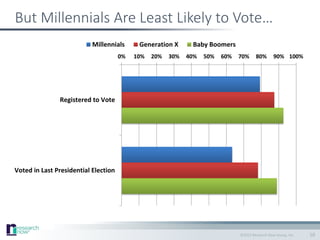
But Millennials Are Least Likely to Vote…
10
0% 10% 20% 30% 40% 50% 60% 70% 80% 90% 100%
Registered to Vote
Voted in Last Presidential Election
Millennials Generation X Baby Boomers
©2015 Research Now Group, Inc.
Generations Differ in Choice of “Most Important Issue”
11
0% 5% 10% 15% 20%
Education
Healthcare
Domestic Economy
National Security
Deficits and National…
Social Issues
Immigration
Global Economy
Taxes
International Events
Millennials
Rank
Gen X
Rank
Boomers
Rank
1 6 6
2 3 3
3 1 2
4 2 1
5 4 4
6 7 9
7 5 5
8 9 10
9 8 8
10 10 7
©2015 Research Now Group, Inc.
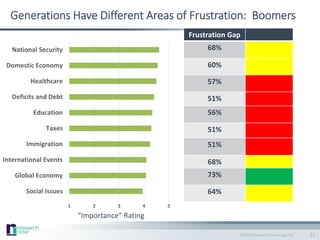
Generations Have Different Areas of Frustration: Boomers
12
Frustration Gap
68%
60%
57%
51%
56%
51%
51%
68%
73%
64%
1 2 3 4 5
National Security
Domestic Economy
Healthcare
Deficits and Debt
Education
Taxes
Immigration
International Events
Global Economy
Social Issues
“Importance” Rating
©2015 Research Now Group, Inc.
Generations Have Different Areas of Frustration: Gen-X
13
Frustration Gap
61%
62%
70%
60%
57%
58%
61%
70%
69%
73%
1 2 3 4 5
Healthcare
Domestic Economy
National Security
Education
Deficits and Debt
Taxes
Immigration
Global Economy
Social Issues
International Events
“Importance” Rating
©2015 Research Now Group, Inc.
Generations Have Different Areas of Frustration: Millennials
14
1 2 3 4 5
Education
Taxes
Healthcare
Domestic Economy
National Security
Deficits and Debt
Global Economy
Social Issues
Immigration
International Events
Frustration Gap
65%
67%
69%
72%
78%
64%
78%
76%
73%
84%
“Importance” Rating
©2015 Research Now Group, Inc.
Generations Have Different Areas of Frustration: Summary
15
Issue Millennials Gen-X Boomers
Education
Taxes
Healthcare
Domestic Economy
National Security
Deficits and Debt
Global Economy
Social Issues
Immigration
International Events
But there’s also quite a bit of
agreement…
©2015 Research Now Group, Inc.
Sneak Peak: Tracking Discretionary Spending
16
0%
10%
20%
30%
40%
50%
60%
70%
80%
90%
November
December
January
February
March
November
December
January
February
March
November
December
January
February
March
Millennials Gen X Baby Boomers
More Dining Out More Travelling More Entertainment
©2015 Research Now Group, Inc.
Sneak Peak: Tracking Discretionary Spending
17
0%
10%
20%
30%
40%
50%
60%
70%
80%
90%
100%
1-Nov
1-Dec
1-Jan
1-Feb
1-Mar
1-Nov
1-Dec
1-Jan
1-Feb
1-Mar
1-Nov
1-Dec
1-Jan
1-Feb
1-Mar
Millennials Gen X Baby Boomers
More Dining Out More Travelling More Entertainment
©2015 Research Now Group, Inc.
Practical Implications
How are Millennials Different? …in so many ways!
18
©2015 Research Now Group, Inc.
In Summary…
19
• Millennials are..
– Optimistic, but less likely to vote
– Somewhat more politically liberal
– Most concerned with issues closer to
home • Implications and Future Directions
– Self-definitions versus perceptions of
others
– How they gather data
– Shopping habits and brand preferences
• Gen-Xers are…
– The middle children
– Lacking a strong generational identity
• Baby Boomers are…
– Most pessimistic and most dissatisfied
– More concerned with immigration and
national security than other
generations
©2015 Research Now Group, Inc.
Thank you for your time!
Courtney Williams, Director of Client Services
cwilliams@researchnow.com
Matt Newman, Research Products Manager
mnewman@researchnow.com
20
*Download our millennial shopper whitepaper at rnmobile.com

Generation Gap? Political and Economic Sentiment Across Three Generations

  • 1.
    The concepts presentedin this presentation are the property of Research Now. Duplication or dissemination of the information without the express written consent of Research Now is prohibited. Generation Gap? Political and Economic Sentiment Across Three Generations Bay Area Research Forum, May 2015 Presented by: Matt Newman and Courtney Williams, Research Now
  • 2.
    ©2015 Research NowGroup, Inc. What will we learn today? Our goal is to share primary research comparing Millennials, Generation X, and Baby Boomers 2 • Who are these generations? • What are their political and economic sentiments? • What are the practical implications?
  • 3.
    ©2015 Research NowGroup, Inc. Silent Generation, Baby Boomers, Xers, and Millennials 3 *Source: Pew Research Center, http://www.pewsocialtrends.org/2015/03/19/comparing-millennials-to-other-generations/ 68.4M 64.6M 74.3M 26.8M 2014 Pop
  • 4.
    ©2015 Research NowGroup, Inc. Putting Millennials in perspective This year (2015), Millennials will overtake Baby Boomers Millennials are expected to comprise 75% of the global workforce by 2025. 4 By 2020, nearly half of all US workforce is expected to be comprised of this generation. Millennial population is projected to peak in 2036 at 81.1 million. Noteworthy the Boomers peaked at 78.8 million in 1999. By 2016, Millennials will have a greater financial spend than Baby Boomers over their life span and will account for 1/3 of all U.S spending by 2020.
  • 5.
    ©2015 Research NowGroup, Inc. Insights from the Opinion Tracker 5
  • 6.
    ©2015 Research NowGroup, Inc. Research Now Opinion Tracker CONTENT AREAS • Presidential / Congressional Approval • Current Events • Economic Sentiment • Spending Behavior • Brand Preferences Tracker has been running since November 2014 Goal is to conduct primary research on public opinion • 400 completes / week • Census balanced on completes • Total N ~ 8,500 (April 16th) • Mobile friendly, LOI < 10 minutes 6
  • 7.
    ©2015 Research NowGroup, Inc. Millennials Most Optimistic About Economy 7 18.60% 13.30% 11.50% 40.30% 34.60% 31.80% 41.10% 52.10% 50.60% Millennials Generation X Baby Boomers How Would You Rate The Economy Overall? Excellent / Very Good Average Fair / Poor 40.30% 29.90% 29.90% 43.60% 48.50% 47% 16% 22.60% 23% Millennials Generation X Baby Boomers How Do You Expect Economy To Change? Improve Stay the Same Decline
  • 8.
    ©2015 Research NowGroup, Inc. Millennials Most Satisfied with All Leadership 8 1.0 1.5 2.0 2.5 3.0 3.5 4.0 4.5 5.0 Presidential Approval Congressional Approval Millennials Generation X Baby Boomers Rated from 1 (very dissatisfied) to 5 (very satisfied) 3 = “neutral”
  • 9.
    ©2015 Research NowGroup, Inc. Millennials Slightly More Liberal… 9 43.40% 38.50% 36.90% 32.87% 33.30% 32.40% 23.90% 28.20% 30.70% 0% 10% 20% 30% 40% 50% 60% 70% 80% 90% 100% Millennials Generation X Baby Boomers Democrat Independent Republican
  • 10.
    ©2015 Research NowGroup, Inc. But Millennials Are Least Likely to Vote… 10 0% 10% 20% 30% 40% 50% 60% 70% 80% 90% 100% Registered to Vote Voted in Last Presidential Election Millennials Generation X Baby Boomers
  • 11.
    ©2015 Research NowGroup, Inc. Generations Differ in Choice of “Most Important Issue” 11 0% 5% 10% 15% 20% Education Healthcare Domestic Economy National Security Deficits and National… Social Issues Immigration Global Economy Taxes International Events Millennials Rank Gen X Rank Boomers Rank 1 6 6 2 3 3 3 1 2 4 2 1 5 4 4 6 7 9 7 5 5 8 9 10 9 8 8 10 10 7
  • 12.
    ©2015 Research NowGroup, Inc. Generations Have Different Areas of Frustration: Boomers 12 Frustration Gap 68% 60% 57% 51% 56% 51% 51% 68% 73% 64% 1 2 3 4 5 National Security Domestic Economy Healthcare Deficits and Debt Education Taxes Immigration International Events Global Economy Social Issues “Importance” Rating
  • 13.
    ©2015 Research NowGroup, Inc. Generations Have Different Areas of Frustration: Gen-X 13 Frustration Gap 61% 62% 70% 60% 57% 58% 61% 70% 69% 73% 1 2 3 4 5 Healthcare Domestic Economy National Security Education Deficits and Debt Taxes Immigration Global Economy Social Issues International Events “Importance” Rating
  • 14.
    ©2015 Research NowGroup, Inc. Generations Have Different Areas of Frustration: Millennials 14 1 2 3 4 5 Education Taxes Healthcare Domestic Economy National Security Deficits and Debt Global Economy Social Issues Immigration International Events Frustration Gap 65% 67% 69% 72% 78% 64% 78% 76% 73% 84% “Importance” Rating
  • 15.
    ©2015 Research NowGroup, Inc. Generations Have Different Areas of Frustration: Summary 15 Issue Millennials Gen-X Boomers Education Taxes Healthcare Domestic Economy National Security Deficits and Debt Global Economy Social Issues Immigration International Events But there’s also quite a bit of agreement…
  • 16.
    ©2015 Research NowGroup, Inc. Sneak Peak: Tracking Discretionary Spending 16 0% 10% 20% 30% 40% 50% 60% 70% 80% 90% November December January February March November December January February March November December January February March Millennials Gen X Baby Boomers More Dining Out More Travelling More Entertainment
  • 17.
    ©2015 Research NowGroup, Inc. Sneak Peak: Tracking Discretionary Spending 17 0% 10% 20% 30% 40% 50% 60% 70% 80% 90% 100% 1-Nov 1-Dec 1-Jan 1-Feb 1-Mar 1-Nov 1-Dec 1-Jan 1-Feb 1-Mar 1-Nov 1-Dec 1-Jan 1-Feb 1-Mar Millennials Gen X Baby Boomers More Dining Out More Travelling More Entertainment
  • 18.
    ©2015 Research NowGroup, Inc. Practical Implications How are Millennials Different? …in so many ways! 18
  • 19.
    ©2015 Research NowGroup, Inc. In Summary… 19 • Millennials are.. – Optimistic, but less likely to vote – Somewhat more politically liberal – Most concerned with issues closer to home • Implications and Future Directions – Self-definitions versus perceptions of others – How they gather data – Shopping habits and brand preferences • Gen-Xers are… – The middle children – Lacking a strong generational identity • Baby Boomers are… – Most pessimistic and most dissatisfied – More concerned with immigration and national security than other generations
  • 20.
    ©2015 Research NowGroup, Inc. Thank you for your time! Courtney Williams, Director of Client Services cwilliams@researchnow.com Matt Newman, Research Products Manager mnewman@researchnow.com 20 *Download our millennial shopper whitepaper at rnmobile.com

Editor's Notes

  • #2 At Research Now, our company mission is “To be the global leader in permission-based digital data collection to power insight” and help create a world of better understanding. A key piece of that mission involves conducting primary research; in this case, we set out to create an online public polling product that could be just as good (or better!) than phone polls. After a few methodology tweaks, we’re able to track pretty closely with established benchmarks.
  • #3 Goal is to share primary research on current predominant US generations. In support of that, we will… 2) Define the generations for our discussion purposes from secondary research resourced from PEW Research. 3) Compare and contrast top level current views of the political and economic sentiment from our primary research. 3) Appreciate the importance of and satisfaction with current approaches to ten issues, as well as areas of greatest frustration by generation. 3) Understand what the “most important issue” is among a list in our primary research, as well as how they differ across three age cohorts. 4) Finally, we’ll end with some practical takeaways
  • #4 Here we define the generations as well as give a population snapshot as of 2014. Note that some sources indicate Millennials are defined as being born between 1977 and 1994, others as 1983 or later, still others (U.S. Bureau of Labor Statistics) as 1976 – 2005… For our purposes, we accept the definition from Pew research as 1981 – 1996. Of course, birth year isn’t your destiny. But these generations are growing up with a common pop culture, and they experience key events at similar ages. There is even some psychological research suggesting that we’re particularly impacted by big events that occur as we’re coming of age. So we think it’s certainly worth asking about generational differences in public opinion. *** “Every generation is characterized by specific attitudes, values and quirks and were shaped by major historical and cultural events: the Silent generation by World War II, the rise of suburbia and the middle class and the early Cold War; the Boomers by the turbulent Sixties, the nuclear threat and Vietnam; and Generation X by the advent of cable T.V., the crash of 1987 and the dotcom bubble. Millennials have grown up with 9/11 and the war on terror followed by a global financial crisis and a daunting recession that still lingers. (Next up is Generation Z, those born since the late 1990s). They also stand apart in one other important way. Nearly every aspect of their life is pervaded by personal technology, which has exploded in their lifetime.” http://plma.com/report/millennials_report2014.pdf. Our RSN study focuses on Millennials, Xers, and Boomers with concentration on Millennials. Notes from Pew Research on other generations (http://www.pewresearch.org/fact-tank/2015/01/16/this-year-millennials-will-overtake-baby-boomers/) Generation X For a few more years, Gen Xers are projected to remain the “middle child” of generations – caught between two larger generations of the Millennials and the Boomers. They are smaller than Millennials because the generational span of Gen X (16 years) is shorter than the Millennials (17 years). Also, the Gen Xers were born during a period when Americans were having fewer children than later decades. When Gen Xers were born, births averaged around 3.4 million per year, compared with the 3.9 million annual rate during the 1980s and 1990s when Millennials were born. Though the oldest Gen Xer is now 50, the Gen X population will still grow for a few more years. The Gen X population is projected to outnumber the Boomers in 2028 when there will be 64.6 million Gen Xers and 63.7 million Boomers. The Census Bureau projects that the Gen X population will peak at 65.8 million in 2018. Baby Boomers Baby Boomers have always had an outsized presence compared with other generations. They were the largest generation and peaked at 78.8 million in 1999. There were a projected 75.4 million Boomers in 2014. By midcentury, the Boomer population will dwindle to 16.6 million. Population notes: Ages shown are as of 2014. Members of the Silent generation were 69 to 86 in 2014. Since the Current Population Survey aggregates those 85 and older into one category, results for 69 to 84 year-olds are shown. *Source: Pew Research Center tabulations of the 2014 March Current Population Survey from the Integrated Public Use Microdata Series (IPUMS)
  • #5 1) Some interesting facts and projections about the Millennial population in the US… 2) Spending power over time 3) Representation in the workforce 4) Peak of population (you may wonder how this is possible since they are no longer “being born” – the answer lies in immigration (adding more to this generation than any other). *** Spend source: “The Millennials Are Coming (PLMA Consumer Research, 2014) – referenced in our Millennial Shoppers Infographic. “Millennials represent a multi-trillion dollar marketing opportunity. By 2016, they will become the country’s largest and most powerful consumer bloc and over time will become the most economically and culturally impactful generation in U.S. history, outspending even Boomers over their life span. They already account for an estimated $1.3 trillion in overall direct annual spending and it is predicted they will buy $60 billion in consumer packaged goods alone over the next ten years. So it’s no wonder retailers are recognizing the need to identify and understand their wants and needs and how best to reach them. And there is no time to waste as, despite their youth, they are forming lifelong grocery shopping habits right now.” “Millennials will account for nearly one-third of total U.S. spending by 2020. Even through the economic tumult of the past five years, their spending has grown by three percent a year,” according to McKinsey & Co.” (PLMA) *** “With immigration adding more numbers to its group than any other, the Millennial population is projected to peak in 2036 at 81.1 million. Thereafter the oldest Millennial will be at least 56 years of age and mortality is projected to outweigh net immigration. By 2050 there will be a projected 79.2 million Millennials.” (PEW) Note: Millennials refers to the population ages 18 to 34 as of 2015. Source: Pew Research Center tabulations of U.S. Census Bureau population projections released December 2014. PEW RESEARCH CENTER
  • #10 *we can’t quite separate cohort from age effects, since this is a snapshot in time. Maybe Millennials are unique, maybe just younger… Additional insight: Gallup NJ, “From 1993 to 2003, 47% of 18- to 29-year-olds, on average, identified as Democrats or said they were independents but leaned to the Democratic Party, while 42% were Republicans or Republican leaners. That time span included two years in which young adults tilted Republican, 1994 and 1995, when Republicans won control of Congress. ***Since 2006, the average gap in favor of the Democratic Party among young adults has been 18 percentage points, 54% to 36%.”
  • #11  *Note: Certainly true that many Millennials were under 18 in the last presidential election.
  • #17 Can we tie these to historical events at the time?
  • #18 Can we tie these to historical events at the time?
  • #19 1) Who’s doing research on Millennials? Pretty much everyone… From PEW to the Whitehouse. 2, 3, 4) We aren’t the first people to ask about generational differences. Here are a few takeaways from recent internal research on shopping habits at Research Now. By the way, implications for research: Millennials are taking surveys on mobile devices at a high rate – as much as 30-40% recorded internally. 5) If you’d like to read more, the whitepaper and larger infographic are available at rnmobile.com (QC Code also) – you’ll need to fill out a quick form on the right of the screen and request it once contacted. *** In our tracker Matt reviewed, our focus is on political, economic, leadership, spending habits and views. From our own prior research, we’ve identified what’s on the slide here as it relates to some spending habits in Millennials versus boomers (the whitepaper is available at rnmobile.com). Millennials will account for one-third of all U.S. spending by 2020 Companies must adapt to their purchase habits and behaviors as their spending grows at least 3% per year* (*Source: The Millennials Are Coming (PLMA Consumer Research, 2014) As it relates to mobile consumption, it is quite notable that “minorities tend to rely more heavily on their phone for internet access, according to Pew Research Center’s recent report on smartphone adoption. Some 13% of Hispanics and 12% of blacks are smartphone-dependent, meaning they don’t have a broadband connection at home and have few options for going online other than their cellphone. In comparison, only 4% of white smartphone owners rely heavily on their cellphone for online access.” (http://www.pewresearch.org/fact-tank/2015/04/30/racial-and-ethnic-differences-in-how-people-use-mobile-technology/).
  • #20 By generation… Millennials Baby Boomers Gen X-ers Implications/Future Research