It’s time to stop
short-changing women
Equal Pay Day
4 September 2015
4 September 2015 is Equal Pay Day
Women are effectively losing a year’s income
every 5.5 years.
The days from the end of the financial year
to September 4, 2015, represent the extra
days on average it takes women to earn the
same wage as men.
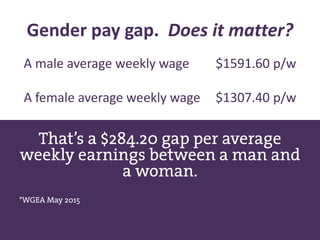
Gender pay gap. Does it matter?
A male average weekly wage $1591.60 p/w
A female average weekly wage $1307.40 p/w
That’s a $284.20 gap per average
weekly earnings between a man and
a woman.
*WGEA May 2015
Yes, it matters.
The gap is currently 17.9% and has hovered
between 15% and 19% for the past two
decades
This disparity is the key factor contributing
to women's financial disadvantage.
*WGEA May 2015
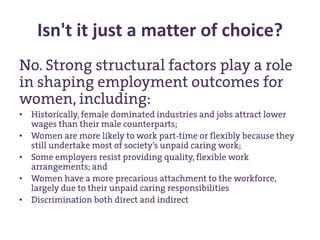
Isn't it just a matter of choice?
No. Strong structural factors play a role
in shaping employment outcomes for
women, including:
• Historically, female dominated industries and jobs attract lower
wages than their male counterparts;
• Women are more likely to work part-time or flexibly because they
still undertake most of society’s unpaid caring work;
• Some employers resist providing quality, flexible work
arrangements; and
• Women have a more precarious attachment to the workforce,
largely due to their unpaid caring responsibilities
• Discrimination both direct and indirect
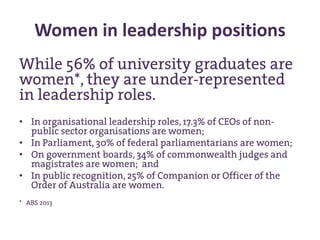
Women in leadership positions
While 56% of university graduates are
women*, they are under-represented
in leadership roles.
• In organisational leadership roles, 17.3% of CEOs of non-
public sector organisations are women;
• In Parliament, 30% of federal parliamentarians are women;
• On government boards, 34% of commonwealth judges and
magistrates are women; and
• In public recognition, 25% of Companion or Officer of the
Order of Australia are women.
* ABS 2013
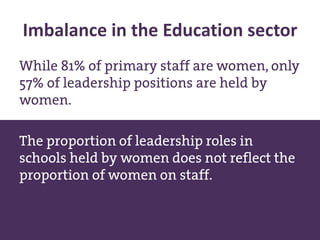
Imbalance in the Education sector
While 81% of primary staff are women, only
57% of leadership positions are held by
women.
The proportion of leadership roles in
schools held by women does not reflect the
proportion of women on staff.
The cost of being a woman
Discrimination, or other factors related to
being a woman, are the main contributing
factors to the gender pay gap.
“Simply being a woman” accounted for 60% of the difference
between women and men’s earnings.
The cost of ‘being a woman” can be seen in the penalties
women experience in the workplace when they are pregnant
and again when they return to work after birth of their child.
Cassells,R; Vidyattamay Mirant R; McNamara (2009). The impact of the sustained gender wage gap
on Australian economy. National Centre for Social and Economic Modelling
Discrimination in the Work Place
The Australian Human Rights Commission
Supporting Working Parents: Pregnancy and
Return to Work National Review2014 found
evidence that pregnancy and return to
work discrimination is widespread in our
workplaces.
The AHRC Supporting Working Parents: Pregnancy and Return
to Work National Review 2014 found evidence of widespread
discrimination in our workplaces.
One in two mothers reported discrimination at some point
during pregnancy, parental leave or on return to work.
IEU submission to the AHRC report
IEU members reported that they were
denied access to flexible work
arrangements, in some cases being forced
to resign from their position.
Other members were unlikely to regain their former earning
capacity as they were denied access to leadership positions.
Research has shown that 70% of women returning from
parental leave opt to work part time and that a woman
returning from one year of maternity leave can expect a 5%
decrease in earnings compared to before going on leave. A
three year gap will result in a fall in earnings of over 10%.
Accumulated Poverty in Retirement
Despite more women participating in the paid
workforce than ever before, the AHRC report
shows the average superannuation payout to
women is only 57%, with many women having
little or no superannuation.
As women live longer than men and are more likely to rely on
the aged pension as their sole source of income in retirement,
the need for effective policy solutions is pressing.
Failure to redress the financial disadvantage of women will
result in ongoing dependence on the aged pension.
AHRC; Accumulating Poverty; Women’s Experience over Lifetime (2009)
Govt to cut paid parental leave
The Abbott government wants to cut the federal
government’s paid parental leave scheme.
In the latest budget, 80,000 new mothers will be
prevented from accessing $11,500, once available
under the government paid parental leave scheme.
This represents nearly half of all current eligible
women, many of whom are IEU members.
Moving from rhetoric to action
We want an honest discussion about the barriers to
women's engagement with work.
We want a commitment for legislative action for
workplace flexibility, including leadership positions.
We want a commitment to paid parental leave so that
working parents can share their family
responsibilities.
We want adequate superannuation provisions which
provide dignity in retirement.
Equal Pay Day
IEU members call upon government and
employers to stop short-changing women
and take positive action to address the
inequality.

IEU Equal Pay Day 4 September

  • 1.
    It’s time tostop short-changing women Equal Pay Day 4 September 2015
  • 2.
    4 September 2015is Equal Pay Day Women are effectively losing a year’s income every 5.5 years. The days from the end of the financial year to September 4, 2015, represent the extra days on average it takes women to earn the same wage as men.
  • 3.
    Gender pay gap.Does it matter? A male average weekly wage $1591.60 p/w A female average weekly wage $1307.40 p/w That’s a $284.20 gap per average weekly earnings between a man and a woman. *WGEA May 2015
  • 4.
    Yes, it matters. Thegap is currently 17.9% and has hovered between 15% and 19% for the past two decades This disparity is the key factor contributing to women's financial disadvantage. *WGEA May 2015
  • 5.
    Isn't it justa matter of choice? No. Strong structural factors play a role in shaping employment outcomes for women, including: • Historically, female dominated industries and jobs attract lower wages than their male counterparts; • Women are more likely to work part-time or flexibly because they still undertake most of society’s unpaid caring work; • Some employers resist providing quality, flexible work arrangements; and • Women have a more precarious attachment to the workforce, largely due to their unpaid caring responsibilities • Discrimination both direct and indirect
  • 6.
    Women in leadershippositions While 56% of university graduates are women*, they are under-represented in leadership roles. • In organisational leadership roles, 17.3% of CEOs of non- public sector organisations are women; • In Parliament, 30% of federal parliamentarians are women; • On government boards, 34% of commonwealth judges and magistrates are women; and • In public recognition, 25% of Companion or Officer of the Order of Australia are women. * ABS 2013
  • 7.
    Imbalance in theEducation sector While 81% of primary staff are women, only 57% of leadership positions are held by women. The proportion of leadership roles in schools held by women does not reflect the proportion of women on staff.
  • 8.
    The cost ofbeing a woman Discrimination, or other factors related to being a woman, are the main contributing factors to the gender pay gap. “Simply being a woman” accounted for 60% of the difference between women and men’s earnings. The cost of ‘being a woman” can be seen in the penalties women experience in the workplace when they are pregnant and again when they return to work after birth of their child. Cassells,R; Vidyattamay Mirant R; McNamara (2009). The impact of the sustained gender wage gap on Australian economy. National Centre for Social and Economic Modelling
  • 9.
    Discrimination in theWork Place The Australian Human Rights Commission Supporting Working Parents: Pregnancy and Return to Work National Review2014 found evidence that pregnancy and return to work discrimination is widespread in our workplaces. The AHRC Supporting Working Parents: Pregnancy and Return to Work National Review 2014 found evidence of widespread discrimination in our workplaces. One in two mothers reported discrimination at some point during pregnancy, parental leave or on return to work.
  • 10.
    IEU submission tothe AHRC report IEU members reported that they were denied access to flexible work arrangements, in some cases being forced to resign from their position. Other members were unlikely to regain their former earning capacity as they were denied access to leadership positions. Research has shown that 70% of women returning from parental leave opt to work part time and that a woman returning from one year of maternity leave can expect a 5% decrease in earnings compared to before going on leave. A three year gap will result in a fall in earnings of over 10%.
  • 11.
    Accumulated Poverty inRetirement Despite more women participating in the paid workforce than ever before, the AHRC report shows the average superannuation payout to women is only 57%, with many women having little or no superannuation. As women live longer than men and are more likely to rely on the aged pension as their sole source of income in retirement, the need for effective policy solutions is pressing. Failure to redress the financial disadvantage of women will result in ongoing dependence on the aged pension. AHRC; Accumulating Poverty; Women’s Experience over Lifetime (2009)
  • 12.
    Govt to cutpaid parental leave The Abbott government wants to cut the federal government’s paid parental leave scheme. In the latest budget, 80,000 new mothers will be prevented from accessing $11,500, once available under the government paid parental leave scheme. This represents nearly half of all current eligible women, many of whom are IEU members.
  • 13.
    Moving from rhetoricto action We want an honest discussion about the barriers to women's engagement with work. We want a commitment for legislative action for workplace flexibility, including leadership positions. We want a commitment to paid parental leave so that working parents can share their family responsibilities. We want adequate superannuation provisions which provide dignity in retirement.
  • 14.
    Equal Pay Day IEUmembers call upon government and employers to stop short-changing women and take positive action to address the inequality.