3-D PRINTING
DEEPAK SAGAR,
NIT PATNA ,
ROLL NO. – 1635013,
M.TECH, PRODUCTION
WHAT IS 3-D PRINTING
• “3D printing” is also called “Additive Manufacturing”
• 3d printing is a process which takes digital input in the
form of Computer Aided Design (CAD) model and
creates solid 3D parts through an additive, layer by layer
process
HISTORY
1984 - 86
Charles Hull invents 3D printing and coins
the term “Stereo Lithography”
1992
First 3D printer built by 3D Systems
1999
First application of 3D printing in the medical
field - creating the human bladder
How ???
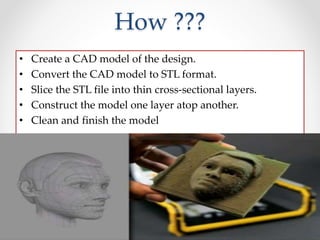
• Create a CAD model of the design.
• Convert the CAD model to STL format.
• Slice the STL file into thin cross-sectional layers.
• Construct the model one layer atop another.
• Clean and finish the model
TERMINOLOGY
• Additive Manufacturing- It is the technology which
creates object through sequential layering.
• Rapid Prototyping- It is group of technique used to
fabricate scale model of physical part or assembly by 3D
CAD data.
• Subtractive Process- Removal of material by method
such ad drilling or cutting.
• Stereo Lithography- System of generating 3D object by
creating a cross sectional pattern of the object to be
formed.
ADDITIVE PROCESS
• STEREO LITHOGRAPHY (SLA)
• FUSED DEPOSITION MODELLING (FDM)
• SELECTIVE LASER SINTERING
• LAMINATED OBJECT MANUFACTURING
STEREO LITHOGRAPHY
• Liquid photosensitive monomer is filled in tank
supported on elevated system.
• Digital Light Processing (DLP) is used to harden the
liquid photosensitive monomer.
• DLP hardens the liquid monomer as it get in contact.
• Elevator moves down and again fresh liquid monomer
get in contact.
• This process continued till the required shape obtained.
Maximum build size 1500mm x 750mm x 550mm
Resolution in Z 0.004”
Speed Medium
Cost High
Material available Thermoset polymers
FUSED DEPOSITION
MODELLING
• A nozzle feed thermo plastic wire ABS (Acrylonitrile
Butadiene Styrene) having diameter 300μm.
• Nozzle heats the wire and extrudes a hot viscous strand.
• Computer controls the nozzle movement in x-y direction
and solidifies after cooling.
• Another nozzle carries wax as support system for the
design of complex part which removed easily.
Maximum size 20” x 20” x 20”
Resolution in z direction +/- (0.002” - 0.01”)
Speed Slow
Cost Medium
Available materials ABS, Polycarbonate,
Polyactic acid
SELECTIVE LASER
SINTERING
• Continuous layer of powder fed on platform
• Focused Laser beam used to sinter powder in small
volume.
• The laser beam is scanned to define a 2D slice of the
object within the layer
• Fabrication piston lowered, the powder delivery piston
is raised and a new layer get deposited.
• After removal from the machine, the unsintered dry
powder is brushed off and recycled.
Maximum build size 700 mm x 380 mm x 560 mm
Resolution in Z 0.005”
Speed Medium
Cost Medium
Available materials Nylon, metal, ceramics, fiber
reinforced PMCs
LAMINATED OBJECT
MANUFACTURING
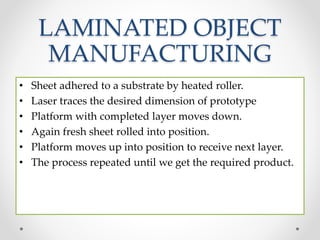
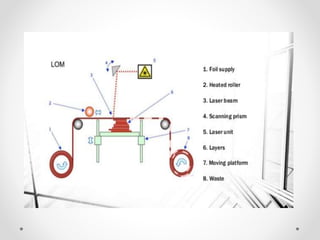
• Sheet adhered to a substrate by heated roller.
• Laser traces the desired dimension of prototype
• Platform with completed layer moves down.
• Again fresh sheet rolled into position.
• Platform moves up into position to receive next layer.
• The process repeated until we get the required product.
PROJECTED GROWTH
ADVANTAGES
• Rapid Prototyping- 3D printing gives designers the
ability to quickly turn concepts into 3D models or
prototypes.
• Wastage of material is negligible.
• Complex shape can be produced.
• It reduces the design complexity.
DISADVANTAGES
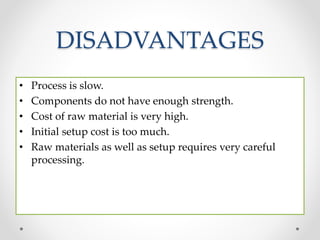
• Process is slow.
• Components do not have enough strength.
• Cost of raw material is very high.
• Initial setup cost is too much.
• Raw materials as well as setup requires very careful
processing.
FUTURE APPLICATIONS
3D
PRINTING
MEDICAL
FASHION
&
RETAIL
DEFENSE
&
SPACE
GAMES
&
ENTERTAI-
NMENT
FOODS
This 3D-printed cast to help repair
broken bones may be the future of
medical orthopedic casts. 3D-printed
casts also bring out the positive
potential of this emerging technology
Surgeon Dr. Anthony
Atala demonstrated
during TED an early-
stage experiment that
could someday solve the
organ-donor problem: a
3D printer that uses living
cells to print out a
transplantable kidney.
To prepare for a future where parts can be
built on-demand in space, Made in Space,
the space manufacturing company, has
partnered with NASA’s Marshall Space
Flight Center to launch the first 3D printer
to space. Made in Space’s customized 3D
printer will be the first device to
manufacture parts away from planet Earth.
The 3D printing in Zero-G Experiment will
validate the capability of additive
manufacturing (AM) in zero-gravity.
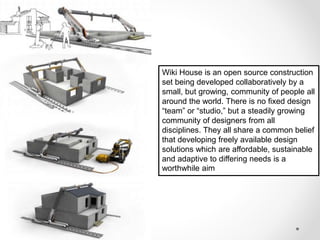
Wiki House is an open source construction
set being developed collaboratively by a
small, but growing, community of people all
around the world. There is no fixed design
“team” or “studio,” but a steadily growing
community of designers from all
disciplines. They all share a common belief
that developing freely available design
solutions which are affordable, sustainable
and adaptive to differing needs is a
worthwhile aim
Designed by Joshua Harris, an industrial
engineer, for an Electrolux design
competition in 2010, the concept printer
would not only print out clothing, but would
recycle used clothing as well. The idea is
that the fashion designers of the future will
sell cartridges for the printer containing
colors and materials to use with their digital
designs!
CONCLUSION
• Relatively new technology.
• Significant decrease in product development cycle, time,
cost.
• Full effect on business as well as society.
• Changes can be done easily.
REFERENCES
• https://3dprinting.com/what-is-3d-printing/
• Standard Terminology for Additive Manufacturing –
General Principles – Terminology. ASTM International.
September 2013, Retrieved 2016-07-11
• Jacobs, Paul Francis (1992-01-01). Rapid Prototyping &
Manufacturing: Fundamentals of Stereolithography. Society
of Manufacturing Engineers. ISBN 978-0-87263-425-1.
3 d printing

3 d printing

  • 1.
    3-D PRINTING DEEPAK SAGAR, NITPATNA , ROLL NO. – 1635013, M.TECH, PRODUCTION
  • 2.
    WHAT IS 3-DPRINTING • “3D printing” is also called “Additive Manufacturing” • 3d printing is a process which takes digital input in the form of Computer Aided Design (CAD) model and creates solid 3D parts through an additive, layer by layer process
  • 3.
    HISTORY 1984 - 86 CharlesHull invents 3D printing and coins the term “Stereo Lithography” 1992 First 3D printer built by 3D Systems 1999 First application of 3D printing in the medical field - creating the human bladder
  • 4.
    How ??? • Createa CAD model of the design. • Convert the CAD model to STL format. • Slice the STL file into thin cross-sectional layers. • Construct the model one layer atop another. • Clean and finish the model
  • 5.
    TERMINOLOGY • Additive Manufacturing-It is the technology which creates object through sequential layering. • Rapid Prototyping- It is group of technique used to fabricate scale model of physical part or assembly by 3D CAD data. • Subtractive Process- Removal of material by method such ad drilling or cutting. • Stereo Lithography- System of generating 3D object by creating a cross sectional pattern of the object to be formed.
  • 6.
    ADDITIVE PROCESS • STEREOLITHOGRAPHY (SLA) • FUSED DEPOSITION MODELLING (FDM) • SELECTIVE LASER SINTERING • LAMINATED OBJECT MANUFACTURING
  • 7.
    STEREO LITHOGRAPHY • Liquidphotosensitive monomer is filled in tank supported on elevated system. • Digital Light Processing (DLP) is used to harden the liquid photosensitive monomer. • DLP hardens the liquid monomer as it get in contact. • Elevator moves down and again fresh liquid monomer get in contact. • This process continued till the required shape obtained.
  • 9.
    Maximum build size1500mm x 750mm x 550mm Resolution in Z 0.004” Speed Medium Cost High Material available Thermoset polymers
  • 10.
    FUSED DEPOSITION MODELLING • Anozzle feed thermo plastic wire ABS (Acrylonitrile Butadiene Styrene) having diameter 300μm. • Nozzle heats the wire and extrudes a hot viscous strand. • Computer controls the nozzle movement in x-y direction and solidifies after cooling. • Another nozzle carries wax as support system for the design of complex part which removed easily.
  • 12.
    Maximum size 20”x 20” x 20” Resolution in z direction +/- (0.002” - 0.01”) Speed Slow Cost Medium Available materials ABS, Polycarbonate, Polyactic acid
  • 13.
    SELECTIVE LASER SINTERING • Continuouslayer of powder fed on platform • Focused Laser beam used to sinter powder in small volume. • The laser beam is scanned to define a 2D slice of the object within the layer • Fabrication piston lowered, the powder delivery piston is raised and a new layer get deposited. • After removal from the machine, the unsintered dry powder is brushed off and recycled.
  • 15.
    Maximum build size700 mm x 380 mm x 560 mm Resolution in Z 0.005” Speed Medium Cost Medium Available materials Nylon, metal, ceramics, fiber reinforced PMCs
  • 16.
    LAMINATED OBJECT MANUFACTURING • Sheetadhered to a substrate by heated roller. • Laser traces the desired dimension of prototype • Platform with completed layer moves down. • Again fresh sheet rolled into position. • Platform moves up into position to receive next layer. • The process repeated until we get the required product.
  • 18.
  • 19.
    ADVANTAGES • Rapid Prototyping-3D printing gives designers the ability to quickly turn concepts into 3D models or prototypes. • Wastage of material is negligible. • Complex shape can be produced. • It reduces the design complexity.
  • 20.
    DISADVANTAGES • Process isslow. • Components do not have enough strength. • Cost of raw material is very high. • Initial setup cost is too much. • Raw materials as well as setup requires very careful processing.
  • 21.
  • 22.
  • 23.
    This 3D-printed castto help repair broken bones may be the future of medical orthopedic casts. 3D-printed casts also bring out the positive potential of this emerging technology
  • 24.
    Surgeon Dr. Anthony Atalademonstrated during TED an early- stage experiment that could someday solve the organ-donor problem: a 3D printer that uses living cells to print out a transplantable kidney.
  • 25.
    To prepare fora future where parts can be built on-demand in space, Made in Space, the space manufacturing company, has partnered with NASA’s Marshall Space Flight Center to launch the first 3D printer to space. Made in Space’s customized 3D printer will be the first device to manufacture parts away from planet Earth. The 3D printing in Zero-G Experiment will validate the capability of additive manufacturing (AM) in zero-gravity.
  • 26.
    Wiki House isan open source construction set being developed collaboratively by a small, but growing, community of people all around the world. There is no fixed design “team” or “studio,” but a steadily growing community of designers from all disciplines. They all share a common belief that developing freely available design solutions which are affordable, sustainable and adaptive to differing needs is a worthwhile aim
  • 27.
    Designed by JoshuaHarris, an industrial engineer, for an Electrolux design competition in 2010, the concept printer would not only print out clothing, but would recycle used clothing as well. The idea is that the fashion designers of the future will sell cartridges for the printer containing colors and materials to use with their digital designs!
  • 28.
    CONCLUSION • Relatively newtechnology. • Significant decrease in product development cycle, time, cost. • Full effect on business as well as society. • Changes can be done easily.
  • 29.
    REFERENCES • https://3dprinting.com/what-is-3d-printing/ • StandardTerminology for Additive Manufacturing – General Principles – Terminology. ASTM International. September 2013, Retrieved 2016-07-11 • Jacobs, Paul Francis (1992-01-01). Rapid Prototyping & Manufacturing: Fundamentals of Stereolithography. Society of Manufacturing Engineers. ISBN 978-0-87263-425-1.

Editor's Notes