MEDICAPSUNIVERSITY
Overview of 3D Printing
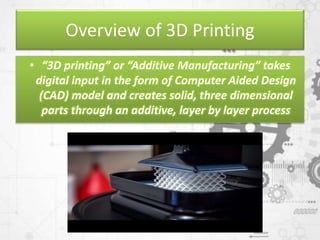
• “3D printing” or “Additive Manufacturing” takes
digital input in the form of Computer Aided Design
(CAD) model and creates solid, three dimensional
parts through an additive, layer by layer process
• Additive Manufacturing
• Subtractive Manufacturing
•
• Additive Manufacturing (AM) is an appropriate name to
describe the technologies that build 3D objects by adding layer-upon-
layer of material, whether the material is plastic, metal, concrete or one
day…..human tissue.
• Common to AM technologies is the use of a computer, 3D modeling
software (Computer Aided Design or CAD), machine equipment and
layering material. Once a CAD sketch is produced, the AM equipment
reads in data from the CAD file and lays downs or adds successive layers
of liquid, powder, sheet material or other, in a layer-upon-layer fashion
to fabricate a 3D object.
• The term AM encompasses many technologies including subsets like 3D
Printing, Rapid Prototyping (RP), Direct Digital Manufacturing (DDM),
layered manufacturing and additive fabrication.
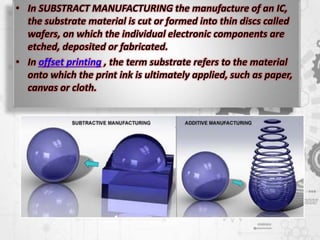
• In SUBSTRACT MANUFACTURING the manufacture of an IC,
the substrate material is cut or formed into thin discs called
wafers, on which the individual electronic components are
etched, deposited or fabricated.
• In offset printing , the term substrate refers to the material
onto which the print ink is ultimately applied, such as paper,
canvas or cloth.
GENERAL PRINCIPALS
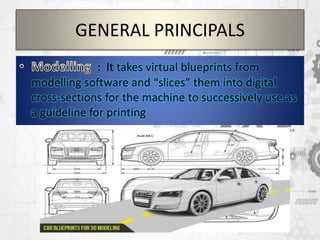
: It takes virtual blueprints from
modelling software and “slices” them into digital
cross-sections for the machine to successively use as
a guideline for printing
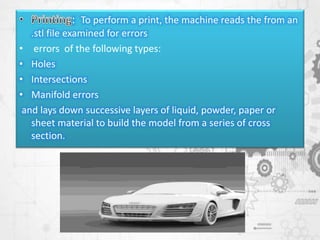
: To perform a print, the machine reads the from an
.stl file examined for errors
• errors of the following types:
• Holes
• Intersections
• Manifold errors
and lays down successive layers of liquid, powder, paper or
sheet material to build the model from a series of cross
section.
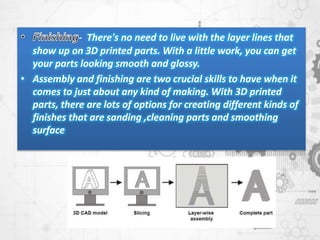
- There's no need to live with the layer lines that
show up on 3D printed parts. With a little work, you can get
your parts looking smooth and glossy.
• Assembly and finishing are two crucial skills to have when it
comes to just about any kind of making. With 3D printed
parts, there are lots of options for creating different kinds of
finishes that are sanding ,cleaning parts and smoothing
surface
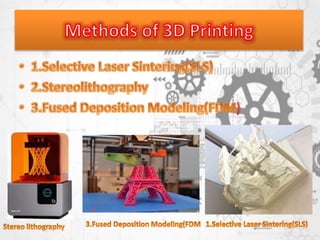
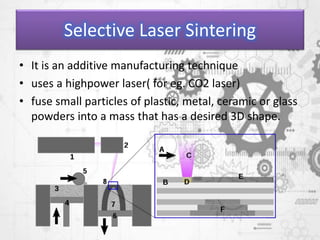
Selective Laser Sintering
• It is an additive manufacturing technique
• uses a highpower laser( for eg. CO2 laser)
• fuse small particles of plastic, metal, ceramic or glass
powders into a mass that has a desired 3D shape.
Stereolithography
• stereolithography apparatus, optical fabrication, photo-
solidification, or resin printing
• form of 3D printing technology used for
creating models, prototypes, patterns, and production parts
in a layer by layer fashion
• using photopolymerization, a process by which light causes
chains of molecules to link, forming polymers.[1] Those
polymers then make up the body of a three-dimensional
solid
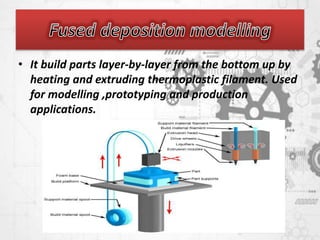
• It build parts layer-by-layer from the bottom up by
heating and extruding thermoplastic filament. Used
for modelling ,prototyping and production
applications.
1.)Acrylonitrile Butadiene
2.)Plastic Filament Styrene (ABS)
3.)PLA Polylactic acid
4.)polylactide (PLA, Poly)
5.)Flexible Plastic (TPE) Nylon
• 1.Concept Modeling :This lets small design and engineering firms
extend their reach by testing out more ideas .
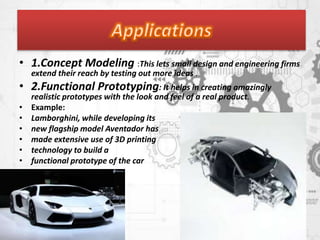
• 2.Functional Prototyping: It helps in creating amazingly
realistic prototypes with the look and feel of a real product.
• Example:
• Lamborghini, while developing its
• new flagship model Aventador has
• made extensive use of 3D printing
• technology to build a
• functional prototype of the car
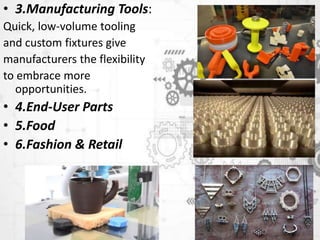
• 3.Manufacturing Tools:
Quick, low-volume tooling
and custom fixtures give
manufacturers the flexibility
to embrace more
opportunities.
• 4.End-User Parts
• 5.Food
• 6.Fashion & Retail
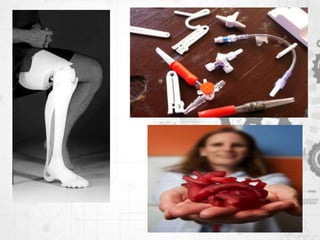
7.).Medical
• BIOPRINTING
• Three dimensional (3D) bioprinting is the utilization of 3D
printing and 3D printing–like techniques to combine cells,
growth factors, and biomaterials to fabricate biomedical
parts that maximally imitate natural tissue
characteristics.[1] Generally, 3D bioprinting utilizes the layer-
by-layer method to deposit materials known as bioinks to
create tissue-like structures that are later used in medical
and tissue engineering fields. Bioprinting covers a broad
range of biomaterials.
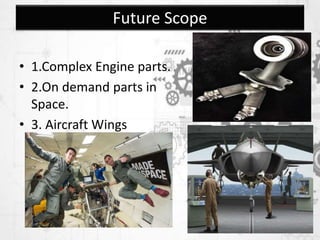
Future Scope
• 1.Complex Engine parts.
• 2.On demand parts in
Space.
• 3. Aircraft Wings
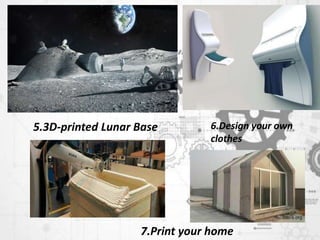
5.3D-printed Lunar Base 6.Design your own
clothes
7.Print your home
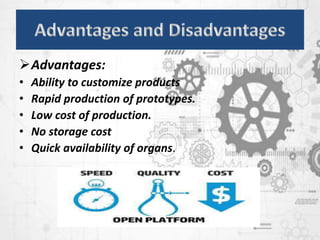
Advantages:
• Ability to customize products
• Rapid production of prototypes.
• Low cost of production.
• No storage cost
• Quick availability of organs.
Disadvantages
• Intellectual property issues
• Unchecked production of dangerous items
• Limitations of size
• Limitations of raw material
• Cost of printers
Conclusion
• 3D Printing is an expanding technology which
may soon start an industry in which everyone
has the possibility of being a manufacturer.
• 3D Printing has a lot of possible benefits to
society.
Presentation1.ppt 3 d printing

Presentation1.ppt 3 d printing

  • 1.
  • 3.
    Overview of 3DPrinting • “3D printing” or “Additive Manufacturing” takes digital input in the form of Computer Aided Design (CAD) model and creates solid, three dimensional parts through an additive, layer by layer process
  • 4.
    • Additive Manufacturing •Subtractive Manufacturing • • Additive Manufacturing (AM) is an appropriate name to describe the technologies that build 3D objects by adding layer-upon- layer of material, whether the material is plastic, metal, concrete or one day…..human tissue. • Common to AM technologies is the use of a computer, 3D modeling software (Computer Aided Design or CAD), machine equipment and layering material. Once a CAD sketch is produced, the AM equipment reads in data from the CAD file and lays downs or adds successive layers of liquid, powder, sheet material or other, in a layer-upon-layer fashion to fabricate a 3D object. • The term AM encompasses many technologies including subsets like 3D Printing, Rapid Prototyping (RP), Direct Digital Manufacturing (DDM), layered manufacturing and additive fabrication.
  • 5.
    • In SUBSTRACTMANUFACTURING the manufacture of an IC, the substrate material is cut or formed into thin discs called wafers, on which the individual electronic components are etched, deposited or fabricated. • In offset printing , the term substrate refers to the material onto which the print ink is ultimately applied, such as paper, canvas or cloth.
  • 6.
    GENERAL PRINCIPALS : Ittakes virtual blueprints from modelling software and “slices” them into digital cross-sections for the machine to successively use as a guideline for printing
  • 7.
    : To performa print, the machine reads the from an .stl file examined for errors • errors of the following types: • Holes • Intersections • Manifold errors and lays down successive layers of liquid, powder, paper or sheet material to build the model from a series of cross section.
  • 8.
    - There's noneed to live with the layer lines that show up on 3D printed parts. With a little work, you can get your parts looking smooth and glossy. • Assembly and finishing are two crucial skills to have when it comes to just about any kind of making. With 3D printed parts, there are lots of options for creating different kinds of finishes that are sanding ,cleaning parts and smoothing surface
  • 10.
    Selective Laser Sintering •It is an additive manufacturing technique • uses a highpower laser( for eg. CO2 laser) • fuse small particles of plastic, metal, ceramic or glass powders into a mass that has a desired 3D shape.
  • 11.
    Stereolithography • stereolithography apparatus,optical fabrication, photo- solidification, or resin printing • form of 3D printing technology used for creating models, prototypes, patterns, and production parts in a layer by layer fashion • using photopolymerization, a process by which light causes chains of molecules to link, forming polymers.[1] Those polymers then make up the body of a three-dimensional solid
  • 12.
    • It buildparts layer-by-layer from the bottom up by heating and extruding thermoplastic filament. Used for modelling ,prototyping and production applications.
  • 13.
    1.)Acrylonitrile Butadiene 2.)Plastic FilamentStyrene (ABS) 3.)PLA Polylactic acid 4.)polylactide (PLA, Poly) 5.)Flexible Plastic (TPE) Nylon
  • 14.
    • 1.Concept Modeling:This lets small design and engineering firms extend their reach by testing out more ideas . • 2.Functional Prototyping: It helps in creating amazingly realistic prototypes with the look and feel of a real product. • Example: • Lamborghini, while developing its • new flagship model Aventador has • made extensive use of 3D printing • technology to build a • functional prototype of the car
  • 15.
    • 3.Manufacturing Tools: Quick,low-volume tooling and custom fixtures give manufacturers the flexibility to embrace more opportunities. • 4.End-User Parts • 5.Food • 6.Fashion & Retail
  • 16.
    7.).Medical • BIOPRINTING • Threedimensional (3D) bioprinting is the utilization of 3D printing and 3D printing–like techniques to combine cells, growth factors, and biomaterials to fabricate biomedical parts that maximally imitate natural tissue characteristics.[1] Generally, 3D bioprinting utilizes the layer- by-layer method to deposit materials known as bioinks to create tissue-like structures that are later used in medical and tissue engineering fields. Bioprinting covers a broad range of biomaterials.
  • 18.
    Future Scope • 1.ComplexEngine parts. • 2.On demand parts in Space. • 3. Aircraft Wings
  • 19.
    5.3D-printed Lunar Base6.Design your own clothes 7.Print your home
  • 20.
    Advantages: • Ability tocustomize products • Rapid production of prototypes. • Low cost of production. • No storage cost • Quick availability of organs.
  • 21.
    Disadvantages • Intellectual propertyissues • Unchecked production of dangerous items • Limitations of size • Limitations of raw material • Cost of printers
  • 22.
    Conclusion • 3D Printingis an expanding technology which may soon start an industry in which everyone has the possibility of being a manufacturer. • 3D Printing has a lot of possible benefits to society.