PRESENTED BY
S.PAVITHRA
3D PRINTING
DEPARTMENT OF ELECTRICAL AND ELECTRONICS ENGINEERING
CONTENTS
• Introduction
• History of printing
• 3D printing
• Evolution of 3D printing
• Process
• Flow chart
• Working
• Methods
• Industry 4.0
• Application
• Size of printers
• Cost of printers
• Impact
• Advantage
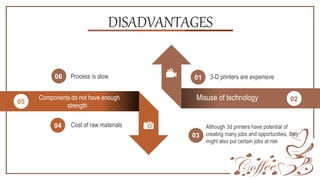
• Disadvantage
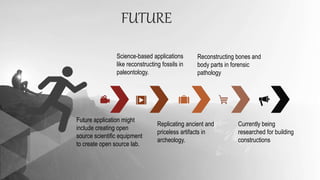
• Future scope
• Reference
INTRODUCTION
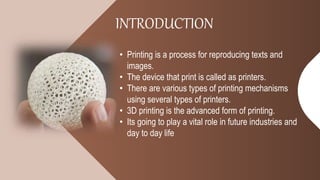
• Printing is a process for reproducing texts and
images.
• The device that print is called as printers.
• There are various types of printing mechanisms
using several types of printers.
• 3D printing is the advanced form of printing.
• Its going to play a vital role in future industries and
day to day life
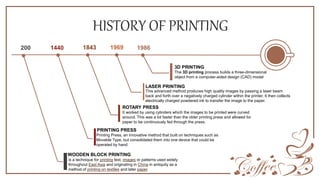
HISTORY OF PRINTING
1440200 1843 1986
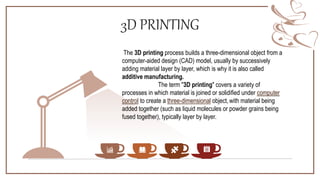
The 3D printing process builds a three-dimensional
object from a computer-aided design (CAD) model
3D PRINTING
This advanced method produces high quality images by passing a laser beam
back and forth over a negatively charged cylinder within the printer. It then collects
electrically charged powdered ink to transfer the image to the paper.
LASER PRINTING
It worked by using cylinders which the images to be printed were curved
around. This was a lot faster than the older printing press and allowed for
paper to be continuously fed through the press.
ROTARY PRESS
Printing Press, an innovative method that built on techniques such as
Movable Type, but consolidated them into one device that could be
operated by hand.
PRINTING PRESS
is a technique for printing text, images or patterns used widely
throughout East Asia and originating in China in antiquity as a
method of printing on textiles and later paper.
WOODEN BLOCK PRINTING
1969
3D PRINTING
The 3D printing process builds a three-dimensional object from a
computer-aided design (CAD) model, usually by successively
adding material layer by layer, which is why it is also called
additive manufacturing.
The term "3D printing" covers a variety of
processes in which material is joined or solidified under computer
control to create a three-dimensional object,with material being
added together (such as liquid molecules or powder grains being
fused together), typically layer by layer.
1984
Chuck Hull of 3D Systems Corporation filed
his own patent for a stereolithography
fabrication system, in which layers are added
by curing photopolymers with ultraviolet light
lasers.
2005
Z corporation launched first
high definition color 3D
printer.
2014
Benjamin S. Cook demonstrate the first multi-
material, vertically integrated printed electronics
additive manufacturing platform which enabled
3D printing of functional electronics operating
up to 40 GHz.
1974
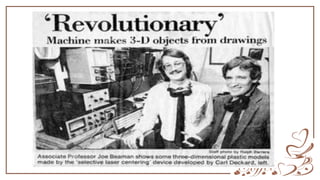
David E. H. Jones laid out the concept of 3D
printing in his regular column Ariadne in the
journal New Scientist.
1993
A company called Solidscape, introducing a
high-precision polymer jet fabrication system
with soluble support structures,
2012
Filabot developed a system for closing the loop[30]
with plastic and allows for any FDM or FFF 3D
printer to be able to print with a wider range of
plastics.
Evolution of 3d printing
process
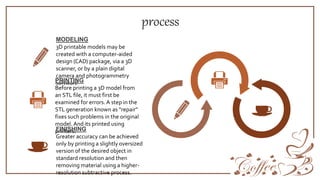
3D printable models may be
created with a computer-aided
design (CAD) package, via a 3D
scanner, or by a plain digital
camera and photogrammetry
software
MODELING
Before printing a 3D model from
an STL file, it must first be
examined for errors. A step in the
STL generation known as "repair"
fixes such problems in the original
model. And its printed using
printers.
PRINTING
Greater accuracy can be achieved
only by printing a slightly oversized
version of the desired object in
standard resolution and then
removing material using a higher-
resolution subtractive process.
FINISHING
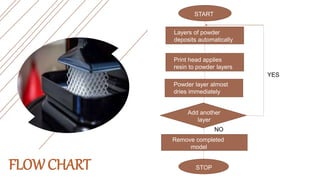
START
Layers of powder
deposits automatically
Print head applies
resin to powder layers
Powder layer almost
dries immediately
Add another
layer
Remove completed
model
STOP
NO
YES
FLOW CHART
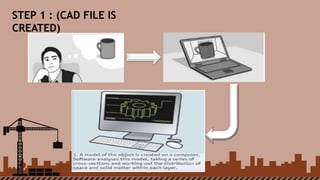
STEP 1 : (CAD FILE IS
CREATED)
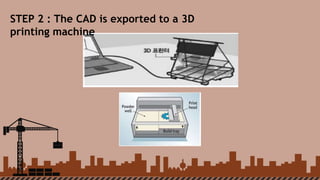
STEP 2 : The CAD is exported to a 3D
printing machine
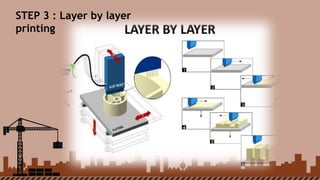
STEP 3 : Layer by layer
printing
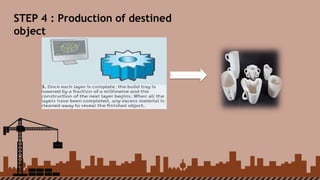
STEP 4 : Production of destined
object
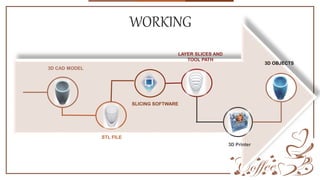
WORKING
3D CAD MODEL
STL FILE
SLICING SOFTWARE
LAYER SLICES AND
TOOL PATH
3D Printer
3D OBJECTS
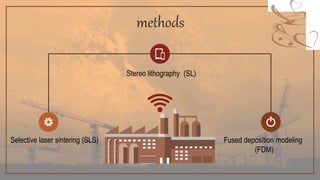
methods
Selective laser sintering (SLS)
Stereo lithography (SL)
Fused deposition modeling
(FDM)
Portfolio Presentation
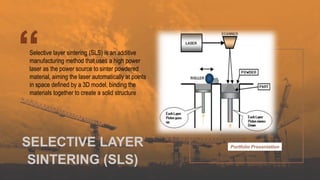
Selective layer sintering (SLS) is an additive
manufacturing method that uses a high power
laser as the power source to sinter powdered
material, aiming the laser automatically at points
in space defined by a 3D model, binding the
materials together to create a solid structure
SELECTIVE LAYER
SINTERING (SLS)
Portfolio Presentation
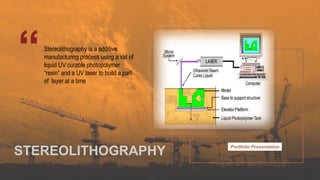
Stereolithography is a additive
manufacturing process using a vat of
liquid UV curable photopolymer
“resin” and a UV laser to build a part
of layer at a time
STEREOLITHOGRAPHY
Portfolio Presentation
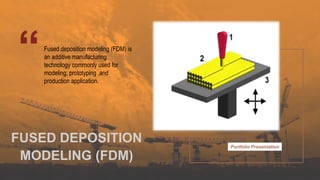
Fused deposition modeling (FDM) is
an additive manufacturing
technology commonly used for
modeling, prototyping ,and
production application.
FUSED DEPOSITION
MODELING (FDM)
ROLE OF
3D PRINTING
• As world manufacturing economy shifts from
mass production of consumer items like shoes or
bicycles to advanced products such as MRI
machines or jet engines, several emerging
technologies - sensors, big data, robotics,
advanced materials, machine learning - are
enabling new levels of precision, productivity
and innovation.
• 3D printing fits perfectly in this new paradigm –
called Industry 4.0 - situated as it is at the
intersection of materials science, robotics, cloud
computing, sensing and imaging, crowdsourcing,
data analytics and other areas.
• 3D printing, like its fabrication predecessors,
has created new manufacturing processes, and it
promises to change not just manufacturing, but
will influence our daily life in one way or other.
• It become one of the important aspect of
INDUSTRY 4.0.
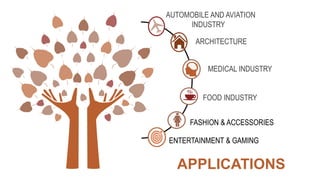
AUTOMOBILE AND AVIATION
INDUSTRY
ARCHITECTURE
MEDICAL INDUSTRY
FOOD INDUSTRY
APPLICATIONS
FASHION & ACCESSORIES
ENTERTAINMENT & GAMING
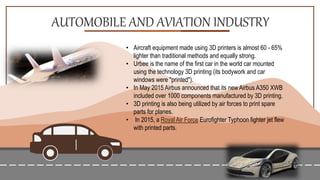
AUTOMOBILE AND AVIATION INDUSTRY
• Aircraft equipment made using 3D printers is almost 60 - 65%
lighter than traditional methods and equally strong.
• Urbee is the name of the first car in the world car mounted
using the technology 3D printing (its bodywork and car
windows were "printed").
• In May 2015 Airbus announced that its new Airbus A350 XWB
included over 1000 components manufactured by 3D printing.
• 3D printing is also being utilized by air forces to print spare
parts for planes.
• In 2015, a Royal Air Force Eurofighter Typhoon fighter jet flew
with printed parts.
ARCHITECTURE
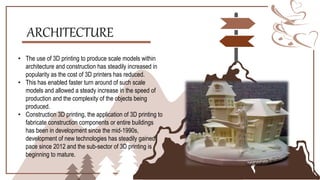
• The use of 3D printing to produce scale models within
architecture and construction has steadily increased in
popularity as the cost of 3D printers has reduced.
• This has enabled faster turn around of such scale
models and allowed a steady increase in the speed of
production and the complexity of the objects being
produced.
• Construction 3D printing, the application of 3D printing to
fabricate construction components or entire buildings
has been in development since the mid-1990s,
development of new technologies has steadily gained
pace since 2012 and the sub-sector of 3D printing is
beginning to mature.
• 3D printing technology can now be used to make exact
replicas of organs. The printer uses images from
patients' MRI or CT scan images as a template and lays
down layers of rubber or plastic.
• 3D printing has been considered as a method of
implanting stem cells capable of generating new
tissues and organs in living humans. With their ability to
transform into any other kind of cell in the human body,
stem cells offer huge potential in 3D bioprinting.
• On October 24, 2014, a five-year-old girl born without
fully formed fingers on her left hand became the first
child in the UK to have a prosthetic hand made with 3D
printing technology.
• In August 2015 the FDA approved the first 3D printed
tablet. Binder-jetting into a powder bed of the drug
allows very porous tablets to be produced, which
enables high drug doses in a single formulation that
rapidly dissolves and is easily absorbed.
MEDICAL
FOOD INDUSTRY
Additive manufacturing of
food is being developed by
squeezing out food, layer by
layer, into three-dimensional
objects.
A large variety of foods are
appropriate candidates, such
as chocolate and candy, and
flat foods such as crackers,
pasta,[28] and pizza.[
NASA has considered the versatility of
the concept, awarding a contract to the
Systems and Materials Research
Consultancy to study the feasibility of
printing food in space.[
One of the problems with food printing
is the nature of the texture of a food.
For example, foods that are not strong
enough to be filed are not appropriate
for 3D printing.
A food-tech startup Novameat from
Barcelona 3D-printed a steak from
peas, rice, seaweed, and some
other ingredients that were laid
down criss-cross, imitating the
intracellular proteins.
NASA is also looking into the
technology in order to create 3D
printed food to limit food waste and to
make food that are designed to fit an
astronaut's dietary needs.[
1
2
3 4
1
5
6
Fasion
Accessor
ies
• 3D printing has entered the world of clothing with fashion
designers experimenting with 3D-printed bikinis, shoes,
and dresses.
• In commercial production Nike used 3D printing to
prototype and manufacture the 2012 Vapor Laser Talon
football shoe for players of American football, and New
Balance is 3D manufacturing custom-fit shoes for
athletes.
• 3D printing has come to the point where companies are
printing consumer grade eyewear with on-demand
custom fit and styling.
• On-demand customization of glasses is possible with
rapid prototyping.
• 3D printing is used to manufacture moulds for making
jewelry, and even the jewelry itself.
• 3D printing is becoming popular in the customisable gifts
industry, with products such as personalized models of
art and dolls, in many shapes
&
GAMING & ENTERTAINMENT
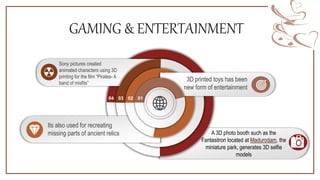
Its also used for recreating
missing parts of ancient relics A 3D photo booth such as the
Fantasitron located at Madurodam, the
miniature park, generates 3D selfie
models
3D printed toys has been
new form of entertainment
Sony pictures created
animated characters using 3D
printing for the film “Pirates- A
band of misfits”
04 03 02 01
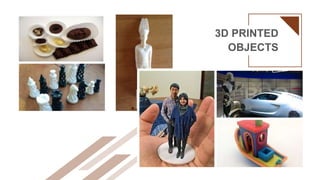
3D PRINTED
OBJECTS
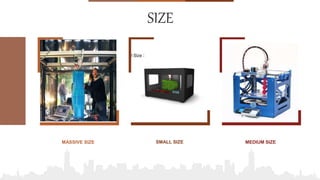
SIZE
MASSIVE SIZE SMALL SIZE MEDIUM SIZE
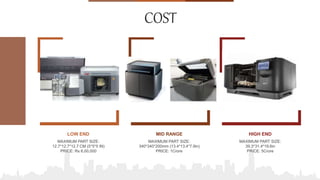
COST
MAXIMUM PART SIZE:
12.7*12.7*12.7 CM (5*5*5 IN)
PRICE: Rs 6,00,000
LOW END
MAXIMUM PART SIZE:
340*340*200mm (13.4*13.4*7.9in)
PRICE: 1Crore
MID RANGE
MAXIMUM PART SIZE:
39.3*31.4*19.6in
PRICE: 5Crore
HIGH END
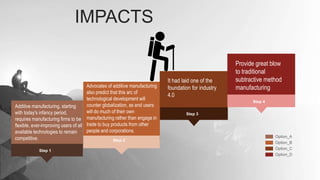
IMPACTS
Additive manufacturing, starting
with today's infancy period,
requires manufacturing firms to be
flexible, ever-improving users of all
available technologies to remain
competitive.
Step 1
Step 2
Step 3
Step 4
Advocates of additive manufacturing
also predict that this arc of
technological development will
counter globalization, as end users
will do much of their own
manufacturing rather than engage in
trade to buy products from other
people and corporations.
It had laid one of the
foundation for industry
4.0
Provide great blow
to traditional
subtractive method
manufacturing
Option_A
Option_B
Option_C
Option_D
ADVANTAGES
• RAPID PROTOTYPING: 3D printing gives
designers the ability to quickly turn concepts into 3D
models or prototyping.
• CLEAN PROCESS: wastage of materials is
negligible
• Complex shapes can be produced
• Easy to use. No skilled person needed.
• Reduce design complexity.
• Cheapest process than any other processes.
• People in remote locations can fabricate objects
that are inaccessible .
DISADVANTAGES
3-D printers are expensive01
Cost of raw materials04
Misuse of technologyYour Text Here
Although 3d printers have potential of
creating many jobs and opportunities, they
might also put certain jobs at risk
Process is slow.
02
03
Components do not have enough
strength
05
06
FUTURE
Future application might
include creating open
source scientific equipment
to create open source lab.
Replicating ancient and
priceless artifacts in
archeology.
Science-based applications
like reconstructing fossils in
paleontology.
Reconstructing bones and
body parts in forensic
pathology
Currently being
researched for building
constructions
EFERENCE
3D PRINTINGR
• https://en.wikipedia.org/wiki/3D_printing
• https://www.designtechproducts.com/articles/3d-printers
• https://en.wikipedia.org/wiki/Applications_of_3D_printing
Thank You

3d printing

  • 1.
    PRESENTED BY S.PAVITHRA 3D PRINTING DEPARTMENTOF ELECTRICAL AND ELECTRONICS ENGINEERING
  • 2.
    CONTENTS • Introduction • Historyof printing • 3D printing • Evolution of 3D printing • Process • Flow chart • Working • Methods • Industry 4.0 • Application • Size of printers • Cost of printers • Impact • Advantage • Disadvantage • Future scope • Reference
  • 3.
    INTRODUCTION • Printing isa process for reproducing texts and images. • The device that print is called as printers. • There are various types of printing mechanisms using several types of printers. • 3D printing is the advanced form of printing. • Its going to play a vital role in future industries and day to day life
  • 4.
    HISTORY OF PRINTING 14402001843 1986 The 3D printing process builds a three-dimensional object from a computer-aided design (CAD) model 3D PRINTING This advanced method produces high quality images by passing a laser beam back and forth over a negatively charged cylinder within the printer. It then collects electrically charged powdered ink to transfer the image to the paper. LASER PRINTING It worked by using cylinders which the images to be printed were curved around. This was a lot faster than the older printing press and allowed for paper to be continuously fed through the press. ROTARY PRESS Printing Press, an innovative method that built on techniques such as Movable Type, but consolidated them into one device that could be operated by hand. PRINTING PRESS is a technique for printing text, images or patterns used widely throughout East Asia and originating in China in antiquity as a method of printing on textiles and later paper. WOODEN BLOCK PRINTING 1969
  • 5.
    3D PRINTING The 3Dprinting process builds a three-dimensional object from a computer-aided design (CAD) model, usually by successively adding material layer by layer, which is why it is also called additive manufacturing. The term "3D printing" covers a variety of processes in which material is joined or solidified under computer control to create a three-dimensional object,with material being added together (such as liquid molecules or powder grains being fused together), typically layer by layer.
  • 6.
    1984 Chuck Hull of3D Systems Corporation filed his own patent for a stereolithography fabrication system, in which layers are added by curing photopolymers with ultraviolet light lasers. 2005 Z corporation launched first high definition color 3D printer. 2014 Benjamin S. Cook demonstrate the first multi- material, vertically integrated printed electronics additive manufacturing platform which enabled 3D printing of functional electronics operating up to 40 GHz. 1974 David E. H. Jones laid out the concept of 3D printing in his regular column Ariadne in the journal New Scientist. 1993 A company called Solidscape, introducing a high-precision polymer jet fabrication system with soluble support structures, 2012 Filabot developed a system for closing the loop[30] with plastic and allows for any FDM or FFF 3D printer to be able to print with a wider range of plastics. Evolution of 3d printing
  • 8.
    process 3D printable modelsmay be created with a computer-aided design (CAD) package, via a 3D scanner, or by a plain digital camera and photogrammetry software MODELING Before printing a 3D model from an STL file, it must first be examined for errors. A step in the STL generation known as "repair" fixes such problems in the original model. And its printed using printers. PRINTING Greater accuracy can be achieved only by printing a slightly oversized version of the desired object in standard resolution and then removing material using a higher- resolution subtractive process. FINISHING
  • 9.
    START Layers of powder depositsautomatically Print head applies resin to powder layers Powder layer almost dries immediately Add another layer Remove completed model STOP NO YES FLOW CHART
  • 10.
    STEP 1 :(CAD FILE IS CREATED)
  • 11.
    STEP 2 :The CAD is exported to a 3D printing machine
  • 12.
    STEP 3 :Layer by layer printing
  • 13.
    STEP 4 :Production of destined object
  • 14.
    WORKING 3D CAD MODEL STLFILE SLICING SOFTWARE LAYER SLICES AND TOOL PATH 3D Printer 3D OBJECTS
  • 15.
    methods Selective laser sintering(SLS) Stereo lithography (SL) Fused deposition modeling (FDM)
  • 16.
    Portfolio Presentation Selective layersintering (SLS) is an additive manufacturing method that uses a high power laser as the power source to sinter powdered material, aiming the laser automatically at points in space defined by a 3D model, binding the materials together to create a solid structure SELECTIVE LAYER SINTERING (SLS)
  • 17.
    Portfolio Presentation Stereolithography isa additive manufacturing process using a vat of liquid UV curable photopolymer “resin” and a UV laser to build a part of layer at a time STEREOLITHOGRAPHY
  • 18.
    Portfolio Presentation Fused depositionmodeling (FDM) is an additive manufacturing technology commonly used for modeling, prototyping ,and production application. FUSED DEPOSITION MODELING (FDM)
  • 19.
    ROLE OF 3D PRINTING •As world manufacturing economy shifts from mass production of consumer items like shoes or bicycles to advanced products such as MRI machines or jet engines, several emerging technologies - sensors, big data, robotics, advanced materials, machine learning - are enabling new levels of precision, productivity and innovation. • 3D printing fits perfectly in this new paradigm – called Industry 4.0 - situated as it is at the intersection of materials science, robotics, cloud computing, sensing and imaging, crowdsourcing, data analytics and other areas. • 3D printing, like its fabrication predecessors, has created new manufacturing processes, and it promises to change not just manufacturing, but will influence our daily life in one way or other. • It become one of the important aspect of INDUSTRY 4.0.
  • 20.
    AUTOMOBILE AND AVIATION INDUSTRY ARCHITECTURE MEDICALINDUSTRY FOOD INDUSTRY APPLICATIONS FASHION & ACCESSORIES ENTERTAINMENT & GAMING
  • 21.
    AUTOMOBILE AND AVIATIONINDUSTRY • Aircraft equipment made using 3D printers is almost 60 - 65% lighter than traditional methods and equally strong. • Urbee is the name of the first car in the world car mounted using the technology 3D printing (its bodywork and car windows were "printed"). • In May 2015 Airbus announced that its new Airbus A350 XWB included over 1000 components manufactured by 3D printing. • 3D printing is also being utilized by air forces to print spare parts for planes. • In 2015, a Royal Air Force Eurofighter Typhoon fighter jet flew with printed parts.
  • 22.
    ARCHITECTURE • The useof 3D printing to produce scale models within architecture and construction has steadily increased in popularity as the cost of 3D printers has reduced. • This has enabled faster turn around of such scale models and allowed a steady increase in the speed of production and the complexity of the objects being produced. • Construction 3D printing, the application of 3D printing to fabricate construction components or entire buildings has been in development since the mid-1990s, development of new technologies has steadily gained pace since 2012 and the sub-sector of 3D printing is beginning to mature.
  • 23.
    • 3D printingtechnology can now be used to make exact replicas of organs. The printer uses images from patients' MRI or CT scan images as a template and lays down layers of rubber or plastic. • 3D printing has been considered as a method of implanting stem cells capable of generating new tissues and organs in living humans. With their ability to transform into any other kind of cell in the human body, stem cells offer huge potential in 3D bioprinting. • On October 24, 2014, a five-year-old girl born without fully formed fingers on her left hand became the first child in the UK to have a prosthetic hand made with 3D printing technology. • In August 2015 the FDA approved the first 3D printed tablet. Binder-jetting into a powder bed of the drug allows very porous tablets to be produced, which enables high drug doses in a single formulation that rapidly dissolves and is easily absorbed. MEDICAL
  • 24.
    FOOD INDUSTRY Additive manufacturingof food is being developed by squeezing out food, layer by layer, into three-dimensional objects. A large variety of foods are appropriate candidates, such as chocolate and candy, and flat foods such as crackers, pasta,[28] and pizza.[ NASA has considered the versatility of the concept, awarding a contract to the Systems and Materials Research Consultancy to study the feasibility of printing food in space.[ One of the problems with food printing is the nature of the texture of a food. For example, foods that are not strong enough to be filed are not appropriate for 3D printing. A food-tech startup Novameat from Barcelona 3D-printed a steak from peas, rice, seaweed, and some other ingredients that were laid down criss-cross, imitating the intracellular proteins. NASA is also looking into the technology in order to create 3D printed food to limit food waste and to make food that are designed to fit an astronaut's dietary needs.[ 1 2 3 4 1 5 6
  • 25.
    Fasion Accessor ies • 3D printinghas entered the world of clothing with fashion designers experimenting with 3D-printed bikinis, shoes, and dresses. • In commercial production Nike used 3D printing to prototype and manufacture the 2012 Vapor Laser Talon football shoe for players of American football, and New Balance is 3D manufacturing custom-fit shoes for athletes. • 3D printing has come to the point where companies are printing consumer grade eyewear with on-demand custom fit and styling. • On-demand customization of glasses is possible with rapid prototyping. • 3D printing is used to manufacture moulds for making jewelry, and even the jewelry itself. • 3D printing is becoming popular in the customisable gifts industry, with products such as personalized models of art and dolls, in many shapes &
  • 26.
    GAMING & ENTERTAINMENT Itsalso used for recreating missing parts of ancient relics A 3D photo booth such as the Fantasitron located at Madurodam, the miniature park, generates 3D selfie models 3D printed toys has been new form of entertainment Sony pictures created animated characters using 3D printing for the film “Pirates- A band of misfits” 04 03 02 01
  • 27.
  • 28.
    SIZE MASSIVE SIZE SMALLSIZE MEDIUM SIZE
  • 29.
    COST MAXIMUM PART SIZE: 12.7*12.7*12.7CM (5*5*5 IN) PRICE: Rs 6,00,000 LOW END MAXIMUM PART SIZE: 340*340*200mm (13.4*13.4*7.9in) PRICE: 1Crore MID RANGE MAXIMUM PART SIZE: 39.3*31.4*19.6in PRICE: 5Crore HIGH END
  • 30.
    IMPACTS Additive manufacturing, starting withtoday's infancy period, requires manufacturing firms to be flexible, ever-improving users of all available technologies to remain competitive. Step 1 Step 2 Step 3 Step 4 Advocates of additive manufacturing also predict that this arc of technological development will counter globalization, as end users will do much of their own manufacturing rather than engage in trade to buy products from other people and corporations. It had laid one of the foundation for industry 4.0 Provide great blow to traditional subtractive method manufacturing Option_A Option_B Option_C Option_D
  • 31.
    ADVANTAGES • RAPID PROTOTYPING:3D printing gives designers the ability to quickly turn concepts into 3D models or prototyping. • CLEAN PROCESS: wastage of materials is negligible • Complex shapes can be produced • Easy to use. No skilled person needed. • Reduce design complexity. • Cheapest process than any other processes. • People in remote locations can fabricate objects that are inaccessible .
  • 32.
    DISADVANTAGES 3-D printers areexpensive01 Cost of raw materials04 Misuse of technologyYour Text Here Although 3d printers have potential of creating many jobs and opportunities, they might also put certain jobs at risk Process is slow. 02 03 Components do not have enough strength 05 06
  • 33.
    FUTURE Future application might includecreating open source scientific equipment to create open source lab. Replicating ancient and priceless artifacts in archeology. Science-based applications like reconstructing fossils in paleontology. Reconstructing bones and body parts in forensic pathology Currently being researched for building constructions
  • 34.
    EFERENCE 3D PRINTINGR • https://en.wikipedia.org/wiki/3D_printing •https://www.designtechproducts.com/articles/3d-printers • https://en.wikipedia.org/wiki/Applications_of_3D_printing
  • 35.