A PRESENTATION ON “3D
PRINTING
TECHNOLOGY”
What is 3D Printing ?
 3D printing or additive manufacturing is a process of
making three dimensional solid objects from a digital file.
 The creation of a 3D printed object is achieved using
additive processes.
 Additive process, where successive layers of material are
laid down in different shapes.
 Objects can be of almost any shape or geometry, and are
produced from a 3D model or other electronic data source.
How Does It Work?
A person creates a 3D image
of an item using a
computer-aided design
(CAD) software program.
The CAD information is sent
to the printer.
The printer forms the item
by depositing the material in
layers—starting from the
bottom layer—onto a
platform. In some cases
light or lasers are used to
harden the material.
History
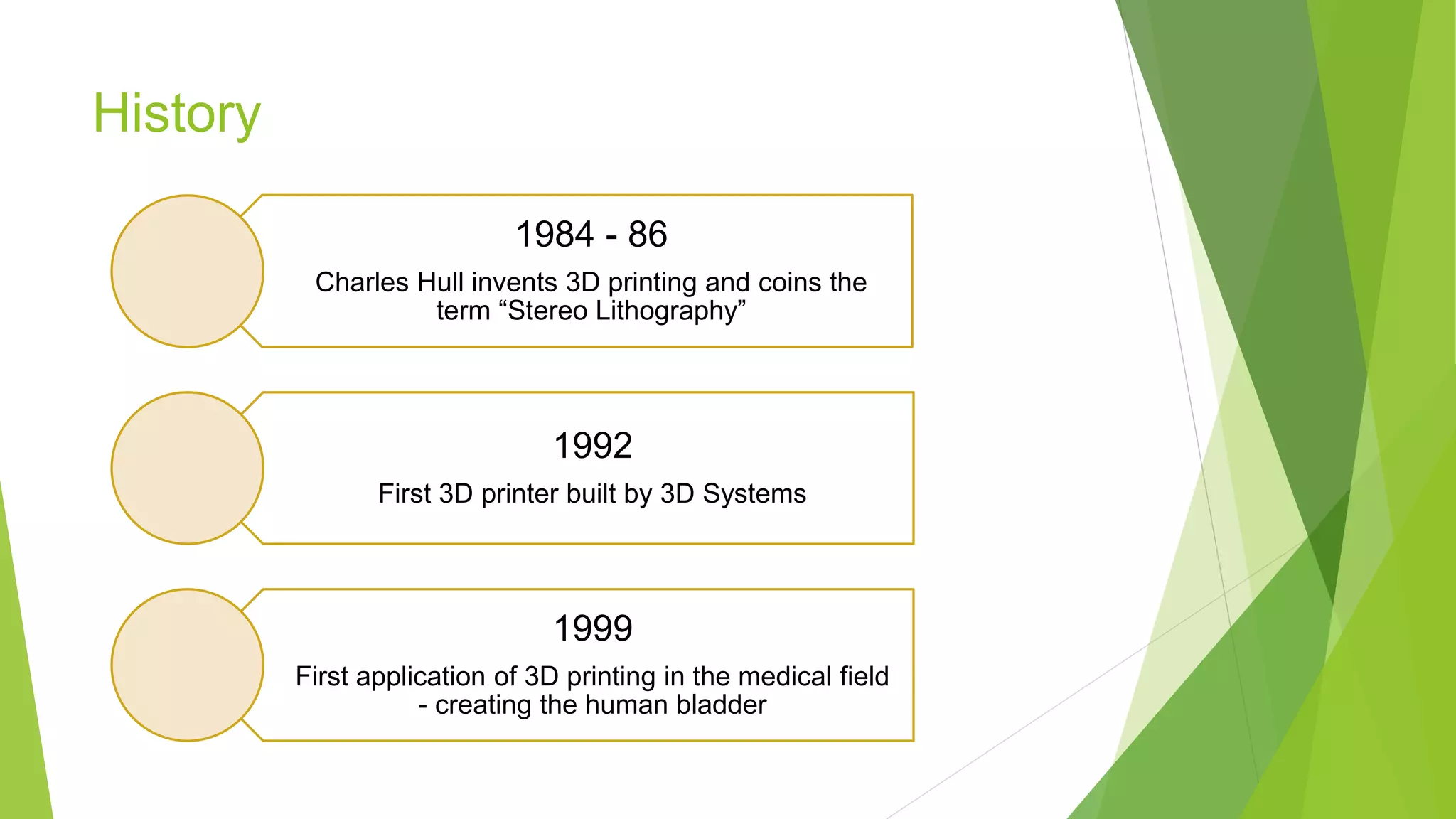
1984 - 86
Charles Hull invents 3D printing and coins the
term “Stereo Lithography”
1992
First 3D printer built by 3D Systems
1999
First application of 3D printing in the medical field
- creating the human bladder
2000
Miniature human kidney created through 3D
printing
2006
The Selective Laser Sintering machine – printing
multiple materials & fields
2009
First usable prosthetic leg – this opens the door
for customized products using 3D printing
2011
3D printers start offering 14k gold as printable
material
Steps Followed in this process:
 Modeling
 Printing
 Finishing
Modeling
Additive manufacturing takes virtual blueprints
from computer aided design (CAD)
or animation modeling software and "slices" them
into digital cross-sections for the machine to
successively use as a guideline for printing.
Printing
To perform a print, the machine reads the design and lays down
successive layers of liquid, powder, or sheet material to build
the model from a series of cross sections. These layers, which
correspond to the virtual cross sections from the CAD model,
are joined together or automatically fused to create the final
shape.
Advantage: Ability to create almost any shape or geometric
feature.
Finishing
Though the printer-produced resolution is sufficient for
many applications, printing a slightly oversized version of
the desired object in standard resolution, and then removing
material with a higher-resolution subtractive process can
achieve a higher-resolution.
Methods & Technologies
 Several ways to realize 3D objects –
 Selective laser sintering (SLS)
 Fused deposition modelling (FDS)
 Stereo lithography (SLA)
Selective laser sintering (SLS)
 This builds objects by using a laser to
selectively fuse together successive
layers of a cocktail of powdered wax,
ceramic, metal, nylon or one of a range
of other materials
 The laser fuses small particles of
plastic, metal, ceramic or glass
powders into a 3-dimensional mass.
Fused deposition modelling (FDS)
 This method uses a plastic filament or metal wire as input
material to an extrusion nozzle. The nozzle is heated to melt
the material and can be moved in both horizontal and
vertical directions by CAM. The material hardens
immediately after extrusion from the nozzle.
Stereo lithography
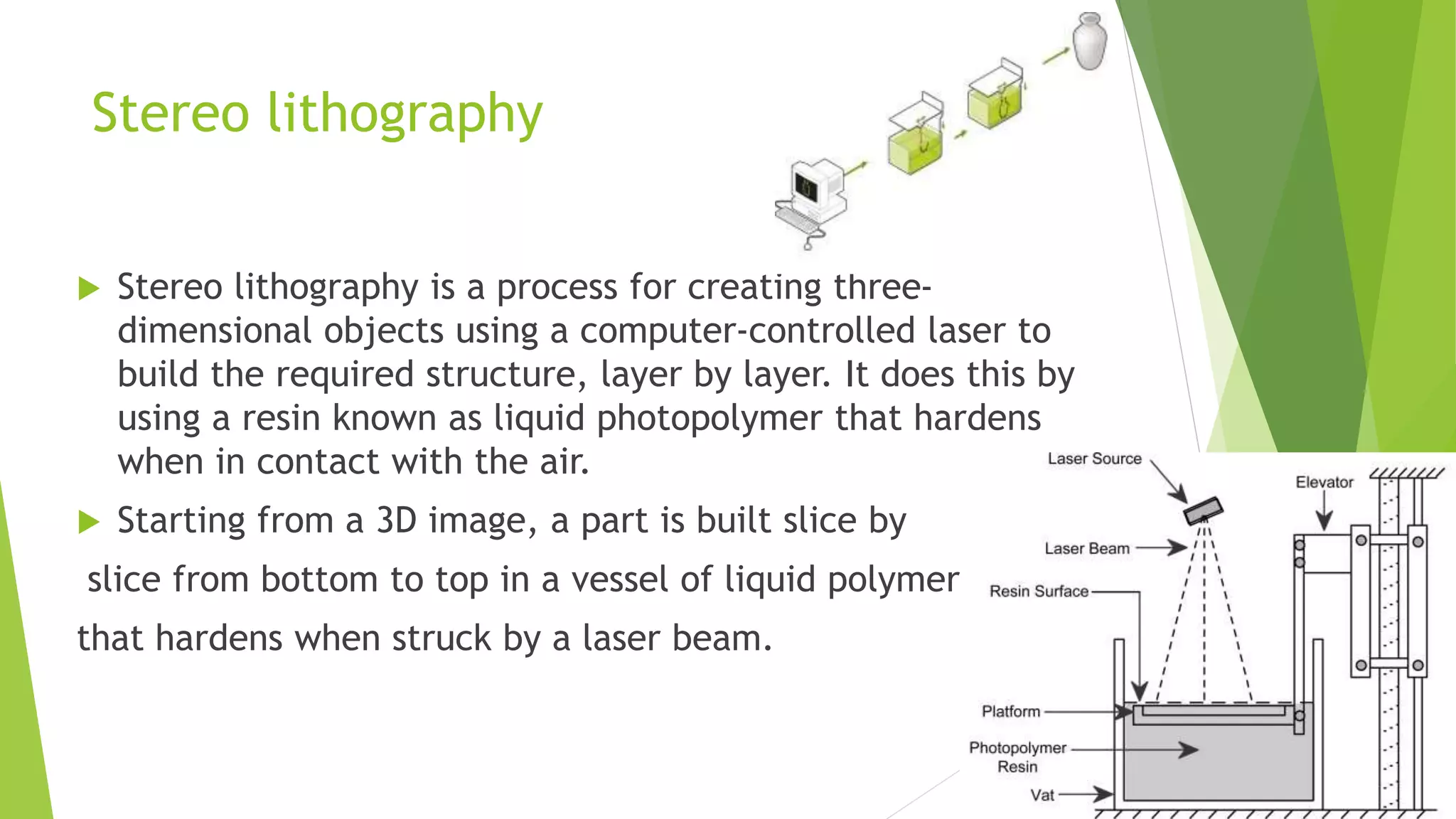
 Stereo lithography is a process for creating three-
dimensional objects using a computer-controlled laser to
build the required structure, layer by layer. It does this by
using a resin known as liquid photopolymer that hardens
when in contact with the air.
 Starting from a 3D image, a part is built slice by
slice from bottom to top in a vessel of liquid polymer
that hardens when struck by a laser beam.
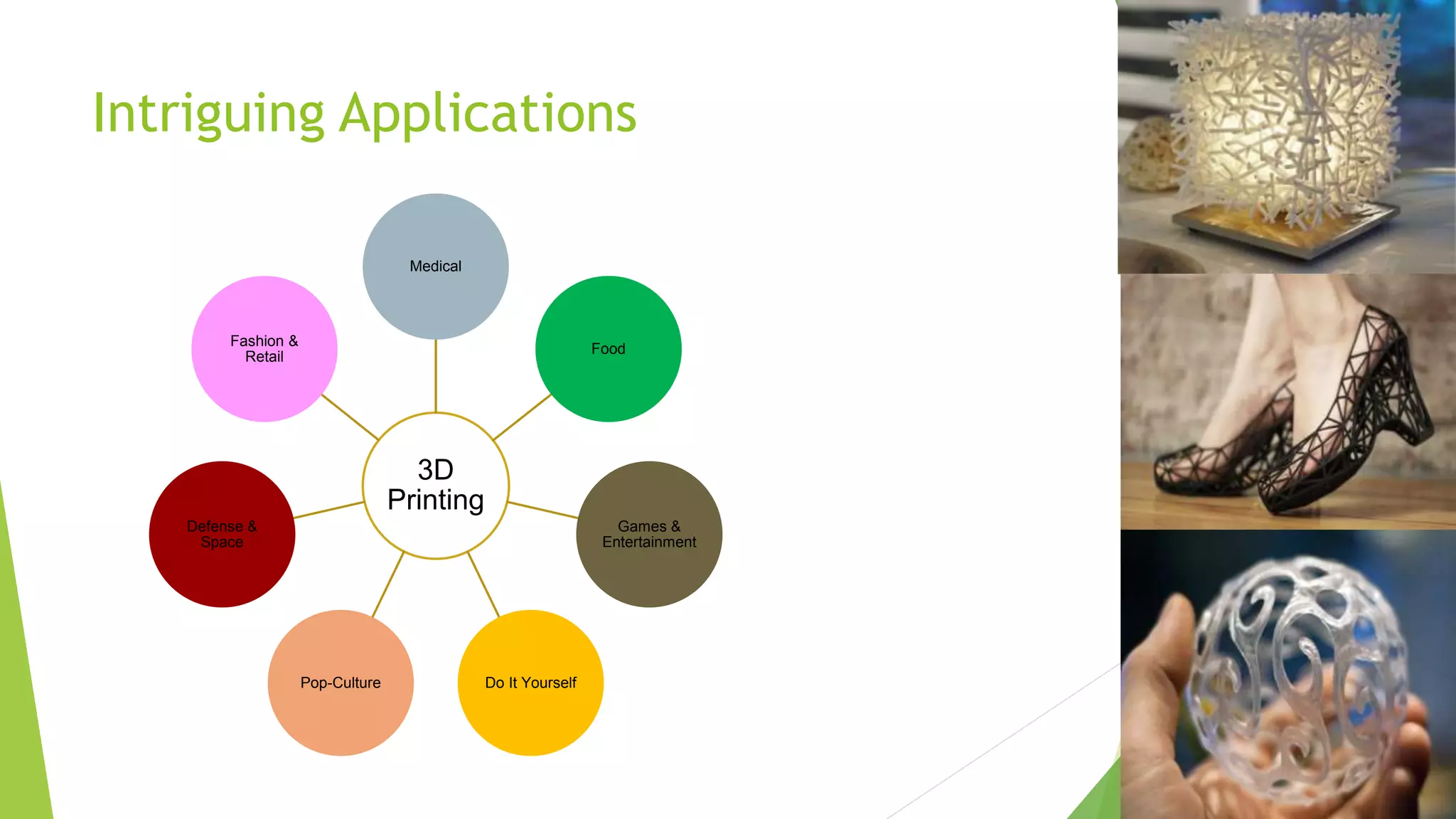
Intriguing Applications
3D
Printing
Medical
Food
Games &
Entertainment
Do It Yourself
Pop-Culture
Defense &
Space
Fashion &
Retail
Fashionable Plaster Medical
This 3D-printed cast to help repair
broken bones may be the future of
medical orthopedic casts. 3D-printed
casts also bring out the positive
potential of this emerging technology.
Bionic Ears
Scientists, including an Indian-
origin researcher, have created a
3D-printed bionic ear that can
"hear" radio frequencies far
beyond the range of normal
human capability. Using off-the-
shelf printing tools, the scientists
at Princeton University explored
3D printing of cells and nano
particles, creating the bionic ear.
Medical
Animated Characters
Sony pictures was the first to embrace
the concept of 3D printing to create
characters for the movie Pirates – A Band
of Misfits.
Games &
Entertain
ment
Sky fall’s Aston Martin
Skyfall filmmakers 3D-printed this rare Aston
Martin so they wouldn't have to damage the
original for the film sequence. The effects crew
model makers called on a company called
Voxeljet, which used a massive 3D printer with a
capacity of 283 cubic feet to reproduce three 1:3
scale models of the Aston Martin.
Pop-
Culture
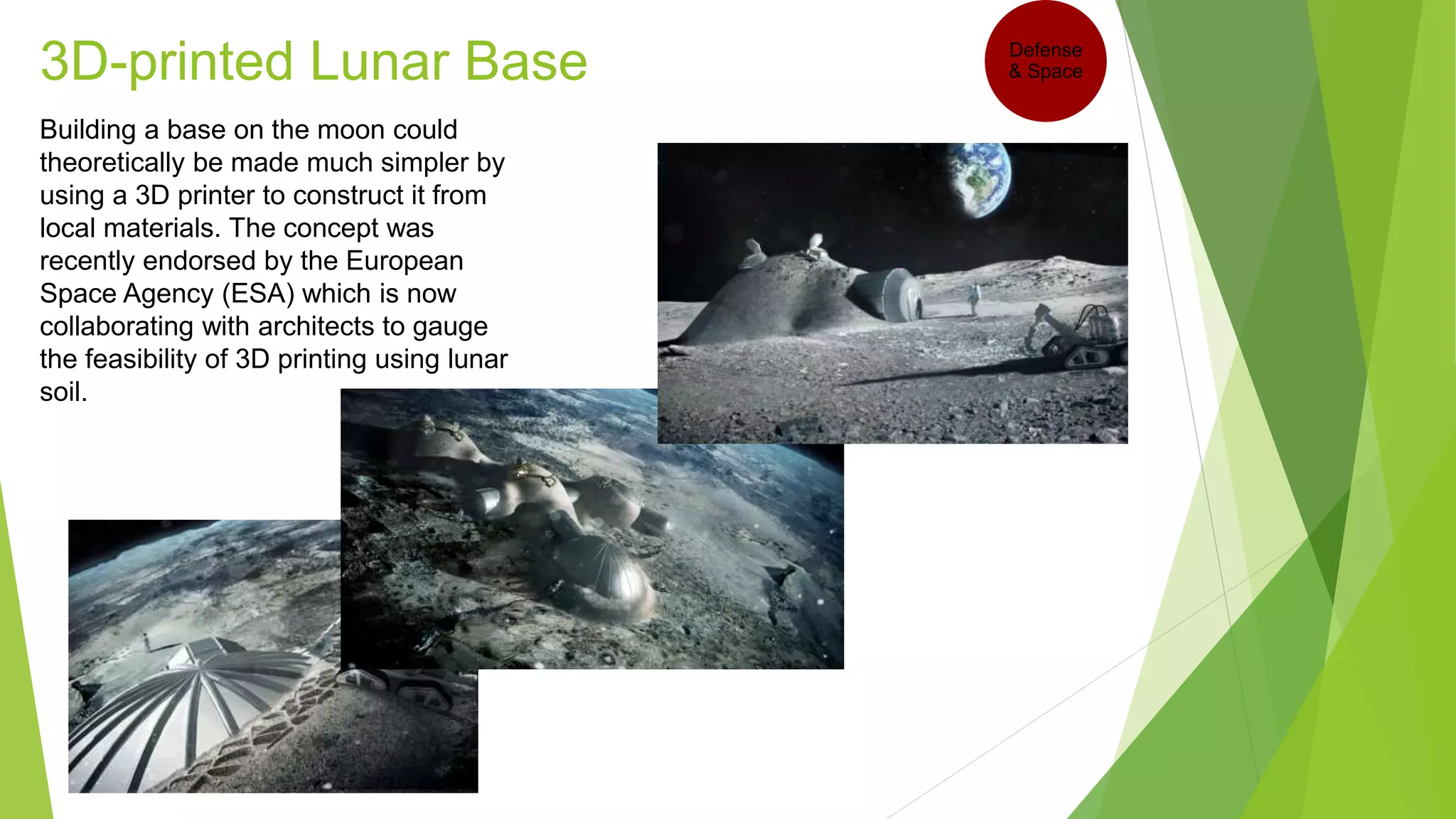
3D-printed Lunar Base
Building a base on the moon could
theoretically be made much simpler by
using a 3D printer to construct it from
local materials. The concept was
recently endorsed by the European
Space Agency (ESA) which is now
collaborating with architects to gauge
the feasibility of 3D printing using lunar
soil.
Defense
& Space
Print Your Footwear
Fashion designer Iris van Herpen
and shoe designer Rem D Koolhaas
have collaborated to create 3D-
printed shoes that look like tree
roots. The shoes were presented at
Paris Fashion Week during Iris van
Herpen's couture show.
Fashion
& Retail

8951019.ppt

  • 1.
    A PRESENTATION ON“3D PRINTING TECHNOLOGY”
  • 2.
    What is 3DPrinting ?  3D printing or additive manufacturing is a process of making three dimensional solid objects from a digital file.  The creation of a 3D printed object is achieved using additive processes.  Additive process, where successive layers of material are laid down in different shapes.  Objects can be of almost any shape or geometry, and are produced from a 3D model or other electronic data source.
  • 3.
    How Does ItWork? A person creates a 3D image of an item using a computer-aided design (CAD) software program. The CAD information is sent to the printer. The printer forms the item by depositing the material in layers—starting from the bottom layer—onto a platform. In some cases light or lasers are used to harden the material.
  • 4.
    History 1984 - 86 CharlesHull invents 3D printing and coins the term “Stereo Lithography” 1992 First 3D printer built by 3D Systems 1999 First application of 3D printing in the medical field - creating the human bladder
  • 5.
    2000 Miniature human kidneycreated through 3D printing 2006 The Selective Laser Sintering machine – printing multiple materials & fields 2009 First usable prosthetic leg – this opens the door for customized products using 3D printing 2011 3D printers start offering 14k gold as printable material
  • 6.
    Steps Followed inthis process:  Modeling  Printing  Finishing
  • 7.
    Modeling Additive manufacturing takesvirtual blueprints from computer aided design (CAD) or animation modeling software and "slices" them into digital cross-sections for the machine to successively use as a guideline for printing.
  • 8.
    Printing To perform aprint, the machine reads the design and lays down successive layers of liquid, powder, or sheet material to build the model from a series of cross sections. These layers, which correspond to the virtual cross sections from the CAD model, are joined together or automatically fused to create the final shape. Advantage: Ability to create almost any shape or geometric feature.
  • 9.
    Finishing Though the printer-producedresolution is sufficient for many applications, printing a slightly oversized version of the desired object in standard resolution, and then removing material with a higher-resolution subtractive process can achieve a higher-resolution.
  • 10.
    Methods & Technologies Several ways to realize 3D objects –  Selective laser sintering (SLS)  Fused deposition modelling (FDS)  Stereo lithography (SLA)
  • 11.
    Selective laser sintering(SLS)  This builds objects by using a laser to selectively fuse together successive layers of a cocktail of powdered wax, ceramic, metal, nylon or one of a range of other materials  The laser fuses small particles of plastic, metal, ceramic or glass powders into a 3-dimensional mass.
  • 12.
    Fused deposition modelling(FDS)  This method uses a plastic filament or metal wire as input material to an extrusion nozzle. The nozzle is heated to melt the material and can be moved in both horizontal and vertical directions by CAM. The material hardens immediately after extrusion from the nozzle.
  • 13.
    Stereo lithography  Stereolithography is a process for creating three- dimensional objects using a computer-controlled laser to build the required structure, layer by layer. It does this by using a resin known as liquid photopolymer that hardens when in contact with the air.  Starting from a 3D image, a part is built slice by slice from bottom to top in a vessel of liquid polymer that hardens when struck by a laser beam.
  • 14.
    Intriguing Applications 3D Printing Medical Food Games & Entertainment DoIt Yourself Pop-Culture Defense & Space Fashion & Retail
  • 15.
    Fashionable Plaster Medical This3D-printed cast to help repair broken bones may be the future of medical orthopedic casts. 3D-printed casts also bring out the positive potential of this emerging technology.
  • 16.
    Bionic Ears Scientists, includingan Indian- origin researcher, have created a 3D-printed bionic ear that can "hear" radio frequencies far beyond the range of normal human capability. Using off-the- shelf printing tools, the scientists at Princeton University explored 3D printing of cells and nano particles, creating the bionic ear. Medical
  • 17.
    Animated Characters Sony pictureswas the first to embrace the concept of 3D printing to create characters for the movie Pirates – A Band of Misfits. Games & Entertain ment
  • 18.
    Sky fall’s AstonMartin Skyfall filmmakers 3D-printed this rare Aston Martin so they wouldn't have to damage the original for the film sequence. The effects crew model makers called on a company called Voxeljet, which used a massive 3D printer with a capacity of 283 cubic feet to reproduce three 1:3 scale models of the Aston Martin. Pop- Culture
  • 19.
    3D-printed Lunar Base Buildinga base on the moon could theoretically be made much simpler by using a 3D printer to construct it from local materials. The concept was recently endorsed by the European Space Agency (ESA) which is now collaborating with architects to gauge the feasibility of 3D printing using lunar soil. Defense & Space
  • 20.
    Print Your Footwear Fashiondesigner Iris van Herpen and shoe designer Rem D Koolhaas have collaborated to create 3D- printed shoes that look like tree roots. The shoes were presented at Paris Fashion Week during Iris van Herpen's couture show. Fashion & Retail