This document discusses 3D image processing operations including enhancement, segmentation, and blur. It provides objectives to implement these basic operations on 3D images. It describes image processing as a form of signal processing where the input is an image and the output is another image or characteristics. The document demonstrates examples of enhancement, segmentation, and blurring on 2D and 3D images and provides histograms to compare the results. It concludes that the presented work elaborates on 3D image processing operations and compares the output algorithms to previous work on 2D images using MATLAB software.
IMAGE PROCESSING:-
• Formof signal processing
•Input – image
•Output –image or set of characteristics or parameters
•Implemented through algorithms
•Current concentration - “Texture", "Surface Mapping", "Video
Tracking”.
•Concentration needed on Spectrum & Hierarchy of
processing levels
4.
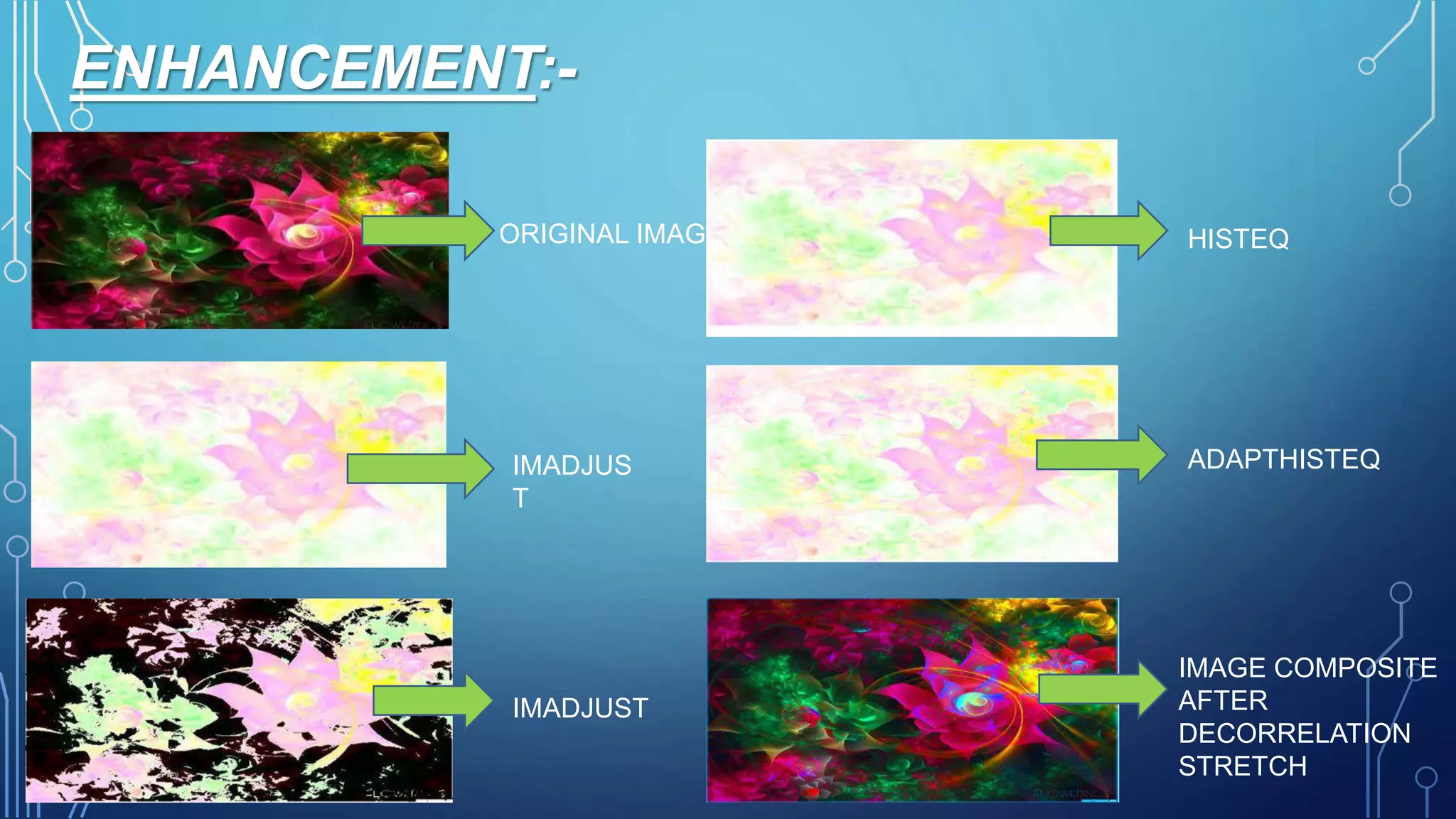
IMAGE ENHANCEMENT:-
•Image Enhancement-Processingan image such as
Sharpening, De blurring,…
•Enhance Multispectral Color Composite Images-suitable
for image interpretation, de-correlation
•Enhance Color Images-Contrast enhancement, converts
image from RGB to L*a*b.
•Imadjust
•Histeq
•Adaphisteq
5.
IMADJUST:-
• Increases thecontrast of the image.
HISTEQ:-
• Perform histogram equalization.
ADAPTHISTEQ:-
• Performs contrast-limited adaptive
histogram equalization.
• Values are already spread out between
the minimum of 0 and maximum of 255.
6.
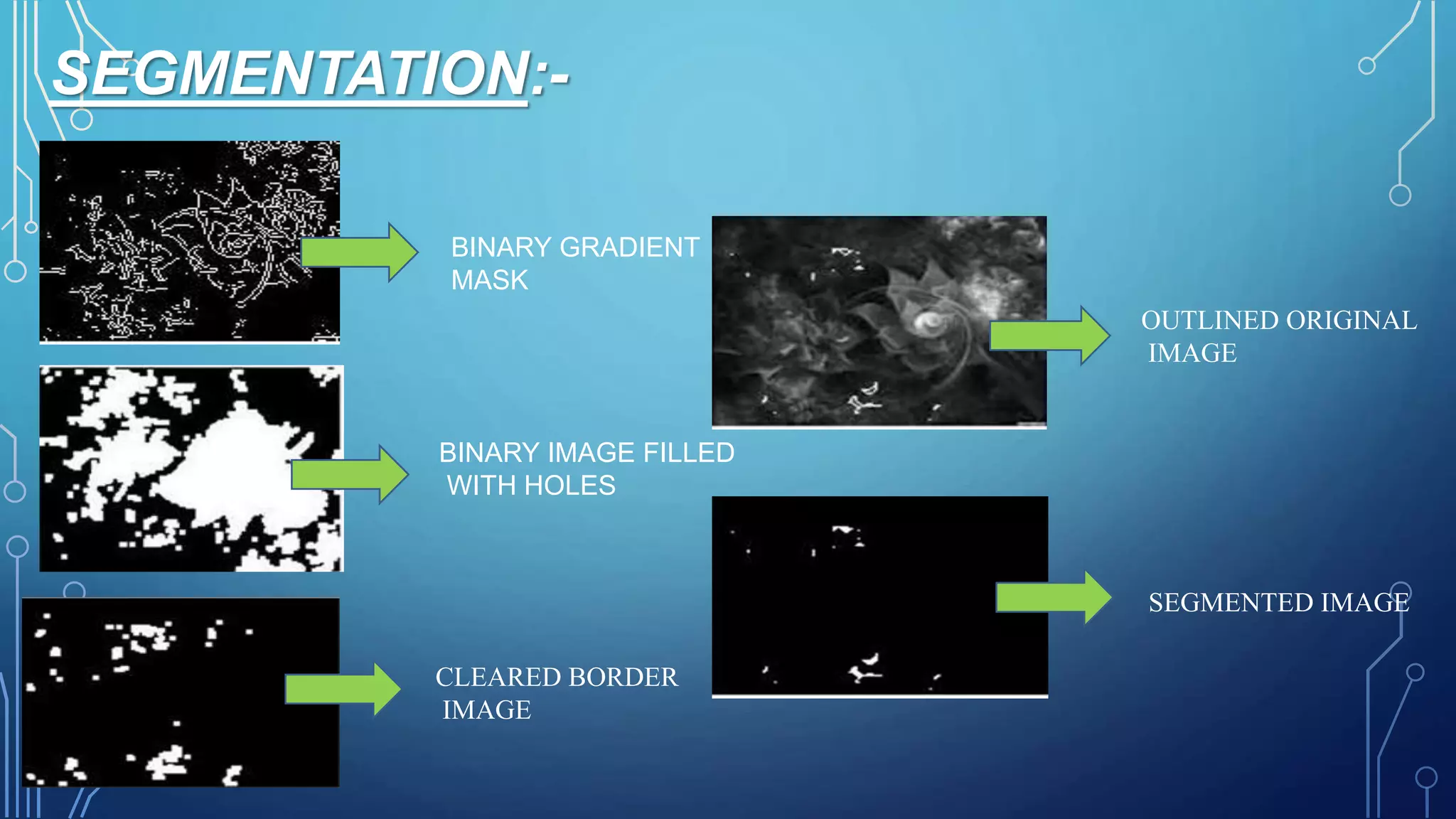
SEGMENTATION:-
process of partitioninga digital image into
multiple segments
Steps Involved:-
•Detect Entire Cell
•Fills Gaps
•Dilate the Images
•Fill Interior Gaps
•Remove Connected Objects on Border
•Smooth the Object
7.
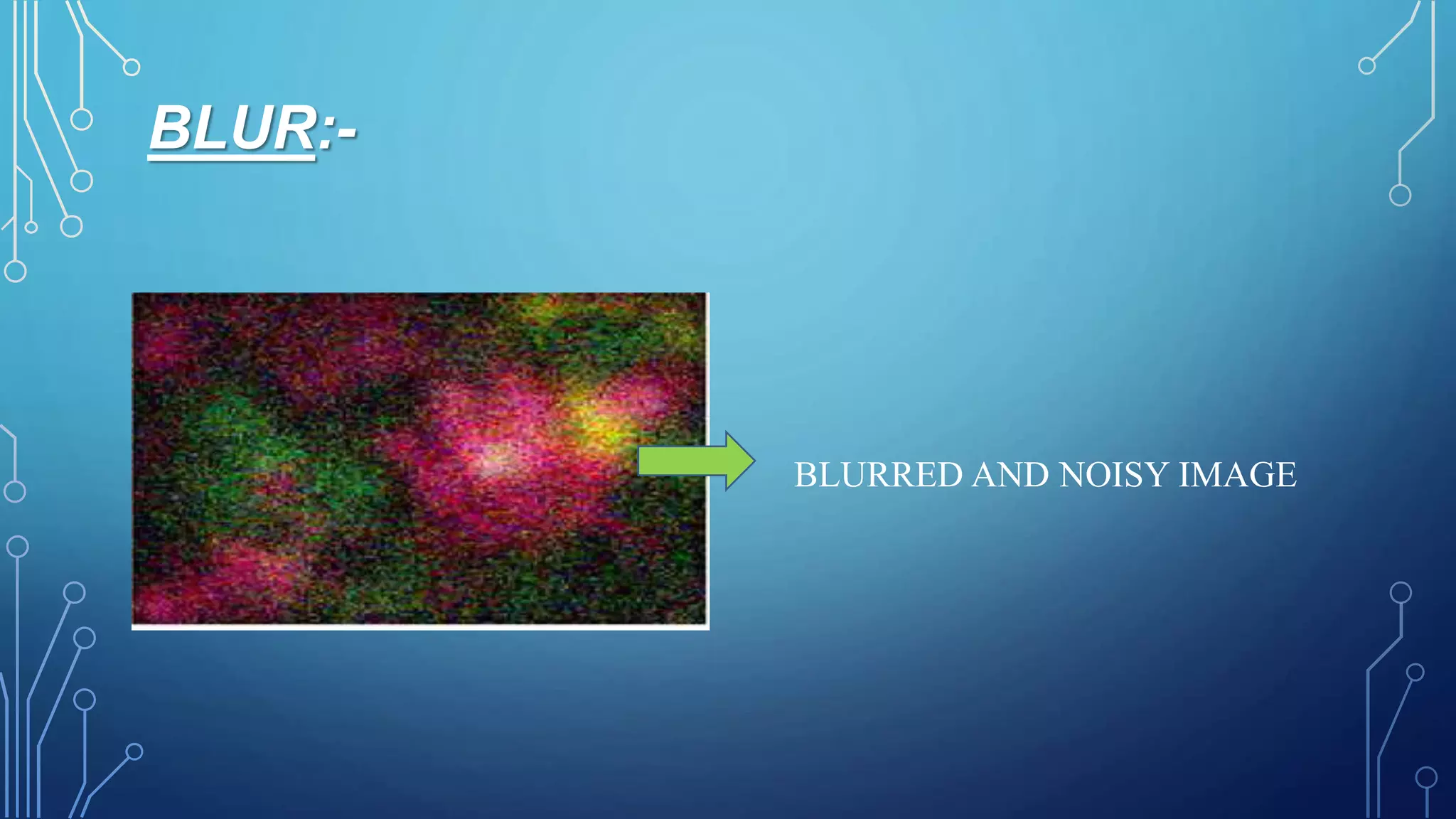
BLUR:-
Usually makes theimages unfocused.
BLUR DECONVOLUTION:-
Algorithm can be used effectively
when no information about the distortion.
8.
EXPERIMENT STUDY:-
Can beprocessed using software such as
C language Matrix- X, Visual Basic, Java program and
MATLAB programming.
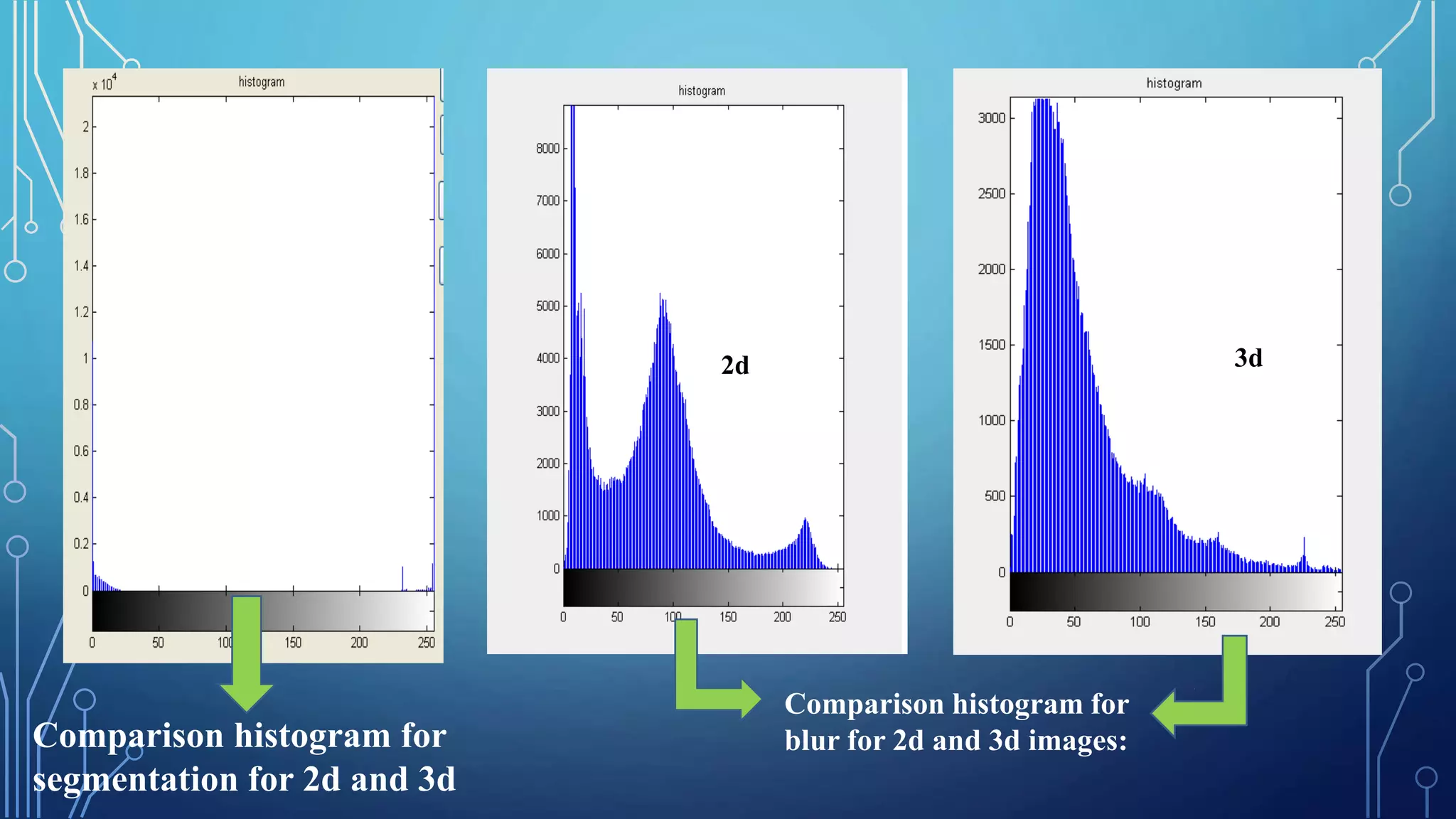
2d 3d
Comparison histogramfor
blur for 2d and 3d images:Comparison histogram for
segmentation for 2d and 3d
14.
CONCLUSION:-
•The presentation brieflyelaborates the image
process operations for 3D images.
•Previous works-in 2D images.
•Proposed work-3D images.
•The output Algorithms are compared.
•The software used is MATLAB
15.
REFERENCES:-
[1] ABDUL HALIMBIN BABA. image processing learning tool-edge detection
bachelor degree. university of technology malaysia 1996.
[2] FIONN MURTAGH. Image Processing data analysis. the multi-scale approach.
University of Ulster.
[3] Fundamentals of image processing,
hany.farid@dartmouth.edu .(http://www.cs.dartmouth.edu/~farid)

![REFERENCES:-
[1] ABDUL HALIM BIN BABA. image processing learning tool-edge detection
bachelor degree. university of technology malaysia 1996.
[2] FIONN MURTAGH. Image Processing data analysis. the multi-scale approach.
University of Ulster.
[3] Fundamentals of image processing,
hany.farid@dartmouth.edu .(http://www.cs.dartmouth.edu/~farid)](https://image.slidesharecdn.com/3dimageprocesssingoperations-161113102237/75/3-d-image-processsing-operations-15-2048.jpg)