IMAGE ENHANCEMENT
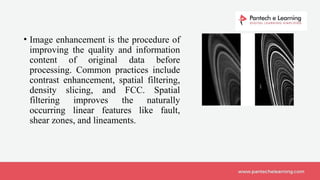
• Image enhancement is the procedure of
improving the quality and information
content of original data before
processing. Common practices include
contrast enhancement, spatial filtering,
density slicing, and FCC. Spatial
filtering improves the naturally
occurring linear features like fault,
shear zones, and lineaments.
IMAGE ENHANCEMENT
• Image enhancement refers to the process of improving the visual
appearance of an image to make it more suitable for analysis or
presentation. The goal is to highlight certain features, improve clarity,
and make the image more visually appealing. Image enhancement
techniques can be applied to various domains such as medical
imaging, satellite imagery, photography, and more.
EROSION AND DILATION
• Erosion is one of two fundamental operations in morphological image
processing from which all other morphological operations are based.
It was originally defined for binary images, later being extended to
grayscale images, and subsequently to complete lattices.
• Dilation expands the image pixels i.e. it is used for expanding an
element A by using structuring element B. Dilation adds pixels to
object boundaries. The value of the output pixel is the maximum
value of all the pixels in the neighborhood.
HISTOGRAM EQUALIZATION
• Histogram equalization is a technique used to enhance the contrast of
an image by redistributing the intensity levels. The basic idea is to
spread out the pixel values across the entire intensity range, making
the image more visually appealing. This method is particularly useful
when an image has a narrow intensity range, and details are not well
represented. Histogram equalization can be applied to grayscale
images as well as individual color channels in a color image.
CONTRAST STRETCHING
• Contrast stretching, also known as intensity scaling, involves
expanding the range of intensity values in an image. The process aims
to increase the difference between the darkest and brightest pixels,
thereby enhancing the overall contrast. This technique is particularly
useful when the original image has low contrast, making it difficult to
distinguish between different features.
SPATIAL DOMAIN METHODS
• Spatial domain methods involve directly manipulating the pixel values
of an image in its spatial domain (the actual space occupied by the
image). This can include operations such as filtering, smoothing,
sharpening, and edge detection. Spatial domain methods are applied
directly to the image matrix and are computationally efficient.
Image Transformations
• Image transformations refer to the process of altering the appearance
of an image. These alterations can include changes in size,
orientation, color, or other visual characteristics. Image
transformations play a crucial role in various fields such as graphic
design, computer vision, and digital image processing. They are used
to enhance or modify images for creative, analytical, or practical
purposes.
Types of Transformations
• Geometric Transformations:
Translation: Move image along x and y axes.
Rotation: Rotate image by a specified angle.
Scaling: Adjust image size (enlarge or shrink).
• Color Transformations:
Grayscale Conversion: Convert to black and white.
• Contrast Adjustment:
Modify light and dark differences.
Color Balance: Adjust color distribution.
Applications of Image
Transformations
• Graphic Design:
• Enhance visual appeal and creativity.
• Create artistic effects and unique designs.
• Computer Vision:
• Preprocess images for analysis and recognition.
• Aid in object recognition and image classification.
• Medical Imaging:
• Enhance image details for improved diagnostics.
• Assist in the processing of X-rays and MRI scans.
• Augmented Reality:
• Align virtual elements seamlessly with real-world scenes.
• Contribute to AR experiences, such as filters and virtual try-ons.
Algorithmic Applications on Images
• Algorithms in image processing are step-by-step procedures or sets of
rules for manipulating and analyzing images. These algorithms can
range from simple operations, like filtering, to complex processes,
such as image segmentation or object recognition. Algorithms play a
crucial role in automating tasks and extracting meaningful information
from images.
Examples of Algorithmic Applications
• Image Segmentation: This algorithmic application involves dividing an
image into segments or regions based on certain criteria, such as
color, intensity, or texture. It is commonly used in medical imaging to
identify and delineate specific structures or anomalies.
• Object Recognition: Algorithms for object recognition aim to identify
and classify objects within an image. Machine learning techniques,
such as convolutional neural networks (CNNs), are commonly
employed for this purpose, allowing systems to recognize and
categorize objects in real-world scenarios.
• Feature Extraction: Algorithms for feature extraction focus on
identifying and extracting relevant features from images. These
features could include edges, corners, or other distinctive patterns.
Feature extraction is essential for subsequent analysis or recognition
tasks.
• Image Registration: Image registration algorithms align different
images of the same scene or object, allowing for the comparison and
analysis of multiple images. This is often used in medical imaging or
remote sensing applications.
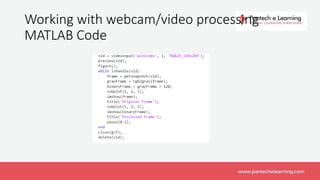
Working with webcam/video processing
MATLAB Code

image processing using matlab in faculty 1

  • 2.
  • 3.
    • Image enhancementis the procedure of improving the quality and information content of original data before processing. Common practices include contrast enhancement, spatial filtering, density slicing, and FCC. Spatial filtering improves the naturally occurring linear features like fault, shear zones, and lineaments.
  • 4.
    IMAGE ENHANCEMENT • Imageenhancement refers to the process of improving the visual appearance of an image to make it more suitable for analysis or presentation. The goal is to highlight certain features, improve clarity, and make the image more visually appealing. Image enhancement techniques can be applied to various domains such as medical imaging, satellite imagery, photography, and more.
  • 5.
    EROSION AND DILATION •Erosion is one of two fundamental operations in morphological image processing from which all other morphological operations are based. It was originally defined for binary images, later being extended to grayscale images, and subsequently to complete lattices. • Dilation expands the image pixels i.e. it is used for expanding an element A by using structuring element B. Dilation adds pixels to object boundaries. The value of the output pixel is the maximum value of all the pixels in the neighborhood.
  • 6.
    HISTOGRAM EQUALIZATION • Histogramequalization is a technique used to enhance the contrast of an image by redistributing the intensity levels. The basic idea is to spread out the pixel values across the entire intensity range, making the image more visually appealing. This method is particularly useful when an image has a narrow intensity range, and details are not well represented. Histogram equalization can be applied to grayscale images as well as individual color channels in a color image.
  • 7.
    CONTRAST STRETCHING • Contraststretching, also known as intensity scaling, involves expanding the range of intensity values in an image. The process aims to increase the difference between the darkest and brightest pixels, thereby enhancing the overall contrast. This technique is particularly useful when the original image has low contrast, making it difficult to distinguish between different features.
  • 8.
    SPATIAL DOMAIN METHODS •Spatial domain methods involve directly manipulating the pixel values of an image in its spatial domain (the actual space occupied by the image). This can include operations such as filtering, smoothing, sharpening, and edge detection. Spatial domain methods are applied directly to the image matrix and are computationally efficient.
  • 9.
    Image Transformations • Imagetransformations refer to the process of altering the appearance of an image. These alterations can include changes in size, orientation, color, or other visual characteristics. Image transformations play a crucial role in various fields such as graphic design, computer vision, and digital image processing. They are used to enhance or modify images for creative, analytical, or practical purposes.
  • 10.
    Types of Transformations •Geometric Transformations: Translation: Move image along x and y axes. Rotation: Rotate image by a specified angle. Scaling: Adjust image size (enlarge or shrink). • Color Transformations: Grayscale Conversion: Convert to black and white. • Contrast Adjustment: Modify light and dark differences. Color Balance: Adjust color distribution.
  • 11.
    Applications of Image Transformations •Graphic Design: • Enhance visual appeal and creativity. • Create artistic effects and unique designs. • Computer Vision: • Preprocess images for analysis and recognition. • Aid in object recognition and image classification. • Medical Imaging: • Enhance image details for improved diagnostics. • Assist in the processing of X-rays and MRI scans. • Augmented Reality: • Align virtual elements seamlessly with real-world scenes. • Contribute to AR experiences, such as filters and virtual try-ons.
  • 12.
    Algorithmic Applications onImages • Algorithms in image processing are step-by-step procedures or sets of rules for manipulating and analyzing images. These algorithms can range from simple operations, like filtering, to complex processes, such as image segmentation or object recognition. Algorithms play a crucial role in automating tasks and extracting meaningful information from images.
  • 13.
    Examples of AlgorithmicApplications • Image Segmentation: This algorithmic application involves dividing an image into segments or regions based on certain criteria, such as color, intensity, or texture. It is commonly used in medical imaging to identify and delineate specific structures or anomalies. • Object Recognition: Algorithms for object recognition aim to identify and classify objects within an image. Machine learning techniques, such as convolutional neural networks (CNNs), are commonly employed for this purpose, allowing systems to recognize and categorize objects in real-world scenarios.
  • 14.
    • Feature Extraction:Algorithms for feature extraction focus on identifying and extracting relevant features from images. These features could include edges, corners, or other distinctive patterns. Feature extraction is essential for subsequent analysis or recognition tasks. • Image Registration: Image registration algorithms align different images of the same scene or object, allowing for the comparison and analysis of multiple images. This is often used in medical imaging or remote sensing applications.
  • 15.
    Working with webcam/videoprocessing MATLAB Code