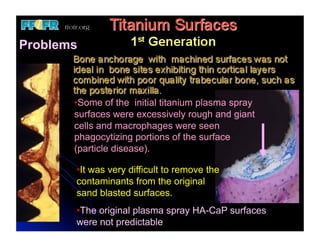
Problems


       •  ome of the initial titanium plasma spray
        S
       surfaces were excessively rough and giant
       cells and macrophages were seen
       phagocytizing portions of the surface
       (particle disease).

       • t was very difficult to remove the
        I
       contaminants from the original
       sand blasted surfaces.
       •  he original plasma spray HA-CaP surfaces
        T
       were not predictable
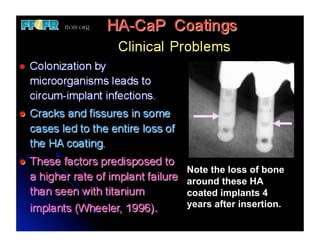
Note the loss of bone
around these HA
coated implants 4
years after insertion.
*Ichiro Nishimura DDS, PhD and Takahiro Ogawa DDS, PhD
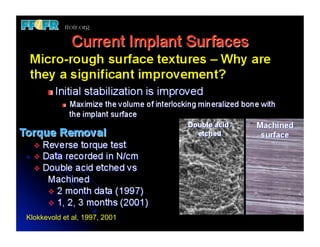
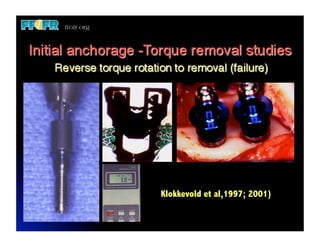
Klokkevold et al, 1997, 2001
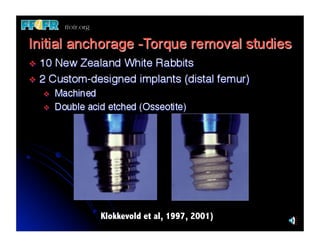
Klokkevold et al, 1997, 2001)
Klokkevold et al,1997; 2001)
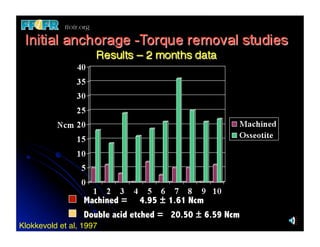
Machined =   4.95 ± 1.61 Ncm	

                  Double acid etched = 20.50 ± 6.59 Ncm
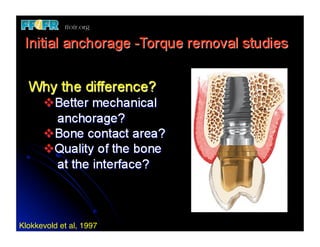
Klokkevold et al, 1997"
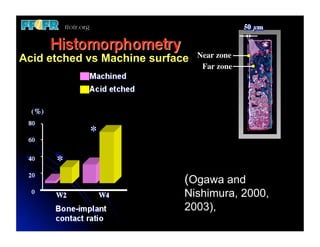
Acid etched vs Machine surface   Near zone	

                                  Far zone	


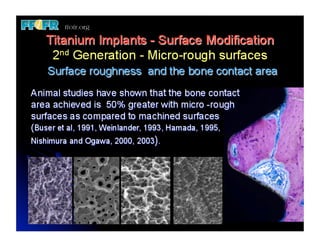
                             (Ogawa and
                             Nishimura, 2000,
                             2003),
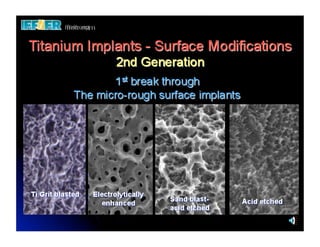
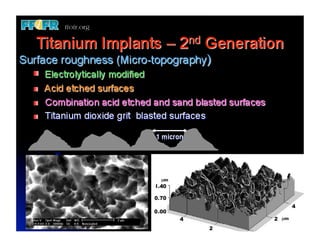
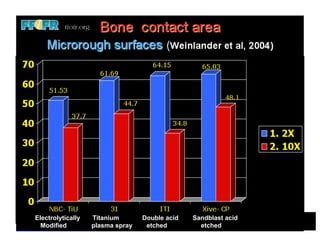
Electrolytically   Titanium       Double acid   Sandblast acid
  Modified         plasma spray    etched         etched
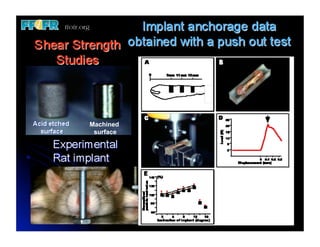
Machined
 surface
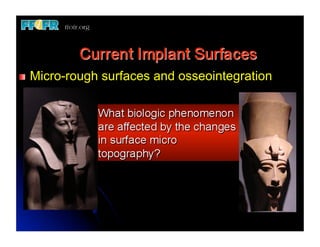
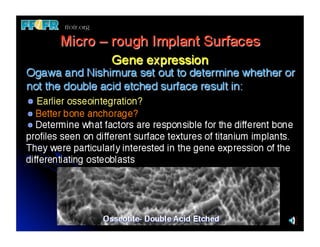
"   Micro-rough   surfaces and osseointegration
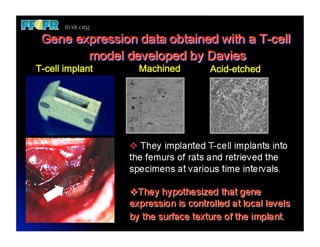
T-cell implant   Machined   Acid-etched
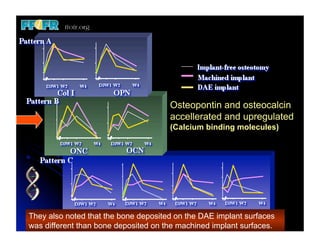
Osteopontin and osteocalcin
                                      accellerated and upregulated
                                      (Calcium binding molecules)


They also noted that the bone deposited on the DAE implant surfaces
was different than bone deposited on the machined implant surfaces.
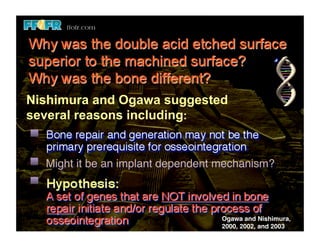
Nishimura and Ogawa suggested
several reasons including:


  Might it be an implant dependent mechanism?"


                                   Ogawa and Nishimura,
                                   2000, 2002, and 2003!
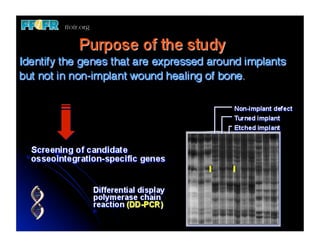
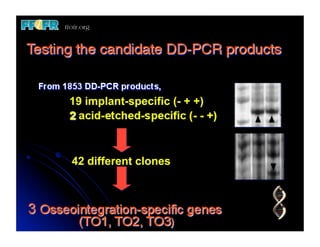
19 implant-specific (- + +)


42 different clones
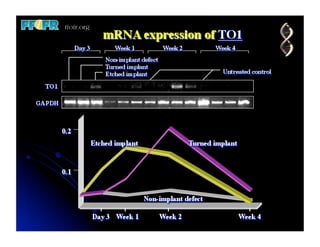
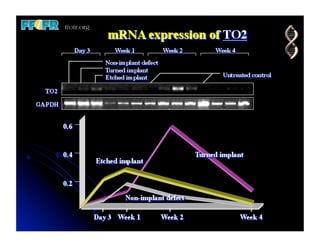
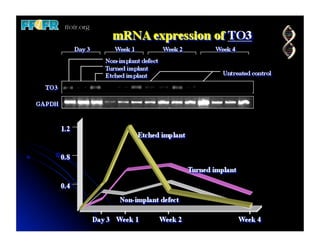
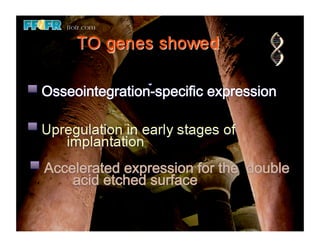
Osseointegration-specific expression


Accelerated expression for the double
    acid etched surface
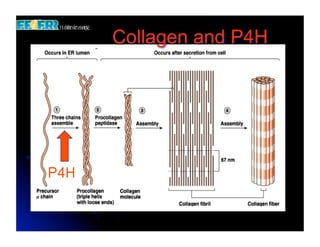
Collagen and P4H
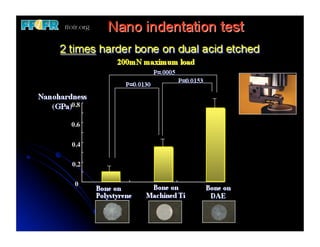
"   Collagendensity and orientation, as well as the
  degree of mineralization are contributing
  factors relative to the microhardness and elastic
  modulus of bone
0.2  	


0.1   	


 0
0.8  	

0.6  	

0.4   	

0.2   	

 0
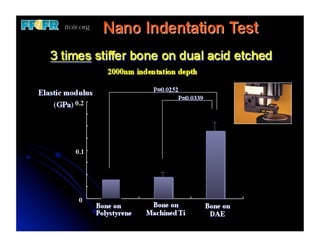
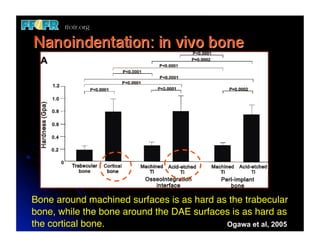
Bone around machined surfaces is as hard as the trabecular
bone, while the bone around the DAE surfaces is as hard as
the cortical bone. "                       Ogawa et al, 2005
Day 28	

                   Day 14	

                        7	

                   Day 21	

                        0	

                        3	


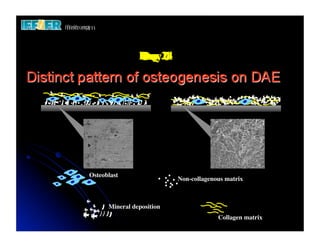
Osteoblast	

                                Non-collagenous matrix	


        Mineral deposition	

                                               Collagen matrix
Cortical
 bone
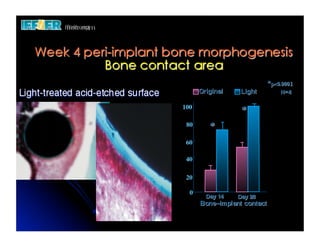
UV-treatment
50	

   50	


40	

   40	


30	

   30	


20	

   20	


10	

   10	


 0	

     0
100	


  80	


 60	


 40	


 20	


    0
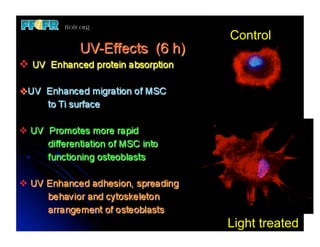
Control


Light treated
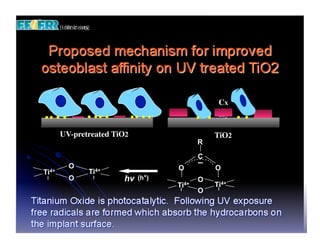
Cx
                                                  Hy	


       UV-pretreated TiO2	

                     TiO2	

                                             R

                                             C
         O                            O          O
Ti4+           Ti4+
         O                hv   (h+)          O
                                      Ti4+       Ti4+
                                             O
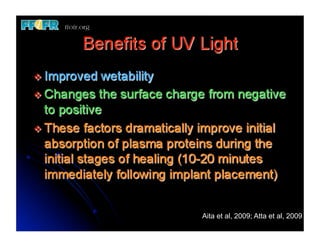
Aita et al, 2009; Atta et al, 2009
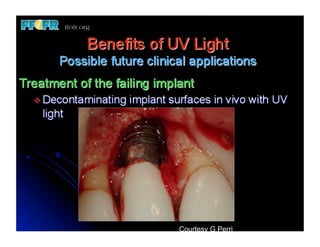
Courtesy G Perri
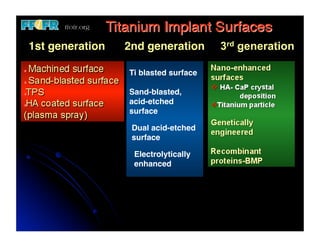
1st generation!   2nd generation!       3rd generation

                  Ti blasted surface!

                  Sand-blasted, !
                  acid-etched
                  surface!

                   Dual acid-etched !
                   surface!

                   Electrolytically
                   enhanced!
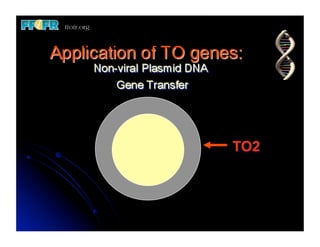
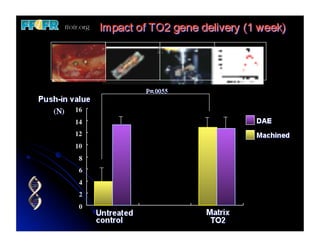
TO2
16	

14	

12	

10	

 8	

 6	

 4	

 2	

 0
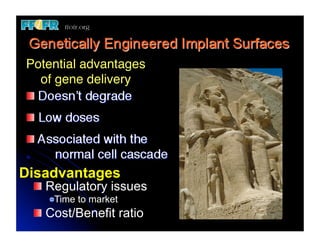
Potential advantages
  of gene delivery"


Disadvantages
 "  Regulatory issues
   "   ime to market
     T
 "  Cost/Benefit ratio
Schliephake et al, 2005
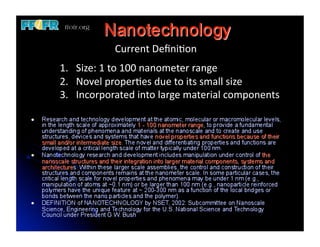
Current	
  Defini6on	
  
1.  Size:	
  1	
  to	
  100	
  nanometer	
  range	
  
2.  Novel	
  proper6es	
  due	
  to	
  its	
  small	
  size	
  
3.  Incorporated	
  into	
  large	
  material	
  components	
  
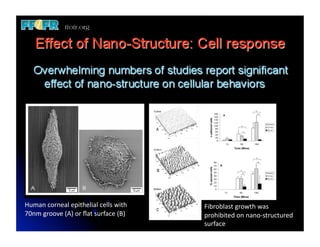
Human	
  corneal	
  epithelial	
  cells	
  with	
          Fibroblast	
  growth	
  was	
  
70nm	
  groove	
  (A)	
  or	
  flat	
  surface	
  (B)	
     prohibited	
  on	
  nano-­‐structured	
  
                                                           surface	
  
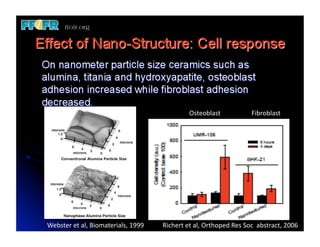
Osteoblast	
                      Fibroblast	


Webster	
  et	
  al,	
  Biomaterials,	
  1999	
     Richert	
  et	
  al,	
  Orthoped	
  Res	
  Soc	
  	
  abstract,	
  2006	
  
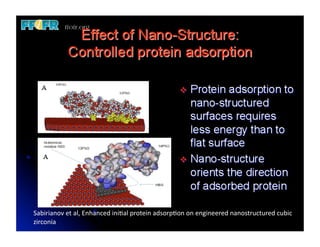
Sabirianov	
  et	
  al,	
  Enhanced	
  ini6al	
  protein	
  adsorp6on	
  on	
  engineered	
  nanostructured	
  cubic	
  
zirconia	
  	
  
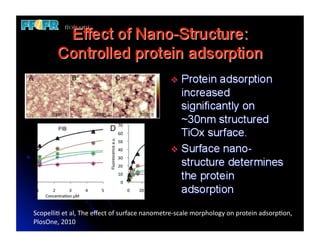
Scopelli6	
  et	
  al,	
  The	
  effect	
  of	
  surface	
  nanometre-­‐scale	
  morphology	
  on	
  protein	
  adsorp6on,	
  
PlosOne,	
  2010	
  	
  
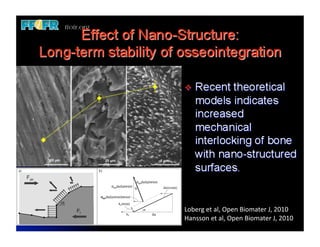
Loberg	
  et	
  al,	
  Open	
  Biomater	
  J,	
  2010	
  
Hansson	
  et	
  al,	
  Open	
  Biomater	
  J,	
  2010	
  
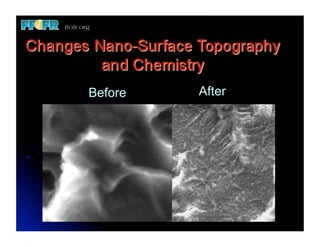
Before   After
Chemical Bonding?
Machined Ti
DAE Ti
DAE Ti-nanoHA
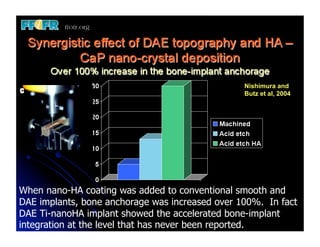
Shear strength at 2 wk

                         S=F/A [N/mm2]
Nishimura and
                                                 Butz et al, 2004


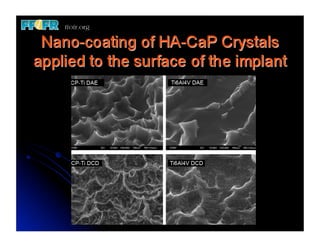
When nano-HA coating was added to conventional smooth and
DAE implants, bone anchorage was increased over 100%. In fact
DAE Ti-nanoHA implant showed the accelerated bone-implant
integration at the level that has never been reported.
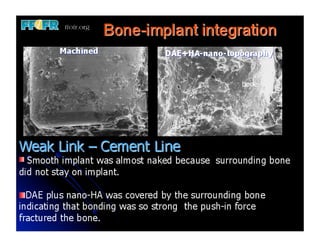
bone
bone
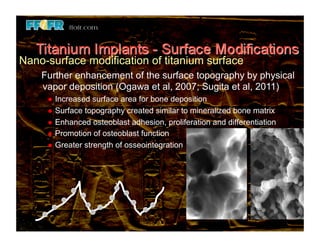
Nano-surface modification of titanium surface
    Further enhancement of the surface topography by physical
    vapor deposition (Ogawa et al, 2007; Sugita et al, 2011)
       Increased  surface area for bone deposition
       Surface topography created similar to mineralized bone matrix
       Enhanced osteoblast adhesion, proliferation and differentiation
       Promotion of osteoblast function
       Greater strength of osseointegration
Sugita et al, 2011
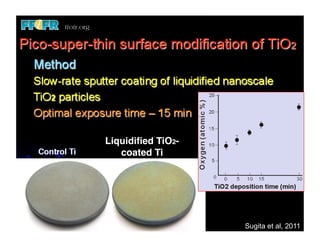
Liquidified TiO2-
   coated Ti!


                   Sugita et al, 2011
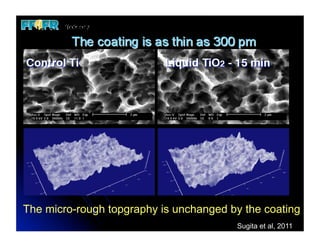
No surface topography change before and after


The micro-rough topgraphy is unchanged by the coating
                                        Sugita et al, 2011
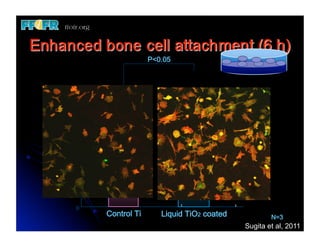
P<0.05


WST-1/cell


    0.2	


    0.1	


       0 	

   Control Ti      Liquid TiO2 coated           N=3
                                                    Sugita et al, 2011
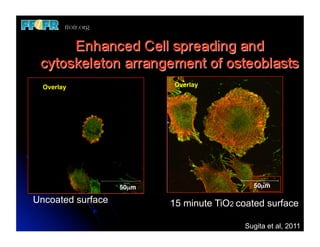
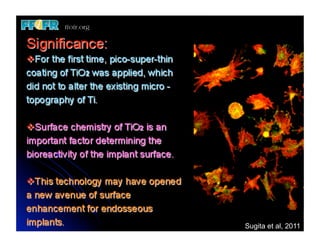
Expedited and enhanced
      cellular settlement and spread
             Control Ti!                 Liquid TiO2 coated!
  Overlay!                          Overlay! min!
                                          15


                           50µm!                          50µm!

Uncoated surface                   15 minute TiO2 coated surface

                                                       Sugita et al, 2011
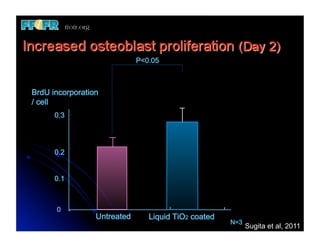
P<0.05


BrdU incorporation
/ cell
      0.3


      0.2


      0.1


      0
                 Untreated      Liquid TiO2 coated
                                                     N=3
                                                           Sugita et al, 2011
P<0.05


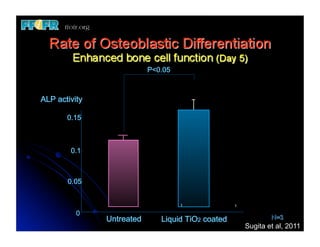
ALP activity

       0.15


        0.1


       0.05


          0
               Untreated      Liquid TiO2 coated
                                                   Sugita et al, 2011
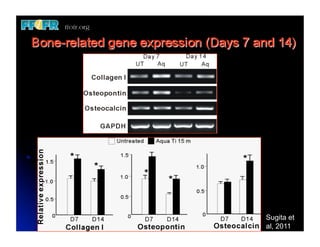
Sugita et
al, 2011
Sugita et al, 2011
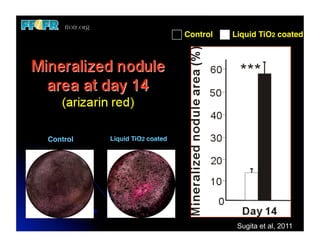
Control!   Liquid TiO2 coated!


Control!   Liquid TiO2 coated!


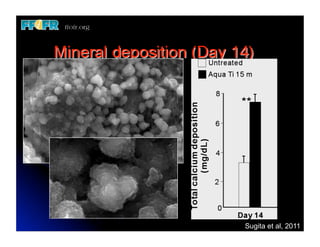
                                             Sugita et al, 2011
Sugita et al, 2011
"   The biologic events leading to
    osseointegration have been accelerated
"   Better bone anchorage
Can we use shorter implants?
2.recent advances in implant surface science

2.recent advances in implant surface science

  • 3.
    Problems •  ome of the initial titanium plasma spray S surfaces were excessively rough and giant cells and macrophages were seen phagocytizing portions of the surface (particle disease). • t was very difficult to remove the I contaminants from the original sand blasted surfaces. •  he original plasma spray HA-CaP surfaces T were not predictable
  • 7.
    Note the lossof bone around these HA coated implants 4 years after insertion.
  • 12.
    *Ichiro Nishimura DDS,PhD and Takahiro Ogawa DDS, PhD
  • 16.
  • 17.
    Klokkevold et al,1997, 2001)
  • 18.
  • 19.
    Machined = 4.95 ± 1.61 Ncm Double acid etched = 20.50 ± 6.59 Ncm Klokkevold et al, 1997"
  • 20.
  • 22.
    Acid etched vsMachine surface Near zone Far zone (Ogawa and Nishimura, 2000, 2003),
  • 23.
    Electrolytically Titanium Double acid Sandblast acid Modified plasma spray etched etched
  • 24.
  • 26.
    "   Micro-rough surfaces and osseointegration
  • 32.
    T-cell implant Machined Acid-etched
  • 33.
    Osteopontin and osteocalcin accellerated and upregulated (Calcium binding molecules) They also noted that the bone deposited on the DAE implant surfaces was different than bone deposited on the machined implant surfaces.
  • 34.
    Nishimura and Ogawasuggested several reasons including: Might it be an implant dependent mechanism?" Ogawa and Nishimura, 2000, 2002, and 2003!
  • 36.
    19 implant-specific (-+ +) 42 different clones
  • 40.
  • 42.
  • 43.
    "   Collagendensityand orientation, as well as the degree of mineralization are contributing factors relative to the microhardness and elastic modulus of bone
  • 45.
  • 46.
    0.8 0.6 0.4 0.2 0
  • 47.
    Bone around machinedsurfaces is as hard as the trabecular bone, while the bone around the DAE surfaces is as hard as the cortical bone. " Ogawa et al, 2005
  • 48.
    Day 28 Day 14 7 Day 21 0 3 Osteoblast Non-collagenous matrix Mineral deposition Collagen matrix
  • 51.
  • 55.
  • 57.
    50 50 40 40 30 30 20 20 10 10 0 0
  • 58.
    100 80 60 40 20 0
  • 59.
  • 60.
    Cx Hy UV-pretreated TiO2 TiO2 R C O O O Ti4+ Ti4+ O hv (h+) O Ti4+ Ti4+ O
  • 61.
    Aita et al,2009; Atta et al, 2009
  • 62.
  • 63.
    1st generation! 2nd generation! 3rd generation Ti blasted surface! Sand-blasted, ! acid-etched surface! Dual acid-etched ! surface! Electrolytically enhanced!
  • 65.
  • 66.
  • 67.
    Potential advantages of gene delivery" Disadvantages "  Regulatory issues "   ime to market T "  Cost/Benefit ratio
  • 68.
  • 70.
    Current  Defini6on   1. Size:  1  to  100  nanometer  range   2.  Novel  proper6es  due  to  its  small  size   3.  Incorporated  into  large  material  components  
  • 71.
    Human  corneal  epithelial  cells  with   Fibroblast  growth  was   70nm  groove  (A)  or  flat  surface  (B)   prohibited  on  nano-­‐structured   surface  
  • 72.
    Osteoblast   Fibroblast   Webster  et  al,  Biomaterials,  1999   Richert  et  al,  Orthoped  Res  Soc    abstract,  2006  
  • 73.
    Sabirianov  et  al,  Enhanced  ini6al  protein  adsorp6on  on  engineered  nanostructured  cubic   zirconia    
  • 74.
    Scopelli6  et  al,  The  effect  of  surface  nanometre-­‐scale  morphology  on  protein  adsorp6on,   PlosOne,  2010    
  • 75.
    Loberg  et  al,  Open  Biomater  J,  2010   Hansson  et  al,  Open  Biomater  J,  2010  
  • 78.
    Before After
  • 80.
    Chemical Bonding? Machined Ti DAETi DAE Ti-nanoHA Shear strength at 2 wk S=F/A [N/mm2]
  • 81.
    Nishimura and Butz et al, 2004 When nano-HA coating was added to conventional smooth and DAE implants, bone anchorage was increased over 100%. In fact DAE Ti-nanoHA implant showed the accelerated bone-implant integration at the level that has never been reported.
  • 82.
  • 83.
  • 85.
    Nano-surface modification oftitanium surface Further enhancement of the surface topography by physical vapor deposition (Ogawa et al, 2007; Sugita et al, 2011)   Increased surface area for bone deposition   Surface topography created similar to mineralized bone matrix   Enhanced osteoblast adhesion, proliferation and differentiation   Promotion of osteoblast function   Greater strength of osseointegration
  • 86.
  • 87.
    Liquidified TiO2- coated Ti! Sugita et al, 2011
  • 88.
    No surface topographychange before and after The micro-rough topgraphy is unchanged by the coating Sugita et al, 2011
  • 90.
    P<0.05 WST-1/cell 0.2 0.1 0 Control Ti Liquid TiO2 coated N=3 Sugita et al, 2011
  • 91.
    Expedited and enhanced cellular settlement and spread Control Ti! Liquid TiO2 coated! Overlay! Overlay! min! 15 50µm! 50µm! Uncoated surface 15 minute TiO2 coated surface Sugita et al, 2011
  • 92.
    P<0.05 BrdU incorporation / cell 0.3 0.2 0.1 0 Untreated Liquid TiO2 coated N=3 Sugita et al, 2011
  • 93.
    P<0.05 ALP activity 0.15 0.1 0.05 0 Untreated Liquid TiO2 coated Sugita et al, 2011
  • 94.
  • 95.
  • 96.
    Control! Liquid TiO2 coated! Control! Liquid TiO2 coated! Sugita et al, 2011
  • 97.
  • 98.
    "   Thebiologic events leading to osseointegration have been accelerated "   Better bone anchorage
  • 99.
    Can we useshorter implants?