
Download to read offline
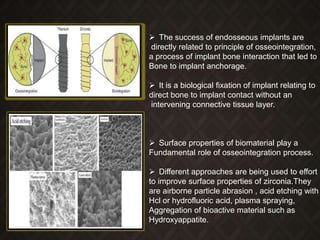
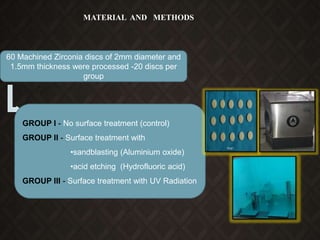
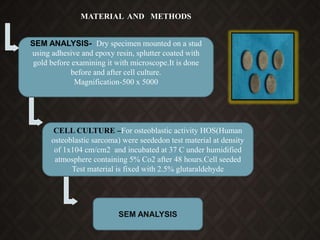
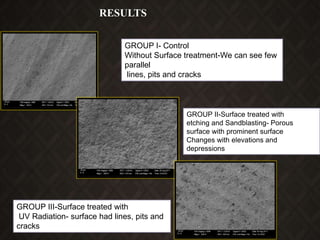
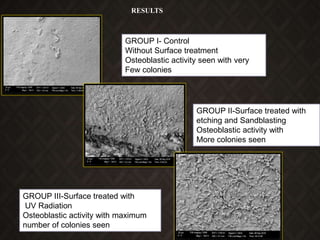

This document discusses a study evaluating osteoblastic activity on zirconia discs with different surface treatments. It is divided into three groups: Group I (no surface treatment), Group II (sandblasting and acid etching), and Group III (UV radiation). SEM analysis found Group I had few parallel lines and pits/cracks, Group II had a porous surface with prominent changes, and Group III had lines/pits/cracks. Results showed Group I had few osteoblastic cell colonies, Group II had more colonies, and Group III had the maximum number of colonies. The conclusion was that UV photofunctionalization (Group III) promoted the best osteoblast adhesion and activity compared to the other groups.


