NANOSECOND FIBER LASER MICRO-TEXTURING OF TITANIUM SURFACE FOR
BIOMEDICAL APPLICATIONS
M502
Habib Abou Saleh
#1
, Ehsan Toyserkani
*2
, Fathy Ismail
#3
#1*2#3
Department of Mechanical and Mechatronics Engineering, University of Waterloo
200 University Avenue West, Waterloo, N2L 3G1, Ontario, Canada
#1
habousal@uwaterloo.ca
*2
etoyserk@uwaterloo.ca
#3
fmismail@mecheng1.uwaterloo.ca
Abstract
This paper investigates the feasibility of generating
micro-self-assembled structures on pure titanium
using a nanosecond Ytterbium fiber laser. The effect
of process parameters, including laser frequency,
power, processing speed and spot size, on the
induction of the micro-self-assembled structures is
investigated. Scanning Electron Microscope (SEM)
and Profilometry analyses are carried out to
demonstrate the size, shape, and roughness of the
generated micro-structures. Analysis of the
experimental results suggests that the generation of
self-assembled structures with a desired roughness is
viable. It is also observed that the laser spot size can
potentially control the local surface roughness when
the other process parameters are fixed.
Keywords - Laser micro-texturing, Ytterbium fiber
laser, Micro-self-assembled structures.
Introduction
The understanding of surface modification of
materials with laser beams along with the
investigation of the underlying principles of laser
radiation interaction with the ablated surfaces are
essential to realize industrial and medical
applications of laser beams [1, 2]. Laser surface
modification of titanium and its alloys are of great
interest [1, 2, 3]. Titanium has been widely used in
biomedical applications due to its bio-stability,
biocompatibility, light weight, high mechanical
strength and long term durability [1, 2, 3]. Surface
topography has a great influence on the implant
performance during in vivo and in vitro studies [1, 3].
The micro structures generated at the surface of
titanium influence the biological processes at the
implant interface after the interaction with the
biological environment [1, 3]. To generate desired
microstructures on the surface of titanium, several
methods have been employed and studied such as
grit-blasting, chemical etching, titanium plasma
spray, electrochemical treatment as well as
combinations of these methods [1, 3]. These methods
generate microstructures with different irregular
patterns, with varying forms and diameters of
structural elements [4]. Osteoinductive qualities and
mechanical stability is determined by the degree of
contamination of the titanium surface. Considerable
amounts of contamination with numerous foreign
elements were found on the processed surfaces using
the above methods [4]. Such surfaces can lead to scar
tissue formation due to the development of random
bone cell orientations and an increase in cytotoxic
concentration elements at the implant surface which
will lead eventually to biological rejection of the
implant, and thus implant failure [1]. Recent studies
have shown that laser processing of implanted
surfaces are of a great importance since they provide
uniformly distributed surface topography with
uniform patterns and less surface contamination
when compared with other methods [3, 4].
Microstructures have been produced using long-pulse
lasers, including nanosecond Nd:YAG laser, copper
vapor laser, nanosecond excimer lasers, picosecond
Nd:YAG laser, and sub-picosecond excimer laser [2,
3, 5, 6, 7, 8, 9]. The laser patterned surfaces were
found suitable for cell adhesion, proliferation and
spreading, but none of the studies have dealt with
generating self-assembled micro-patterns using
nanosecond Ytterbium fiber laser, and its interaction
with Titanium surfaces.
In this paper, the feasibility of generating self-
assembled structures on pure titanium samples using
a nanosecond Ytterbium fiber laser is investigated.
Titanium samples were laser irradiated at different
laser process parameters which include laser
frequency, laser power, interaction time and spot
size. The process parameters that result in the local
surface roughness ranging from 0.9 to 2 µm (which is
suitable for osteoblasts tissue integration) are
revealed and the deviation of surface roughness vs.
laser spot size is explained.
Materials and Fabrication Procedures
Titanium Samples Preparation
Titanium specimens, 12mm x 10mm x 10mm were
cut from titanium plates. The specimens were cast
into a baked sample casting using Phenolic powder.
After casting, the samples were ground using silicon
carbide (SiC) papers. SiC papers of number 320, 400,
600, and 1200 were used with an average grain size
of 32 μm, 22 μm, 15 μm, 5 μm, respectively for fine
grinding. Specimens were cleaned with water and
alcohol and dried out after the use of each SiC paper
to eliminate any residuals on the surface of the
specimens.
Laser Workstation
The titanium specimens were irradiated by
nanosecond Ytterbium fiber laser (YLR-1/100/20/20,
IPG Photonics, MA, USA), generating a laser beam
wavelength of 1062 nm with pulse duration of 100
ns, pulse energy of 1 mJ, and maximum power of 24
watts. A NIR 10X laser head lens (Edmund Optics,
USA) with a focal length of 20 mm was used to focus
the laser beam. The focal spot size was estimated at
4.5 microns. The specimens were mounted on the
controlled X-Y translational stages, Heavy Load,
High Torque Stages # 55-788 by (Edmund Optics,
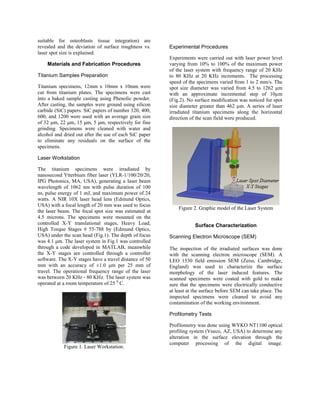
USA) under the scan head (Fig.1). The depth of focus
was 4.1 μm. The laser system in Fig.1 was controlled
through a code developed in MATLAB, meanwhile
the X-Y stages are controlled through a controller
software. The X-Y stages have a travel distance of 50
mm with an accuracy of ±1.0 μm per 25 mm of
travel. The operational frequency range of the laser
was between 20 KHz - 80 KHz. The laser system was
operated at a room temperature of 25 0
C.
Figure 1. Laser Workstation.
Experimental Procedures
Experiments were carried out with laser power level
varying from 10% to 100% of the maximum power
of the laser system with frequency range of 20 KHz
to 80 KHz at 20 KHz increments. The processing
speed of the specimens varied from 1 to 2 mm/s. The
spot size diameter was varied from 4.5 to 1262 µm
with an approximate incremental step of 10µm
(Fig.2). No surface modification was noticed for spot
size diameter greater than 462 µm. A series of laser
irradiated titanium specimens along the horizontal
direction of the scan field were produced.
Figure 2. Graphic model of the Laser System
Surface Characterization
Scanning Electron Microscope (SEM)
The inspection of the irradiated surfaces was done
with the scanning electron microscope (SEM). A
LEO 1530 field emission SEM (Zeiss, Cambridge,
England) was used to characterize the surface
morphology of the laser induced features. The
scanned specimens were coated with gold to make
sure that the specimens were electrically conductive
at least at the surface before SEM can take place. The
inspected specimens were cleaned to avoid any
contamination of the working environment.
Profilometry Tests
Profilometry was done using WYKO NT1100 optical
profiling system (Veeco, AZ, USA) to determine any
alteration in the surface elevation through the
computer processing of the digital image.
(a) (b)
(c) (d)
(e)
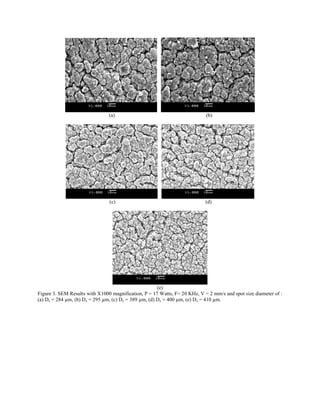
Figure 3. SEM Results with X1000 magnification, P = 17 Watts, F= 20 KHz, V = 2 mm/s and spot size diameter of :
(a) Dz = 284 µm, (b) Dz = 295 µm, (c) Dz = 389 µm, (d) Dz = 400 µm, (e) Dz = 410 µm.
Figure 4. Profilometry Result of one specimen (# 4), at P = 17 Watts, F = 20 KHz, V = 2 mm/s, Dz = 400 µm.
Results and Discussion
The goal of this study was to investigate the
feasibility of producing microstructures with surface
roughness ranging from 1 µm to 2 µm which
enhances osteoblasts tissue integration. Laser
irradiated zones produced at a processing speed of 2
mm/s with laser power of 17 Watts, frequency of 20
KHz, and spot size diameter of 284 µm, 295 µm, 389
µm, 400 µm, and 410 µm were selected for detailed
visual and surface metrological characterization using
SEM and profilometry tests. It should be noted that
numerous experiments were conducted; however, the
abovementioned parameters have resulted in the
generation of microstructures with the desired surface
roughness for the specific application. Table 1 lists
surface roughness parameters including the average
roughness, Rl and root mean square Rq, which are
calculated over the measured array, Furthermore, the
value of the peak-to-valley was measured and found
to be between 10 to 16 µm. The surface roughness
parameters were obtained by selecting a subregion of
dimension of 75 µm x 75 µm of the entire measured
array. Furthermore, the corresponding values for the
effective energy are listed in the table. The effective
energy (Ep) is calculated as:
Where, E is the laser pulse energy (J); F is laser
frequency (Hz); V is the laser processing speed (m/s);
and D is the spot size diameter (m).
Fig. 3 shows SEM images at different process
parameters. As seen, the size of the self-assembled
structures (grains) reduces when the spot size
increases. The profilometry result is shown in Fig. 4.
The figure also shows the extreme peak-to-valley
value in the measured array.
Table1. Specimens Surface Roughness Parameters
Specimens Spot Size Ep Rl Rq
1 284 µm 3.52x10⁷
1.68 µm 2.25µm
2 295 µm 3.38x10⁷
1.32 µm 1.72µm
3 389 µm 2.57x10⁷
1.33 µm 1.73µm
4 400 µm 2.50x10⁷
0.926µm 1.23µm
5 410 µm 2.44x10⁷
0.957µm 1.27µm
The generated surface parameters Rl and Rt can be
used to study the effect of surface roughness on the
cell integration and adhesion. It has been reported
that the osteoblasts tissue integration is favoured with
surface roughness ≤ 2 µm, and features depth
between 8 µm to 12 µm [1, 7, 10, 11, 12, 13, 14, 15,
16]. According to Ball et al. 2005 [16], osteoblasts
tissue integration is favoured with microstructures of
micron scale topography. In his study,
osteointegration was noticed on titanium surfaces
with surface roughness ranging from 0.05 µm to 1.75
µm. According to our results, osteoblasts tissue
integration would occur with our generated
microstructures which have a local surface roughness
range approximately between 1 µm to 2 µm. As a
result, nanosecond Ytterbium fiber laser for titanium
micro-texturing is well suited for micron scale
topographical surface modifications to influence and
increase osteointegration of bone contacting devices.
Surface roughness was found to be inversely
proportional to the spot size diameter of the laser
beam. A decrease in the surface roughness and
surface grain size was noticed at the same time with
the increase in the spot size of the laser beam which
also coincided with decrease in the laser effective
energy. As a future work, we will analyse the role of
wide range of the process parameters on the top
viewed features size of micro self-assembled
structures.
Conclusion
Nanosecond Ytterbium fiber laser micro-texturing of
titanium specimens was investigated in this paper In
conclusion:
1- Nanosecond Ytterbium fiber laser has the
potential to be used for generating self-
assembled micro-structures.
2- The roughness ranging from 1 µm to 2 µm
was produced at a processing speed of 2
mm/s with 17 Watts laser power, frequency
of 20 KHz, and spot size diameter of
approximately 284 µm, 295 µm, 389 µm,
400 µm, and 410 µm.
3- A decrease in the surface roughness was
identified with an increase in the spot
diameter of the laser beam.
Acknowledgments
The authors would like to acknowledge technical
help of Negar Rasti and Hamidreza Alemohammad.
The authors also acknowledge the financial support
provided by NSERC.
References
[1] Mwenifumbo Steven, Li Mingwei, Chen Jianbo,
Beye Aboubaker, Soboyejo Wol´e, “Cell/surface
interactions on laser micro-textured titanium-
coatedsilicon surfaces”, J Mater Sci: Mater Med
(2007) 18:9–23.
[2] Trtica M.S., Radak B.B., Gakovic B.M.,
Milovanovic D.S., Batani D., Desai T., “Surface
modifications of Ti6Al4V by a picoseconds Nd:YAG
laser”, Laser and Particle Beams, 2009, 27, pp 85–90.
[3] Vorobyev A.Y., Guo Chunlei, “Femtosecond
laser structuring of titanium implants”, Applied
Surface Science 253, 2007, pp 7272-7280.
[4] Gaggl A., Schultes G., MuKller W.D., KaKrcher
H., “Scanning electron microscopical analysis of
laser-treated titanium implant surfaces*a comparative
study”, Biomaterials 21, 2000, pp: 1067 - 1073
[5] Tian Y.S, Chen C.Z, Li S.T. , Huo Q.H,
“Research progress on laser surface modification of
titanium alloys” . Appl. Surf. Sci. 2005, 242, pp 177–
184.
[6] Tritca M., Gakovic B. Batani D. Desai T., Panjan
P. Radak B. “ Surface modifications of a titanium
implant by a picosecond Nd:YAG laser operating at
1064 and 532 nm” , Appl. Surf. Sci. 2006, 253, pp
2551–2556.
[7] Mirhosseini N., Crouse P.L., Schmidth M.J.J., Li
L. Garrod D., “Laser surface micro-texturing of Ti–
6Al–4V substrates for improved cell integration”,
Appl. Surf. Sci. 2007, 253, pp 7738–7743
[8] Khosroshahi M.E, Magmoodi M. Tavakoli J. “
Characterization of Ti6Al4V implant surface treated
by Nd:YAG laser and emery paper for orthopaedic
applications”, Appl. Surf. Sci. 2007, 253, pp 8772–
8781.
[9] Zelinski A., Jazdzewska M., Narozniak-Luksza
A., Serbinski W., “Surface structure and properties of
Ti6A4V alloy laser melted at cryogenic conditions",
J. Achiev. Mat. Manufact. Engin. 2006, 18, pp 423–
426.
[10] Lloyd Robert, Abdolvand Amin, Schmidt Marc,
Crouse Philips, Whitehead David, Liu Zhu, and Li
Lin, “Laser Assisted Generation of Self-assembled
Microstructures on Stainless Steel” , Applied Physics
A: Materials Science & Processing, 2008, Volume
93, Number 1, pp 117-122.
[11] Bacakova L., Filova E., Rypacek F., Svorcik V.,
“Cell Adhesion on Artificial Materials for Tissue
Engineering”, Physiological Research, 2004, ISSN
0862-8408, Volume 53, pp 35-45.
[12] Gerald M. Edelman, “Cell Adhesion and the
Molecular Process of Morphogenesis”, Ann. Rev.
Biochem. 1985.54:135-169.
[13] L. Marcotte a,b, M. Tabrizian, “General review:
Sensing surfaces: Challenges in studying the cell
adhesion process and the cell adhesion forces on
biomaterials”, ScienceDirect, 2008, ITBM-RBM 29,
pp 77–88.
[14] Kurella Anil, Dahotre Narendra B., “Review
paper: Surface Modification for Bioimplants: The
Role of Laser Surface Engineering”, J Biomater Appl
2005; 20; 5, pp 4 – 50.
[15] Lincks J, Boyan BD, Blanchard CR, et al.
Response of MG63 osteoblast-like cells to titanium
and titanium alloy is dependent on surface roughness
and composition. Biomaterials 1998; 19(23), pp:
2219 - 2232
[16] Ball Michael, Grant David M., Lo Wei-Jen,
Scotchford Colin A., “The effect of different surface
morphology and roughness on osteoblast-like cells”,
Wiley InterScience, 2005, pp 637 – 647.

ICALEO-2009-Habib Abou Saleh-ET

  • 1.
    NANOSECOND FIBER LASERMICRO-TEXTURING OF TITANIUM SURFACE FOR BIOMEDICAL APPLICATIONS M502 Habib Abou Saleh #1 , Ehsan Toyserkani *2 , Fathy Ismail #3 #1*2#3 Department of Mechanical and Mechatronics Engineering, University of Waterloo 200 University Avenue West, Waterloo, N2L 3G1, Ontario, Canada #1 habousal@uwaterloo.ca *2 etoyserk@uwaterloo.ca #3 fmismail@mecheng1.uwaterloo.ca Abstract This paper investigates the feasibility of generating micro-self-assembled structures on pure titanium using a nanosecond Ytterbium fiber laser. The effect of process parameters, including laser frequency, power, processing speed and spot size, on the induction of the micro-self-assembled structures is investigated. Scanning Electron Microscope (SEM) and Profilometry analyses are carried out to demonstrate the size, shape, and roughness of the generated micro-structures. Analysis of the experimental results suggests that the generation of self-assembled structures with a desired roughness is viable. It is also observed that the laser spot size can potentially control the local surface roughness when the other process parameters are fixed. Keywords - Laser micro-texturing, Ytterbium fiber laser, Micro-self-assembled structures. Introduction The understanding of surface modification of materials with laser beams along with the investigation of the underlying principles of laser radiation interaction with the ablated surfaces are essential to realize industrial and medical applications of laser beams [1, 2]. Laser surface modification of titanium and its alloys are of great interest [1, 2, 3]. Titanium has been widely used in biomedical applications due to its bio-stability, biocompatibility, light weight, high mechanical strength and long term durability [1, 2, 3]. Surface topography has a great influence on the implant performance during in vivo and in vitro studies [1, 3]. The micro structures generated at the surface of titanium influence the biological processes at the implant interface after the interaction with the biological environment [1, 3]. To generate desired microstructures on the surface of titanium, several methods have been employed and studied such as grit-blasting, chemical etching, titanium plasma spray, electrochemical treatment as well as combinations of these methods [1, 3]. These methods generate microstructures with different irregular patterns, with varying forms and diameters of structural elements [4]. Osteoinductive qualities and mechanical stability is determined by the degree of contamination of the titanium surface. Considerable amounts of contamination with numerous foreign elements were found on the processed surfaces using the above methods [4]. Such surfaces can lead to scar tissue formation due to the development of random bone cell orientations and an increase in cytotoxic concentration elements at the implant surface which will lead eventually to biological rejection of the implant, and thus implant failure [1]. Recent studies have shown that laser processing of implanted surfaces are of a great importance since they provide uniformly distributed surface topography with uniform patterns and less surface contamination when compared with other methods [3, 4]. Microstructures have been produced using long-pulse lasers, including nanosecond Nd:YAG laser, copper vapor laser, nanosecond excimer lasers, picosecond Nd:YAG laser, and sub-picosecond excimer laser [2, 3, 5, 6, 7, 8, 9]. The laser patterned surfaces were found suitable for cell adhesion, proliferation and spreading, but none of the studies have dealt with generating self-assembled micro-patterns using nanosecond Ytterbium fiber laser, and its interaction with Titanium surfaces. In this paper, the feasibility of generating self- assembled structures on pure titanium samples using a nanosecond Ytterbium fiber laser is investigated. Titanium samples were laser irradiated at different laser process parameters which include laser frequency, laser power, interaction time and spot size. The process parameters that result in the local surface roughness ranging from 0.9 to 2 µm (which is
  • 2.
    suitable for osteoblaststissue integration) are revealed and the deviation of surface roughness vs. laser spot size is explained. Materials and Fabrication Procedures Titanium Samples Preparation Titanium specimens, 12mm x 10mm x 10mm were cut from titanium plates. The specimens were cast into a baked sample casting using Phenolic powder. After casting, the samples were ground using silicon carbide (SiC) papers. SiC papers of number 320, 400, 600, and 1200 were used with an average grain size of 32 μm, 22 μm, 15 μm, 5 μm, respectively for fine grinding. Specimens were cleaned with water and alcohol and dried out after the use of each SiC paper to eliminate any residuals on the surface of the specimens. Laser Workstation The titanium specimens were irradiated by nanosecond Ytterbium fiber laser (YLR-1/100/20/20, IPG Photonics, MA, USA), generating a laser beam wavelength of 1062 nm with pulse duration of 100 ns, pulse energy of 1 mJ, and maximum power of 24 watts. A NIR 10X laser head lens (Edmund Optics, USA) with a focal length of 20 mm was used to focus the laser beam. The focal spot size was estimated at 4.5 microns. The specimens were mounted on the controlled X-Y translational stages, Heavy Load, High Torque Stages # 55-788 by (Edmund Optics, USA) under the scan head (Fig.1). The depth of focus was 4.1 μm. The laser system in Fig.1 was controlled through a code developed in MATLAB, meanwhile the X-Y stages are controlled through a controller software. The X-Y stages have a travel distance of 50 mm with an accuracy of ±1.0 μm per 25 mm of travel. The operational frequency range of the laser was between 20 KHz - 80 KHz. The laser system was operated at a room temperature of 25 0 C. Figure 1. Laser Workstation. Experimental Procedures Experiments were carried out with laser power level varying from 10% to 100% of the maximum power of the laser system with frequency range of 20 KHz to 80 KHz at 20 KHz increments. The processing speed of the specimens varied from 1 to 2 mm/s. The spot size diameter was varied from 4.5 to 1262 µm with an approximate incremental step of 10µm (Fig.2). No surface modification was noticed for spot size diameter greater than 462 µm. A series of laser irradiated titanium specimens along the horizontal direction of the scan field were produced. Figure 2. Graphic model of the Laser System Surface Characterization Scanning Electron Microscope (SEM) The inspection of the irradiated surfaces was done with the scanning electron microscope (SEM). A LEO 1530 field emission SEM (Zeiss, Cambridge, England) was used to characterize the surface morphology of the laser induced features. The scanned specimens were coated with gold to make sure that the specimens were electrically conductive at least at the surface before SEM can take place. The inspected specimens were cleaned to avoid any contamination of the working environment. Profilometry Tests Profilometry was done using WYKO NT1100 optical profiling system (Veeco, AZ, USA) to determine any alteration in the surface elevation through the computer processing of the digital image.
  • 3.
    (a) (b) (c) (d) (e) Figure3. SEM Results with X1000 magnification, P = 17 Watts, F= 20 KHz, V = 2 mm/s and spot size diameter of : (a) Dz = 284 µm, (b) Dz = 295 µm, (c) Dz = 389 µm, (d) Dz = 400 µm, (e) Dz = 410 µm.
  • 4.
    Figure 4. ProfilometryResult of one specimen (# 4), at P = 17 Watts, F = 20 KHz, V = 2 mm/s, Dz = 400 µm. Results and Discussion The goal of this study was to investigate the feasibility of producing microstructures with surface roughness ranging from 1 µm to 2 µm which enhances osteoblasts tissue integration. Laser irradiated zones produced at a processing speed of 2 mm/s with laser power of 17 Watts, frequency of 20 KHz, and spot size diameter of 284 µm, 295 µm, 389 µm, 400 µm, and 410 µm were selected for detailed visual and surface metrological characterization using SEM and profilometry tests. It should be noted that numerous experiments were conducted; however, the abovementioned parameters have resulted in the generation of microstructures with the desired surface roughness for the specific application. Table 1 lists surface roughness parameters including the average roughness, Rl and root mean square Rq, which are calculated over the measured array, Furthermore, the value of the peak-to-valley was measured and found to be between 10 to 16 µm. The surface roughness parameters were obtained by selecting a subregion of dimension of 75 µm x 75 µm of the entire measured array. Furthermore, the corresponding values for the effective energy are listed in the table. The effective energy (Ep) is calculated as: Where, E is the laser pulse energy (J); F is laser frequency (Hz); V is the laser processing speed (m/s); and D is the spot size diameter (m). Fig. 3 shows SEM images at different process parameters. As seen, the size of the self-assembled structures (grains) reduces when the spot size increases. The profilometry result is shown in Fig. 4. The figure also shows the extreme peak-to-valley value in the measured array. Table1. Specimens Surface Roughness Parameters Specimens Spot Size Ep Rl Rq 1 284 µm 3.52x10⁷ 1.68 µm 2.25µm 2 295 µm 3.38x10⁷ 1.32 µm 1.72µm 3 389 µm 2.57x10⁷ 1.33 µm 1.73µm 4 400 µm 2.50x10⁷ 0.926µm 1.23µm 5 410 µm 2.44x10⁷ 0.957µm 1.27µm The generated surface parameters Rl and Rt can be used to study the effect of surface roughness on the cell integration and adhesion. It has been reported that the osteoblasts tissue integration is favoured with surface roughness ≤ 2 µm, and features depth between 8 µm to 12 µm [1, 7, 10, 11, 12, 13, 14, 15, 16]. According to Ball et al. 2005 [16], osteoblasts tissue integration is favoured with microstructures of micron scale topography. In his study,
  • 5.
    osteointegration was noticedon titanium surfaces with surface roughness ranging from 0.05 µm to 1.75 µm. According to our results, osteoblasts tissue integration would occur with our generated microstructures which have a local surface roughness range approximately between 1 µm to 2 µm. As a result, nanosecond Ytterbium fiber laser for titanium micro-texturing is well suited for micron scale topographical surface modifications to influence and increase osteointegration of bone contacting devices. Surface roughness was found to be inversely proportional to the spot size diameter of the laser beam. A decrease in the surface roughness and surface grain size was noticed at the same time with the increase in the spot size of the laser beam which also coincided with decrease in the laser effective energy. As a future work, we will analyse the role of wide range of the process parameters on the top viewed features size of micro self-assembled structures. Conclusion Nanosecond Ytterbium fiber laser micro-texturing of titanium specimens was investigated in this paper In conclusion: 1- Nanosecond Ytterbium fiber laser has the potential to be used for generating self- assembled micro-structures. 2- The roughness ranging from 1 µm to 2 µm was produced at a processing speed of 2 mm/s with 17 Watts laser power, frequency of 20 KHz, and spot size diameter of approximately 284 µm, 295 µm, 389 µm, 400 µm, and 410 µm. 3- A decrease in the surface roughness was identified with an increase in the spot diameter of the laser beam. Acknowledgments The authors would like to acknowledge technical help of Negar Rasti and Hamidreza Alemohammad. The authors also acknowledge the financial support provided by NSERC. References [1] Mwenifumbo Steven, Li Mingwei, Chen Jianbo, Beye Aboubaker, Soboyejo Wol´e, “Cell/surface interactions on laser micro-textured titanium- coatedsilicon surfaces”, J Mater Sci: Mater Med (2007) 18:9–23. [2] Trtica M.S., Radak B.B., Gakovic B.M., Milovanovic D.S., Batani D., Desai T., “Surface modifications of Ti6Al4V by a picoseconds Nd:YAG laser”, Laser and Particle Beams, 2009, 27, pp 85–90. [3] Vorobyev A.Y., Guo Chunlei, “Femtosecond laser structuring of titanium implants”, Applied Surface Science 253, 2007, pp 7272-7280. [4] Gaggl A., Schultes G., MuKller W.D., KaKrcher H., “Scanning electron microscopical analysis of laser-treated titanium implant surfaces*a comparative study”, Biomaterials 21, 2000, pp: 1067 - 1073 [5] Tian Y.S, Chen C.Z, Li S.T. , Huo Q.H, “Research progress on laser surface modification of titanium alloys” . Appl. Surf. Sci. 2005, 242, pp 177– 184. [6] Tritca M., Gakovic B. Batani D. Desai T., Panjan P. Radak B. “ Surface modifications of a titanium implant by a picosecond Nd:YAG laser operating at 1064 and 532 nm” , Appl. Surf. Sci. 2006, 253, pp 2551–2556. [7] Mirhosseini N., Crouse P.L., Schmidth M.J.J., Li L. Garrod D., “Laser surface micro-texturing of Ti– 6Al–4V substrates for improved cell integration”, Appl. Surf. Sci. 2007, 253, pp 7738–7743 [8] Khosroshahi M.E, Magmoodi M. Tavakoli J. “ Characterization of Ti6Al4V implant surface treated by Nd:YAG laser and emery paper for orthopaedic applications”, Appl. Surf. Sci. 2007, 253, pp 8772– 8781. [9] Zelinski A., Jazdzewska M., Narozniak-Luksza A., Serbinski W., “Surface structure and properties of Ti6A4V alloy laser melted at cryogenic conditions", J. Achiev. Mat. Manufact. Engin. 2006, 18, pp 423– 426. [10] Lloyd Robert, Abdolvand Amin, Schmidt Marc, Crouse Philips, Whitehead David, Liu Zhu, and Li Lin, “Laser Assisted Generation of Self-assembled Microstructures on Stainless Steel” , Applied Physics A: Materials Science & Processing, 2008, Volume 93, Number 1, pp 117-122. [11] Bacakova L., Filova E., Rypacek F., Svorcik V., “Cell Adhesion on Artificial Materials for Tissue Engineering”, Physiological Research, 2004, ISSN 0862-8408, Volume 53, pp 35-45.
  • 6.
    [12] Gerald M.Edelman, “Cell Adhesion and the Molecular Process of Morphogenesis”, Ann. Rev. Biochem. 1985.54:135-169. [13] L. Marcotte a,b, M. Tabrizian, “General review: Sensing surfaces: Challenges in studying the cell adhesion process and the cell adhesion forces on biomaterials”, ScienceDirect, 2008, ITBM-RBM 29, pp 77–88. [14] Kurella Anil, Dahotre Narendra B., “Review paper: Surface Modification for Bioimplants: The Role of Laser Surface Engineering”, J Biomater Appl 2005; 20; 5, pp 4 – 50. [15] Lincks J, Boyan BD, Blanchard CR, et al. Response of MG63 osteoblast-like cells to titanium and titanium alloy is dependent on surface roughness and composition. Biomaterials 1998; 19(23), pp: 2219 - 2232 [16] Ball Michael, Grant David M., Lo Wei-Jen, Scotchford Colin A., “The effect of different surface morphology and roughness on osteoblast-like cells”, Wiley InterScience, 2005, pp 637 – 647.