
DENTALS IMPLANTS AND
BIOMATERIALS
BY
FELIX CHIBUZO OBI (20144610)
EDNA S MREMA (20124748)
DENTALS IMPLANTS AND BIOMATERIALS 1
INTRODOCTION
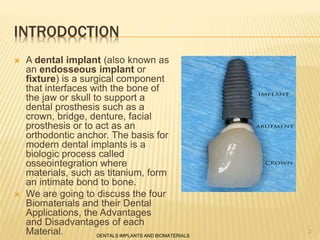
 A dental implant (also known as
an endosseous implant or
fixture) is a surgical component
that interfaces with the bone of
the jaw or skull to support a
dental prosthesis such as a
crown, bridge, denture, facial
prosthesis or to act as an
orthodontic anchor. The basis for
modern dental implants is a
biologic process called
osseointegration where
materials, such as titanium, form
an intimate bond to bone.
 We are going to discuss the four
Biomaterials and their Dental
Applications, the Advantages
and Disadvantages of each
Material. DENTALS IMPLANTS AND BIOMATERIALS
2
COMPOSITES AS DENTAL IMPLANTS
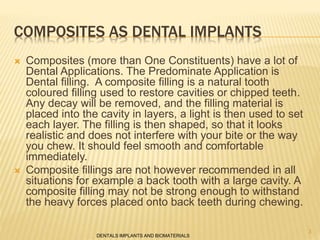
 Composites (more than One Constituents) have a lot of
Dental Applications. The Predominate Application is
Dental filling. A composite filling is a natural tooth
coloured filling used to restore cavities or chipped teeth.
Any decay will be removed, and the filling material is
placed into the cavity in layers, a light is then used to set
each layer. The filling is then shaped, so that it looks
realistic and does not interfere with your bite or the way
you chew. It should feel smooth and comfortable
immediately.
 Composite fillings are not however recommended in all
situations for example a back tooth with a large cavity. A
composite filling may not be strong enough to withstand
the heavy forces placed onto back teeth during chewing.
DENTALS IMPLANTS AND BIOMATERIALS
3
DENTALS IMPLANTS AND BIOMATERIALS
4
ADVANTAGES OF COMPOSITE FILLINGS:
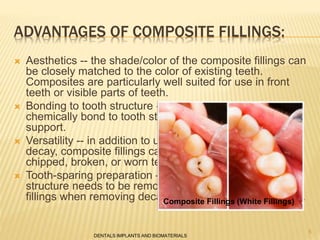
 Aesthetics -- the shade/color of the composite fillings can
be closely matched to the color of existing teeth.
Composites are particularly well suited for use in front
teeth or visible parts of teeth.
 Bonding to tooth structure -- composite fillings actually
chemically bond to tooth structure, providing further
support.
 Versatility -- in addition to use as a filling material for
decay, composite fillings can also be used to repair
chipped, broken, or worn teeth.
 Tooth-sparing preparation -- sometimes less tooth
structure needs to be removed compared with amalgam
fillings when removing decay and preparing for the filling.Composite Fillings (White Fillings)
DENTALS IMPLANTS AND BIOMATERIALS
5
DISADVANTAGES OF COMPOSITES FILLING
 Moderate occurrence of tooth sensitivity; sensitive to
dentist’s method of application .
 Costs more than dental amalgam
 Material shrinks when hardened and could lead to further
decay and/or temperature sensitivity
 Requires more than one visit for inlays, veneers, and
crowns
 May wear faster than dental enamel
 May leak over time when bonded beneath the layer of
enamel
DENTALS IMPLANTS AND BIOMATERIALS
6
CARAMICS DENTAL IMPLANTS
 Ceramics are nonorganic, nonmetallic, nonpolymeric materials manufactured by
compacting and sintering at elevated temperatures. They can be categorized
according to tissue response as:
• Bioactive: Bioglass/Glass ceramic
• Bioresorbable: Calcium phosphate
• Bioinert: Alumina, zirconia and carbon.
 Ceramics were introduced for surgical implant devices because of their inertness
to biodegradation, high strength and physical characteristics, such as minimal
thermal and electrical conductivity with a wide range of material specific elastic
properties. Ceramics are chemically inert, care must be taken in handling and
replacement due to its low ductility and inherent brittleness has resulted in its
limitations.
 A good example of Ceramics that has Dental Application is Zirconia (Artificial
Diamond), which is Hard and Allotropic in Nature.
 Porcelain is another Ceramic with Dental Application. It is a glass-like material
formed into fillings or crowns using models of the prepared teeth. The material is
tooth- colored and is used in inlays, veneers, crowns and fixed bridges.
DENTALS IMPLANTS AND BIOMATERIALS
7
ADVANTAGES OF CERAMICS DENTAL IMPLANTS
 Good resistance to further decay if the
restoration fits well.
 Is resistant to surface wear but can cause
some wear on opposing teeth.
 Resists leakage because it can be shaped
for a very accurate fit.
 The material doesn’t cause tooth sensitivity.
DENTALS IMPLANTS AND BIOMATERIALS
8
DISADVANTANGES OF CERAMICS AS DENTAL
IMPLANTS
 Material is brittle and can break under biting
force.
 May not be recommended for molar teeth.
 Higher cost because it requires at least two
office visits and laboratory services.
DENTALS IMPLANTS AND BIOMATERIALS
9
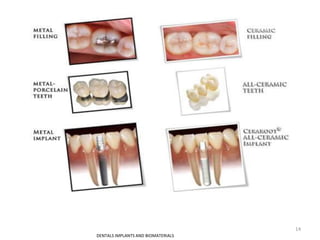
METALS AS DENTALS IMPLANTS
 Most dental implants are made of titanium, a metal that
has special qualities that make it useful for this purpose.
Titanium develops a thin film on its surface that protects it
from corrosion. It is resistant to acids, salt solutions and
oxygen, among other things. Titanium also is almost
completely nonmagnetic and is extremely strong for its
weight. Perhaps most important, the body does not reject
titanium implants as foreign objects. When implants are
placed in bone, the bone grows around the implant in a
process called osseointegration.
 Gold Alloy, a gold-Colored mixture of Gold, Copper and
other metals is used mainly for crowns and fixed bridges
and some partial denture frameworks.
 Metals like Gold and Silver are used in Dental Filling
DENTALS IMPLANTS AND BIOMATERIALS
10
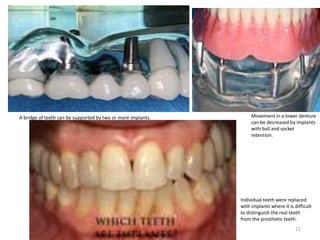
A bridge of teeth can be supported by two or more implants.
Individual teeth were replaced
with implants where it is difficult
to distinguish the real teeth
from the prosthetic teeth.
Movement in a lower denture
can be decreased by implants
with ball and socket
retention.
DENTALS IMPLANTS AND BIOMATERIALS
11
ADVANTAGES OF METAL DENTAL IMPLANTS
 Durability -- lasts at least 10 to 15 years and
usually longer; doesn't corrode
 Strength -- can withstand chewing forces
 Aesthetics -- some patients find gold very
pleasing to the eyes.
 Resists Leakage because they can be
shaped for a very accurate fit.
 They do not cause tooth Sensitivity (they are
Biocompatible).
DENTALS IMPLANTS AND BIOMATERIALS
12
DISADVANTAGES OF METAL DENTAL IMPLANTS
 Gold is very expensive
 Additional office visits -- requires at least two
office visits to place
 Aesthetics -- most patients dislike metal
"colored" fillings and prefer fillings that match
the rest of the tooth.
 Conducts heat and Cold; may irritate
Sensitive teeth.
DENTALS IMPLANTS AND BIOMATERIALS
13
DENTALS IMPLANTS AND BIOMATERIALS
14
POLYMERS AS DENTALS IMPLANTS
Polymers like Polymethyl methacrylate (PMMA), Polyamides and
Poly(Zn acrylate are used for Dental fillings and prosthesis. These
polymers are strong, as a Result they are Stable and have high
resistance to corrosion and fatique.
The more inert polymeric biomaterials include polytetrafluroethylene
(PTFE), polyethyleneterephthalate (PET),
polymethylmethacrylate (PMMA), ultra high molecular weight
polyethylene (UHMW-PE), polypropylene (PP), polysulfone (PSF)
and polydimethyl siloxane (PDS) or silicone rubber (SR).
 In general, polymers have lower strengths and elastic moduli, and
higher elongation to fracture compared with other class of
biomaterials. They are thermal and electrical insulators, and when
constituted as a high molecular weight system without
plasticizers, they are relatively resistant to biodegradation
compared with bone; most polymers have lower elastic moduli
with magnitudes closer to soft tissues.
DENTALS IMPLANTS AND BIOMATERIALS
15
ADVANTAGES OF POLYMERS IN DENTAL
APPLICATIONS
 Low Allergecity
 Resistance to corrosion and fatigue
 Good Adhesion with tissues
 High Strength and Stability
DENTALS IMPLANTS AND BIOMATERIALS
16
DISADVANTAGES OF POLYMERS AS DENTAL
IMPLANTS
 In general, polymers and composites of polymers are especially
sensitive to sterilization and handling techniques. If intended for
implant use, most cannot be sterilized by steam or ethylene
oxide.
 Most polymeric biomaterials have electrostatic surface properties
and tend to gather dust or other particulate if exposed to
semiclean oral environments.
 Because many can be shaped by cutting or auto- polymerizing in
vivo (PMMA), extreme care must be taken to maintain quality
surface conditions of the implant.
 Porous polymers can be deformed elastically, which can close
open regions intended for tissue ingrowth.
 Also, cleaning the contaminated porous polymers is not possible
without a laboratory environment.
DENTALS IMPLANTS AND BIOMATERIALS
17
CONCLUSION
 Dental implantology is an exciting treatment concept that includes
series of surgical, prosthetic and periodontal restorative skills
 Success or failure of implants depends on the health of the
person receiving it, drugs which impact the chances of
osseointegration and the health of the tissues in the mouth. The
amount of stress that will be put on the implant and fixture during
normal function is also evaluated.
 The final prosthetic can be either fixed, where a person cannot
remove the denture or teeth from their mouth or removable,
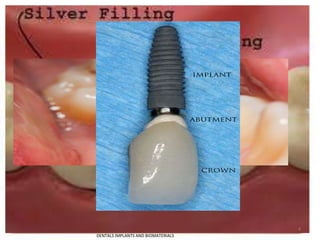
where they can remove the prosthetic. In each case an abutment
is attached to the implant fixture. Where the prosthetic is fixed,
the crown, bridge or denture is fixed to the abutment with either
lag-screws or cement. Where the prosthetic is removable, a
corresponding adapter is placed in the prosthetic so that the two
pieces can be secured together.
DENTALS IMPLANTS AND BIOMATERIALS
18
 The risks and complications related to
implant therapy are divided into those that
occur during surgery (such as excessive
bleeding or nerve injury), those that occur in
the first six months (such as infection and
failure to osseointegrate) and those that
occur long-term (such as perri-implantitis
and mechanical failures). In the presence of
healthy tissues, a well integrated implant
with appropriate biomechanical loads can
have long term success rates of 93 to 98
percent for the fixture and 10 to 15 year life
spans for the prosthetic teeth
DENTALS IMPLANTS AND BIOMATERIALS
19
REFERENCES
1. Misch CE. Contemporary Implant Dentistry (2nd ed). Mosby, St
Louis, USA 1999:271-302.
2. Weiss CM, Weiss A. Principles and practice of implant dentistry
(1st ed). Mosby, St Louis, USA 2001:28-46.
3. Garcia DA, Sullivan TM, O’Neill DM. Biocompatibility of dental
implant material measured in animal model. J Dent Res
1981;60(1):44-49.
4. Tschernitschek, et al. Non-alloyed titanium as a bioinert metal—A
review. Quintessence Int 2005;36:523-30.
5. Polymer Biomaterial (Lecture Note) Asso. Prof. Terlin Adali
Department of Biomedical Engineering, Near East University.
6. Wang R, Fenton A. Titanium for prosthodontic applications: A
review of the literature. Quintessence Int 1996;27:401-08.
7. Renner AM. The versatile use of titanium in implant
prosthodontics. Quintessence Dent Technol 2001:188-97.
DENTALS IMPLANTS AND BIOMATERIALS
20
THANK YOU
FOR
LISTENING.
DENTALS IMPLANTS AND BIOMATERIALS
21

Dental implants and biomaterials

  • 1.
    DENTALS IMPLANTS AND BIOMATERIALS BY FELIXCHIBUZO OBI (20144610) EDNA S MREMA (20124748) DENTALS IMPLANTS AND BIOMATERIALS 1
  • 2.
    INTRODOCTION  A dentalimplant (also known as an endosseous implant or fixture) is a surgical component that interfaces with the bone of the jaw or skull to support a dental prosthesis such as a crown, bridge, denture, facial prosthesis or to act as an orthodontic anchor. The basis for modern dental implants is a biologic process called osseointegration where materials, such as titanium, form an intimate bond to bone.  We are going to discuss the four Biomaterials and their Dental Applications, the Advantages and Disadvantages of each Material. DENTALS IMPLANTS AND BIOMATERIALS 2
  • 3.
    COMPOSITES AS DENTALIMPLANTS  Composites (more than One Constituents) have a lot of Dental Applications. The Predominate Application is Dental filling. A composite filling is a natural tooth coloured filling used to restore cavities or chipped teeth. Any decay will be removed, and the filling material is placed into the cavity in layers, a light is then used to set each layer. The filling is then shaped, so that it looks realistic and does not interfere with your bite or the way you chew. It should feel smooth and comfortable immediately.  Composite fillings are not however recommended in all situations for example a back tooth with a large cavity. A composite filling may not be strong enough to withstand the heavy forces placed onto back teeth during chewing. DENTALS IMPLANTS AND BIOMATERIALS 3
  • 4.
    DENTALS IMPLANTS ANDBIOMATERIALS 4
  • 5.
    ADVANTAGES OF COMPOSITEFILLINGS:  Aesthetics -- the shade/color of the composite fillings can be closely matched to the color of existing teeth. Composites are particularly well suited for use in front teeth or visible parts of teeth.  Bonding to tooth structure -- composite fillings actually chemically bond to tooth structure, providing further support.  Versatility -- in addition to use as a filling material for decay, composite fillings can also be used to repair chipped, broken, or worn teeth.  Tooth-sparing preparation -- sometimes less tooth structure needs to be removed compared with amalgam fillings when removing decay and preparing for the filling.Composite Fillings (White Fillings) DENTALS IMPLANTS AND BIOMATERIALS 5
  • 6.
    DISADVANTAGES OF COMPOSITESFILLING  Moderate occurrence of tooth sensitivity; sensitive to dentist’s method of application .  Costs more than dental amalgam  Material shrinks when hardened and could lead to further decay and/or temperature sensitivity  Requires more than one visit for inlays, veneers, and crowns  May wear faster than dental enamel  May leak over time when bonded beneath the layer of enamel DENTALS IMPLANTS AND BIOMATERIALS 6
  • 7.
    CARAMICS DENTAL IMPLANTS Ceramics are nonorganic, nonmetallic, nonpolymeric materials manufactured by compacting and sintering at elevated temperatures. They can be categorized according to tissue response as: • Bioactive: Bioglass/Glass ceramic • Bioresorbable: Calcium phosphate • Bioinert: Alumina, zirconia and carbon.  Ceramics were introduced for surgical implant devices because of their inertness to biodegradation, high strength and physical characteristics, such as minimal thermal and electrical conductivity with a wide range of material specific elastic properties. Ceramics are chemically inert, care must be taken in handling and replacement due to its low ductility and inherent brittleness has resulted in its limitations.  A good example of Ceramics that has Dental Application is Zirconia (Artificial Diamond), which is Hard and Allotropic in Nature.  Porcelain is another Ceramic with Dental Application. It is a glass-like material formed into fillings or crowns using models of the prepared teeth. The material is tooth- colored and is used in inlays, veneers, crowns and fixed bridges. DENTALS IMPLANTS AND BIOMATERIALS 7
  • 8.
    ADVANTAGES OF CERAMICSDENTAL IMPLANTS  Good resistance to further decay if the restoration fits well.  Is resistant to surface wear but can cause some wear on opposing teeth.  Resists leakage because it can be shaped for a very accurate fit.  The material doesn’t cause tooth sensitivity. DENTALS IMPLANTS AND BIOMATERIALS 8
  • 9.
    DISADVANTANGES OF CERAMICSAS DENTAL IMPLANTS  Material is brittle and can break under biting force.  May not be recommended for molar teeth.  Higher cost because it requires at least two office visits and laboratory services. DENTALS IMPLANTS AND BIOMATERIALS 9
  • 10.
    METALS AS DENTALSIMPLANTS  Most dental implants are made of titanium, a metal that has special qualities that make it useful for this purpose. Titanium develops a thin film on its surface that protects it from corrosion. It is resistant to acids, salt solutions and oxygen, among other things. Titanium also is almost completely nonmagnetic and is extremely strong for its weight. Perhaps most important, the body does not reject titanium implants as foreign objects. When implants are placed in bone, the bone grows around the implant in a process called osseointegration.  Gold Alloy, a gold-Colored mixture of Gold, Copper and other metals is used mainly for crowns and fixed bridges and some partial denture frameworks.  Metals like Gold and Silver are used in Dental Filling DENTALS IMPLANTS AND BIOMATERIALS 10
  • 11.
    A bridge ofteeth can be supported by two or more implants. Individual teeth were replaced with implants where it is difficult to distinguish the real teeth from the prosthetic teeth. Movement in a lower denture can be decreased by implants with ball and socket retention. DENTALS IMPLANTS AND BIOMATERIALS 11
  • 12.
    ADVANTAGES OF METALDENTAL IMPLANTS  Durability -- lasts at least 10 to 15 years and usually longer; doesn't corrode  Strength -- can withstand chewing forces  Aesthetics -- some patients find gold very pleasing to the eyes.  Resists Leakage because they can be shaped for a very accurate fit.  They do not cause tooth Sensitivity (they are Biocompatible). DENTALS IMPLANTS AND BIOMATERIALS 12
  • 13.
    DISADVANTAGES OF METALDENTAL IMPLANTS  Gold is very expensive  Additional office visits -- requires at least two office visits to place  Aesthetics -- most patients dislike metal "colored" fillings and prefer fillings that match the rest of the tooth.  Conducts heat and Cold; may irritate Sensitive teeth. DENTALS IMPLANTS AND BIOMATERIALS 13
  • 14.
    DENTALS IMPLANTS ANDBIOMATERIALS 14
  • 15.
    POLYMERS AS DENTALSIMPLANTS Polymers like Polymethyl methacrylate (PMMA), Polyamides and Poly(Zn acrylate are used for Dental fillings and prosthesis. These polymers are strong, as a Result they are Stable and have high resistance to corrosion and fatique. The more inert polymeric biomaterials include polytetrafluroethylene (PTFE), polyethyleneterephthalate (PET), polymethylmethacrylate (PMMA), ultra high molecular weight polyethylene (UHMW-PE), polypropylene (PP), polysulfone (PSF) and polydimethyl siloxane (PDS) or silicone rubber (SR).  In general, polymers have lower strengths and elastic moduli, and higher elongation to fracture compared with other class of biomaterials. They are thermal and electrical insulators, and when constituted as a high molecular weight system without plasticizers, they are relatively resistant to biodegradation compared with bone; most polymers have lower elastic moduli with magnitudes closer to soft tissues. DENTALS IMPLANTS AND BIOMATERIALS 15
  • 16.
    ADVANTAGES OF POLYMERSIN DENTAL APPLICATIONS  Low Allergecity  Resistance to corrosion and fatigue  Good Adhesion with tissues  High Strength and Stability DENTALS IMPLANTS AND BIOMATERIALS 16
  • 17.
    DISADVANTAGES OF POLYMERSAS DENTAL IMPLANTS  In general, polymers and composites of polymers are especially sensitive to sterilization and handling techniques. If intended for implant use, most cannot be sterilized by steam or ethylene oxide.  Most polymeric biomaterials have electrostatic surface properties and tend to gather dust or other particulate if exposed to semiclean oral environments.  Because many can be shaped by cutting or auto- polymerizing in vivo (PMMA), extreme care must be taken to maintain quality surface conditions of the implant.  Porous polymers can be deformed elastically, which can close open regions intended for tissue ingrowth.  Also, cleaning the contaminated porous polymers is not possible without a laboratory environment. DENTALS IMPLANTS AND BIOMATERIALS 17
  • 18.
    CONCLUSION  Dental implantologyis an exciting treatment concept that includes series of surgical, prosthetic and periodontal restorative skills  Success or failure of implants depends on the health of the person receiving it, drugs which impact the chances of osseointegration and the health of the tissues in the mouth. The amount of stress that will be put on the implant and fixture during normal function is also evaluated.  The final prosthetic can be either fixed, where a person cannot remove the denture or teeth from their mouth or removable, where they can remove the prosthetic. In each case an abutment is attached to the implant fixture. Where the prosthetic is fixed, the crown, bridge or denture is fixed to the abutment with either lag-screws or cement. Where the prosthetic is removable, a corresponding adapter is placed in the prosthetic so that the two pieces can be secured together. DENTALS IMPLANTS AND BIOMATERIALS 18
  • 19.
     The risksand complications related to implant therapy are divided into those that occur during surgery (such as excessive bleeding or nerve injury), those that occur in the first six months (such as infection and failure to osseointegrate) and those that occur long-term (such as perri-implantitis and mechanical failures). In the presence of healthy tissues, a well integrated implant with appropriate biomechanical loads can have long term success rates of 93 to 98 percent for the fixture and 10 to 15 year life spans for the prosthetic teeth DENTALS IMPLANTS AND BIOMATERIALS 19
  • 20.
    REFERENCES 1. Misch CE.Contemporary Implant Dentistry (2nd ed). Mosby, St Louis, USA 1999:271-302. 2. Weiss CM, Weiss A. Principles and practice of implant dentistry (1st ed). Mosby, St Louis, USA 2001:28-46. 3. Garcia DA, Sullivan TM, O’Neill DM. Biocompatibility of dental implant material measured in animal model. J Dent Res 1981;60(1):44-49. 4. Tschernitschek, et al. Non-alloyed titanium as a bioinert metal—A review. Quintessence Int 2005;36:523-30. 5. Polymer Biomaterial (Lecture Note) Asso. Prof. Terlin Adali Department of Biomedical Engineering, Near East University. 6. Wang R, Fenton A. Titanium for prosthodontic applications: A review of the literature. Quintessence Int 1996;27:401-08. 7. Renner AM. The versatile use of titanium in implant prosthodontics. Quintessence Dent Technol 2001:188-97. DENTALS IMPLANTS AND BIOMATERIALS 20
  • 21.