The Moon
 SECTION 28.2
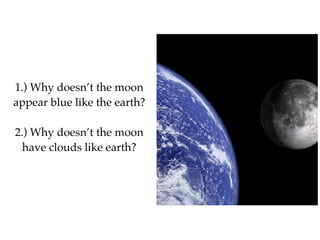
1.) Why doesn’t the moon
appear blue like the earth?

2.) Why doesn’t the moon
  have clouds like earth?
Landed on Moon Clip
Reaching for Moon
Reaching for Moon

• most knowledge about moon comes from space
  explorations by space probes
Reaching for Moon

• most knowledge about moon comes from space
  explorations by space probes
• Neil Armstrong and Buzz Aldrin first men to
  step on moon
First Steps Clip
Lunar Properties
Lunar Properties
• one of largest moons (compared to size of
  planet it orbits)
Lunar Properties
• one of largest moons (compared to size of
  planet it orbits)
• moon relatively further from earth than most
  moons are from planets they orbit
Lunar Properties
• one of largest moons (compared to size of
  planet it orbits)
• moon relatively further from earth than most
  moons are from planets they orbit
• solid, rocky body
Lunar Properties
• one of largest moons (compared to size of
  planet it orbits)
• moon relatively further from earth than most
  moons are from planets they orbit
• solid, rocky body
• only large moon among inner planets
Lunar Surface
Lunar Surface

• albedo - amount of sunlight moon’s surface
  reflects
Lunar Surface

• albedo - amount of sunlight moon’s surface
  reflects
 • very small
Lunar Surface

• albedo - amount of sunlight moon’s surface
  reflects
 • very small
   • temperatures as high as 127ºC
Lunar Surface

• albedo - amount of sunlight moon’s surface
  reflects
 • very small
   • temperatures as high as 127ºC
   • temperatures as low as -173ºC
Surface Features


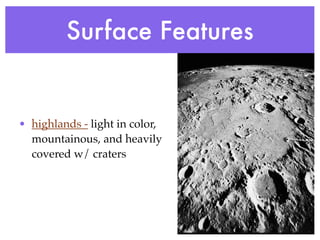
• highlands - light in color,
  mountainous, and heavily
  covered w/ craters
Surface Features

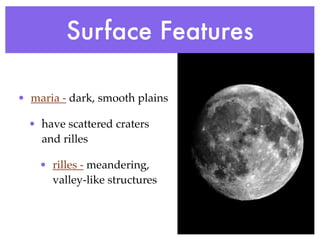
• maria - dark, smooth plains

  • have scattered craters
    and rilles

    • rilles - meandering,
      valley-like structures
Surface Features


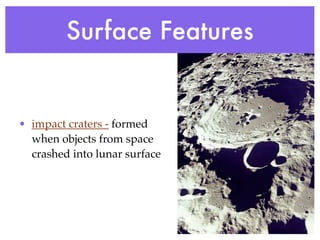
• impact craters - formed
  when objects from space
  crashed into lunar surface
Surface Features

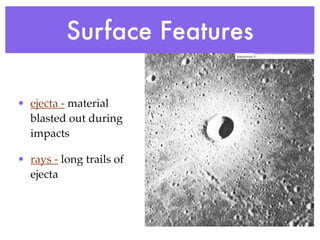
• ejecta - material
  blasted out during
  impacts

• rays - long trails of
  ejecta
Surface Features
Surface Features

• Q: Why does moon have craters, while earth
  has few?
Surface Features

• Q: Why does moon have craters, while earth
  has few?
• A: Erosion on earth has eliminated traces of all
  but younger craters; on moon, craters present
  until one impact covers another
History of Moon
History of Moon

• age b/w 3.8 and 4.6 billion years old
History of Moon

• age b/w 3.8 and 4.6 billion years old
• have regolith b/c of being bombarded heavily
  by space objects
History of Moon

• age b/w 3.8 and 4.6 billion years old
• have regolith b/c of being bombarded heavily
  by space objects
 • regolith - layer of loose, ground-up rock
History of Moon

• age b/w 3.8 and 4.6 billion years old
• have regolith b/c of being bombarded heavily
  by space objects
 • regolith - layer of loose, ground-up rock
• maria slightly younger than highlands
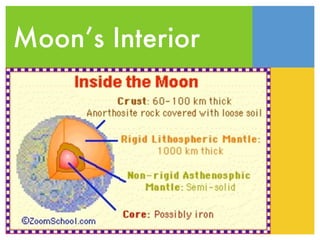
Moon’s Interior
Tectonics on Moon?
Tectonics on Moon?

• Q: Is the moon tectonically active?
Tectonics on Moon?

• Q: Is the moon tectonically active?
• A: Has moonquakes, but theorize that NOT
  tectonically active b/c no volcanos and no
  significant magnetic field
Capture Theory
Capture Theory
• as solar system forming, large object ventured
  too near to forming earth, became trapped by
  gravitational pull, and formed into moon
Capture Theory
• as solar system forming, large object ventured
  too near to forming earth, became trapped by
  gravitational pull, and formed into moon
 • something needed to slow down object to be
   trapped
Capture Theory
• as solar system forming, large object ventured
  too near to forming earth, became trapped by
  gravitational pull, and formed into moon
 • something needed to slow down object to be
   trapped
 • earth and moon composed of very similar
   materials
Simultaneous Formation

• moon and earth formed at same time and in
  same general areas thus materials they are
  formed from are essentially the same
Simultaneous Formation

• moon and earth formed at same time and in
  same general areas thus materials they are
  formed from are essentially the same
 • does NOT account for different amounts of
   iron on earth and moon
Impact Theory
Impact Theory


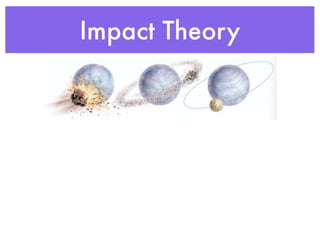
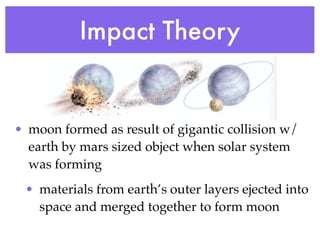
• moon formed as result of gigantic collision w/
  earth by mars sized object when solar system
  was forming
 • materials from earth’s outer layers ejected into
   space and merged together to form moon

28.2 Presentation (CP)

  • 1.
  • 2.
    1.) Why doesn’tthe moon appear blue like the earth? 2.) Why doesn’t the moon have clouds like earth?
  • 3.
  • 4.
  • 5.
    Reaching for Moon •most knowledge about moon comes from space explorations by space probes
  • 6.
    Reaching for Moon •most knowledge about moon comes from space explorations by space probes • Neil Armstrong and Buzz Aldrin first men to step on moon
  • 7.
  • 8.
  • 9.
    Lunar Properties • oneof largest moons (compared to size of planet it orbits)
  • 10.
    Lunar Properties • oneof largest moons (compared to size of planet it orbits) • moon relatively further from earth than most moons are from planets they orbit
  • 11.
    Lunar Properties • oneof largest moons (compared to size of planet it orbits) • moon relatively further from earth than most moons are from planets they orbit • solid, rocky body
  • 12.
    Lunar Properties • oneof largest moons (compared to size of planet it orbits) • moon relatively further from earth than most moons are from planets they orbit • solid, rocky body • only large moon among inner planets
  • 13.
  • 14.
    Lunar Surface • albedo- amount of sunlight moon’s surface reflects
  • 15.
    Lunar Surface • albedo- amount of sunlight moon’s surface reflects • very small
  • 16.
    Lunar Surface • albedo- amount of sunlight moon’s surface reflects • very small • temperatures as high as 127ºC
  • 17.
    Lunar Surface • albedo- amount of sunlight moon’s surface reflects • very small • temperatures as high as 127ºC • temperatures as low as -173ºC
  • 18.
    Surface Features • highlands- light in color, mountainous, and heavily covered w/ craters
  • 19.
    Surface Features • maria- dark, smooth plains • have scattered craters and rilles • rilles - meandering, valley-like structures
  • 20.
    Surface Features • impactcraters - formed when objects from space crashed into lunar surface
  • 21.
    Surface Features • ejecta- material blasted out during impacts • rays - long trails of ejecta
  • 22.
  • 23.
    Surface Features • Q:Why does moon have craters, while earth has few?
  • 24.
    Surface Features • Q:Why does moon have craters, while earth has few? • A: Erosion on earth has eliminated traces of all but younger craters; on moon, craters present until one impact covers another
  • 25.
  • 26.
    History of Moon •age b/w 3.8 and 4.6 billion years old
  • 27.
    History of Moon •age b/w 3.8 and 4.6 billion years old • have regolith b/c of being bombarded heavily by space objects
  • 28.
    History of Moon •age b/w 3.8 and 4.6 billion years old • have regolith b/c of being bombarded heavily by space objects • regolith - layer of loose, ground-up rock
  • 29.
    History of Moon •age b/w 3.8 and 4.6 billion years old • have regolith b/c of being bombarded heavily by space objects • regolith - layer of loose, ground-up rock • maria slightly younger than highlands
  • 30.
  • 31.
  • 32.
    Tectonics on Moon? •Q: Is the moon tectonically active?
  • 33.
    Tectonics on Moon? •Q: Is the moon tectonically active? • A: Has moonquakes, but theorize that NOT tectonically active b/c no volcanos and no significant magnetic field
  • 34.
  • 35.
    Capture Theory • assolar system forming, large object ventured too near to forming earth, became trapped by gravitational pull, and formed into moon
  • 36.
    Capture Theory • assolar system forming, large object ventured too near to forming earth, became trapped by gravitational pull, and formed into moon • something needed to slow down object to be trapped
  • 37.
    Capture Theory • assolar system forming, large object ventured too near to forming earth, became trapped by gravitational pull, and formed into moon • something needed to slow down object to be trapped • earth and moon composed of very similar materials
  • 38.
  • 39.
    Simultaneous Formation • moonand earth formed at same time and in same general areas thus materials they are formed from are essentially the same
  • 40.
    Simultaneous Formation • moonand earth formed at same time and in same general areas thus materials they are formed from are essentially the same • does NOT account for different amounts of iron on earth and moon
  • 41.
  • 42.
    Impact Theory • moonformed as result of gigantic collision w/ earth by mars sized object when solar system was forming • materials from earth’s outer layers ejected into space and merged together to form moon