Chapters 25 &26
Moon and Sun
Astronomy
Define Astronomy.
Astronomy is the study of the …
Universe
Origin of the Moon
4 Theories
Origin of the Moon
4 Theories
●Earth spinning so fast that a chunk spun off
into orbit
●Moon was formed elsewhere in the solar
system and captured by Earth’s gravity
●Earth and moon formed simultaneously
●Earth and a planet sized object collided,
debris from the impact pulled together to
form the moon
Origin of the Moon
Which is the
most accepted
theory on how
the moon was
formed?
Development of the Moon
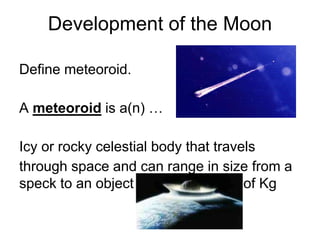
Define meteoroid.
A meteoroid is a(n) …
Icy or rocky celestial body that travels
through space and can range in size from a
speck to an object weighing 1000’s of Kg
Earth's Moon
●Lunar history
● Hypothesis suggests that a giant asteroid
collided with Earth to produce the Moon
● Older areas have a higher density
● Younger areas are still smooth
● Moon evolved in three phases
● Original crust (highlands)
● As Moon formed, its outer shell melted,
cooled, solidified, and became the
highlands
● About 4.5 billion years old
Major topographic features
on the lunar surface
Earth's Moon
●Lunar surface
● Two types of terrain
● Maria (singular, Marem), Latin for "sea"
● Dark regions
● Fairly smooth lowlands
● Originated from asteroid impacts and lava
flooding the surface
Formation of lunar maria
Development of the Moon
Define crater.
A crater is a …
A depression in the moon’s surface created
by a meteoroid
Crater rim
Basin
Craters
●Most obvious features of the lunar surface
●Most are produced by an impact from a
meteoroid
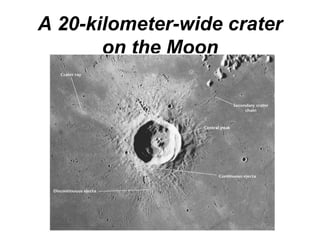
A 20-kilometer-wide crater
on the Moon
Formation of a Crater
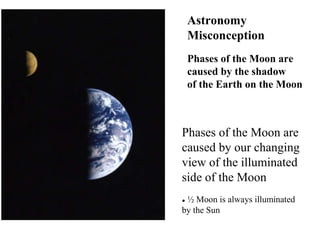
Astronomy
Misconception
Phases of the Moon are
caused by the shadow
of the Earth on the Moon
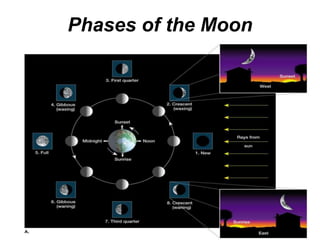
Phases of the Moon are
caused by our changing
view of the illuminated
side of the Moon
● ½ Moon is always illuminated
by the Sun
Synchronous Rotation
moon takes exactly the same amount of time to orbit Earth as it does to rotate
● no“dark side” of the Moon
●each location experiences about 14 days of daylight and 14 days of night.
Phases of the Moon
Motions of the Earth-Moon
system
●Eclipses
● Simply shadow effects that were first
understood by the early Greeks
● Two types of eclipses
● SSolar eclipse
● Moon moves in a line directly between Earth
and the Sun
● Can only occur during the new-Moon phase
● This is the only time when the outer layers
of the sun are visible
Solar eclipse
Motions of the Earth-Moon
system
●Eclipses
● Two types of eclipses
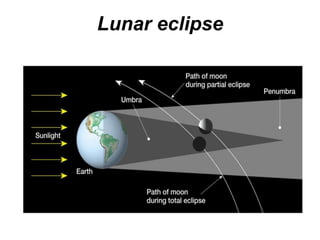
● Lunar Eclipse
● Moon moves within the shadow of Earth
● Only occurs during the full-Moon phase
● The usual number of eclipses is four per
year
Lunar eclipse
Lunar Eclipse
Solar eclipse

notes through moon.ppt.pptx

  • 2.
  • 3.
    Astronomy Define Astronomy. Astronomy isthe study of the … Universe
  • 4.
    Origin of theMoon 4 Theories
  • 5.
    Origin of theMoon 4 Theories ●Earth spinning so fast that a chunk spun off into orbit ●Moon was formed elsewhere in the solar system and captured by Earth’s gravity ●Earth and moon formed simultaneously ●Earth and a planet sized object collided, debris from the impact pulled together to form the moon
  • 6.
    Origin of theMoon Which is the most accepted theory on how the moon was formed?
  • 7.
    Development of theMoon Define meteoroid. A meteoroid is a(n) … Icy or rocky celestial body that travels through space and can range in size from a speck to an object weighing 1000’s of Kg
  • 9.
    Earth's Moon ●Lunar history ●Hypothesis suggests that a giant asteroid collided with Earth to produce the Moon ● Older areas have a higher density ● Younger areas are still smooth ● Moon evolved in three phases ● Original crust (highlands) ● As Moon formed, its outer shell melted, cooled, solidified, and became the highlands ● About 4.5 billion years old
  • 10.
  • 11.
    Earth's Moon ●Lunar surface ●Two types of terrain ● Maria (singular, Marem), Latin for "sea" ● Dark regions ● Fairly smooth lowlands ● Originated from asteroid impacts and lava flooding the surface
  • 12.
  • 13.
    Development of theMoon Define crater. A crater is a … A depression in the moon’s surface created by a meteoroid Crater rim Basin
  • 14.
    Craters ●Most obvious featuresof the lunar surface ●Most are produced by an impact from a meteoroid
  • 15.
  • 16.
  • 17.
    Astronomy Misconception Phases of theMoon are caused by the shadow of the Earth on the Moon Phases of the Moon are caused by our changing view of the illuminated side of the Moon ● ½ Moon is always illuminated by the Sun
  • 18.
    Synchronous Rotation moon takesexactly the same amount of time to orbit Earth as it does to rotate ● no“dark side” of the Moon ●each location experiences about 14 days of daylight and 14 days of night.
  • 19.
  • 20.
    Motions of theEarth-Moon system ●Eclipses ● Simply shadow effects that were first understood by the early Greeks ● Two types of eclipses ● SSolar eclipse ● Moon moves in a line directly between Earth and the Sun ● Can only occur during the new-Moon phase ● This is the only time when the outer layers of the sun are visible
  • 21.
  • 23.
    Motions of theEarth-Moon system ●Eclipses ● Two types of eclipses ● Lunar Eclipse ● Moon moves within the shadow of Earth ● Only occurs during the full-Moon phase ● The usual number of eclipses is four per year
  • 24.
  • 25.
  • 26.