Drug Addiction and Drug Abuse In Teenage
By
SASMITA SAHA
B. Pharm. 6th Sem.
University Roll No :
20101911037
Under the Guidance of
Dr. Sailee Chowdhury
Assistant Professor
BCDA COLLEGE OF PHARMACY & TECHNOLOGY
The curse of drug affecting
our youth as well as our
society…
Now a days drug abuse is a complex problem affects
peoples from different ages.
The Body’s
Weight: about 3 pounds
Job: Controlling
everything we do
DRUGS CHANGE
THE WAY OUR
BRAIN WORKS…
That’s how you get
addicted
What do
drugs do to
the brain?
Drugs are chemicals
that interfere with the
neuron’s communication
Drugs change the
brain — sometimes
permanently
Communication ways in brain
Neurotransmitters: The brain’s chemical messengers
Receptors: The brain’s chemical receivers
Transporters: The brain’s chemical recyclers
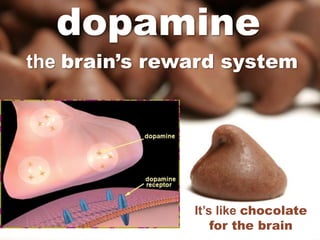
dopamine
the brain’s reward system
It’s like chocolate
for the brain
Dopamine Pathways
Functions
•reward (motivation)
•pleasure,euphoria
•motor function
(fine tuning)
•compulsion
•perserveration
•decision making
Serotonin Pathways
Functions
•mood
•memory
processing
•sleep
nucleus
accumbens
hippocampus
striatum
frontal
cortex
substantia
nigra/VTA
raphe
affects
our
brain
in 3
main
areas
When Reading Emotion…
Adults Rely More on the Frontal Cortex
While Teens Rely More on the Amygdala
Drug Addiction
Primary , chronic &
neurobiological disease
with psychological and
genetic factors that
influence its development
& manifestation.
Drug Abuse
Self administration of
drugs, in a manner not
in accord with accepted
social or medical
pattern
A. Psychological
Dependency/Habituation
B. Physical Dependency
C. Compulsive Drug Use
D. Tolerence
Drug Addiction & Abuse includes
What is Teen Substance Abuse?
 Teens try alcohol, tobacco, marijuana, or other drugs.
 Some try these only for few times & stop. But others
can't control their urges or cravings for them.
Most often They try :-
 Nicotine
 Alcohols
 Hallucinogens
 Over the counter medicines
Basic Science Tells Us that Adolescents’
Brains Are Still Developing…
Brain Development
• Earlier development of the back of the
brain and later development of the
front of the brain
MRI Scans of Healthy Children and Teens Over Time
Drug use starts early & peaks in the teen yearsFirstDrugUse(numberofinitiates)
Infant Teen Adult Older AdultChild
Evidence from survey
How does someone get
addicted to drugs?
Because of the extra dopamine,
the brain chemistry changes
The brain stops making
enough of its own dopamine
Without enough dopamine, the
user feels flat, depressed, and
lifeless
The user needs more and more
drugs to feel good
The brain’s changes make the
user need the drug just to feel
normal
even if it’s ruining their life
Pushing Factors For Teenagers Towards Drug Use
 Psychological Or Inner
EXCITEMENT
WANT TO FIT WITH CERTAIN FRIENDS
GROUP
TEENAGERS FEELS MORE GROWN UP
FRUSTATION & INADEQUACY
DESIRED FOR INTENSE SENSATION
Social
FRIENDS & FAMILY
PROBLEMS
EDUCATION & FAILURE AT SCHOOL
ART MOVIES & CULTURAL
INFORMATION
CURIOSITY & TEMPTATION
Hallucinogen
Dried matured leaves
of cannabis plant.
Flowering Tops of
cannabis sativa.
Entire cannabis
plant with variable
portions
Hallucinogen
Hallucinogens
Colour
precipitation,
sensation
loss,death.
pupil dialation,
tachycardia,increase
body temperature &
respiration.
Pulse rate
increases.
Alcohol
Sedative, hypnotic,
tranquillazer
Has Slowing
effects on CNS
Causes
 Failure of liver
 Gastric pancreatitis
 toxic psychosis
 nerve disorder
 heart diseases.
 Problem remembering things, recently said or did.
 Getting drunk on a regular basis.
 Thinking that drug is necessary to have fun.
 Having frequent hangovers.
 Feeling run-down, depressed, or even suicidal.
 Having "blackouts"--forgetting what you did while
drinking.
DriveSaliency
Memory
Control
Non-Addicted Brain
NO
GO
Addicted Brain
Drive
Memory
Control
GOSaliency
Why Can’t Addicts Just Quit ?
Because Addiction Changes Brain Circuits
ONE WAY TO AVOID DRUG, IS BY SELF AWARENESS, SAY NO TO DRUGS.
Treating a Biobehavioral Disorder Must Go
Beyond Just Fixing the Chemistry
Pharmacological
(medications)
We Need to Treat the Whole Person!
Behavioral Therapies
Medical Social Services
CB1 Antagonists
Inhibitors of
metabolizing
enzymes
CRF Antagonists
MedicationBasic Research
Agonist Therapy
Methadone
Buprenorphine
Opiate agonists stabilize brain function
in heroin addicts
CB1 KO mice have decreased responses
to multiple drugs of abuse
Smokers who are poor nicotine
metabolizers smoke less
Stress triggers relapse in animal models
of addiction and CRF antagonists
interfere with the response to stress
 “The Federation of Indian NGOs for Drug Abuse prevention”
(FINGODAP) , was initiated by Society for Promotion of Youth &
Masses (SPYM), New Delhi on 11th August 1991.
 The national institute of social defence is a nodal institute and activities
and programmes for protection of our society from drug abuse.
 United Nations Office on Drugs and crime (UNODC’s) recently
launched Global study Homicide 2013 on 8 May 2014.
Accept life
unconditionally with a
Positive attitude
Recovery and relapse are
just around the
corner.
Choose ONE
• Clark, D. B., Kirisci, L., & Tarter, R. E. (1998). Adolescent versus adult onset and
the development of substance use disorders in males. Drug and Alcohol
Dependence, 49, 115-121.
• Buck JA.(2011), The looming expansion and transformation of public substance
abuse treatment under the Affordable Care Act. Health Aff
(Millwood);30(8):1402–10.
• Cohen C, Perrault G, Voltz C, Steinberg R, and Soubrie P (2002) SR141716, a
central cannabinoid (CB(1)) receptor antagonist, blocks the motivational and
dopamine-releasing effects of nicotine in rats. Behav Pharmacol 13: 451–463.
• Zobel.A., Nickel, T., Kunzel(2000) . Effects of the high-affinity corticotropin-
releasing hormone receptor 1 antagonist R121919 in major depression: the first
20 patients treated. J Psychiatr, 34 : 171-81.
• Brown, S.A., Tapert, S.F., Granholm, E., & Delis, D.C. (2000). Neurocognitive
functioning of adolescents: Effects of protracted alcohol use. Alcoholism: Clinical
and Experimental Research, 242, 164-171.
References
• Preti A (2007). "New developments in the pharmacotherapy of cocaine
abuse". Addict Biol 12 (2): 133–51
• Hall, F. Scott; Drgonova, Jana; Jain, Siddharth; Uhl, George R. (December
2013). "Implications of genome wide association studies for addiction: Are
our a priori assumptions all wrong?". Pharmacology & Therapeutics 140 (3):
267–279.
• Nutt King, Saulsbury , Blakemore (2007). "Development of a rational scale to
assess the harm of drugs of potential misuse". Lancet 369 (9566): 1047–53.
• Chen JC, Chen PC, Chiang YC (2009). "Molecular mechanisms of
psychostimulant addiction". Chang Gung Medical Journal 32 (2): 148–54.
• Durrant, R; Adamson, S; Todd, F; Sellman, D (November 2009). "Drug use and
addiction: evolutionary perspective.". The Australian and New Zealand
journal of psychiatry 43 (11): 1049–56.
Seminar_Final 1

Seminar_Final 1

  • 1.
    Drug Addiction andDrug Abuse In Teenage By SASMITA SAHA B. Pharm. 6th Sem. University Roll No : 20101911037 Under the Guidance of Dr. Sailee Chowdhury Assistant Professor BCDA COLLEGE OF PHARMACY & TECHNOLOGY
  • 2.
    The curse ofdrug affecting our youth as well as our society… Now a days drug abuse is a complex problem affects peoples from different ages.
  • 3.
    The Body’s Weight: about3 pounds Job: Controlling everything we do DRUGS CHANGE THE WAY OUR BRAIN WORKS… That’s how you get addicted
  • 4.
    What do drugs doto the brain? Drugs are chemicals that interfere with the neuron’s communication Drugs change the brain — sometimes permanently
  • 6.
    Communication ways inbrain Neurotransmitters: The brain’s chemical messengers Receptors: The brain’s chemical receivers Transporters: The brain’s chemical recyclers
  • 7.
    dopamine the brain’s rewardsystem It’s like chocolate for the brain
  • 8.
    Dopamine Pathways Functions •reward (motivation) •pleasure,euphoria •motorfunction (fine tuning) •compulsion •perserveration •decision making Serotonin Pathways Functions •mood •memory processing •sleep nucleus accumbens hippocampus striatum frontal cortex substantia nigra/VTA raphe
  • 9.
  • 10.
    When Reading Emotion… AdultsRely More on the Frontal Cortex While Teens Rely More on the Amygdala
  • 11.
    Drug Addiction Primary ,chronic & neurobiological disease with psychological and genetic factors that influence its development & manifestation. Drug Abuse Self administration of drugs, in a manner not in accord with accepted social or medical pattern
  • 12.
    A. Psychological Dependency/Habituation B. PhysicalDependency C. Compulsive Drug Use D. Tolerence Drug Addiction & Abuse includes
  • 13.
    What is TeenSubstance Abuse?  Teens try alcohol, tobacco, marijuana, or other drugs.  Some try these only for few times & stop. But others can't control their urges or cravings for them. Most often They try :-  Nicotine  Alcohols  Hallucinogens  Over the counter medicines
  • 14.
    Basic Science TellsUs that Adolescents’ Brains Are Still Developing…
  • 15.
    Brain Development • Earlierdevelopment of the back of the brain and later development of the front of the brain MRI Scans of Healthy Children and Teens Over Time
  • 16.
    Drug use startsearly & peaks in the teen yearsFirstDrugUse(numberofinitiates) Infant Teen Adult Older AdultChild Evidence from survey
  • 18.
    How does someoneget addicted to drugs? Because of the extra dopamine, the brain chemistry changes The brain stops making enough of its own dopamine Without enough dopamine, the user feels flat, depressed, and lifeless The user needs more and more drugs to feel good The brain’s changes make the user need the drug just to feel normal even if it’s ruining their life
  • 19.
    Pushing Factors ForTeenagers Towards Drug Use  Psychological Or Inner EXCITEMENT WANT TO FIT WITH CERTAIN FRIENDS GROUP TEENAGERS FEELS MORE GROWN UP FRUSTATION & INADEQUACY DESIRED FOR INTENSE SENSATION
  • 20.
    Social FRIENDS & FAMILY PROBLEMS EDUCATION& FAILURE AT SCHOOL ART MOVIES & CULTURAL INFORMATION CURIOSITY & TEMPTATION
  • 23.
    Hallucinogen Dried matured leaves ofcannabis plant. Flowering Tops of cannabis sativa. Entire cannabis plant with variable portions Hallucinogen
  • 24.
  • 25.
    Alcohol Sedative, hypnotic, tranquillazer Has Slowing effectson CNS Causes  Failure of liver  Gastric pancreatitis  toxic psychosis  nerve disorder  heart diseases.
  • 26.
     Problem rememberingthings, recently said or did.  Getting drunk on a regular basis.  Thinking that drug is necessary to have fun.  Having frequent hangovers.  Feeling run-down, depressed, or even suicidal.  Having "blackouts"--forgetting what you did while drinking.
  • 28.
  • 31.
    ONE WAY TOAVOID DRUG, IS BY SELF AWARENESS, SAY NO TO DRUGS.
  • 33.
    Treating a BiobehavioralDisorder Must Go Beyond Just Fixing the Chemistry Pharmacological (medications) We Need to Treat the Whole Person! Behavioral Therapies Medical Social Services
  • 34.
    CB1 Antagonists Inhibitors of metabolizing enzymes CRFAntagonists MedicationBasic Research Agonist Therapy Methadone Buprenorphine Opiate agonists stabilize brain function in heroin addicts CB1 KO mice have decreased responses to multiple drugs of abuse Smokers who are poor nicotine metabolizers smoke less Stress triggers relapse in animal models of addiction and CRF antagonists interfere with the response to stress
  • 35.
     “The Federationof Indian NGOs for Drug Abuse prevention” (FINGODAP) , was initiated by Society for Promotion of Youth & Masses (SPYM), New Delhi on 11th August 1991.  The national institute of social defence is a nodal institute and activities and programmes for protection of our society from drug abuse.  United Nations Office on Drugs and crime (UNODC’s) recently launched Global study Homicide 2013 on 8 May 2014.
  • 36.
    Accept life unconditionally witha Positive attitude Recovery and relapse are just around the corner. Choose ONE
  • 37.
    • Clark, D.B., Kirisci, L., & Tarter, R. E. (1998). Adolescent versus adult onset and the development of substance use disorders in males. Drug and Alcohol Dependence, 49, 115-121. • Buck JA.(2011), The looming expansion and transformation of public substance abuse treatment under the Affordable Care Act. Health Aff (Millwood);30(8):1402–10. • Cohen C, Perrault G, Voltz C, Steinberg R, and Soubrie P (2002) SR141716, a central cannabinoid (CB(1)) receptor antagonist, blocks the motivational and dopamine-releasing effects of nicotine in rats. Behav Pharmacol 13: 451–463. • Zobel.A., Nickel, T., Kunzel(2000) . Effects of the high-affinity corticotropin- releasing hormone receptor 1 antagonist R121919 in major depression: the first 20 patients treated. J Psychiatr, 34 : 171-81. • Brown, S.A., Tapert, S.F., Granholm, E., & Delis, D.C. (2000). Neurocognitive functioning of adolescents: Effects of protracted alcohol use. Alcoholism: Clinical and Experimental Research, 242, 164-171.
  • 38.
    References • Preti A(2007). "New developments in the pharmacotherapy of cocaine abuse". Addict Biol 12 (2): 133–51 • Hall, F. Scott; Drgonova, Jana; Jain, Siddharth; Uhl, George R. (December 2013). "Implications of genome wide association studies for addiction: Are our a priori assumptions all wrong?". Pharmacology & Therapeutics 140 (3): 267–279. • Nutt King, Saulsbury , Blakemore (2007). "Development of a rational scale to assess the harm of drugs of potential misuse". Lancet 369 (9566): 1047–53. • Chen JC, Chen PC, Chiang YC (2009). "Molecular mechanisms of psychostimulant addiction". Chang Gung Medical Journal 32 (2): 148–54. • Durrant, R; Adamson, S; Todd, F; Sellman, D (November 2009). "Drug use and addiction: evolutionary perspective.". The Australian and New Zealand journal of psychiatry 43 (11): 1049–56.