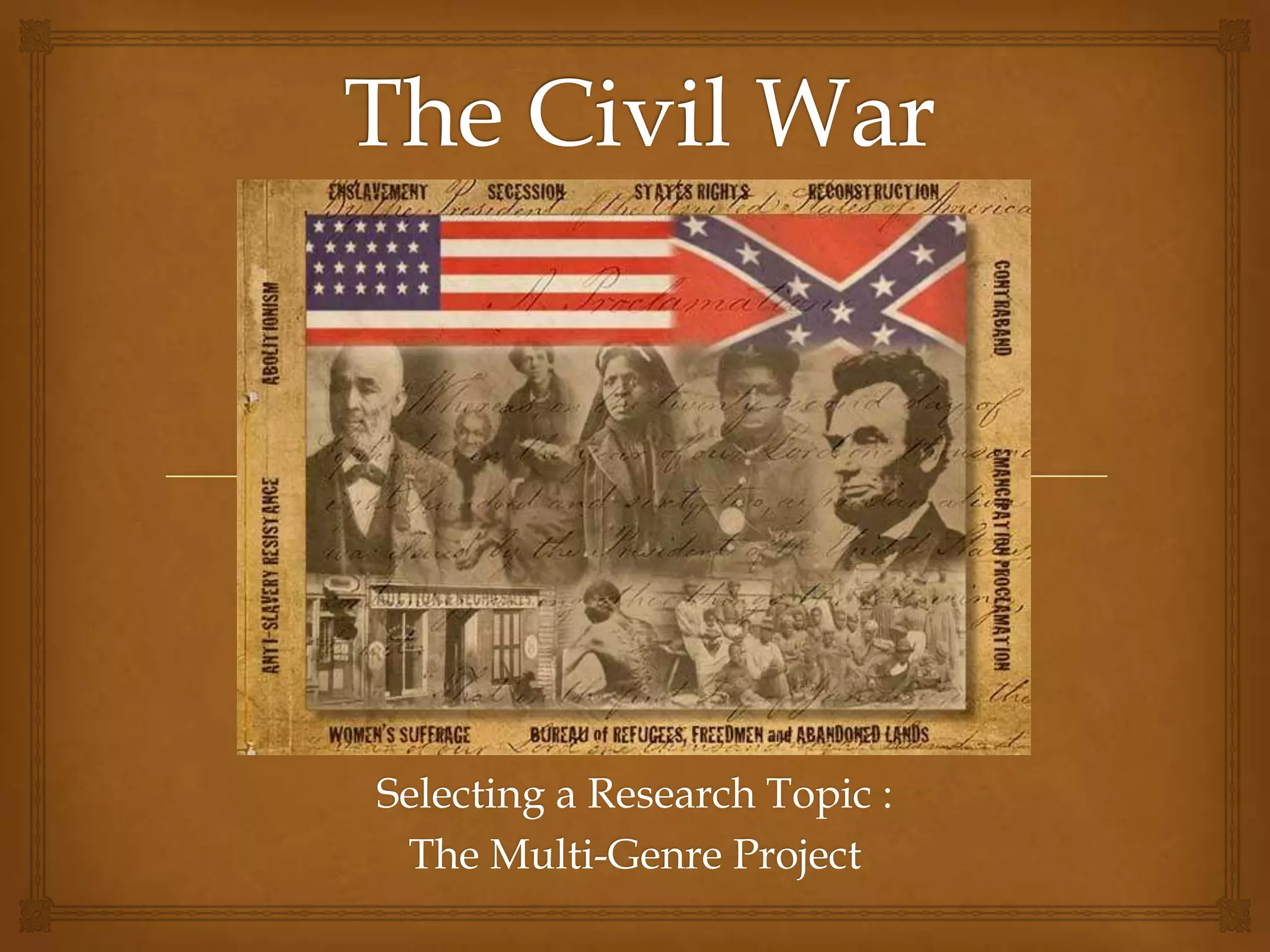
Selecting a Research Topic :
The Multi-Genre Project

 Over the next month, you will be focusing your
research on a single person or event from the Civil
War Era.
 Therefore, you must pick a topic that genuinely
piques your interest.
 You will spend a lot of energy becoming an expert
on your topic in order to build historical empathy.
What was it like to walk in their shoes? What
influenced their actions? Or, how did the battle or
event influence the outcome of the war?
Why Topic Selection is So Important:

 After looking at the following slides, your task is to
rank your top 3 choices for research topics.
 You will need to defend your reasons for picking
your topic to your teacher.
 Ask Yourself:
 What really captures my interests?
 Will I be motivated to spend an extended amount of
time studying this topic?
 Is it something that is important to me?
 Why is this topic fascinating to me?
Defend Your Choice

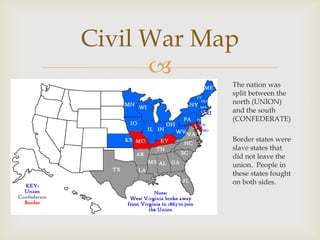
The nation was
split between the
north (UNION)
and the south
(CONFEDERATE)
Border states were
slave states that
did not leave the
union. People in
these states fought
on both sides.
Civil War Map
- What started as a war to preserve the Union, and keep all the
United States together changed over time into a war to end slavery.
- These individuals fought, worked, gave speeches, wrote articles,
nursed, spied and helped the on the side of the Union.
- An abolitionist is a person who wanted to outlaw and end slavery.
Not everyone in the north, however, held the same views on slavery.

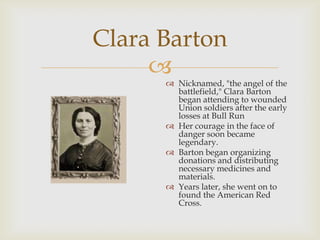
Clara Barton
 Nicknamed, "the angel of the
battlefield," Clara Barton
began attending to wounded
Union soldiers after the early
losses at Bull Run
 Her courage in the face of
danger soon became
legendary.
 Barton began organizing
donations and distributing
necessary medicines and
materials.
 Years later, she went on to
found the American Red
Cross.

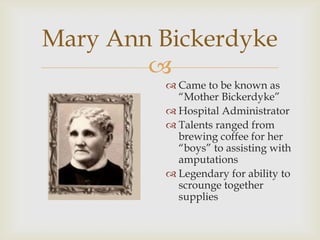
Mary Ann Bickerdyke
 Came to be known as
“Mother Bickerdyke”
 Hospital Administrator
 Talents ranged from
brewing coffee for her
“boys” to assisting with
amputations
 Legendary for ability to
scrounge together
supplies

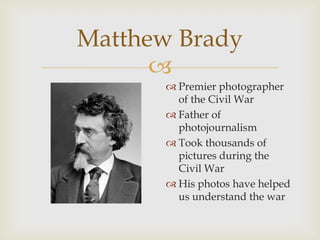
Matthew Brady
 Premier photographer
of the Civil War
 Father of
photojournalism
 Took thousands of
pictures during the
Civil War
 His photos have helped
us understand the war

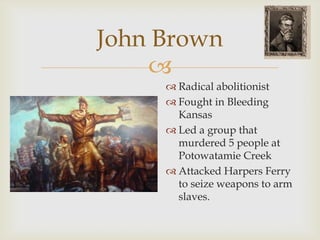
John Brown
 Radical abolitionist
 Fought in Bleeding
Kansas
 Led a group that
murdered 5 people at
Potowatamie Creek
 Attacked Harpers Ferry
to seize weapons to arm
slaves.

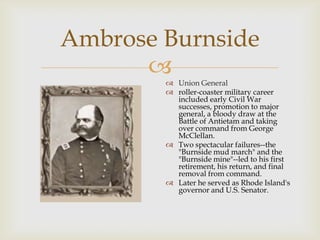
Ambrose Burnside
 Union General
 roller-coaster military career
included early Civil War
successes, promotion to major
general, a bloody draw at the
Battle of Antietam and taking
over command from George
McClellan.
 Two spectacular failures--the
"Burnside mud march" and the
"Burnside mine"--led to his first
retirement, his return, and final
removal from command.
 Later he served as Rhode Island's
governor and U.S. Senator.

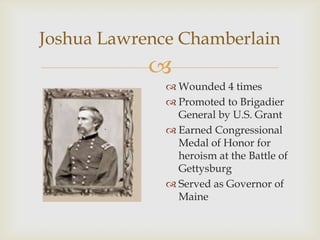
Joshua Lawrence Chamberlain
 Wounded 4 times
 Promoted to Brigadier
General by U.S. Grant
 Earned Congressional
Medal of Honor for
heroism at the Battle of
Gettysburg
 Served as Governor of
Maine

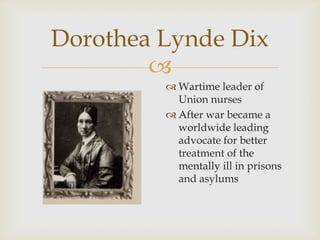
Dorothea Lynde Dix
 Wartime leader of
Union nurses
 After war became a
worldwide leading
advocate for better
treatment of the
mentally ill in prisons
and asylums

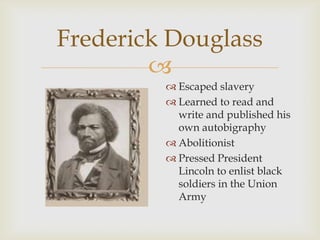
Frederick Douglass
 Escaped slavery
 Learned to read and
write and published his
own autobigraphy
 Abolitionist
 Pressed President
Lincoln to enlist black
soldiers in the Union
Army

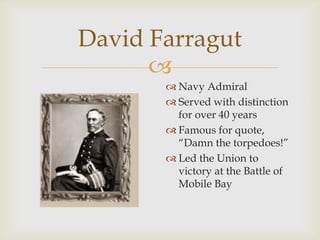
David Farragut
 Navy Admiral
 Served with distinction
for over 40 years
 Famous for quote,
“Damn the torpedoes!”
 Led the Union to
victory at the Battle of
Mobile Bay

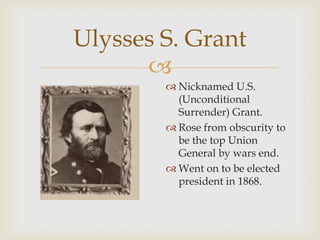
Ulysses S. Grant
 Nicknamed U.S.
(Unconditional
Surrender) Grant.
 Rose from obscurity to
be the top Union
General by wars end.
 Went on to be elected
president in 1868.

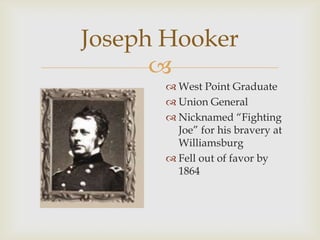
Joseph Hooker
 West Point Graduate
 Union General
 Nicknamed “Fighting
Joe” for his bravery at
Williamsburg
 Fell out of favor by
1864

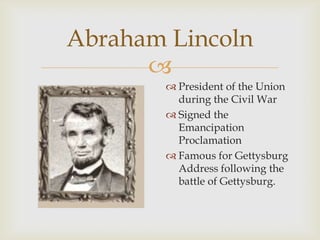
Abraham Lincoln
 President of the Union
during the Civil War
 Signed the
Emancipation
Proclamation
 Famous for Gettysburg
Address following the
battle of Gettysburg.

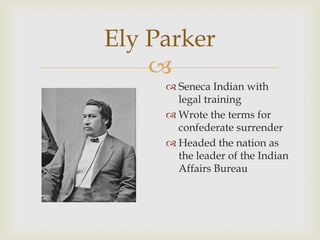
Ely Parker
 Seneca Indian with
legal training
 Wrote the terms for
confederate surrender
 Headed the nation as
the leader of the Indian
Affairs Bureau

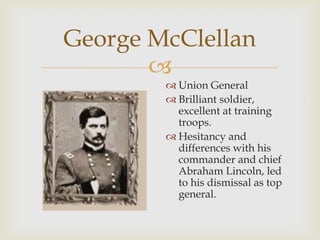
George McClellan
 Union General
 Brilliant soldier,
excellent at training
troops.
 Hesitancy and
differences with his
commander and chief
Abraham Lincoln, led
to his dismissal as top
general.

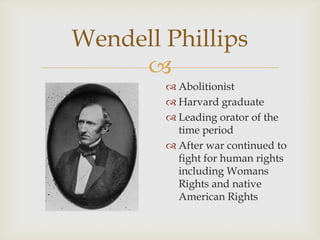
Wendell Phillips
 Abolitionist
 Harvard graduate
 Leading orator of the
time period
 After war continued to
fight for human rights
including Womans
Rights and native
American Rights

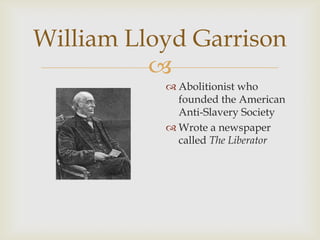
William Lloyd Garrison
 Abolitionist who
founded the American
Anti-Slavery Society
 Wrote a newspaper
called The Liberator

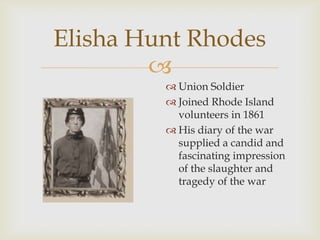
Elisha Hunt Rhodes
 Union Soldier
 Joined Rhode Island
volunteers in 1861
 His diary of the war
supplied a candid and
fascinating impression
of the slaughter and
tragedy of the war

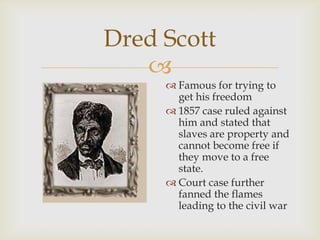
Dred Scott
 Famous for trying to
get his freedom
 1857 case ruled against
him and stated that
slaves are property and
cannot become free if
they move to a free
state.
 Court case further
fanned the flames
leading to the civil war

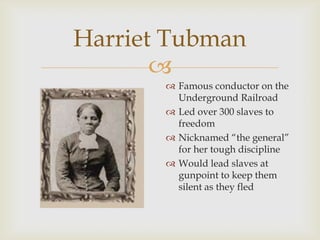
Harriet Tubman
 Famous conductor on the
Underground Railroad
 Led over 300 slaves to
freedom
 Nicknamed “the general”
for her tough discipline
 Would lead slaves at
gunpoint to keep them
silent as they fled

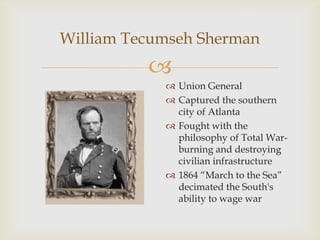
William Tecumseh Sherman
 Union General
 Captured the southern
city of Atlanta
 Fought with the
philosophy of Total War-
burning and destroying
civilian infrastructure
 1864 “March to the Sea”
decimated the South's
ability to wage war

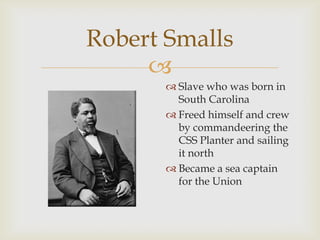
Robert Smalls
 Slave who was born in
South Carolina
 Freed himself and crew
by commandeering the
CSS Planter and sailing
it north
 Became a sea captain
for the Union

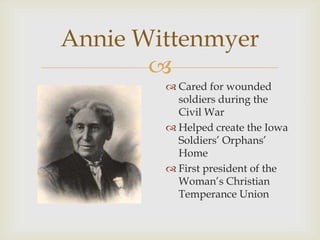
Annie Wittenmyer
 Cared for wounded
soldiers during the
Civil War
 Helped create the Iowa
Soldiers’ Orphans’
Home
 First president of the
Woman’s Christian
Temperance Union

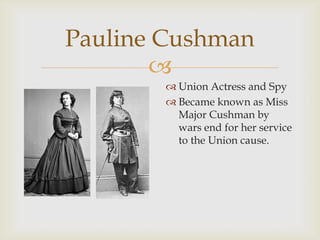
Pauline Cushman
 Union Actress and Spy
 Became known as Miss
Major Cushman by
wars end for her service
to the Union cause.

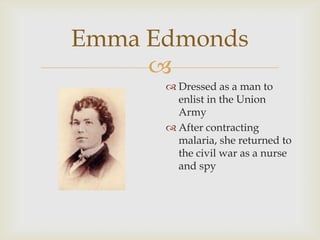
Emma Edmonds
 Dressed as a man to
enlist in the Union
Army
 After contracting
malaria, she returned to
the civil war as a nurse
and spy

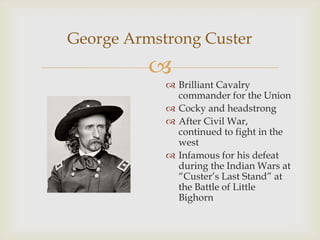
George Armstrong Custer
 Brilliant Cavalry
commander for the Union
 Cocky and headstrong
 After Civil War,
continued to fight in the
west
 Infamous for his defeat
during the Indian Wars at
“Custer’s Last Stand” at
the Battle of Little
Bighorn

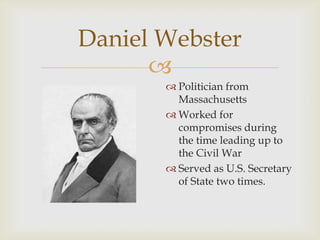
Daniel Webster
 Politician from
Massachusetts
 Worked for
compromises during
the time leading up to
the Civil War
 Served as U.S. Secretary
of State two times.

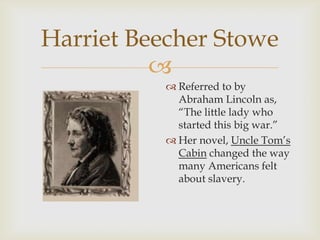
Harriet Beecher Stowe
 Referred to by
Abraham Lincoln as,
“The little lady who
started this big war.”
 Her novel, Uncle Tom’s
Cabin changed the way
many Americans felt
about slavery.

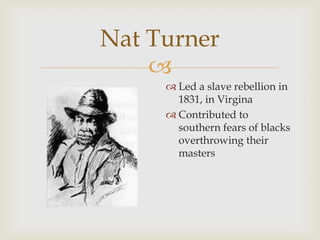
Nat Turner
 Led a slave rebellion in
1831, in Virgina
 Contributed to
southern fears of blacks
overthrowing their
masters
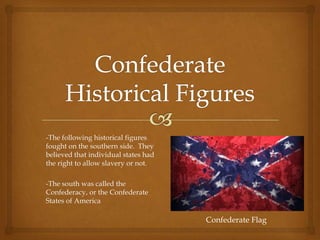
-The following historical figures
fought on the southern side. They
believed that individual states had
the right to allow slavery or not.
-The south was called the
Confederacy, or the Confederate
States of America
Confederate Flag

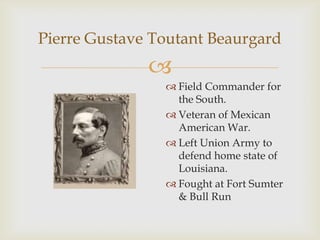
Pierre Gustave Toutant Beaurgard
 Field Commander for
the South.
 Veteran of Mexican
American War.
 Left Union Army to
defend home state of
Louisiana.
 Fought at Fort Sumter
& Bull Run

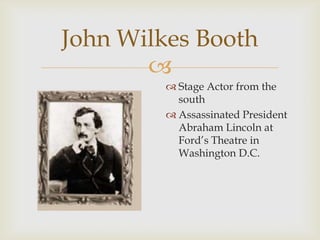
John Wilkes Booth
 Stage Actor from the
south
 Assassinated President
Abraham Lincoln at
Ford’s Theatre in
Washington D.C.

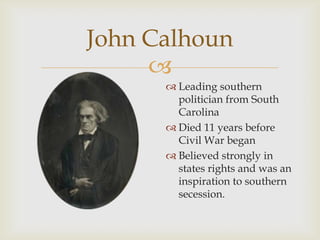
John Calhoun
 Leading southern
politician from South
Carolina
 Died 11 years before
Civil War began
 Believed strongly in
states rights and was an
inspiration to southern
secession.

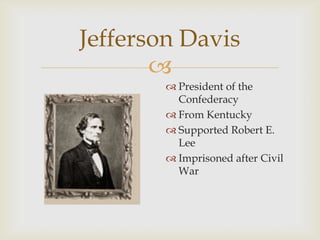
Jefferson Davis
 President of the
Confederacy
 From Kentucky
 Supported Robert E.
Lee
 Imprisoned after Civil
War

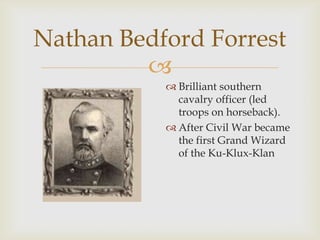
Nathan Bedford Forrest
 Brilliant southern
cavalry officer (led
troops on horseback).
 After Civil War became
the first Grand Wizard
of the Ku-Klux-Klan

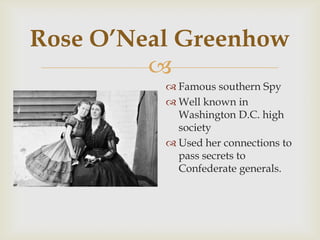
Rose O’Neal Greenhow
 Famous southern Spy
 Well known in
Washington D.C. high
society
 Used her connections to
pass secrets to
Confederate generals.

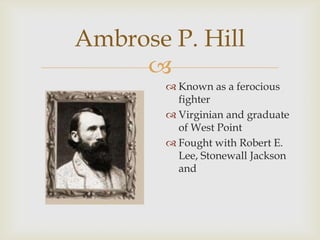
Ambrose P. Hill
 Known as a ferocious
fighter
 Virginian and graduate
of West Point
 Fought with Robert E.
Lee, Stonewall Jackson
and

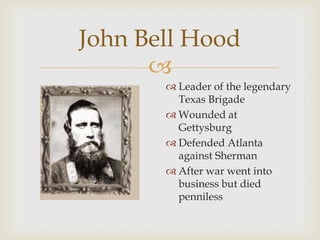
John Bell Hood
 Leader of the legendary
Texas Brigade
 Wounded at
Gettysburg
 Defended Atlanta
against Sherman
 After war went into
business but died
penniless

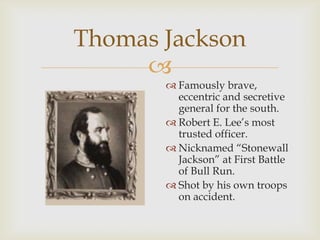
Thomas Jackson
 Famously brave,
eccentric and secretive
general for the south.
 Robert E. Lee’s most
trusted officer.
 Nicknamed “Stonewall
Jackson” at First Battle
of Bull Run.
 Shot by his own troops
on accident.

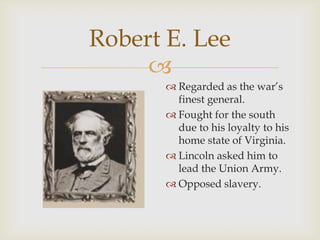
Robert E. Lee
 Regarded as the war’s
finest general.
 Fought for the south
due to his loyalty to his
home state of Virginia.
 Lincoln asked him to
lead the Union Army.
 Opposed slavery.

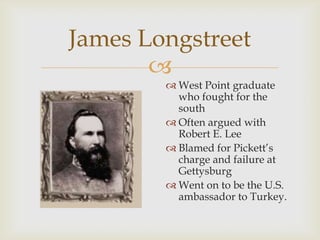
James Longstreet
 West Point graduate
who fought for the
south
 Often argued with
Robert E. Lee
 Blamed for Pickett’s
charge and failure at
Gettysburg
 Went on to be the U.S.
ambassador to Turkey.

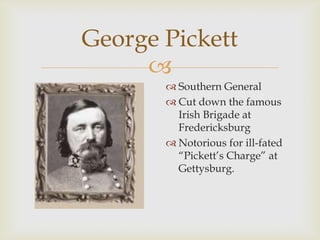
George Pickett
 Southern General
 Cut down the famous
Irish Brigade at
Fredericksburg
 Notorious for ill-fated
“Pickett’s Charge” at
Gettysburg.

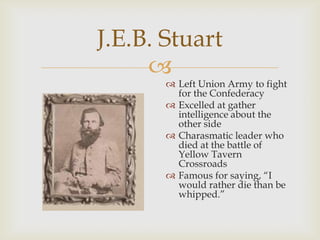
J.E.B. Stuart
 Left Union Army to fight
for the Confederacy
 Excelled at gather
intelligence about the
other side
 Charasmatic leader who
died at the battle of
Yellow Tavern
Crossroads
 Famous for saying, “I
would rather die than be
whipped.”

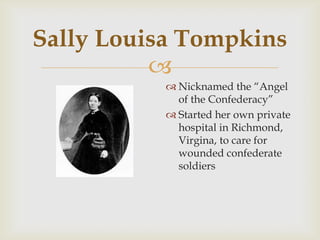
Sally Louisa Tompkins
 Nicknamed the “Angel
of the Confederacy”
 Started her own private
hospital in Richmond,
Virgina, to care for
wounded confederate
soldiers

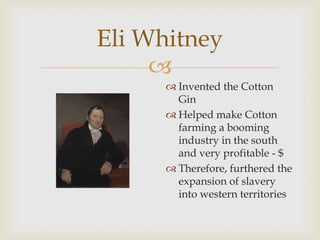
Eli Whitney
 Invented the Cotton
Gin
 Helped make Cotton
farming a booming
industry in the south
and very profitable - $
 Therefore, furthered the
expansion of slavery
into western territories

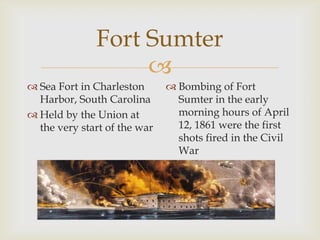
Fort Sumter
 Sea Fort in Charleston
Harbor, South Carolina
 Held by the Union at
the very start of the war
 Bombing of Fort
Sumter in the early
morning hours of April
12, 1861 were the first
shots fired in the Civil
War

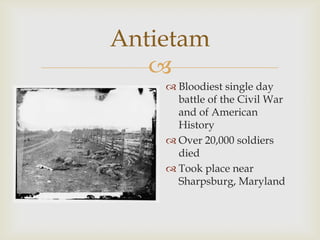
Antietam
 Bloodiest single day
battle of the Civil War
and of American
History
 Over 20,000 soldiers
died
 Took place near
Sharpsburg, Maryland

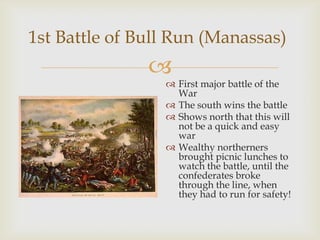
1st Battle of Bull Run (Manassas)
 First major battle of the
War
 The south wins the battle
 Shows north that this will
not be a quick and easy
war
 Wealthy northerners
brought picnic lunches to
watch the battle, until the
confederates broke
through the line, when
they had to run for safety!

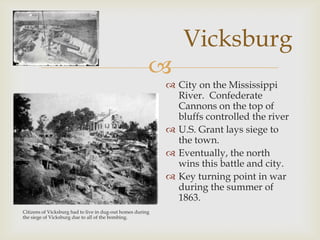
Vicksburg
Citizens of Vicksburg had to live in dug-out homes during
the siege of Vicksburg due to all of the bombing.
 City on the Mississippi
River. Confederate
Cannons on the top of
bluffs controlled the river
 U.S. Grant lays siege to
the town.
 Eventually, the north
wins this battle and city.
 Key turning point in war
during the summer of
1863.

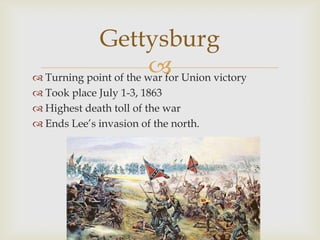
Gettysburg
 Turning point of the war for Union victory
 Took place July 1-3, 1863
 Highest death toll of the war
 Ends Lee’s invasion of the north.

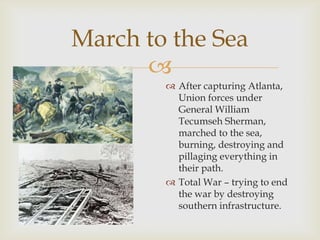
March to the Sea
 After capturing Atlanta,
Union forces under
General William
Tecumseh Sherman,
marched to the sea,
burning, destroying and
pillaging everything in
their path.
 Total War – trying to end
the war by destroying
southern infrastructure.

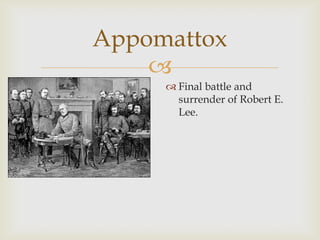
Appomattox
 Final battle and
surrender of Robert E.
Lee.

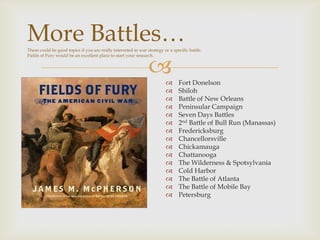
More Battles…These could be good topics if you are really interested in war strategy or a specific battle.
Fields of Fury would be an excellent place to start your research.
 Fort Donelson
 Shiloh
 Battle of New Orleans
 Peninsular Campaign
 Seven Days Battles
 2nd Battle of Bull Run (Manassas)
 Fredericksburg
 Chancellorsville
 Chickamauga
 Chattanooga
 The Wilderness & Spotsylvania
 Cold Harbor
 The Battle of Atlanta
 The Battle of Mobile Bay
 Petersburg

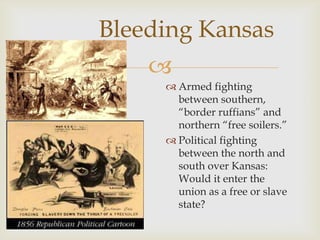
Bleeding Kansas
 Armed fighting
between southern,
“border ruffians” and
northern “free soilers.”
 Political fighting
between the north and
south over Kansas:
Would it enter the
union as a free or slave
state?

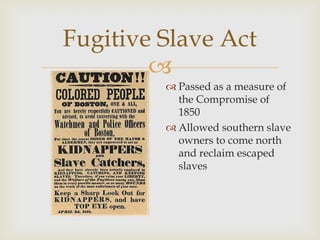
Fugitive Slave Act
 Passed as a measure of
the Compromise of
1850
 Allowed southern slave
owners to come north
and reclaim escaped
slaves

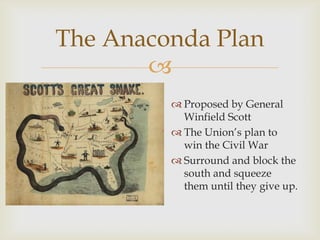
The Anaconda Plan
 Proposed by General
Winfield Scott
 The Union’s plan to
win the Civil War
 Surround and block the
south and squeeze
them until they give up.

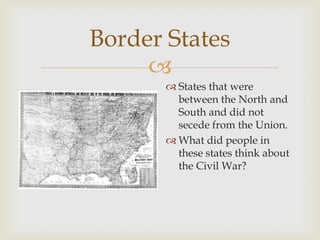
Border States
 States that were
between the North and
South and did not
secede from the Union.
 What did people in
these states think about
the Civil War?

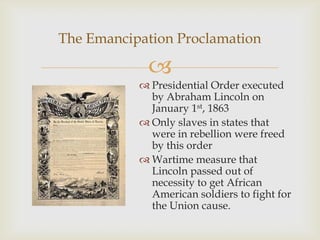
The Emancipation Proclamation
 Presidential Order executed
by Abraham Lincoln on
January 1st, 1863
 Only slaves in states that
were in rebellion were freed
by this order
 Wartime measure that
Lincoln passed out of
necessity to get African
American soldiers to fight for
the Union cause.

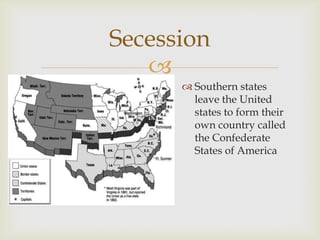
Secession
 Southern states
leave the United
states to form their
own country called
the Confederate
States of America

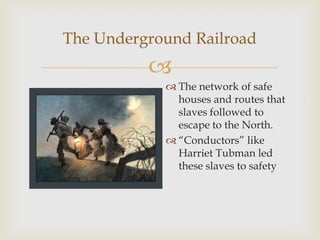
The Underground Railroad
 The network of safe
houses and routes that
slaves followed to
escape to the North.
 “Conductors” like
Harriet Tubman led
these slaves to safety

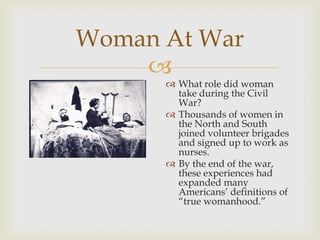
Woman At War
 What role did woman
take during the Civil
War?
 Thousands of women in
the North and South
joined volunteer brigades
and signed up to work as
nurses.
 By the end of the war,
these experiences had
expanded many
Americans’ definitions of
“true womanhood.”

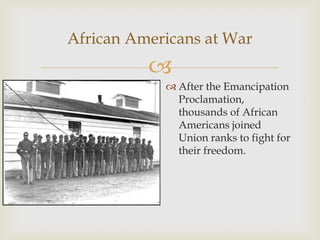
African Americans at War
 After the Emancipation
Proclamation,
thousands of African
Americans joined
Union ranks to fight for
their freedom.

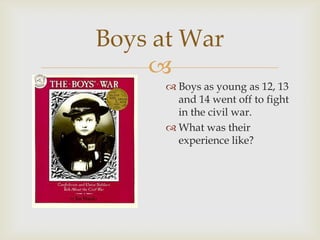
Boys at War
 Boys as young as 12, 13
and 14 went off to fight
in the civil war.
 What was their
experience like?

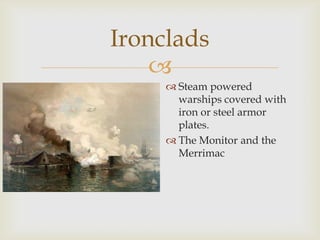
Ironclads
 Steam powered
warships covered with
iron or steel armor
plates.
 The Monitor and the
Merrimac

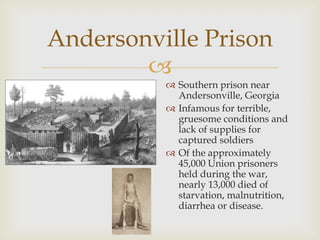
Andersonville Prison
 Southern prison near
Andersonville, Georgia
 Infamous for terrible,
gruesome conditions and
lack of supplies for
captured soldiers
 Of the approximately
45,000 Union prisoners
held during the war,
nearly 13,000 died of
starvation, malnutrition,
diarrhea or disease.

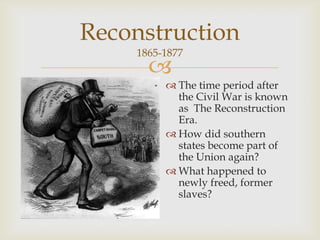
Reconstruction
1865-1877
 The time period after
the Civil War is known
as The Reconstruction
Era.
 How did southern
states become part of
the Union again?
 What happened to
newly freed, former
slaves?

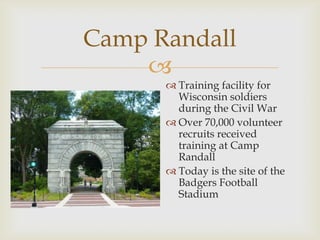
Camp Randall
 Training facility for
Wisconsin soldiers
during the Civil War
 Over 70,000 volunteer
recruits received
training at Camp
Randall
 Today is the site of the
Badgers Football
Stadium

Wisconsin Volunteers
 During its four long
years, more than 90,000
Wisconsin soldiers
fought for the Union
cause.
 Do you have an
ancestor who fought for
the Union?
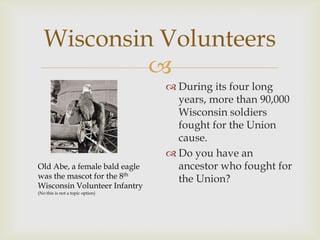
Old Abe, a female bald eagle
was the mascot for the 8th
Wisconsin Volunteer Infantry
(No this is not a topic option)

Sources
Pictures and information gathered from:
 http://www.pbs.org/civilwar/war/
 http://en.wikipedia.org/wiki/American_Civil_War

The civil war topic power point

  • 1.
    Selecting a ResearchTopic : The Multi-Genre Project
  • 2.
      Over thenext month, you will be focusing your research on a single person or event from the Civil War Era.  Therefore, you must pick a topic that genuinely piques your interest.  You will spend a lot of energy becoming an expert on your topic in order to build historical empathy. What was it like to walk in their shoes? What influenced their actions? Or, how did the battle or event influence the outcome of the war? Why Topic Selection is So Important:
  • 3.
      After lookingat the following slides, your task is to rank your top 3 choices for research topics.  You will need to defend your reasons for picking your topic to your teacher.  Ask Yourself:  What really captures my interests?  Will I be motivated to spend an extended amount of time studying this topic?  Is it something that is important to me?  Why is this topic fascinating to me? Defend Your Choice
  • 4.
     The nation was splitbetween the north (UNION) and the south (CONFEDERATE) Border states were slave states that did not leave the union. People in these states fought on both sides. Civil War Map
  • 5.
    - What startedas a war to preserve the Union, and keep all the United States together changed over time into a war to end slavery. - These individuals fought, worked, gave speeches, wrote articles, nursed, spied and helped the on the side of the Union. - An abolitionist is a person who wanted to outlaw and end slavery. Not everyone in the north, however, held the same views on slavery.
  • 6.
     Clara Barton  Nicknamed,"the angel of the battlefield," Clara Barton began attending to wounded Union soldiers after the early losses at Bull Run  Her courage in the face of danger soon became legendary.  Barton began organizing donations and distributing necessary medicines and materials.  Years later, she went on to found the American Red Cross.
  • 7.
     Mary Ann Bickerdyke Came to be known as “Mother Bickerdyke”  Hospital Administrator  Talents ranged from brewing coffee for her “boys” to assisting with amputations  Legendary for ability to scrounge together supplies
  • 8.
     Matthew Brady  Premierphotographer of the Civil War  Father of photojournalism  Took thousands of pictures during the Civil War  His photos have helped us understand the war
  • 9.
     John Brown  Radicalabolitionist  Fought in Bleeding Kansas  Led a group that murdered 5 people at Potowatamie Creek  Attacked Harpers Ferry to seize weapons to arm slaves.
  • 10.
     Ambrose Burnside  UnionGeneral  roller-coaster military career included early Civil War successes, promotion to major general, a bloody draw at the Battle of Antietam and taking over command from George McClellan.  Two spectacular failures--the "Burnside mud march" and the "Burnside mine"--led to his first retirement, his return, and final removal from command.  Later he served as Rhode Island's governor and U.S. Senator.
  • 11.
     Joshua Lawrence Chamberlain Wounded 4 times  Promoted to Brigadier General by U.S. Grant  Earned Congressional Medal of Honor for heroism at the Battle of Gettysburg  Served as Governor of Maine
  • 12.
     Dorothea Lynde Dix Wartime leader of Union nurses  After war became a worldwide leading advocate for better treatment of the mentally ill in prisons and asylums
  • 13.
     Frederick Douglass  Escapedslavery  Learned to read and write and published his own autobigraphy  Abolitionist  Pressed President Lincoln to enlist black soldiers in the Union Army
  • 14.
     David Farragut  NavyAdmiral  Served with distinction for over 40 years  Famous for quote, “Damn the torpedoes!”  Led the Union to victory at the Battle of Mobile Bay
  • 15.
     Ulysses S. Grant Nicknamed U.S. (Unconditional Surrender) Grant.  Rose from obscurity to be the top Union General by wars end.  Went on to be elected president in 1868.
  • 16.
     Joseph Hooker  WestPoint Graduate  Union General  Nicknamed “Fighting Joe” for his bravery at Williamsburg  Fell out of favor by 1864
  • 17.
     Abraham Lincoln  Presidentof the Union during the Civil War  Signed the Emancipation Proclamation  Famous for Gettysburg Address following the battle of Gettysburg.
  • 18.
     Ely Parker  SenecaIndian with legal training  Wrote the terms for confederate surrender  Headed the nation as the leader of the Indian Affairs Bureau
  • 19.
     George McClellan  UnionGeneral  Brilliant soldier, excellent at training troops.  Hesitancy and differences with his commander and chief Abraham Lincoln, led to his dismissal as top general.
  • 20.
     Wendell Phillips  Abolitionist Harvard graduate  Leading orator of the time period  After war continued to fight for human rights including Womans Rights and native American Rights
  • 21.
     William Lloyd Garrison Abolitionist who founded the American Anti-Slavery Society  Wrote a newspaper called The Liberator
  • 22.
     Elisha Hunt Rhodes Union Soldier  Joined Rhode Island volunteers in 1861  His diary of the war supplied a candid and fascinating impression of the slaughter and tragedy of the war
  • 23.
     Dred Scott  Famousfor trying to get his freedom  1857 case ruled against him and stated that slaves are property and cannot become free if they move to a free state.  Court case further fanned the flames leading to the civil war
  • 24.
     Harriet Tubman  Famousconductor on the Underground Railroad  Led over 300 slaves to freedom  Nicknamed “the general” for her tough discipline  Would lead slaves at gunpoint to keep them silent as they fled
  • 25.
     William Tecumseh Sherman Union General  Captured the southern city of Atlanta  Fought with the philosophy of Total War- burning and destroying civilian infrastructure  1864 “March to the Sea” decimated the South's ability to wage war
  • 26.
     Robert Smalls  Slavewho was born in South Carolina  Freed himself and crew by commandeering the CSS Planter and sailing it north  Became a sea captain for the Union
  • 27.
     Annie Wittenmyer  Caredfor wounded soldiers during the Civil War  Helped create the Iowa Soldiers’ Orphans’ Home  First president of the Woman’s Christian Temperance Union
  • 28.
     Pauline Cushman  UnionActress and Spy  Became known as Miss Major Cushman by wars end for her service to the Union cause.
  • 29.
     Emma Edmonds  Dressedas a man to enlist in the Union Army  After contracting malaria, she returned to the civil war as a nurse and spy
  • 30.
     George Armstrong Custer Brilliant Cavalry commander for the Union  Cocky and headstrong  After Civil War, continued to fight in the west  Infamous for his defeat during the Indian Wars at “Custer’s Last Stand” at the Battle of Little Bighorn
  • 31.
     Daniel Webster  Politicianfrom Massachusetts  Worked for compromises during the time leading up to the Civil War  Served as U.S. Secretary of State two times.
  • 32.
     Harriet Beecher Stowe Referred to by Abraham Lincoln as, “The little lady who started this big war.”  Her novel, Uncle Tom’s Cabin changed the way many Americans felt about slavery.
  • 33.
     Nat Turner  Leda slave rebellion in 1831, in Virgina  Contributed to southern fears of blacks overthrowing their masters
  • 34.
    -The following historicalfigures fought on the southern side. They believed that individual states had the right to allow slavery or not. -The south was called the Confederacy, or the Confederate States of America Confederate Flag
  • 35.
     Pierre Gustave ToutantBeaurgard  Field Commander for the South.  Veteran of Mexican American War.  Left Union Army to defend home state of Louisiana.  Fought at Fort Sumter & Bull Run
  • 36.
     John Wilkes Booth Stage Actor from the south  Assassinated President Abraham Lincoln at Ford’s Theatre in Washington D.C.
  • 37.
     John Calhoun  Leadingsouthern politician from South Carolina  Died 11 years before Civil War began  Believed strongly in states rights and was an inspiration to southern secession.
  • 38.
     Jefferson Davis  Presidentof the Confederacy  From Kentucky  Supported Robert E. Lee  Imprisoned after Civil War
  • 39.
     Nathan Bedford Forrest Brilliant southern cavalry officer (led troops on horseback).  After Civil War became the first Grand Wizard of the Ku-Klux-Klan
  • 40.
     Rose O’Neal Greenhow Famous southern Spy  Well known in Washington D.C. high society  Used her connections to pass secrets to Confederate generals.
  • 41.
     Ambrose P. Hill Known as a ferocious fighter  Virginian and graduate of West Point  Fought with Robert E. Lee, Stonewall Jackson and
  • 42.
     John Bell Hood Leader of the legendary Texas Brigade  Wounded at Gettysburg  Defended Atlanta against Sherman  After war went into business but died penniless
  • 43.
     Thomas Jackson  Famouslybrave, eccentric and secretive general for the south.  Robert E. Lee’s most trusted officer.  Nicknamed “Stonewall Jackson” at First Battle of Bull Run.  Shot by his own troops on accident.
  • 44.
     Robert E. Lee Regarded as the war’s finest general.  Fought for the south due to his loyalty to his home state of Virginia.  Lincoln asked him to lead the Union Army.  Opposed slavery.
  • 45.
     James Longstreet  WestPoint graduate who fought for the south  Often argued with Robert E. Lee  Blamed for Pickett’s charge and failure at Gettysburg  Went on to be the U.S. ambassador to Turkey.
  • 46.
     George Pickett  SouthernGeneral  Cut down the famous Irish Brigade at Fredericksburg  Notorious for ill-fated “Pickett’s Charge” at Gettysburg.
  • 47.
     J.E.B. Stuart  LeftUnion Army to fight for the Confederacy  Excelled at gather intelligence about the other side  Charasmatic leader who died at the battle of Yellow Tavern Crossroads  Famous for saying, “I would rather die than be whipped.”
  • 48.
     Sally Louisa Tompkins Nicknamed the “Angel of the Confederacy”  Started her own private hospital in Richmond, Virgina, to care for wounded confederate soldiers
  • 49.
     Eli Whitney  Inventedthe Cotton Gin  Helped make Cotton farming a booming industry in the south and very profitable - $  Therefore, furthered the expansion of slavery into western territories
  • 51.
     Fort Sumter  SeaFort in Charleston Harbor, South Carolina  Held by the Union at the very start of the war  Bombing of Fort Sumter in the early morning hours of April 12, 1861 were the first shots fired in the Civil War
  • 52.
     Antietam  Bloodiest singleday battle of the Civil War and of American History  Over 20,000 soldiers died  Took place near Sharpsburg, Maryland
  • 53.
     1st Battle ofBull Run (Manassas)  First major battle of the War  The south wins the battle  Shows north that this will not be a quick and easy war  Wealthy northerners brought picnic lunches to watch the battle, until the confederates broke through the line, when they had to run for safety!
  • 54.
     Vicksburg Citizens of Vicksburghad to live in dug-out homes during the siege of Vicksburg due to all of the bombing.  City on the Mississippi River. Confederate Cannons on the top of bluffs controlled the river  U.S. Grant lays siege to the town.  Eventually, the north wins this battle and city.  Key turning point in war during the summer of 1863.
  • 55.
     Gettysburg  Turning pointof the war for Union victory  Took place July 1-3, 1863  Highest death toll of the war  Ends Lee’s invasion of the north.
  • 56.
     March to theSea  After capturing Atlanta, Union forces under General William Tecumseh Sherman, marched to the sea, burning, destroying and pillaging everything in their path.  Total War – trying to end the war by destroying southern infrastructure.
  • 57.
     Appomattox  Final battleand surrender of Robert E. Lee.
  • 58.
     More Battles…These couldbe good topics if you are really interested in war strategy or a specific battle. Fields of Fury would be an excellent place to start your research.  Fort Donelson  Shiloh  Battle of New Orleans  Peninsular Campaign  Seven Days Battles  2nd Battle of Bull Run (Manassas)  Fredericksburg  Chancellorsville  Chickamauga  Chattanooga  The Wilderness & Spotsylvania  Cold Harbor  The Battle of Atlanta  The Battle of Mobile Bay  Petersburg
  • 60.
     Bleeding Kansas  Armedfighting between southern, “border ruffians” and northern “free soilers.”  Political fighting between the north and south over Kansas: Would it enter the union as a free or slave state?
  • 61.
     Fugitive Slave Act Passed as a measure of the Compromise of 1850  Allowed southern slave owners to come north and reclaim escaped slaves
  • 62.
     The Anaconda Plan Proposed by General Winfield Scott  The Union’s plan to win the Civil War  Surround and block the south and squeeze them until they give up.
  • 63.
     Border States  Statesthat were between the North and South and did not secede from the Union.  What did people in these states think about the Civil War?
  • 64.
     The Emancipation Proclamation Presidential Order executed by Abraham Lincoln on January 1st, 1863  Only slaves in states that were in rebellion were freed by this order  Wartime measure that Lincoln passed out of necessity to get African American soldiers to fight for the Union cause.
  • 65.
     Secession  Southern states leavethe United states to form their own country called the Confederate States of America
  • 66.
     The Underground Railroad The network of safe houses and routes that slaves followed to escape to the North.  “Conductors” like Harriet Tubman led these slaves to safety
  • 67.
     Woman At War What role did woman take during the Civil War?  Thousands of women in the North and South joined volunteer brigades and signed up to work as nurses.  By the end of the war, these experiences had expanded many Americans’ definitions of “true womanhood.”
  • 68.
     African Americans atWar  After the Emancipation Proclamation, thousands of African Americans joined Union ranks to fight for their freedom.
  • 69.
     Boys at War Boys as young as 12, 13 and 14 went off to fight in the civil war.  What was their experience like?
  • 70.
     Ironclads  Steam powered warshipscovered with iron or steel armor plates.  The Monitor and the Merrimac
  • 71.
     Andersonville Prison  Southernprison near Andersonville, Georgia  Infamous for terrible, gruesome conditions and lack of supplies for captured soldiers  Of the approximately 45,000 Union prisoners held during the war, nearly 13,000 died of starvation, malnutrition, diarrhea or disease.
  • 72.
     Reconstruction 1865-1877  The timeperiod after the Civil War is known as The Reconstruction Era.  How did southern states become part of the Union again?  What happened to newly freed, former slaves?
  • 73.
     Camp Randall  Trainingfacility for Wisconsin soldiers during the Civil War  Over 70,000 volunteer recruits received training at Camp Randall  Today is the site of the Badgers Football Stadium
  • 74.
     Wisconsin Volunteers  Duringits four long years, more than 90,000 Wisconsin soldiers fought for the Union cause.  Do you have an ancestor who fought for the Union? Old Abe, a female bald eagle was the mascot for the 8th Wisconsin Volunteer Infantry (No this is not a topic option)
  • 75.
     Sources Pictures and informationgathered from:  http://www.pbs.org/civilwar/war/  http://en.wikipedia.org/wiki/American_Civil_War