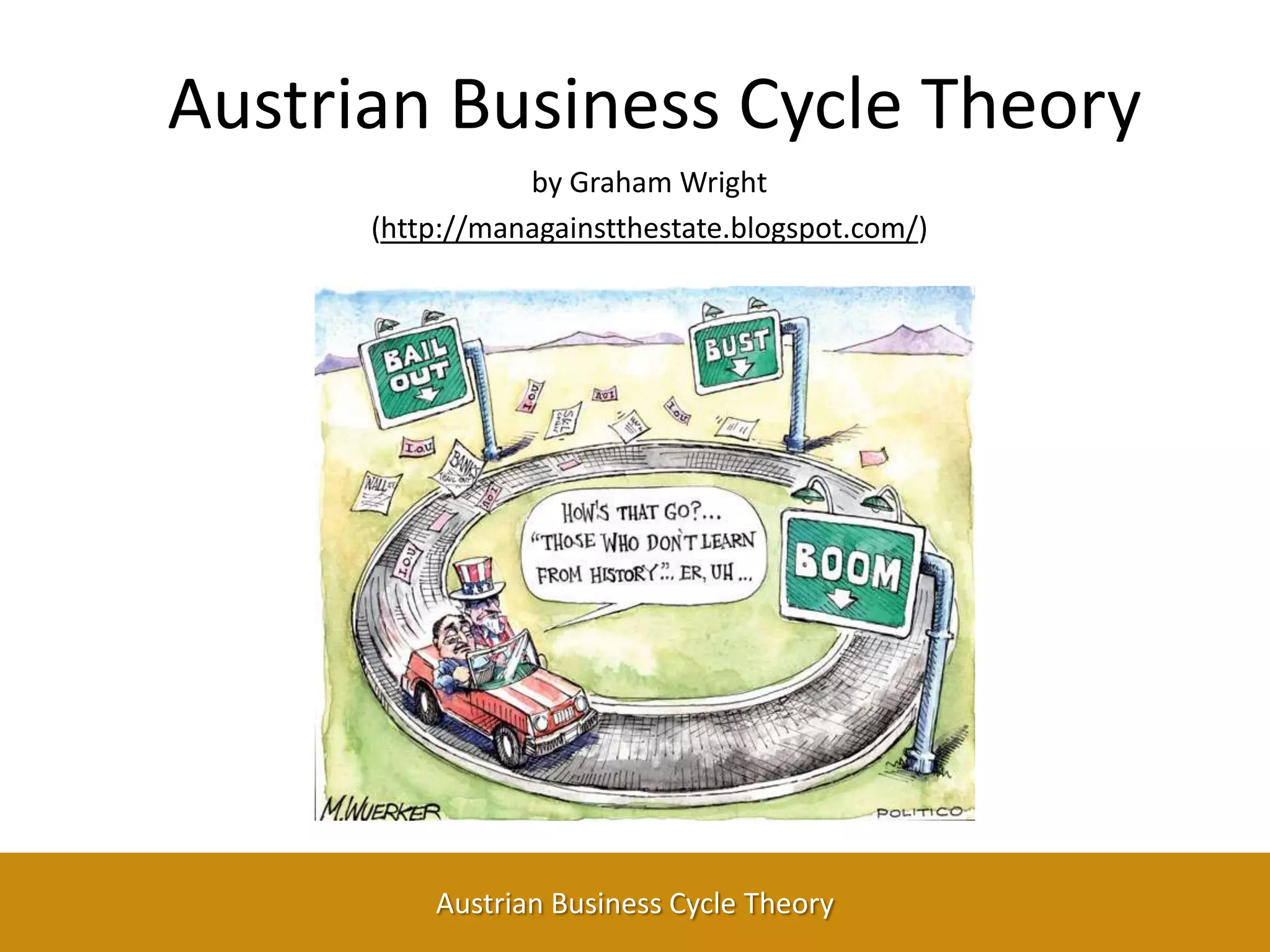
Austrian Business Cycle Theory - How Government Manipulation of Interest Rates Causes Booms, Busts, Recessions and Depressions
The Austrian Business Cycle Theory, developed by Ludwig von Mises and F.A. Hayek, explains how government intervention in the economy leads to misallocation of resources and recurrent business cycles, emphasizing that a free market self-regulates through price signals. It argues that artificially low interest rates create malinvestments, resulting in boom-bust cycles where the market eventually corrects through recessions. Historical examples illustrate that less government intervention allows for quicker recoveries from economic downturns.
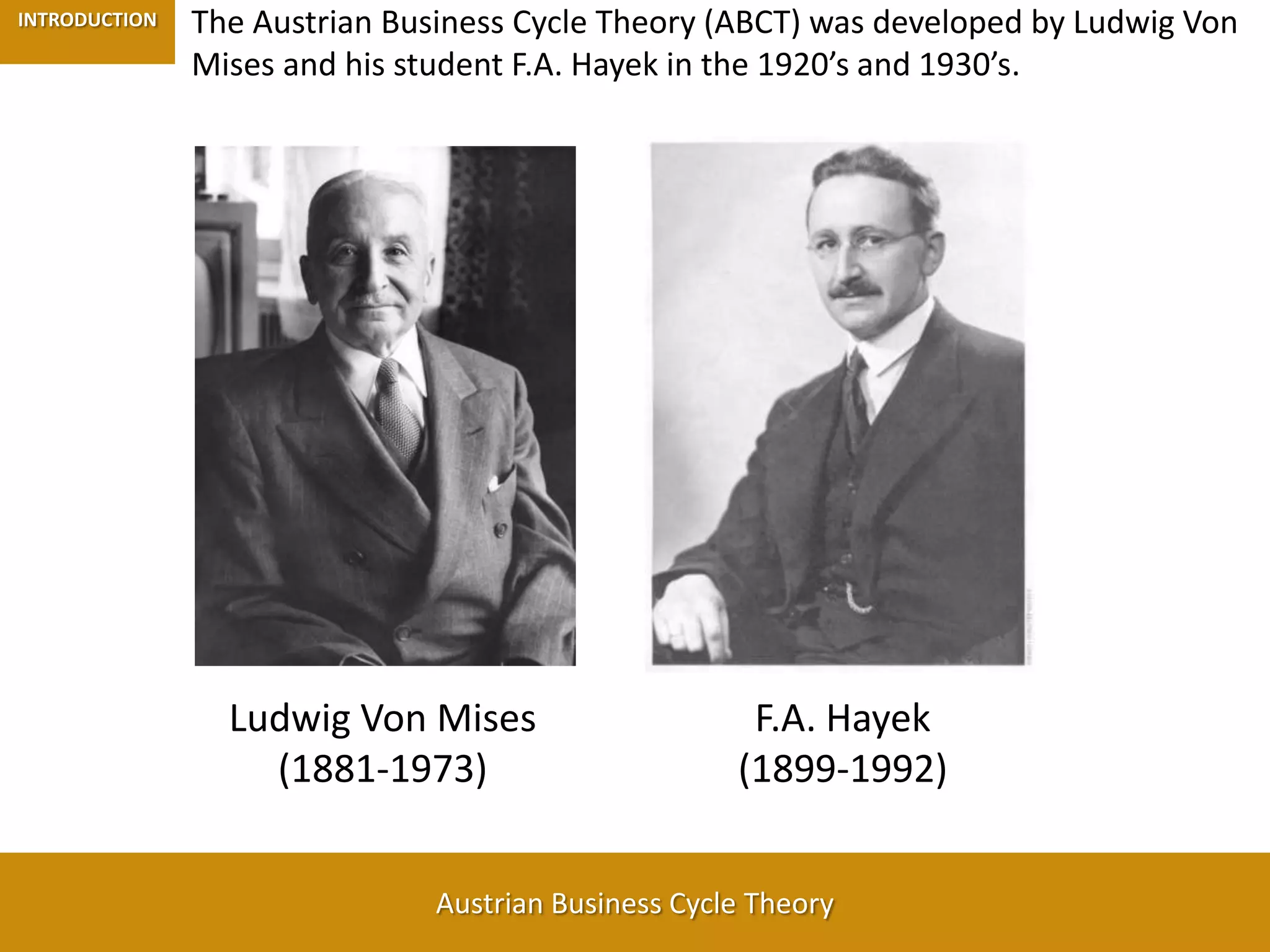
The Austrian BusinessCycle Theory (ABCT) was developed by Ludwig Von Mises and his student F.A. Hayek in the 1920’s and 1930’s. INTRODUCTIONLudwig Von Mises (1881-1973)F.A. Hayek(1899-1992)
3.
Agenda“Before we canmeaningfully ask what might go wrong, we should first understand how things could ever go right.”“How Things Go Right”: Prices and ProductionAustrians and Keynesians on Business CyclesAustrian Theory of the Boom and the BustIn a recession, what can government do to help?
4.
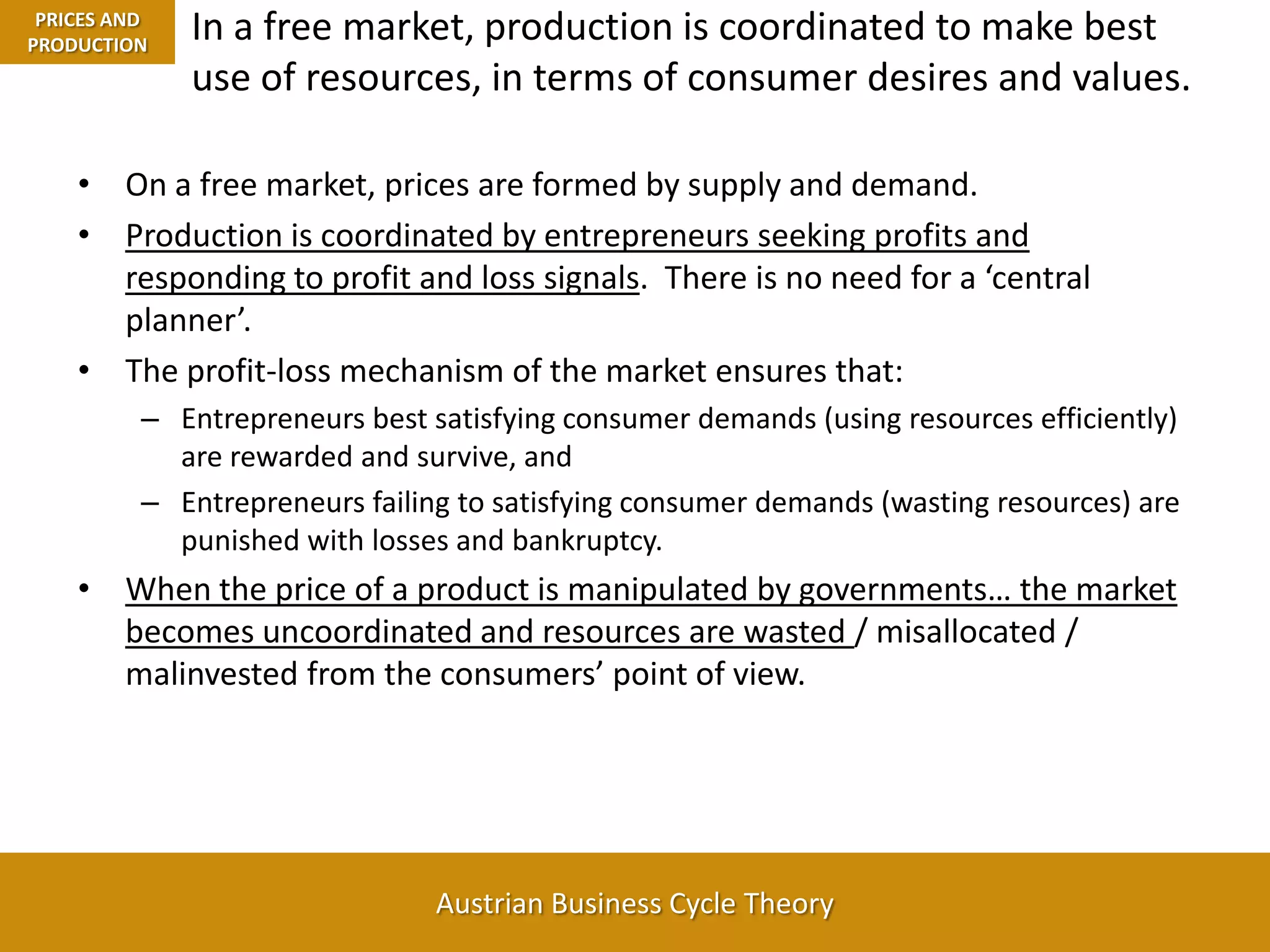
In a freemarket, production is coordinated to make best use of resources, in terms of consumer desires and values.PRICES AND PRODUCTIONOn a free market, prices are formed by supply and demand.Production is coordinated by entrepreneurs seeking profits and responding to profit and loss signals. There is no need for a ‘central planner’.The profit-loss mechanism of the market ensures that:Entrepreneurs best satisfying consumer demands (using resources efficiently) are rewarded and survive, and Entrepreneurs failing to satisfying consumer demands (wasting resources) are punished with losses and bankruptcy.When the price of a product is manipulated by governments… the market becomes uncoordinated and resources are wasted / misallocated / malinvested from the consumers’ point of view.
5.
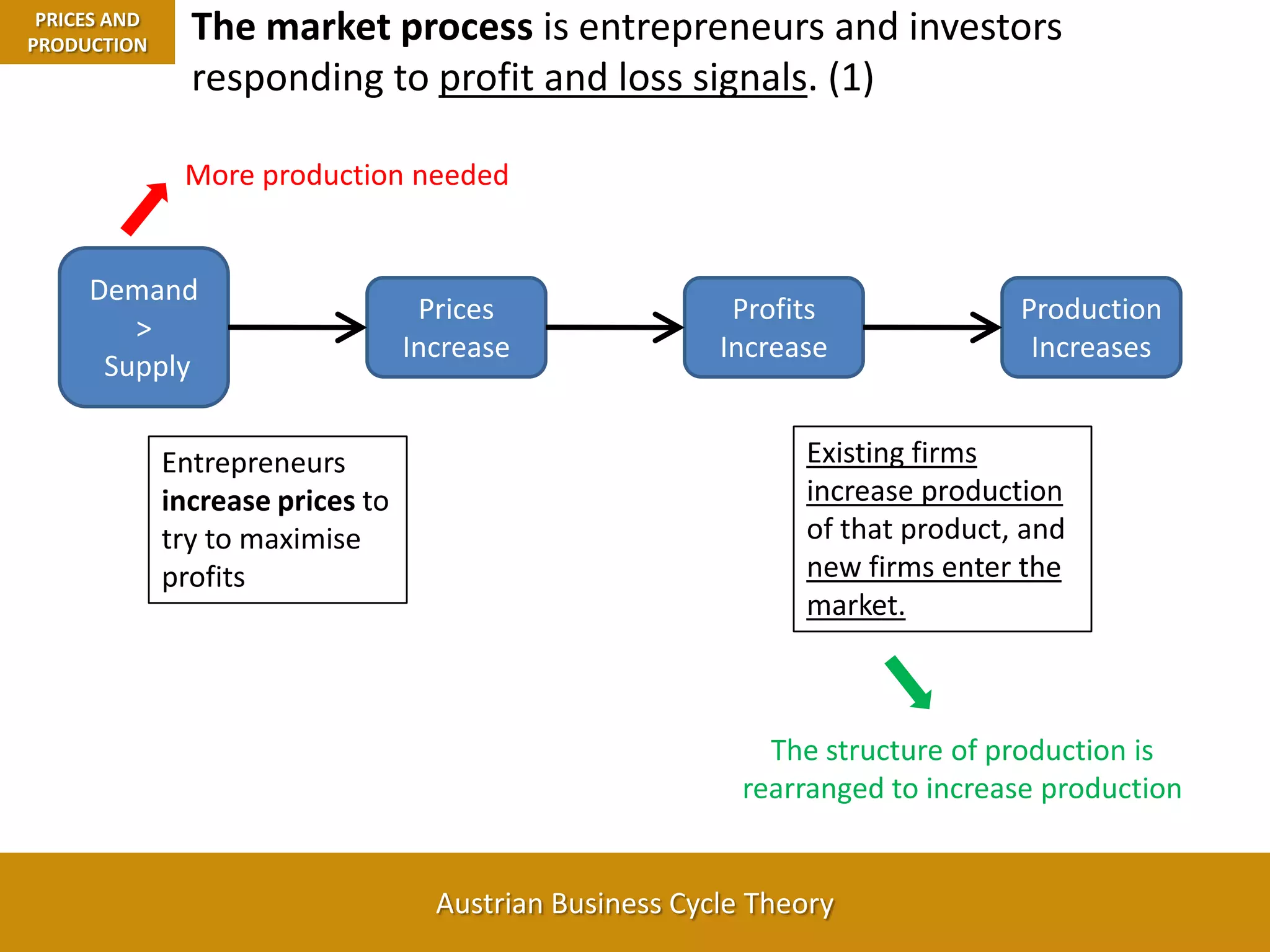
The market processis entrepreneurs and investors responding to profit and loss signals. (1) PRICES AND PRODUCTIONMore production neededDemand > SupplyPrices IncreaseProfits IncreaseProduction IncreasesExisting firms increase production of that product, and new firms enter the market.Entrepreneurs increase prices to try to maximise profitsThe structure of production is rearranged to increase production
6.
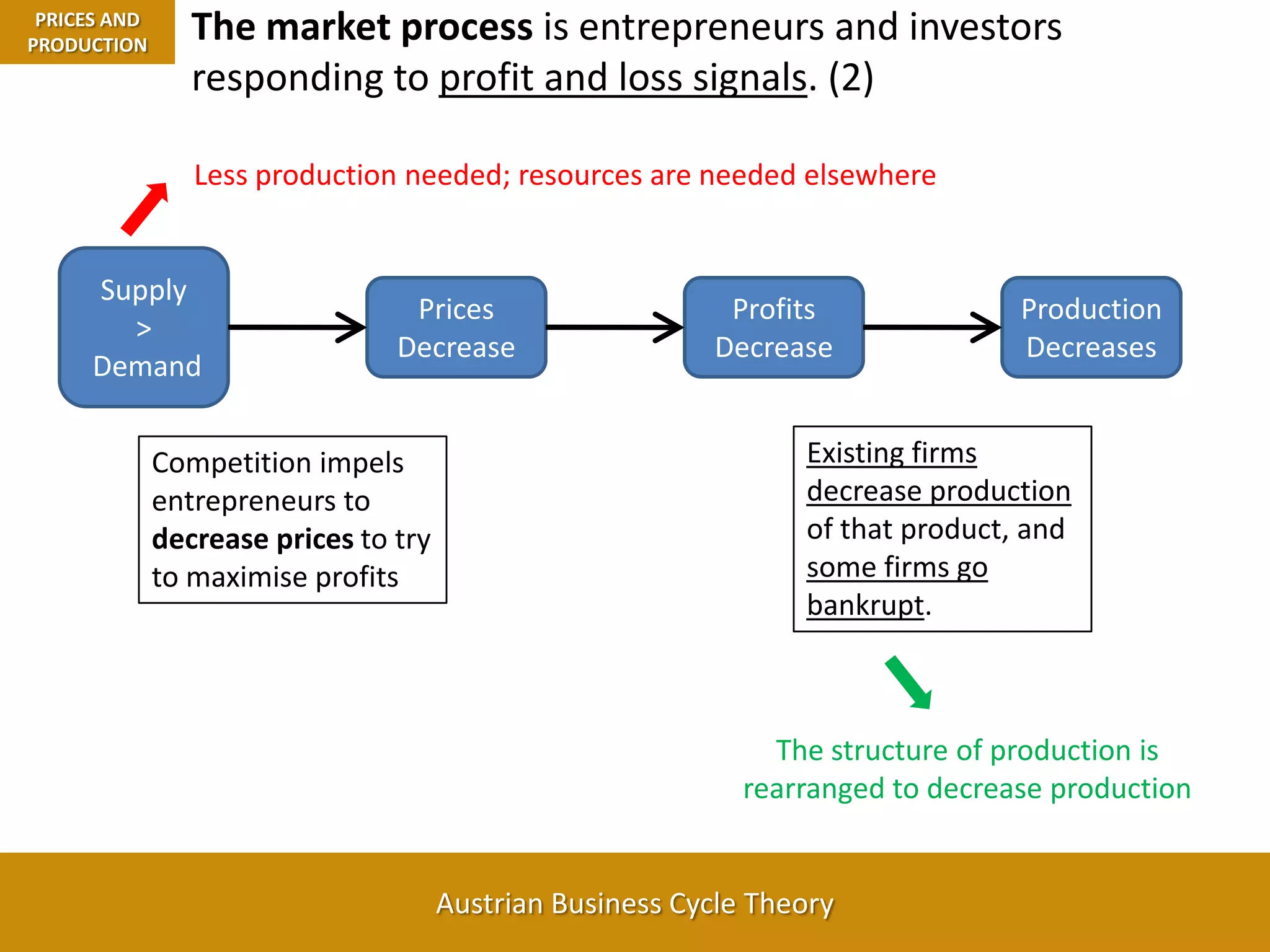
The market processis entrepreneurs and investors responding to profit and loss signals. (2)PRICES AND PRODUCTIONLess production needed; resources are needed elsewhereSupply > DemandPrices DecreaseProfits DecreaseProduction DecreasesExisting firms decrease production of that product, and some firms go bankrupt.Competition impels entrepreneurs to decrease prices to try to maximise profitsThe structure of production is rearranged to decrease production
7.
Agenda“How Things GoRight”: Prices and ProductionAustrians and Keynesians on Business CyclesAustrian Theory of the Boom and the BustIn a recession, what can government do to help?
8.
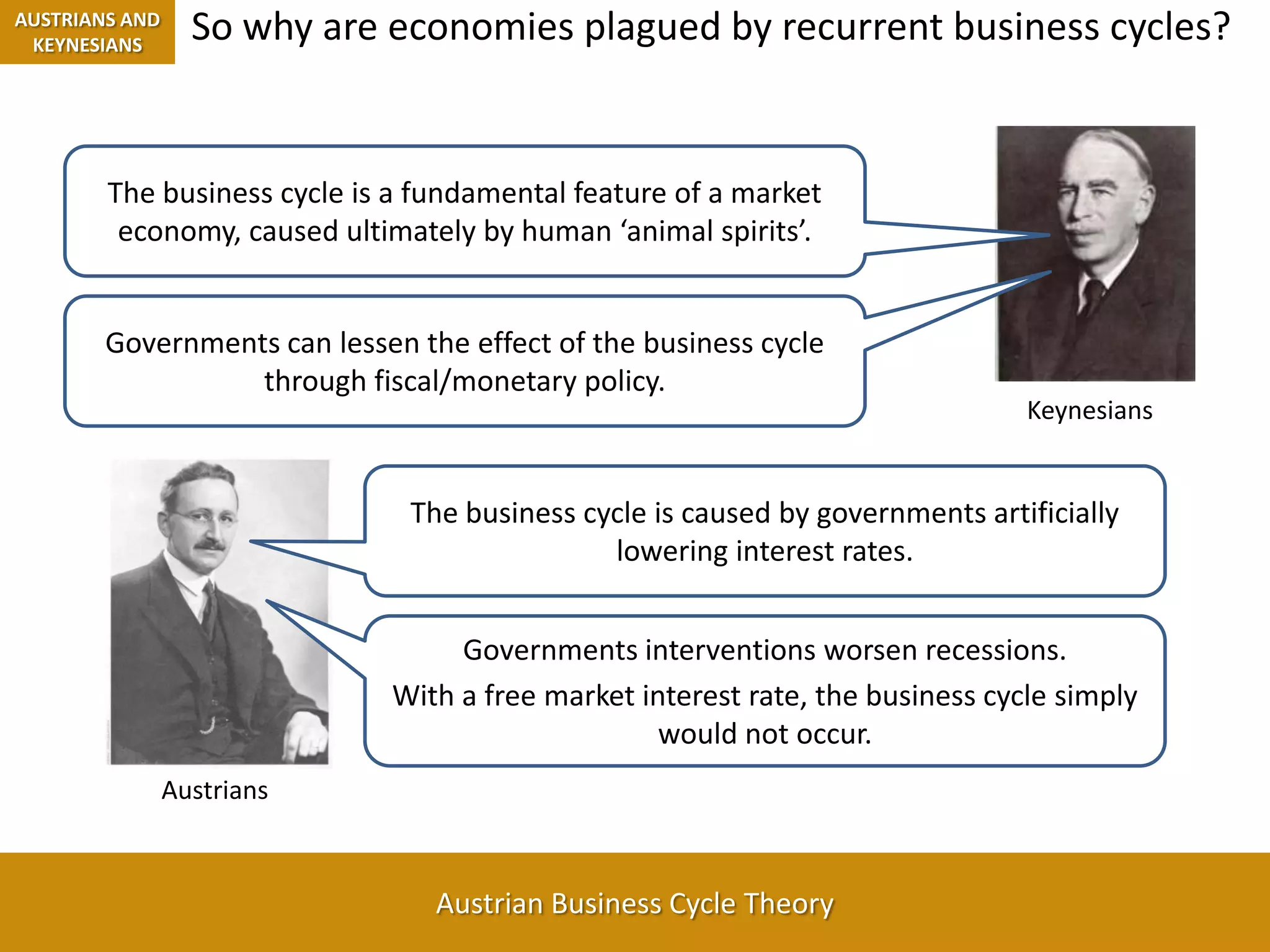
So why areeconomies plagued by recurrent business cycles?AUSTRIANS AND KEYNESIANSThe business cycle is a fundamental feature of a market economy, caused ultimately by human ‘animal spirits’.Governments can lessen the effect of the business cycle through fiscal/monetary policy.KeynesiansThe business cycle is caused by governments artificially lowering interest rates.Governments interventions worsen recessions. With a free market interest rate, the business cycle simply would not occur. Austrians
9.
AUSTRIANS AND KEYNESIANS“FearThe Boom and Bust” - A Hayek vs. Keynes Rap Anthem( http://www.youtube.com/watch?v=d0nERTFo-Sk )
10.
Agenda“How Things GoRight”: Prices and ProductionAustrians and Keynesians on Business CyclesAustrian Theory of the Boom and the BustIn a recession, what can government do to help?
11.
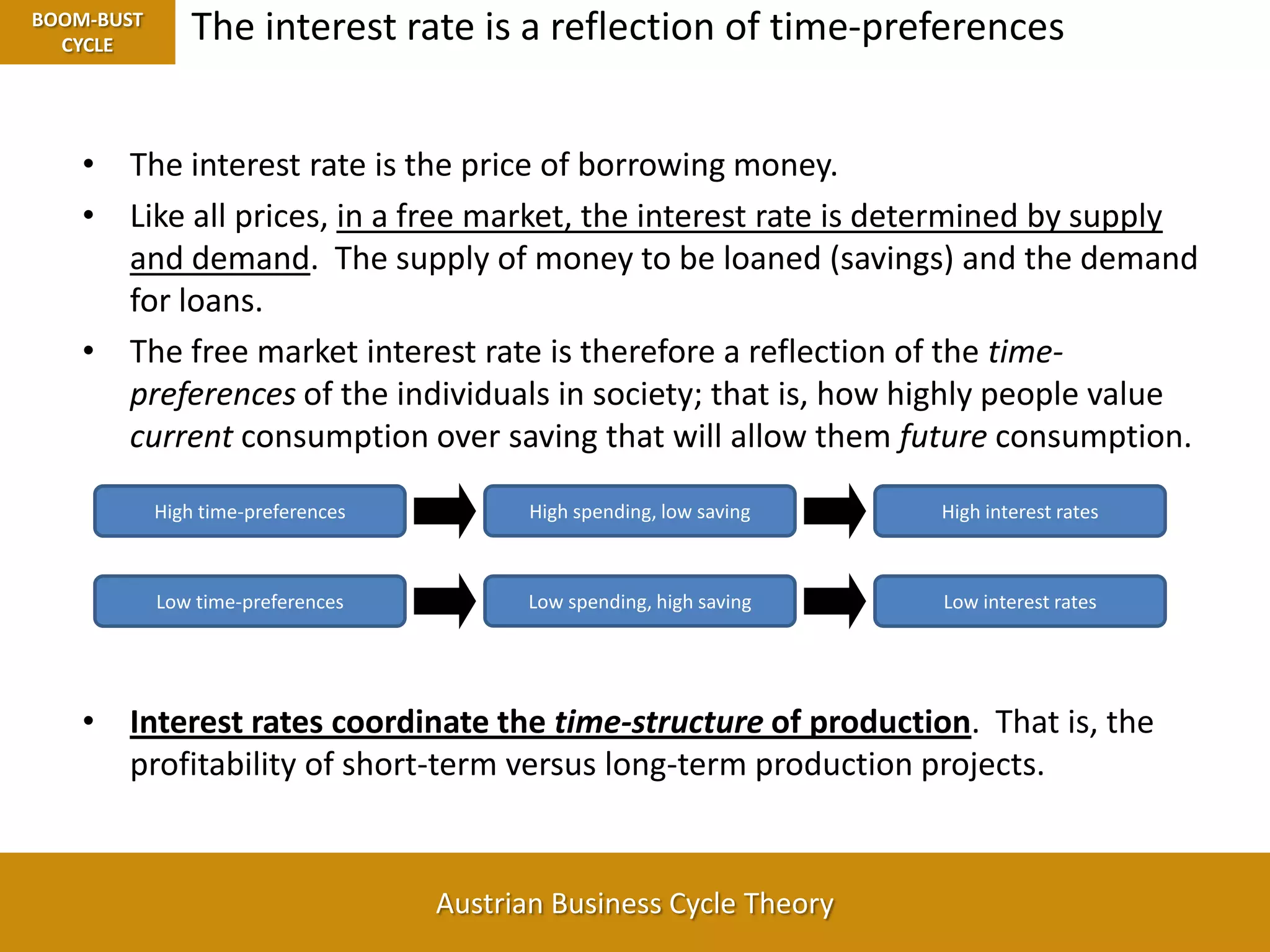
The interest rateis a reflection of time-preferencesBOOM-BUST CYCLEHigh time-preferencesHigh interest ratesHigh spending, low savingLow time-preferencesLow interest ratesLow spending, high savingThe interest rate is the price of borrowing money.Like all prices, in a free market, the interest rate is determined by supply and demand. The supply of money to be loaned (savings) and the demand for loans.The free market interest rate is therefore a reflection of the time-preferences of the individuals in society; that is, how highly people value current consumption over saving that will allow them future consumption.Interest rates coordinate the time-structure of production. That is, the profitability of short-term versus long-term production projects.
12.
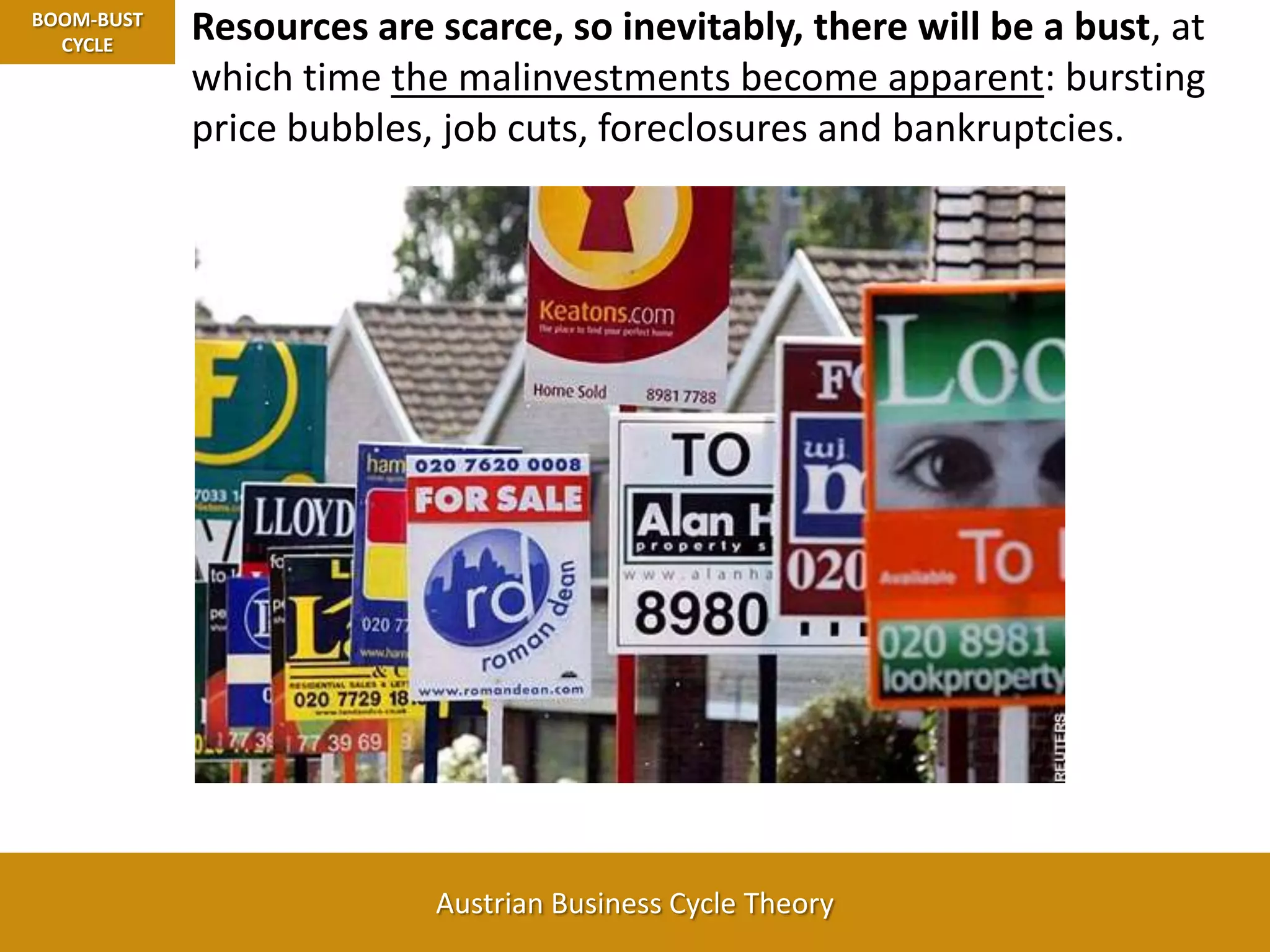
Government manipulation ofthe interest necessarily results in a malinvestment boomBOOM-BUST CYCLEWhen a central bank inflates the money supply the interest rate price signal is distorted. This causes the time-structure of production to become distorted.With an interest rate lower than the free market rate due to government manipulation, the amount of savings appears to be higher than it really is. It appears as though people are saving for the future, when in fact they want to consume now.Entrepreneurs are misled into starting more and different, especially long-term production projects, believing they will be profitable.There is an “artificial” boom, especially in capital goods industries: housing, construction, mining, manufacturing, etc. This boom is a result of malinvestments of resources in unsustainable projects.While the boom continues, the malinvestments are unseen; they appear to be profitable businesses. The bigger and longer the boom, the more malinvestments occur.
13.
Resources are scarce,so inevitably, there will be a bust, at which time the malinvestments become apparent: bursting price bubbles, job cuts, foreclosures and bankruptcies.BOOM-BUST CYCLE
14.
Agenda“How Things GoRight”: Prices and ProductionAustrians and Keynesians on Business CyclesAustrian Theory of the Boom and the BustIn a recession, what can government do to help?
15.
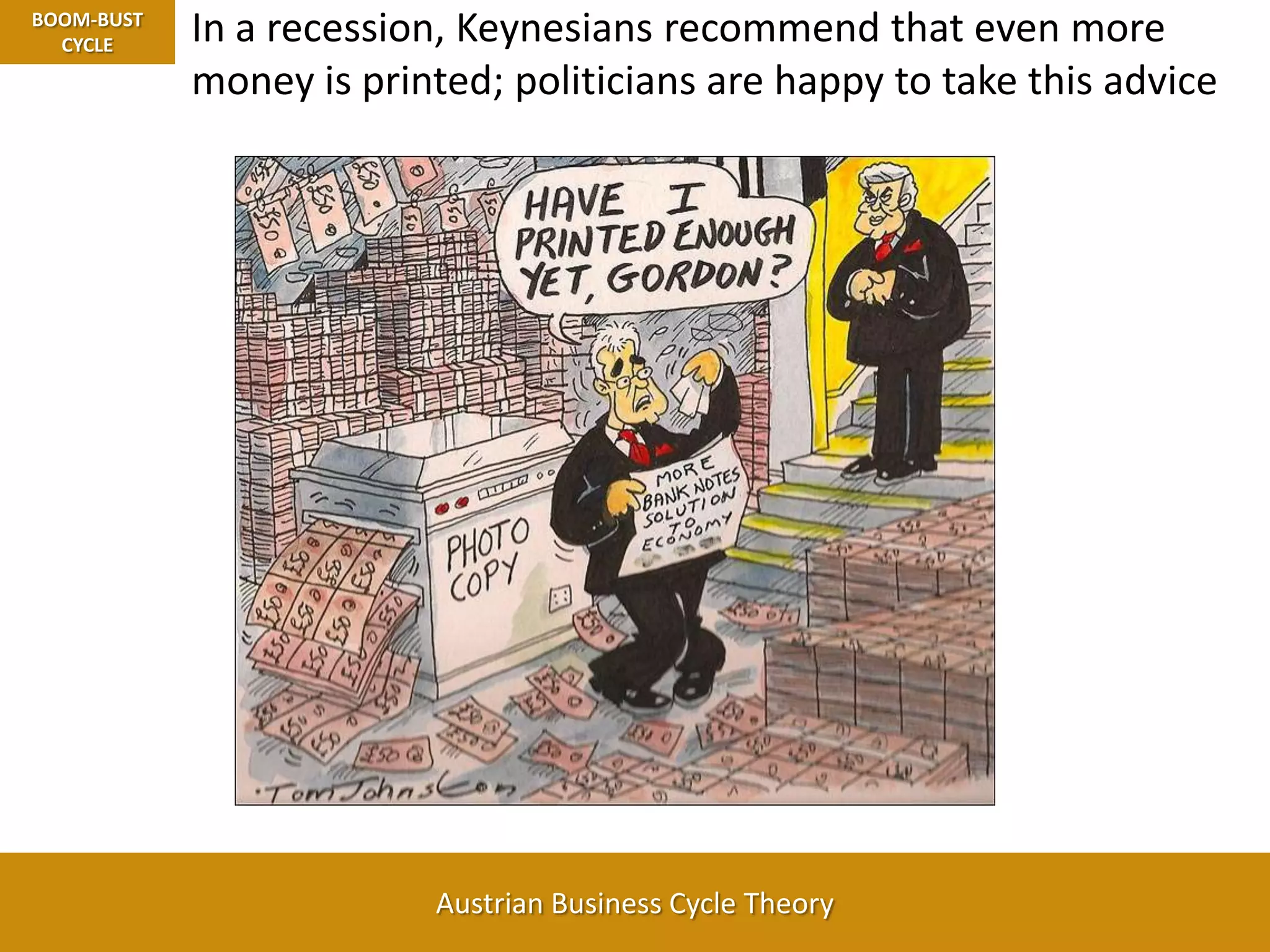
In a recession,Keynesians recommend that even more money is printed; politicians are happy to take this adviceBOOM-BUST CYCLE
16.
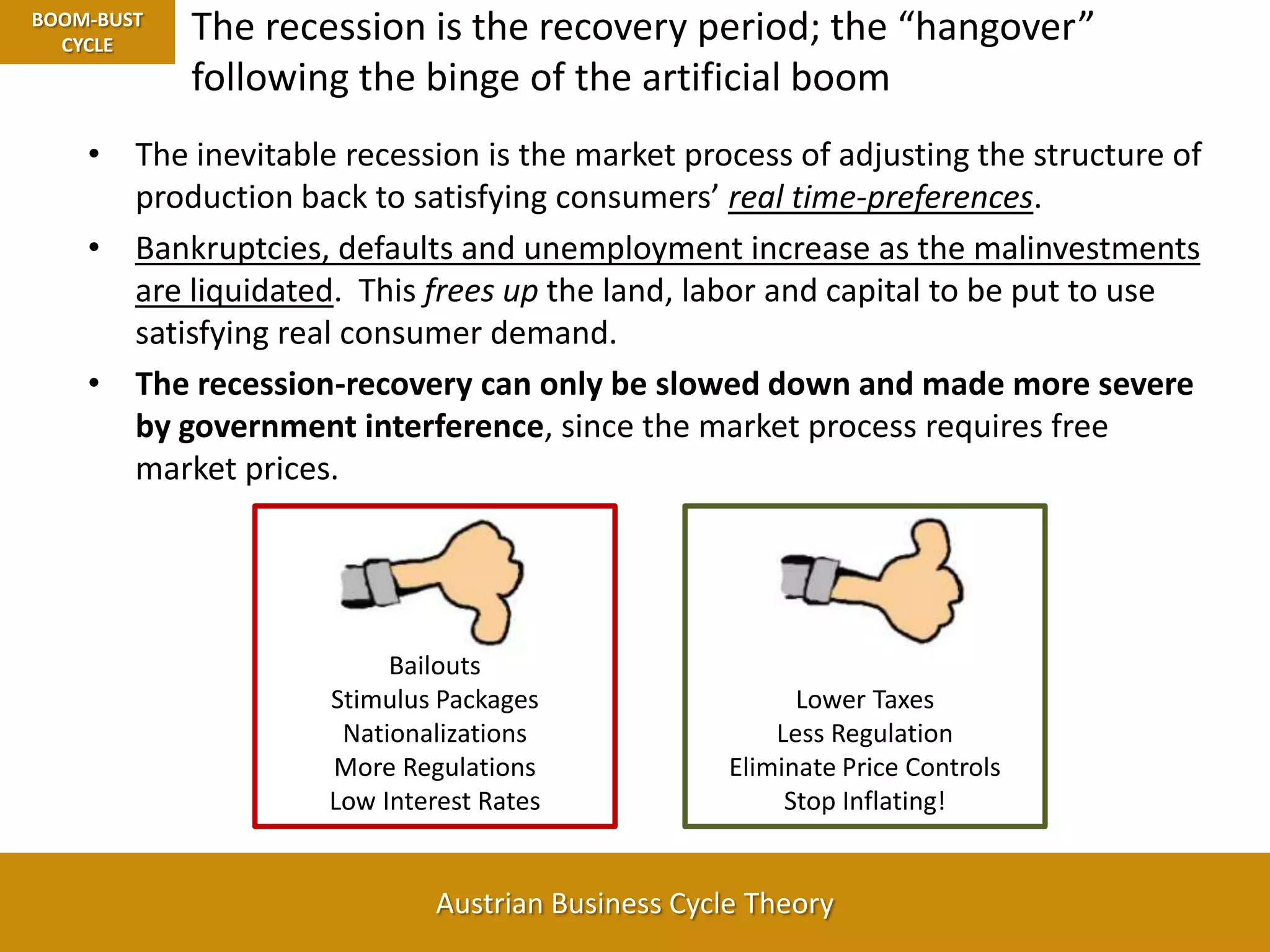
BOOM-BUST CYCLEThe recessionis the recovery period; the “hangover” following the binge of the artificial boomThe inevitable recession is the market process of adjusting the structure of production back to satisfying consumers’ real time-preferences. Bankruptcies, defaults and unemployment increase as the malinvestments are liquidated. This frees up the land, labor and capital to be put to use satisfying real consumer demand. The recession-recovery can only be slowed down and made more severe by government interference, since the market process requires free market prices.BailoutsStimulus PackagesNationalizationsMore RegulationsLow Interest RatesLower TaxesLess RegulationEliminate Price ControlsStop Inflating!
17.
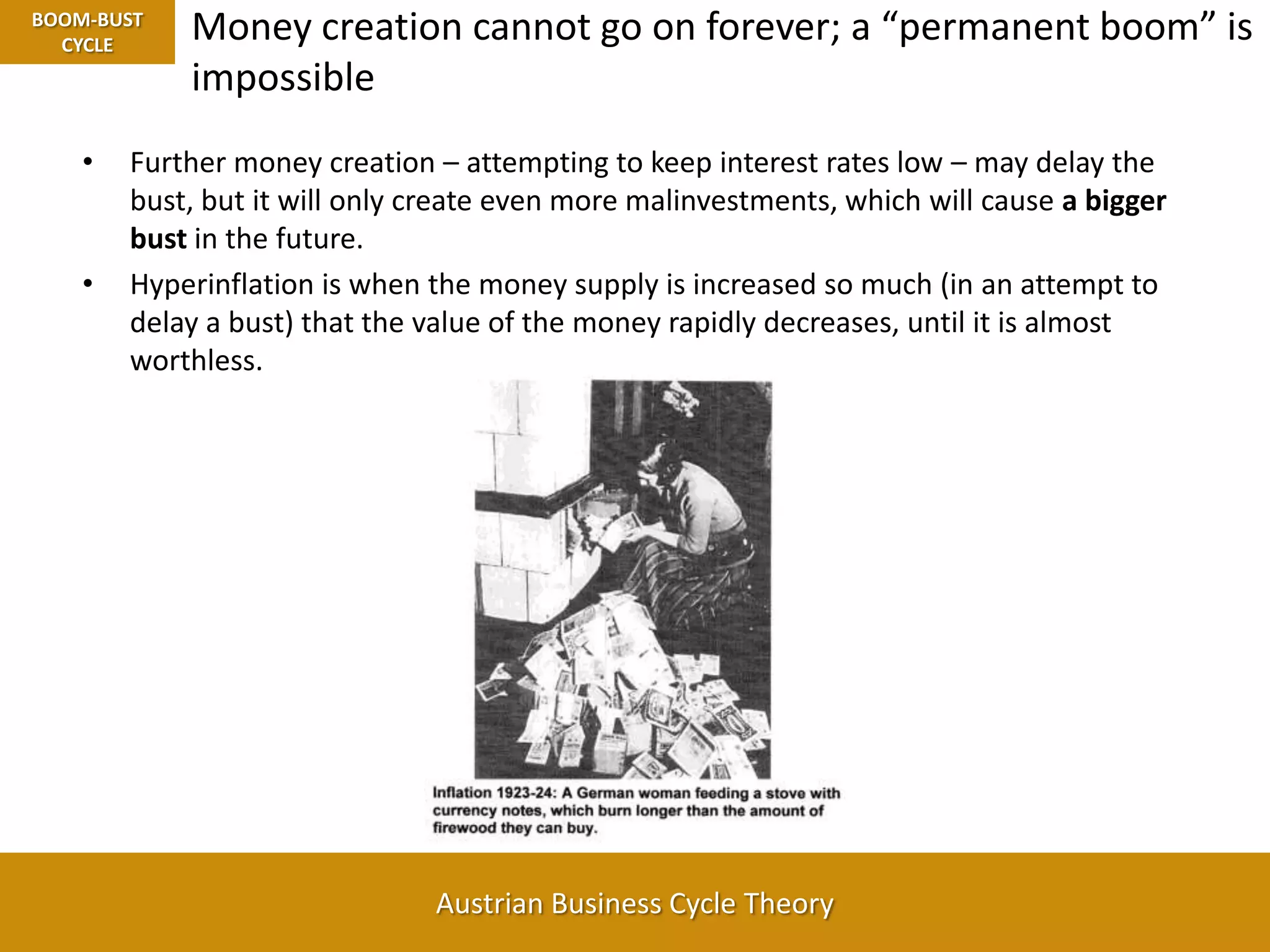
BOOM-BUST CYCLEMoney creationcannot go on forever; a “permanent boom” is impossibleFurther money creation – attempting to keep interest rates low – may delay the bust, but it will only create even more malinvestments, which will cause a bigger bust in the future.Hyperinflation is when the money supply is increased so much (in an attempt to delay a bust) that the value of the money rapidly decreases, until it is almost worthless.
18.
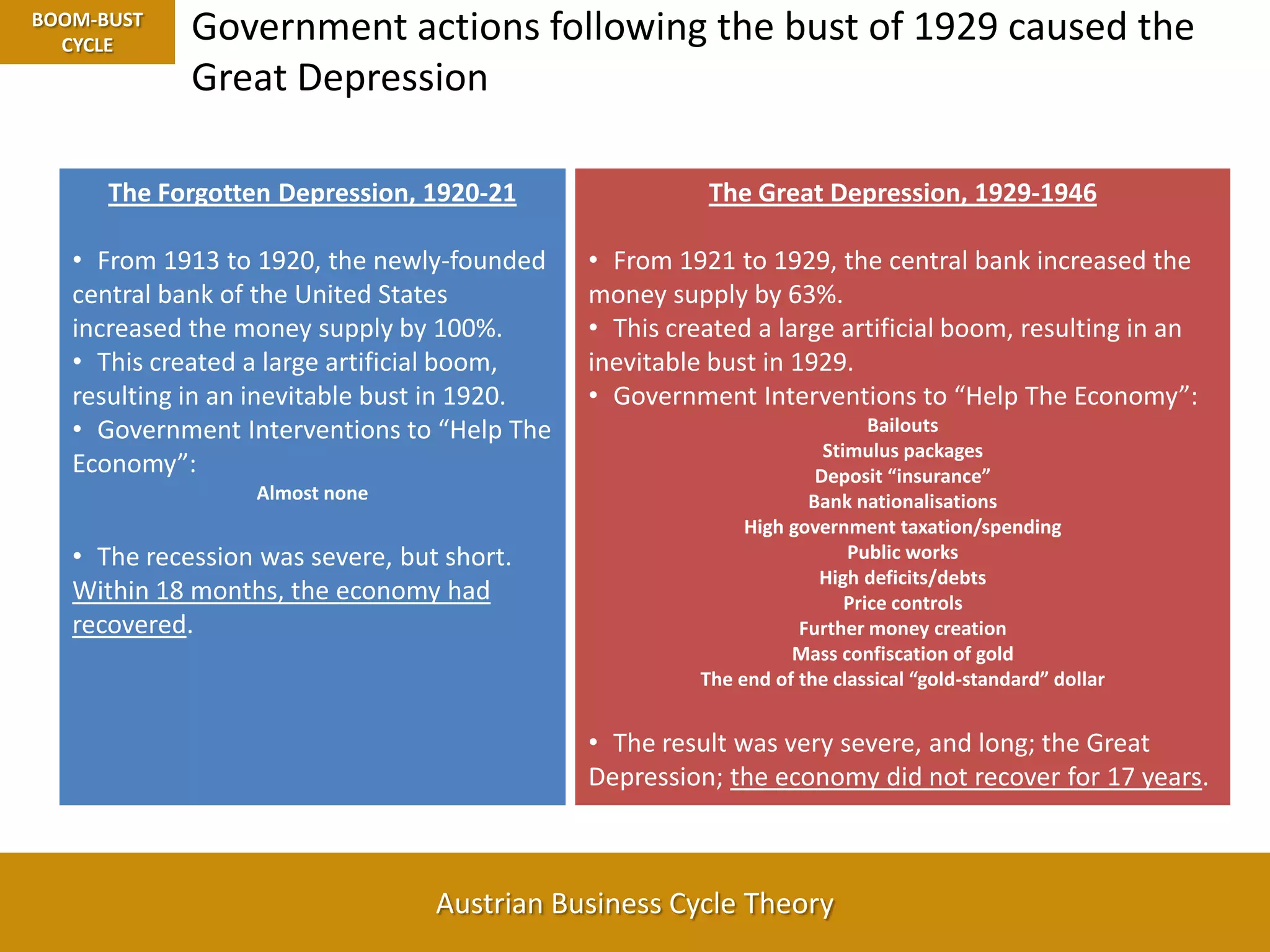
Government actions followingthe bust of 1929 caused the Great DepressionBOOM-BUST CYCLEThe Forgotten Depression, 1920-21From 1913 to 1920, the newly-founded central bank of the United States increased the money supply by 100%.
19.
This created alarge artificial boom, resulting in an inevitable bust in 1920.
20.
Government Interventions to“Help The Economy”: Almost none The recession was severe, but short. Within 18 months, the economy had recovered. The Great Depression, 1929-1946From 1921 to 1929, the central bank increased the money supply by 63%.
21.
This created alarge artificial boom, resulting in an inevitable bust in 1929.
22.
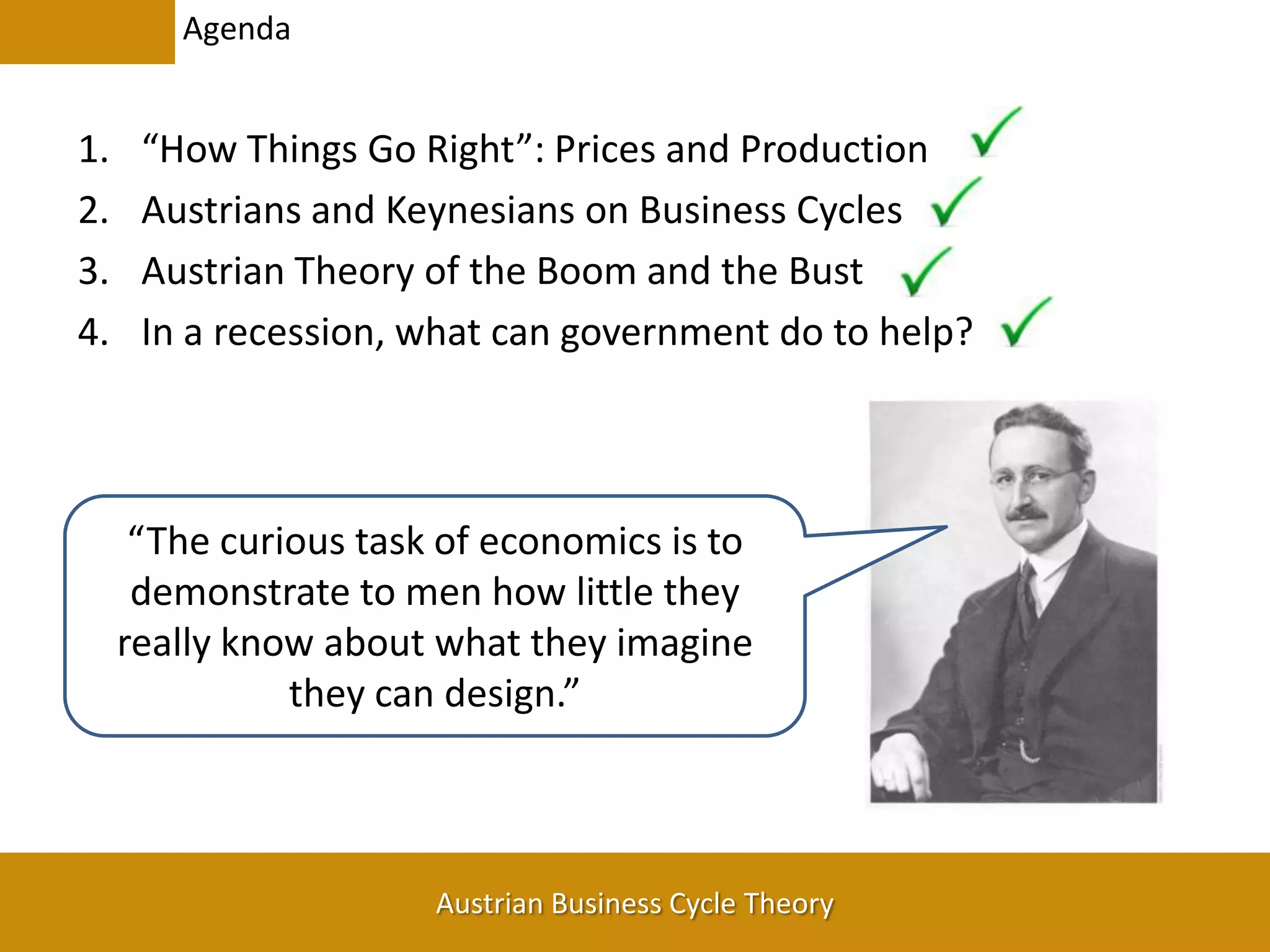
Government Interventions to“Help The Economy”:BailoutsStimulus packagesDeposit “insurance”Bank nationalisationsHigh government taxation/spendingPublic worksHigh deficits/debtsPrice controlsFurther money creationMass confiscation of goldThe end of the classical “gold-standard” dollarThe result was very severe, and long; the Great Depression; the economy did not recover for 17 years. Agenda“How Things Go Right”: Prices and ProductionAustrians and Keynesians on Business CyclesAustrian Theory of the Boom and the BustIn a recession, what can government do to help?“The curious task of economics is to demonstrate to men how little they really know about what they imagine they can design.”
23.
For free education,visitThe Ludwig von Mises Institute,the intellectual home of the Austrian School,atmises.org