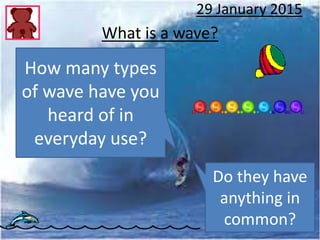
What is a wave?
29 January 2015
How many types
of wave have you
heard of in
everyday use?
Do they have
anything in
common?
Aims
• Describe the origin of a wave
• Explain the properties of a wave
Key terms
• Displacement: how far the
wave is disturbed from its rest
position
• Oscillation: a complete to and
fro movement; this could be
going up and down or
sideways
What is a wave?
A wave is a
disturbance
moving through a
material
What causes a wave?
• The source of a wave
is always something
that vibrates
• The material that the
wave travels through
is called the medium
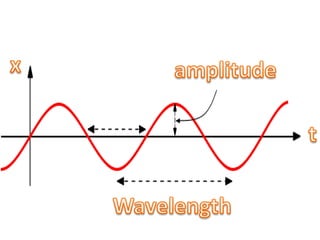
Amplitude, A
• The maximum distance that each point in the
medium moves from its normal position as
the wave passes
• Measured in metres, m
Frequency, f
• This is the number of waves that pass any
point in the medium every second, so it is the
same as the number of vibrations per second
• Frequency is measured in per seconds or
hertz, 1/s, s-1 or Hz
Wave speed, v
• This is the speed at which each wave crest
moves through the medium.
• Measured in metres per second, m/s or ms-1
Wavelength, λ
• This is the length of a complete wave
measured from any point to the next identical
point – the distance is always the same no
matter which point you choose
• It is measured in metres, m
Wavelength, λ
• This is the length of a complete wave
measured from any point to the next identical
point – the distance is always the same no
matter which point you choose
• It is measured in metres, m
fv 
Where:
v = speed of wave / m/s
f = frequency of wave / Hz (1/s)
λ = wavelength of wave / m
How can we prove this?
1
1
330
330





msf
msv
fv


What would happen if we increased the wavelength of a wave?
What would happen if we decreased the wavelength of a wave?
Assessment activity 2.6
• Discuss how you could model the movement
of a wave (P3)
• Construct your model or role play it to
another group
• REMEMBER: the longer the wavelength, the
smaller the frequency. When calculating
speed, make sure you change the prefixes

2.6 what is a wave

  • 1.
    What is awave? 29 January 2015 How many types of wave have you heard of in everyday use? Do they have anything in common?
  • 2.
    Aims • Describe theorigin of a wave • Explain the properties of a wave
  • 3.
    Key terms • Displacement:how far the wave is disturbed from its rest position • Oscillation: a complete to and fro movement; this could be going up and down or sideways
  • 4.
    What is awave? A wave is a disturbance moving through a material
  • 5.
    What causes awave? • The source of a wave is always something that vibrates • The material that the wave travels through is called the medium
  • 10.
    Amplitude, A • Themaximum distance that each point in the medium moves from its normal position as the wave passes • Measured in metres, m
  • 11.
    Frequency, f • Thisis the number of waves that pass any point in the medium every second, so it is the same as the number of vibrations per second • Frequency is measured in per seconds or hertz, 1/s, s-1 or Hz
  • 12.
    Wave speed, v •This is the speed at which each wave crest moves through the medium. • Measured in metres per second, m/s or ms-1
  • 13.
    Wavelength, λ • Thisis the length of a complete wave measured from any point to the next identical point – the distance is always the same no matter which point you choose • It is measured in metres, m
  • 14.
    Wavelength, λ • Thisis the length of a complete wave measured from any point to the next identical point – the distance is always the same no matter which point you choose • It is measured in metres, m
  • 15.
    fv  Where: v =speed of wave / m/s f = frequency of wave / Hz (1/s) λ = wavelength of wave / m
  • 16.
    How can weprove this? 1 1 330 330      msf msv fv   What would happen if we increased the wavelength of a wave? What would happen if we decreased the wavelength of a wave?
  • 26.
    Assessment activity 2.6 •Discuss how you could model the movement of a wave (P3) • Construct your model or role play it to another group • REMEMBER: the longer the wavelength, the smaller the frequency. When calculating speed, make sure you change the prefixes