TRANSVERSE
VS.
LONGITUDINAL
WAVES
A wave is a traveling disturbance
that carries energy from place to
place with or without a medium.
A medium is matter in which
waves can travel and transfer
energy.
Waves that require a medium such
as water waves, sound waves, and
waves along the slinky are
mechanical waves. On the other
hand, electromagnetic waves can
travel even without a medium.
Examples of electromagnetic
waves are light, radio waves, and
microwaves.
Transverse wave exist when the
disturbance occurs perpendicular
to the direction of travel of the
waves.
Longitudinal wave is one in which
the disturbance occurs parallel to
the direction or travel of the waves.
Example of a longitudinal wave is
a sound wave. Sound waves,
which include ultrasound and
infrasonic waves, can travel
through a variety of media.
CHARACTERISTICS OF WAVE
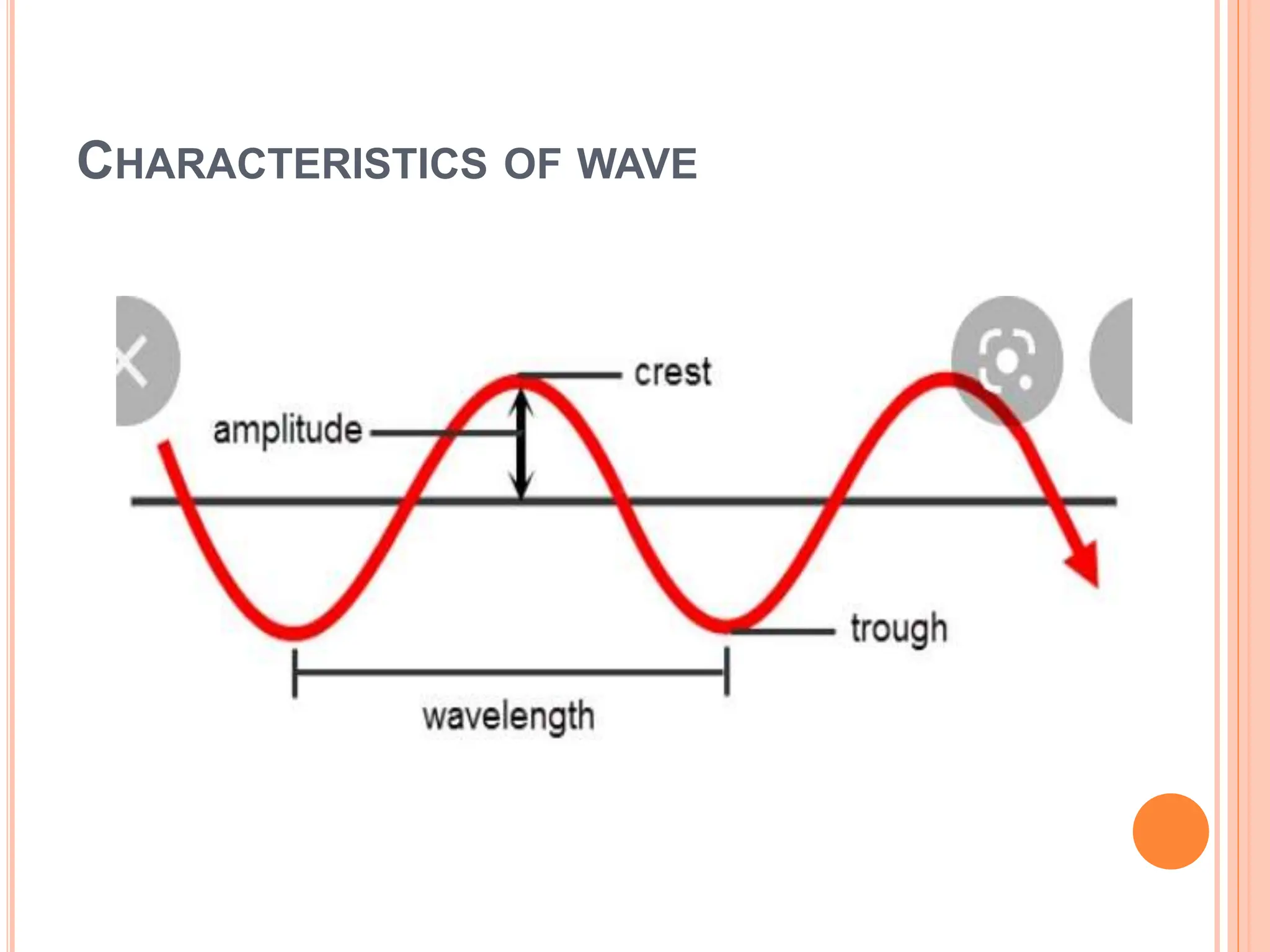
The highest points in the wave are
called crests or peaks, whereas the
lowest points are called troughs.
The amplitude (a) is the height of
the crest or the depth of a trough.
The wavelength (λ) is the measure
of the horizontal distance between
two successive crests or two
successive troughs. It is also equal
to the horizontal distance between
any identical points on the
successive waves.
𝑇 = 𝑓
1
he speed (v) of the wave is the
distance of a wave in one second.
Because the wave crest travels a
distance of one wavelength in one
period. The wave speed is
computed using :
𝑣 = 𝑇 𝑂𝑟 𝑉=𝑓λ
λ
Where v is the speed measured in
meters per second (m/s), λ is the
wavelength measured in meters
(m), T is the period measured in
seconds (s), and f is the frequency
measured in cycles per (1/s) or
hertz (Hz).
The sample shows the displacement-
position graph of a wave traveling
along a length of a rope. It took 3s for
the energy of the wave to reach 3m
along the rope. Determine the
following in the wave:
a. Amplitude, a
b. Period, T
d. Frequency, f
e. Speed, v
Solution:
a. amplitude, a = 0.3 m
b. wavelength, λ =
3𝑚
2
= 1.5 m
c. Period, T =
3𝑚
2
= 1.5s
Frequency, f
1
𝑇
=
1
1.5 𝑆
= 0.67 Hz
e. Speed, v = 𝑓λ
= (0.67 Hz) (1.5 m)

Q-3 Transverse vs Longitudinal waves Science 7 - Week 3-4.pptx

  • 1.
  • 2.
    A wave isa traveling disturbance that carries energy from place to place with or without a medium.
  • 3.
    A medium ismatter in which waves can travel and transfer energy.
  • 4.
    Waves that requirea medium such as water waves, sound waves, and waves along the slinky are mechanical waves. On the other hand, electromagnetic waves can travel even without a medium.
  • 5.
    Examples of electromagnetic wavesare light, radio waves, and microwaves.
  • 6.
    Transverse wave existwhen the disturbance occurs perpendicular to the direction of travel of the waves.
  • 7.
    Longitudinal wave isone in which the disturbance occurs parallel to the direction or travel of the waves.
  • 8.
    Example of alongitudinal wave is a sound wave. Sound waves, which include ultrasound and infrasonic waves, can travel through a variety of media.
  • 9.
  • 10.
    The highest pointsin the wave are called crests or peaks, whereas the lowest points are called troughs.
  • 11.
    The amplitude (a)is the height of the crest or the depth of a trough.
  • 12.
    The wavelength (λ)is the measure of the horizontal distance between two successive crests or two successive troughs. It is also equal to the horizontal distance between any identical points on the successive waves. 𝑇 = 𝑓 1
  • 13.
    he speed (v)of the wave is the distance of a wave in one second. Because the wave crest travels a distance of one wavelength in one period. The wave speed is computed using : 𝑣 = 𝑇 𝑂𝑟 𝑉=𝑓λ λ
  • 14.
    Where v isthe speed measured in meters per second (m/s), λ is the wavelength measured in meters (m), T is the period measured in seconds (s), and f is the frequency measured in cycles per (1/s) or hertz (Hz).
  • 16.
    The sample showsthe displacement- position graph of a wave traveling along a length of a rope. It took 3s for the energy of the wave to reach 3m along the rope. Determine the following in the wave: a. Amplitude, a b. Period, T d. Frequency, f e. Speed, v
  • 17.
    Solution: a. amplitude, a= 0.3 m b. wavelength, λ = 3𝑚 2 = 1.5 m c. Period, T = 3𝑚 2 = 1.5s Frequency, f 1 𝑇 = 1 1.5 𝑆 = 0.67 Hz e. Speed, v = 𝑓λ = (0.67 Hz) (1.5 m)