STELLAR OBJECTS
RINGS OF THE GAS GIANTS
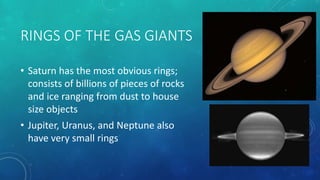
• Saturn has the most obvious rings;
consists of billions of pieces of rocks
and ice ranging from dust to house
size objects
• Jupiter, Uranus, and Neptune also
have very small rings
ASTEROIDS
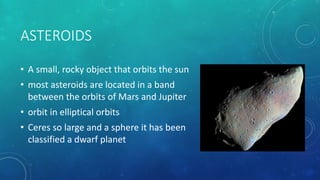
• A small, rocky object that orbits the sun
• most asteroids are located in a band
between the orbits of Mars and Jupiter
• orbit in elliptical orbits
• Ceres so large and a sphere it has been
classified a dwarf planet
ASTEROIDS
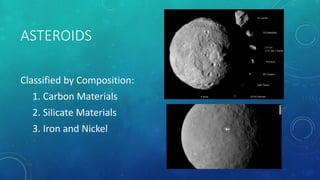
Classified by Composition:
1. Carbon Materials
2. Silicate Materials
3. Iron and Nickel
ASTEROIDS
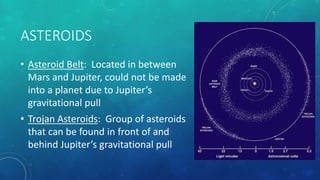
• Asteroid Belt: Located in between
Mars and Jupiter, could not be made
into a planet due to Jupiter’s
gravitational pull
• Trojan Asteroids: Group of asteroids
that can be found in front of and
behind Jupiter’s gravitational pull
COMETS
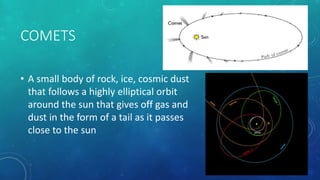
• A small body of rock, ice, cosmic dust
that follows a highly elliptical orbit
around the sun that gives off gas and
dust in the form of a tail as it passes
close to the sun
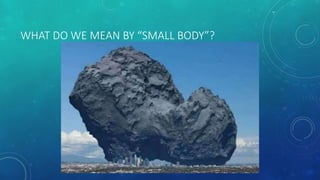
WHAT DO WE MEAN BY “SMALL BODY”?
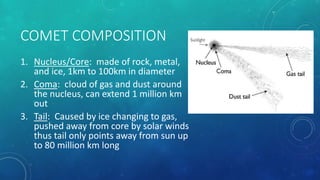
COMET COMPOSITION
1. Nucleus/Core: made of rock, metal,
and ice, 1km to 100km in diameter
2. Coma: cloud of gas and dust around
the nucleus, can extend 1 million km
out
3. Tail: Caused by ice changing to gas,
pushed away from core by solar winds
thus tail only points away from sun up
to 80 million km long
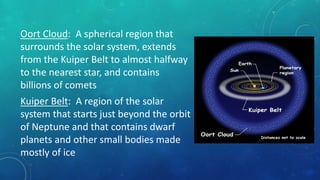
Oort Cloud: A spherical region that
surrounds the solar system, extends
from the Kuiper Belt to almost halfway
to the nearest star, and contains
billions of comets
Kuiper Belt: A region of the solar
system that starts just beyond the orbit
of Neptune and that contains dwarf
planets and other small bodies made
mostly of ice
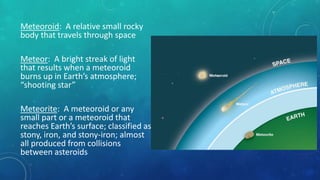
Meteoroid: A relative small rocky
body that travels through space
Meteor: A bright streak of light
that results when a meteoroid
burns up in Earth’s atmosphere;
“shooting star”
Meteorite: A meteoroid or any
small part or a meteoroid that
reaches Earth’s surface; classified as
stony, iron, and stony-iron; almost
all produced from collisions
between asteroids

26. Stellar Objects Notes

  • 1.
  • 2.
    RINGS OF THEGAS GIANTS • Saturn has the most obvious rings; consists of billions of pieces of rocks and ice ranging from dust to house size objects • Jupiter, Uranus, and Neptune also have very small rings
  • 3.
    ASTEROIDS • A small,rocky object that orbits the sun • most asteroids are located in a band between the orbits of Mars and Jupiter • orbit in elliptical orbits • Ceres so large and a sphere it has been classified a dwarf planet
  • 4.
    ASTEROIDS Classified by Composition: 1.Carbon Materials 2. Silicate Materials 3. Iron and Nickel
  • 5.
    ASTEROIDS • Asteroid Belt:Located in between Mars and Jupiter, could not be made into a planet due to Jupiter’s gravitational pull • Trojan Asteroids: Group of asteroids that can be found in front of and behind Jupiter’s gravitational pull
  • 6.
    COMETS • A smallbody of rock, ice, cosmic dust that follows a highly elliptical orbit around the sun that gives off gas and dust in the form of a tail as it passes close to the sun
  • 7.
    WHAT DO WEMEAN BY “SMALL BODY”?
  • 8.
    COMET COMPOSITION 1. Nucleus/Core:made of rock, metal, and ice, 1km to 100km in diameter 2. Coma: cloud of gas and dust around the nucleus, can extend 1 million km out 3. Tail: Caused by ice changing to gas, pushed away from core by solar winds thus tail only points away from sun up to 80 million km long
  • 9.
    Oort Cloud: Aspherical region that surrounds the solar system, extends from the Kuiper Belt to almost halfway to the nearest star, and contains billions of comets Kuiper Belt: A region of the solar system that starts just beyond the orbit of Neptune and that contains dwarf planets and other small bodies made mostly of ice
  • 10.
    Meteoroid: A relativesmall rocky body that travels through space Meteor: A bright streak of light that results when a meteoroid burns up in Earth’s atmosphere; “shooting star” Meteorite: A meteoroid or any small part or a meteoroid that reaches Earth’s surface; classified as stony, iron, and stony-iron; almost all produced from collisions between asteroids