Comets, Asteroids, Meteoroids
LEARNING OBJECTIVES
• At the of a 60-minute period, students should be
able to:
• 1. Discuss the origin and fact about comets,
asteroids and meteors.
• 2. Draw how impact craters are formed when a
meteor or asteroid hits Earth.
• 3. Value the importance and occurrence of
comets, meteors, and asteroids.
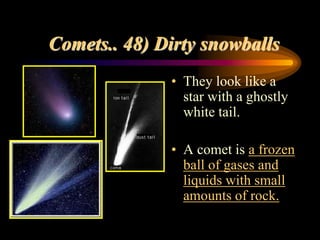
Comets.. 48) Dirty snowballs
• They look like a
star with a ghostly
white tail.
• A comet is a frozen
ball of gases and
liquids with small
amounts of rock.
• 46)What is a comet? A frozen ball of gases
and liquids with small amounts of rock.
• 47) Comets are chunks of ice and dust that
revolve around the sun with very elliptical
orbits.
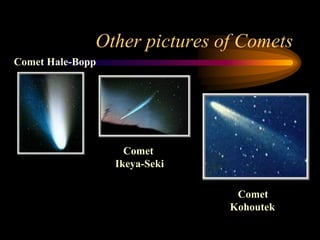
Other pictures of Comets
Comet Hale-Bopp
Comet
Ikeya-Seki
Comet
Kohoutek
49)The tails of comets always
point away from the sun because
the sun’s radiation slowly burns
away some of the comet as it
orbits the sun.
Comets orbit
• If a comet has a large orbit, it takes a long
time to go around the Sun.
– Some comets are "short-period" comets that
take five or ten years to complete an orbit.
– Some comets are "long-period" comets that
take decades, centuries, or millenia to orbit the
Sun.
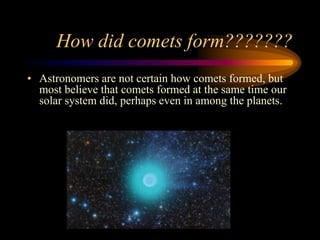
How did comets form???????
• Astronomers are not certain how comets formed, but
most believe that comets formed at the same time our
solar system did, perhaps even in among the planets.
45)Comets and asteroids are
objects smaller than planets that
orbit the sun and vary in size,
composition, and characteristics.
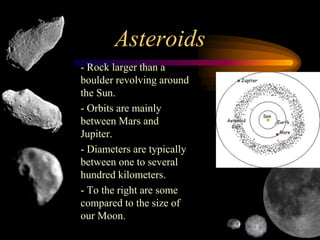
1. - Rock larger than a
boulder revolving around
the Sun.
2. - Orbits are mainly
between Mars and
Jupiter.
3. - Diameters are typically
between one to several
hundred kilometers.
4. - To the right are some
compared to the size of
our Moon.
Asteroids
• 50)Asteroids are smaller than
planets and can be found
orbiting the Sun.
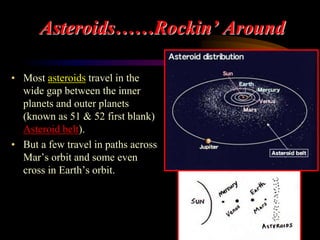
Asteroids……Rockin’ Around
• Most asteroids travel in the
wide gap between the inner
planets and outer planets
(known as 51 & 52 first blank)
Asteroid belt).
• But a few travel in paths across
Mar’s orbit and some even
cross in Earth’s orbit.
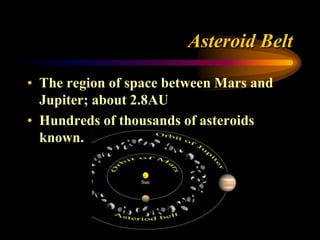
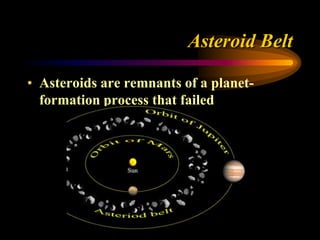
Asteroid Belt
• The region of space between Mars and
Jupiter; about 2.8AU
• Hundreds of thousands of asteroids
known. Probably millions.
Asteroid Belt
• Asteroids are remnants of a planet-
formation process that failed
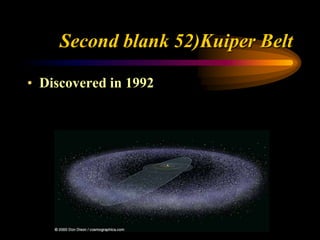
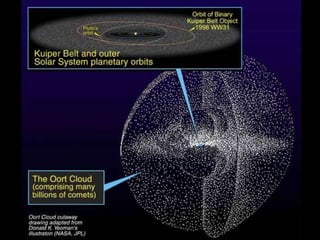
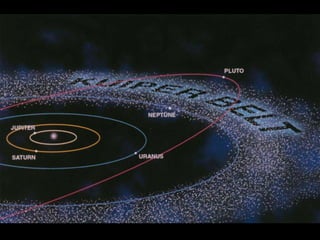
Second blank 52)Kuiper Belt
• Discovered in 1992
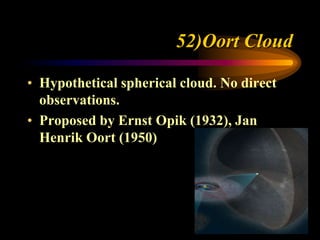
52)Oort Cloud
• Hypothetical spherical cloud. No direct
observations.
• Proposed by Ernst Opik (1932), Jan
Henrik Oort (1950)
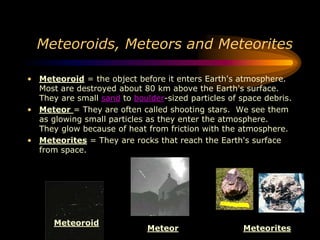
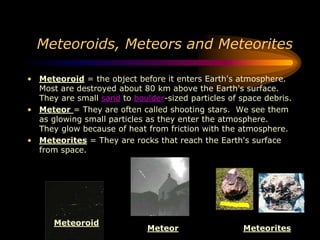
Meteoroids, Meteors and Meteorites
• Meteoroid = the object before it enters Earth's atmosphere.
Most are destroyed about 80 km above the Earth's surface.
They are small sand to boulder-sized particles of space debris.
• Meteor = They are often called shooting stars. We see them
as glowing small particles as they enter the atmosphere.
They glow because of heat from friction with the atmosphere.
• Meteorites = They are rocks that reach the Earth's surface
from space.
Meteor Meteorites
Meteoroid
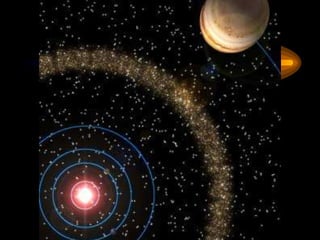
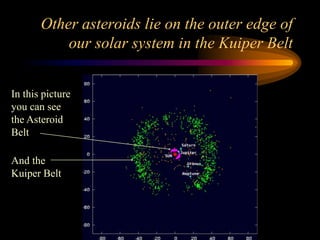
Other asteroids lie on the outer edge of
our solar system in the Kuiper Belt
In this picture
you can see
the Asteroid
Belt
And the
Kuiper Belt
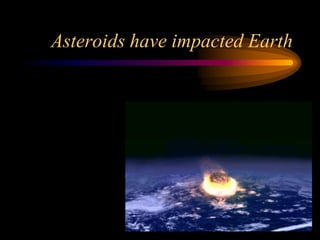
Asteroids have impacted Earth
53)Scientists suggest that the last
massive asteroid that hit Earth
landed approximately 65 million
years ago.
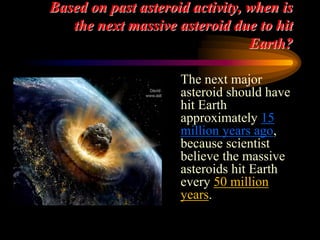
Based on past asteroid activity, when is
the next massive asteroid due to hit
Earth?
The next major
asteroid should have
hit Earth
approximately 15
million years ago,
because scientist
believe the massive
asteroids hit Earth
every 50 million
years.
Meteoroids, Meteors and Meteorites
• Meteoroid = the object before it enters Earth's atmosphere.
Most are destroyed about 80 km above the Earth's surface.
They are small sand to boulder-sized particles of space debris.
• Meteor = They are often called shooting stars. We see them
as glowing small particles as they enter the atmosphere.
They glow because of heat from friction with the atmosphere.
• Meteorites = They are rocks that reach the Earth's surface
from space.
Meteor Meteorites
Meteoroid
Meteors…Shooting Stars or Space
Garbage
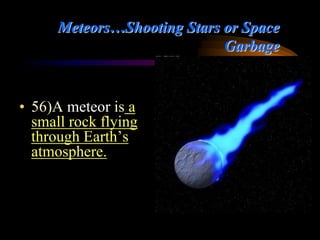
• 56)A meteor is a
small rock flying
through Earth’s
atmosphere.
Meteors…Shooting Stars or Space
Garbage
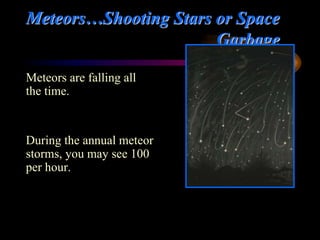
Meteors are falling all
the time.
During the annual meteor
storms, you may see 100
per hour.
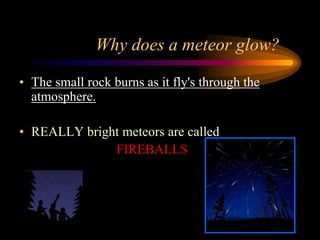
Why does a meteor glow?
• The small rock burns as it fly's through the
atmosphere.
• REALLY bright meteors are called
FIREBALLS
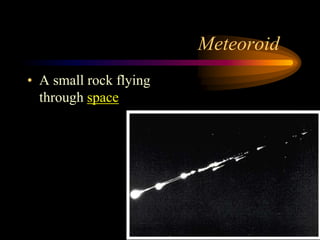
Meteoroid
• A small rock flying
through space
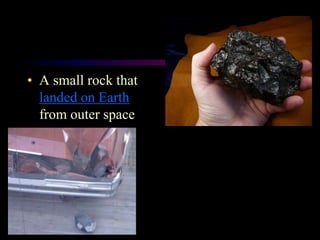
Meteorite
• A small rock that
landed on Earth
from outer space
54)Based on past asteroid activity, when is the
next massive asteroid due to hit Earth? The next
major asteroid should have hit Earth
approximately 15 million years ago. We are
overdue.
55)Meteoroids are a chuck of rock or dust found
in space, and usually come from a comet or
asteroid.
• 56)A meteor is small rock flying through
Earth’s atmosphere, a meteoroid is a small
rock flying through space, and a meteorite
is a small rock that landed on Earth from
outer space.
• 57)Why does a meteor glow? The small
rock burns as it flies through the
atmosphere.
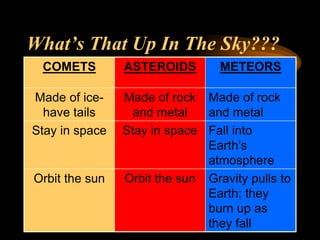
What’s That Up In The Sky???
COMETS ASTEROIDS METEORS
Made of ice-
have tails
Made of rock
and metal
Made of rock
and metal
Stay in space Stay in space Fall into
Earth’s
atmosphere
Orbit the sun Orbit the sun Gravity pulls to
Earth; they
burn up as
they fall
So, what have we learned
• What are comets?
• Where are they usually located?
• What are Meteoroids, Meteors, and
Meteorites?
• What are Asteroids?
• Name three places where we can find
asteroids?

PPT Comets Asteroids Meteoroids.ppt

  • 1.
  • 2.
    LEARNING OBJECTIVES • Atthe of a 60-minute period, students should be able to: • 1. Discuss the origin and fact about comets, asteroids and meteors. • 2. Draw how impact craters are formed when a meteor or asteroid hits Earth. • 3. Value the importance and occurrence of comets, meteors, and asteroids.
  • 3.
    Comets.. 48) Dirtysnowballs • They look like a star with a ghostly white tail. • A comet is a frozen ball of gases and liquids with small amounts of rock.
  • 4.
    • 46)What isa comet? A frozen ball of gases and liquids with small amounts of rock. • 47) Comets are chunks of ice and dust that revolve around the sun with very elliptical orbits.
  • 5.
    Other pictures ofComets Comet Hale-Bopp Comet Ikeya-Seki Comet Kohoutek
  • 6.
    49)The tails ofcomets always point away from the sun because the sun’s radiation slowly burns away some of the comet as it orbits the sun.
  • 7.
    Comets orbit • Ifa comet has a large orbit, it takes a long time to go around the Sun. – Some comets are "short-period" comets that take five or ten years to complete an orbit. – Some comets are "long-period" comets that take decades, centuries, or millenia to orbit the Sun.
  • 8.
    How did cometsform??????? • Astronomers are not certain how comets formed, but most believe that comets formed at the same time our solar system did, perhaps even in among the planets.
  • 9.
    45)Comets and asteroidsare objects smaller than planets that orbit the sun and vary in size, composition, and characteristics.
  • 10.
    1. - Rocklarger than a boulder revolving around the Sun. 2. - Orbits are mainly between Mars and Jupiter. 3. - Diameters are typically between one to several hundred kilometers. 4. - To the right are some compared to the size of our Moon. Asteroids
  • 11.
    • 50)Asteroids aresmaller than planets and can be found orbiting the Sun.
  • 12.
    Asteroids……Rockin’ Around • Mostasteroids travel in the wide gap between the inner planets and outer planets (known as 51 & 52 first blank) Asteroid belt). • But a few travel in paths across Mar’s orbit and some even cross in Earth’s orbit.
  • 14.
    Asteroid Belt • Theregion of space between Mars and Jupiter; about 2.8AU • Hundreds of thousands of asteroids known. Probably millions.
  • 15.
    Asteroid Belt • Asteroidsare remnants of a planet- formation process that failed
  • 17.
    Second blank 52)KuiperBelt • Discovered in 1992
  • 19.
    52)Oort Cloud • Hypotheticalspherical cloud. No direct observations. • Proposed by Ernst Opik (1932), Jan Henrik Oort (1950)
  • 20.
    Meteoroids, Meteors andMeteorites • Meteoroid = the object before it enters Earth's atmosphere. Most are destroyed about 80 km above the Earth's surface. They are small sand to boulder-sized particles of space debris. • Meteor = They are often called shooting stars. We see them as glowing small particles as they enter the atmosphere. They glow because of heat from friction with the atmosphere. • Meteorites = They are rocks that reach the Earth's surface from space. Meteor Meteorites Meteoroid
  • 21.
    Other asteroids lieon the outer edge of our solar system in the Kuiper Belt In this picture you can see the Asteroid Belt And the Kuiper Belt
  • 22.
  • 23.
    53)Scientists suggest thatthe last massive asteroid that hit Earth landed approximately 65 million years ago.
  • 24.
    Based on pastasteroid activity, when is the next massive asteroid due to hit Earth? The next major asteroid should have hit Earth approximately 15 million years ago, because scientist believe the massive asteroids hit Earth every 50 million years.
  • 25.
    Meteoroids, Meteors andMeteorites • Meteoroid = the object before it enters Earth's atmosphere. Most are destroyed about 80 km above the Earth's surface. They are small sand to boulder-sized particles of space debris. • Meteor = They are often called shooting stars. We see them as glowing small particles as they enter the atmosphere. They glow because of heat from friction with the atmosphere. • Meteorites = They are rocks that reach the Earth's surface from space. Meteor Meteorites Meteoroid
  • 26.
    Meteors…Shooting Stars orSpace Garbage • 56)A meteor is a small rock flying through Earth’s atmosphere.
  • 27.
    Meteors…Shooting Stars orSpace Garbage Meteors are falling all the time. During the annual meteor storms, you may see 100 per hour.
  • 28.
    Why does ameteor glow? • The small rock burns as it fly's through the atmosphere. • REALLY bright meteors are called FIREBALLS
  • 29.
    Meteoroid • A smallrock flying through space
  • 30.
    Meteorite • A smallrock that landed on Earth from outer space
  • 31.
    54)Based on pastasteroid activity, when is the next massive asteroid due to hit Earth? The next major asteroid should have hit Earth approximately 15 million years ago. We are overdue. 55)Meteoroids are a chuck of rock or dust found in space, and usually come from a comet or asteroid.
  • 32.
    • 56)A meteoris small rock flying through Earth’s atmosphere, a meteoroid is a small rock flying through space, and a meteorite is a small rock that landed on Earth from outer space. • 57)Why does a meteor glow? The small rock burns as it flies through the atmosphere.
  • 33.
    What’s That UpIn The Sky??? COMETS ASTEROIDS METEORS Made of ice- have tails Made of rock and metal Made of rock and metal Stay in space Stay in space Fall into Earth’s atmosphere Orbit the sun Orbit the sun Gravity pulls to Earth; they burn up as they fall
  • 34.
    So, what havewe learned • What are comets? • Where are they usually located? • What are Meteoroids, Meteors, and Meteorites? • What are Asteroids? • Name three places where we can find asteroids?