Chapter 14 Lecture
© 2014 Pearson Education, Inc.
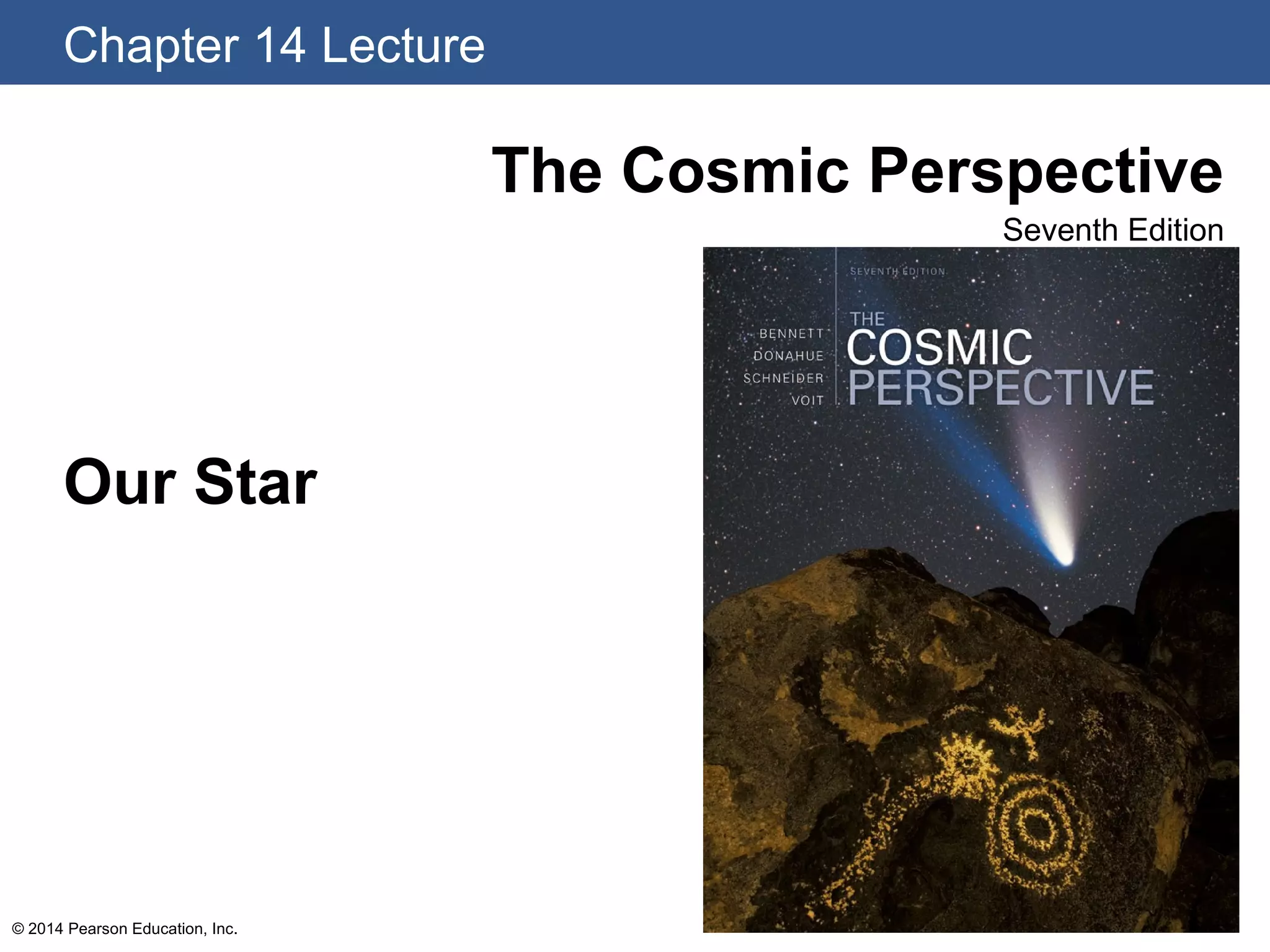
The Cosmic Perspective
Seventh Edition
Our Star
14.1 A Closer Look at the Sun
• Our goals for learning:
– Why does the Sun shine?
– What is the Sun's structure?
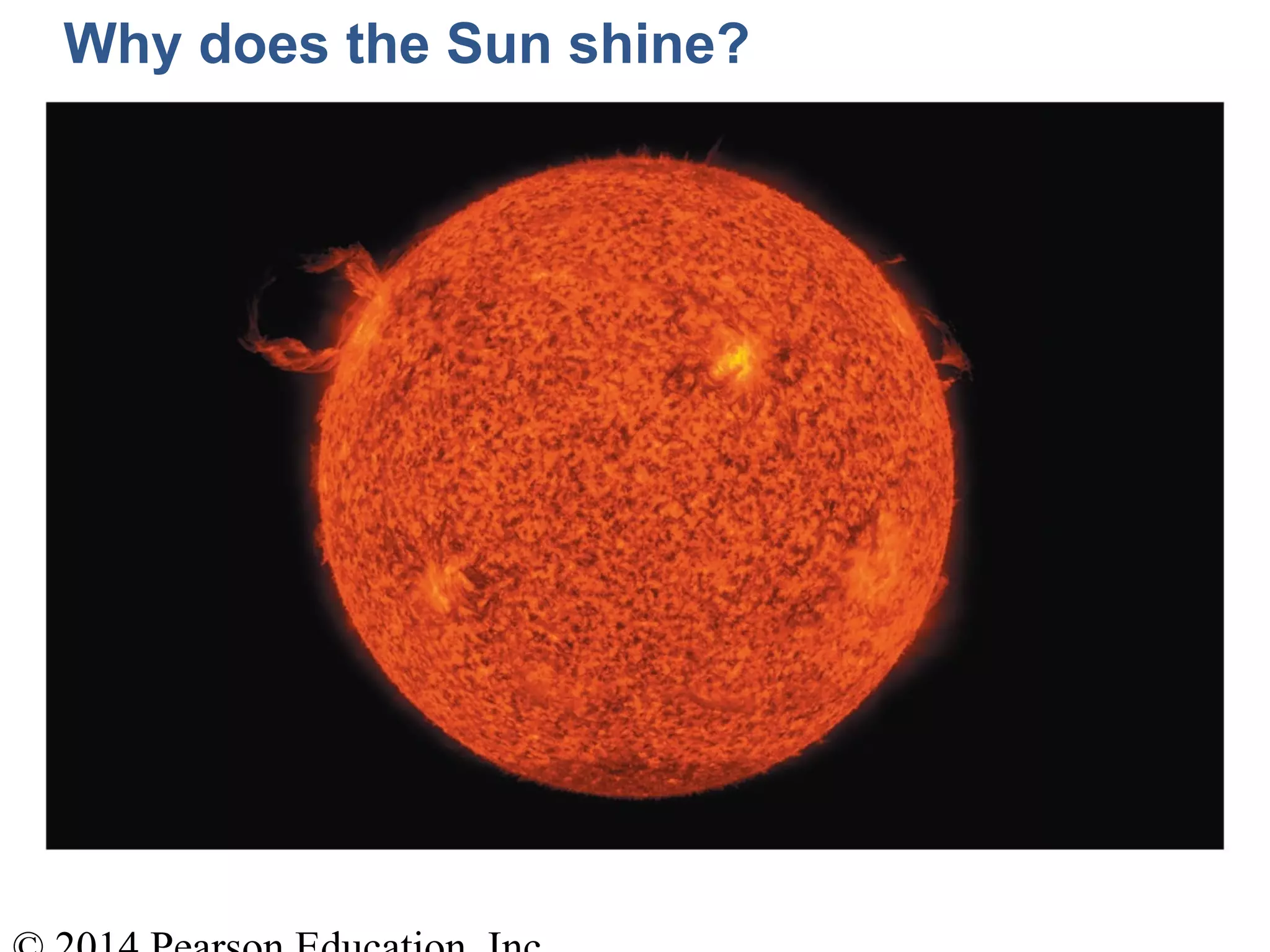
Why does the Sun shine?
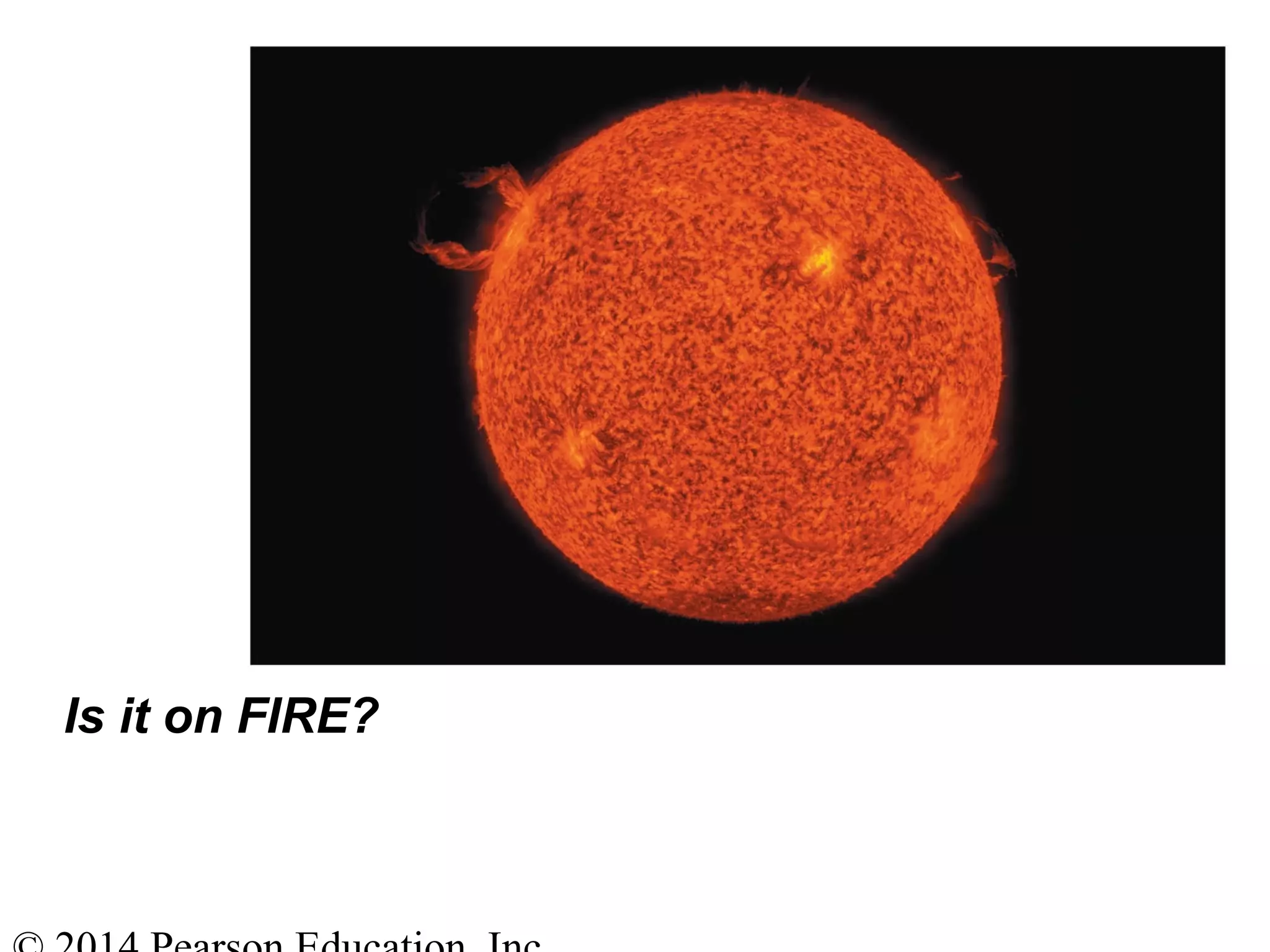
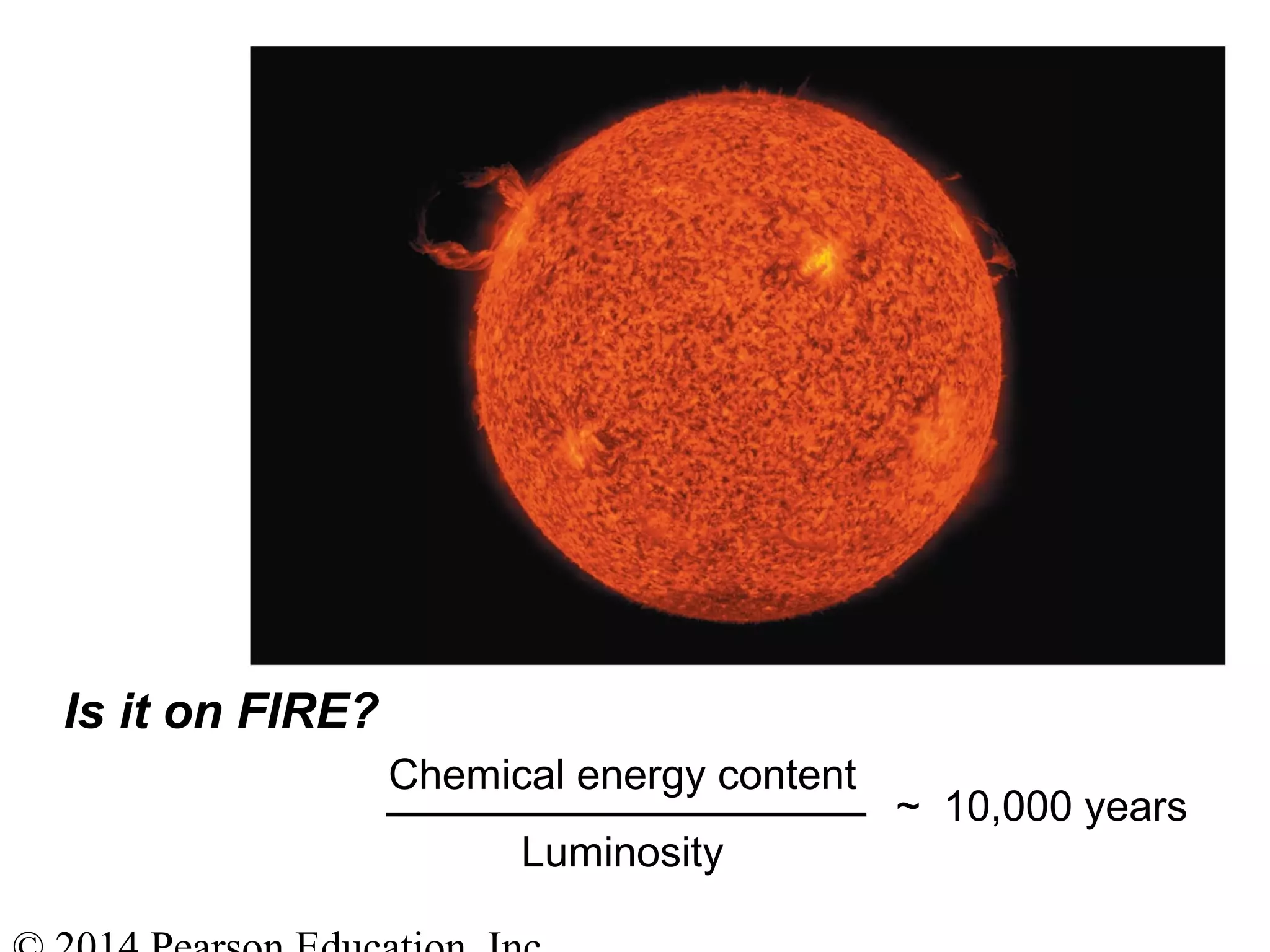
Is it on FIRE?
Luminosity
~ 10,000 years
Chemical energy content
Is it on FIRE?
Luminosity
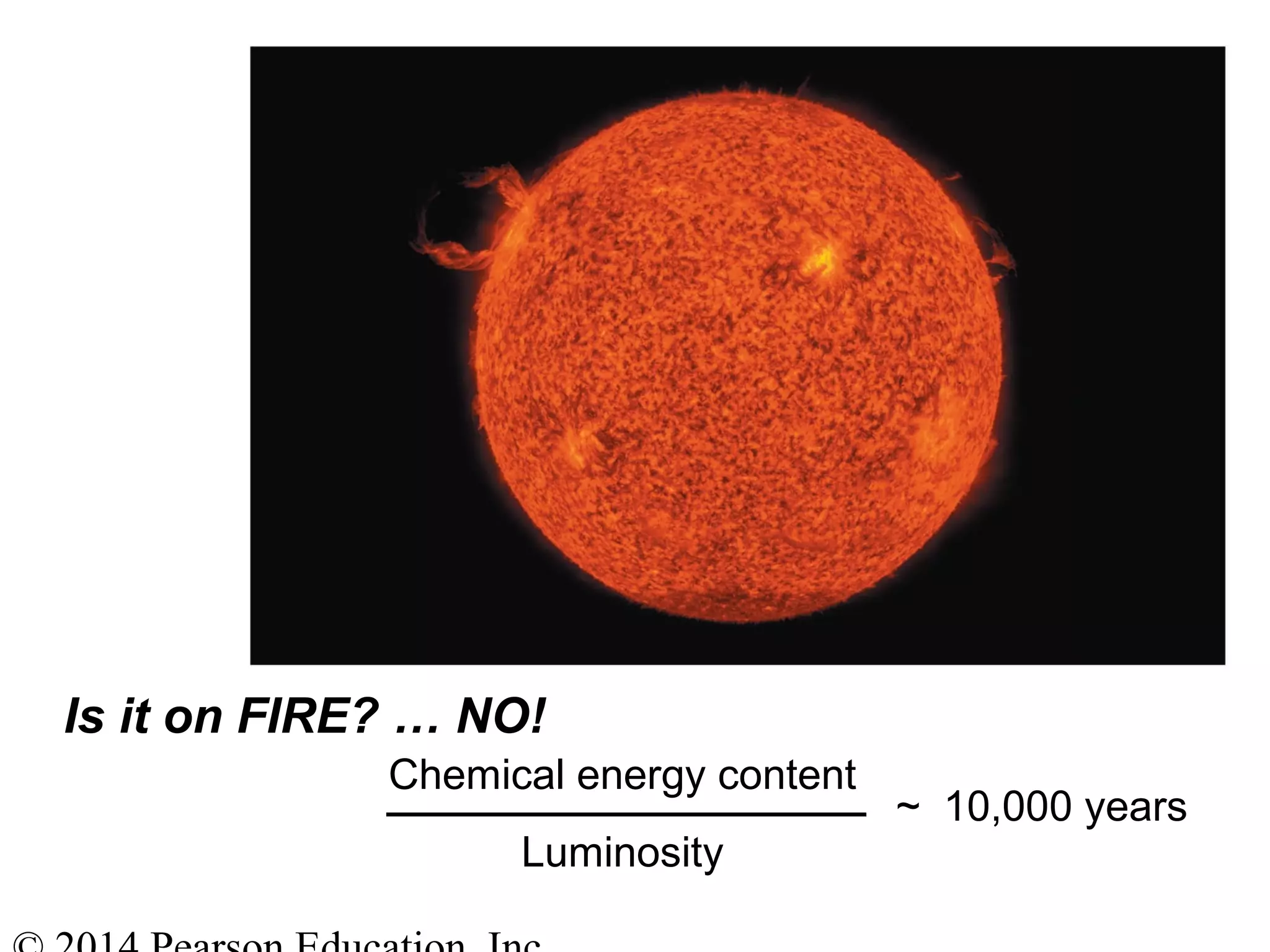
Chemical energy content
~ 10,000 years
Is it on FIRE? … NO!
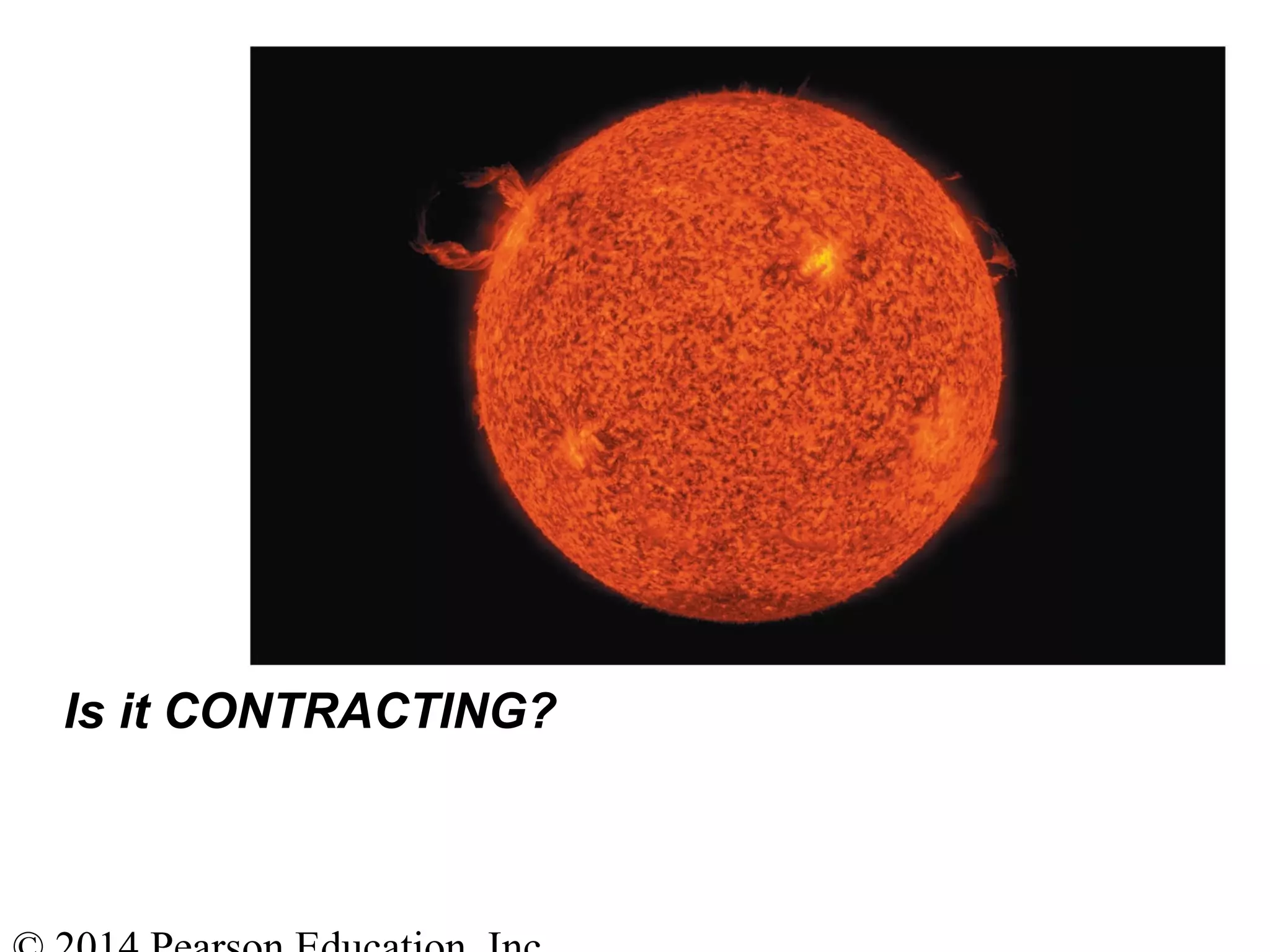
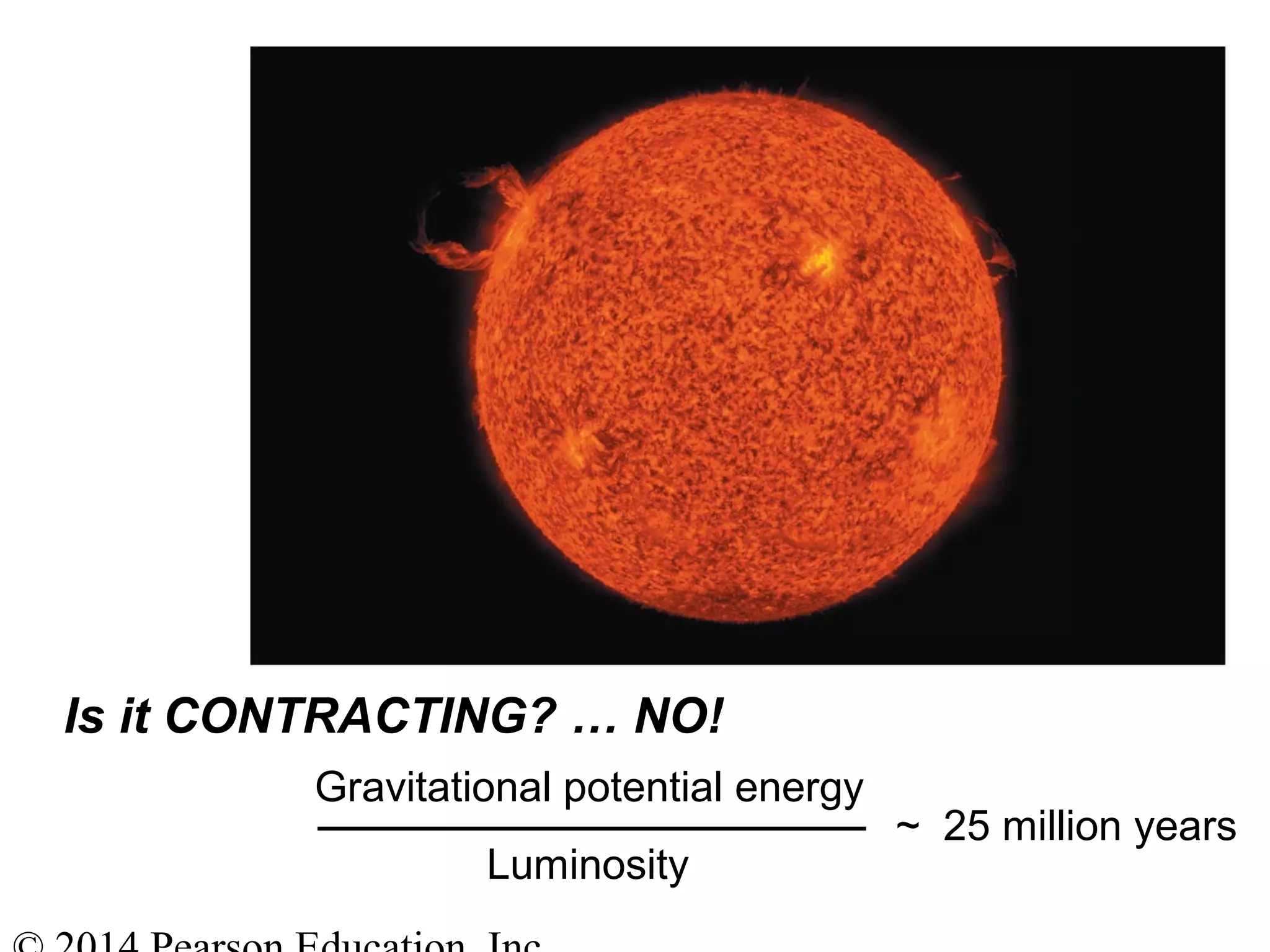
Is it CONTRACTING?
Luminosity
~ 25 million years
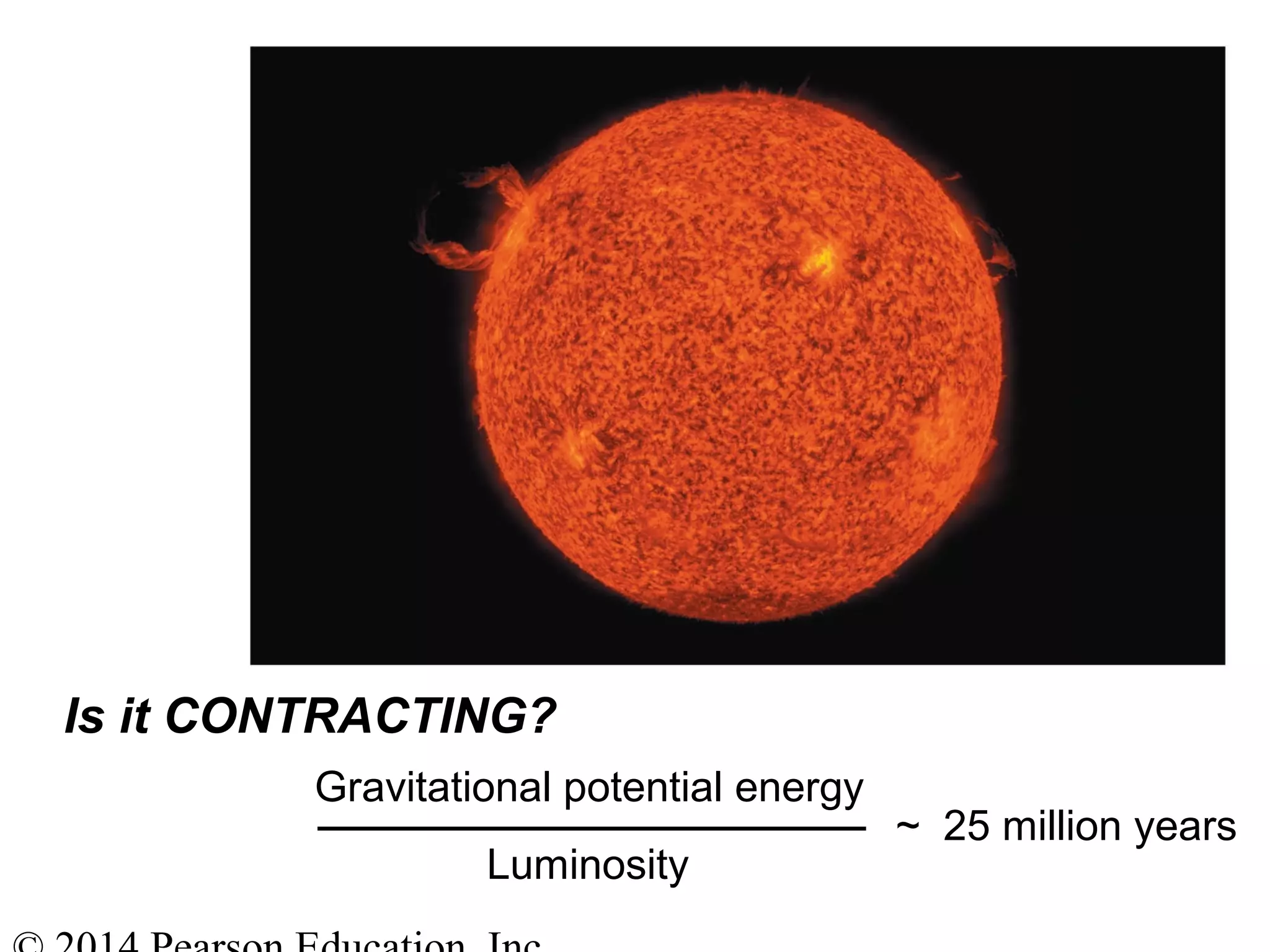
Gravitational potential energy
Is it CONTRACTING?
Luminosity
~ 25 million years
Is it CONTRACTING? … NO!
Gravitational potential energy
Luminosity
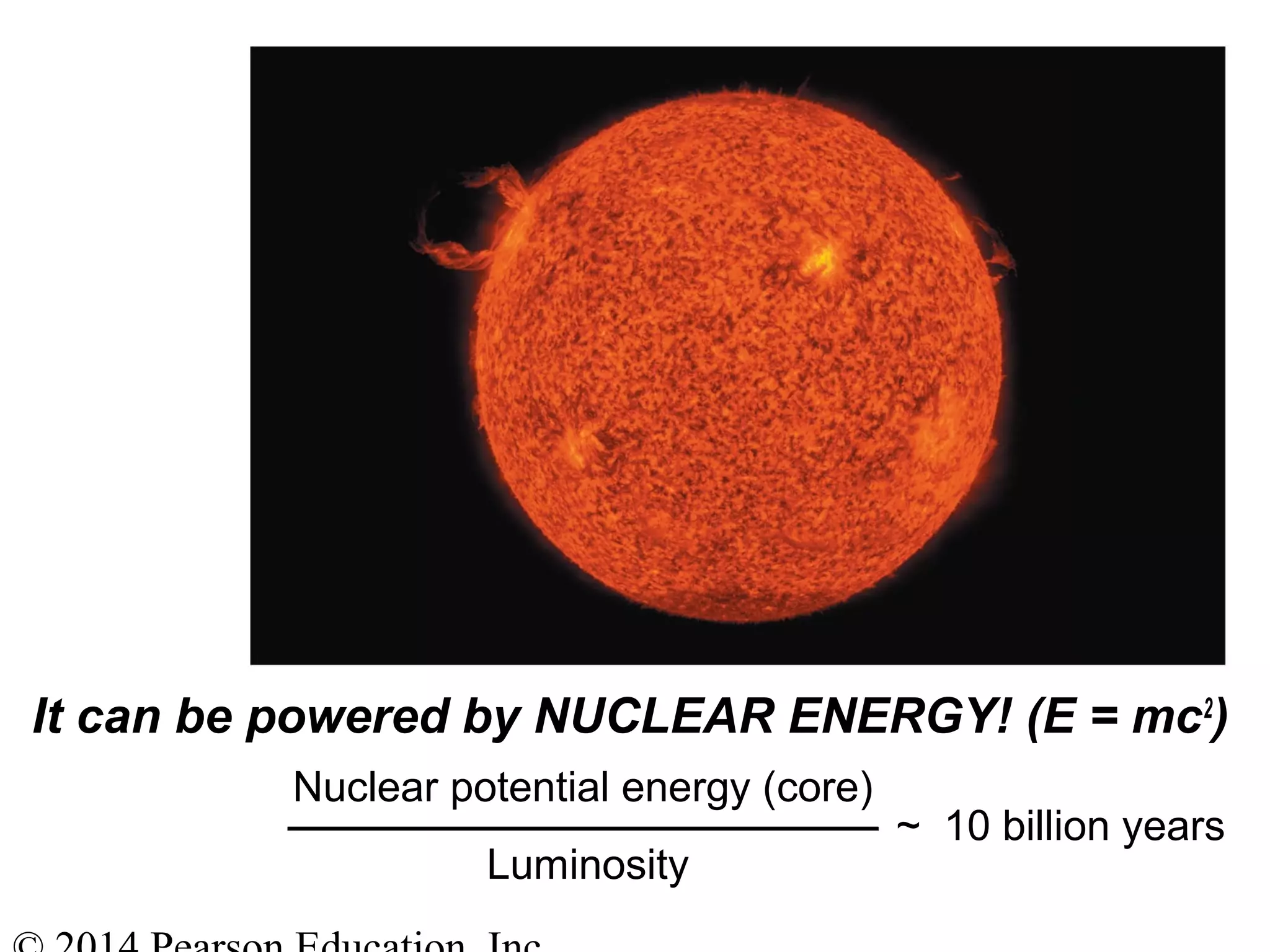
~ 10 billion years
Nuclear potential energy (core)
It can be powered by NUCLEAR ENERGY! (E = mc2
)
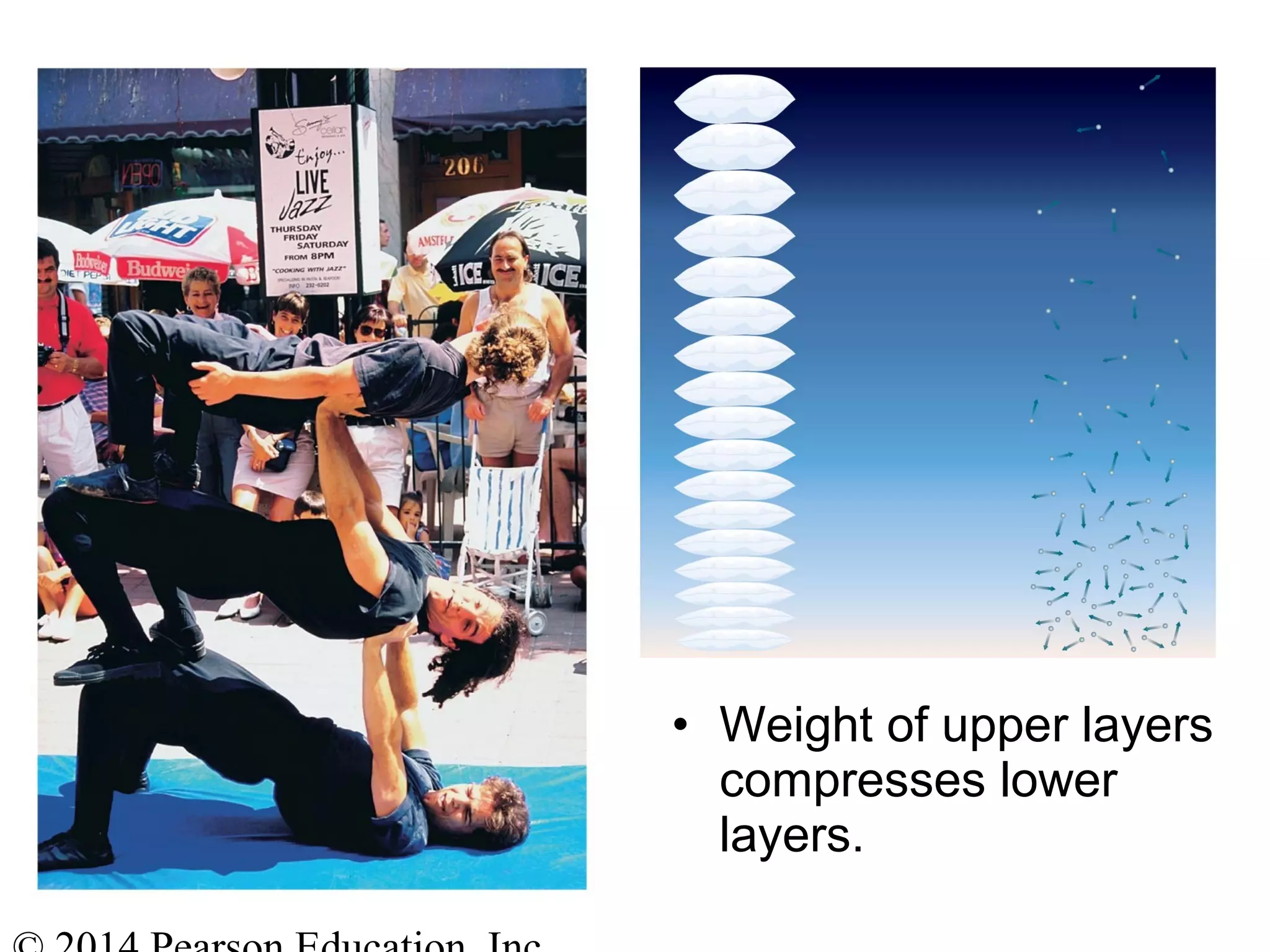
• Weight of upper layers
compresses lower
layers.
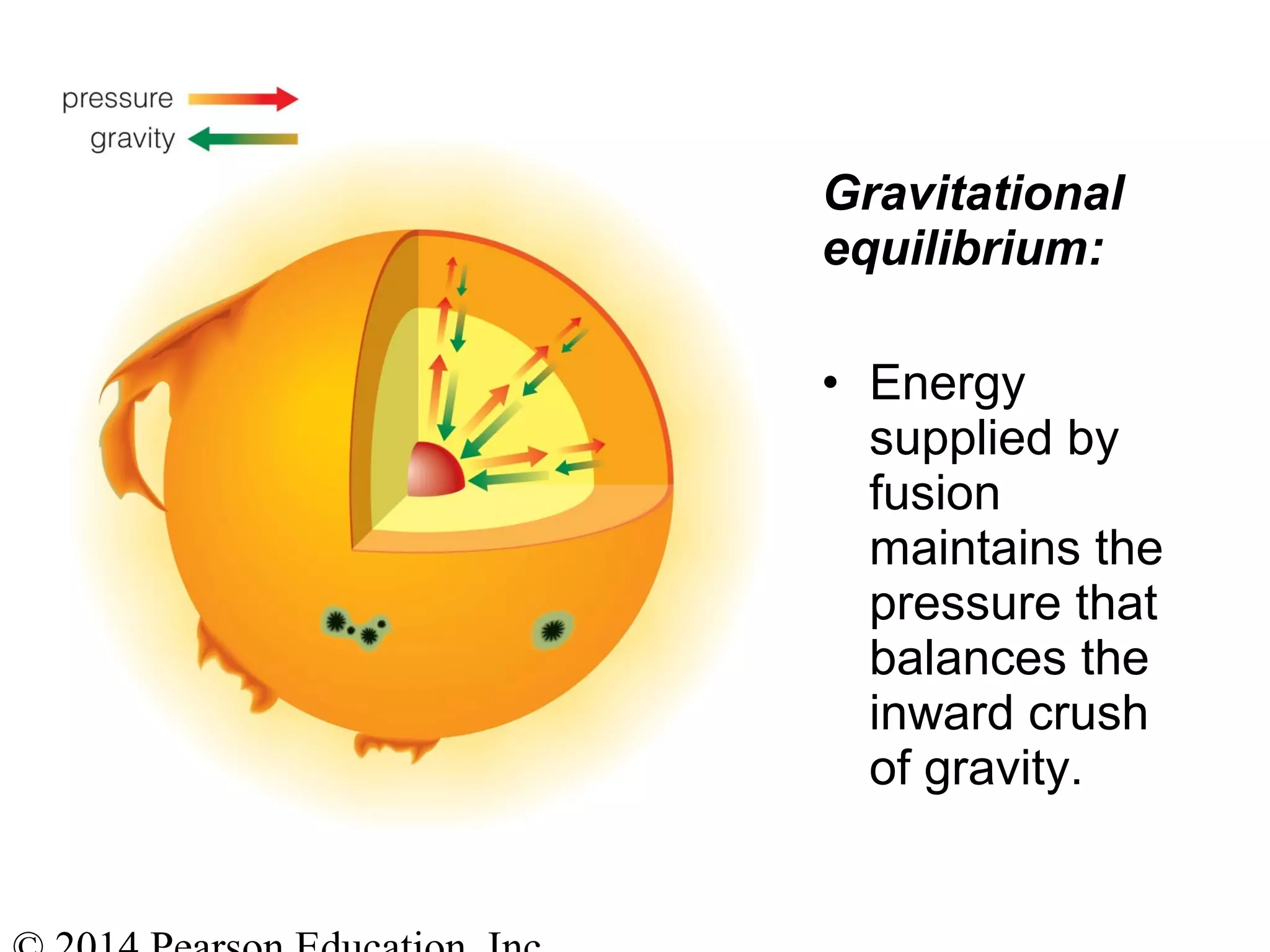
Gravitational
equilibrium:
• Energy
supplied by
fusion
maintains the
pressure that
balances the
inward crush
of gravity.
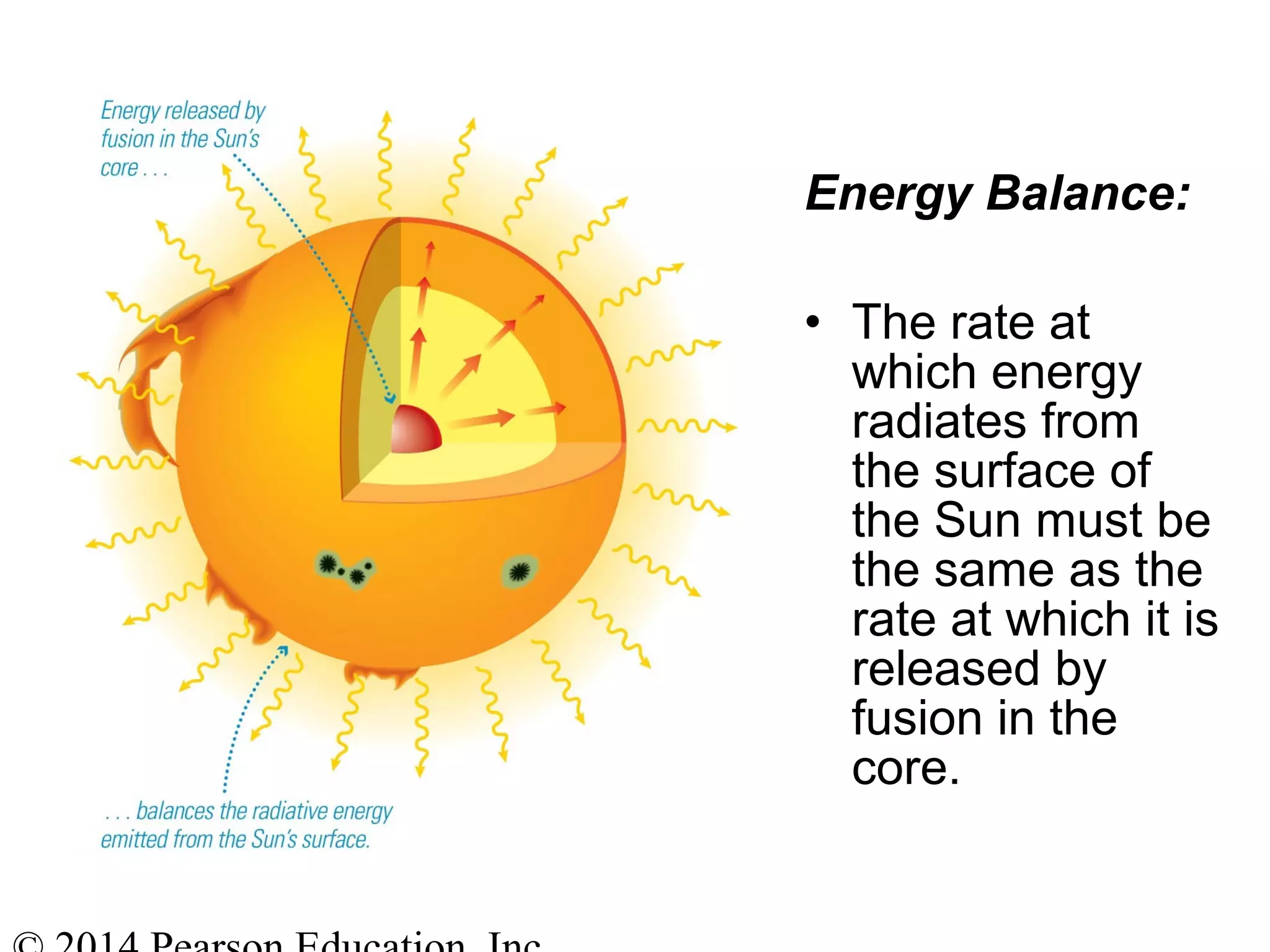
Energy Balance:
• The rate at
which energy
radiates from
the surface of
the Sun must be
the same as the
rate at which it is
released by
fusion in the
core.
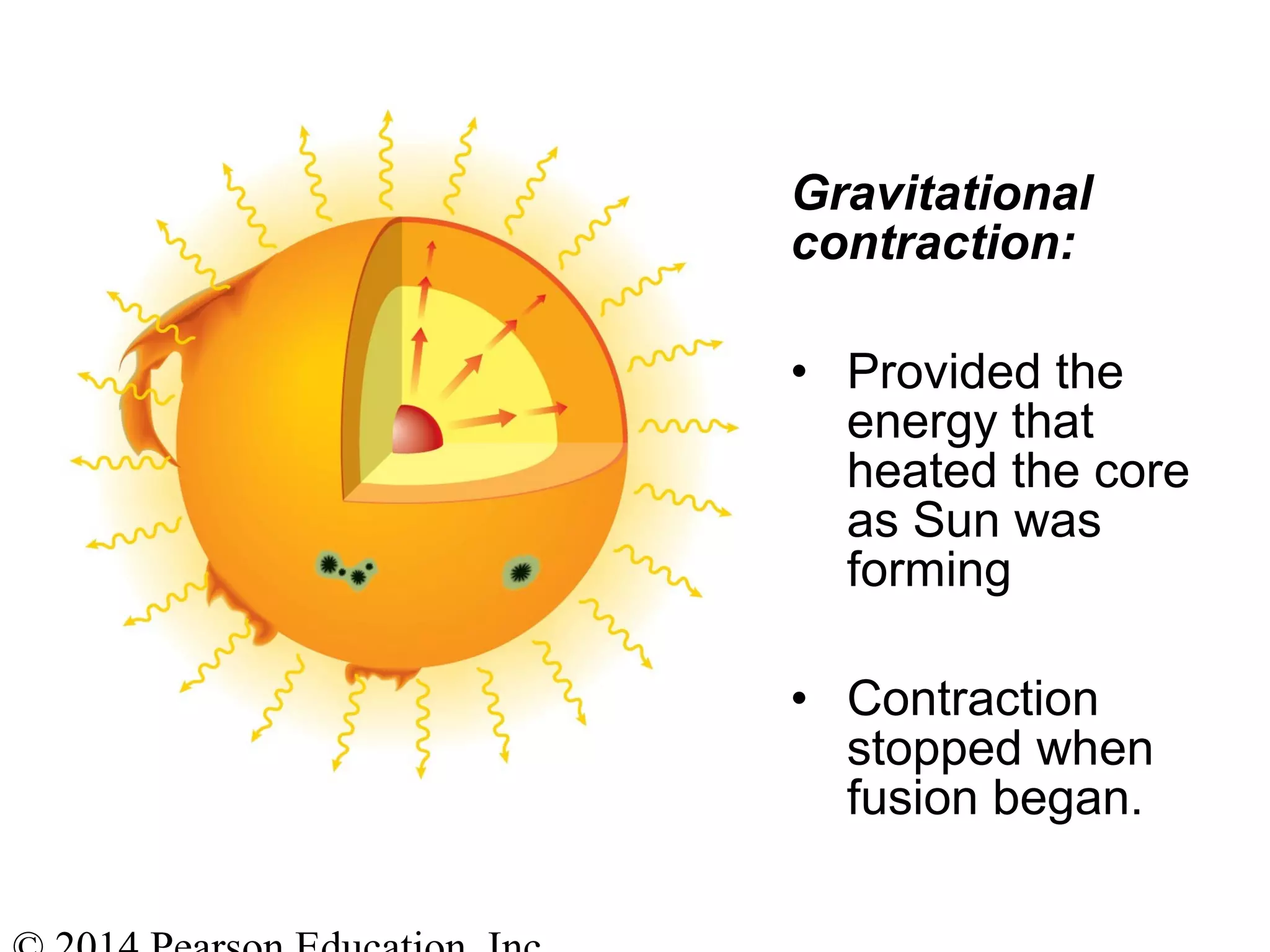
Gravitational
contraction:
• Provided the
energy that
heated the core
as Sun was
forming
• Contraction
stopped when
fusion began.
What is the Sun's structure?
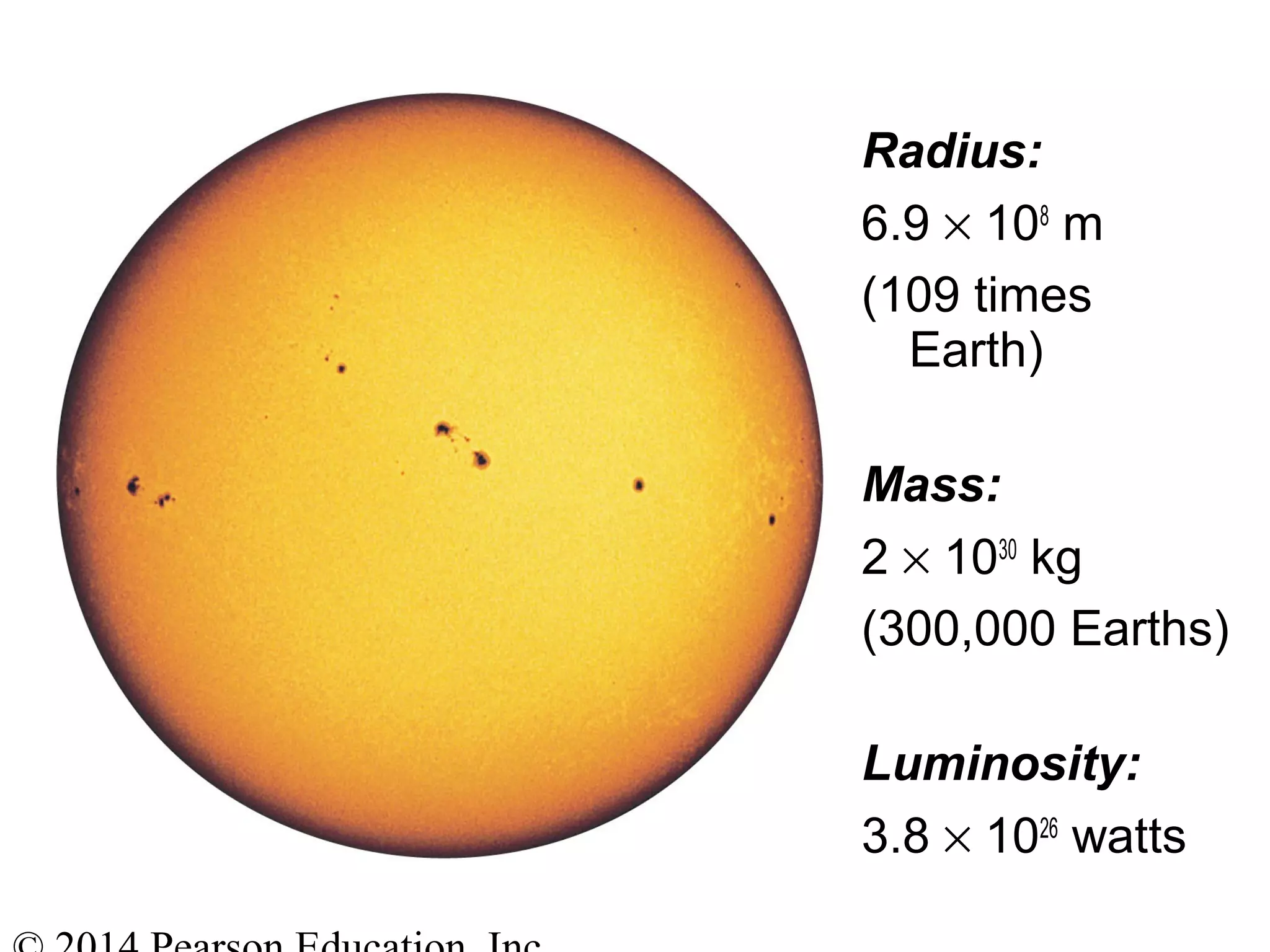
Radius:
6.9 × 10⁸
m
(109 times
Earth)
Mass:
2 × 1030
kg
(300,000 Earths)
Luminosity:
3.8 × 1026
watts
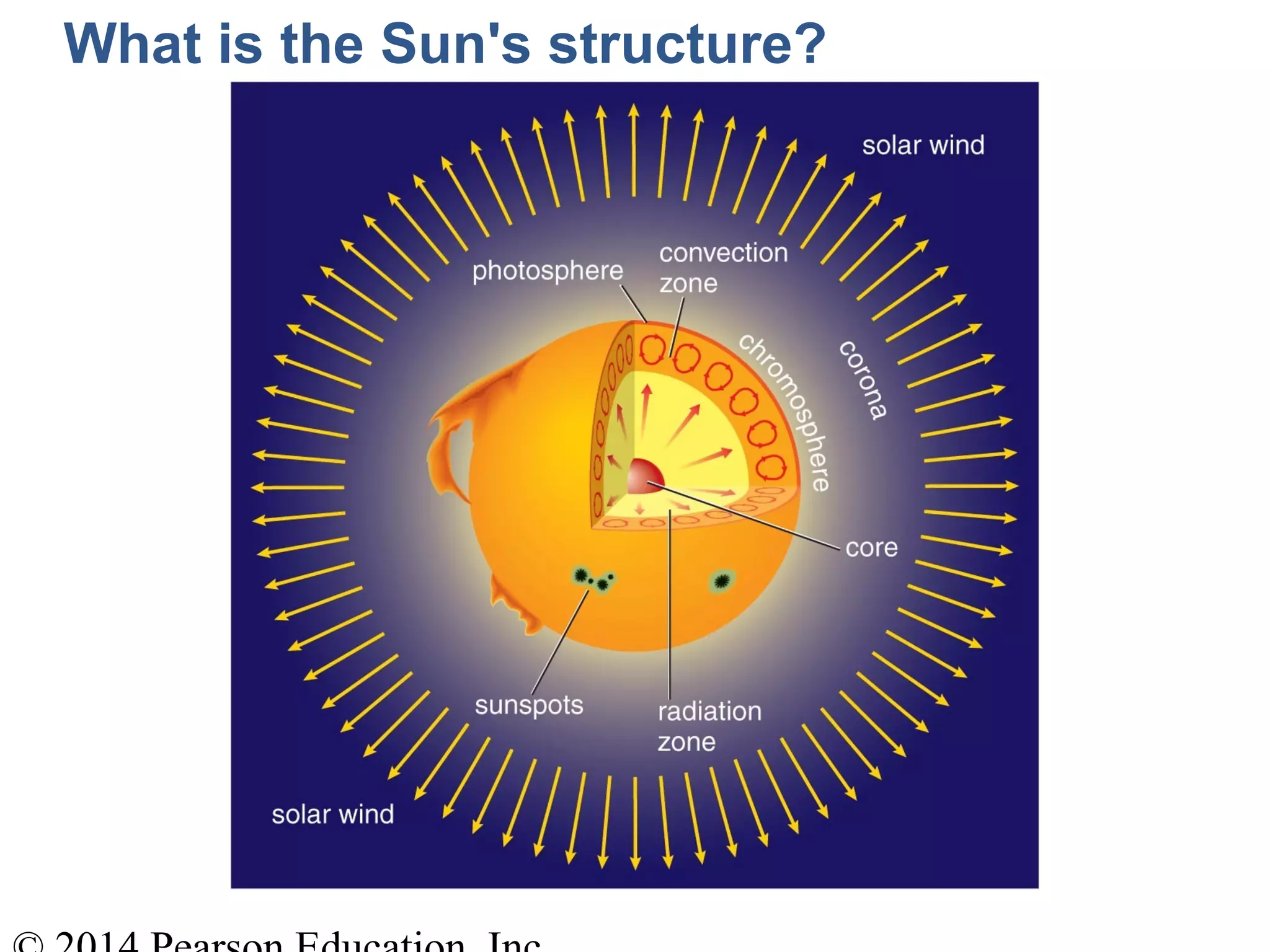
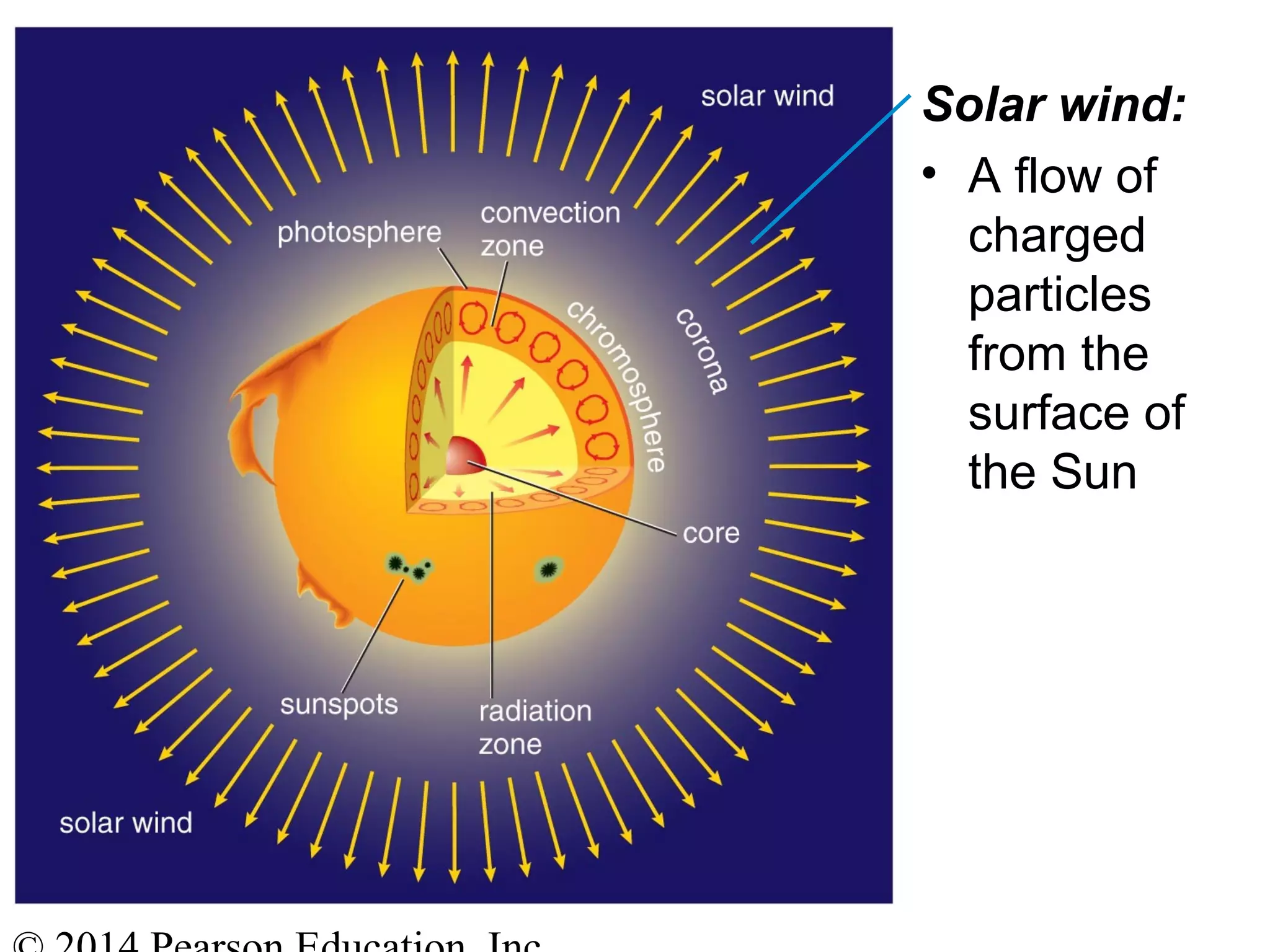
Solar wind:
• A flow of
charged
particles
from the
surface of
the Sun
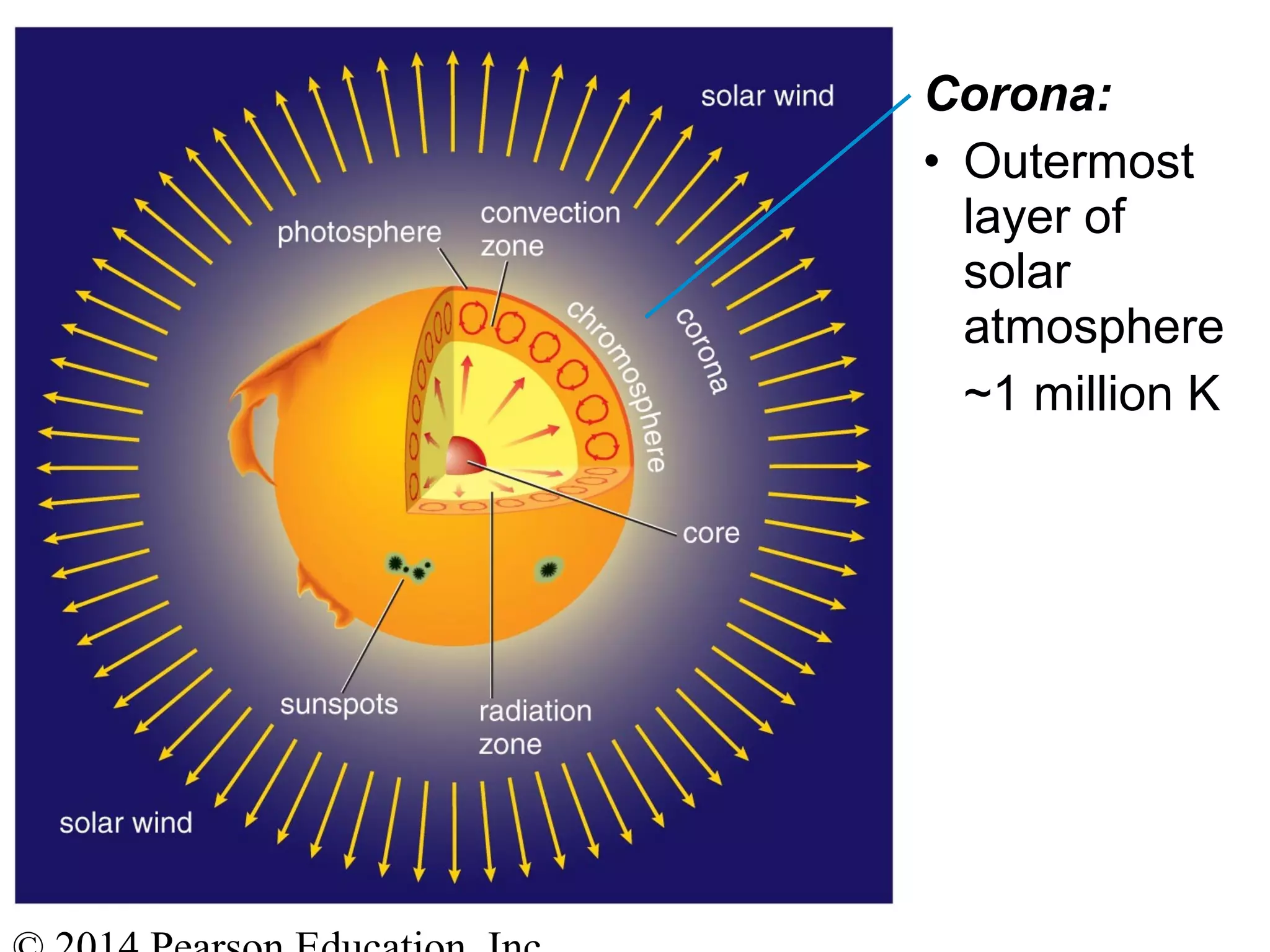
Corona:
• Outermost
layer of
solar
atmosphere
~1 million K
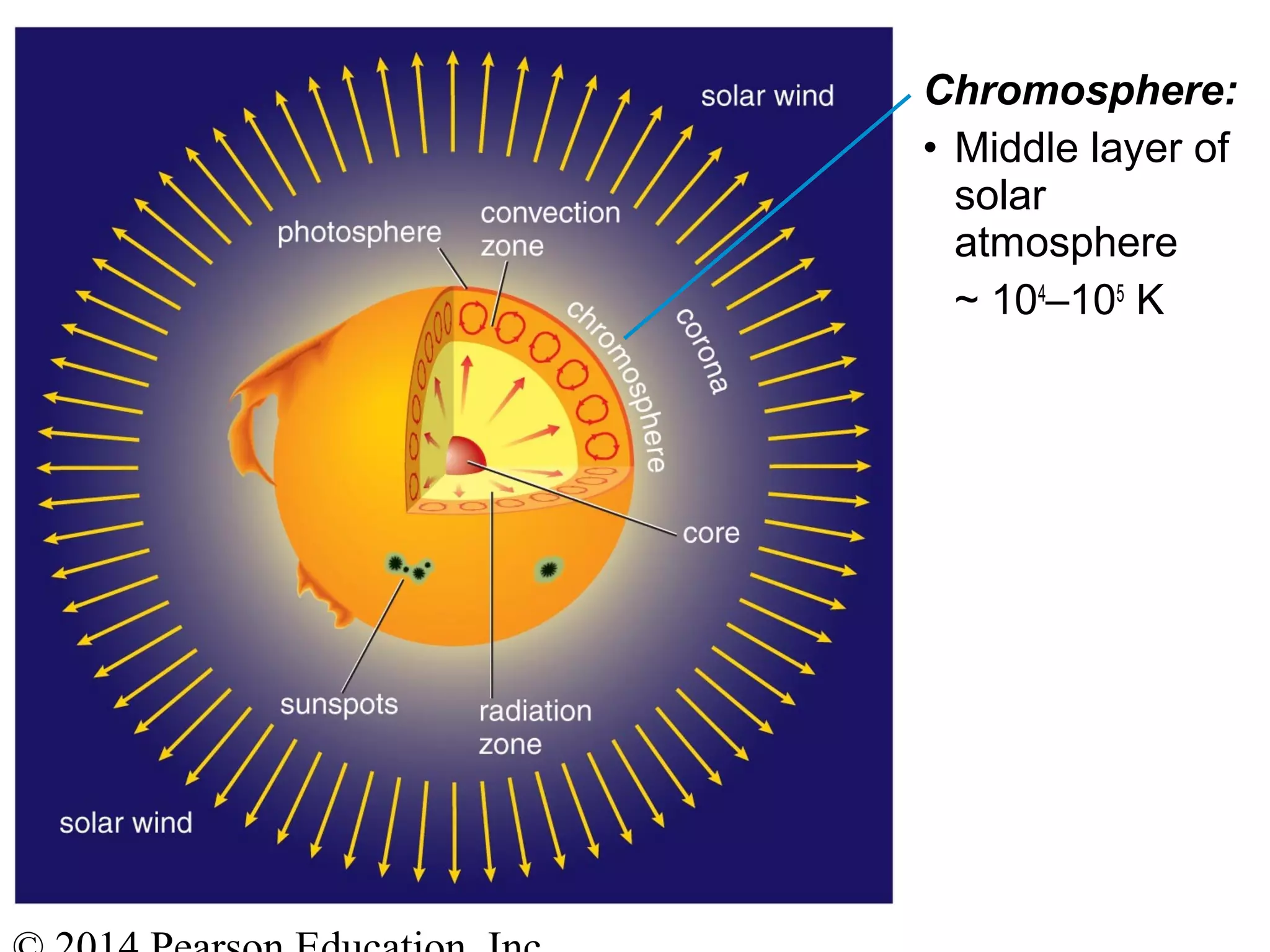
Chromosphere:
• Middle layer of
solar
atmosphere
~ 104
–105
K
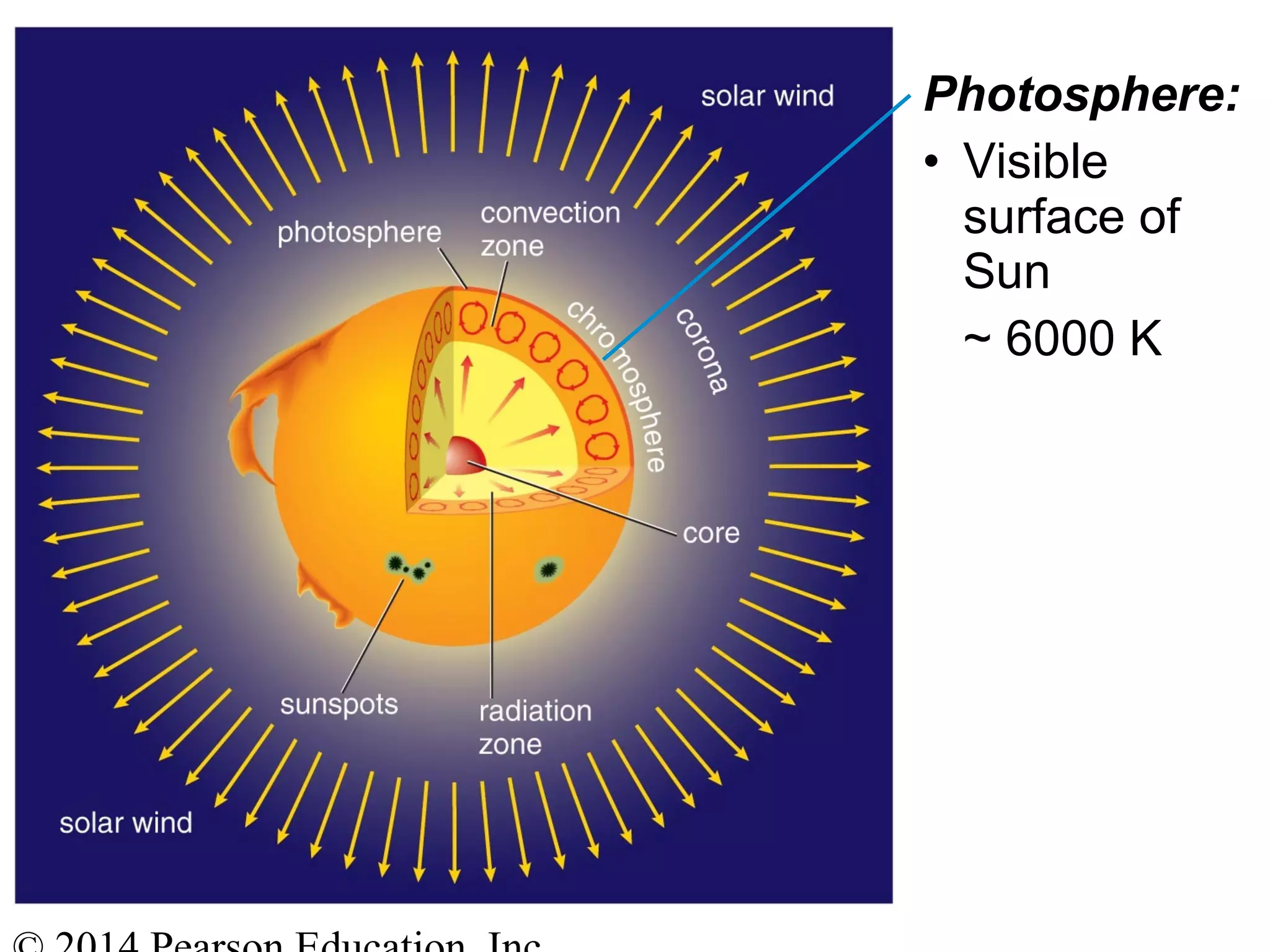
Photosphere:
• Visible
surface of
Sun
~ 6000 K
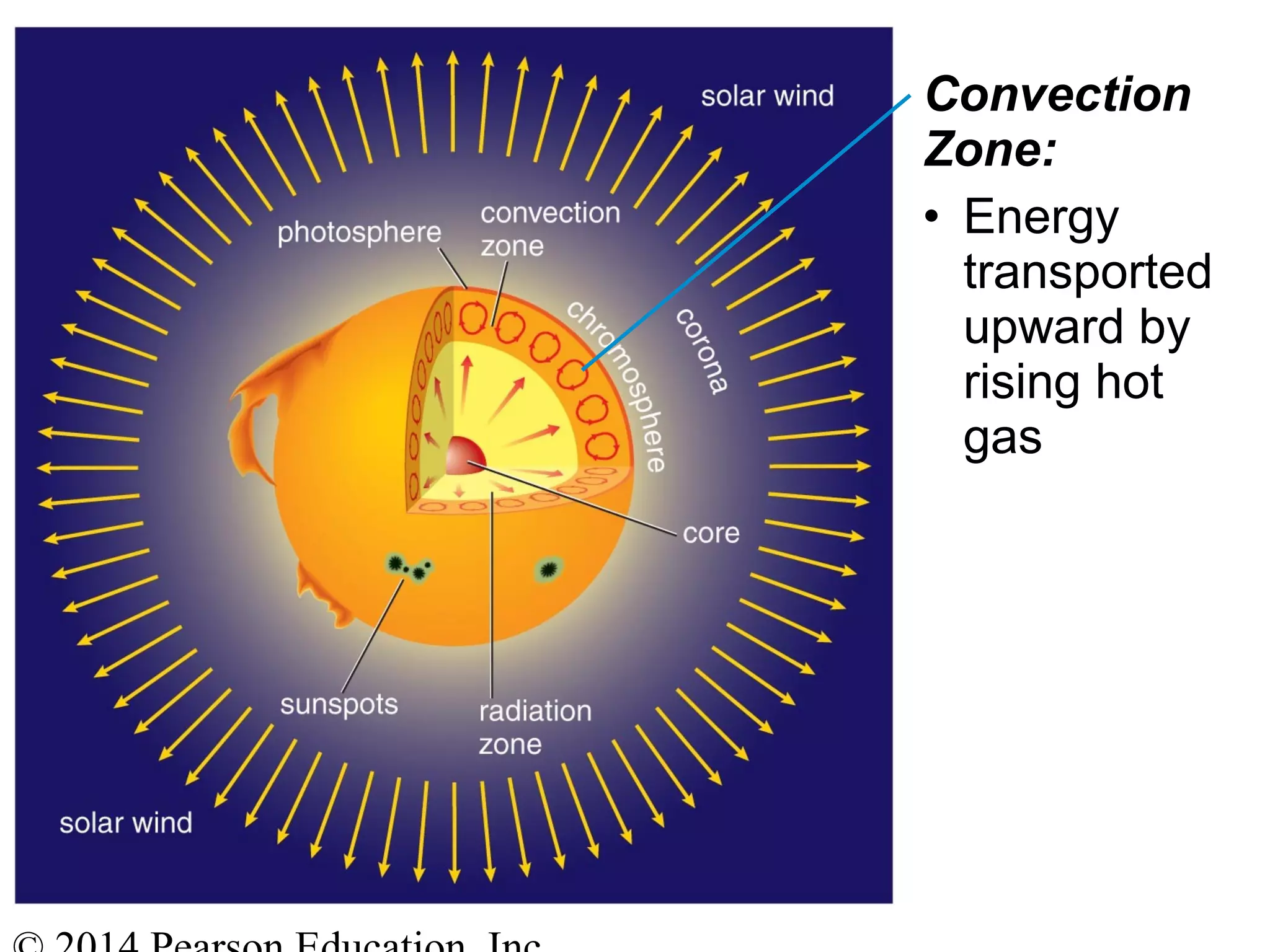
Convection
Zone:
• Energy
transported
upward by
rising hot
gas
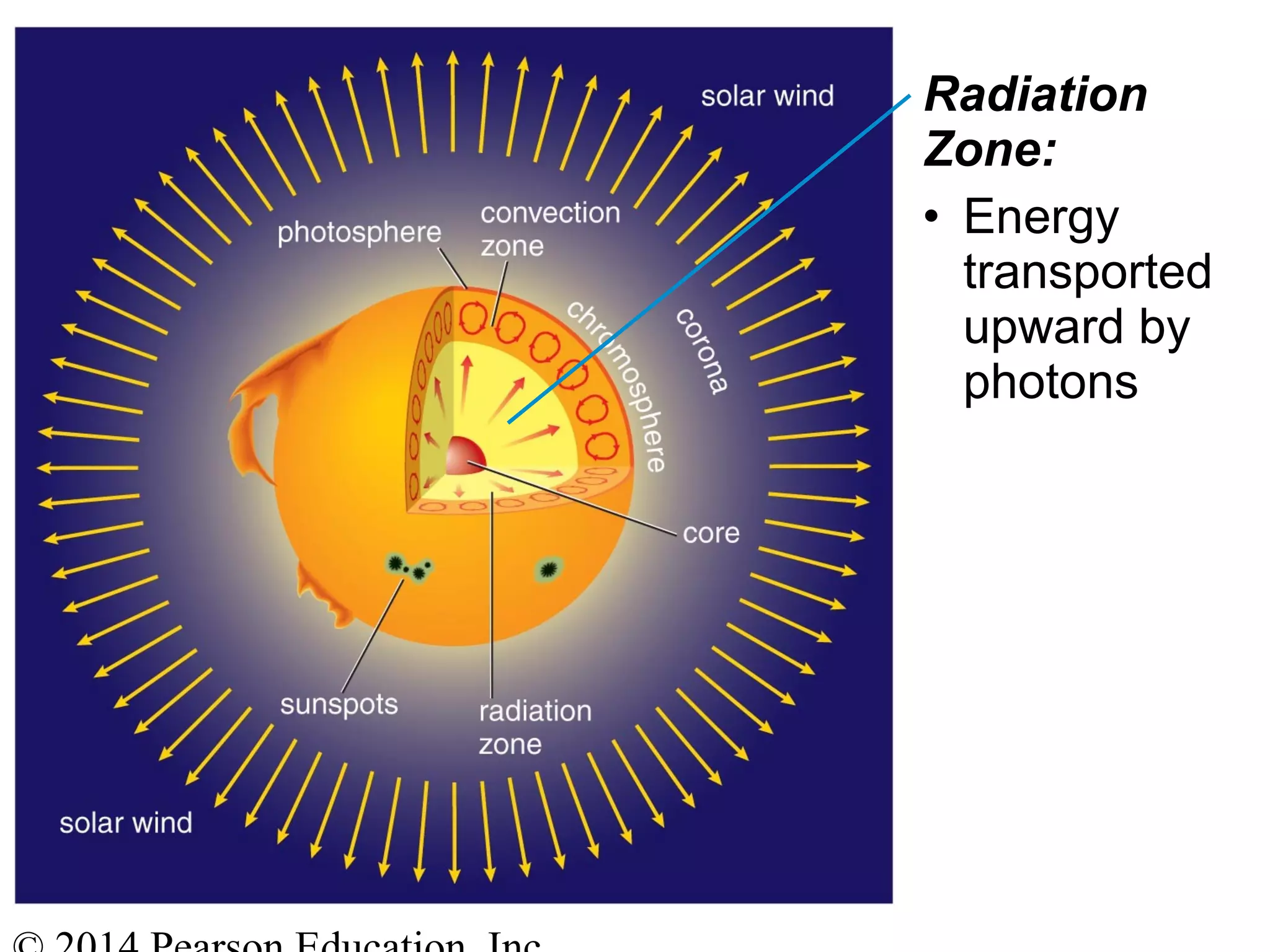
Radiation
Zone:
• Energy
transported
upward by
photons
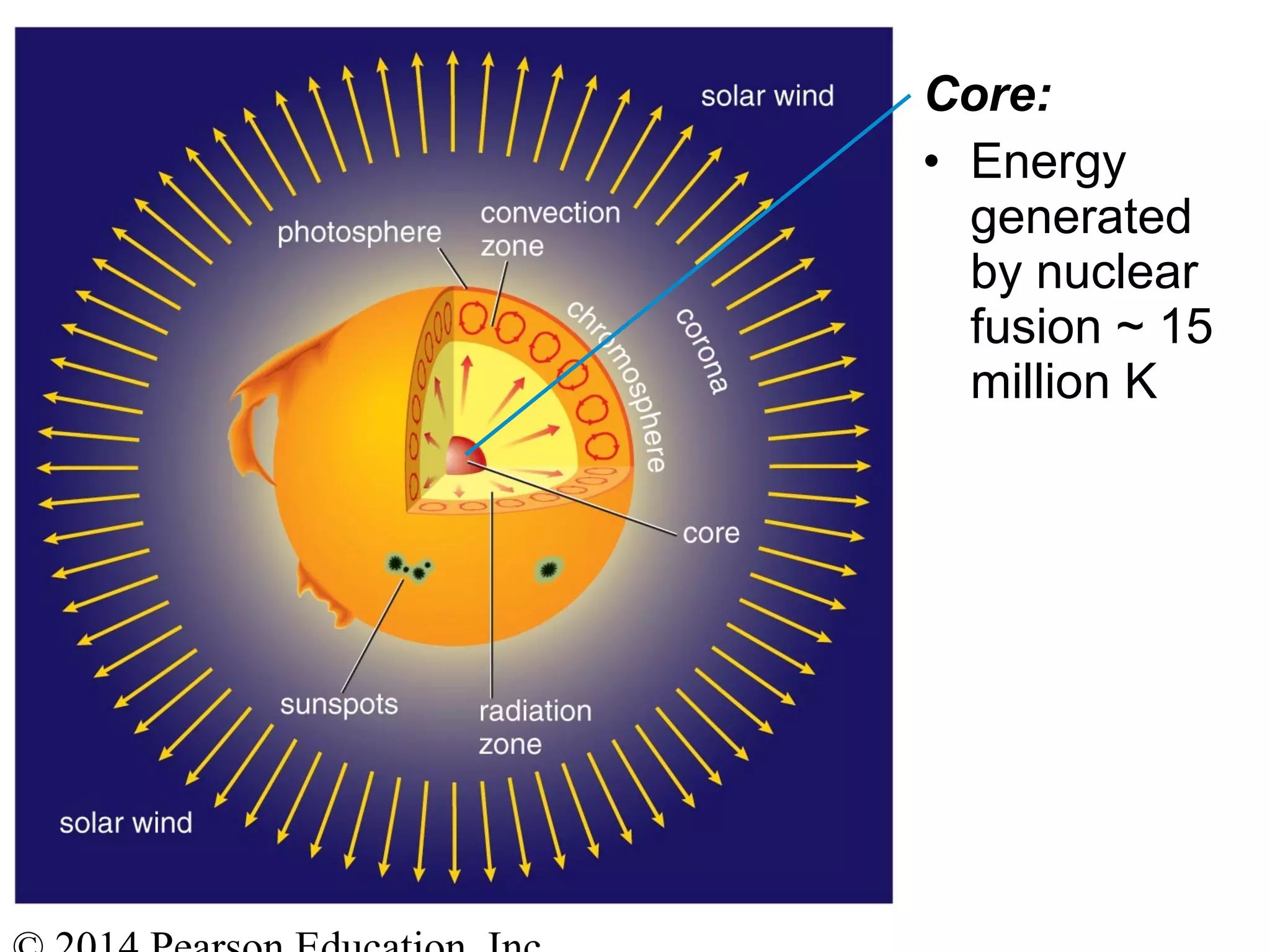
Core:
• Energy
generated
by nuclear
fusion ~ 15
million K
What have we learned?
• Why does the Sun shine?
– Chemical and gravitational energy sources
could not explain how the Sun could sustain
its luminosity for more than about 25 million
years.
– The Sun shines because gravitational
equilibrium keeps its core hot and dense
enough to release energy through nuclear
fusion.
What have we learned?
• What is the Sun's structure?
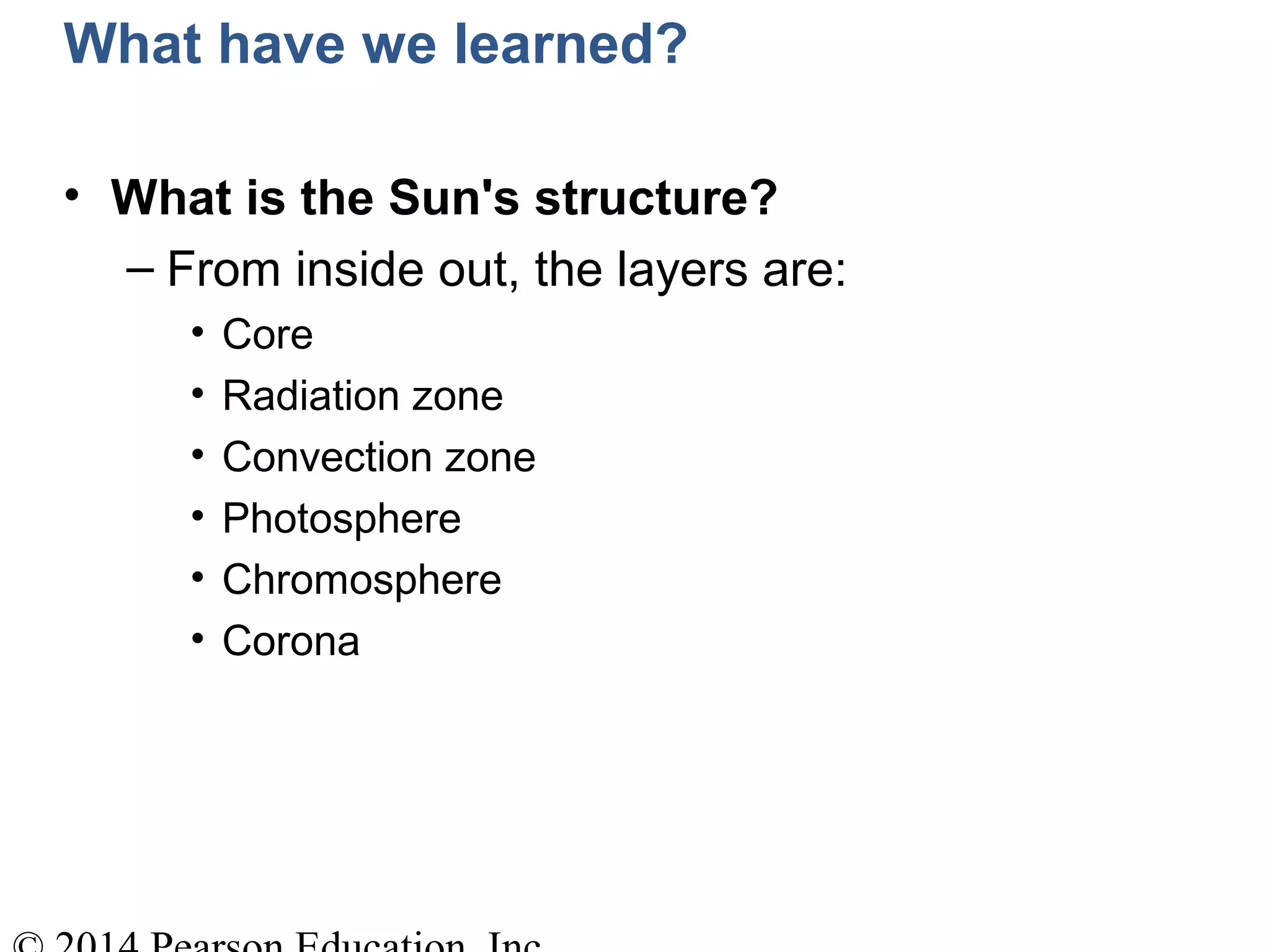
– From inside out, the layers are:
• Core
• Radiation zone
• Convection zone
• Photosphere
• Chromosphere
• Corona
14.2 Nuclear Fusion in the Sun
• Our goals for learning:
– How does nuclear fusion occur in the Sun?
– How does the energy from fusion get out of
the Sun?
– How do we know what is happening inside
the Sun?
How does nuclear fusion occur in the Sun?
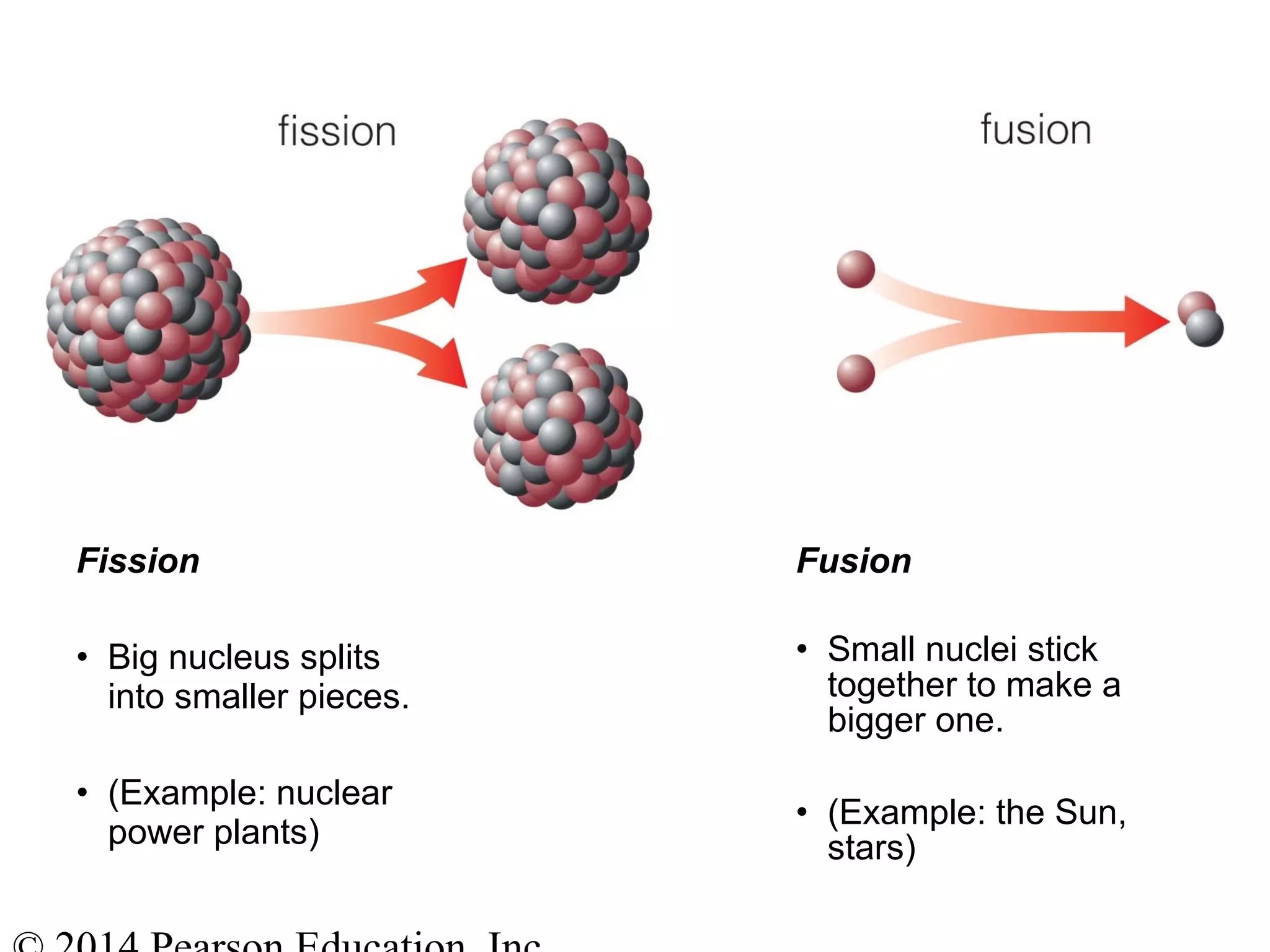
Fission
• Big nucleus splits
into smaller pieces.
• (Example: nuclear
power plants)
Fusion
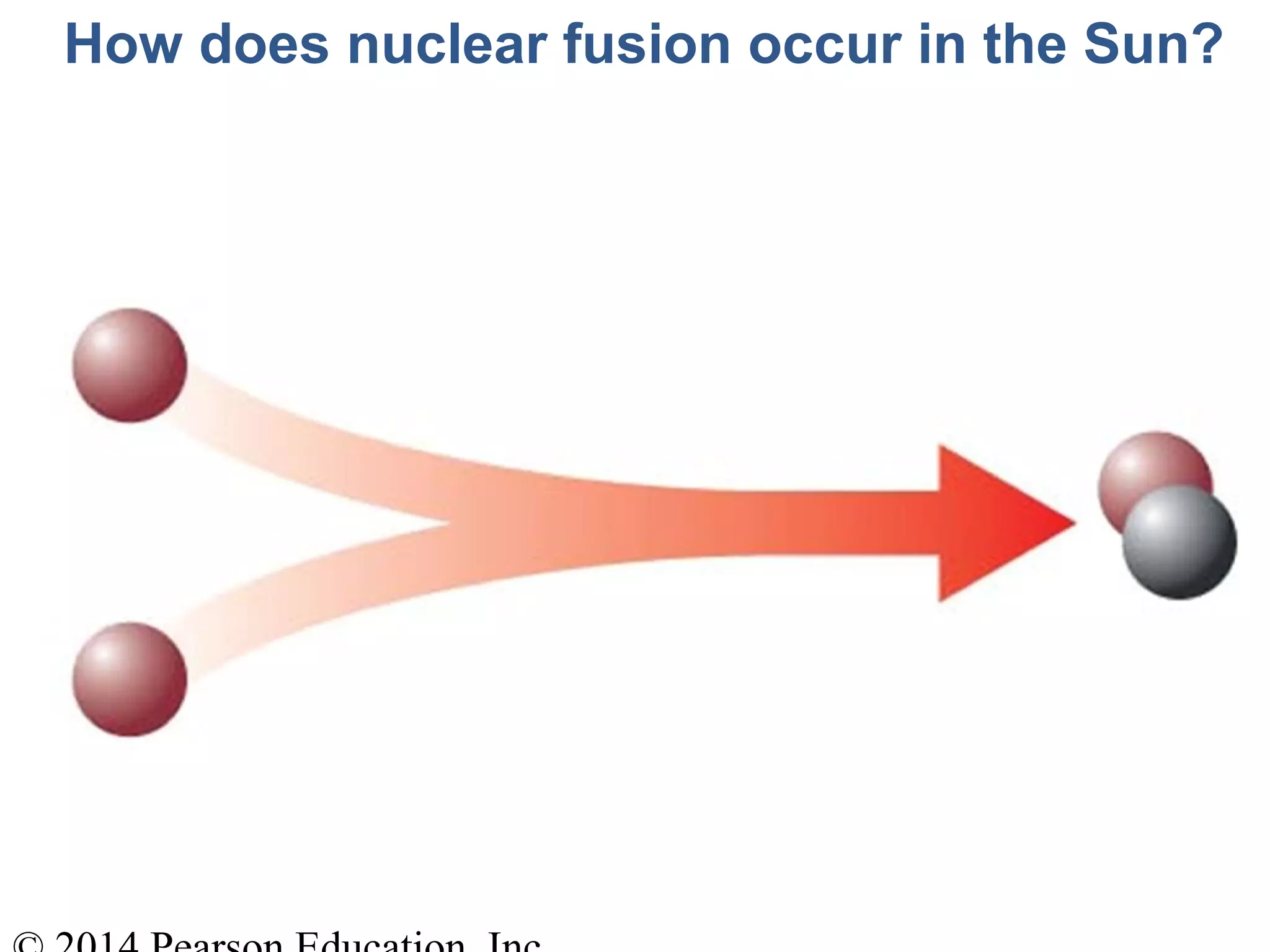
• Small nuclei stick
together to make a
bigger one.
• (Example: the Sun,
stars)
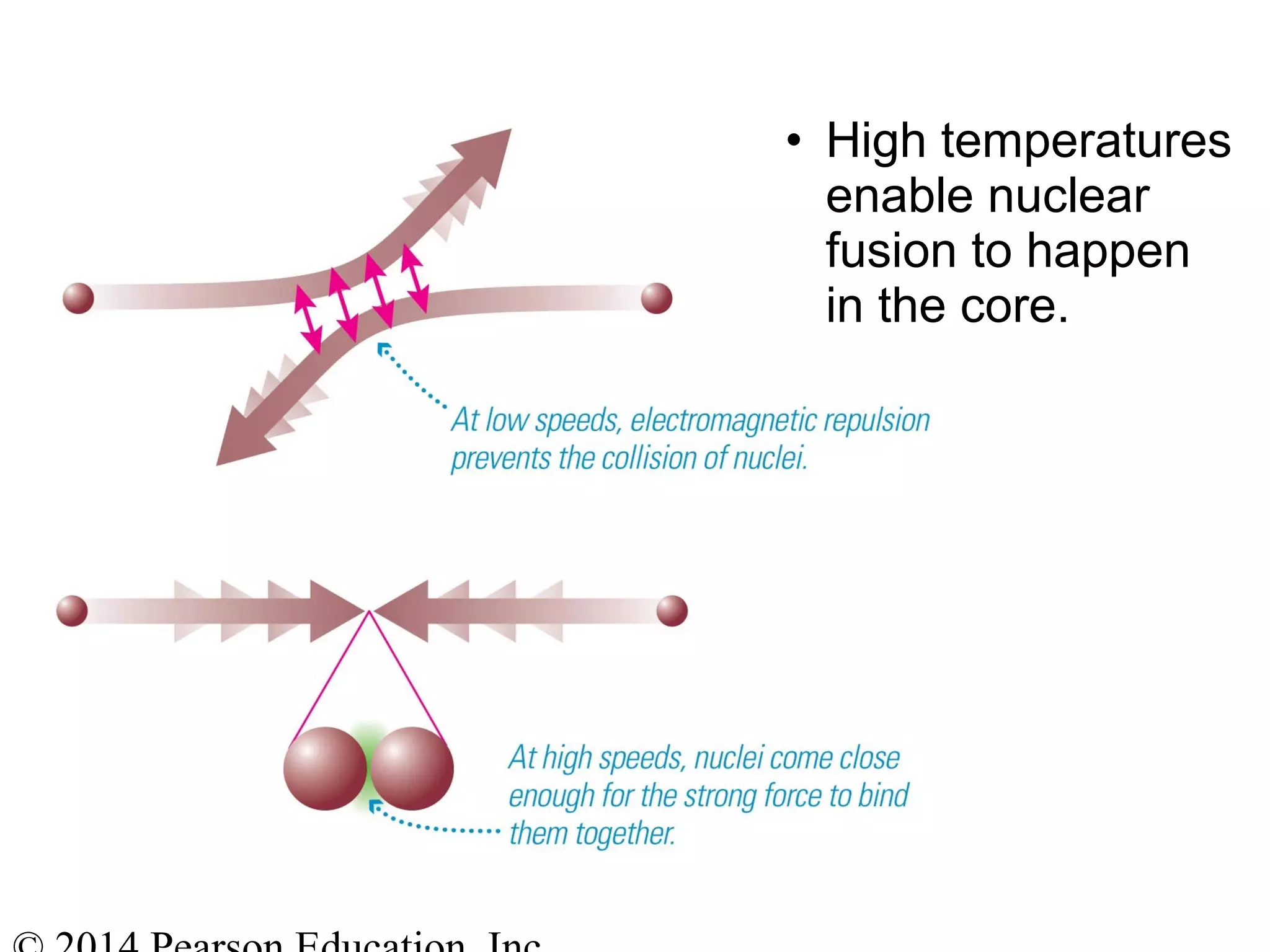
• High temperatures
enable nuclear
fusion to happen
in the core.
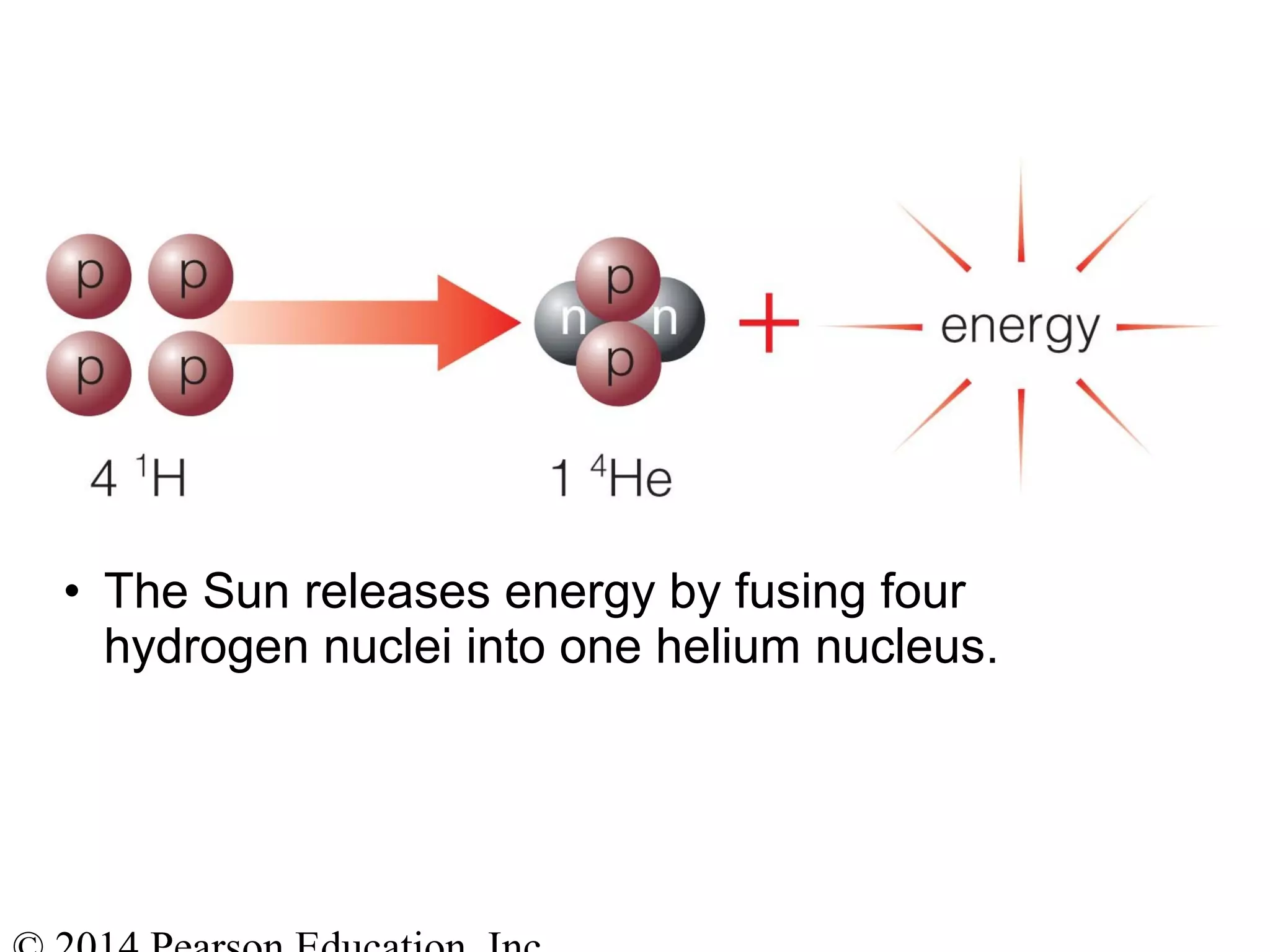
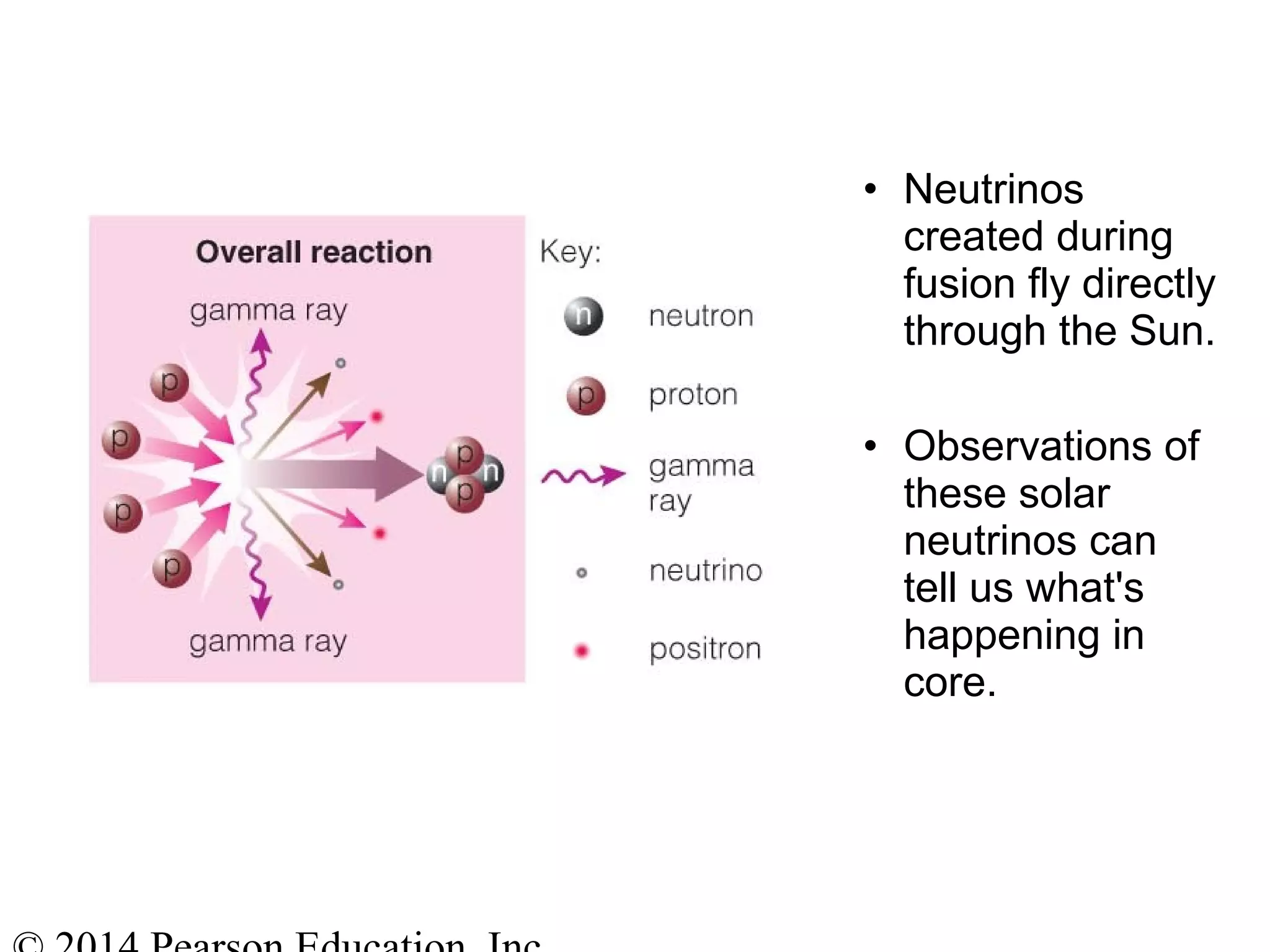
• The Sun releases energy by fusing four
hydrogen nuclei into one helium nucleus.
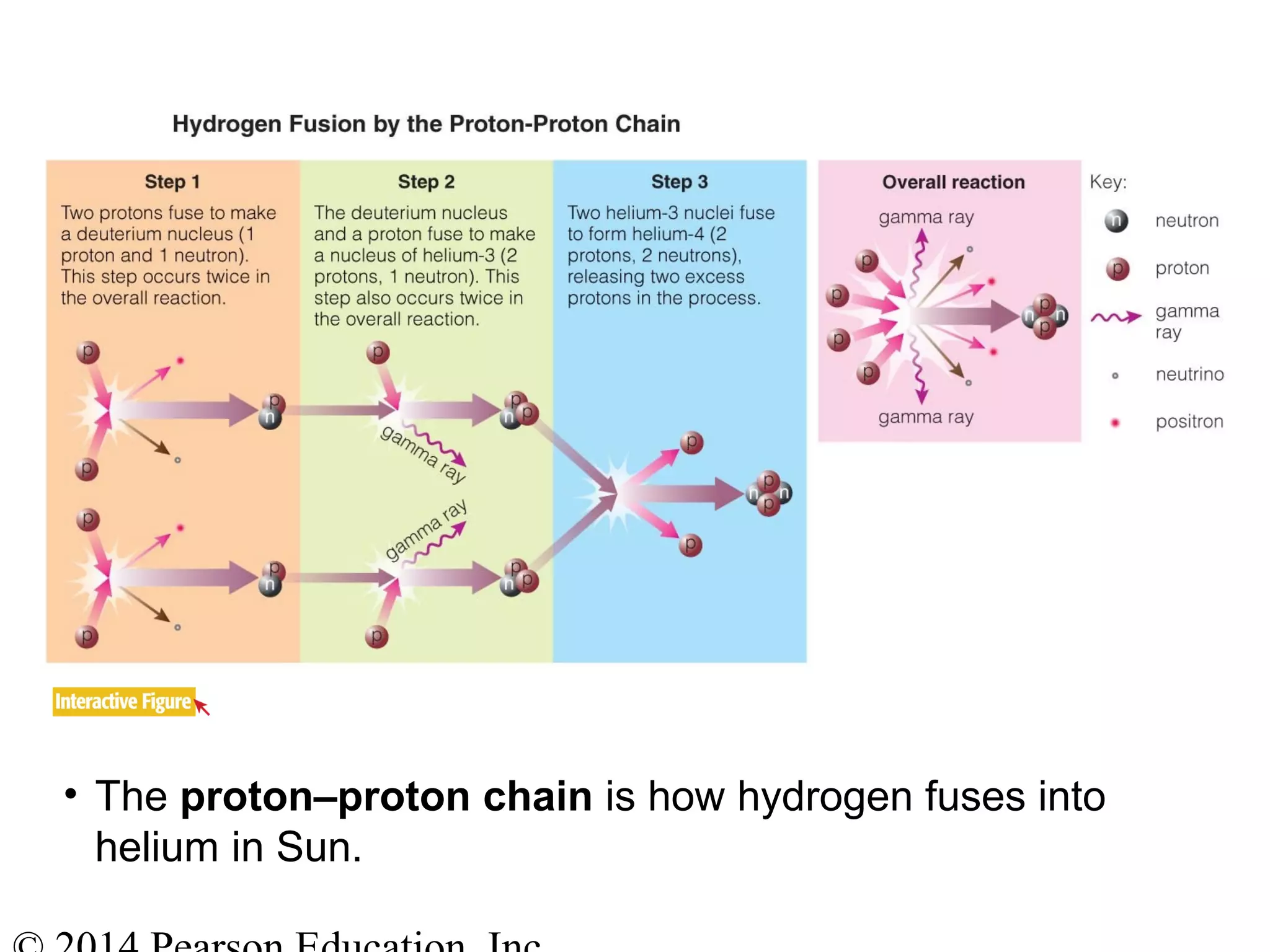
• The proton–proton chain is how hydrogen fuses into
helium in Sun.
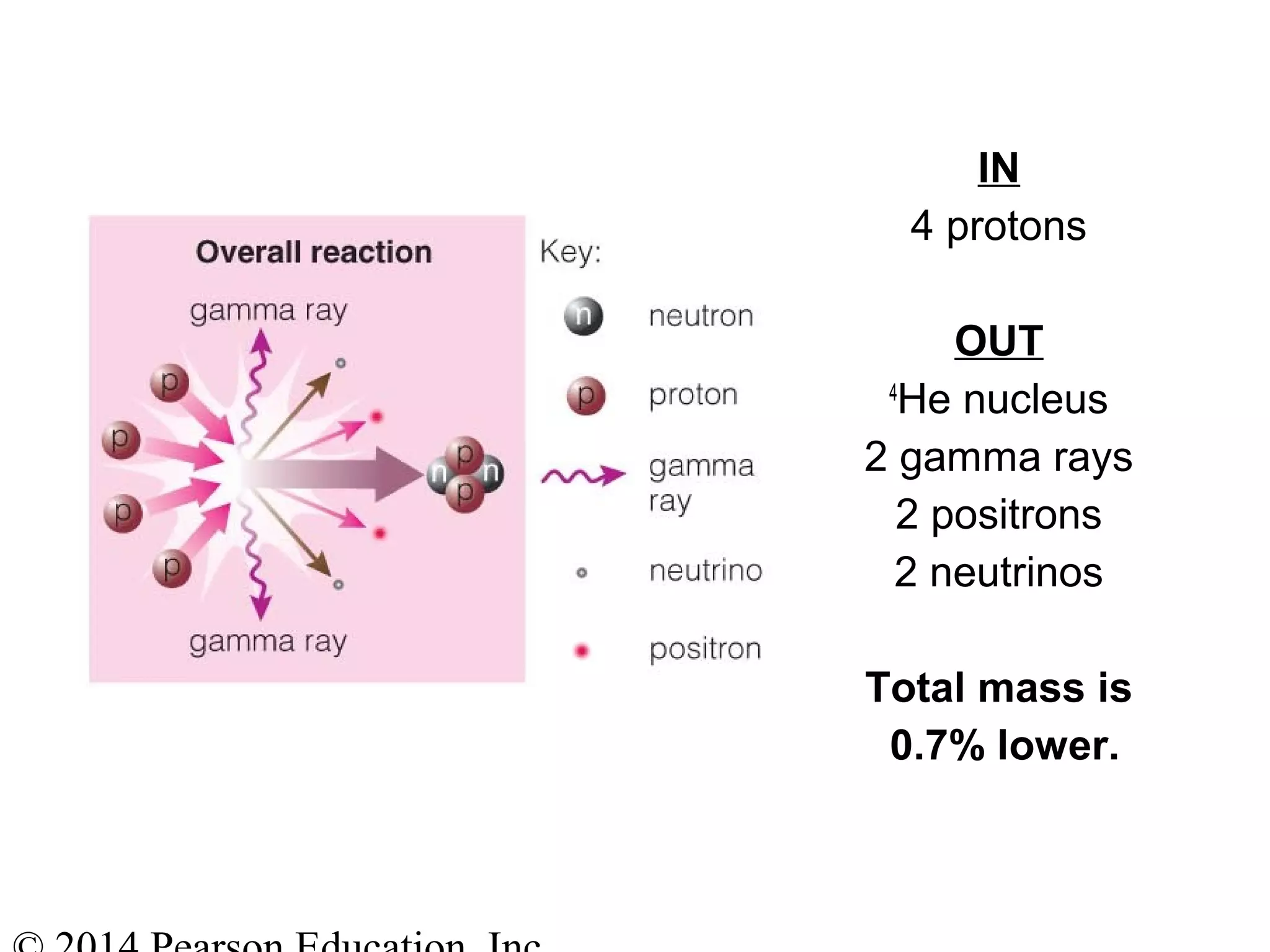
IN
4 protons
OUT
4
He nucleus
2 gamma rays
2 positrons
2 neutrinos
Total mass is
0.7% lower.
Thought Question
What would happen inside the Sun if a slight rise in
core temperature led to a rapid rise in fusion
energy?
A. The core would expand and heat up slightly.
B. The core would expand and cool.
C. The Sun would blow up like a hydrogen bomb.
Thought Question
What would happen inside the Sun if a slight rise
in core temperature led to a rapid rise in fusion
energy?
A. The core would expand and heat up slightly.
B. The core would expand and cool.
C. The Sun would blow up like a hydrogen bomb.
The solar thermostat keeps burning rate steady.
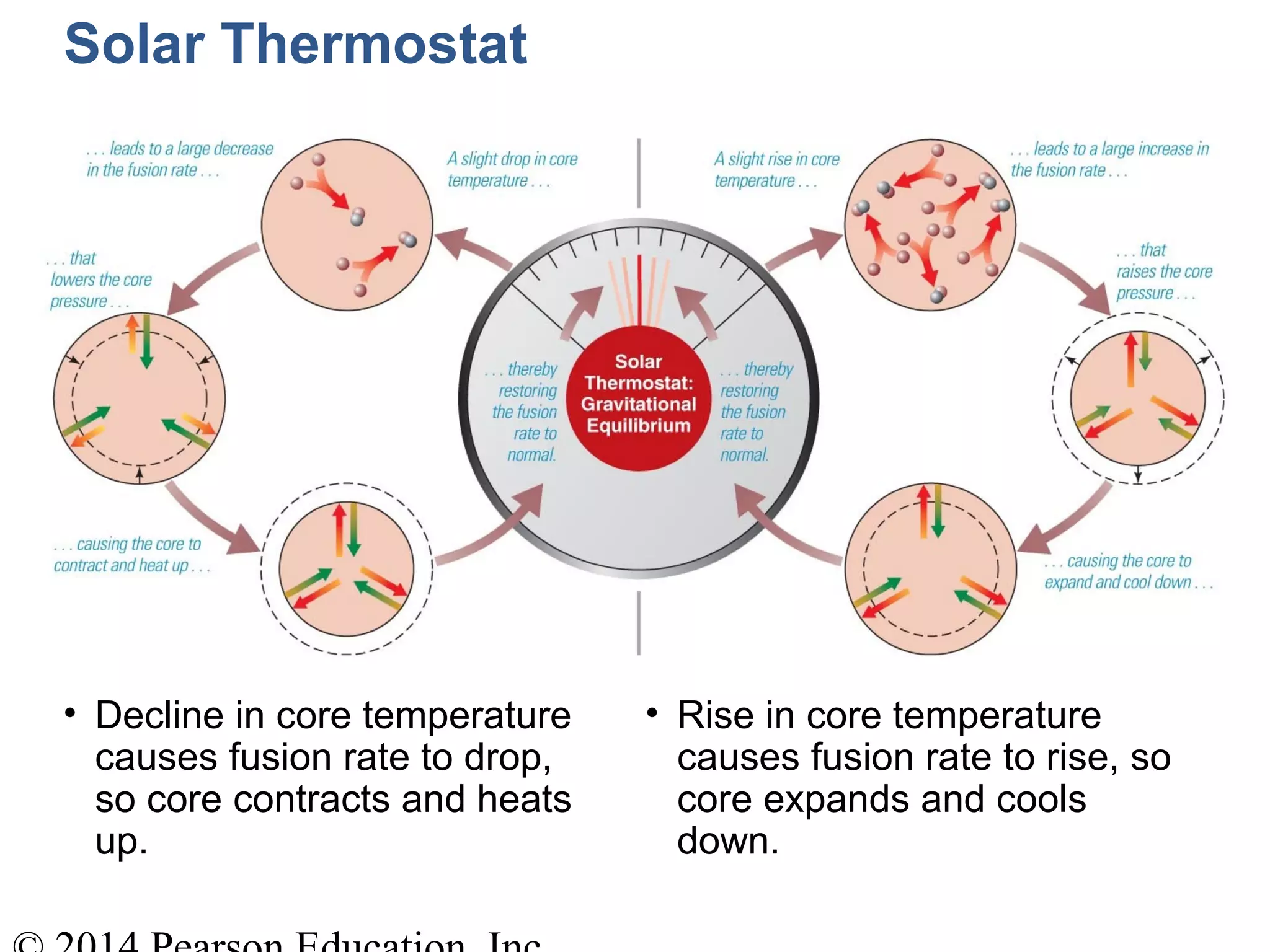
Solar Thermostat
• Decline in core temperature
causes fusion rate to drop,
so core contracts and heats
up.
• Rise in core temperature
causes fusion rate to rise, so
core expands and cools
down.
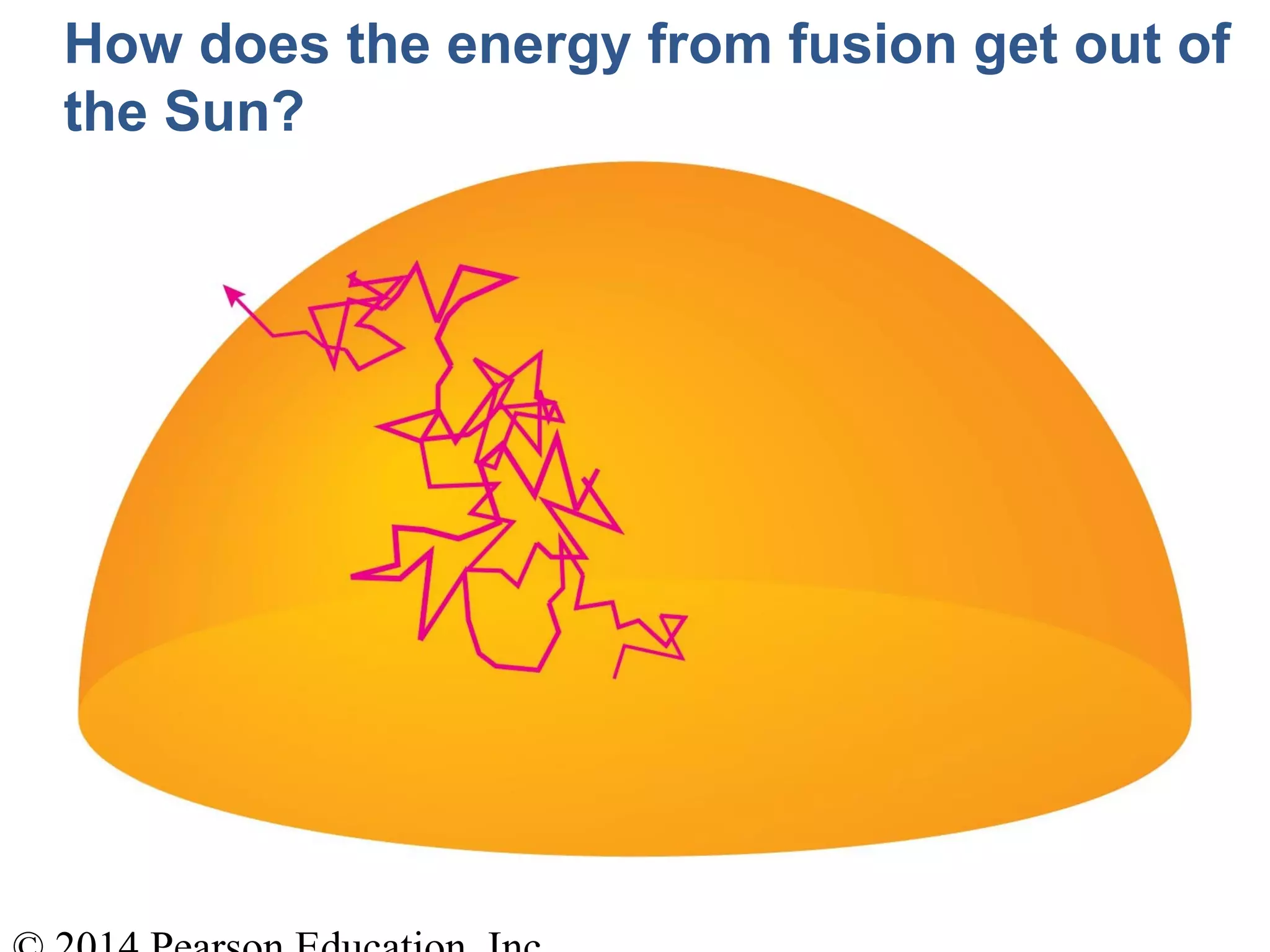
How does the energy from fusion get out of
the Sun?
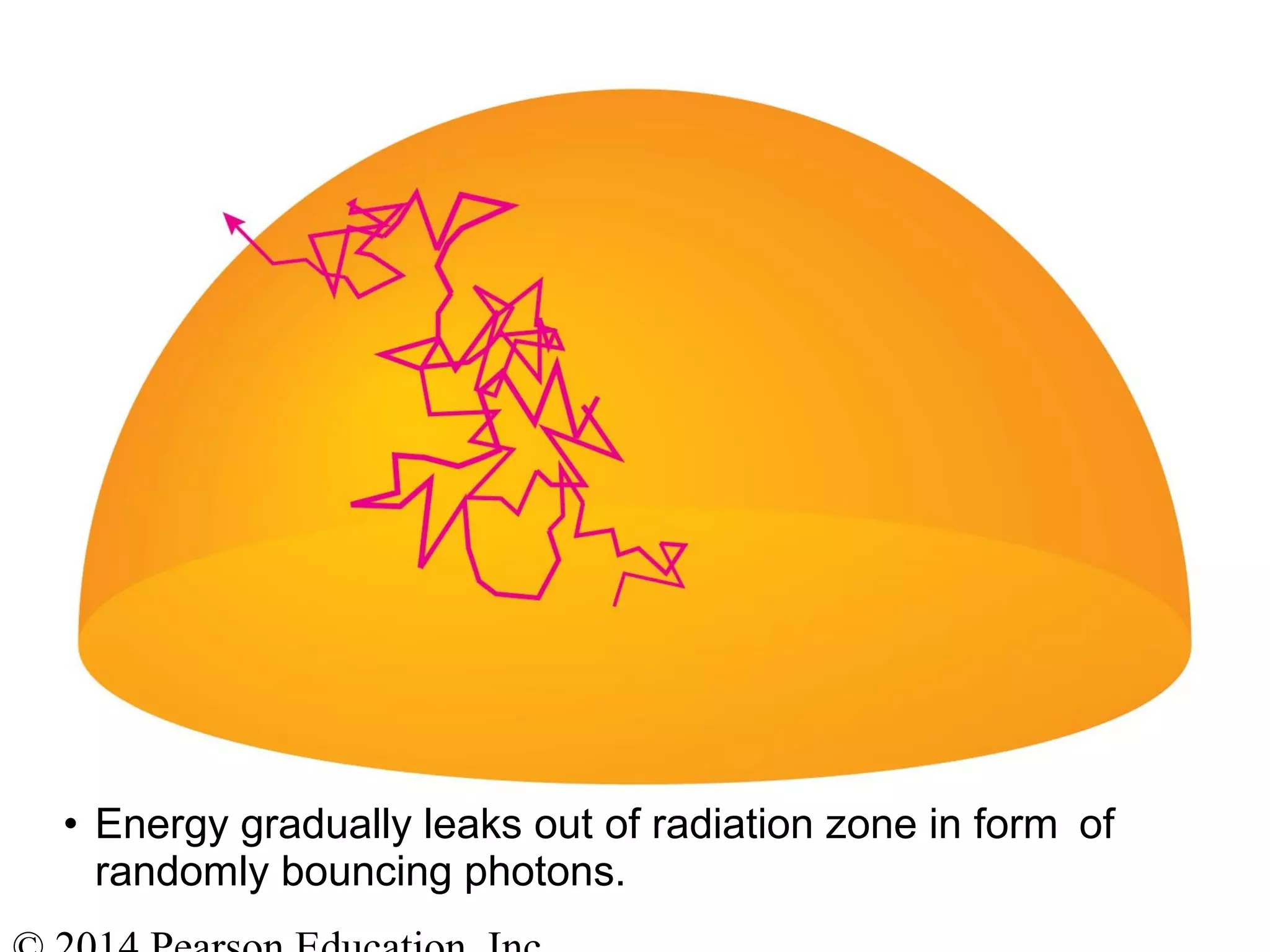
• Energy gradually leaks out of radiation zone in form of
randomly bouncing photons.
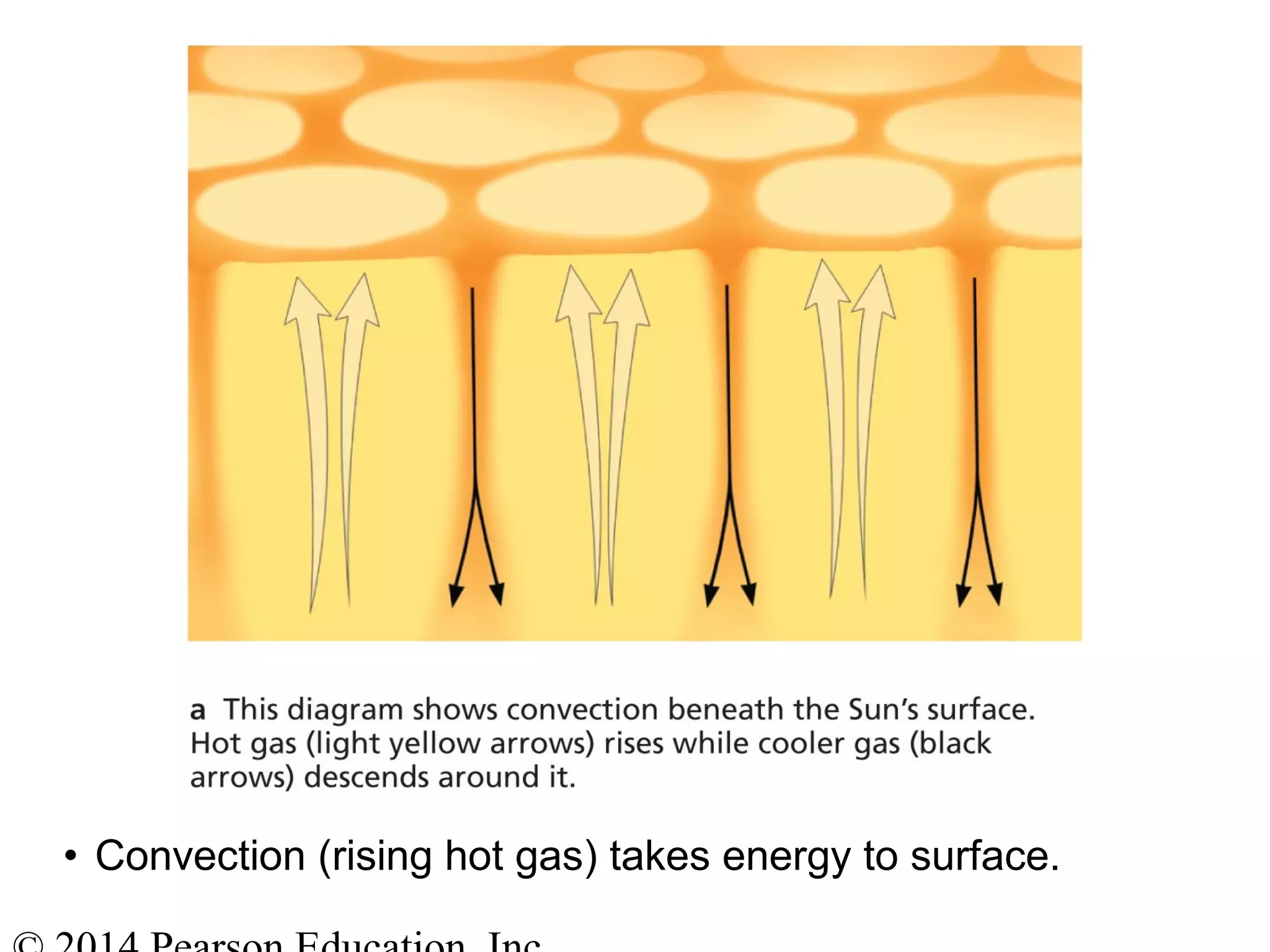
• Convection (rising hot gas) takes energy to surface.
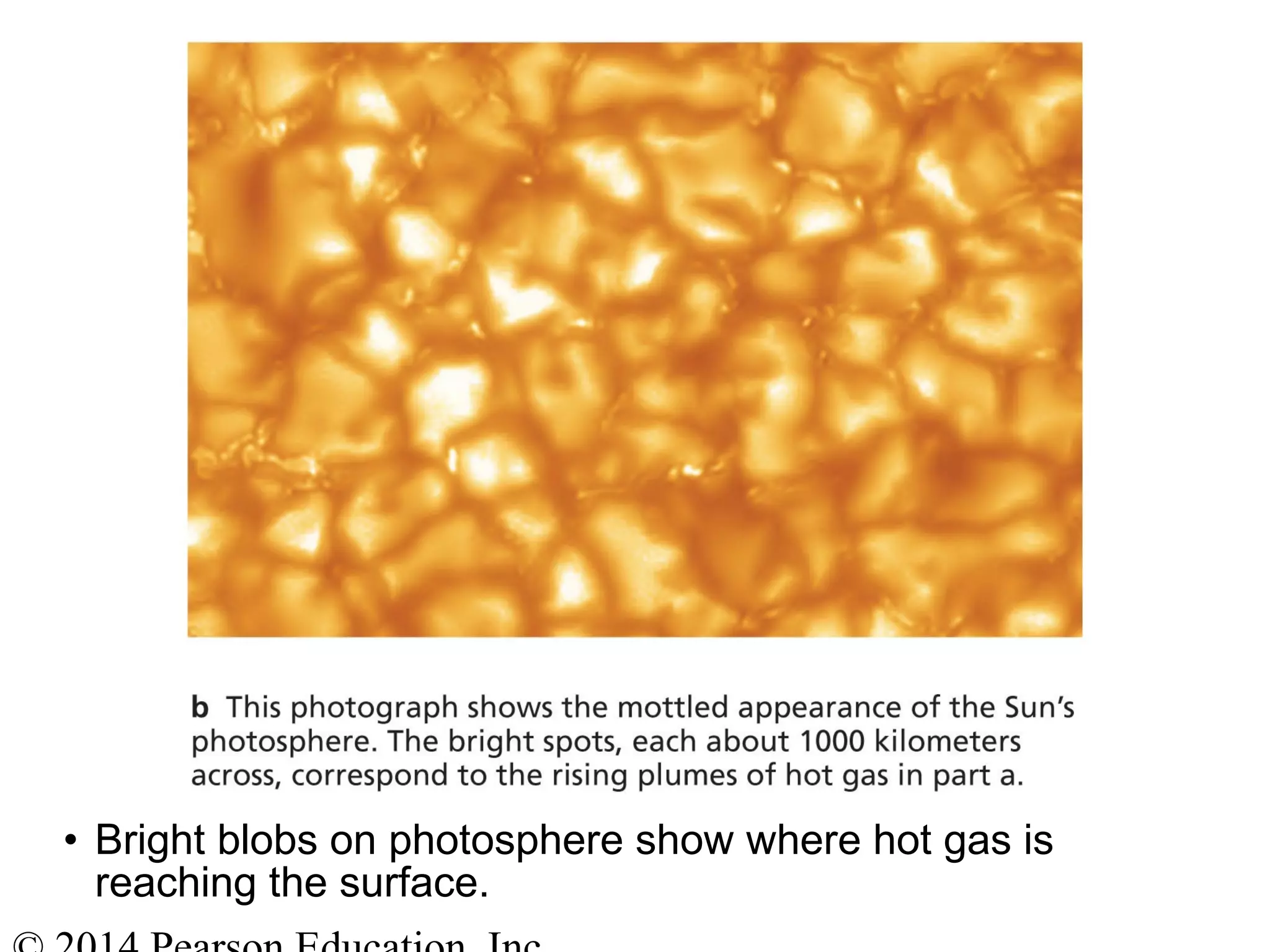
• Bright blobs on photosphere show where hot gas is
reaching the surface.
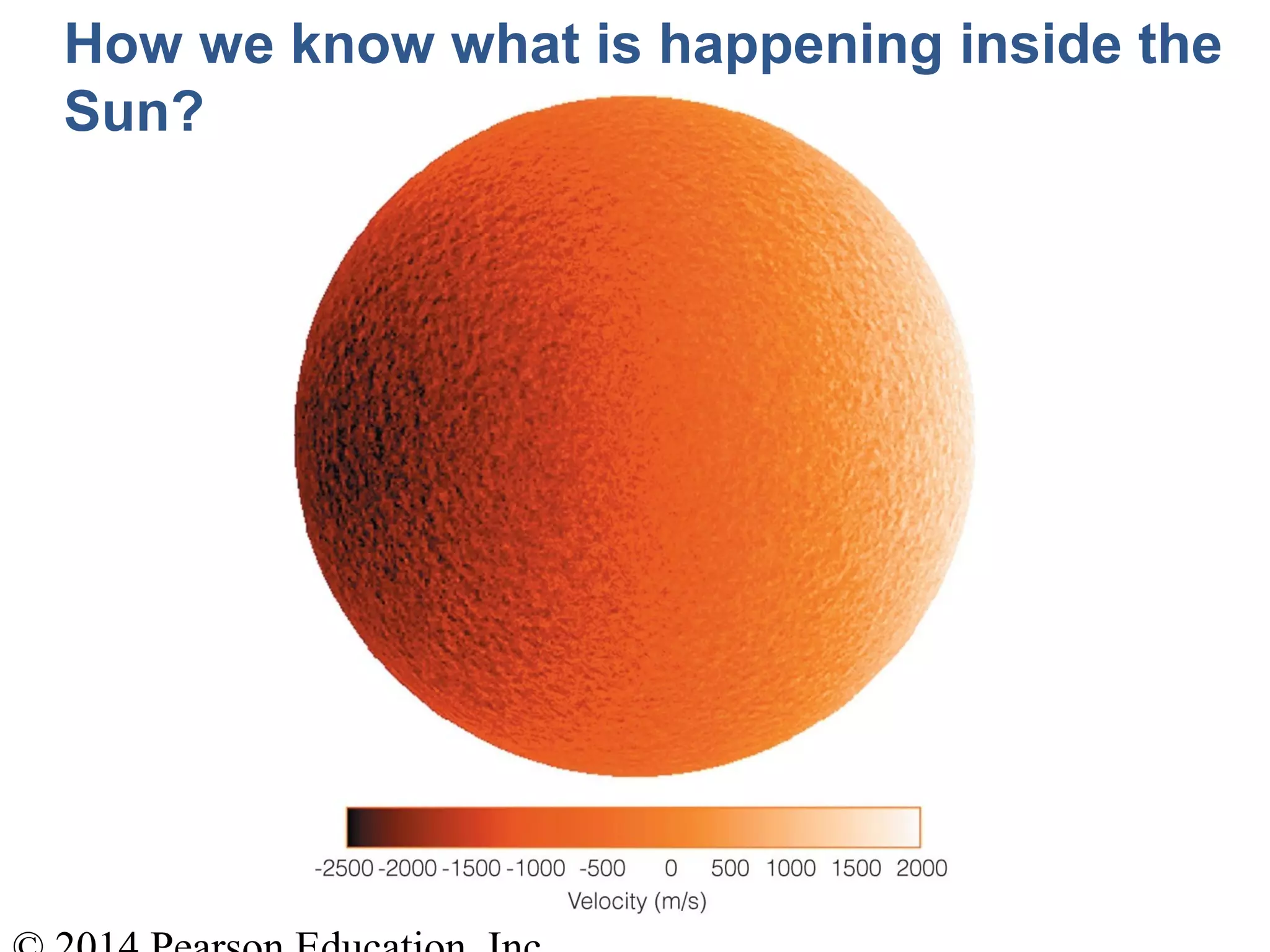
How we know what is happening inside the
Sun?
We learn about the inside of the Sun by …
• making mathematical models
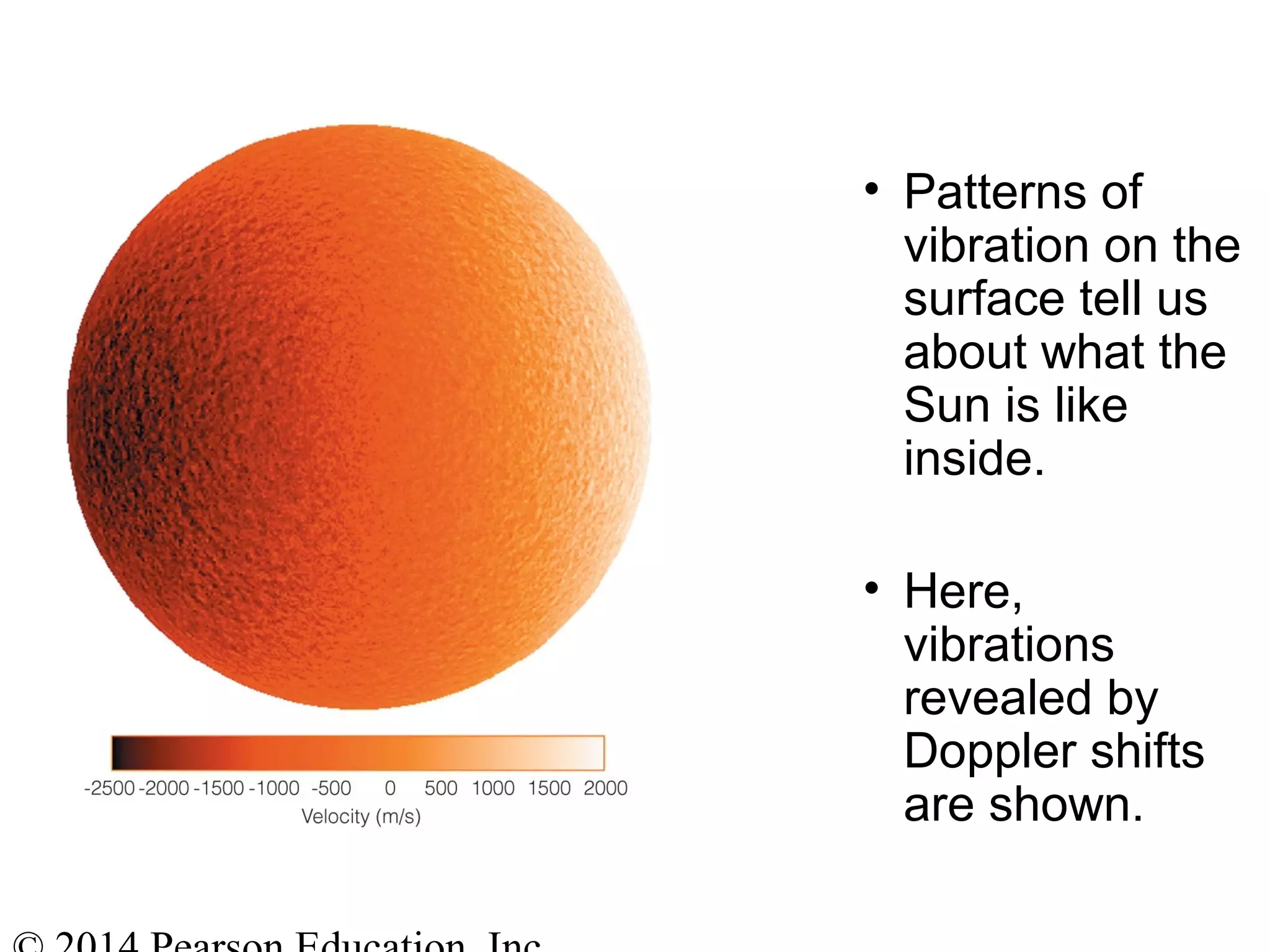
• observing solar vibrations
• observing solar neutrinos
• Patterns of
vibration on the
surface tell us
about what the
Sun is like
inside.
• Here,
vibrations
revealed by
Doppler shifts
are shown.
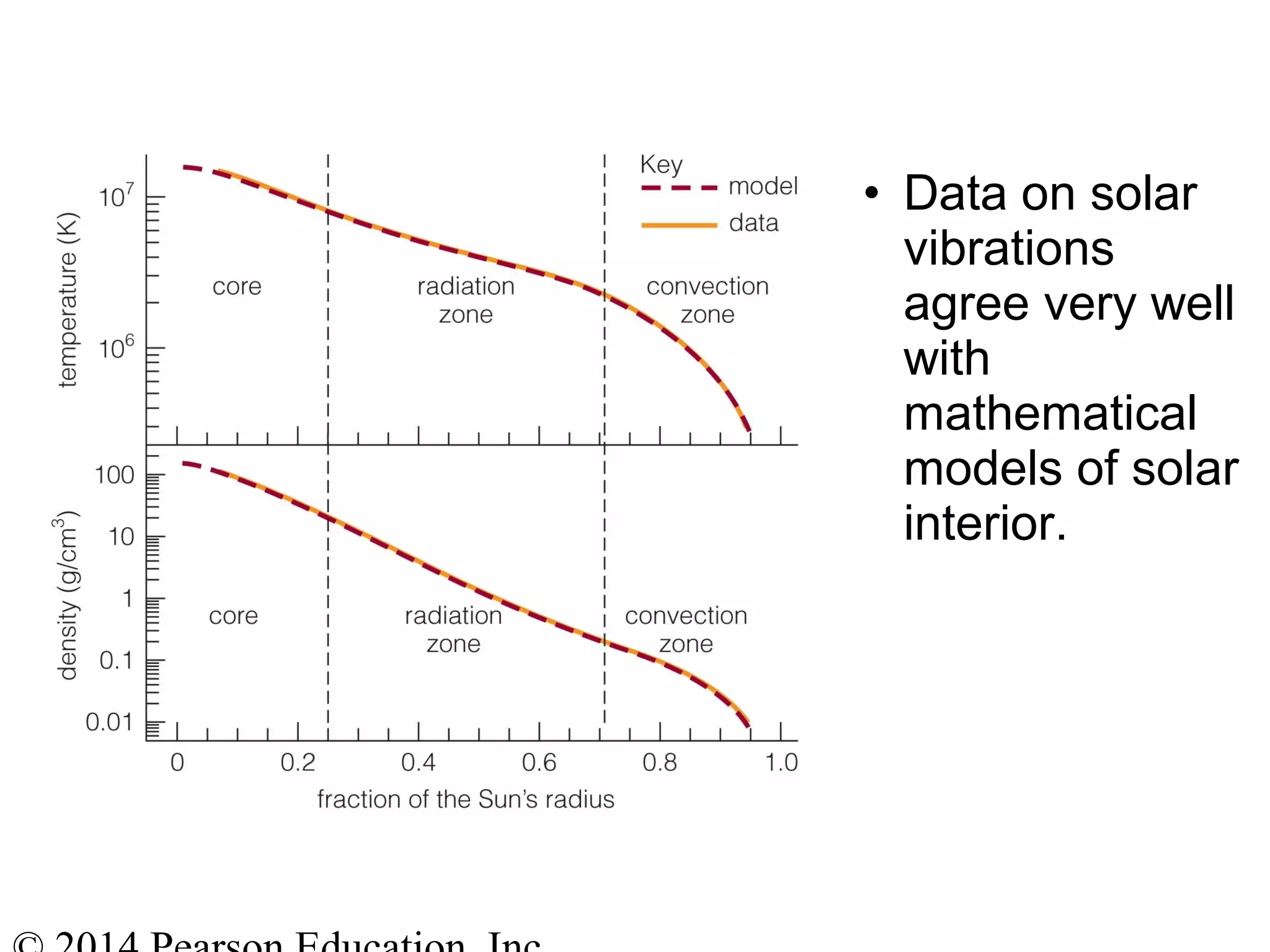
• Data on solar
vibrations
agree very well
with
mathematical
models of solar
interior.
• Neutrinos
created during
fusion fly directly
through the Sun.
• Observations of
these solar
neutrinos can
tell us what's
happening in
core.
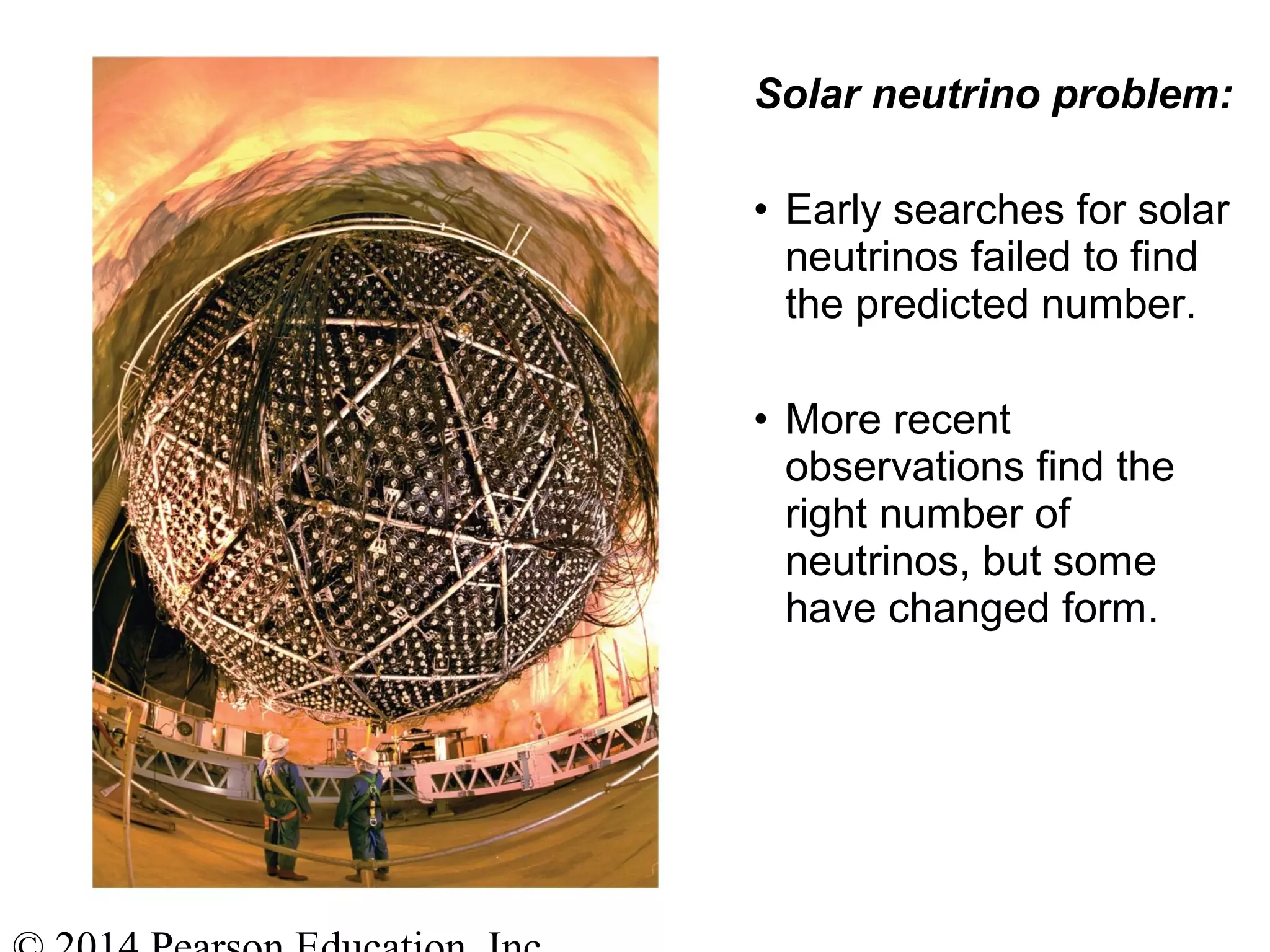
Solar neutrino problem:
• Early searches for solar
neutrinos failed to find
the predicted number.
• More recent
observations find the
right number of
neutrinos, but some
have changed form.
What have we learned?
• How does nuclear fusion occur in the Sun?
– The core's extreme temperature and density
are just right for nuclear fusion of hydrogen to
helium through the proton–proton chain.
– Gravitational equilibrium acts as a thermostat
to regulate the core temperature because
fusion rate is very sensitive to temperature.
What have we learned?
• How does the energy from fusion get out of
the Sun?
– Randomly bouncing photons carry energy
through the radiation zone.
– Rising of hot plasma carries energy through
the convection zone to photosphere.
• How do we know what is happening inside
the Sun?
– Mathematical models agree with observations
of solar vibrations and solar neutrinos.
14.3 The Sun–Earth Connection
• Our goals for learning:
– What causes solar activity?
– How does solar activity affect humans?
– How does solar activity vary with time?
What causes solar activity?
Solar activity is like "weather".
• Sunspots
• Solar flares
• Solar prominences
• All these phenomena are related to magnetic
fields.
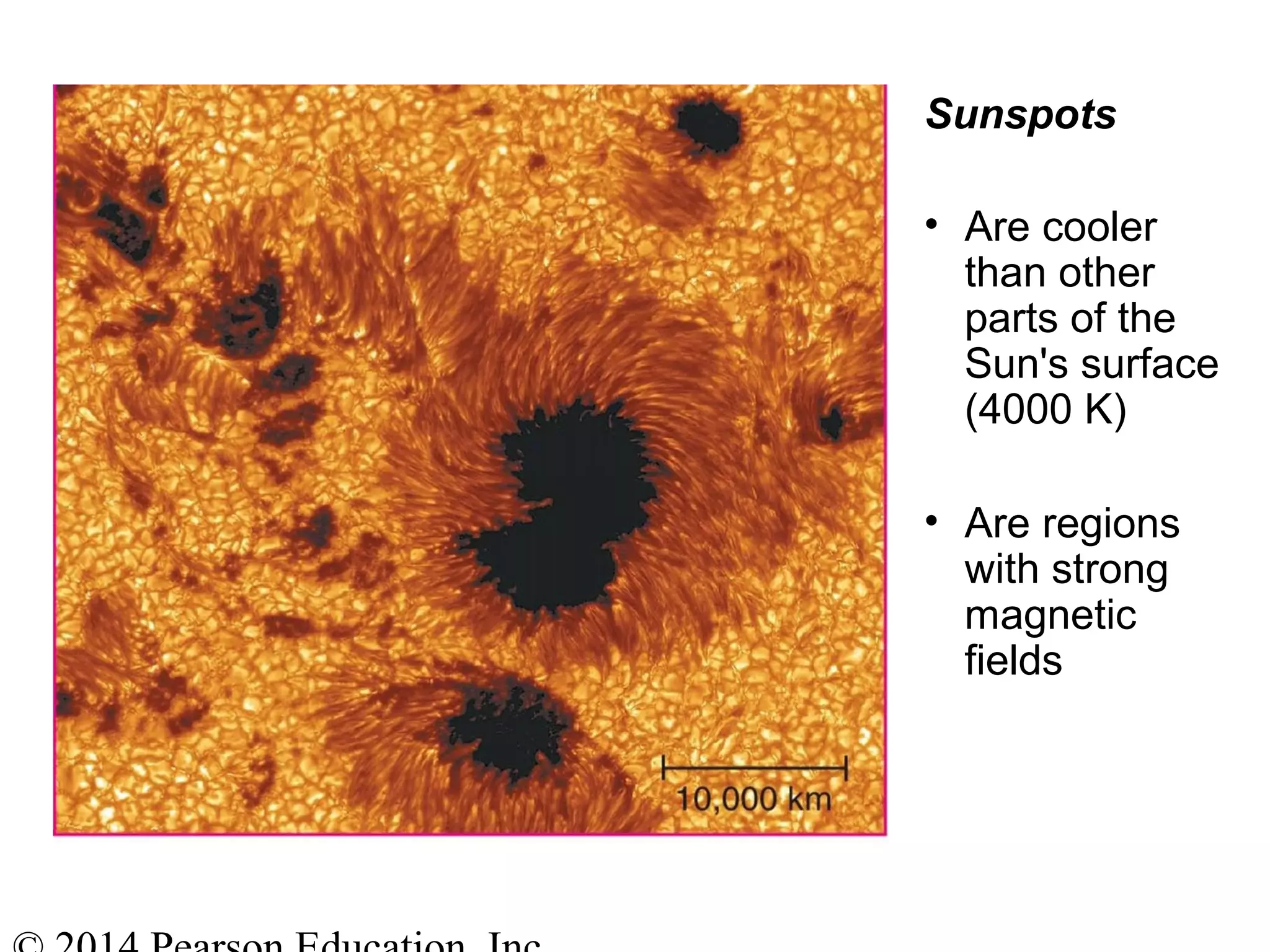
Sunspots
• Are cooler
than other
parts of the
Sun's surface
(4000 K)
• Are regions
with strong
magnetic
fields
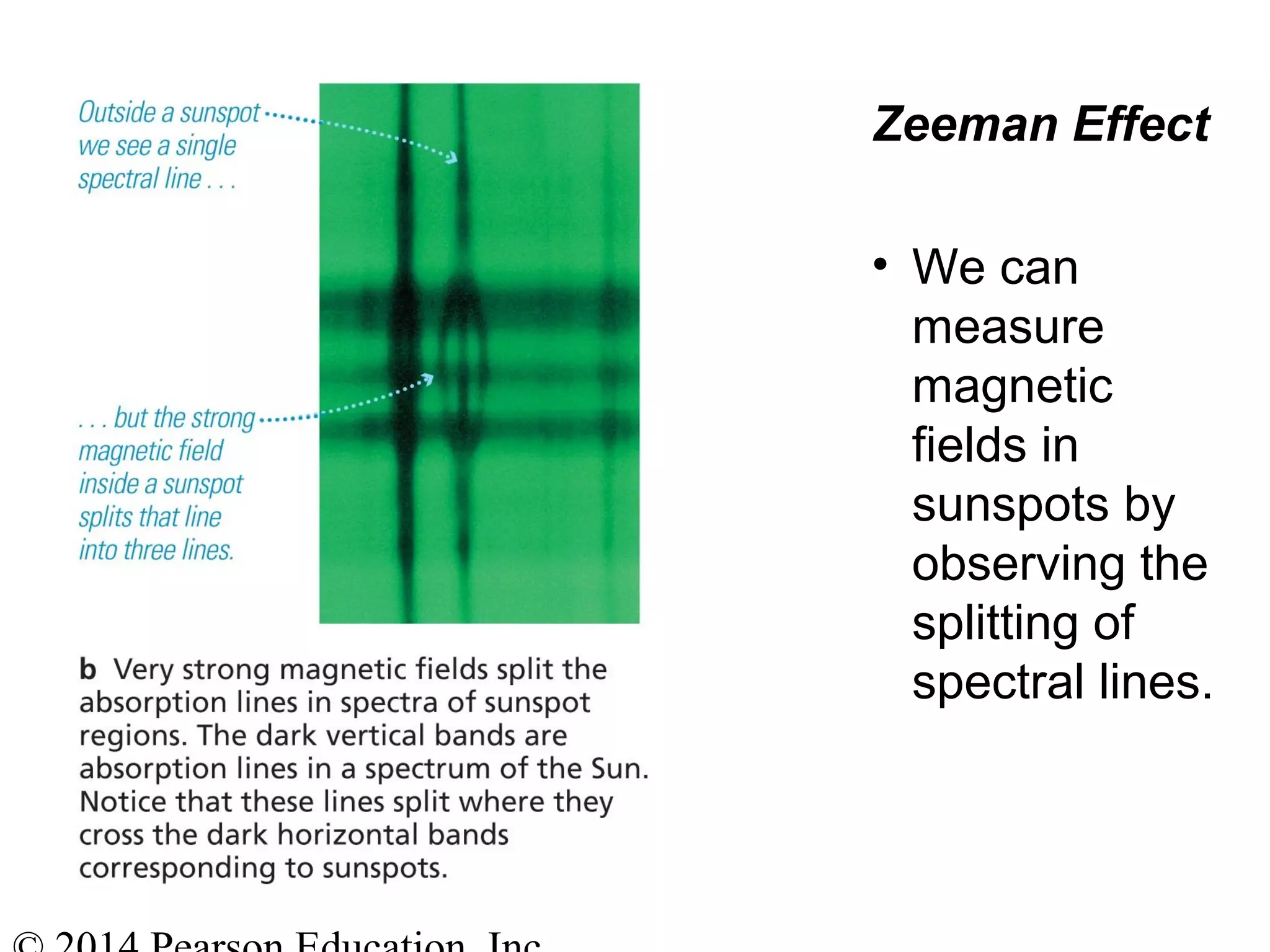
Zeeman Effect
• We can
measure
magnetic
fields in
sunspots by
observing the
splitting of
spectral lines.
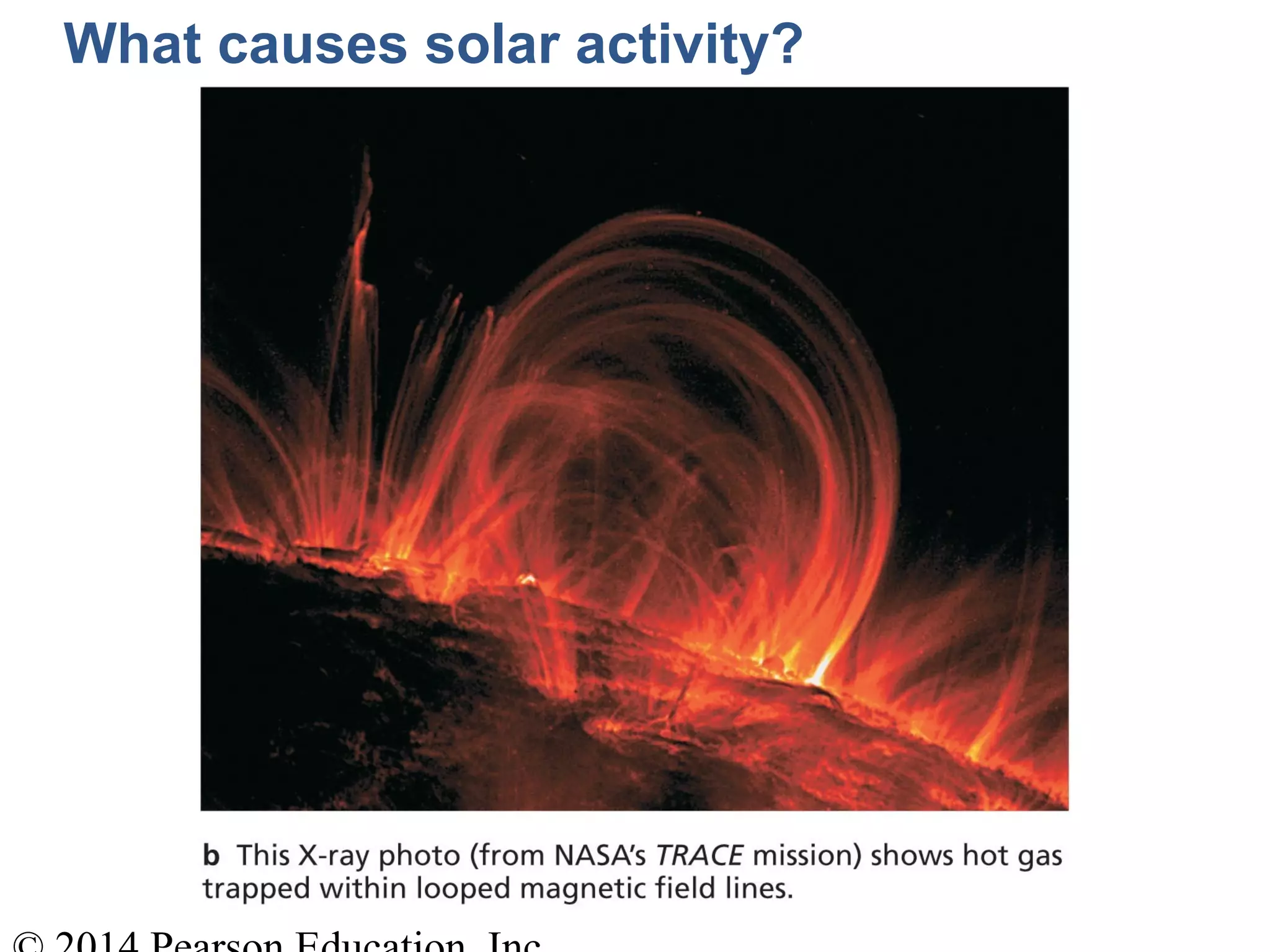
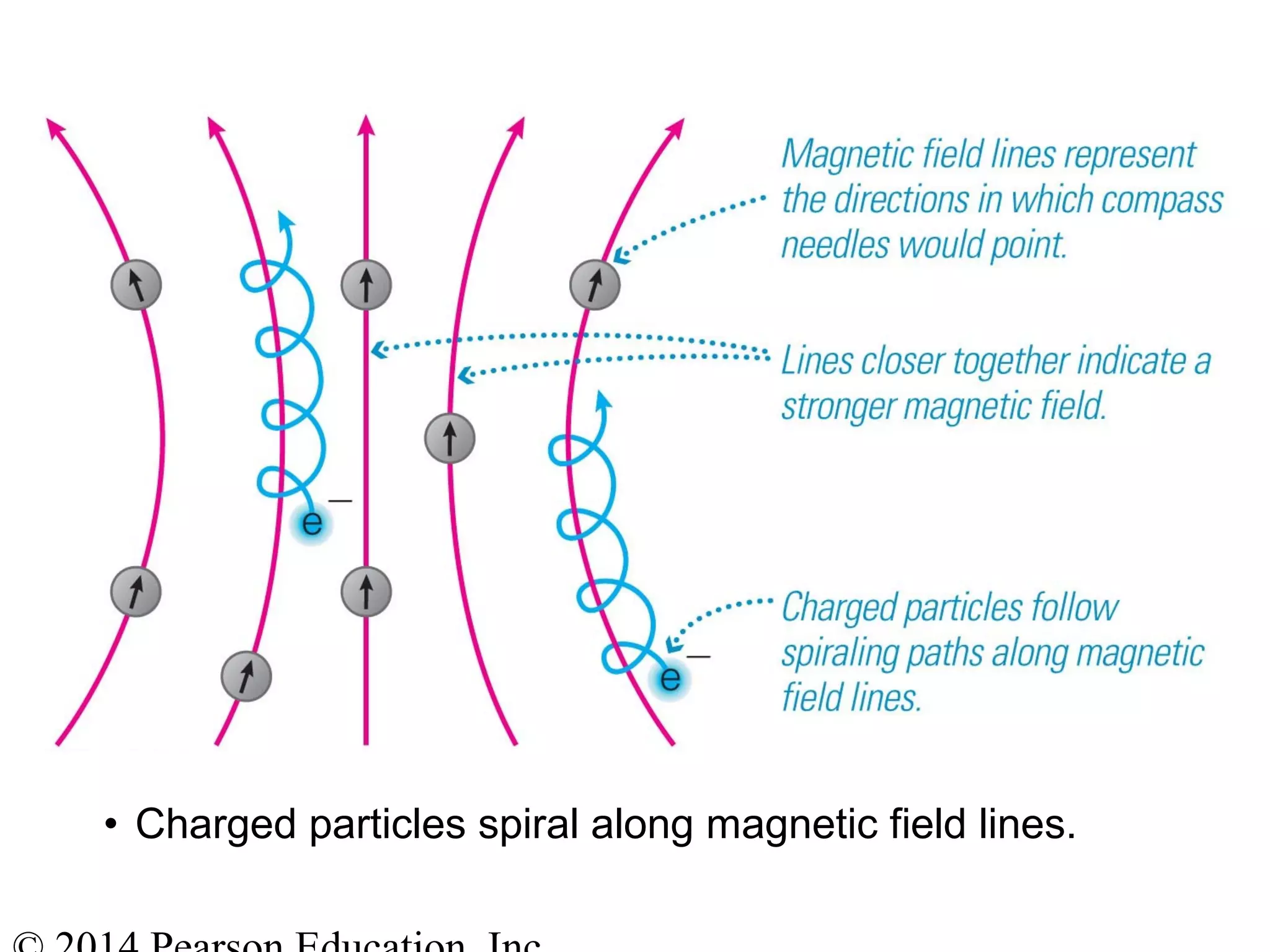
• Charged particles spiral along magnetic field lines.
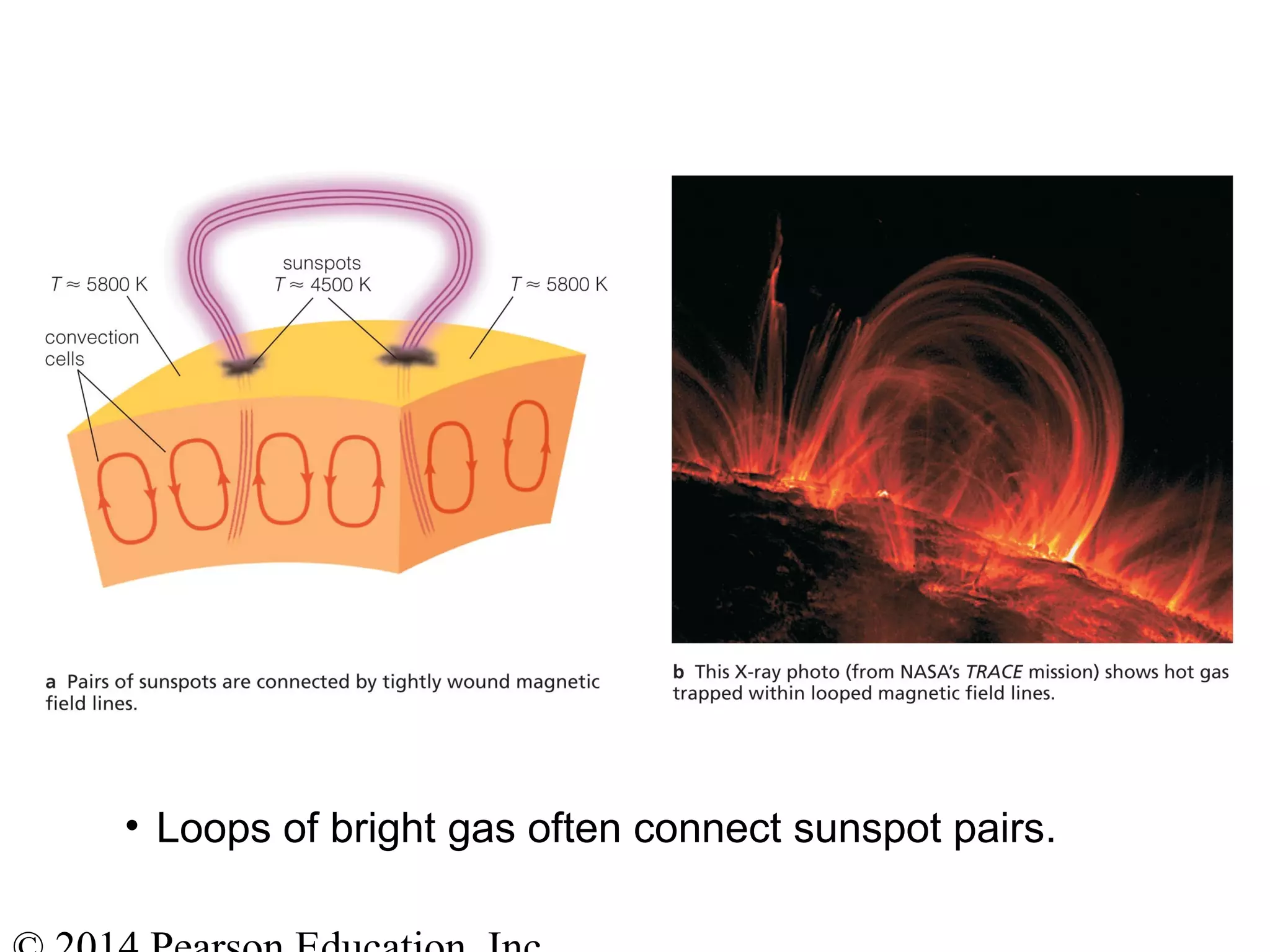
• Loops of bright gas often connect sunspot pairs.
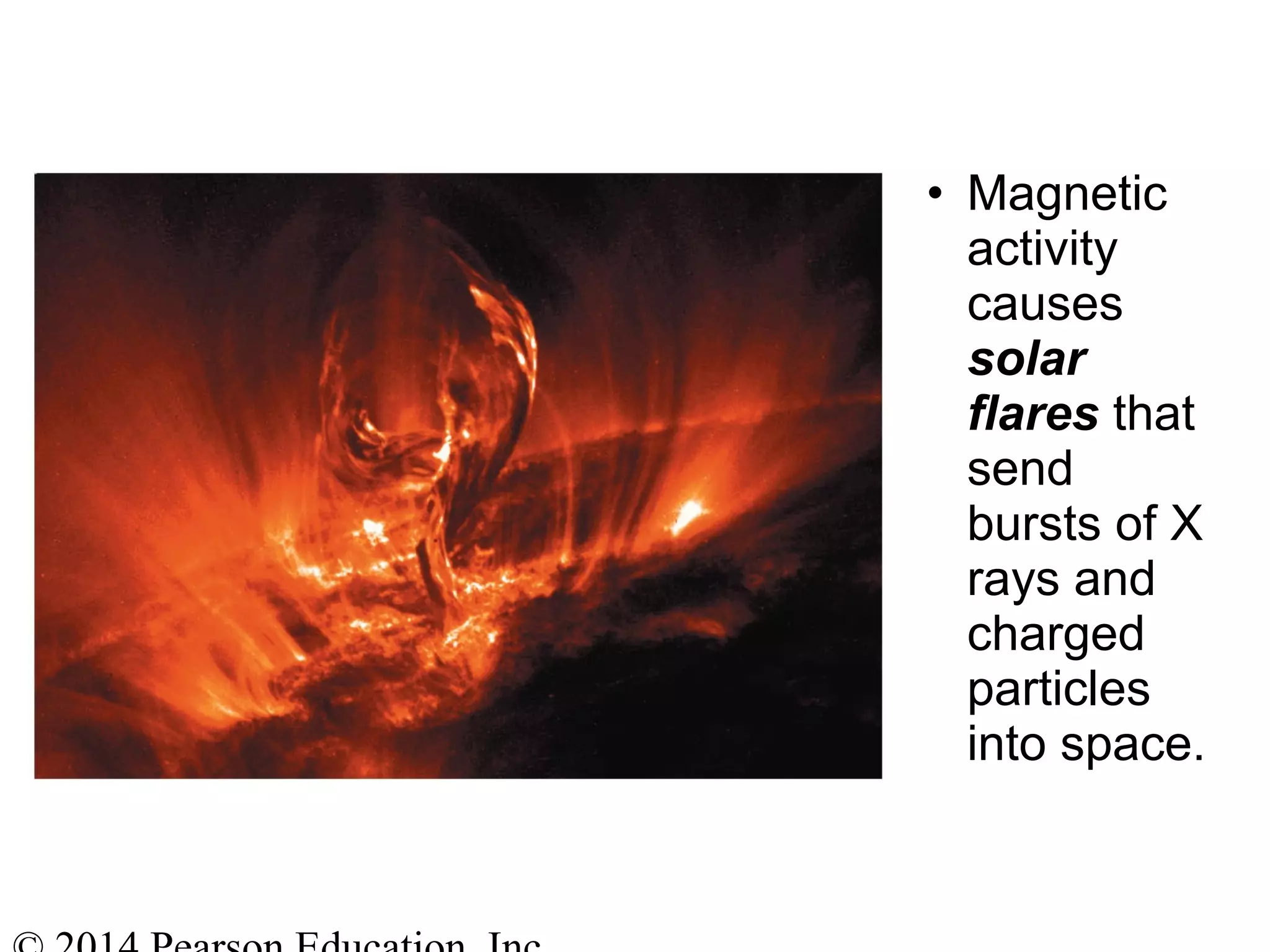
• Magnetic
activity
causes
solar
flares that
send
bursts of X
rays and
charged
particles
into space.
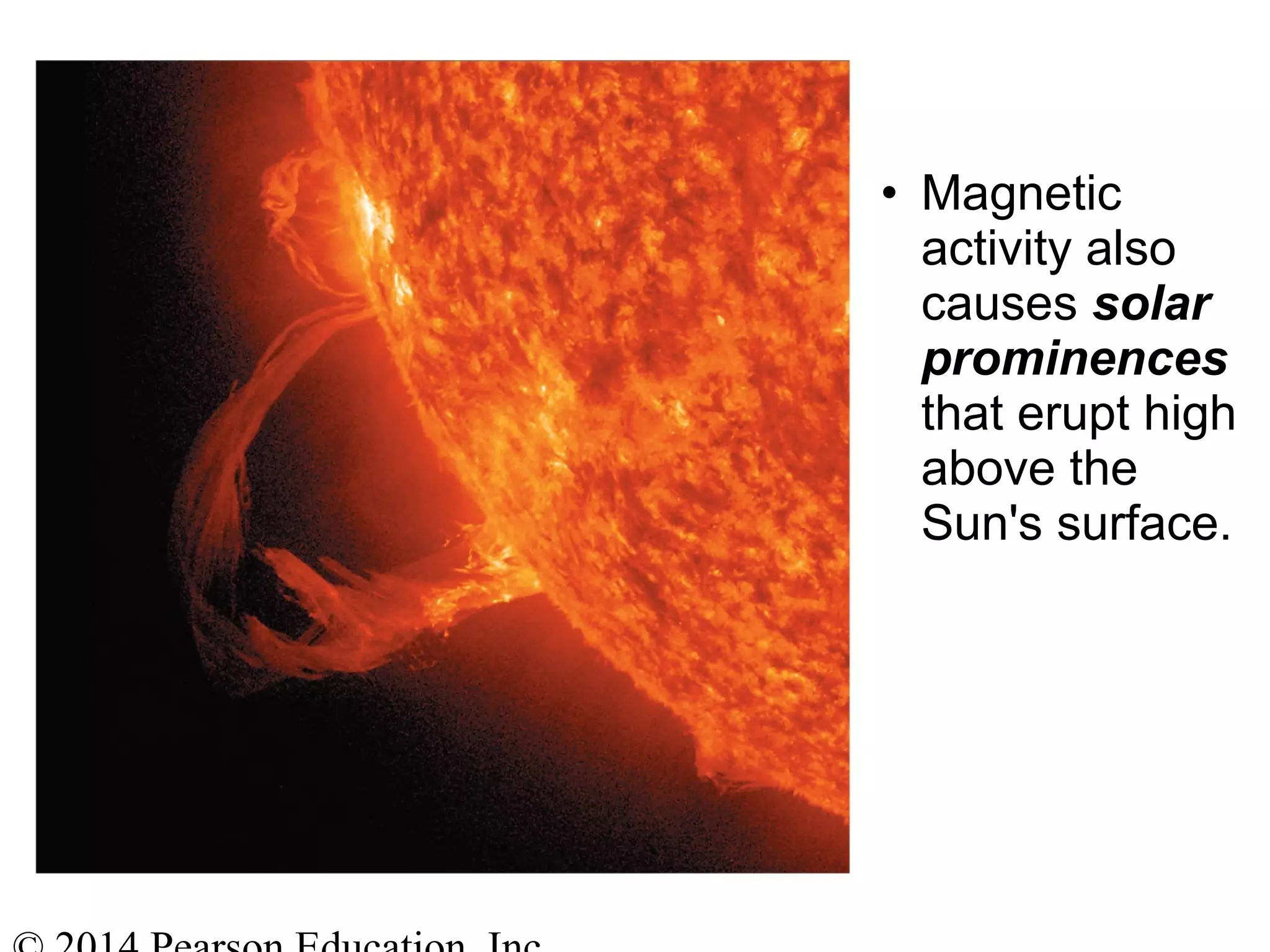
• Magnetic
activity also
causes solar
prominences
that erupt high
above the
Sun's surface.
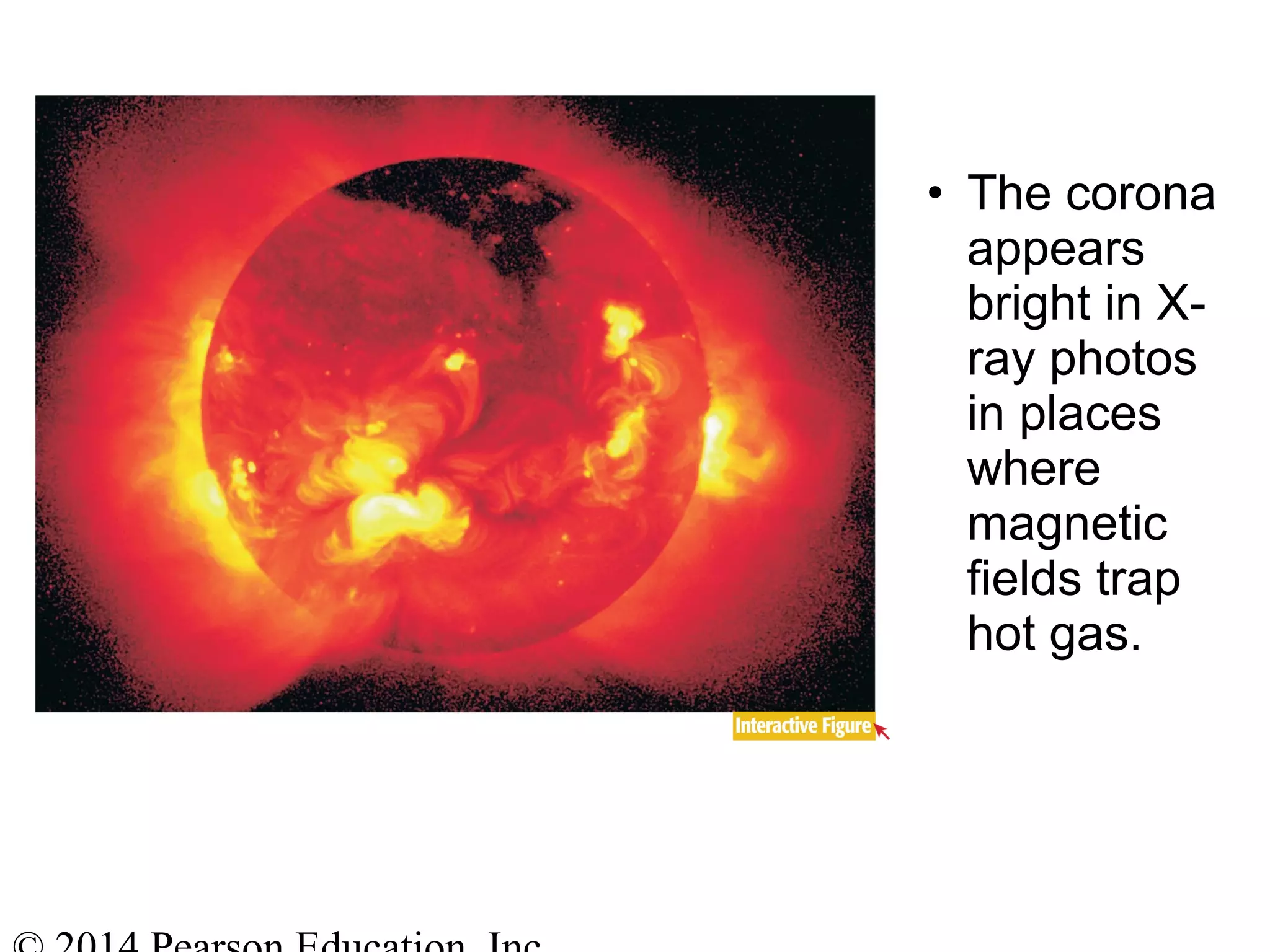
• The corona
appears
bright in X-
ray photos
in places
where
magnetic
fields trap
hot gas.
How does solar activity affect humans?
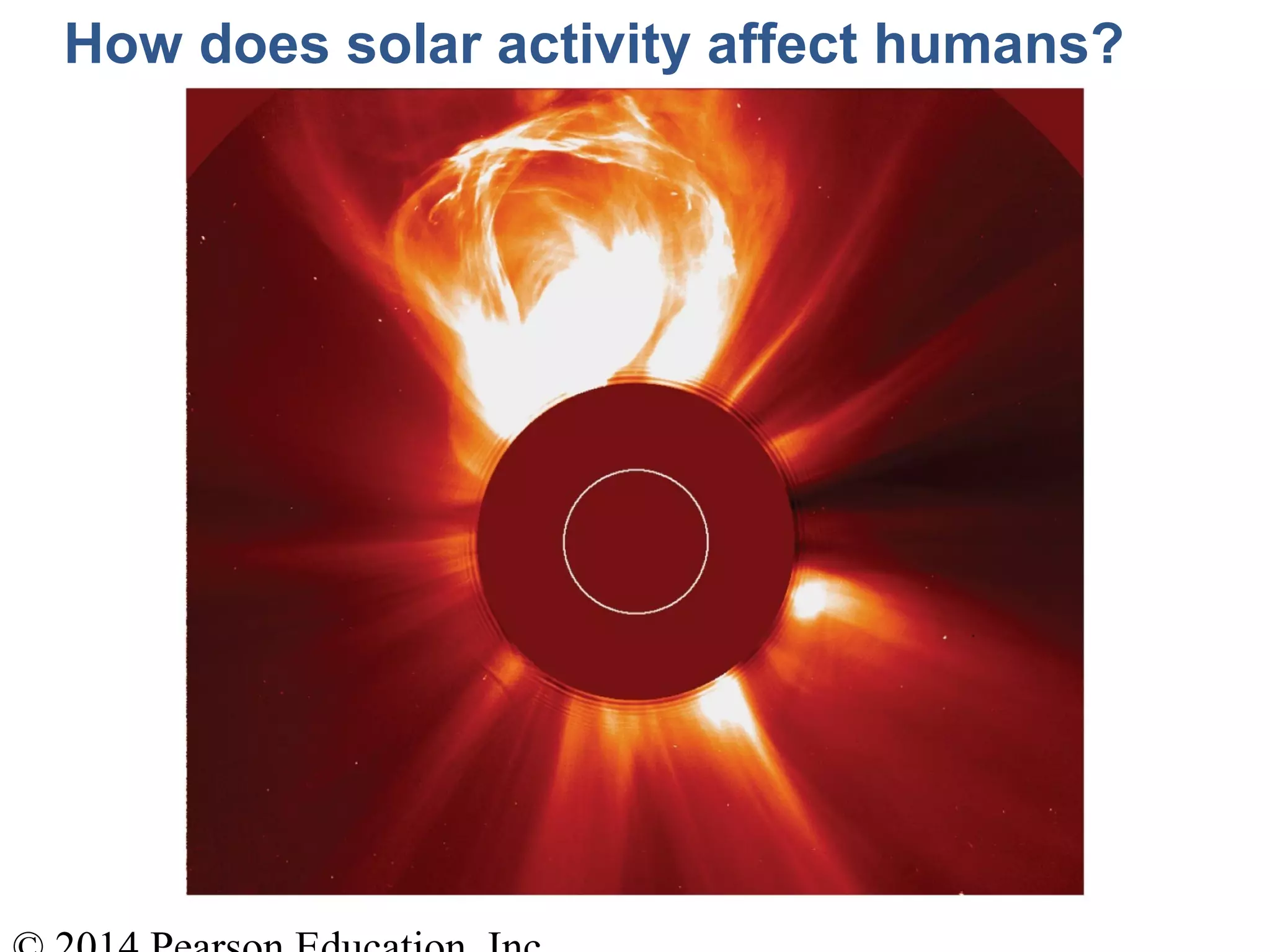
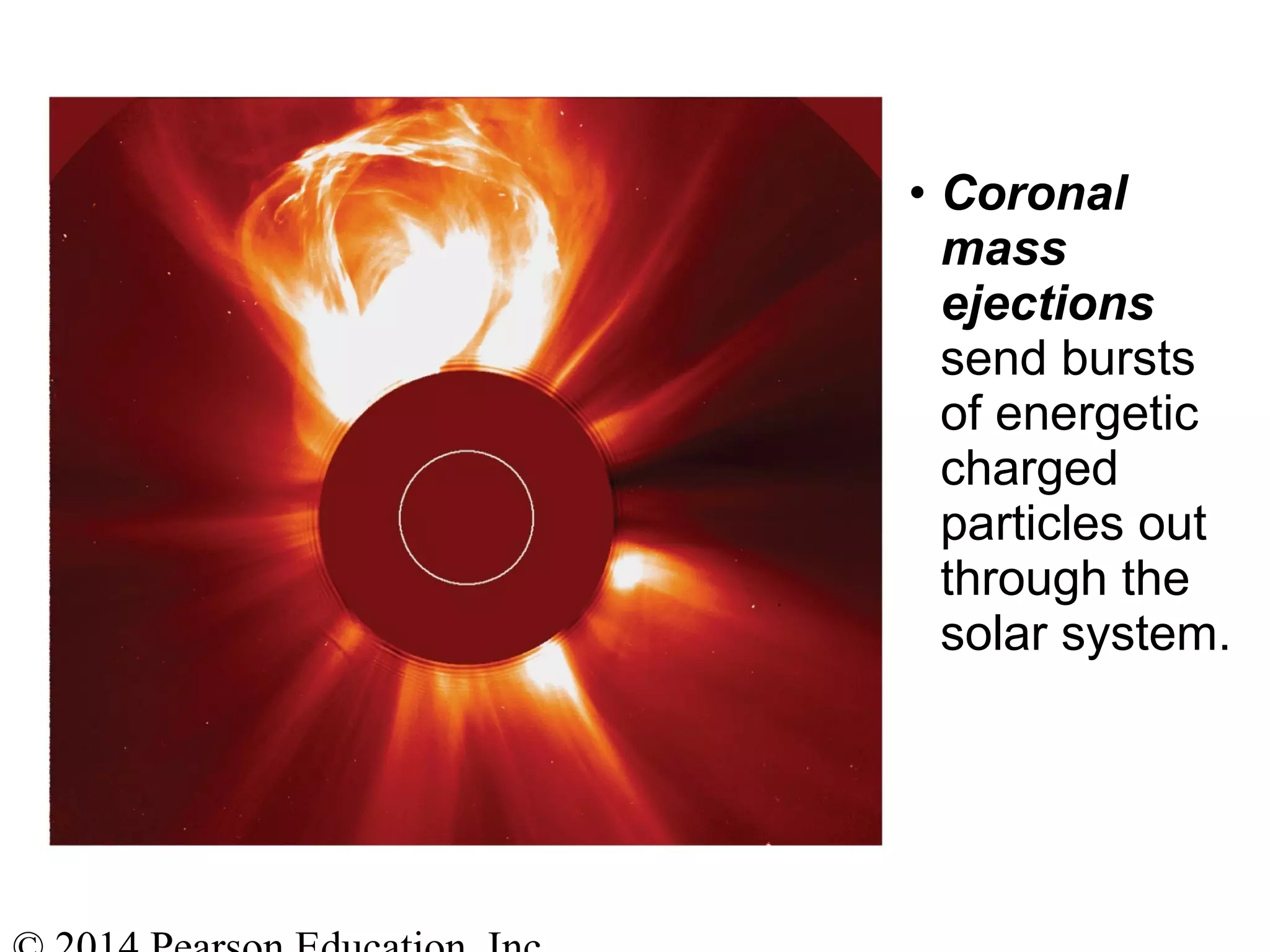
• Coronal
mass
ejections
send bursts
of energetic
charged
particles out
through the
solar system.
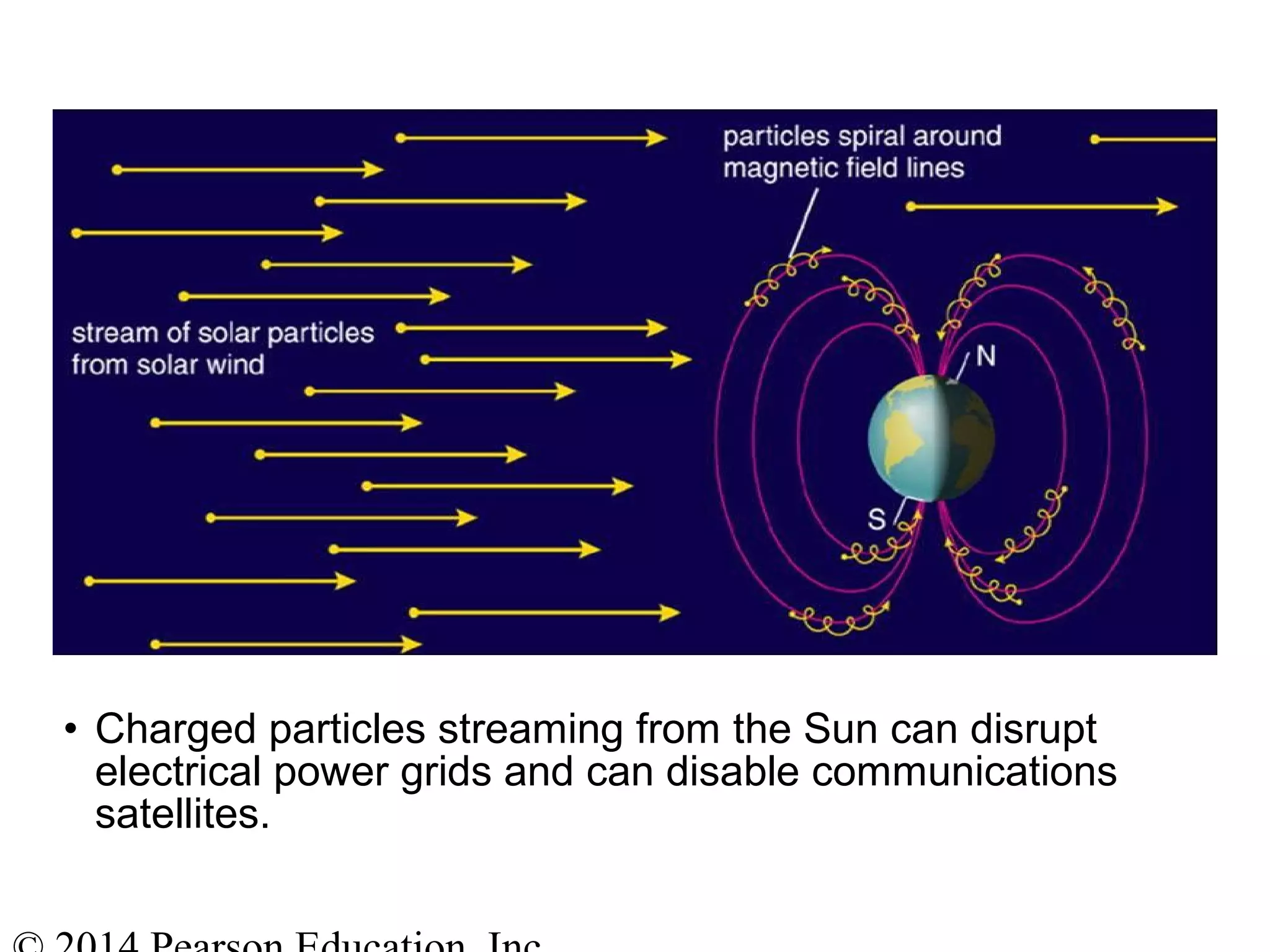
• Charged particles streaming from the Sun can disrupt
electrical power grids and can disable communications
satellites.
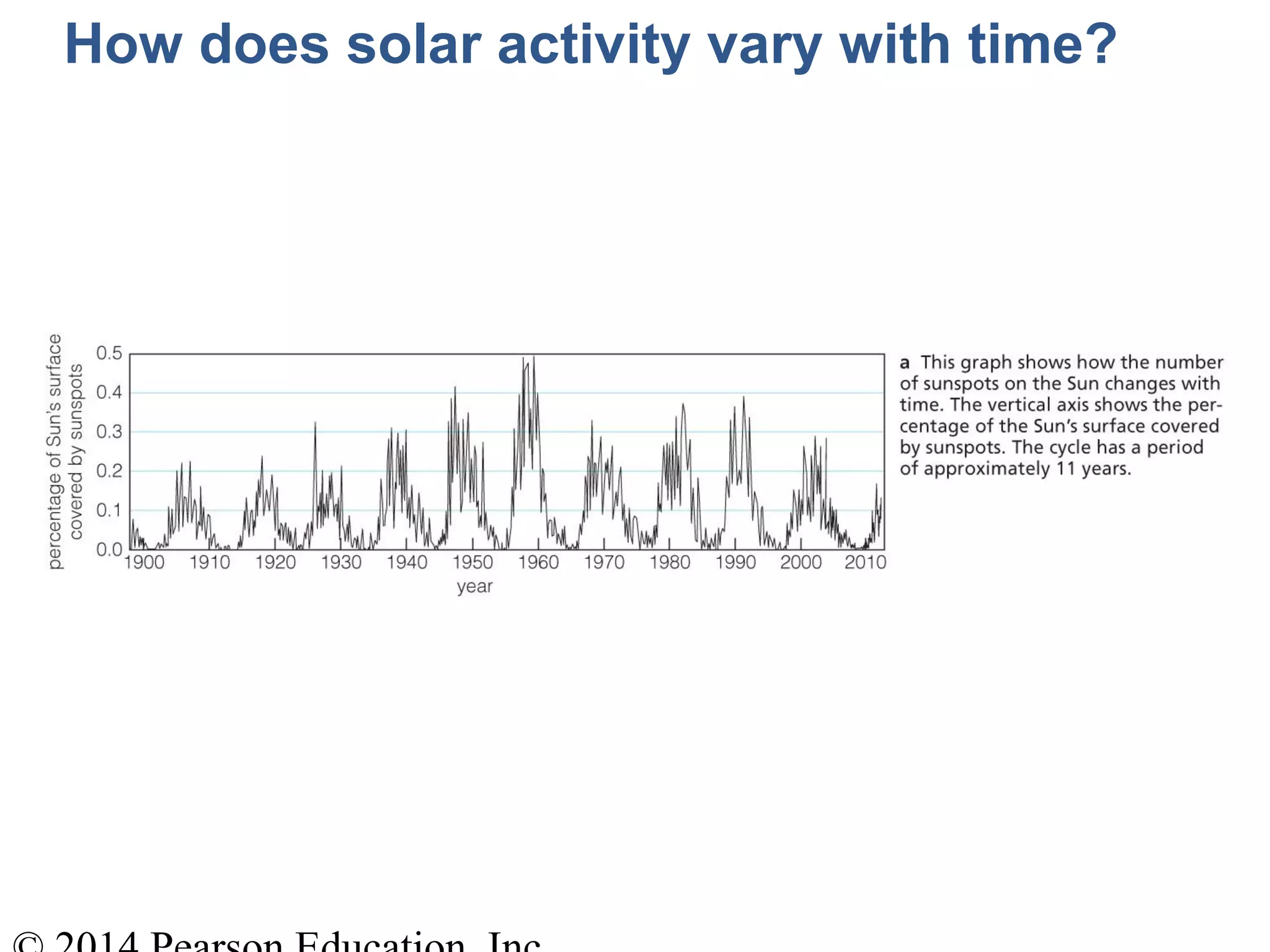
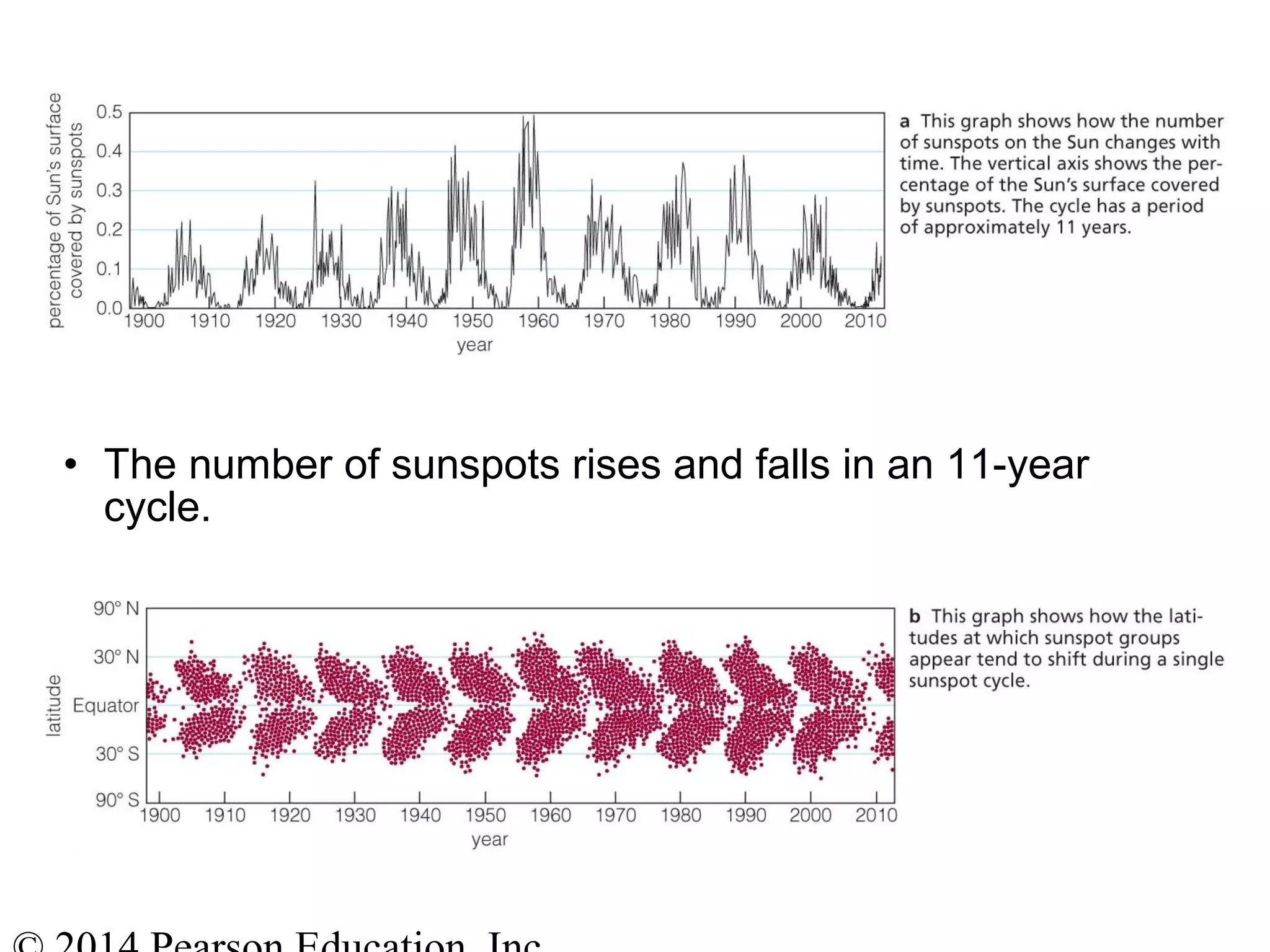
How does solar activity vary with time?
• The number of sunspots rises and falls in an 11-year
cycle.
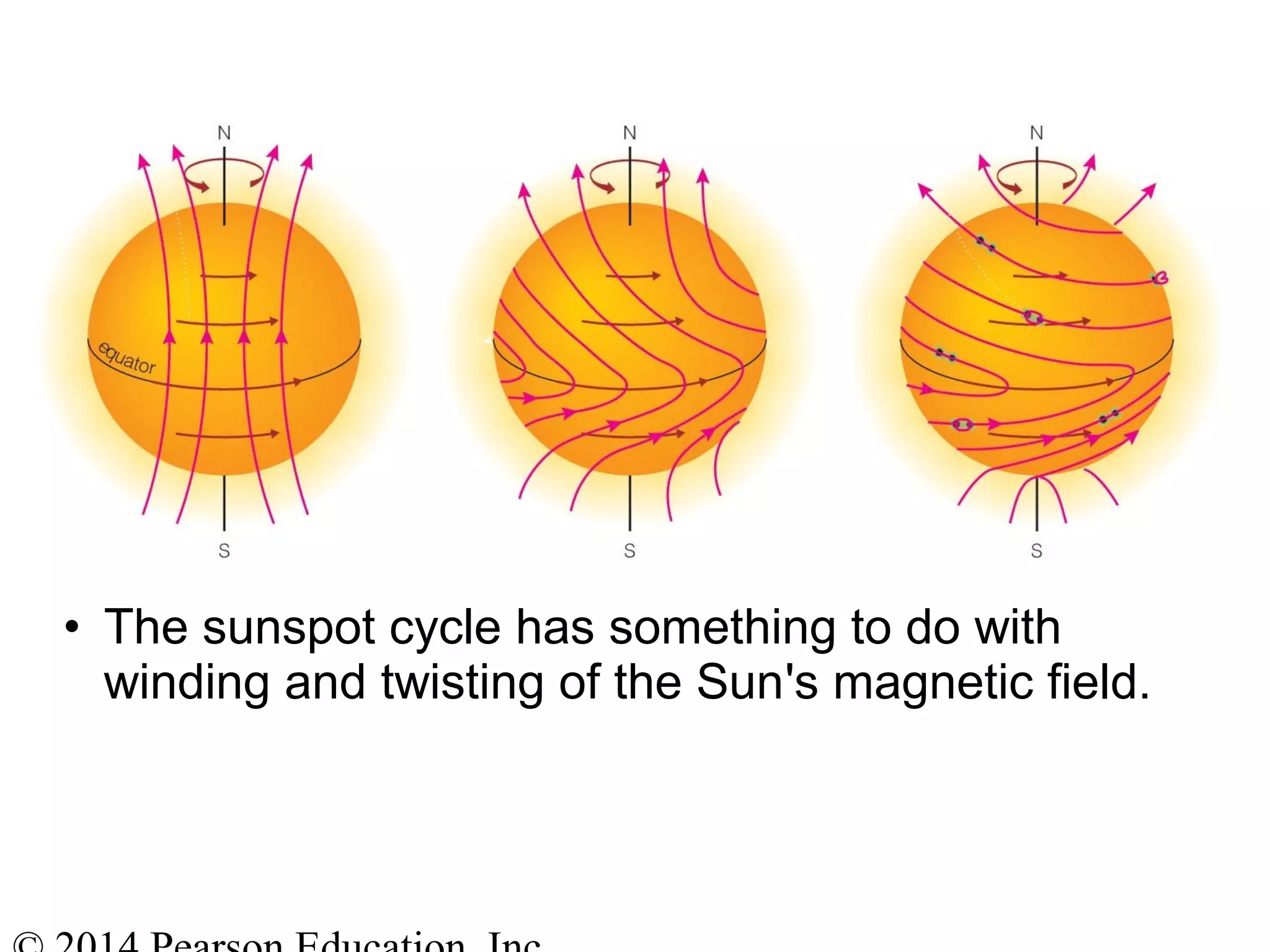
• The sunspot cycle has something to do with
winding and twisting of the Sun's magnetic field.
What have we learned?
• What causes solar activity?
– Stretching and twisting of magnetic field lines
near the Sun's surface cause solar activity.
• How does solar activity affect humans?
– Bursts of charged particles from the Sun can
disrupt radio communication and electrical
power generation and damage satellites.
• How does solar activity vary with time?
– Activity rises and falls with an 11-year period.

14 lecture outline

Editor's Notes

  • #17 Good Sun movies to download: http://es.rice.edu/ES/humsoc/Galileo/Things/g_sunspots.html Images compiled from Owen Gingerich's copy of the first edition of Istoria e Dimostrazioni Wave_fade.mpg photosphere:chromosphere:corona, optical:UV:X-ray http://www.lmsal.com/YPOP/FilmFestival/index.html C2_1mth.mpg http://lasco-www.nrl.navy.mil/
  • #25 (edited)
  • #43 Download a movie to illustrate solar oscillations from: http://science.nasa.gov/ssl/pad/solar/p_modes.htm
  • #44 Download a movie to illustrate solar oscillations from: http://science.nasa.gov/ssl/pad/solar/p_modes.htm
  • #58 Wave_fade.mpg photosphere:chromosphere:corona, optical:UV:X-ray http://www.lmsal.com/YPOP/FilmFestival/index.html