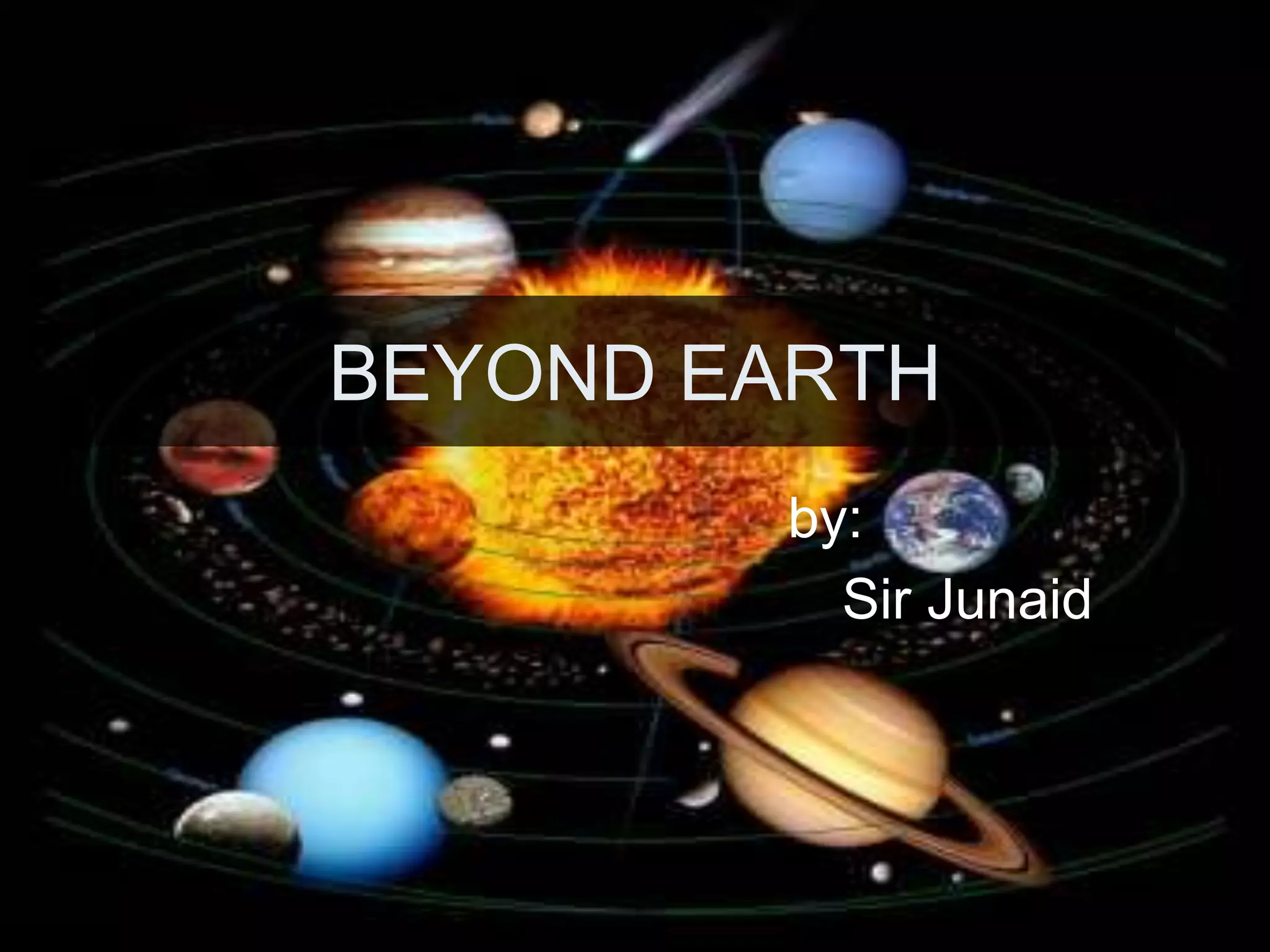
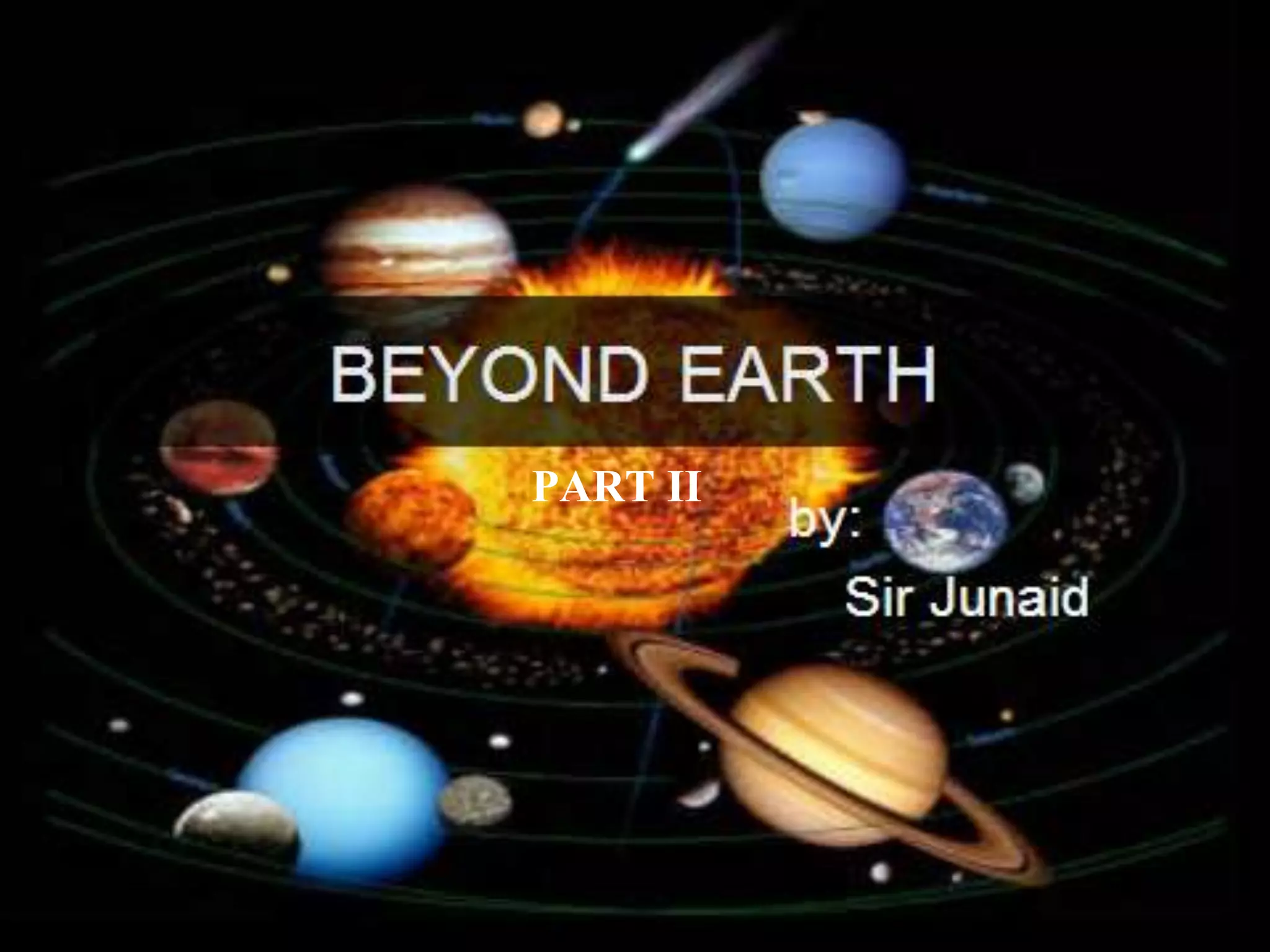
BEYOND EARTH
by:
Sir Junaid
THE
PLANETS
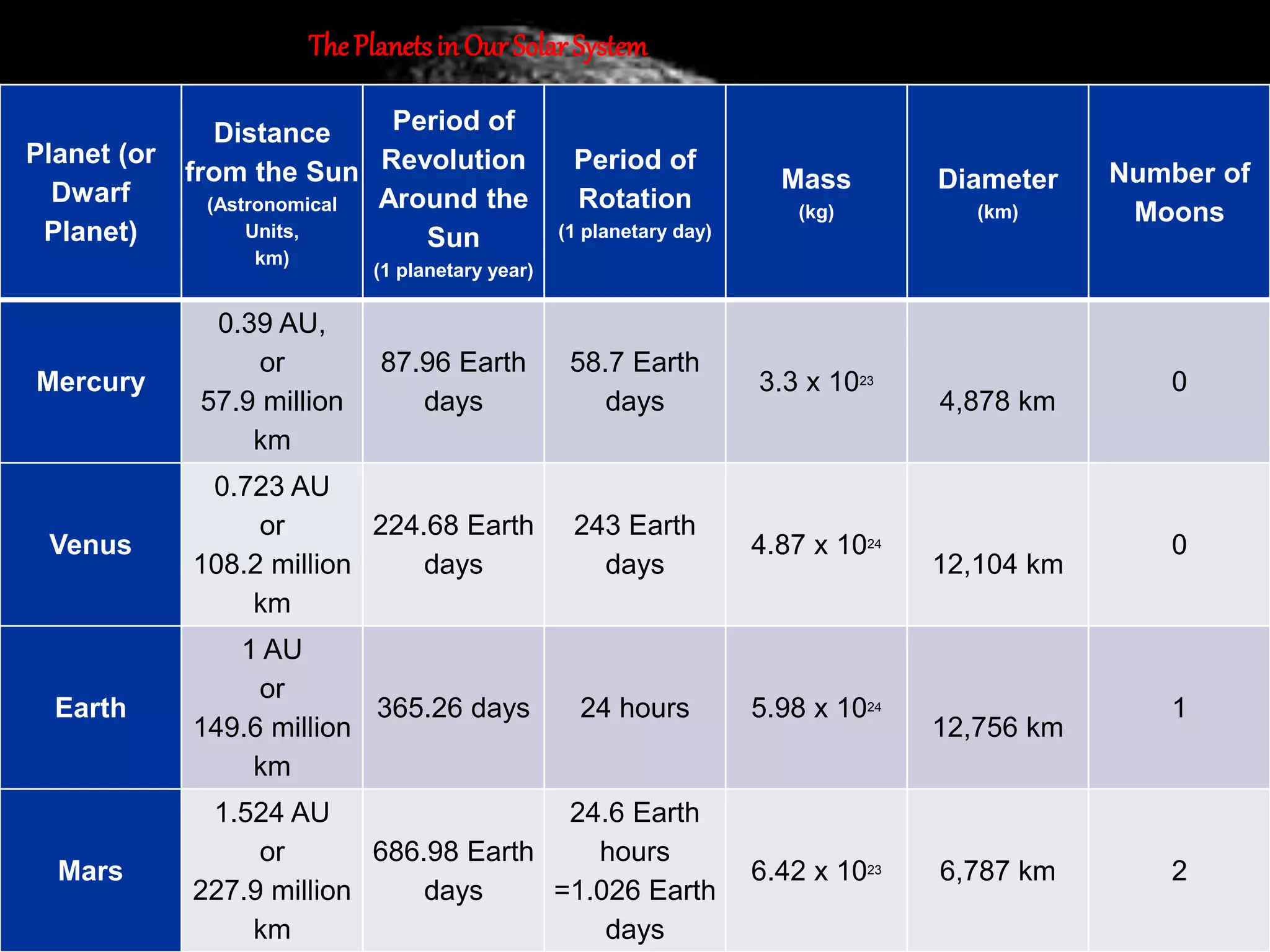
Planet (or
Dwarf
Planet)
Distance
from the Sun
(Astronomical
Units,
km)
Period of
Revolution
Around the
Sun
(1 planetary year)
Period of
Rotation
(1 planetary day)
Mass
(kg)
Diameter
(km)
Number of
Moons
Mercury
0.39 AU,
or
57.9 million
km
87.96 Earth
days
58.7 Earth
days
3.3 x 10²³
4,878 km
0
Venus
0.723 AU
or
108.2 million
km
224.68 Earth
days
243 Earth
days
4.87 x 1024
12,104 km
0
Earth
1 AU
or
149.6 million
km
365.26 days 24 hours 5.98 x 1024
12,756 km
1
Mars
1.524 AU
or
227.9 million
km
686.98 Earth
days
24.6 Earth
hours
=1.026 Earth
days
6.42 x 10²³ 6,787 km 2
ThePlanetsinOurSolarSystem
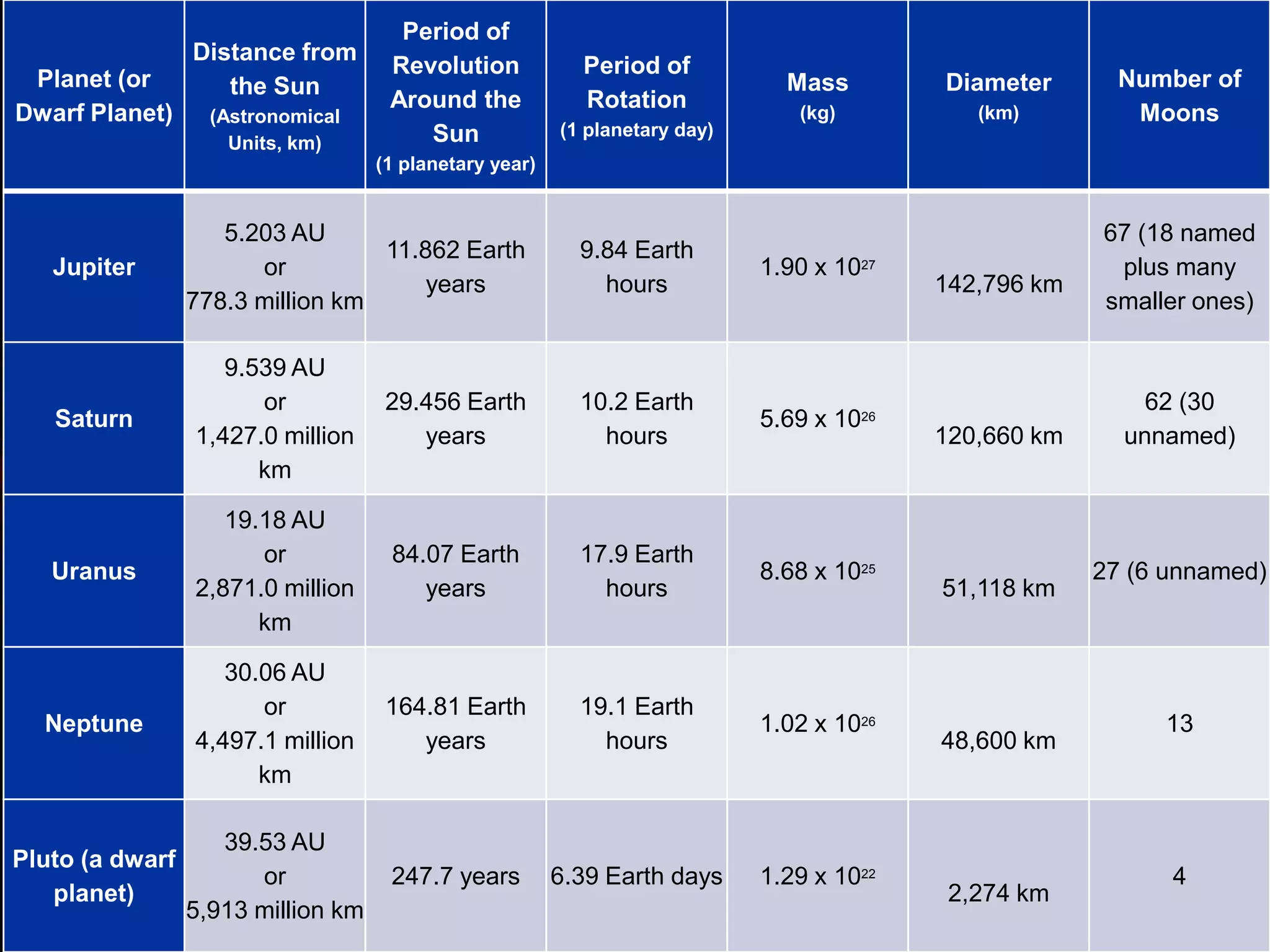
Planet (or
Dwarf Planet)
Distance from
the Sun
(Astronomical
Units, km)
Period of
Revolution
Around the
Sun
(1 planetary year)
Period of
Rotation
(1 planetary day)
Mass
(kg)
Diameter
(km)
Number of
Moons
Jupiter
5.203 AU
or
778.3 million km
11.862 Earth
years
9.84 Earth
hours
1.90 x 1027
142,796 km
67 (18 named
plus many
smaller ones)
Saturn
9.539 AU
or
1,427.0 million
km
29.456 Earth
years
10.2 Earth
hours
5.69 x 1026
120,660 km
62 (30
unnamed)
Uranus
19.18 AU
or
2,871.0 million
km
84.07 Earth
years
17.9 Earth
hours
8.68 x 1025
51,118 km
27 (6 unnamed)
Neptune
30.06 AU
or
4,497.1 million
km
164.81 Earth
years
19.1 Earth
hours
1.02 x 1026
48,600 km
13
Pluto (a dwarf
planet)
39.53 AU
or
5,913 million km
247.7 years 6.39 Earth days 1.29 x 10²²
2,274 km
4
PART II
COMETS
ASTEROIDS
METEOROIDS
METEORS
METEORITES
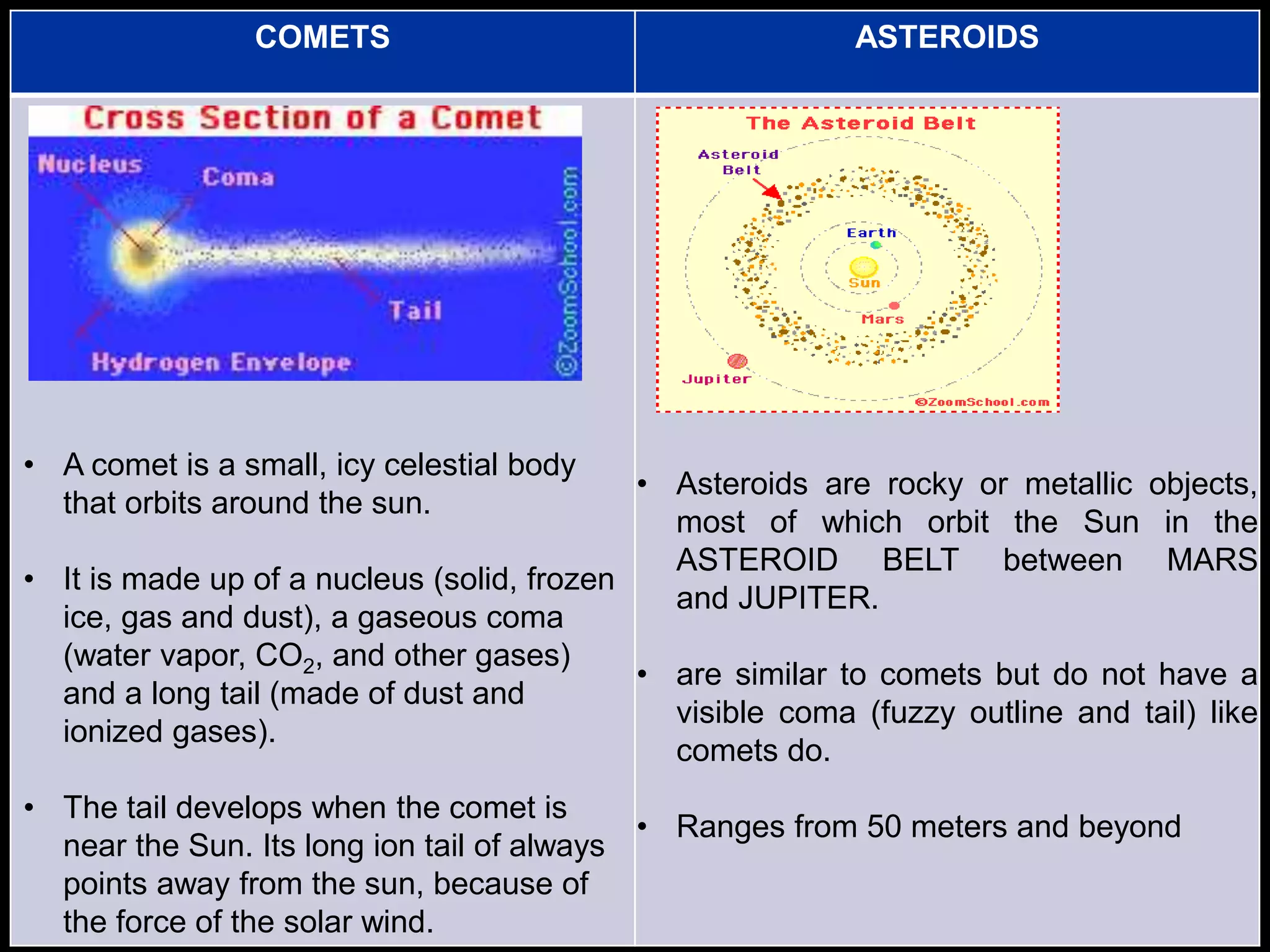
COMETS ASTEROIDS
• A comet is a small, icy celestial body
that orbits around the sun.
• It is made up of a nucleus (solid, frozen
ice, gas and dust), a gaseous coma
(water vapor, CO2, and other gases)
and a long tail (made of dust and
ionized gases).
• The tail develops when the comet is
near the Sun. Its long ion tail of always
points away from the sun, because of
the force of the solar wind.
• Asteroids are rocky or metallic objects,
most of which orbit the Sun in the
ASTEROID BELT between MARS
and JUPITER.
• are similar to comets but do not have a
visible coma (fuzzy outline and tail) like
comets do.
• Ranges from 50 meters and beyond
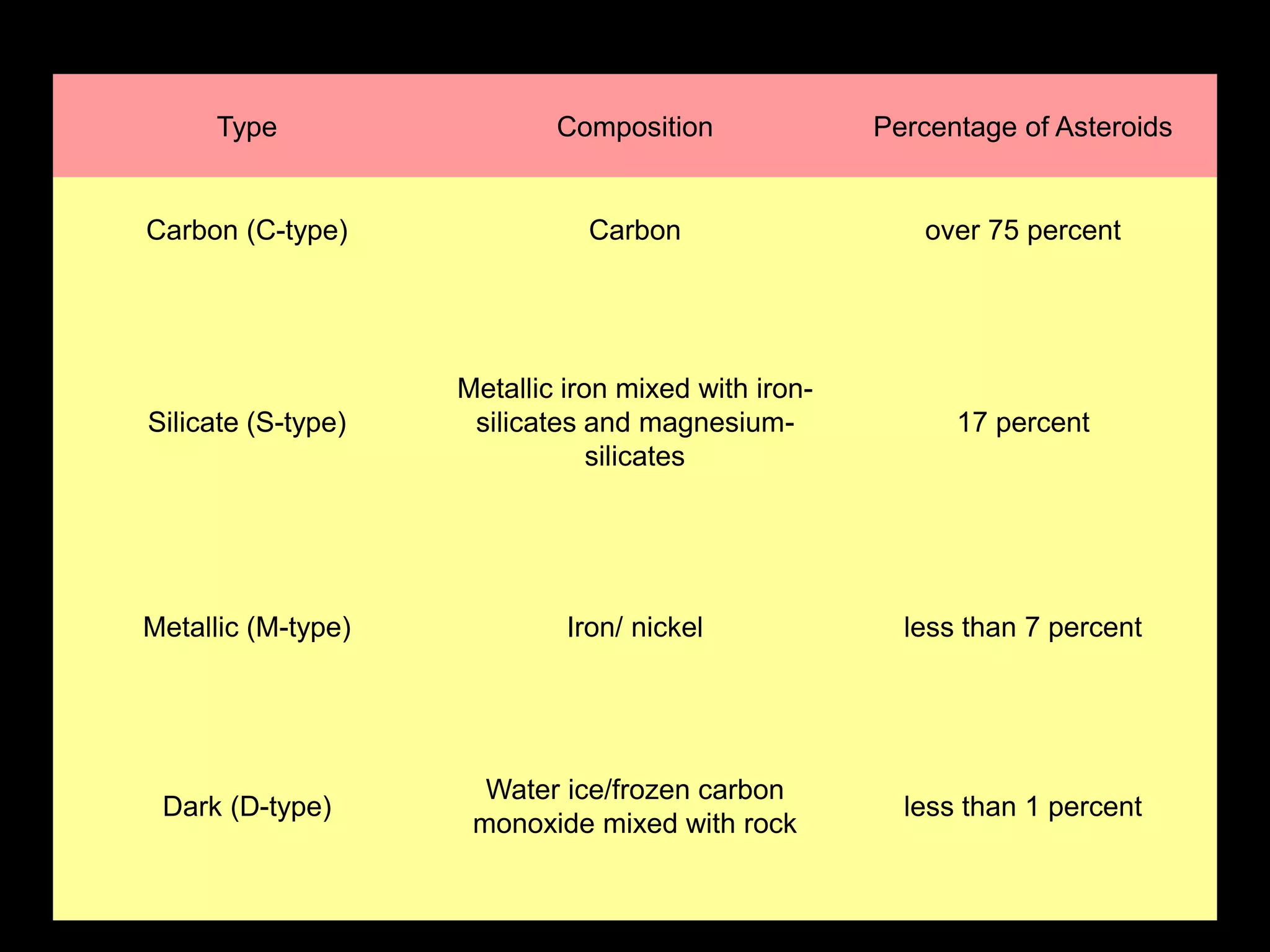
TYPES
OF
ASTEROID
Type Composition Percentage of Asteroids
Carbon (C-type) Carbon over 75 percent
Silicate (S-type)
Metallic iron mixed with iron-
silicates and magnesium-
silicates
17 percent
Metallic (M-type) Iron/ nickel less than 7 percent
Dark (D-type)
Water ice/frozen carbon
monoxide mixed with rock
less than 1 percent
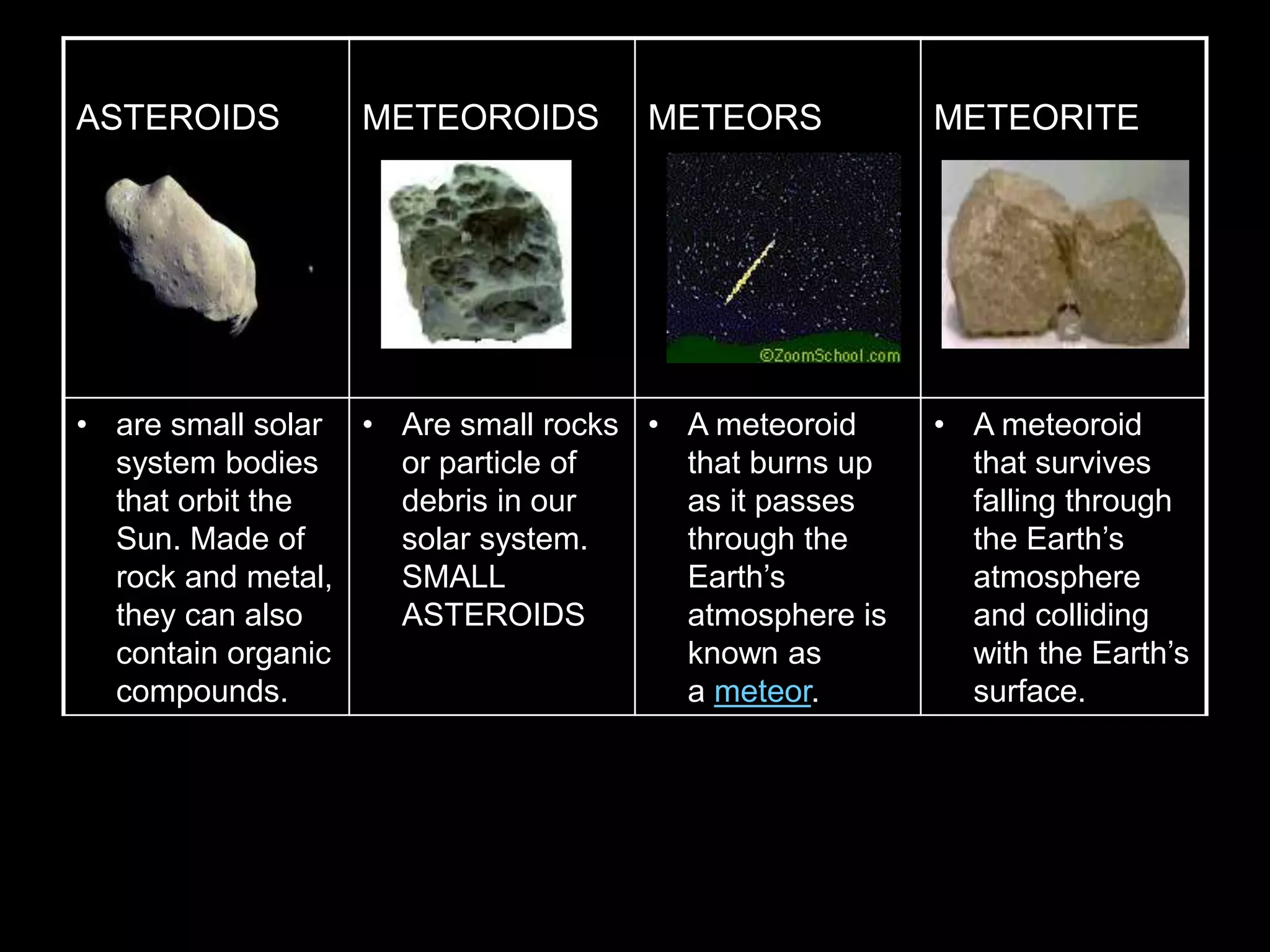
ASTEROIDS METEOROIDS METEORS METEORITE
• are small solar
system bodies
that orbit the
Sun. Made of
rock and metal,
they can also
contain organic
compounds.
• Are small rocks
or particle of
debris in our
solar system.
SMALL
ASTEROIDS
• A meteoroid
that burns up
as it passes
through the
Earth’s
atmosphere is
known as
a meteor.
• A meteoroid
that survives
falling through
the Earth’s
atmosphere
and colliding
with the Earth’s
surface.
References:
http://www.enchantedlearning.com/subjects/astronomy/planets/index.shtml
http://www.enchantedlearning.com/subjects/astronomy/asteroids/index.shtml
http://www.enchantedlearning.com/subjects/astronomy/meteors/index.shtml
end

Planets, asteroids, meteoroids, meteors and meteorites

  • 1.
  • 2.
  • 3.
    Planet (or Dwarf Planet) Distance from theSun (Astronomical Units, km) Period of Revolution Around the Sun (1 planetary year) Period of Rotation (1 planetary day) Mass (kg) Diameter (km) Number of Moons Mercury 0.39 AU, or 57.9 million km 87.96 Earth days 58.7 Earth days 3.3 x 10²³ 4,878 km 0 Venus 0.723 AU or 108.2 million km 224.68 Earth days 243 Earth days 4.87 x 1024 12,104 km 0 Earth 1 AU or 149.6 million km 365.26 days 24 hours 5.98 x 1024 12,756 km 1 Mars 1.524 AU or 227.9 million km 686.98 Earth days 24.6 Earth hours =1.026 Earth days 6.42 x 10²³ 6,787 km 2 ThePlanetsinOurSolarSystem
  • 4.
    Planet (or Dwarf Planet) Distancefrom the Sun (Astronomical Units, km) Period of Revolution Around the Sun (1 planetary year) Period of Rotation (1 planetary day) Mass (kg) Diameter (km) Number of Moons Jupiter 5.203 AU or 778.3 million km 11.862 Earth years 9.84 Earth hours 1.90 x 1027 142,796 km 67 (18 named plus many smaller ones) Saturn 9.539 AU or 1,427.0 million km 29.456 Earth years 10.2 Earth hours 5.69 x 1026 120,660 km 62 (30 unnamed) Uranus 19.18 AU or 2,871.0 million km 84.07 Earth years 17.9 Earth hours 8.68 x 1025 51,118 km 27 (6 unnamed) Neptune 30.06 AU or 4,497.1 million km 164.81 Earth years 19.1 Earth hours 1.02 x 1026 48,600 km 13 Pluto (a dwarf planet) 39.53 AU or 5,913 million km 247.7 years 6.39 Earth days 1.29 x 10²² 2,274 km 4
  • 5.
  • 6.
  • 7.
    COMETS ASTEROIDS • Acomet is a small, icy celestial body that orbits around the sun. • It is made up of a nucleus (solid, frozen ice, gas and dust), a gaseous coma (water vapor, CO2, and other gases) and a long tail (made of dust and ionized gases). • The tail develops when the comet is near the Sun. Its long ion tail of always points away from the sun, because of the force of the solar wind. • Asteroids are rocky or metallic objects, most of which orbit the Sun in the ASTEROID BELT between MARS and JUPITER. • are similar to comets but do not have a visible coma (fuzzy outline and tail) like comets do. • Ranges from 50 meters and beyond
  • 8.
  • 9.
    Type Composition Percentageof Asteroids Carbon (C-type) Carbon over 75 percent Silicate (S-type) Metallic iron mixed with iron- silicates and magnesium- silicates 17 percent Metallic (M-type) Iron/ nickel less than 7 percent Dark (D-type) Water ice/frozen carbon monoxide mixed with rock less than 1 percent
  • 10.
    ASTEROIDS METEOROIDS METEORSMETEORITE • are small solar system bodies that orbit the Sun. Made of rock and metal, they can also contain organic compounds. • Are small rocks or particle of debris in our solar system. SMALL ASTEROIDS • A meteoroid that burns up as it passes through the Earth’s atmosphere is known as a meteor. • A meteoroid that survives falling through the Earth’s atmosphere and colliding with the Earth’s surface.
  • 11.