CS 354
Global Illumination
Mark Kilgard
University of Texas
April 19, 2012
CS 354                                          2


         Today’s material
        In-class quiz
            On ray casting & tracing lecture
        Lecture topic
          Project 4
          Global illumination
CS 354                            3


         My Office Hours
        Tuesday, before class
            Painter (PAI) 5.35
            8:45 a.m. to 9:15
        Thursday, after class
            ACE 6.302
            11:00 a.m. to 12


        Randy’s office hours
            Monday & Wednesday
            11 a.m. to 12:00
            Painter (PAI) 5.33
CS 354                                          4


         Last time, this time
        Last lecture, we discussed
            Ray casting and tracing
        This lecture
            Global illumination
        Projects
          Project 3 due yesterday
          Project 4 on ray tracing on Piazza
                 Due May 2, 2012
CS 354                                                                                 5

                                         On a sheet of paper
         Daily Quiz                      • Write your EID, name, and date
                                         • Write #1, #2, #3 followed by its answer
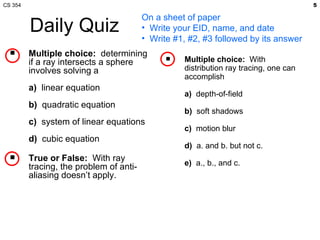
        Multiple choice: determining
         if a ray intersects a sphere             Multiple choice: With
         involves solving a                        distribution ray tracing, one can
                                                   accomplish
         a) linear equation
                                                   a) depth-of-field
         b) quadratic equation
                                                   b) soft shadows
         c) system of linear equations
                                                   c) motion blur
         d) cubic equation
                                                   d) a. and b. but not c.
        True or False: With ray
         tracing, the problem of anti-             e) a., b., and c.
         aliasing doesn’t apply.
CS 354                                                      6

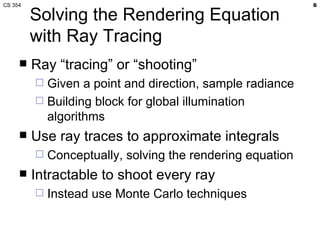
         Solving the Rendering Equation
         with Ray Tracing
        Ray “tracing” or “shooting”
          Given a point and direction, sample radiance
          Building block for global illumination
           algorithms
        Use ray traces to approximate integrals
            Conceptually, solving the rendering equation
        Intractable to shoot every ray
            Instead use Monte Carlo techniques
CS 354                                                            7


         Aspects of Modeling Light
        Geometric optics
            Our concern
            Assume light travels instantaneously
            Light travels in straight lines
            Light not influenced by gravity or magnetic fields
        Wave optics
            Diffraction, etc.
        Quantum optics
            Sub-microscopic
CS 354                                                                                                  8


         Rendering Equation
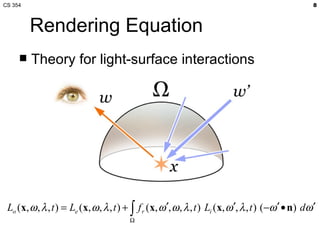
        Theory for light-surface interactions


 Lo (x, ω , λ , t ) = Le (x, ω , λ , t ) + ∫ f r (x, ω ′, ω , λ , t ) Li (x, ω ′, λ , t ) (−ω ′ • n) dω ′
                                          Ω
CS 354                                                                                                     9


         Rendering Equation Parts
Lo (x, ω , λ , t ) = Le (x, ω , λ , t ) + ∫ f r (x, ω ′, ω , λ , t ) Li (x, ω ′, λ , t ) (−ω ′ • n) dω ′
                                         Ω


        Lo = outgoing light from x in direction ω
        x = point on a surface
        ω = normalized outgoing light vector
        λ = wavelength of light
        t = time
        Le = emitted light at x going towards from ω
        n = surface normal at x
CS 354                                                              10


         Rendering Equation Integral
        ∫ = integrate over a region
        Ω = region of a hemisphere
            Together: “integrate overall the incoming directions
             for a hemisphere at a point x”
        ωˊ = normalized incoming light vector
        Li = incoming light at x coming from ωˊ
        n = surface normal at x
        (-ωˊ • n) = cosine of angle between incoming
         light and surface normal
        dωˊ = differential of incoming angle
CS 354                                                                                  11

         Bidirectional Reflectance
         Distribution Function
        Ratio of differential outgoing (reflected) radiance
         to differential incoming irradiance
                            dLr (x, ω , λ , t )          dLr (x, ω , λ , t )
 f r (x, ω ′, ω , λ , t ) =                     =
                            dEi (x, ω ′, λ , t ) dLi (x, ω ′, λ , t ) (−ω ′ • n) dω ′
        Physically based BRDF properties                          L = radiance
            Must be non-negative                                  E = irradiance
            Must be reciprocal
                 Swap incoming & relected directions generates same ratio
            Conserves energy
                 Integrating over entire hemisphere must be ≤ 1
CS 354                                                      12


         Cosine Weighting for Irradiance


        At shallow angles, incoming light spreads over a
         wider area of the surface
            Thus spreading the energy
            Thus dimming the received light
CS 354                                             13


         Measuring BRDFs Empirically
        Gonioreflectometer is device to measure
         BRDFs
CS 354                                             14


         BRDF Decomposition
        Broad characterization of BRDF
         appearance


          Pure diffuse   Pure specular    Glossy
CS 354                                                                15


         Common BRDFs
        Diffuse model, a.k.a. Lambertian
                          f diffuse (x, Ψ ↔ Θ, λ , t ) = k d


                                   ( R • Θ) n
      Phongphong (x, Ψ ↔a.k.a.=Reflection dSpecular
           f model, Θ, λ , t ) k s            +k
                                     N •Ψ


                                                    ( N • H )n
                   f blinn (x, Ψ ↔ Θ, λ , t ) = k s            + kd
        Blinn   model, a.k.a. Half-angle Specular    N •Ψ
CS 354                                              16


         Hemisphere over a Surface
        Incident radiance is integrated over the
         hemisphere
CS 354                                                                                                 17


         Rendering Equation Interpretation
        Recursive equation

 Lo (x, ω , λ , t ) = Le (x, ω , λ , t ) + ∫ f r (x, ω ′, ω , λ , t ) Li (x, ω ′, λ , t ) (−ω ′ • n) dω ′
                                          Ω

                outgoing light “sums up” all incoming light
                for all directions on hemisphere
        Integral over hemisphere (Ω)
        Limitations
             Treats wavelengths all independent
             Treats time in Newtonian way
             Ignores volumetric and subsurface scattering
             More complex models can incorporate these aspects of light
             Impractical for actual computer graphics rendering
CS 354                                                                                                   18


         Alternate Rendering Equation
        Integrate over all points in the scene
             Instead of all directions for a hemisphere

  Lo (x, ω , λ , t ) = Le (x, ω , λ , t ) +   ∫ f (x, ω
                                              y∈Γ
                                                    r     yx   , ω , λ , t ) L(y, ωyx , λ , t ) G (x, y ) dy

                        outgoing light “sums up” all incoming light
                        for all surfaces, modulated by visibility

        Notes
           G(x,y) returns the visibility (occlusion) between points x & y
           Integral over all surface points (Γ) in the scene
CS 354                                                                                                                                                                     19

             Two Versions of
             Rendering Equation
                                                                                                                                      Occlusion (G) is zero


                                                                                                                                o


                                                Le (x, ω , λ , t ) +
                                                                                                                                         Le (x, ω , λ , t ) +
Lo (x, ω , λ , t ) =
                       ∫
                       Ω
                           f r (x, ω ′, ω , λ , t ) Li (x, ω ′, λ , t ) (−ω ′ • n) dω ′   Lo (x, ω , λ , t ) =
                                                                                                                 ∫     f r (x, ωyx , ω , λ , t ) L(y, ωyx , λ , t ) G (x, y ) dy
                                                                                                                 y∈Γ


           Integrate over hemisphere                                                                Integrate over all surface points
CS 354                                                    20


         Discrete Integral Approximation
        Uniform sampling
            Shown in 1D, but we need to integrate over
             hemisphere (solid angles)
CS 354                         21


         Hemisphere Sampling
        Vary Euler angles
CS 354                                                     22


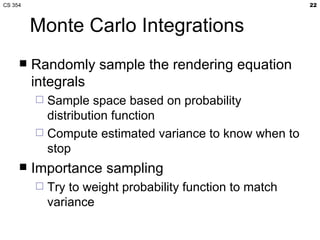
         Monte Carlo Integrations
        Randomly sample the rendering equation
         integrals
          Sample space based on probability
           distribution function
          Compute estimated variance to know when to
           stop
        Importance sampling
            Try to weight probability function to match
             variance
CS 354                                     23


         Ray Casting for Initial Samples
CS 354                                   24

         Path Tracing via
         Simple Stochastic Ray Tracing
CS 354                                                                                                                                                                     25

             Two Versions of
             Rendering Equation (again)                                                                                                       Occlusion (G) is zero


                                                                                                                           o


                                                Le (x, ω , λ , t ) +
                                                                                                                                         Le (x, ω , λ , t ) +
Lo (x, ω , λ , t ) =
                       ∫
                       Ω
                           f r (x, ω ′, ω , λ , t ) Li (x, ω ′, λ , t ) (−ω ′ • n) dω ′   Lo (x, ω , λ , t ) =
                                                                                                                 ∫     f r (x, ωyx , ω , λ , t ) L(y, ωyx , λ , t ) G (x, y ) dy
                                                                                                                 y∈Γ


           Integrate over hemisphere                                                                Integrate over all surface points
CS 354                                    26


         Sufficient Shadow Ray Sampling
CS 354                                                    27


         Light Tracing
        Trace rays from the light
            Contribution rays accumulate image samples
CS 354                                 28

         Light Tracing Needs Lots of
         Samples
CS 354                                                             29


         How many rays to shoot?
        Two approaches
            Fixed number of ray evaluations
               Limits the depth of recursion
               Means some paths can never be explored

               Implies bias in result, since favors short paths

            Russian Roulette approach
               Roll dice to see if ray tracing should continue
               Reduces bias in rendering result

               Allows “obscure” paths to be explored
CS 354                                                             30


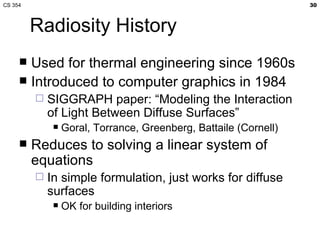
         Radiosity History
      Used for thermal engineering since 1960s
      Introduced to computer graphics in 1984
            SIGGRAPH paper: “Modeling the Interaction
             of Light Between Diffuse Surfaces”
                 Goral, Torrance, Greenberg, Battaile (Cornell)
        Reduces to solving a linear system of
         equations
            In simple formulation, just works for diffuse
             surfaces
                 OK for building interiors
CS 354                       31


         Radiosity Example
CS 354                                      32


         Scene Diced into Uniform Patches
CS 354                                                                 33


         Radiosity Method


          Self-emitted       reflectivity                total
           radiosity                                   radiosity


                                                      Form factor

                         Approximation to general Rendering Equation
CS 354                                                                34


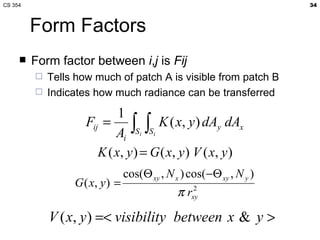
         Form Factors
        Form factor between i,j is Fij
            Tells how much of patch A is visible from patch B
            Indicates how much radiance can be transferred

                             1
                     Fij = ∫ ∫ K ( x, y ) dAy dAx
                            Ai Si Si
                        K ( x , y ) = G ( x, y ) V ( x, y )
                                 cos(Θ xy , N x ) cos(−Θ xy , N y )
                  G ( x, y ) =
                                               π rxy
                                                   2


             V ( x, y ) =< visibility between x & y >
CS 354                                      35


         Form Factor Visualized
        Mutual visibility of two patches
            Don’t have to be same size
CS 354                                              36

         Differential Patches and
         Foreshortening
        Cosine fall-off applies
            And assuming Lambertian surfaces


                                   foreshortening
CS 354                                                  37

         Hemi-cube Approach to Sampling
         Form Factors
        Think about drawing hemi-cube at every point
            What you see is an input for radiosity
            Known as “instant radiosity”
CS 354                                                                      38


         Interpolation of Radiosity Solution
  Constant Approximation        “true” solution   Quadratic Approximation


            flat       smooth
CS 354                                                                                  39


         Iterative Radiosity Solver


          1 iteration                   4 iterations                    16 iterations


                        64 iterations                  252 iterations
CS 354                                                                       40


          Participating Media
         Light doesn’t just interact with surfaces
               Gaseous phenomena affects lighting
               Usually handled statistically


                emission
                                      in-scattering   [Jarosz et.al. 2008]


         absorption
                           out-scattering               [FogShop 2007]
CS 354                                     41


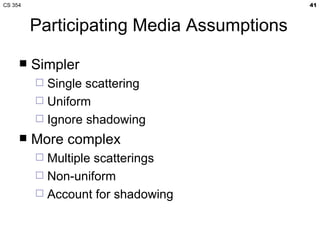
         Participating Media Assumptions

        Simpler
          Single scattering
          Uniform
          Ignore shadowing
        More complex
          Multiple scatterings
          Non-uniform
          Account for shadowing
CS 354                                                            42


         Photon Mapping
        Two-pass global illumination algorithm
            Developed by Henrick Jensen (1996)
            Two passes
                 Randomly distribute photons around the scene
                      Called “photon map construction”
                 Render treating photons as mini-light sources
        Capable of efficiently generating otherwise very
         expensive effects
            Caustics
            Diffuse inter-reflections, such as color bleed
            Sub-surface scattering
CS 354                                                                  43


         Photon Mapping Examples


                                     without diffuse     photo map
               caustics              interreflection    visualization


          sub-surface scattering

                                   diffuse interreflection
CS 354                                                        44


         Next Class
        Next lecture
            Acceleration structures
            How do we make the ray trace operation faster?

        Reading
            Chapter 5, 297-298
            Chapter 11, 569-577

        Project 4
            Project 4 is a simple ray tracer
            Due Wednesday, May 2, 2012

CS 354 Global Illumination

  • 1.
    CS 354 Global Illumination MarkKilgard University of Texas April 19, 2012
  • 2.
    CS 354 2 Today’s material  In-class quiz  On ray casting & tracing lecture  Lecture topic  Project 4  Global illumination
  • 3.
    CS 354 3 My Office Hours  Tuesday, before class  Painter (PAI) 5.35  8:45 a.m. to 9:15  Thursday, after class  ACE 6.302  11:00 a.m. to 12  Randy’s office hours  Monday & Wednesday  11 a.m. to 12:00  Painter (PAI) 5.33
  • 4.
    CS 354 4 Last time, this time  Last lecture, we discussed  Ray casting and tracing  This lecture  Global illumination  Projects  Project 3 due yesterday  Project 4 on ray tracing on Piazza  Due May 2, 2012
  • 5.
    CS 354 5 On a sheet of paper Daily Quiz • Write your EID, name, and date • Write #1, #2, #3 followed by its answer  Multiple choice: determining if a ray intersects a sphere  Multiple choice: With involves solving a distribution ray tracing, one can accomplish a) linear equation a) depth-of-field b) quadratic equation b) soft shadows c) system of linear equations c) motion blur d) cubic equation d) a. and b. but not c.  True or False: With ray tracing, the problem of anti- e) a., b., and c. aliasing doesn’t apply.
  • 6.
    CS 354 6 Solving the Rendering Equation with Ray Tracing  Ray “tracing” or “shooting”  Given a point and direction, sample radiance  Building block for global illumination algorithms  Use ray traces to approximate integrals  Conceptually, solving the rendering equation  Intractable to shoot every ray  Instead use Monte Carlo techniques
  • 7.
    CS 354 7 Aspects of Modeling Light  Geometric optics  Our concern  Assume light travels instantaneously  Light travels in straight lines  Light not influenced by gravity or magnetic fields  Wave optics  Diffraction, etc.  Quantum optics  Sub-microscopic
  • 8.
    CS 354 8 Rendering Equation  Theory for light-surface interactions Lo (x, ω , λ , t ) = Le (x, ω , λ , t ) + ∫ f r (x, ω ′, ω , λ , t ) Li (x, ω ′, λ , t ) (−ω ′ • n) dω ′ Ω
  • 9.
    CS 354 9 Rendering Equation Parts Lo (x, ω , λ , t ) = Le (x, ω , λ , t ) + ∫ f r (x, ω ′, ω , λ , t ) Li (x, ω ′, λ , t ) (−ω ′ • n) dω ′ Ω  Lo = outgoing light from x in direction ω  x = point on a surface  ω = normalized outgoing light vector  λ = wavelength of light  t = time  Le = emitted light at x going towards from ω  n = surface normal at x
  • 10.
    CS 354 10 Rendering Equation Integral  ∫ = integrate over a region  Ω = region of a hemisphere  Together: “integrate overall the incoming directions for a hemisphere at a point x”  ωˊ = normalized incoming light vector  Li = incoming light at x coming from ωˊ  n = surface normal at x  (-ωˊ • n) = cosine of angle between incoming light and surface normal  dωˊ = differential of incoming angle
  • 11.
    CS 354 11 Bidirectional Reflectance Distribution Function  Ratio of differential outgoing (reflected) radiance to differential incoming irradiance dLr (x, ω , λ , t ) dLr (x, ω , λ , t ) f r (x, ω ′, ω , λ , t ) = = dEi (x, ω ′, λ , t ) dLi (x, ω ′, λ , t ) (−ω ′ • n) dω ′  Physically based BRDF properties L = radiance  Must be non-negative E = irradiance  Must be reciprocal  Swap incoming & relected directions generates same ratio  Conserves energy  Integrating over entire hemisphere must be ≤ 1
  • 12.
    CS 354 12 Cosine Weighting for Irradiance  At shallow angles, incoming light spreads over a wider area of the surface  Thus spreading the energy  Thus dimming the received light
  • 13.
    CS 354 13 Measuring BRDFs Empirically  Gonioreflectometer is device to measure BRDFs
  • 14.
    CS 354 14 BRDF Decomposition  Broad characterization of BRDF appearance Pure diffuse Pure specular Glossy
  • 15.
    CS 354 15 Common BRDFs  Diffuse model, a.k.a. Lambertian f diffuse (x, Ψ ↔ Θ, λ , t ) = k d ( R • Θ) n  Phongphong (x, Ψ ↔a.k.a.=Reflection dSpecular f model, Θ, λ , t ) k s +k N •Ψ ( N • H )n f blinn (x, Ψ ↔ Θ, λ , t ) = k s + kd  Blinn model, a.k.a. Half-angle Specular N •Ψ
  • 16.
    CS 354 16 Hemisphere over a Surface  Incident radiance is integrated over the hemisphere
  • 17.
    CS 354 17 Rendering Equation Interpretation  Recursive equation Lo (x, ω , λ , t ) = Le (x, ω , λ , t ) + ∫ f r (x, ω ′, ω , λ , t ) Li (x, ω ′, λ , t ) (−ω ′ • n) dω ′ Ω outgoing light “sums up” all incoming light for all directions on hemisphere  Integral over hemisphere (Ω)  Limitations  Treats wavelengths all independent  Treats time in Newtonian way  Ignores volumetric and subsurface scattering  More complex models can incorporate these aspects of light  Impractical for actual computer graphics rendering
  • 18.
    CS 354 18 Alternate Rendering Equation  Integrate over all points in the scene  Instead of all directions for a hemisphere Lo (x, ω , λ , t ) = Le (x, ω , λ , t ) + ∫ f (x, ω y∈Γ r yx , ω , λ , t ) L(y, ωyx , λ , t ) G (x, y ) dy outgoing light “sums up” all incoming light for all surfaces, modulated by visibility  Notes  G(x,y) returns the visibility (occlusion) between points x & y  Integral over all surface points (Γ) in the scene
  • 19.
    CS 354 19 Two Versions of Rendering Equation Occlusion (G) is zero o Le (x, ω , λ , t ) + Le (x, ω , λ , t ) + Lo (x, ω , λ , t ) = ∫ Ω f r (x, ω ′, ω , λ , t ) Li (x, ω ′, λ , t ) (−ω ′ • n) dω ′ Lo (x, ω , λ , t ) = ∫ f r (x, ωyx , ω , λ , t ) L(y, ωyx , λ , t ) G (x, y ) dy y∈Γ Integrate over hemisphere Integrate over all surface points
  • 20.
    CS 354 20 Discrete Integral Approximation  Uniform sampling  Shown in 1D, but we need to integrate over hemisphere (solid angles)
  • 21.
    CS 354 21 Hemisphere Sampling  Vary Euler angles
  • 22.
    CS 354 22 Monte Carlo Integrations  Randomly sample the rendering equation integrals  Sample space based on probability distribution function  Compute estimated variance to know when to stop  Importance sampling  Try to weight probability function to match variance
  • 23.
    CS 354 23 Ray Casting for Initial Samples
  • 24.
    CS 354 24 Path Tracing via Simple Stochastic Ray Tracing
  • 25.
    CS 354 25 Two Versions of Rendering Equation (again) Occlusion (G) is zero o Le (x, ω , λ , t ) + Le (x, ω , λ , t ) + Lo (x, ω , λ , t ) = ∫ Ω f r (x, ω ′, ω , λ , t ) Li (x, ω ′, λ , t ) (−ω ′ • n) dω ′ Lo (x, ω , λ , t ) = ∫ f r (x, ωyx , ω , λ , t ) L(y, ωyx , λ , t ) G (x, y ) dy y∈Γ Integrate over hemisphere Integrate over all surface points
  • 26.
    CS 354 26 Sufficient Shadow Ray Sampling
  • 27.
    CS 354 27 Light Tracing  Trace rays from the light  Contribution rays accumulate image samples
  • 28.
    CS 354 28 Light Tracing Needs Lots of Samples
  • 29.
    CS 354 29 How many rays to shoot?  Two approaches  Fixed number of ray evaluations  Limits the depth of recursion  Means some paths can never be explored  Implies bias in result, since favors short paths  Russian Roulette approach  Roll dice to see if ray tracing should continue  Reduces bias in rendering result  Allows “obscure” paths to be explored
  • 30.
    CS 354 30 Radiosity History  Used for thermal engineering since 1960s  Introduced to computer graphics in 1984  SIGGRAPH paper: “Modeling the Interaction of Light Between Diffuse Surfaces”  Goral, Torrance, Greenberg, Battaile (Cornell)  Reduces to solving a linear system of equations  In simple formulation, just works for diffuse surfaces  OK for building interiors
  • 31.
    CS 354 31 Radiosity Example
  • 32.
    CS 354 32 Scene Diced into Uniform Patches
  • 33.
    CS 354 33 Radiosity Method Self-emitted reflectivity total radiosity radiosity Form factor Approximation to general Rendering Equation
  • 34.
    CS 354 34 Form Factors  Form factor between i,j is Fij  Tells how much of patch A is visible from patch B  Indicates how much radiance can be transferred 1 Fij = ∫ ∫ K ( x, y ) dAy dAx Ai Si Si K ( x , y ) = G ( x, y ) V ( x, y ) cos(Θ xy , N x ) cos(−Θ xy , N y ) G ( x, y ) = π rxy 2 V ( x, y ) =< visibility between x & y >
  • 35.
    CS 354 35 Form Factor Visualized  Mutual visibility of two patches  Don’t have to be same size
  • 36.
    CS 354 36 Differential Patches and Foreshortening  Cosine fall-off applies  And assuming Lambertian surfaces foreshortening
  • 37.
    CS 354 37 Hemi-cube Approach to Sampling Form Factors  Think about drawing hemi-cube at every point  What you see is an input for radiosity  Known as “instant radiosity”
  • 38.
    CS 354 38 Interpolation of Radiosity Solution Constant Approximation “true” solution Quadratic Approximation flat smooth
  • 39.
    CS 354 39 Iterative Radiosity Solver 1 iteration 4 iterations 16 iterations 64 iterations 252 iterations
  • 40.
    CS 354 40 Participating Media  Light doesn’t just interact with surfaces  Gaseous phenomena affects lighting  Usually handled statistically emission in-scattering [Jarosz et.al. 2008] absorption out-scattering [FogShop 2007]
  • 41.
    CS 354 41 Participating Media Assumptions  Simpler  Single scattering  Uniform  Ignore shadowing  More complex  Multiple scatterings  Non-uniform  Account for shadowing
  • 42.
    CS 354 42 Photon Mapping  Two-pass global illumination algorithm  Developed by Henrick Jensen (1996)  Two passes  Randomly distribute photons around the scene  Called “photon map construction”  Render treating photons as mini-light sources  Capable of efficiently generating otherwise very expensive effects  Caustics  Diffuse inter-reflections, such as color bleed  Sub-surface scattering
  • 43.
    CS 354 43 Photon Mapping Examples without diffuse photo map caustics interreflection visualization sub-surface scattering diffuse interreflection
  • 44.
    CS 354 44 Next Class  Next lecture  Acceleration structures  How do we make the ray trace operation faster?  Reading  Chapter 5, 297-298  Chapter 11, 569-577  Project 4  Project 4 is a simple ray tracer  Due Wednesday, May 2, 2012