Topic 1
Foundations of Environmental
Systems and Societies
1.4 Sustainability
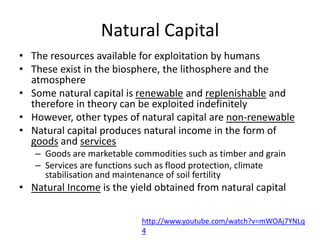
Natural Capital
• The resources available for exploitation by humans
• These exist in the biosphere, the lithosphere and the
atmosphere
• Some natural capital is renewable and replenishable and
therefore in theory can be exploited indefinitely
• However, other types of natural capital are non-renewable
• Natural capital produces natural income in the form of
goods and services
– Goods are marketable commodities such as timber and grain
– Services are functions such as flood protection, climate
stabilisation and maintenance of soil fertility
• Natural Income is the yield obtained from natural capital
http://www.youtube.com/watch?v=mWOAj7YNLq
4
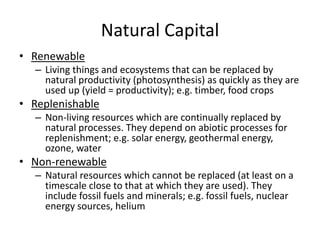
Natural Capital
• Renewable
– Living things and ecosystems that can be replaced by
natural productivity (photosynthesis) as quickly as they are
used up (yield = productivity); e.g. timber, food crops
• Replenishable
– Non-living resources which are continually replaced by
natural processes. They depend on abiotic processes for
replenishment; e.g. solar energy, geothermal energy,
ozone, water
• Non-renewable
– Natural resources which cannot be replaced (at least on a
timescale close to that at which they are used). They
include fossil fuels and minerals; e.g. fossil fuels, nuclear
energy sources, helium
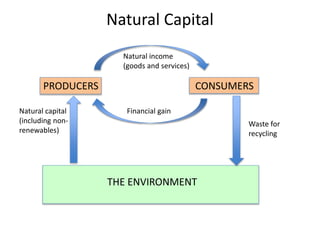
Natural Capital
PRODUCERS CONSUMERS
THE ENVIRONMENT
Waste for
recycling
Natural capital
(including non-
renewables)
Natural income
(goods and services)
Financial gain
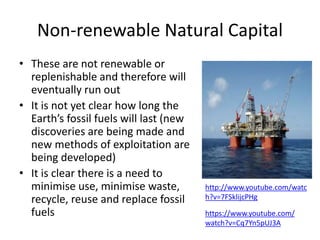
Non-renewable Natural Capital
• These are not renewable or
replenishable and therefore will
eventually run out
• It is not yet clear how long the
Earth’s fossil fuels will last (new
discoveries are being made and
new methods of exploitation are
being developed)
• It is clear there is a need to
minimise use, minimise waste,
recycle, reuse and replace fossil
fuels
http://www.youtube.com/watc
h?v=7FSklijcPHg
https://www.youtube.com/
watch?v=Cq7Yn5pUJ3A
Environmental Philosophies
• Technocentric
– A view that shortages of natural capital will always be
overcome by advances in technology
– Tends to predominate in MEDCs (where people are more
remote from nature)
• Ecocentric
– A view that shortages in natural capital are best approached
by limiting the use of non-renewable resources and switching
to renewables
– Tends to predominate in LEDCs (where people are in closer
contact with nature)
The Dynamic Nature of Natural Capital
• The value and status of natural capital changes over
time (it is dynamic)
• As new technologies are developed, resources which
once had little value may become valuable
commodities (e.g. before the advent of the combustion
engine oil (bitumen) was used primarily only as
waterproofing for houses and boats; before the nuclear
age uranium was not seen as having value)
• Conversely, as old technologies are superseded,
resources may also lose their value (e.g. flint used to
make stone axes was superseded when metal tools
were developed)
The Intrinsic Value of Natural Capital
• Economic value
– The monetary value gained by producers and paid by
consumers
• Ecological value
– Services provided by nature independently of economic
value (e.g. prevention of soil erosion, carbon sequestration
and oxygen production by photosynthesis, nitrogen fixation)
• Aesthetic value
– The appreciation of the beauty of nature
• Recreational value
– Holiday destinations and places to relax or use for sports etc.
http://edroness.blogspot.mx/2013/10/putting-value-on-nature.html
The Intrinsic Value of Natural Capital
• Consumptive use
– Harvesting (timber, crops, animals, medicines etc.)
• Non-consumptive use
– Recreational use and cultural activities
• Indirect use
– Benefits provided by the ecosystem itself (water filtration,
prevention of erosion etc.)
• Optional use
– Potential future use – by your generation (option value), or
future generations (bequest value)
• Non-use (existence use)
– Aesthetic value
There is a lot of debate about how we can find ways to give value to nature. You could
argue it is actually impossible
http://www.youtube.com/watch?v=2zuJdY_Wrng
Sustainability
• Sustainability
– The use and management of resources that allows
their full natural replacement and full recovery of the
ecosystem afterwards
(IB ESS guide)
• Sustainable Development
– ‘Development that meets the needs of the present
without compromising the ability of future
generations to meet their own needs’
(UN World Commission on Environment and Development)
Sustainability
• The rate at which replenishable and
renewable natural capital may be exploited to
allow regeneration
• Long-term harvesting or release of pollution
should not exceed rates of natural capital
regeneration
• During processing to produce goods,
sustainability should be applied at each level
of the supply chain
http://www.youtube.com/watch?v=bmnWIOgc39k
http://www.youtube.com/watch?v=_5r4loXPyx8
Sustainable Development
• This concept incorporates economic and social
factors together with time
• The problem is that your idea of what sustainable
development is changes with your viewpoint. An
economist’s idea of it would be different to an
environmentalist’s (some might actually argue
that sustainability and development are actually
contradictions in terms)
Sustainable Development
• Not-possible?
– People are not prepared to accept a reduction in their standard of
living
– Non-renewable resources are running out
– LEDCs are home to 80% of the world’s population and are using
increasing amounts of natural capital
– The oil lobby is very powerful (especially in the U.S.)
– Some problems are local in nature while others are global
• Possible?
– Use of renewable resources is increasing
– Renewable technologies are become cheaper and more accepted
– We may have no choice in the future but to embrace an economy
based on renewable and replenishable resources
The choices we make are largely dependent on our environmental philosophies
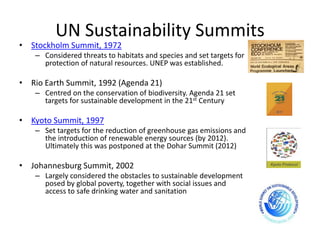
UN Sustainability Summits
• Stockholm Summit, 1972
– Considered threats to habitats and species and set targets for
protection of natural resources. UNEP was established.
• Rio Earth Summit, 1992 (Agenda 21)
– Centred on the conservation of biodiversity. Agenda 21 set
targets for sustainable development in the 21st Century
• Kyoto Summit, 1997
– Set targets for the reduction of greenhouse gas emissions and
the introduction of renewable energy sources (by 2012).
Ultimately this was postponed at the Dohar Summit (2012)
• Johannesburg Summit, 2002
– Largely considered the obstacles to sustainable development
posed by global poverty, together with social issues and
access to safe drinking water and sanitation
Environmental Impact Assessments (EIAs)
• These became law in the US in 1969 and are
being increasingly used around the world
• They are a method of predicting possible impacts
on the environment prior to any major project,
and helps to decide if it should go ahead
• In some countries they have legal status, in
others they just supply information for decision-
making (in some they may be ignored in favour of
economic benefits)
Environmental Impact Assessments (EIAs)
• The first stage is always a baseline study to assess the status of the
environment prior to the project
– Habitat types and area
– Species present
– Biodiversity
– List of endangered species
– Hydrology
– Human population and requirements
– Soil types and quality
• The quality of an EIA depends to a large extent on the quality of the
baseline study
• All EIAs are speculative to some extent due to the inherent
complexities of ecosystems
http://edroness.blogspot.mx/
2014/02/environmental-
impact-assessment.html
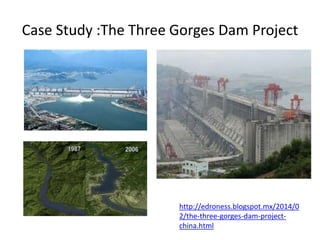
Case Study :The Three Gorges Dam Project
http://edroness.blogspot.mx/2014/0
2/the-three-gorges-dam-project-
china.html
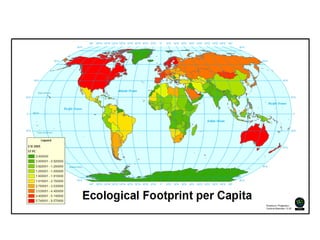
Ecological Footprint
• An ecological footprint is the hypothetical area of land
needed by an individual, group or society to fulfil its
resource needs and assimilate all waste
• An ecological footprint is not necessarily sustainable.
It may refer to an unstable equilibrium
• A country with a total ecological footprint greater than
its available land is in theory living beyond its means (It
has an ecological deficit)
Factors affecting ecological footprint
• A large footprint could be caused by:
– Reliance on fossil fuels
– Increased use of technology (depending on its use)
– High levels of importation
– Large production of carbon waste
– High food consumption
– Meat-rich diets
• Footprint could be reduced by:
– Reduced resource consumption
– Recycling and reuse of resources
– Improved efficiency of resource use
– Reduced pollution
– Exportation of waste
– Use of technology (to increase carrying capacity and efficiency of land use)
– Reduced population
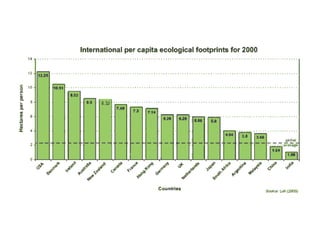
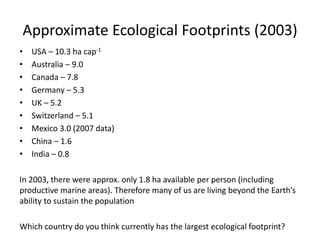
Approximate Ecological Footprints (2003)
• USA – 10.3 ha cap-1
• Australia – 9.0
• Canada – 7.8
• Germany – 5.3
• UK – 5.2
• Switzerland – 5.1
• Mexico 3.0 (2007 data)
• China – 1.6
• India – 0.8
In 2003, there were approx. only 1.8 ha available per person (including
productive marine areas). Therefore many of us are living beyond the Earth’s
ability to sustain the population
Which country do you think currently has the largest ecological footprint?
Questions
1. Define the term Natural Capital
2. Define the terms Renewable, Replenishable
and Non-renewable
3. Explain why resources can be considered to
be dynamic in nature
4. Discuss the concept of sustainable
development
5. Discuss two opposing environmental
philosophies

Summary of topic 1.4

  • 1.
    Topic 1 Foundations ofEnvironmental Systems and Societies 1.4 Sustainability
  • 2.
    Natural Capital • Theresources available for exploitation by humans • These exist in the biosphere, the lithosphere and the atmosphere • Some natural capital is renewable and replenishable and therefore in theory can be exploited indefinitely • However, other types of natural capital are non-renewable • Natural capital produces natural income in the form of goods and services – Goods are marketable commodities such as timber and grain – Services are functions such as flood protection, climate stabilisation and maintenance of soil fertility • Natural Income is the yield obtained from natural capital http://www.youtube.com/watch?v=mWOAj7YNLq 4
  • 3.
    Natural Capital • Renewable –Living things and ecosystems that can be replaced by natural productivity (photosynthesis) as quickly as they are used up (yield = productivity); e.g. timber, food crops • Replenishable – Non-living resources which are continually replaced by natural processes. They depend on abiotic processes for replenishment; e.g. solar energy, geothermal energy, ozone, water • Non-renewable – Natural resources which cannot be replaced (at least on a timescale close to that at which they are used). They include fossil fuels and minerals; e.g. fossil fuels, nuclear energy sources, helium
  • 4.
    Natural Capital PRODUCERS CONSUMERS THEENVIRONMENT Waste for recycling Natural capital (including non- renewables) Natural income (goods and services) Financial gain
  • 5.
    Non-renewable Natural Capital •These are not renewable or replenishable and therefore will eventually run out • It is not yet clear how long the Earth’s fossil fuels will last (new discoveries are being made and new methods of exploitation are being developed) • It is clear there is a need to minimise use, minimise waste, recycle, reuse and replace fossil fuels http://www.youtube.com/watc h?v=7FSklijcPHg https://www.youtube.com/ watch?v=Cq7Yn5pUJ3A
  • 6.
    Environmental Philosophies • Technocentric –A view that shortages of natural capital will always be overcome by advances in technology – Tends to predominate in MEDCs (where people are more remote from nature) • Ecocentric – A view that shortages in natural capital are best approached by limiting the use of non-renewable resources and switching to renewables – Tends to predominate in LEDCs (where people are in closer contact with nature)
  • 7.
    The Dynamic Natureof Natural Capital • The value and status of natural capital changes over time (it is dynamic) • As new technologies are developed, resources which once had little value may become valuable commodities (e.g. before the advent of the combustion engine oil (bitumen) was used primarily only as waterproofing for houses and boats; before the nuclear age uranium was not seen as having value) • Conversely, as old technologies are superseded, resources may also lose their value (e.g. flint used to make stone axes was superseded when metal tools were developed)
  • 8.
    The Intrinsic Valueof Natural Capital • Economic value – The monetary value gained by producers and paid by consumers • Ecological value – Services provided by nature independently of economic value (e.g. prevention of soil erosion, carbon sequestration and oxygen production by photosynthesis, nitrogen fixation) • Aesthetic value – The appreciation of the beauty of nature • Recreational value – Holiday destinations and places to relax or use for sports etc. http://edroness.blogspot.mx/2013/10/putting-value-on-nature.html
  • 9.
    The Intrinsic Valueof Natural Capital • Consumptive use – Harvesting (timber, crops, animals, medicines etc.) • Non-consumptive use – Recreational use and cultural activities • Indirect use – Benefits provided by the ecosystem itself (water filtration, prevention of erosion etc.) • Optional use – Potential future use – by your generation (option value), or future generations (bequest value) • Non-use (existence use) – Aesthetic value There is a lot of debate about how we can find ways to give value to nature. You could argue it is actually impossible http://www.youtube.com/watch?v=2zuJdY_Wrng
  • 10.
    Sustainability • Sustainability – Theuse and management of resources that allows their full natural replacement and full recovery of the ecosystem afterwards (IB ESS guide) • Sustainable Development – ‘Development that meets the needs of the present without compromising the ability of future generations to meet their own needs’ (UN World Commission on Environment and Development)
  • 11.
    Sustainability • The rateat which replenishable and renewable natural capital may be exploited to allow regeneration • Long-term harvesting or release of pollution should not exceed rates of natural capital regeneration • During processing to produce goods, sustainability should be applied at each level of the supply chain http://www.youtube.com/watch?v=bmnWIOgc39k http://www.youtube.com/watch?v=_5r4loXPyx8
  • 12.
    Sustainable Development • Thisconcept incorporates economic and social factors together with time • The problem is that your idea of what sustainable development is changes with your viewpoint. An economist’s idea of it would be different to an environmentalist’s (some might actually argue that sustainability and development are actually contradictions in terms)
  • 13.
    Sustainable Development • Not-possible? –People are not prepared to accept a reduction in their standard of living – Non-renewable resources are running out – LEDCs are home to 80% of the world’s population and are using increasing amounts of natural capital – The oil lobby is very powerful (especially in the U.S.) – Some problems are local in nature while others are global • Possible? – Use of renewable resources is increasing – Renewable technologies are become cheaper and more accepted – We may have no choice in the future but to embrace an economy based on renewable and replenishable resources The choices we make are largely dependent on our environmental philosophies
  • 14.
    UN Sustainability Summits •Stockholm Summit, 1972 – Considered threats to habitats and species and set targets for protection of natural resources. UNEP was established. • Rio Earth Summit, 1992 (Agenda 21) – Centred on the conservation of biodiversity. Agenda 21 set targets for sustainable development in the 21st Century • Kyoto Summit, 1997 – Set targets for the reduction of greenhouse gas emissions and the introduction of renewable energy sources (by 2012). Ultimately this was postponed at the Dohar Summit (2012) • Johannesburg Summit, 2002 – Largely considered the obstacles to sustainable development posed by global poverty, together with social issues and access to safe drinking water and sanitation
  • 15.
    Environmental Impact Assessments(EIAs) • These became law in the US in 1969 and are being increasingly used around the world • They are a method of predicting possible impacts on the environment prior to any major project, and helps to decide if it should go ahead • In some countries they have legal status, in others they just supply information for decision- making (in some they may be ignored in favour of economic benefits)
  • 16.
    Environmental Impact Assessments(EIAs) • The first stage is always a baseline study to assess the status of the environment prior to the project – Habitat types and area – Species present – Biodiversity – List of endangered species – Hydrology – Human population and requirements – Soil types and quality • The quality of an EIA depends to a large extent on the quality of the baseline study • All EIAs are speculative to some extent due to the inherent complexities of ecosystems http://edroness.blogspot.mx/ 2014/02/environmental- impact-assessment.html
  • 17.
    Case Study :TheThree Gorges Dam Project http://edroness.blogspot.mx/2014/0 2/the-three-gorges-dam-project- china.html
  • 18.
    Ecological Footprint • Anecological footprint is the hypothetical area of land needed by an individual, group or society to fulfil its resource needs and assimilate all waste • An ecological footprint is not necessarily sustainable. It may refer to an unstable equilibrium • A country with a total ecological footprint greater than its available land is in theory living beyond its means (It has an ecological deficit)
  • 19.
    Factors affecting ecologicalfootprint • A large footprint could be caused by: – Reliance on fossil fuels – Increased use of technology (depending on its use) – High levels of importation – Large production of carbon waste – High food consumption – Meat-rich diets • Footprint could be reduced by: – Reduced resource consumption – Recycling and reuse of resources – Improved efficiency of resource use – Reduced pollution – Exportation of waste – Use of technology (to increase carrying capacity and efficiency of land use) – Reduced population
  • 22.
    Approximate Ecological Footprints(2003) • USA – 10.3 ha cap-1 • Australia – 9.0 • Canada – 7.8 • Germany – 5.3 • UK – 5.2 • Switzerland – 5.1 • Mexico 3.0 (2007 data) • China – 1.6 • India – 0.8 In 2003, there were approx. only 1.8 ha available per person (including productive marine areas). Therefore many of us are living beyond the Earth’s ability to sustain the population Which country do you think currently has the largest ecological footprint?
  • 23.
    Questions 1. Define theterm Natural Capital 2. Define the terms Renewable, Replenishable and Non-renewable 3. Explain why resources can be considered to be dynamic in nature 4. Discuss the concept of sustainable development 5. Discuss two opposing environmental philosophies