Energy Flow in Ecosystem
And
Statistical Ecology
Presentation on
Presented by
Eftekharul Alam Emon
Agenda
01 02
03 04
Ecology Ecosystem
Flow of
energy in
Ecosystem
Statistical
Ecology
Ecology – Definition and Concept
• The term ‘Ecology’ was first proposed by the German Zoologist Ernst
Haeckel in 1869
• The word ‘Ecology’ is derived from two Greek words ‘Oikos’ which means
house or habitat, and ‘Logos’ which means study or knowledge
• Ecology is the study of relationships between living organisms to their
physical environment
• Also the study of inter-relationship between biotic and abiotic
components.
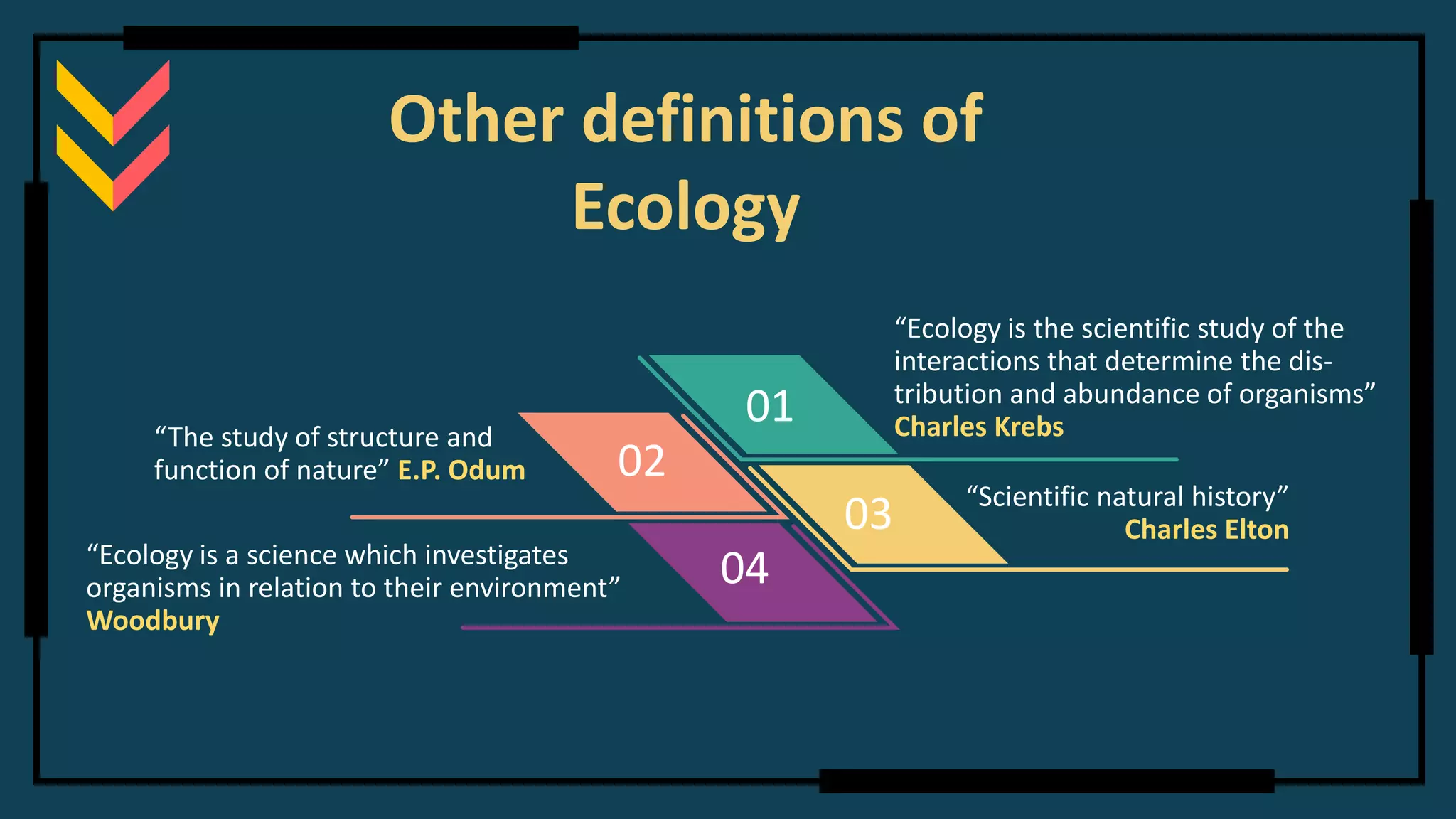
“Ecology is the scientific study of the
interactions that determine the dis-
tribution and abundance of organisms”
Charles Krebs
“Scientific natural history”
Charles Elton
“The study of structure and
function of nature” E.P. Odum
“Ecology is a science which investigates
organisms in relation to their environment”
Woodbury
02
01
04
03
Other definitions of
Ecology
ECOSYSTEM
• Ecosystem is the community of living organisms in an area
• Living organism interact among themselves and with the surrounding
physical environment
• Organisms interact with the physical factors as a Dynamic System
• It is the functional unit of nature
• Structure of Ecosystems: An Ecosystem has two components:
(1) Biotic components, and
(2) Abiotic components.
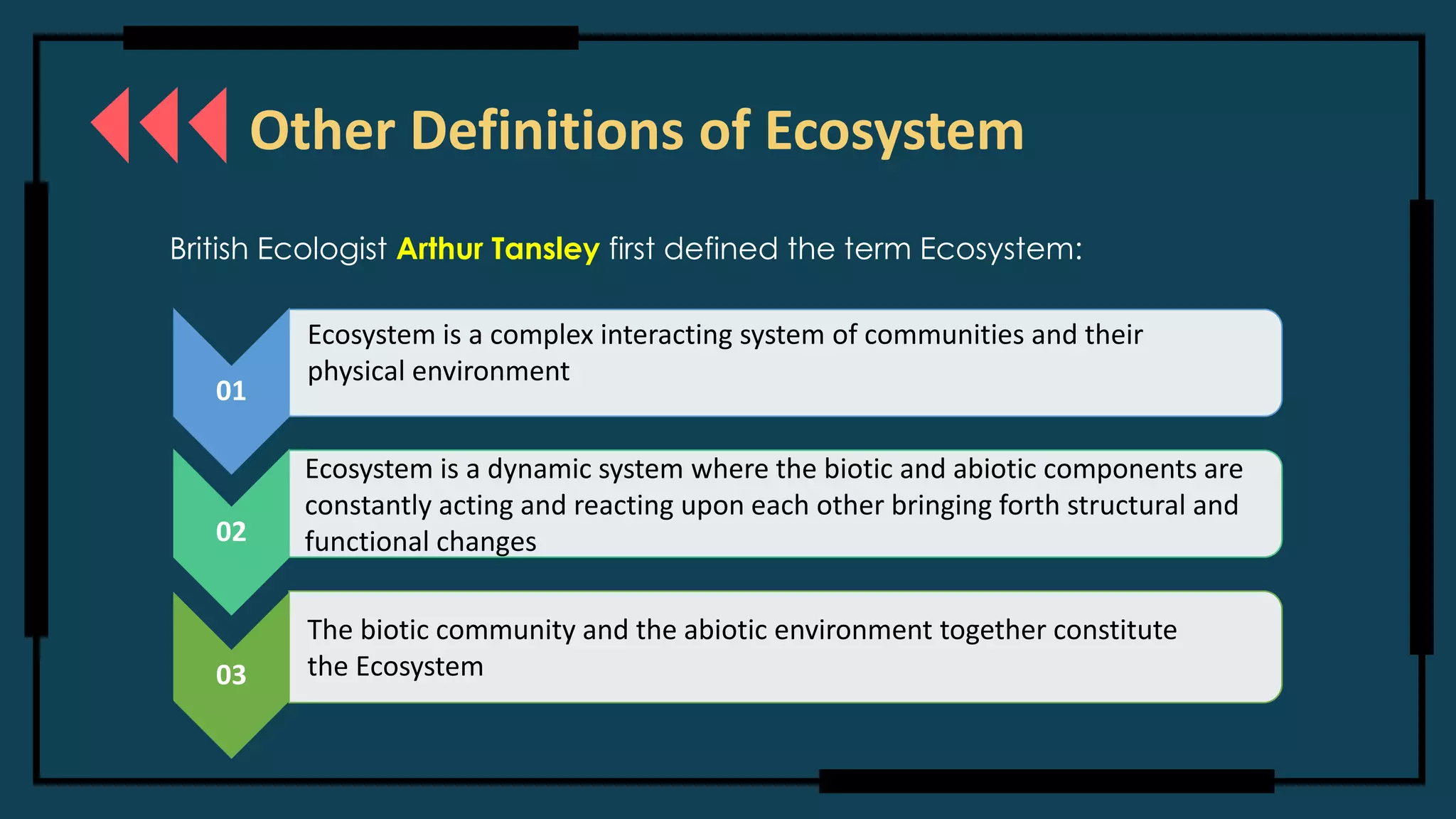
Other Definitions of Ecosystem
01
02
03
British Ecologist Arthur Tansley first defined the term Ecosystem:
Ecosystem is a complex interacting system of communities and their
physical environment
Ecosystem is a dynamic system where the biotic and abiotic components are
constantly acting and reacting upon each other bringing forth structural and
functional changes
The biotic community and the abiotic environment together constitute
the Ecosystem
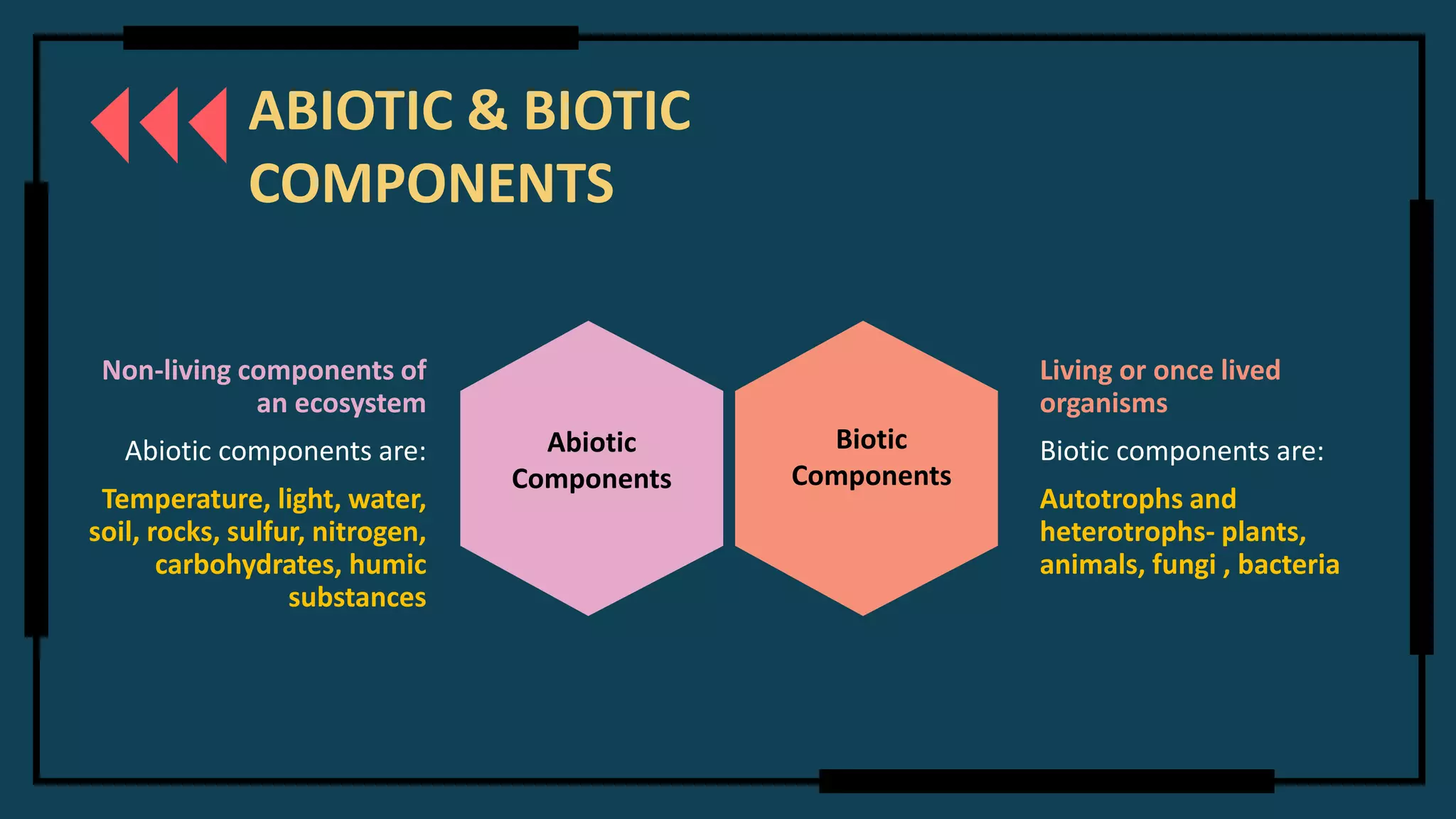
Non-living components of
an ecosystem
Abiotic components are:
Temperature, light, water,
soil, rocks, sulfur, nitrogen,
carbohydrates, humic
substances
Living or once lived
organisms
Biotic components are:
Autotrophs and
heterotrophs- plants,
animals, fungi , bacteria
Abiotic
Components
Biotic
Components
ABIOTIC & BIOTIC
COMPONENTS
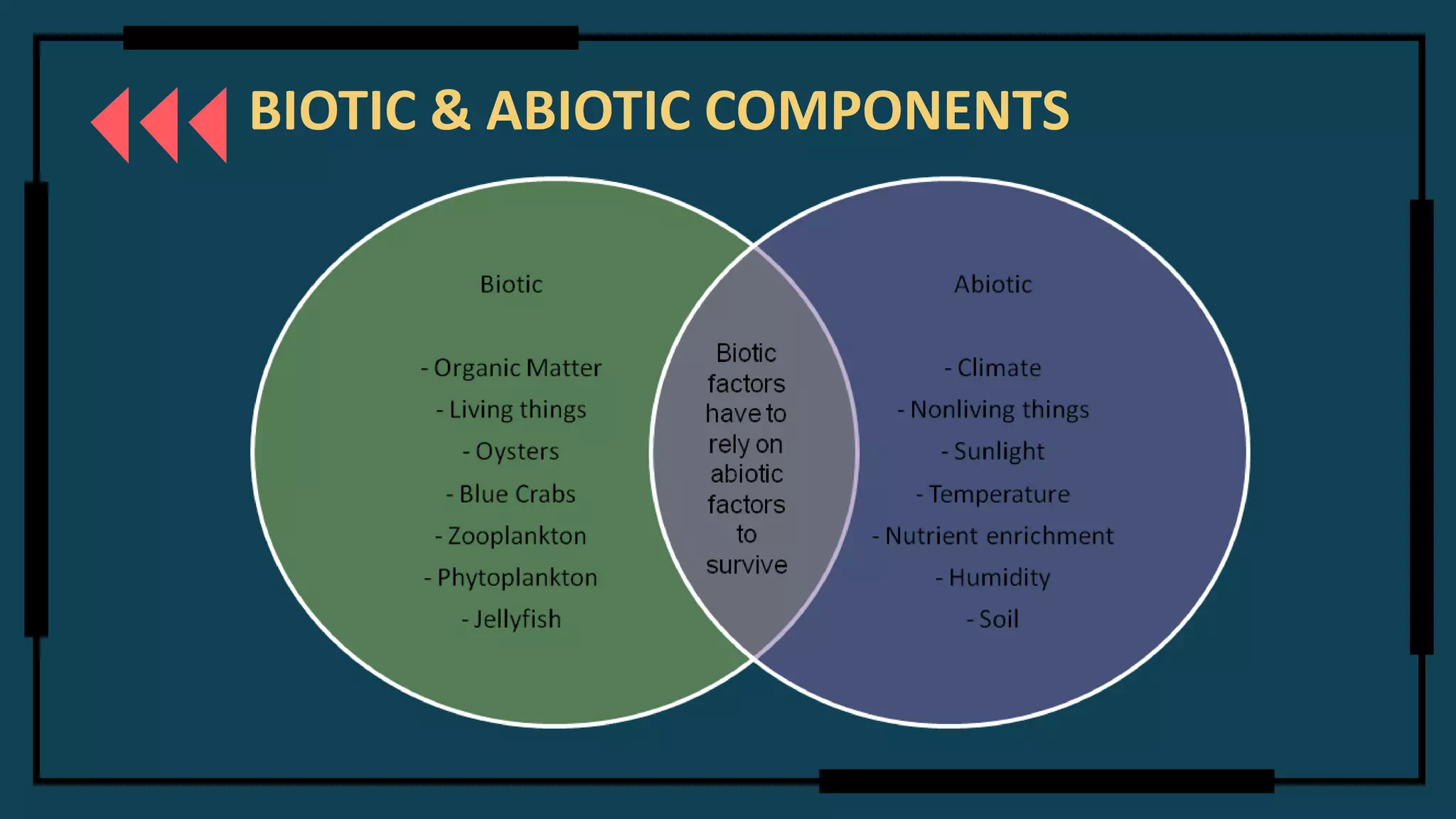
BIOTIC & ABIOTIC COMPONENTS
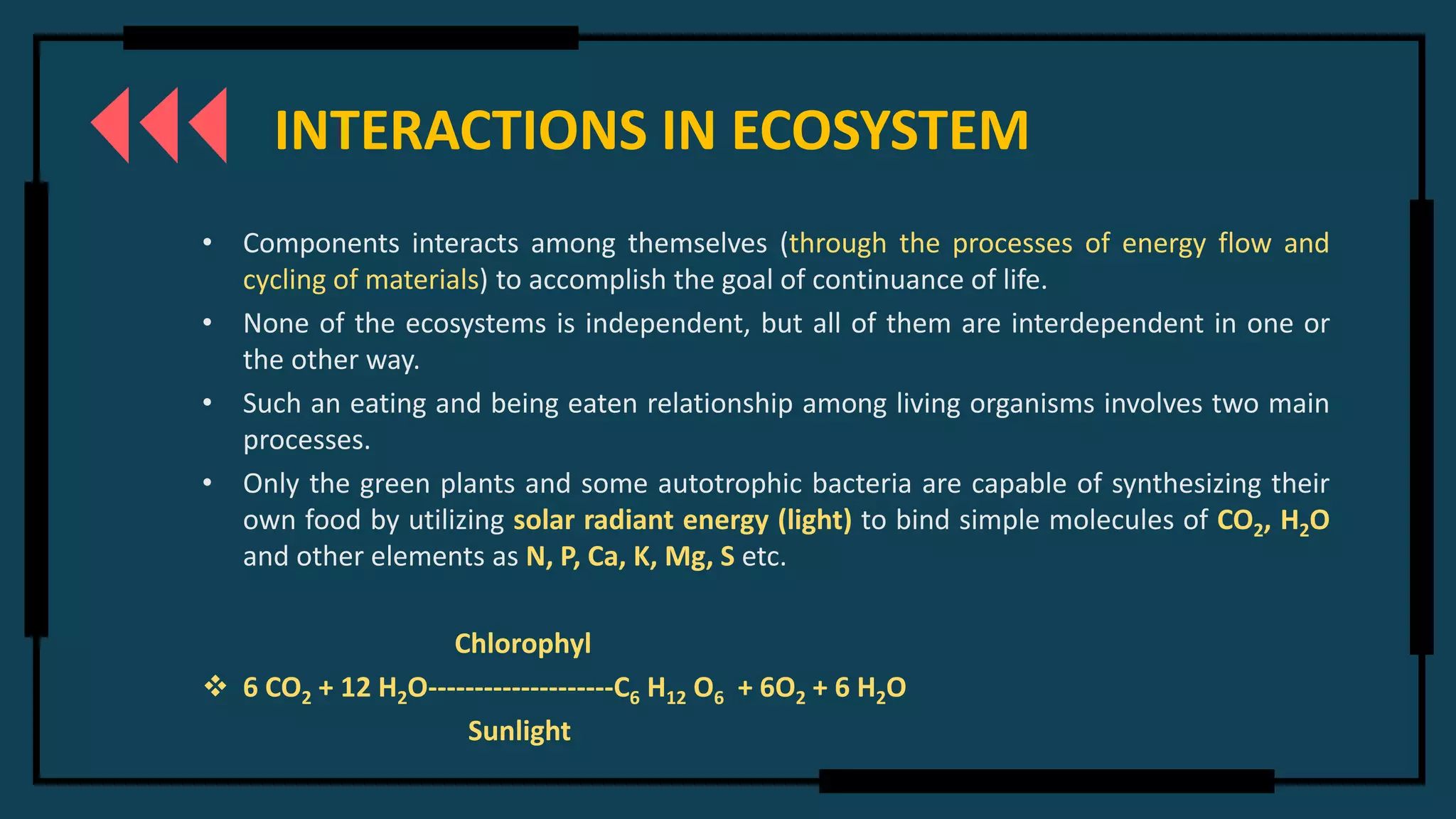
INTERACTIONS IN ECOSYSTEM
• Components interacts among themselves (through the processes of energy flow and
cycling of materials) to accomplish the goal of continuance of life.
• None of the ecosystems is independent, but all of them are interdependent in one or
the other way.
• Such an eating and being eaten relationship among living organisms involves two main
processes.
• Only the green plants and some autotrophic bacteria are capable of synthesizing their
own food by utilizing solar radiant energy (light) to bind simple molecules of CO2, H2O
and other elements as N, P, Ca, K, Mg, S etc.
Chlorophyl
❖ 6 CO2 + 12 H2O--------------------C6 H12 O6 + 6O2 + 6 H2O
Sunlight
ENERGY FLOW IN ECOSYSTEM
FLOW OF ENERGY
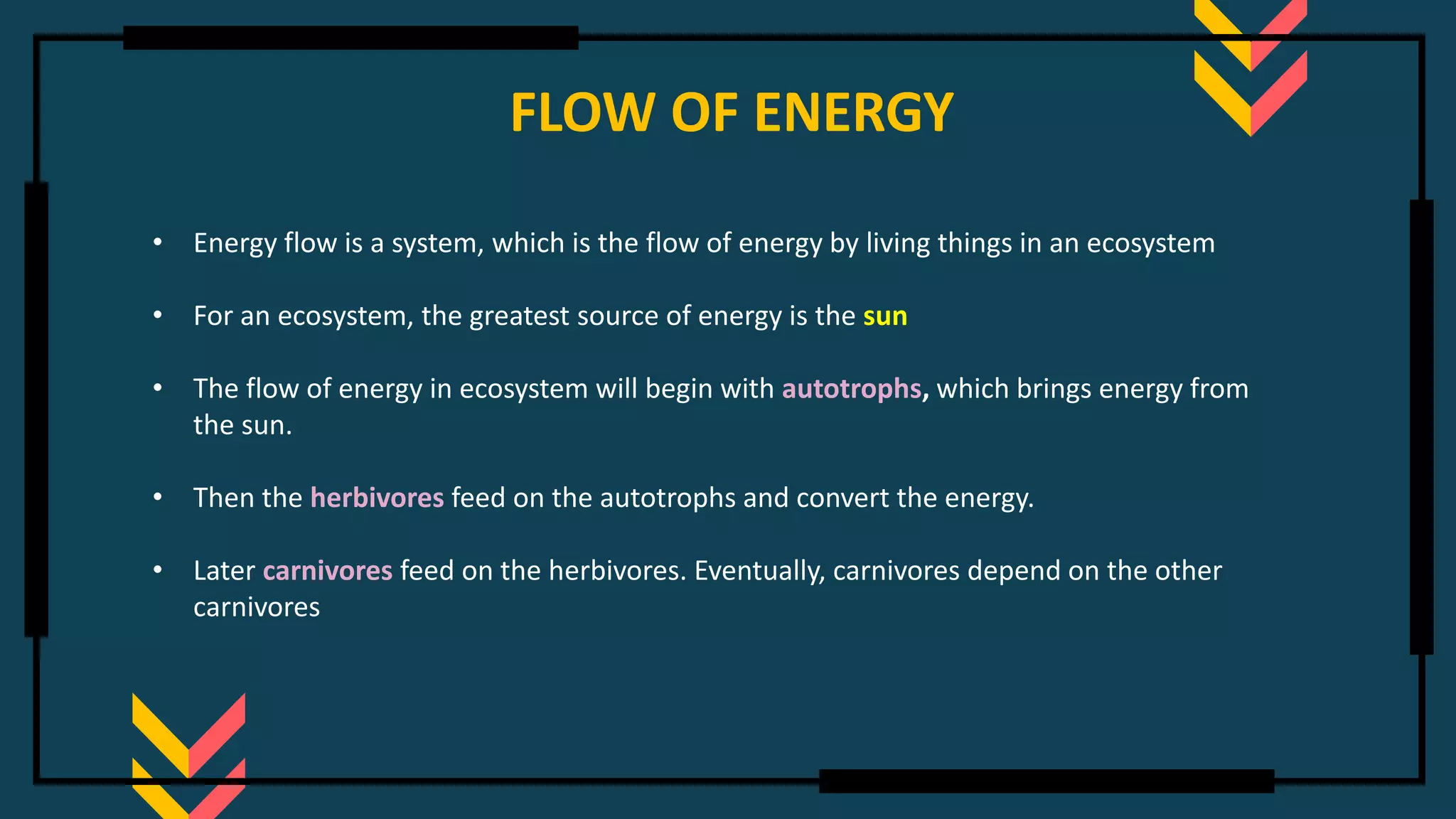
• Energy flow is a system, which is the flow of energy by living things in an ecosystem
• For an ecosystem, the greatest source of energy is the sun
• The flow of energy in ecosystem will begin with autotrophs, which brings energy from
the sun.
• Then the herbivores feed on the autotrophs and convert the energy.
• Later carnivores feed on the herbivores. Eventually, carnivores depend on the other
carnivores
THEORY OF ENERGY FLOW
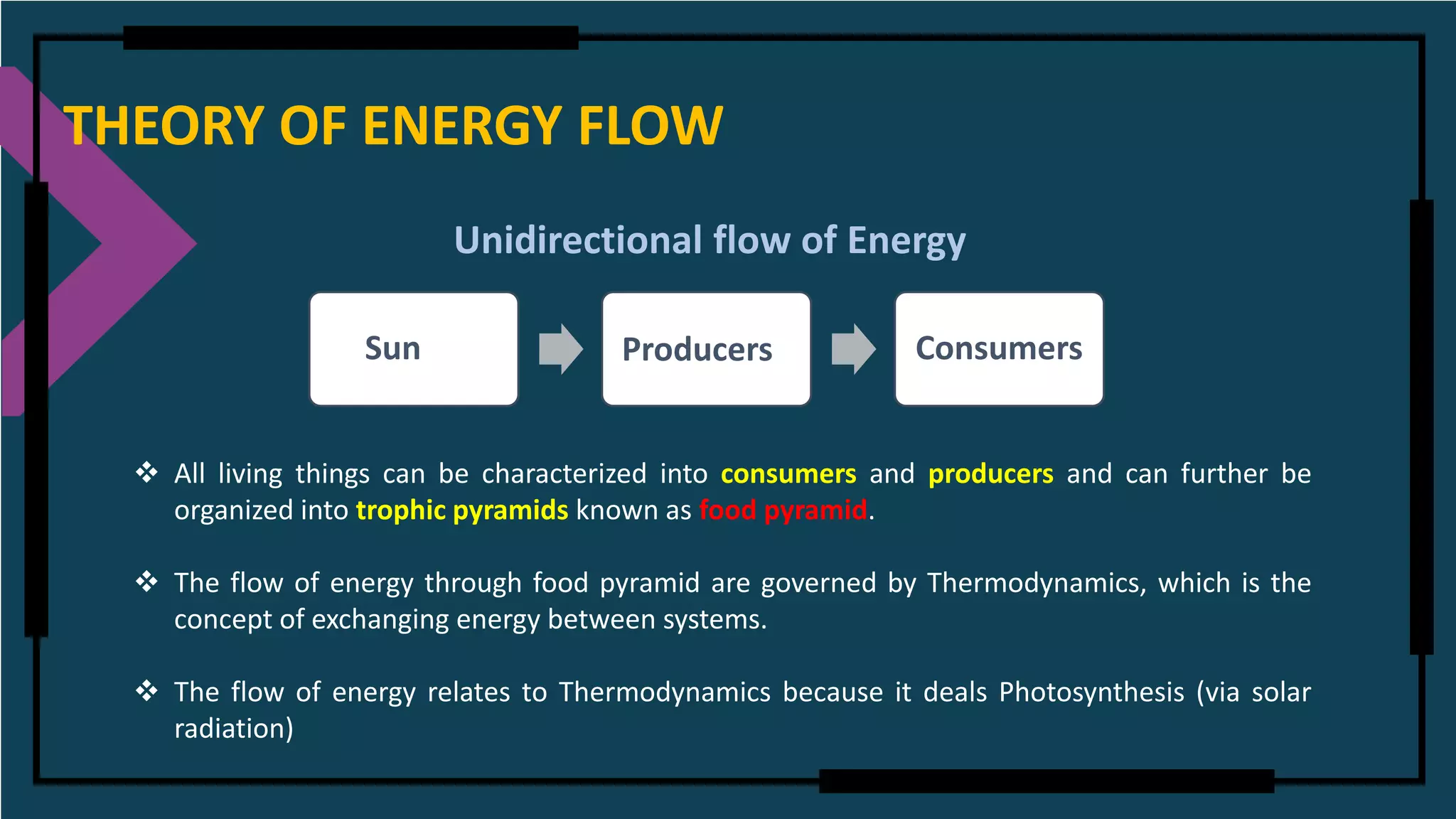
❖ All living things can be characterized into consumers and producers and can further be
organized into trophic pyramids known as food pyramid.
❖ The flow of energy through food pyramid are governed by Thermodynamics, which is the
concept of exchanging energy between systems.
❖ The flow of energy relates to Thermodynamics because it deals Photosynthesis (via solar
radiation)
Sun Producers Consumers
Unidirectional flow of Energy
PHOTOSYNTHESIS
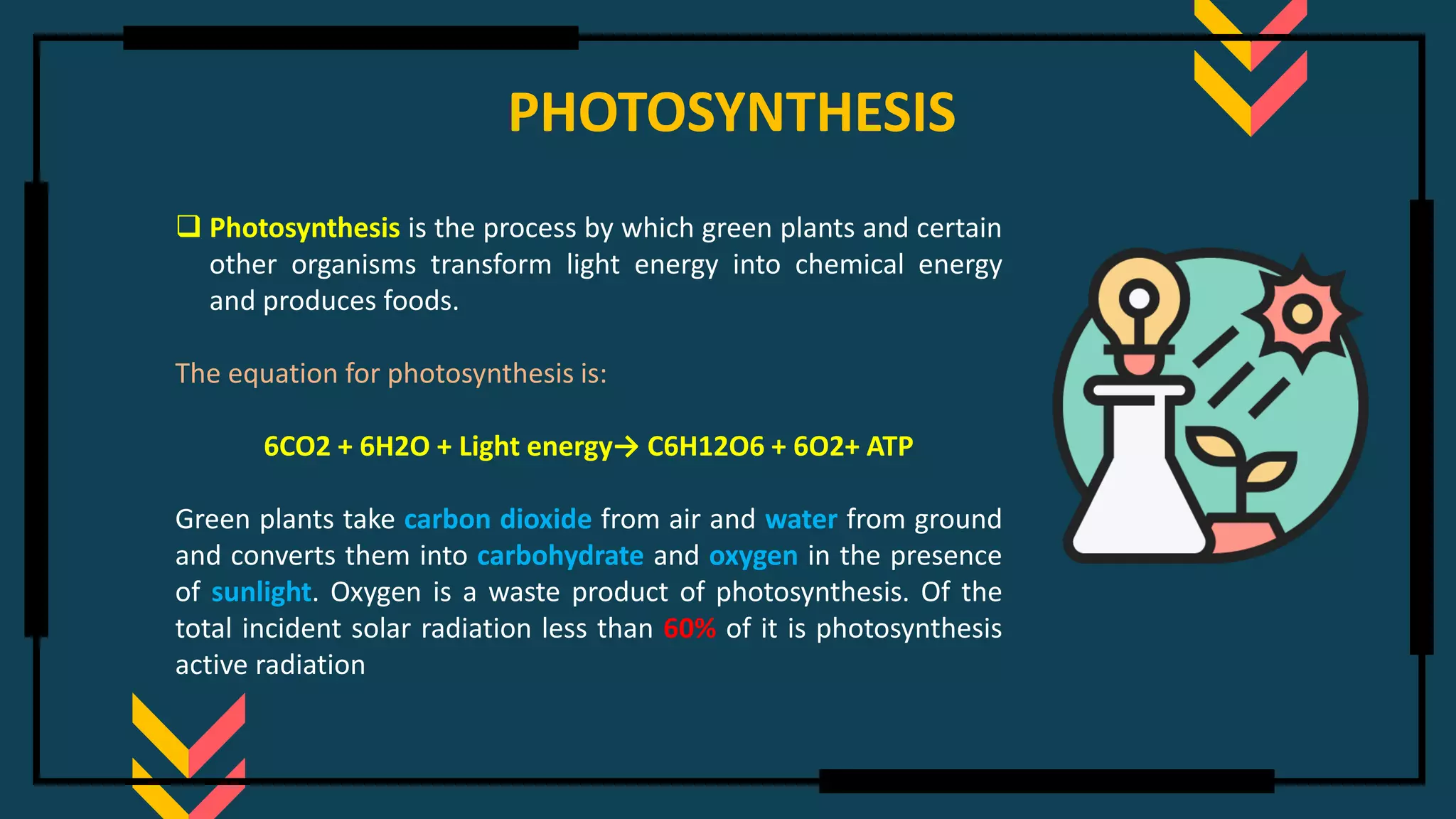
❑ Photosynthesis is the process by which green plants and certain
other organisms transform light energy into chemical energy
and produces foods.
The equation for photosynthesis is:
6CO2 + 6H2O + Light energy→ C6H12O6 + 6O2+ ATP
Green plants take carbon dioxide from air and water from ground
and converts them into carbohydrate and oxygen in the presence
of sunlight. Oxygen is a waste product of photosynthesis. Of the
total incident solar radiation less than 60% of it is photosynthesis
active radiation
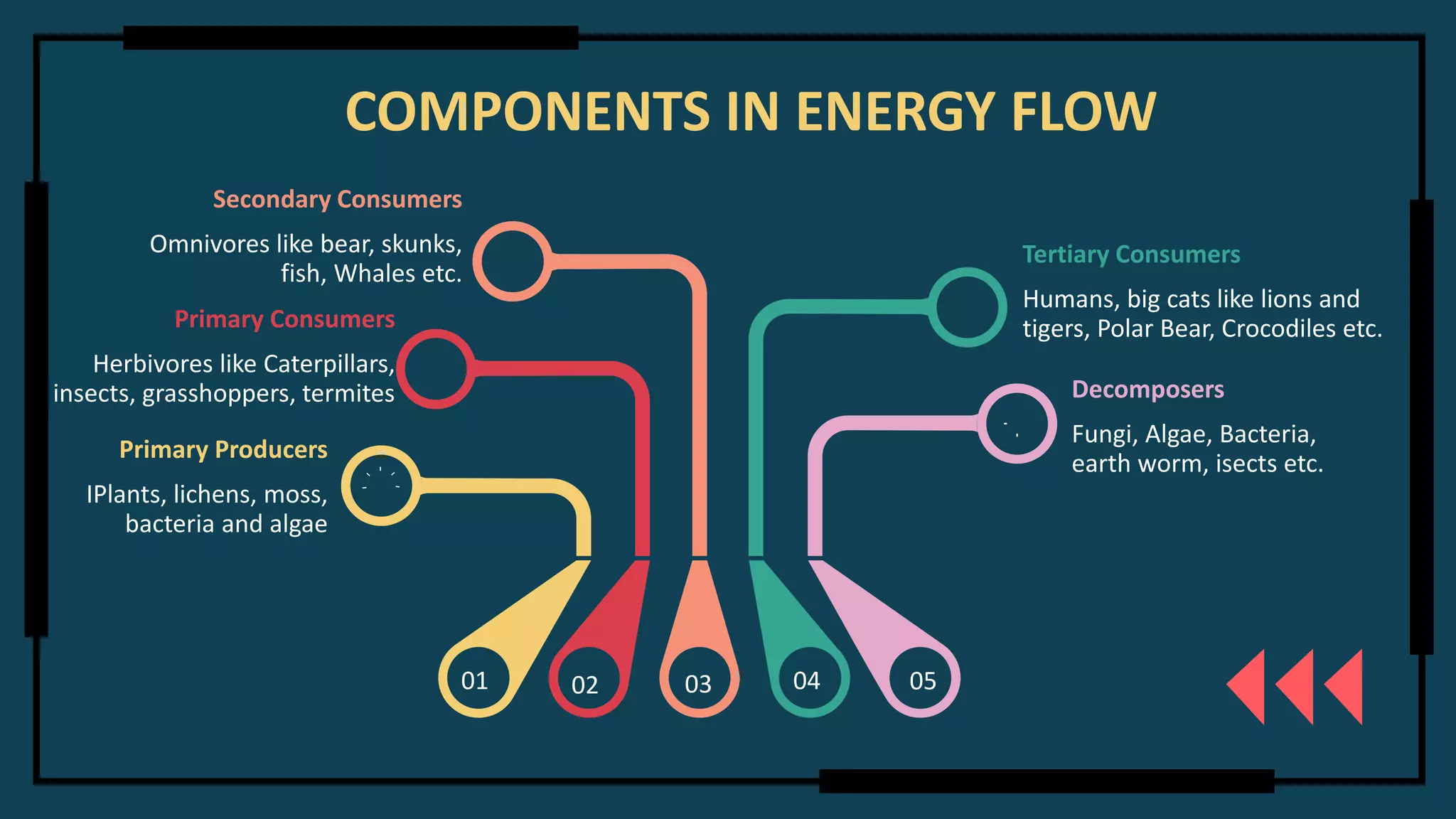
01 02 03 04 05
Primary Producers
IPlants, lichens, moss,
bacteria and algae
Decomposers
Fungi, Algae, Bacteria,
earth worm, isects etc.
Primary Consumers
Herbivores like Caterpillars,
insects, grasshoppers, termites
Secondary Consumers
Omnivores like bear, skunks,
fish, Whales etc.
Tertiary Consumers
Humans, big cats like lions and
tigers, Polar Bear, Crocodiles etc.
COMPONENTS IN ENERGY FLOW
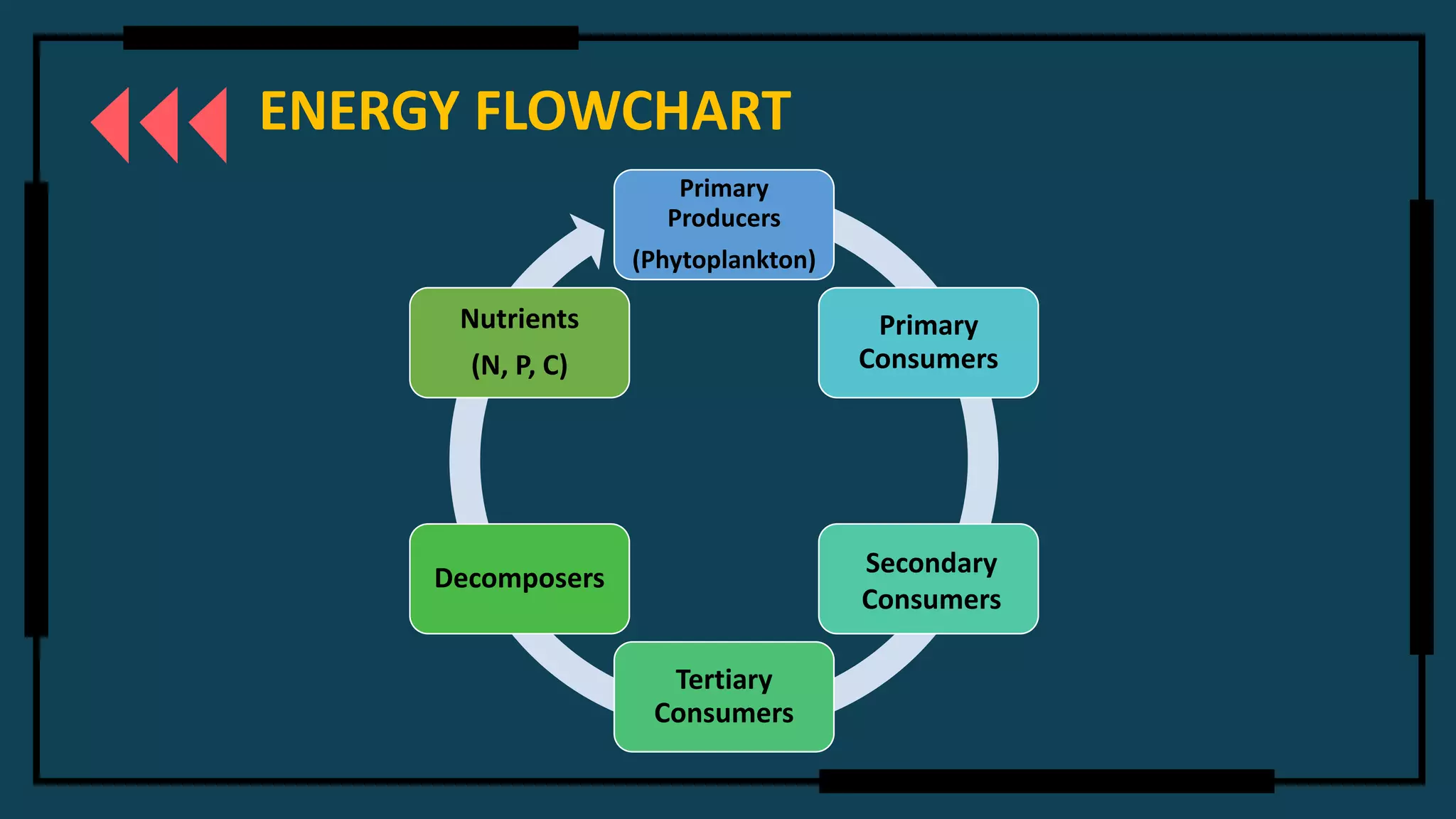
ENERGY FLOWCHART
Primary
Producers
(Phytoplankton)
Primary
Consumers
Tertiary
Consumers
Decomposers
Nutrients
(N, P, C)
Secondary
Consumers
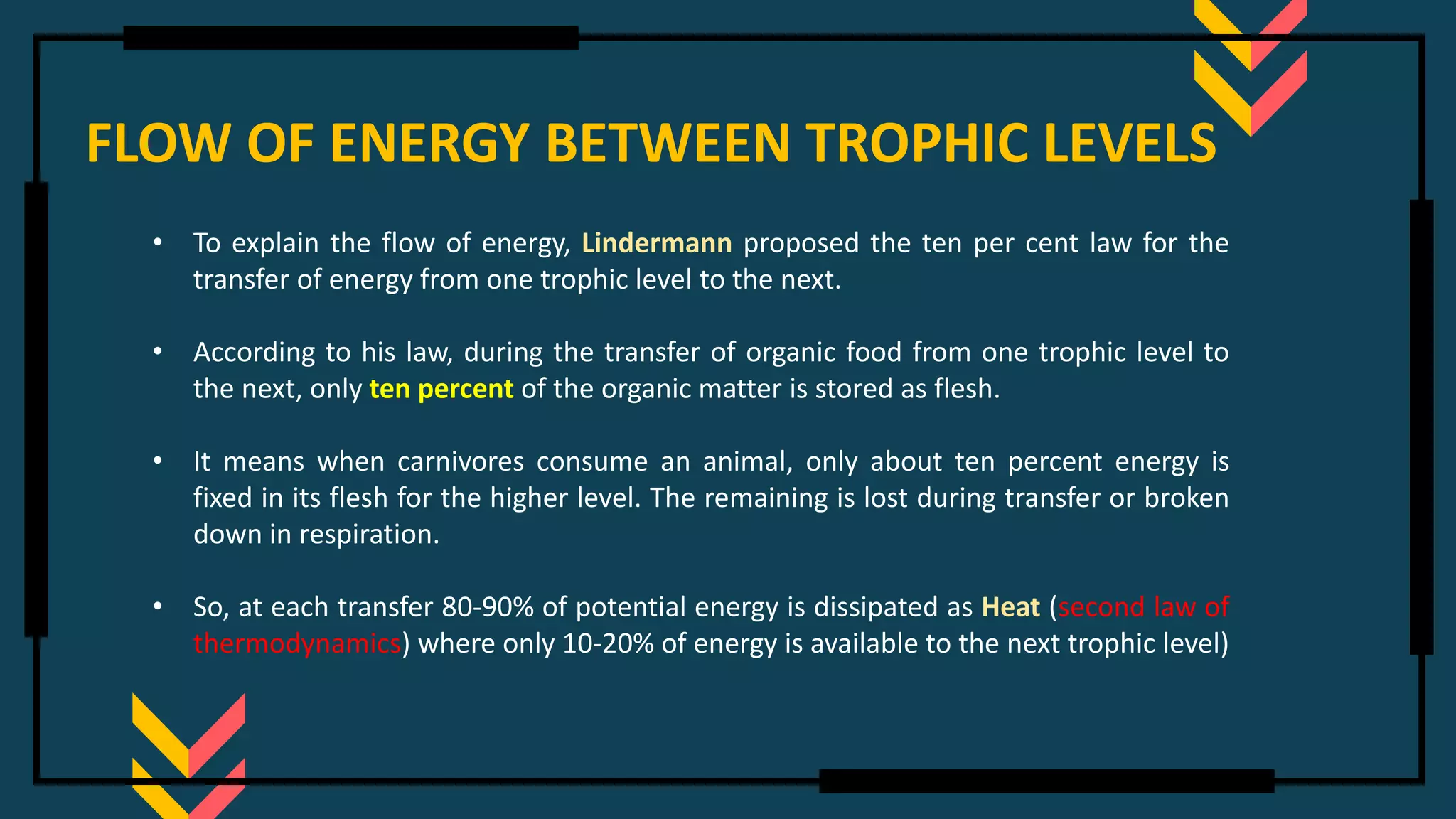
FLOW OF ENERGY BETWEEN TROPHIC LEVELS
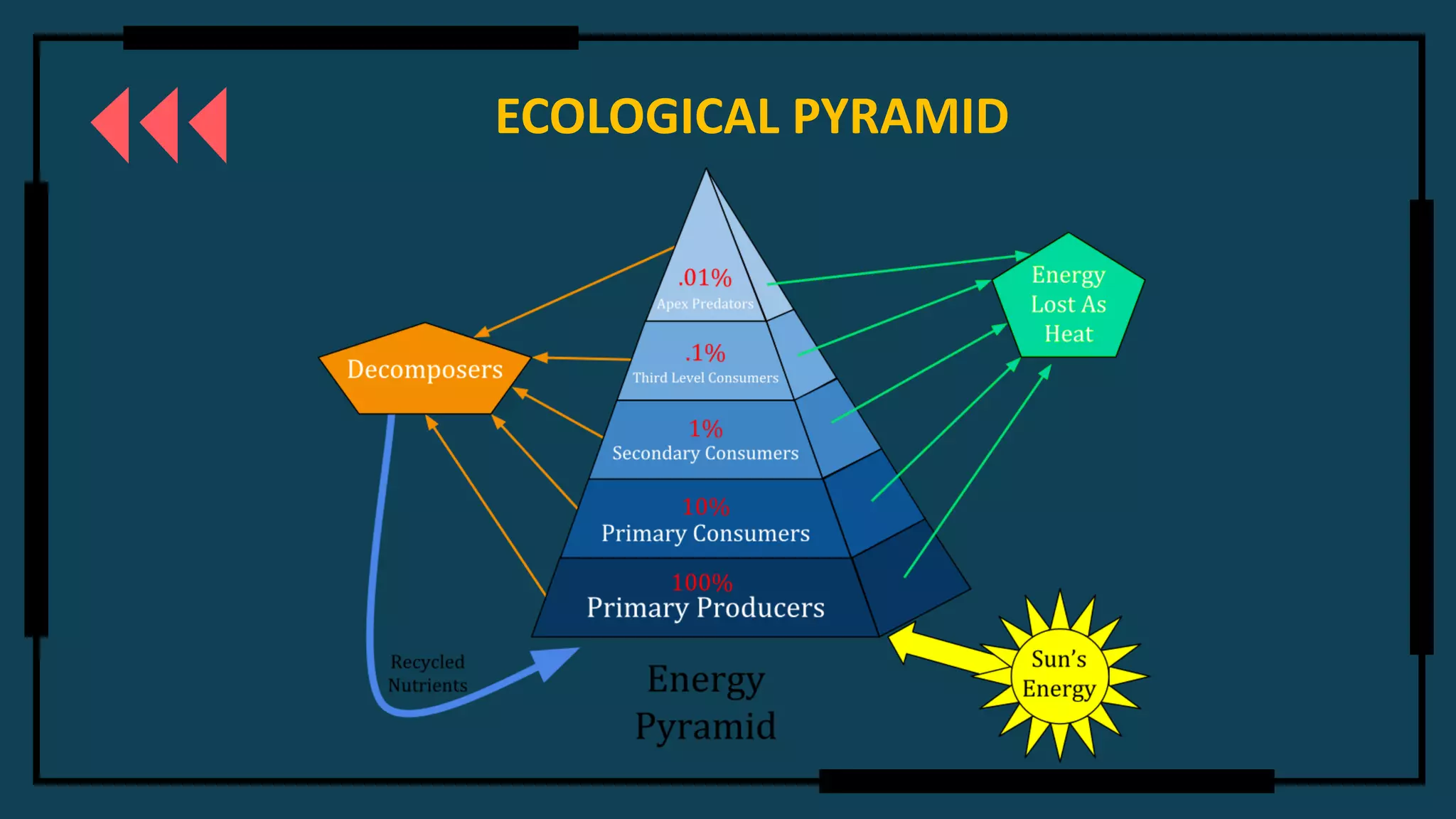
• To explain the flow of energy, Lindermann proposed the ten per cent law for the
transfer of energy from one trophic level to the next.
• According to his law, during the transfer of organic food from one trophic level to
the next, only ten percent of the organic matter is stored as flesh.
• It means when carnivores consume an animal, only about ten percent energy is
fixed in its flesh for the higher level. The remaining is lost during transfer or broken
down in respiration.
• So, at each transfer 80-90% of potential energy is dissipated as Heat (second law of
thermodynamics) where only 10-20% of energy is available to the next trophic level)
The First law of Thermodynamics is applicable to define the
flow of energy
❑ First Law: Energy can neither be created or destroyed, but energy can be transferred
and transformed.
• This solar energy is converted into chemical energy by plants through the
process of photosynthesis
• Only the 1% of the total energy fall on green part of leaves is changed into the
potential energy/heat
• Which states that energy is transferred and transformed in the ecosystem in the
as form of heat and proves the first law of thermodynamics
The Second law of Thermodynamics is applicable to define
the flow of energy
❑ Second Law: Every step of energy transformation and flow through a system=
Gradual loss of the ability to do work
❑ In ecosystems, the biggest losses occur as respiration
❑ At every trophic level, there is decreased in the amount of energy available for
organisms of the next trophic level.
❑ Which states that energy is lost at every step in the ecosystem in the form of
heat and proves the second law of thermodynamics
ECOLOGICAL PYRAMID
STATISTICAL ECOLOGY
Statistical Ecology
• Statistical ecology deals with the development of new methods for analyzing ecological
data
• Advanced statistical models and techniques are often needed to provide robust
analyses of the available data
• Statistical methods were initially developed for use in basic and applied sciences, and
later in engineering and management.
• It is helpful to distinguish between experimental or observational approaches in order
to clarify differences between various types of ecological research.
STAGES OF AN OBSERVATIONAL
ECOLOGY APPROACH
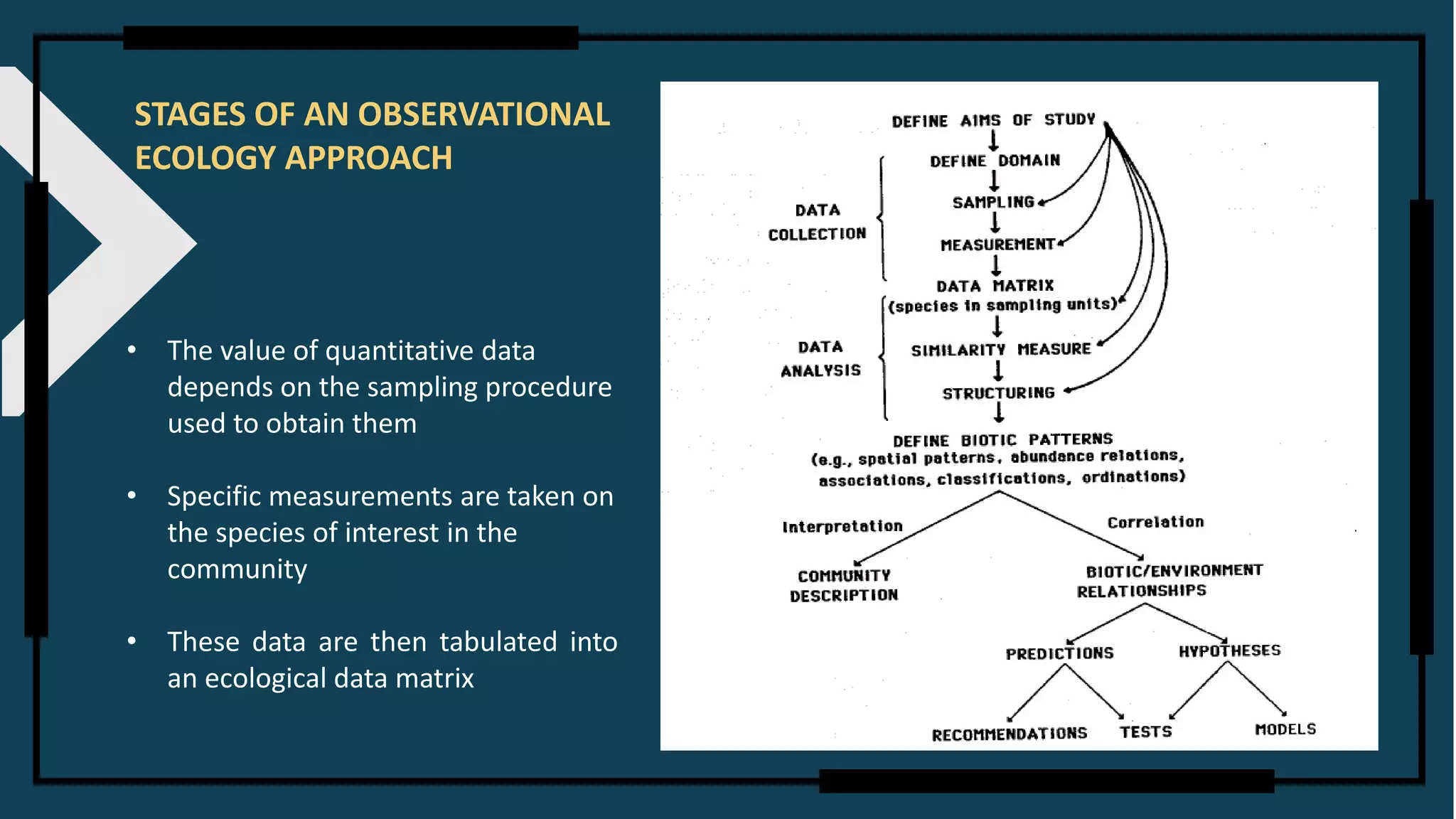
• The value of quantitative data
depends on the sampling procedure
used to obtain them
• Specific measurements are taken on
the species of interest in the
community
• These data are then tabulated into
an ecological data matrix
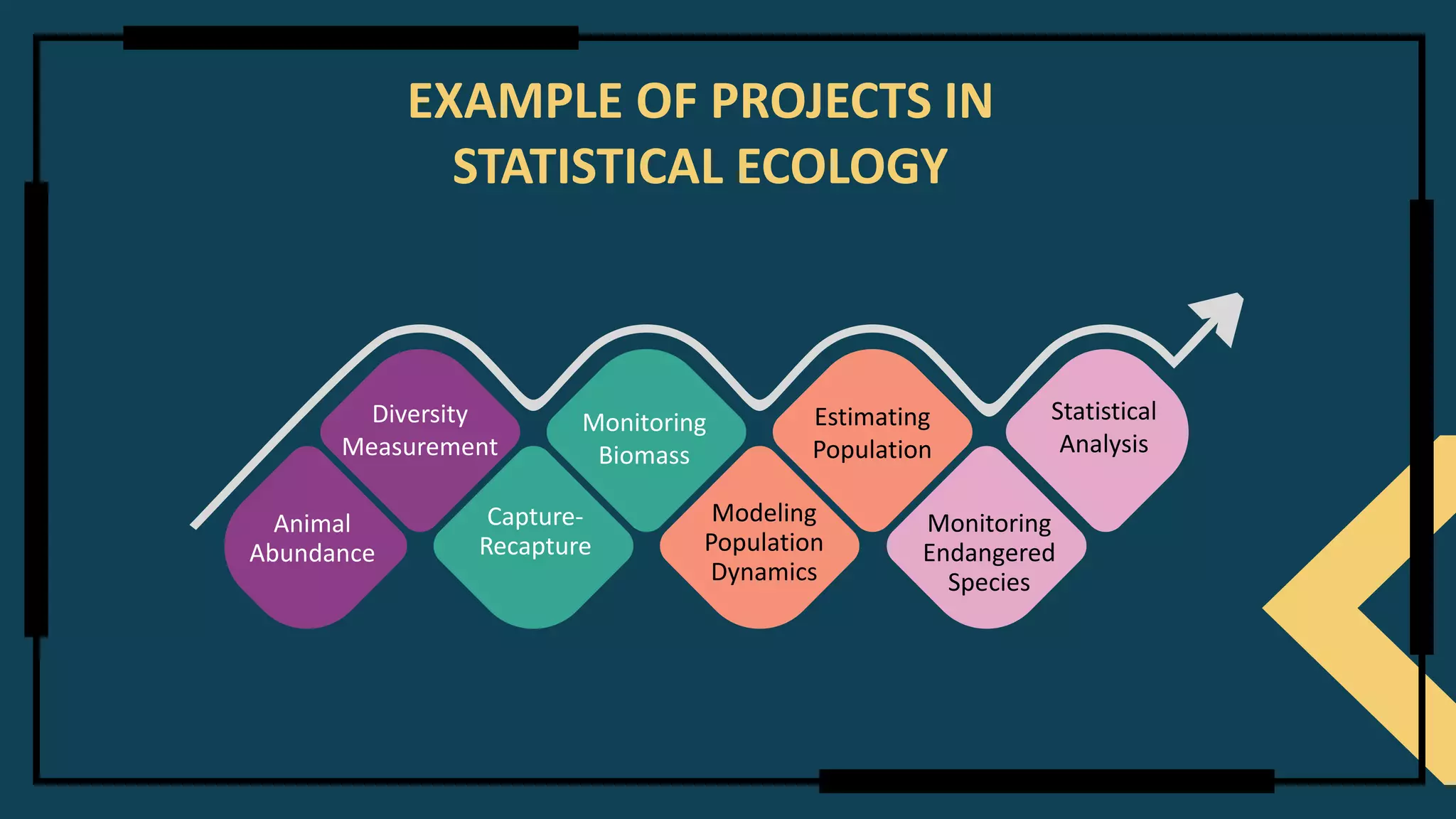
EXAMPLE OF PROJECTS IN
STATISTICAL ECOLOGY
Modeling
Population
Dynamics
Capture-
Recapture
Animal
Abundance
Monitoring
Endangered
Species
Diversity
Measurement
Monitoring
Biomass
Estimating
Population
Statistical
Analysis
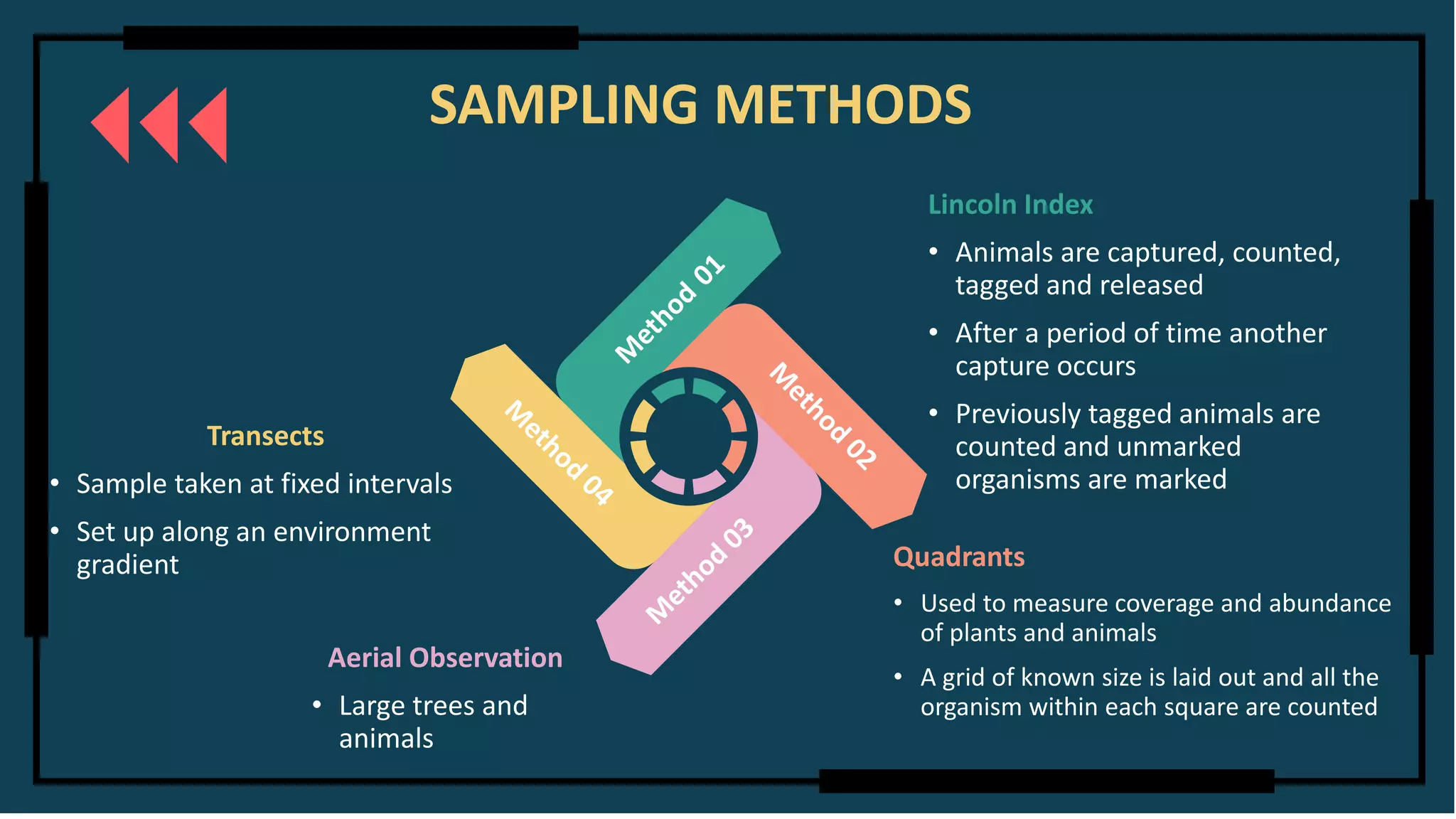
Lincoln Index
• Animals are captured, counted,
tagged and released
• After a period of time another
capture occurs
• Previously tagged animals are
counted and unmarked
organisms are marked
Aerial Observation
• Large trees and
animals
Transects
• Sample taken at fixed intervals
• Set up along an environment
gradient Quadrants
• Used to measure coverage and abundance
of plants and animals
• A grid of known size is laid out and all the
organism within each square are counted
SAMPLING METHODS
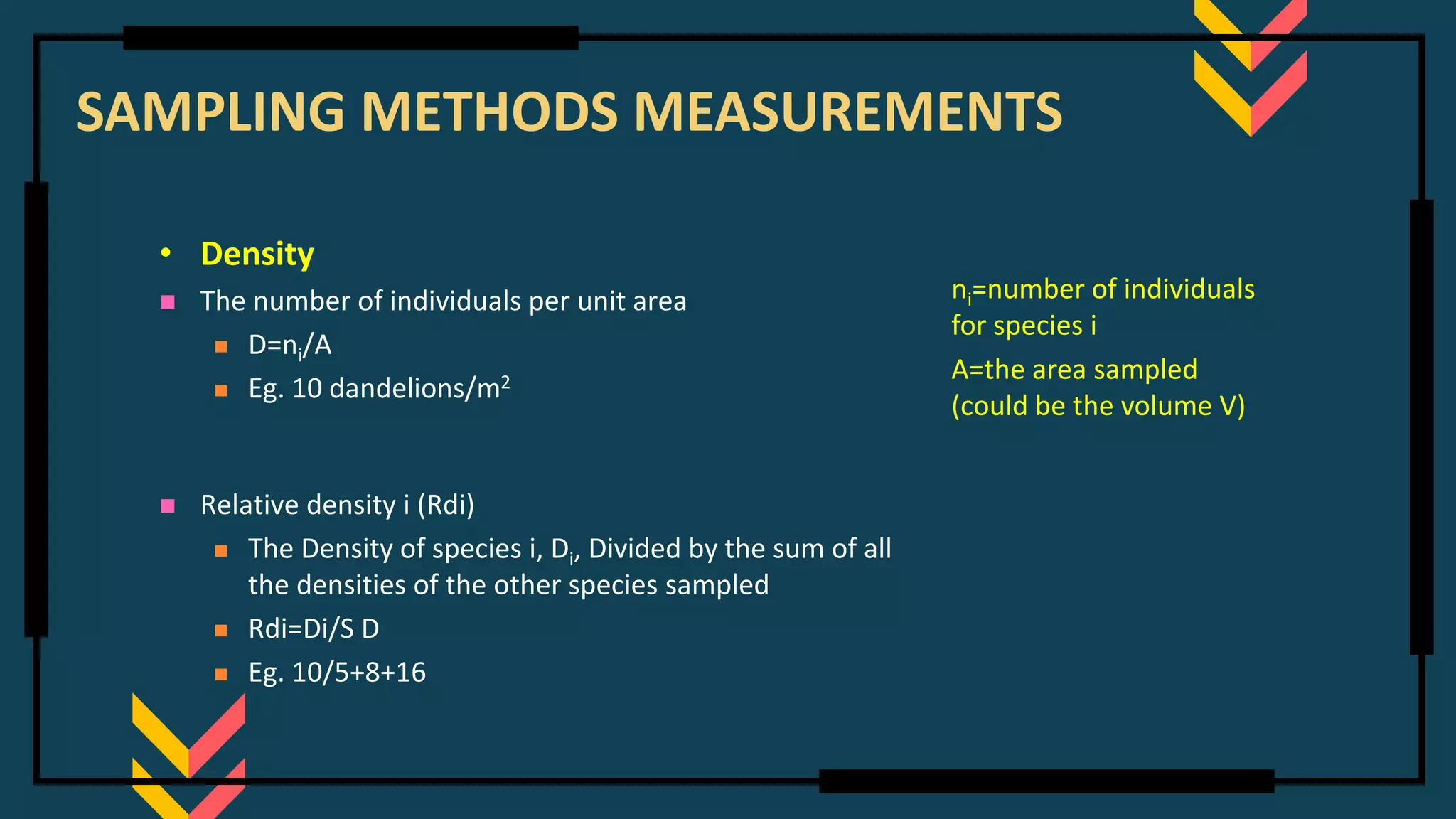
SAMPLING METHODS MEASUREMENTS
• Density
◼ The number of individuals per unit area
◼ D=ni/A
◼ Eg. 10 dandelions/m2
◼ Relative density i (Rdi)
◼ The Density of species i, Di, Divided by the sum of all
the densities of the other species sampled
◼ Rdi=Di/S D
◼ Eg. 10/5+8+16
ni=number of individuals
for species i
A=the area sampled
(could be the volume V)
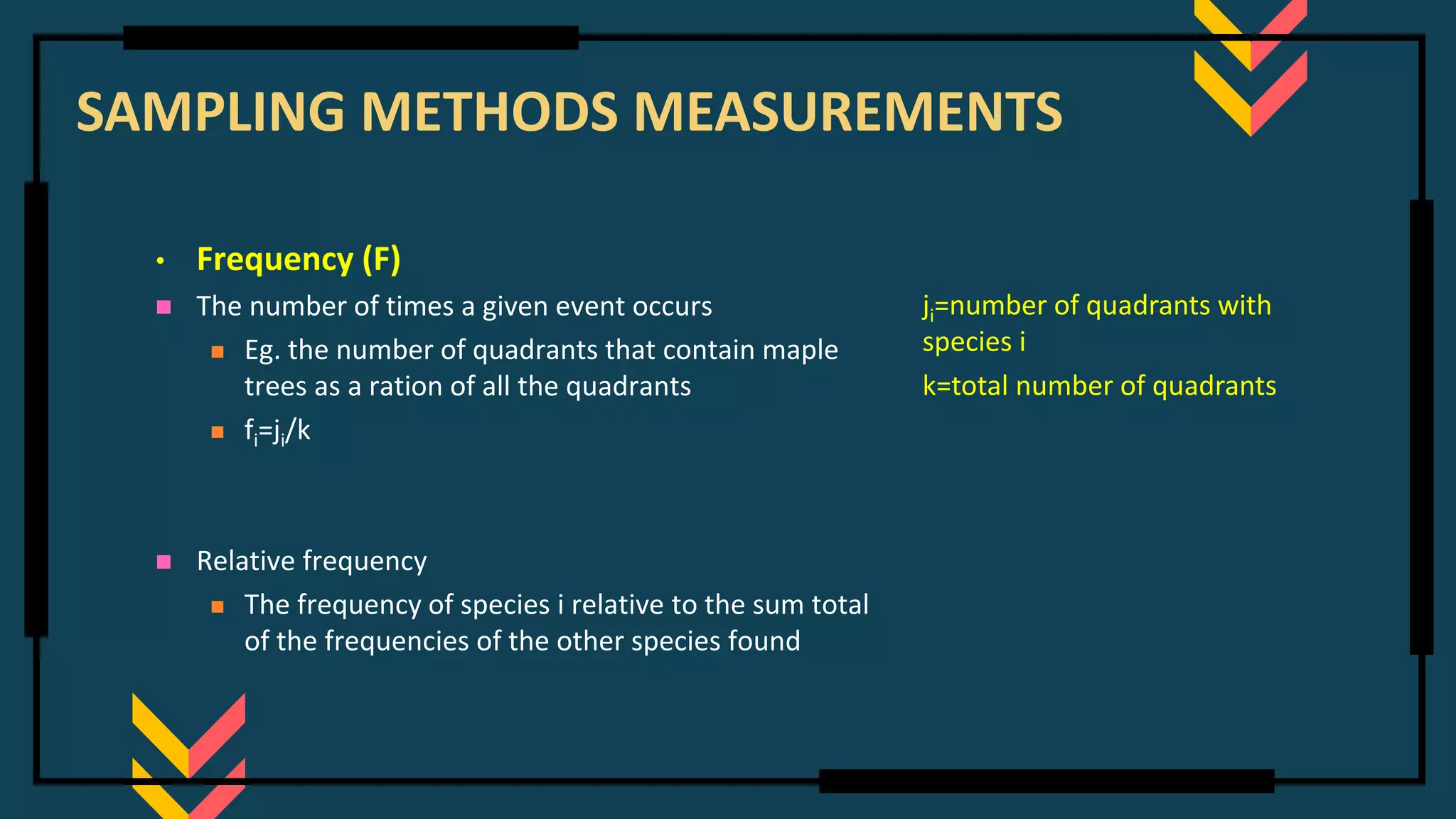
SAMPLING METHODS MEASUREMENTS
• Frequency (F)
◼ The number of times a given event occurs
◼ Eg. the number of quadrants that contain maple
trees as a ration of all the quadrants
◼ fi=ji/k
◼ Relative frequency
◼ The frequency of species i relative to the sum total
of the frequencies of the other species found
ji=number of quadrants with
species i
k=total number of quadrants
SAMPLING METHODS MEASUREMENTS
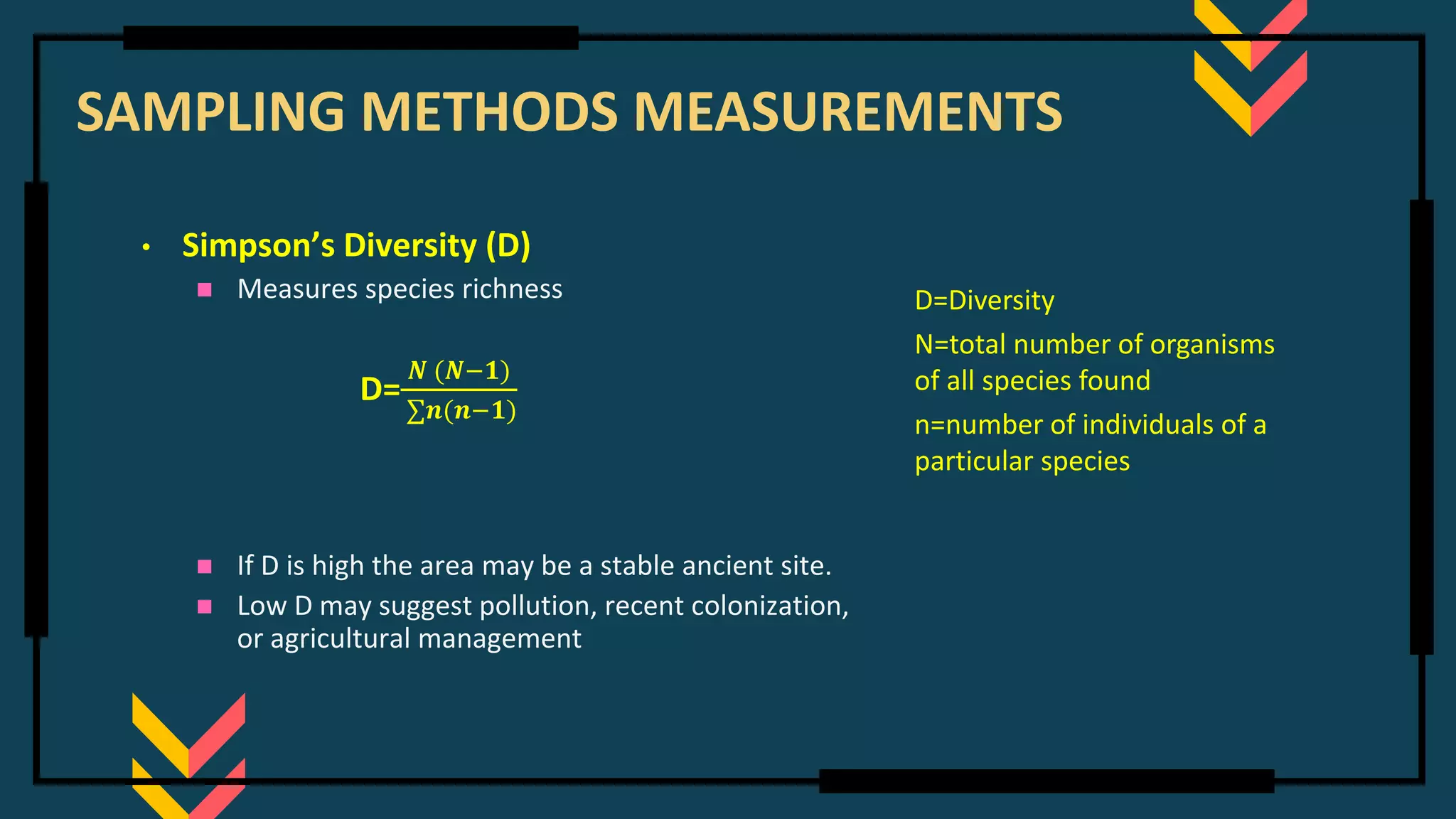
• Simpson’s Diversity (D)
◼ Measures species richness
D=
𝑵 (𝑵−𝟏)
∑𝒏(𝒏−𝟏)
◼ If D is high the area may be a stable ancient site.
◼ Low D may suggest pollution, recent colonization,
or agricultural management
D=Diversity
N=total number of organisms
of all species found
n=number of individuals of a
particular species
SAMPLING METHODS MEASUREMENTS
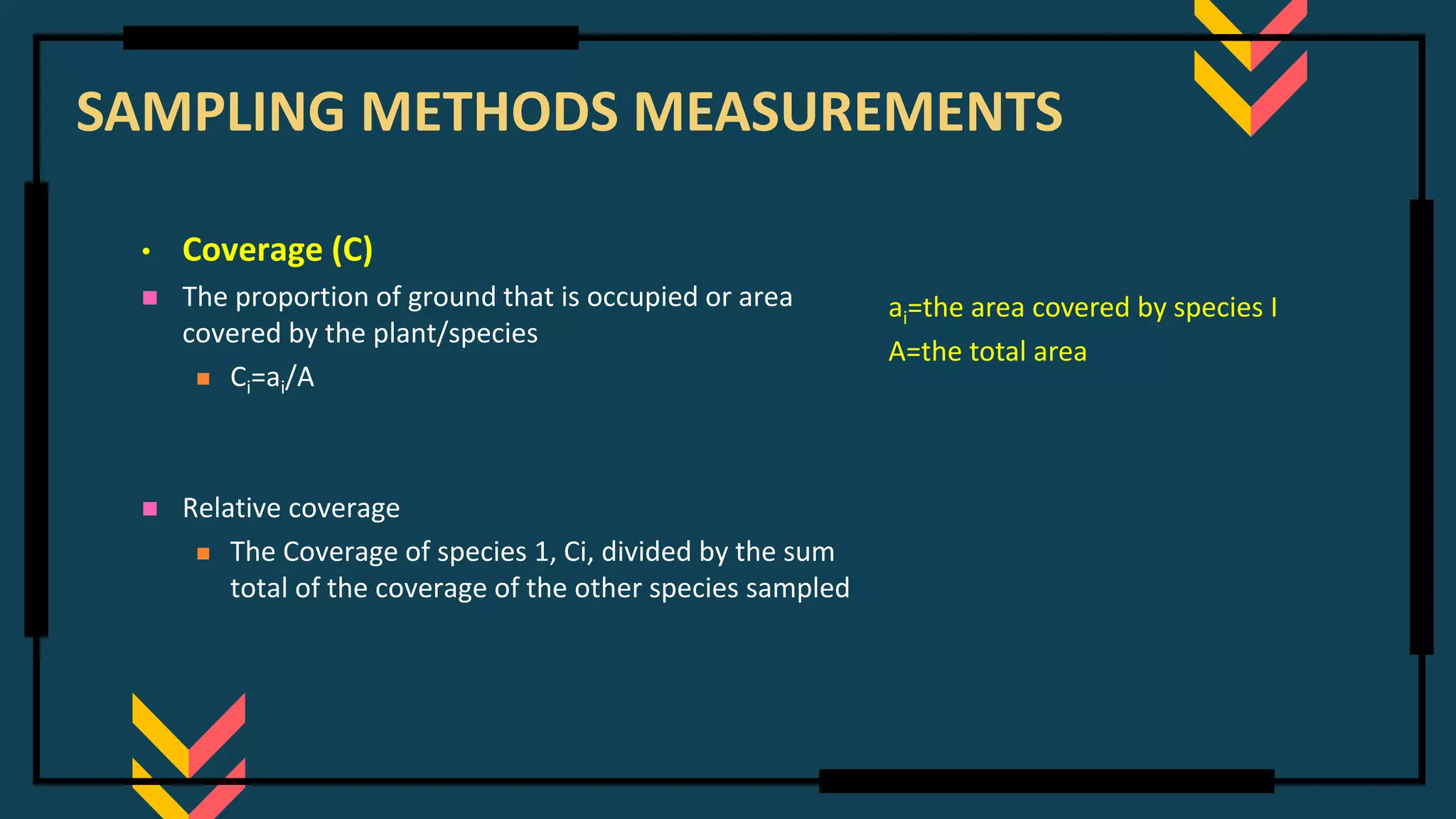
• Coverage (C)
◼ The proportion of ground that is occupied or area
covered by the plant/species
◼ Ci=ai/A
◼ Relative coverage
◼ The Coverage of species 1, Ci, divided by the sum
total of the coverage of the other species sampled
ai=the area covered by species I
A=the total area
SAMPLING METHODS MEASUREMENTS
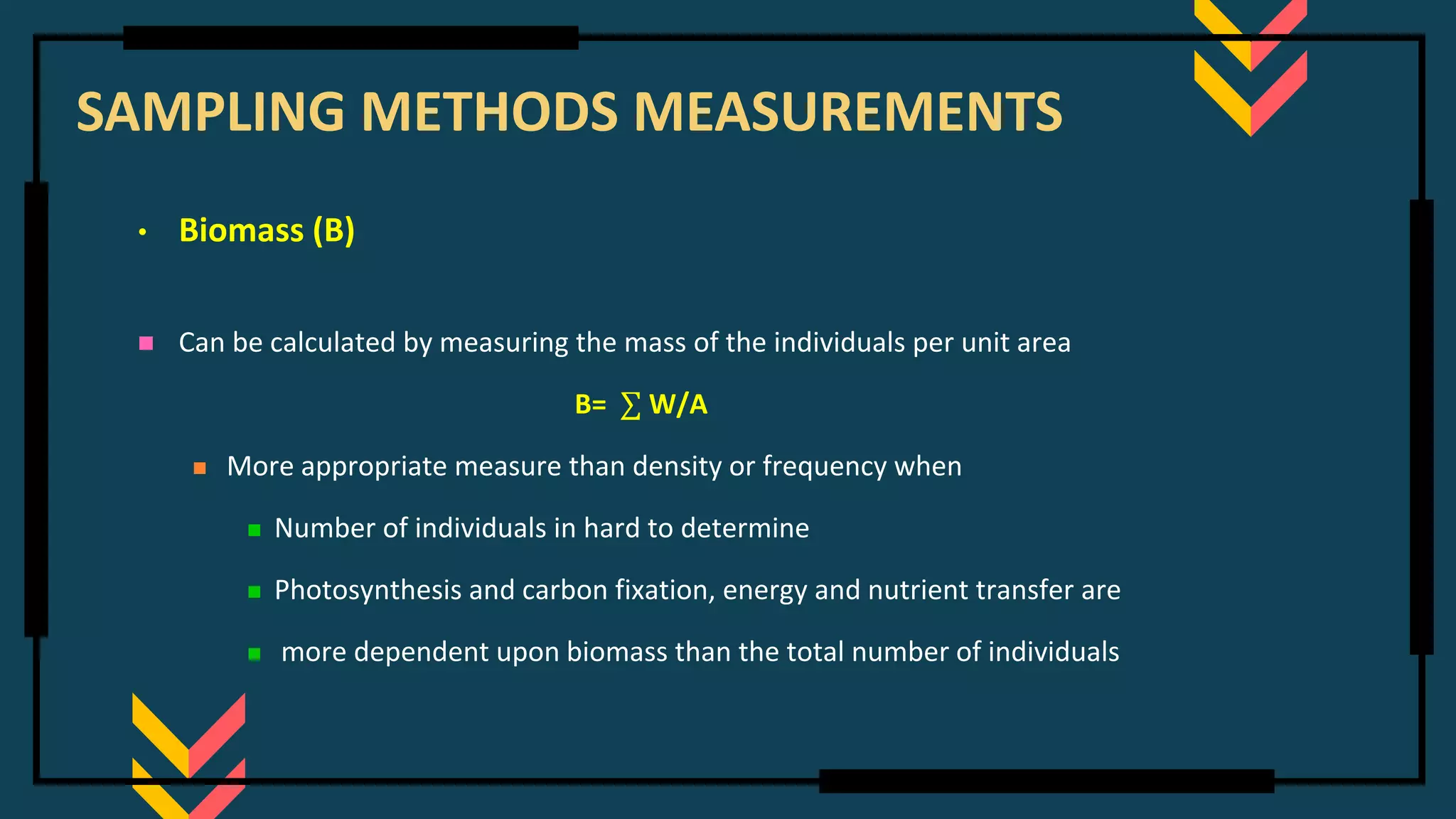
• Biomass (B)
◼ Can be calculated by measuring the mass of the individuals per unit area
B= ∑ W/A
◼ More appropriate measure than density or frequency when
◼ Number of individuals in hard to determine
◼ Photosynthesis and carbon fixation, energy and nutrient transfer are
◼ more dependent upon biomass than the total number of individuals
ROLE OF STATISTICAL ECOLOGY
❑ Locate, Define and measure extent of species
❑ Identify risk factors for extinction
❑ Develop statistical methodologies to address questions arising from ecological
condition
❑ Identify and develop remediation for pollution and extinction
❑ Design, monitor, analyze, interpret, and report results of ecological studies
❑ Ultimate objective -- improve the health of individual and community
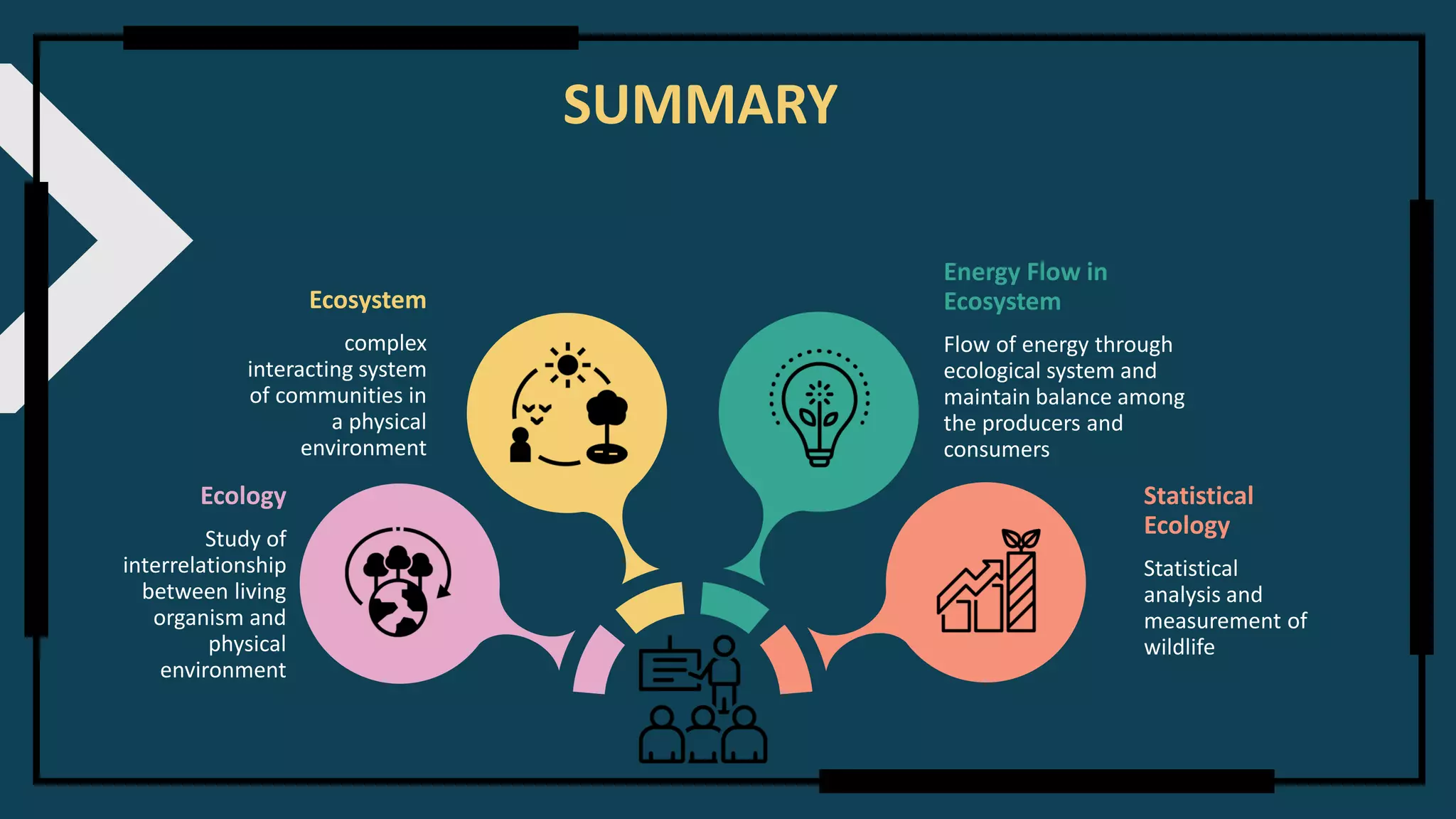
Energy Flow in
Ecosystem
Flow of energy through
ecological system and
maintain balance among
the producers and
consumers
Statistical
Ecology
Statistical
analysis and
measurement of
wildlife
Ecosystem
complex
interacting system
of communities in
a physical
environment
Ecology
Study of
interrelationship
between living
organism and
physical
environment
SUMMARY
Thank you
For your attention

Energy Flow in Ecosystem and Statistical Ecology Presentation.pdf

  • 1.
    Energy Flow inEcosystem And Statistical Ecology Presentation on Presented by Eftekharul Alam Emon
  • 2.
    Agenda 01 02 03 04 EcologyEcosystem Flow of energy in Ecosystem Statistical Ecology
  • 3.
    Ecology – Definitionand Concept • The term ‘Ecology’ was first proposed by the German Zoologist Ernst Haeckel in 1869 • The word ‘Ecology’ is derived from two Greek words ‘Oikos’ which means house or habitat, and ‘Logos’ which means study or knowledge • Ecology is the study of relationships between living organisms to their physical environment • Also the study of inter-relationship between biotic and abiotic components.
  • 4.
    “Ecology is thescientific study of the interactions that determine the dis- tribution and abundance of organisms” Charles Krebs “Scientific natural history” Charles Elton “The study of structure and function of nature” E.P. Odum “Ecology is a science which investigates organisms in relation to their environment” Woodbury 02 01 04 03 Other definitions of Ecology
  • 5.
    ECOSYSTEM • Ecosystem isthe community of living organisms in an area • Living organism interact among themselves and with the surrounding physical environment • Organisms interact with the physical factors as a Dynamic System • It is the functional unit of nature • Structure of Ecosystems: An Ecosystem has two components: (1) Biotic components, and (2) Abiotic components.
  • 6.
    Other Definitions ofEcosystem 01 02 03 British Ecologist Arthur Tansley first defined the term Ecosystem: Ecosystem is a complex interacting system of communities and their physical environment Ecosystem is a dynamic system where the biotic and abiotic components are constantly acting and reacting upon each other bringing forth structural and functional changes The biotic community and the abiotic environment together constitute the Ecosystem
  • 7.
    Non-living components of anecosystem Abiotic components are: Temperature, light, water, soil, rocks, sulfur, nitrogen, carbohydrates, humic substances Living or once lived organisms Biotic components are: Autotrophs and heterotrophs- plants, animals, fungi , bacteria Abiotic Components Biotic Components ABIOTIC & BIOTIC COMPONENTS
  • 8.
    BIOTIC & ABIOTICCOMPONENTS
  • 9.
    INTERACTIONS IN ECOSYSTEM •Components interacts among themselves (through the processes of energy flow and cycling of materials) to accomplish the goal of continuance of life. • None of the ecosystems is independent, but all of them are interdependent in one or the other way. • Such an eating and being eaten relationship among living organisms involves two main processes. • Only the green plants and some autotrophic bacteria are capable of synthesizing their own food by utilizing solar radiant energy (light) to bind simple molecules of CO2, H2O and other elements as N, P, Ca, K, Mg, S etc. Chlorophyl ❖ 6 CO2 + 12 H2O--------------------C6 H12 O6 + 6O2 + 6 H2O Sunlight
  • 10.
    ENERGY FLOW INECOSYSTEM
  • 11.
    FLOW OF ENERGY •Energy flow is a system, which is the flow of energy by living things in an ecosystem • For an ecosystem, the greatest source of energy is the sun • The flow of energy in ecosystem will begin with autotrophs, which brings energy from the sun. • Then the herbivores feed on the autotrophs and convert the energy. • Later carnivores feed on the herbivores. Eventually, carnivores depend on the other carnivores
  • 12.
    THEORY OF ENERGYFLOW ❖ All living things can be characterized into consumers and producers and can further be organized into trophic pyramids known as food pyramid. ❖ The flow of energy through food pyramid are governed by Thermodynamics, which is the concept of exchanging energy between systems. ❖ The flow of energy relates to Thermodynamics because it deals Photosynthesis (via solar radiation) Sun Producers Consumers Unidirectional flow of Energy
  • 13.
    PHOTOSYNTHESIS ❑ Photosynthesis isthe process by which green plants and certain other organisms transform light energy into chemical energy and produces foods. The equation for photosynthesis is: 6CO2 + 6H2O + Light energy→ C6H12O6 + 6O2+ ATP Green plants take carbon dioxide from air and water from ground and converts them into carbohydrate and oxygen in the presence of sunlight. Oxygen is a waste product of photosynthesis. Of the total incident solar radiation less than 60% of it is photosynthesis active radiation
  • 14.
    01 02 0304 05 Primary Producers IPlants, lichens, moss, bacteria and algae Decomposers Fungi, Algae, Bacteria, earth worm, isects etc. Primary Consumers Herbivores like Caterpillars, insects, grasshoppers, termites Secondary Consumers Omnivores like bear, skunks, fish, Whales etc. Tertiary Consumers Humans, big cats like lions and tigers, Polar Bear, Crocodiles etc. COMPONENTS IN ENERGY FLOW
  • 15.
  • 16.
    FLOW OF ENERGYBETWEEN TROPHIC LEVELS • To explain the flow of energy, Lindermann proposed the ten per cent law for the transfer of energy from one trophic level to the next. • According to his law, during the transfer of organic food from one trophic level to the next, only ten percent of the organic matter is stored as flesh. • It means when carnivores consume an animal, only about ten percent energy is fixed in its flesh for the higher level. The remaining is lost during transfer or broken down in respiration. • So, at each transfer 80-90% of potential energy is dissipated as Heat (second law of thermodynamics) where only 10-20% of energy is available to the next trophic level)
  • 17.
    The First lawof Thermodynamics is applicable to define the flow of energy ❑ First Law: Energy can neither be created or destroyed, but energy can be transferred and transformed. • This solar energy is converted into chemical energy by plants through the process of photosynthesis • Only the 1% of the total energy fall on green part of leaves is changed into the potential energy/heat • Which states that energy is transferred and transformed in the ecosystem in the as form of heat and proves the first law of thermodynamics
  • 18.
    The Second lawof Thermodynamics is applicable to define the flow of energy ❑ Second Law: Every step of energy transformation and flow through a system= Gradual loss of the ability to do work ❑ In ecosystems, the biggest losses occur as respiration ❑ At every trophic level, there is decreased in the amount of energy available for organisms of the next trophic level. ❑ Which states that energy is lost at every step in the ecosystem in the form of heat and proves the second law of thermodynamics
  • 19.
  • 20.
  • 21.
    Statistical Ecology • Statisticalecology deals with the development of new methods for analyzing ecological data • Advanced statistical models and techniques are often needed to provide robust analyses of the available data • Statistical methods were initially developed for use in basic and applied sciences, and later in engineering and management. • It is helpful to distinguish between experimental or observational approaches in order to clarify differences between various types of ecological research.
  • 22.
    STAGES OF ANOBSERVATIONAL ECOLOGY APPROACH • The value of quantitative data depends on the sampling procedure used to obtain them • Specific measurements are taken on the species of interest in the community • These data are then tabulated into an ecological data matrix
  • 23.
    EXAMPLE OF PROJECTSIN STATISTICAL ECOLOGY Modeling Population Dynamics Capture- Recapture Animal Abundance Monitoring Endangered Species Diversity Measurement Monitoring Biomass Estimating Population Statistical Analysis
  • 24.
    Lincoln Index • Animalsare captured, counted, tagged and released • After a period of time another capture occurs • Previously tagged animals are counted and unmarked organisms are marked Aerial Observation • Large trees and animals Transects • Sample taken at fixed intervals • Set up along an environment gradient Quadrants • Used to measure coverage and abundance of plants and animals • A grid of known size is laid out and all the organism within each square are counted SAMPLING METHODS
  • 25.
    SAMPLING METHODS MEASUREMENTS •Density ◼ The number of individuals per unit area ◼ D=ni/A ◼ Eg. 10 dandelions/m2 ◼ Relative density i (Rdi) ◼ The Density of species i, Di, Divided by the sum of all the densities of the other species sampled ◼ Rdi=Di/S D ◼ Eg. 10/5+8+16 ni=number of individuals for species i A=the area sampled (could be the volume V)
  • 26.
    SAMPLING METHODS MEASUREMENTS •Frequency (F) ◼ The number of times a given event occurs ◼ Eg. the number of quadrants that contain maple trees as a ration of all the quadrants ◼ fi=ji/k ◼ Relative frequency ◼ The frequency of species i relative to the sum total of the frequencies of the other species found ji=number of quadrants with species i k=total number of quadrants
  • 27.
    SAMPLING METHODS MEASUREMENTS •Simpson’s Diversity (D) ◼ Measures species richness D= 𝑵 (𝑵−𝟏) ∑𝒏(𝒏−𝟏) ◼ If D is high the area may be a stable ancient site. ◼ Low D may suggest pollution, recent colonization, or agricultural management D=Diversity N=total number of organisms of all species found n=number of individuals of a particular species
  • 28.
    SAMPLING METHODS MEASUREMENTS •Coverage (C) ◼ The proportion of ground that is occupied or area covered by the plant/species ◼ Ci=ai/A ◼ Relative coverage ◼ The Coverage of species 1, Ci, divided by the sum total of the coverage of the other species sampled ai=the area covered by species I A=the total area
  • 29.
    SAMPLING METHODS MEASUREMENTS •Biomass (B) ◼ Can be calculated by measuring the mass of the individuals per unit area B= ∑ W/A ◼ More appropriate measure than density or frequency when ◼ Number of individuals in hard to determine ◼ Photosynthesis and carbon fixation, energy and nutrient transfer are ◼ more dependent upon biomass than the total number of individuals
  • 30.
    ROLE OF STATISTICALECOLOGY ❑ Locate, Define and measure extent of species ❑ Identify risk factors for extinction ❑ Develop statistical methodologies to address questions arising from ecological condition ❑ Identify and develop remediation for pollution and extinction ❑ Design, monitor, analyze, interpret, and report results of ecological studies ❑ Ultimate objective -- improve the health of individual and community
  • 31.
    Energy Flow in Ecosystem Flowof energy through ecological system and maintain balance among the producers and consumers Statistical Ecology Statistical analysis and measurement of wildlife Ecosystem complex interacting system of communities in a physical environment Ecology Study of interrelationship between living organism and physical environment SUMMARY
  • 32.