Water as a molecule
Water as a molecule
• Water has a polar
  covalent bond
• The electrons are
  shared unevenly
• Oxygen is stronger, so
  it pulls the electrons
  to itself
Water as a molecule
• Water is a polar molecule
• One part is more negative,
  and one part is more
  positive
Water as a molecule
• The polar parts of
  water will connect,
  giving water special
  properties


**You will see these
properties in lab**
Vocabulary
• POLAR – a molecule that has an uneven
  distribution of electrons
• POLAR - una molécula que tiene una
  distribución desigual de los electrones
• POLAR - 的分子,具有電子的不均勻分佈
Vocabulary
• Cohesion – when similar things stick to each
  other (ex: water molecule to other water
  molecules to form drops)

• Adhesion – When different things stick to
  each other (ex: water sticks to grass)
Lab part 1
• Talk in lab group – record in notebook
  – What did you observe?
  – Explain why you saw what you did
• Share out – whole group
  – Many drops could fit on the penny than we
    predicted
  – This happened because of cohesion. The water
    molecules stuck to each other to allow more
    water to fit.
Lab part 2
• Talk in lab group – record in notebook
  – What did you observe?
  – Explain why you saw what you did
• Share out – whole group
  – The paper clip could float on water.
  – This happened because of cohesion. The water
    molecules stuck to each other to allow more
    water to fit.
Lab part 3
• Question: How do different chemicals affect
  the surface tension of water?
• Safety!! – Wear goggles when handling
  chemicals
• Make sure to get your procedure approved
  BEFORE conducting your experiment
• Use a new pipette for each solution to avoid
  contamination (mixing the chemicals by accident)
• sdf
Vocabulary
• Nonpolar - a compound where electrons are
  shared equally. Areas of the compound are
  neutral.
• Hydrophobic – “scared of water” a substance
  that does not dissolve in water. Nonpolar
  substances are hydrophobic.
• Hydrophilic – “Water loving” a substance that
  will dissolve in water. All polar substances are
  hydrophilic
Detergents (Soap)
• Micelle
  – Forms when hydrophobic ends clump together
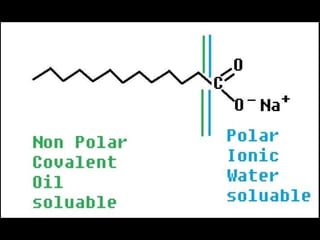
• Detergent molecules have a polar end and a
  non polar end
Detergents
• Amphiphilic – has a polar and a nonpolar end.
  Detergents have a hydrophobic end and a
  hydrophilic end.
                                 The polar end
                                 will dissolve in
                                 water
                                 The nonpolar
                                 end will dissolve
                                 in oil
Properties of water
• Cohesion – water sticks together
• Resistance to temperature change – needs a
  lot of energy to raise temperature
• Density – solid ice floats in liquid water
• Universal Solvent – can dissolve almost
  anything
How soap dissolves oil
• Green
  head=hydrophillic,
  polar, dissolves in
  water
• Yellow tail –
  hydrophobic,
  nonpolar, dissolves
  oil
• LIKE DISSOLVES LIKE
Quiz next week: Properties of water
•   4 properties from reading # 3.5
•   Solubility
•   Polar
•   Non-polar
•   Amphipathic
•   Experimental design
    – Controlling an experiment
As you read…
Create definitions for the following terms
• Solubility
• Solute
• Solvent
• Homogeneous
• Solution
• Mixture
Vocab
• Mixture - a system where 2 or more things
  are combined, but not chemically
• Solution – when 2 or more things are
  combined evenly
• Solubility – The amount of solute that can be
  dissolved by a solvent
Vocab
• Homogeneous
  mixture – a
  mixture that is
  evenly mixed.       (ex.
  CO2 bubbles in soda) AKA
  a solution
• Heterogeneous
  mixture – a
  mixture that is
  unevenly mixed. (ex.
  Sand in water)
Vocab
• Solvent – the substance that dissolves the
  solute (often, it is water)
• Solute - the substance that is dissolved

Water notes only

  • 1.
    Water as amolecule
  • 2.
    Water as amolecule • Water has a polar covalent bond • The electrons are shared unevenly • Oxygen is stronger, so it pulls the electrons to itself
  • 3.
    Water as amolecule • Water is a polar molecule • One part is more negative, and one part is more positive
  • 4.
    Water as amolecule • The polar parts of water will connect, giving water special properties **You will see these properties in lab**
  • 5.
    Vocabulary • POLAR –a molecule that has an uneven distribution of electrons • POLAR - una molécula que tiene una distribución desigual de los electrones • POLAR - 的分子,具有電子的不均勻分佈
  • 6.
    Vocabulary • Cohesion –when similar things stick to each other (ex: water molecule to other water molecules to form drops) • Adhesion – When different things stick to each other (ex: water sticks to grass)
  • 7.
    Lab part 1 •Talk in lab group – record in notebook – What did you observe? – Explain why you saw what you did • Share out – whole group – Many drops could fit on the penny than we predicted – This happened because of cohesion. The water molecules stuck to each other to allow more water to fit.
  • 8.
    Lab part 2 •Talk in lab group – record in notebook – What did you observe? – Explain why you saw what you did • Share out – whole group – The paper clip could float on water. – This happened because of cohesion. The water molecules stuck to each other to allow more water to fit.
  • 9.
    Lab part 3 •Question: How do different chemicals affect the surface tension of water? • Safety!! – Wear goggles when handling chemicals • Make sure to get your procedure approved BEFORE conducting your experiment • Use a new pipette for each solution to avoid contamination (mixing the chemicals by accident)
  • 10.
  • 11.
    Vocabulary • Nonpolar -a compound where electrons are shared equally. Areas of the compound are neutral. • Hydrophobic – “scared of water” a substance that does not dissolve in water. Nonpolar substances are hydrophobic. • Hydrophilic – “Water loving” a substance that will dissolve in water. All polar substances are hydrophilic
  • 12.
    Detergents (Soap) • Micelle – Forms when hydrophobic ends clump together • Detergent molecules have a polar end and a non polar end
  • 13.
    Detergents • Amphiphilic –has a polar and a nonpolar end. Detergents have a hydrophobic end and a hydrophilic end. The polar end will dissolve in water The nonpolar end will dissolve in oil
  • 14.
    Properties of water •Cohesion – water sticks together • Resistance to temperature change – needs a lot of energy to raise temperature • Density – solid ice floats in liquid water • Universal Solvent – can dissolve almost anything
  • 16.
  • 17.
    How soap dissolvesoil • Green head=hydrophillic, polar, dissolves in water • Yellow tail – hydrophobic, nonpolar, dissolves oil • LIKE DISSOLVES LIKE
  • 18.
    Quiz next week:Properties of water • 4 properties from reading # 3.5 • Solubility • Polar • Non-polar • Amphipathic • Experimental design – Controlling an experiment
  • 19.
    As you read… Createdefinitions for the following terms • Solubility • Solute • Solvent • Homogeneous • Solution • Mixture
  • 20.
    Vocab • Mixture -a system where 2 or more things are combined, but not chemically • Solution – when 2 or more things are combined evenly • Solubility – The amount of solute that can be dissolved by a solvent
  • 21.
    Vocab • Homogeneous mixture – a mixture that is evenly mixed. (ex. CO2 bubbles in soda) AKA a solution • Heterogeneous mixture – a mixture that is unevenly mixed. (ex. Sand in water)
  • 22.
    Vocab • Solvent –the substance that dissolves the solute (often, it is water) • Solute - the substance that is dissolved