IB Biology Chapter 1 Notes: Introduction to Cells (1.1) NAME:
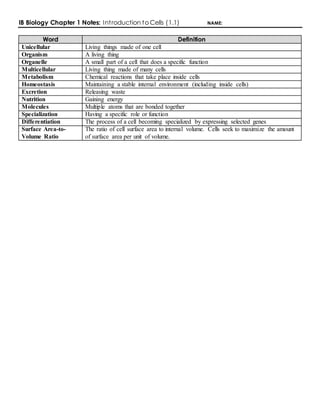
Word Definition
Unicellular Living things made of one cell
Organism A living thing
Organelle A small part of a cell that does a specific function
Multicellular Living thing made of many cells
Metabolism Chemical reactions that take place inside cells
Homeostasis Maintaining a stable internal environment (including inside cells)
Excretion Releasing waste
Nutrition Gaining energy
Molecules Multiple atoms that are bonded together
Specialization Having a specific role or function
Differentiation The process of a cell becoming specialized by expressing selected genes
Surface Area-to-
Volume Ratio
The ratio of cell surface area to internal volume. Cells seek to maximize the amount
of surface area per unit of volume.
1.1.1 According to the cell
theory, living organisms are
composed of cells
1.1.2 Organisms consisting
of only one cell carry out all
functions of life in that cell
1.1.3 Surface are to volume
ratio is important in the
limitation of cell size
1.1.4 Multicellular
organisms have properties
that emerge from the
interaction of their cellular
components
1.1.5 Specialized tissues can
develop by cell
differentiation in
multicellular organisms
State common features of all cells:
Outline the seven characteristics / functions of life shown by unicellular organisms:
Explain how the Surface Area : Volume ratio limits cell size (i.e. nutrient absorption,waste removal,
and heat transfer):
As the cell grows larger, the membrane Surface Area ____________________ and the cell’s Volume
also ____________________,but the SA : Volume ratio ______________________.
Describe what is meant by an emergent property:
1.1.6 Differentiation
involves the expression of
some genes and not others in
the cell’s genome
1.1.8 Question the cell
theory using atypical
examples, including striated
muscle, giant algae and
aseptate fungal hyphae
1.1.9 Investigate functions of
life in Paramecium and one
named photosynthetic
unicellular organism
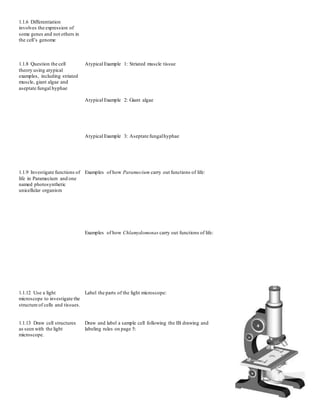
1.1.12 Use a light
microscope to investigate the
structure of cells and tissues.
1.1.13 Draw cell structures
as seen with the light
microscope.
Atypical Example 1: Striated muscle tissue
Atypical Example 2: Giant algae
Atypical Example 3: Aseptate fungalhyphae
Examples of how Paramecium carry out functions of life:
Examples of how Chlamydomonas carry out functions of life:
Label the parts of the light microscope:
Draw and label a sample cell following the IB drawing and
labeling rules on page 5:
1.1.14 Calculate the
magnification of drawings
and the actual size of
structures shown in drawings
or micrographs.
Unit Abbreviation
Metric Equivalent
Whole Scientific Notation
kilometer km 1000 m 103 m
meter m 1 m 1 m
centimeter cm .01 m 10-2 m
millimeter mm 0.001 m 10-3 m
micrometer μm 0.000001 m 10-6 m
nanometer nm .000000001 m 10-9m
Outline the equation to calculate the Magnification of an image:
Example: If the drawn length of a cell is 30 mm, but the actual size of the cell is 3 μm, calculate the
magnification of the image—show work!

1.1 Notes

  • 1.
    IB Biology Chapter1 Notes: Introduction to Cells (1.1) NAME: Word Definition Unicellular Living things made of one cell Organism A living thing Organelle A small part of a cell that does a specific function Multicellular Living thing made of many cells Metabolism Chemical reactions that take place inside cells Homeostasis Maintaining a stable internal environment (including inside cells) Excretion Releasing waste Nutrition Gaining energy Molecules Multiple atoms that are bonded together Specialization Having a specific role or function Differentiation The process of a cell becoming specialized by expressing selected genes Surface Area-to- Volume Ratio The ratio of cell surface area to internal volume. Cells seek to maximize the amount of surface area per unit of volume.
  • 2.
    1.1.1 According tothe cell theory, living organisms are composed of cells 1.1.2 Organisms consisting of only one cell carry out all functions of life in that cell 1.1.3 Surface are to volume ratio is important in the limitation of cell size 1.1.4 Multicellular organisms have properties that emerge from the interaction of their cellular components 1.1.5 Specialized tissues can develop by cell differentiation in multicellular organisms State common features of all cells: Outline the seven characteristics / functions of life shown by unicellular organisms: Explain how the Surface Area : Volume ratio limits cell size (i.e. nutrient absorption,waste removal, and heat transfer): As the cell grows larger, the membrane Surface Area ____________________ and the cell’s Volume also ____________________,but the SA : Volume ratio ______________________. Describe what is meant by an emergent property:
  • 3.
    1.1.6 Differentiation involves theexpression of some genes and not others in the cell’s genome 1.1.8 Question the cell theory using atypical examples, including striated muscle, giant algae and aseptate fungal hyphae 1.1.9 Investigate functions of life in Paramecium and one named photosynthetic unicellular organism 1.1.12 Use a light microscope to investigate the structure of cells and tissues. 1.1.13 Draw cell structures as seen with the light microscope. Atypical Example 1: Striated muscle tissue Atypical Example 2: Giant algae Atypical Example 3: Aseptate fungalhyphae Examples of how Paramecium carry out functions of life: Examples of how Chlamydomonas carry out functions of life: Label the parts of the light microscope: Draw and label a sample cell following the IB drawing and labeling rules on page 5:
  • 4.
    1.1.14 Calculate the magnificationof drawings and the actual size of structures shown in drawings or micrographs. Unit Abbreviation Metric Equivalent Whole Scientific Notation kilometer km 1000 m 103 m meter m 1 m 1 m centimeter cm .01 m 10-2 m millimeter mm 0.001 m 10-3 m micrometer μm 0.000001 m 10-6 m nanometer nm .000000001 m 10-9m Outline the equation to calculate the Magnification of an image: Example: If the drawn length of a cell is 30 mm, but the actual size of the cell is 3 μm, calculate the magnification of the image—show work!