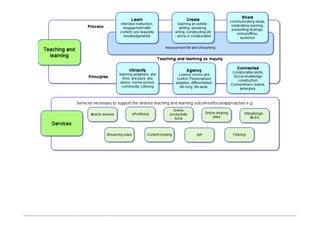
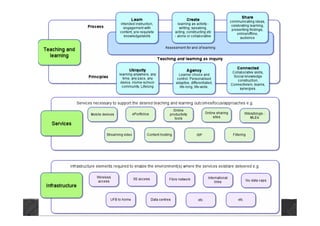
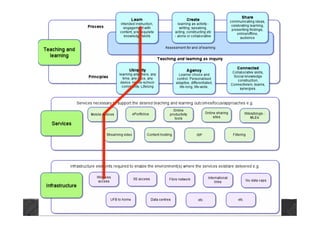
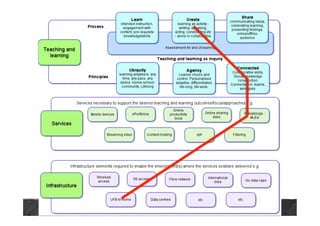
21st Century libraries, the imperative
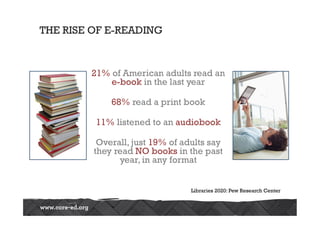
THE RISE OF E-READING


        21% of American adults read an
            e-book in the last year

             68% read a print book

         11% listened to an audiobook

          Overall, just 19% of adults say
         they read NO books in the past
               year, in any format


                                 Libraries 2020: Pew Research Center
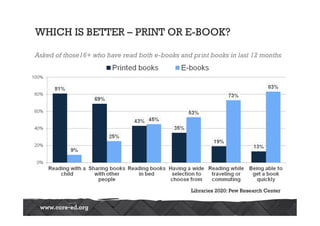
WHICH IS BETTER – PRINT OR E-BOOK?

Asked of those16+ who have read both e-books and print books in last 12 months


                                                 Libraries 2020: Pew Research Center
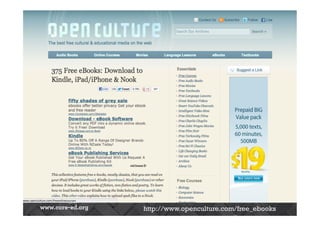
FREE E-BOOKS


               http://www.openculture.com/free_ebooks
MORE FREE E-BOOKS


http://www.hongkiat.com/blog/20-best-websites-to-download-free-e-books/
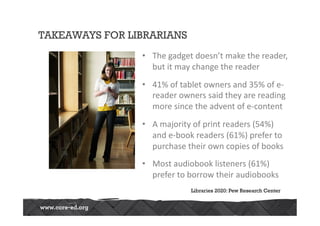
TAKEAWAYS FOR LIBRARIANS
                •  The	
  gadget	
  doesn’t	
  make	
  the	
  reader,	
  
                   but	
  it	
  may	
  change	
  the	
  reader	
  
                •  41%	
  of	
  tablet	
  owners	
  and	
  35%	
  of	
  e-­‐
                   reader	
  owners	
  said	
  they	
  are	
  reading	
  
                   more	
  since	
  the	
  advent	
  of	
  e-­‐content	
  
                •  A	
  majority	
  of	
  print	
  readers	
  (54%)	
  
                   and	
  e-­‐book	
  readers	
  (61%)	
  prefer	
  to	
  
                   purchase	
  their	
  own	
  copies	
  of	
  books	
  
                •  Most	
  audiobook	
  listeners	
  (61%)	
  
                   prefer	
  to	
  borrow	
  their	
  audiobooks	
  
                                    Libraries 2020: Pew Research Center
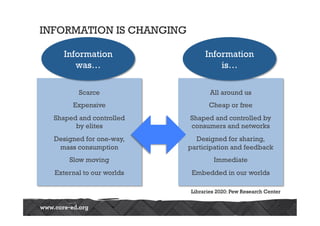
INFORMATION IS CHANGING

    Information                 Information
       was…                         is…

         Scarce                   All around us
       Expensive                 Cheap or free
  Shaped and controlled    Shaped and controlled by
        by elites          consumers and networks
  Designed for one-way,      Designed for sharing,
   mass consumption        participation and feedback
      Slow moving                  Immediate
  External to our worlds    Embedded in our worlds

                           Libraries 2020: Pew Research Center
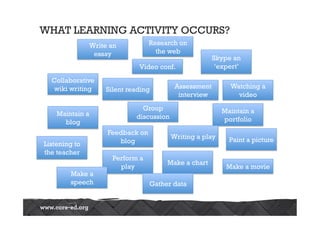
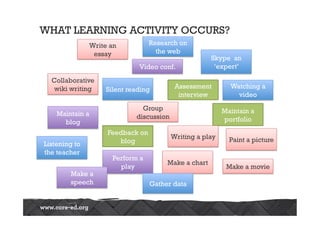
WHAT LEARNING ACTIVITY OCCURS?
               Write an           Research on
                essay               the web
                                                       Skype an
                             Video conf.                ‘expert’

  Collaborative
   wiki writing    Silent reading         Assessment        Watching a
                                           interview          video
                              Group                       Maintain a
    Maintain a              discussion
      blog                                                portfolio
                    Feedback on
                                         Writing a play     Paint a picture
Listening to           blog
the teacher
                     Perform a
                                       Make a chart
                       play                                Make a movie
        Make a
        speech                    Gather data
WHAT LEARNING ACTIVITY OCCURS?
               Write an           Research on
                essay               the web
                                                      Skype an
                             Video conf.               ‘expert’

  Collaborative
   wiki writing    Silent reading         Assessment        Watching a
                                           interview          video
                              Group                       Maintain a
    Maintain a              discussion
      blog                                                portfolio
                    Feedback on
                                         Writing a play     Paint a picture
Listening to           blog
the teacher
                     Perform a
                                       Make a chart
                       play                                Make a movie
        Make a
        speech                    Gather data
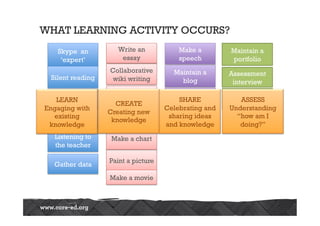
WHAT LEARNING ACTIVITY OCCURS?
   Skype an          Write an           Make a         Maintain a
    ‘expert’          essay             speech         portfolio
                  Collaborative       Maintain a      Assessment
 Silent reading    wiki writing         blog           interview
  Research on         Group           Video conf.     Feedback on
   LEARN            discussion          SHARE             ASSESS
    the web         CREATE                                blog
Engaging with                       Celebrating and    Understanding
                  Creating new         Perform a
  existing a
   Watching       Writing a play     sharing ideas       “how am I
                   knowledge              play
     video
 knowledge                          and knowledge         doing?”
  Listening to     Make a chart
  the teacher

                  Paint a picture
  Gather data
                  Make a movie
What makes this different in
the third millennium?
In the future our learning will be even more
digital, more mobile, and more multimedia
than it is now.
It frequently will be more informal and
definitely will be more self-directed,
individualized, and personalized.
It will be more open and more accessible
and may occur in simulation or video game-
like environments.
It will be more networked and more
interconnected and often will occur online.
In the future our learning will be even more
digital, more mobile, and more multimedia
than it is now.
It frequently will be more informal and
definitely will be more self-directed,
individualized, and personalized.
It will be more open and more accessible
and may occur in simulation or video game-
like environments.
It will be more networked and more
interconnected and often will occur online.
In the future our learning will be even more
digital, more mobile, and more multimedia
than it is now.
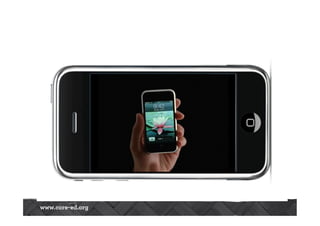
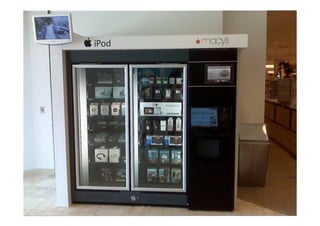
•  Picture here of iphone dispenser at the airport
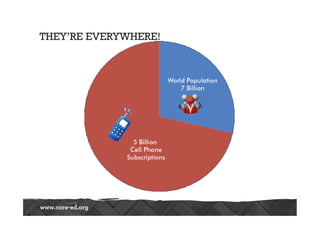
THEY’RE EVERYWHERE!
THEY’RE AFFORDABLE!
http://www.youtube.com/watch?
annotation_id=annotation_153827&feature=iv&src_vid=8NK295ldF_g&v=Hl7pE_p41D4
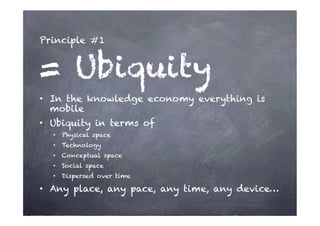
Principle #1


= Ubiquity
•  In the knowledge economy everything is
   mobile
•  Ubiquity in terms of
  •  Physical space
  •  Technology
  •  Conceptual space
  •  Social space
  •  Dispersed over time

•  Any place, any pace, any time, any device…
It frequently will be more informal and
definitely will be more self-directed,
individualized, and personalized.
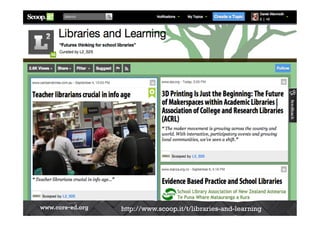
LIBRARIES AND LEARNING


             http://www.scoop.it/t/libraries-and-learning
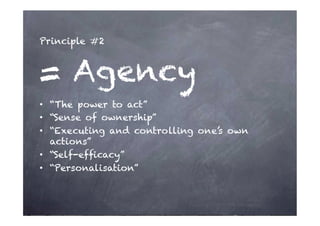
Principle #2


= Agency
•  “The power to act”
•  “Sense of ownership”
•  “Executing and controlling one’s own
   actions”
•  “Self-efficacy”
•  “Personalisation”
It will be more open and more accessible
and may occur in simulation or video game-
like environments.
It will be more networked and more
interconnected and often will occur online.
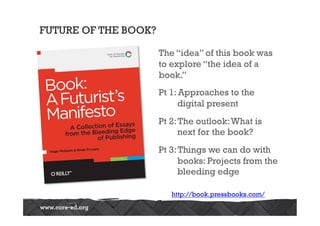
FUTURE OF THE BOOK?

                      The “idea” of this book was
                      to explore “the idea of a
                      book.”
                      Pt 1: Approaches to the
                           digital present
                      Pt 2: The outlook: What is
                            next for the book?
                      Pt 3: Things we can do with
                            books: Projects from the
                            bleeding edge

                         http://book.pressbooks.com/
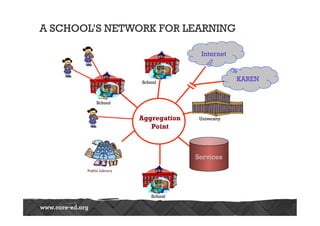
A SCHOOL’S NETWORK FOR LEARNING

                                              Internet	

                            School A
                           School	

                                                             KAREN	

         School A

             School	


                           Aggregation       University	

                              Point


                                            Services	

       Public Library	


                            School A
                                School
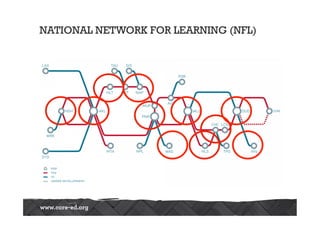
NATIONAL NETWORK FOR LEARNING (NFL)
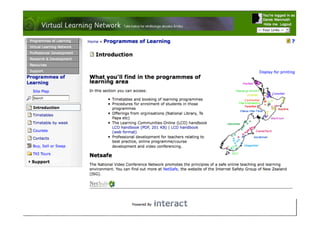
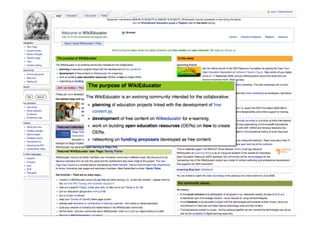
WIKI EDUCATOR
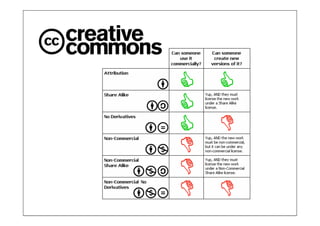
CREATIVE COMMONS
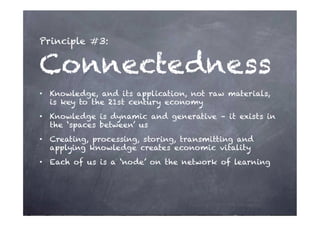
Principle #3:


Connectedness
•  Knowledge, and its application, not raw materials,
   is key to the 21st century economy
•  Knowledge is dynamic and generative – it exists in
   the ‘spaces between’ us
•  Creating, processing, storing, transmitting and
   applying knowledge creates economic vitality
•  Each of us is a ‘node’ on the network of learning
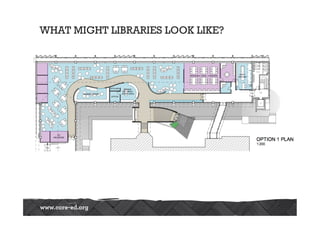
WHAT MIGHT LIBRARIES LOOK LIKE?
ROLE OF THE LIBRARIAN…


 Sentries        Evaluators        Filters        Certifiers

Identifying and locating the highest quality information
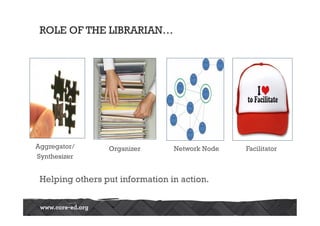
ROLE OF THE LIBRARIAN…


Aggregator/      Organizer       Network Node   Facilitator
Synthesizer


 Helping others put information in action.
BIG QUESTIONS

•  What is driving the decision making around ICTs and
   libraries in your context?

•  Is it grounded in a shared view of 21st century
   pedagogy?

•  Is it transparent to all stakeholders?

•  Is it used as a reference for all decision making?
Derek Wenmoth
          Email: derek@core-ed.org
Blog: http://blog.core-ed.org/derek
                Skype: <dwenmoth>

21st Century Libraries

  • 1.
  • 4.
    THE RISE OFE-READING 21% of American adults read an e-book in the last year 68% read a print book 11% listened to an audiobook Overall, just 19% of adults say they read NO books in the past year, in any format Libraries 2020: Pew Research Center
  • 5.
    WHICH IS BETTER– PRINT OR E-BOOK? Asked of those16+ who have read both e-books and print books in last 12 months Libraries 2020: Pew Research Center
  • 6.
    FREE E-BOOKS http://www.openculture.com/free_ebooks
  • 7.
  • 8.
    TAKEAWAYS FOR LIBRARIANS •  The  gadget  doesn’t  make  the  reader,   but  it  may  change  the  reader   •  41%  of  tablet  owners  and  35%  of  e-­‐ reader  owners  said  they  are  reading   more  since  the  advent  of  e-­‐content   •  A  majority  of  print  readers  (54%)   and  e-­‐book  readers  (61%)  prefer  to   purchase  their  own  copies  of  books   •  Most  audiobook  listeners  (61%)   prefer  to  borrow  their  audiobooks   Libraries 2020: Pew Research Center
  • 9.
    INFORMATION IS CHANGING Information Information was… is… Scarce All around us Expensive Cheap or free Shaped and controlled Shaped and controlled by by elites consumers and networks Designed for one-way, Designed for sharing, mass consumption participation and feedback Slow moving Immediate External to our worlds Embedded in our worlds Libraries 2020: Pew Research Center
  • 10.
    WHAT LEARNING ACTIVITYOCCURS? Write an Research on essay the web Skype an Video conf. ‘expert’ Collaborative wiki writing Silent reading Assessment Watching a interview video Group Maintain a Maintain a discussion blog portfolio Feedback on Writing a play Paint a picture Listening to blog the teacher Perform a Make a chart play Make a movie Make a speech Gather data
  • 11.
    WHAT LEARNING ACTIVITYOCCURS? Write an Research on essay the web Skype an Video conf. ‘expert’ Collaborative wiki writing Silent reading Assessment Watching a interview video Group Maintain a Maintain a discussion blog portfolio Feedback on Writing a play Paint a picture Listening to blog the teacher Perform a Make a chart play Make a movie Make a speech Gather data
  • 12.
    WHAT LEARNING ACTIVITYOCCURS? Skype an Write an Make a Maintain a ‘expert’ essay speech portfolio Collaborative Maintain a Assessment Silent reading wiki writing blog interview Research on Group Video conf. Feedback on LEARN discussion SHARE ASSESS the web CREATE blog Engaging with Celebrating and Understanding Creating new Perform a existing a Watching Writing a play sharing ideas “how am I knowledge play video knowledge and knowledge doing?” Listening to Make a chart the teacher Paint a picture Gather data Make a movie
  • 13.
    What makes thisdifferent in the third millennium?
  • 14.
    In the futureour learning will be even more digital, more mobile, and more multimedia than it is now. It frequently will be more informal and definitely will be more self-directed, individualized, and personalized. It will be more open and more accessible and may occur in simulation or video game- like environments. It will be more networked and more interconnected and often will occur online.
  • 15.
    In the futureour learning will be even more digital, more mobile, and more multimedia than it is now. It frequently will be more informal and definitely will be more self-directed, individualized, and personalized. It will be more open and more accessible and may occur in simulation or video game- like environments. It will be more networked and more interconnected and often will occur online.
  • 16.
    In the futureour learning will be even more digital, more mobile, and more multimedia than it is now.
  • 18.
    •  Picture hereof iphone dispenser at the airport
  • 19.
  • 20.
  • 21.
  • 22.
    Principle #1 = Ubiquity • In the knowledge economy everything is mobile •  Ubiquity in terms of •  Physical space •  Technology •  Conceptual space •  Social space •  Dispersed over time •  Any place, any pace, any time, any device…
  • 23.
    It frequently willbe more informal and definitely will be more self-directed, individualized, and personalized.
  • 25.
    LIBRARIES AND LEARNING http://www.scoop.it/t/libraries-and-learning
  • 26.
    Principle #2 = Agency • “The power to act” •  “Sense of ownership” •  “Executing and controlling one’s own actions” •  “Self-efficacy” •  “Personalisation”
  • 27.
    It will bemore open and more accessible and may occur in simulation or video game- like environments. It will be more networked and more interconnected and often will occur online.
  • 28.
    FUTURE OF THEBOOK? The “idea” of this book was to explore “the idea of a book.” Pt 1: Approaches to the digital present Pt 2: The outlook: What is next for the book? Pt 3: Things we can do with books: Projects from the bleeding edge http://book.pressbooks.com/
  • 29.
    A SCHOOL’S NETWORKFOR LEARNING Internet School A School KAREN School A School Aggregation University Point Services Public Library School A School
  • 30.
    NATIONAL NETWORK FORLEARNING (NFL)
  • 32.
  • 33.
  • 35.
    Principle #3: Connectedness •  Knowledge,and its application, not raw materials, is key to the 21st century economy •  Knowledge is dynamic and generative – it exists in the ‘spaces between’ us •  Creating, processing, storing, transmitting and applying knowledge creates economic vitality •  Each of us is a ‘node’ on the network of learning
  • 36.
  • 44.
    ROLE OF THELIBRARIAN… Sentries Evaluators Filters Certifiers Identifying and locating the highest quality information
  • 45.
    ROLE OF THELIBRARIAN… Aggregator/ Organizer Network Node Facilitator Synthesizer Helping others put information in action.
  • 46.
    BIG QUESTIONS •  Whatis driving the decision making around ICTs and libraries in your context? •  Is it grounded in a shared view of 21st century pedagogy? •  Is it transparent to all stakeholders? •  Is it used as a reference for all decision making?
  • 47.
    Derek Wenmoth Email: derek@core-ed.org Blog: http://blog.core-ed.org/derek Skype: <dwenmoth>