Mobile Museums
Mobile Museums
Mobile Museums
Mobile Museums
Mobile Museums
Mobile Museums
Mobile Museums
Mobile Museums
Mobile Museums
Mobile Museums
Mobile Museums
Mobile Museums
Mobile Museums
Mobile Museums
Mobile Museums
Mobile Museums
Mobile Museums
Mobile Museums
Mobile Museums
Mobile Museums
Mobile Museums
Mobile Museums
Mobile Museums
Mobile Museums
Mobile Museums
Mobile Museums

Editor's Notes

  • #2 I have provided notes so that when reviewing this presentation, you can follow the links that I mention and their position within my argument. For more information or explanation, please contact me at dan.sutch@futurelab.org.ukThe aim of this brief presentation is to demonstrate that their is currently a changing paradigm in the provision of, and expectation in, education in the UK. This changing paradigm presents new opportunities for holistic services and for the organisations and companies that provide them.There is an appetite at policy level and in practice for this new paradigm which is supported through financial and social investment: in infrastructure, products and services and in new approaches to learning and teaching.I hope this brief presentation can outline some of the policy documents, national initiatives, local initiatives and practices, as well as some of Futurelab’s own work to demonstrate this change in educational expectation and provision. I don’t intend to labour Futurelab’s experiences in mobile learning (more information can be found at www.futurelab.org.uk) but I would be happy to discuss our work in further detail.
  • #3 2 questions to have in the back of your minds during the presentations...What is your interest and what are you trying to do?
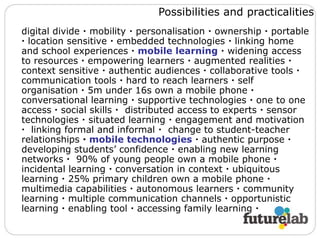
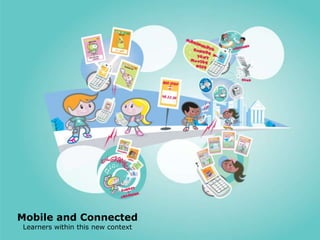
  • #4 Theoretically and empirically, there are many reasons that mobile learning has become of major interest to educationalists, learners and policy makers. Throughout this presentation I hope to provide evidence of this interest, and indeed of this new paradigm, demonstrating the opportunities for new involvement and investment in this area.However, before I do, to highlight a key distinction that is often blurred within the ‘mlearn’ community. I am talking today about mobile learning, not simply learning with mobile technologies. Although there is, of course, huge overlap between the two, my focus here is upon supporting a mobile learner to interact with experts and information; to become involved in tasks, conversations and social activity, across different temporal, spacial and domain contexts. The focus then is upon the person/group – not upon the mobile technology. For Nokia’s point of view then, the focus is upon services to support learners that cross (for example) home/school boundaries, accessible through personal (and shared) technologies.
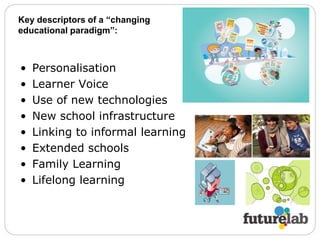
  • #6 Mainstream education is moving away from the Victorian/Fordist model of education. It is not easy – educational change is complex – but it is beginning to take shape. The key descriptors laid out in this slide describe a learning context that is about providing services and offerings around the need of the learner; that build on their interests, out of school learning and experiences, and that support not just classroom activities, but family learning and linking with the community. This is supported by well applied technologies that support new learning networks and access to tools, support and expertise where and when the learner requires it.Particularly at KS3 (and more so at KS2) – new opportunities within the school curricula to work in partnership with other learning organisations, such as museums, galleries. Now is the time to think about what new services you can offer that will enable stronger partnerships with schools as they are looking for these opportunities.
  • #7 To help describe these terms, some references have been inserted within the text. PersonalisationBuilding services around the need of the learner – content, support, time, place, tools etc. How can learning experiences be tailored to suit the needs of the learnerLearner Voice2008 Harnessing Technology 2 Strategy advocates a ‘learner driven’ education strategy in the use of ICT; but wider than the use of ICT, this is listening and acting upon the voice of learners in a negotiated curriculum – to lead towards greater personalisation.Use of new technologiesSupporting the above goals and appropriately applying technology to realise the sorts of activities highlighted above.10% of Build Schools for the Future funding is for ICT (about £1450 per pupil) – also investment in primary school rebuilds (Primary Capital Projects)Molenet funding - £10m over 2 years just for mobile technologies within HE (new partnerships and networks etc)New school Infrastructure£14bn spent on renewing, rebuilding schools and their infrastructure. Early builds were criticised for renewing existing practices and traditions, but more recently more focus has been spent upon visioning, of understanding new educational challenges and building for this new approach for the provision of education.
  • #8 DFES to DSCF – in name and focusFunding for home access broadband (parental choice of device)Becta responsibility for family learningInvestigating into the Future of Lifelong Learning (NIACE – National Institute for Adult Continued Education)Particularly change in delivery model of learning. Not using mobile devices as ‘third screen’ to deliver educational content, but enabling the learner to access the data, information and knowledge that they want, when they want.Not teacher controlled content, but learner accessible devicesThere is still a core entitlement. There are still assessment goals. There is still a role for domain expertise and subject knowledge – but there is more emphasis upon the learner’s rights, expectations and voice.
  • #15 Links to useful resources
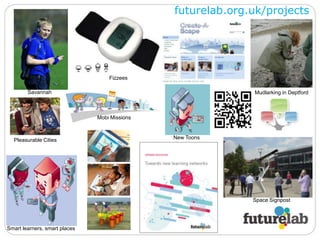
  • #16 A whole range of Futurelab projects that have investigated the nature of mobile learning, the opportunities and challenges it presents – set within this new educational paradigm.www.futurelab.org.uk/projects
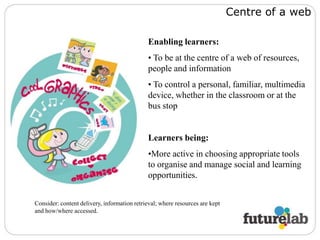
  • #17 Enquiring Minds is an approach to teaching and learning, developed by Futurelab- funded by Microsoft, that takes students’ ideas, interests and experiences as its starting point, and provides them with more responsibility for the direction and content of their learning. Negotiated curriculum. Involves family, community services, community spaces and requires a whole new type of expertise from the teacher, new resources for the learner and new ways to access and share information, resources and people.Supporting the mobile learner in the school, in the home, in the community etc. It is an example of how a learning service – in this case a curriculum – can be developed around the needs of the learner in a reactive way.Over30 schools have now developed this approach since the research finished in June 2008
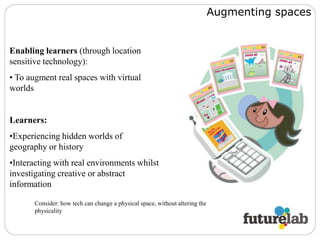
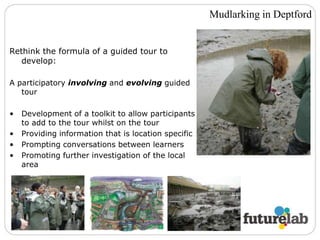
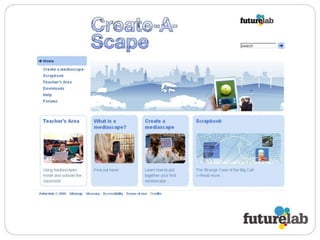
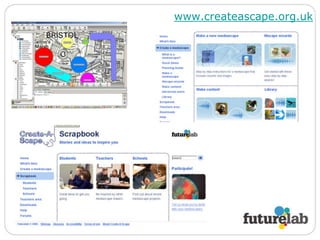
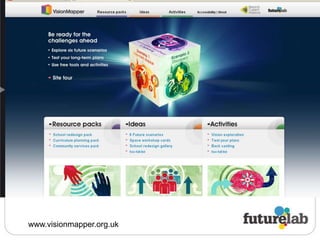
  • #21 Providing the tools to support teachers and learners to create mediascapes – media rich augmented experiences of a real location. Moving beyond activities pre-determined centrally, to providing the tools for local authorship and importantly local ownership. The sorts of activities this has been used for: imagining possible futures, creating school tours, investigating things on a macro scale (local history) and micro scale (blood and the human body).Importantly though, this is an authoring tool, a resource bank, a site for sharing and communicating.
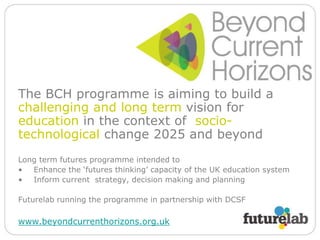
  • #25 Working with the Department for Children, Schools and Families – this programme is investigating possible social and technological changes 2025 and beyond, and then to understand the implications for education. It is an example of a greater emphasis upon a systematic investigation of the future and of future need; which in turn (along with other programme of research) is providing the evidence to support the sorts of changes I have detailed in this brief presentation.In order to prepare for this uncertain future then, I would suggest that investment in education – across the lifecourse – will increase in order to ensure there is appropriate preparation for an uncertain future.
  • #27 A short presentation then, and a brief overview into the possibilities of change within formal education at the moment.The main challenges for considering new approaches in mobile learning:A new paradigm – how can museums, galleries work with (and complement schools)To think of enabling learners, rather than providing content