Blended learning in primary school

      a case of a learning process between
the physical classroom and online environments

  by Francesca Ravanelli, PhD University Bolzano
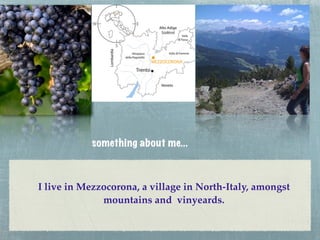
something about me...


I live in Mezzocorona, a village in North-Italy, amongst
              mountains and vinyeards.
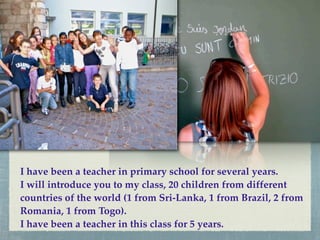
I have been a teacher in primary school for several years.
I will introduce you to my class, 20 children from different
countries of the world (1 from Sri-Lanka, 1 from Brazil, 2 from
Romania, 1 from Togo).
I have been a teacher in this class for 5 years.
I have always updated my teaching(knowledge and practices)
in the last years to make them more suitable to the needs of
new students and new society.
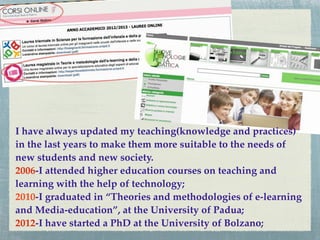
2006-I attended higher education courses on teaching and
learning with the help of technology;
2010-I graduated in “Theories and methodologies of e-learning
and Media-education”, at the University of Padua;
2012-I have started a PhD at the University of Bolzano;
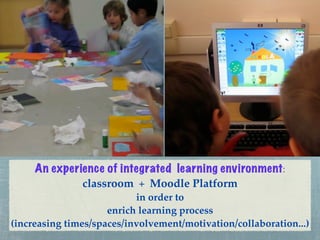
An experience of integrated learning environment:
              classroom + Moodle Platform
                           in order to
                     enrich learning process
(increasing times/spaces/involvement/motivation/collaboration...)
Where? In a primary class

When e How long? From 2007 to 2012. It has been a five
years long project

Who? My students and their parents, any other
colleague and obviously myself

Why? I wanted to take advantage of the opportunities
that digital tools give in order to enrich learning
processes and to break down the boundaries between
school and home, expanding times and spaces of
learning, taking the school at home and in the family.
The questions...
How can we enhance and extend learning
in order to bring the school into the life
of students?

How can we adapt Multimedia to
enhance human learning?

How can technologies help build
learning communities?
The theoretical premisis of this
               work
Our Students : Digital Natives

Collaborative construction of knowledge

The significance of metacognition

The multiple intelligences

Learning enviroments and learning communities

Multimedia learning

Emotional Intelligence
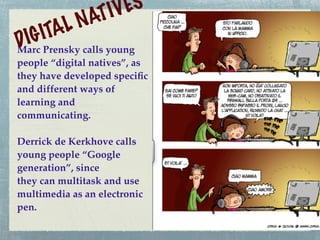
IV ES
          LN AT
DIG ITA
Marc Prensky calls young
people “digital natives”, as
they have developed specific
and different ways of
learning and
communicating.

Derrick de Kerkhove calls
young people “Google
generation”, since
they can multitask and use
multimedia as an electronic
pen.
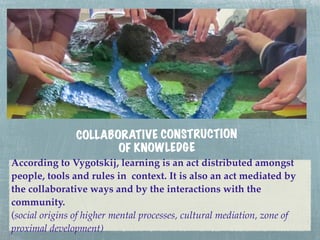
COLLAB ORATIV E CONSTRUCT ION
                        OF KNOWLEDGE
According to Vygotskij, learning is an act distributed amongst
people, tools and rules in context. It is also an act mediated by
the collaborative ways and by the interactions with the
community.
(social origins of higher mental processes, cultural mediation, zone of
proximal development)
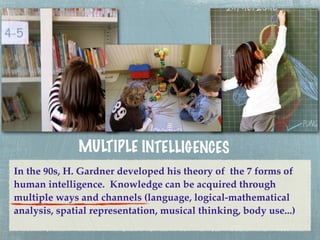
MULTIP LE INTELLIGENCES
In the 90s, H. Gardner developed his theory of the 7 forms of
human intelligence. Knowledge can be acquired through
multiple ways and channels (language, logical-mathematical
analysis, spatial representation, musical thinking, body use...)
RN I NG
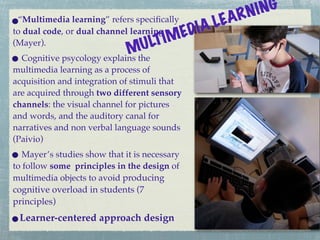
 “Multimedia learning” refers specifically
                                               I AL EA
to dual code, or dual channel learning
                                       IM ED
(Mayer).
                            M   U LT
  Cognitive psycology explains the
multimedia learning as a process of
acquisition and integration of stimuli that
are acquired through two different sensory
channels: the visual channel for pictures
and words, and the auditory canal for
narratives and non verbal language sounds
(Paivio)
   Mayer’s studies show that it is necessary
to follow some principles in the design of
multimedia objects to avoid producing
cognitive overload in students (7
principles)
 Learner-centered approach design
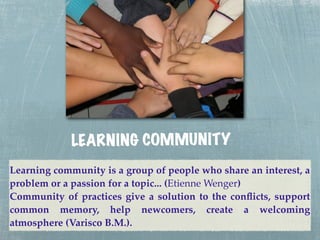
LEA RN ING COMMUN ITY
Learning community is a group of people who share an interest, a
problem or a passion for a topic... (Etienne Wenger)
Community of practices give a solution to the conflicts, support
common memory, help newcomers, create a welcoming
atmosphere (Varisco B.M.).
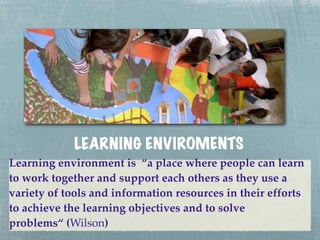
LEARNING ENVIROME NTS
Learning environment is “a place where people can learn
to work together and support each others as they use a
variety of tools and information resources in their efforts
to achieve the learning objectives and to solve
problems“ (Wilson)
EMOTIONAL INTELLIGENCE

D. Goleman defines this kind of intelligence as “the ability to
recognize our feelings and those of others from motivating
ourselves and to manage our emotions positively, both
internally and socially”.
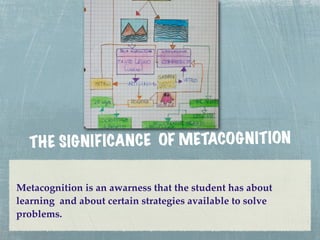
T H E SI G N IFICA NCE OF M ETACOG N IT ION

Metacognition is an awarness that the student has about
learning and about certain strategies available to solve
problems.
THE NEW CITIZENSHIP SKILLS defined by
the European Union

 Communication in the mother tongue

 Communication in foreign languages

 Mathematical competences and basic competences in science and technology

 Digital competence

 Learning to learn

 Social and civic competence

 Sense of iniziative and entrepreneurship

 Cultural awarness and expression
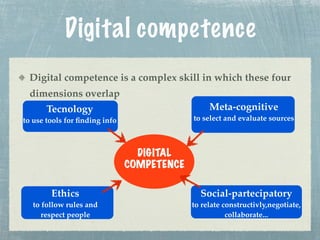
Digital competence
 Digital competence is a complex skill in which these four
 dimensions overlap
       Tecnology                                 Meta-cognitive
to use tools for finding info                to select and evaluate sources


                                 DIGITAL
                               COMPETENCE

        Ethics                                Social-partecipatory
  to follow rules and                       to relate constructivly,negotiate,
     respect people                                    collaborate...
...in order to integrate TECHNOLOGY
   IN THE LEARNING PROCESS

 Jonassen says “We think technology as a cognitive
 tool”

 This tool can help interconnect people and
 knowledge, individuals with the groups, the specific
 discipline with the complexity of thought

 This tool can also help students to achieve a “well
 built mind”, advocated by Edgar Morin
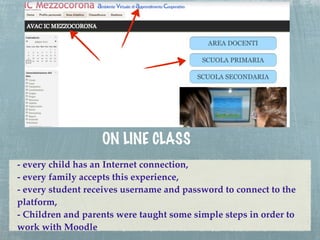
ON LINE CLASS
- every child has an Internet connection,
- every family accepts this experience,
- every student receives username and password to connect to the
platform,
- Children and parents were taught some simple steps in order to
work with Moodle
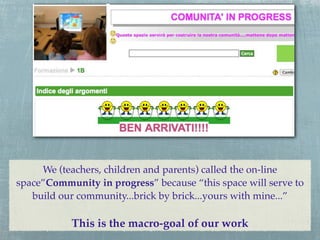
We (teachers, children and parents) called the on-line
space”Community in progress” because “this space will serve to
   build our community...brick by brick...yours with mine...”

           This is the macro-goal of our work
sub-goals
to learn to use technology in a safe environment

to expand times and spaces of learning

to create an archive of documents about activities in the classroom (photos,
films...)

to give voice to all children and their parents (forums, questionnaires, surveys...)

to mediate the relationship between the students and Internet (in order to
develop critical thinking)

to increase the relationship between pupils and teachers (chat, messaging,
forums)

to increase the time of cooperative learning (wiki)

to integrate the educational resources with multimedia and interactive sources

to allow the sick students to attend lessons too (blended learning)
AN ON-LINE CLASS
 HAS ALLOWED...
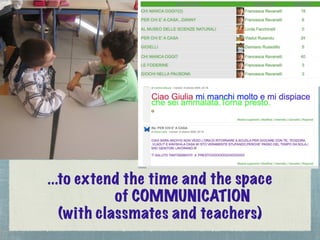
...to extend the time and the space
            of COMMUNICATION
   (with classmates and teachers)
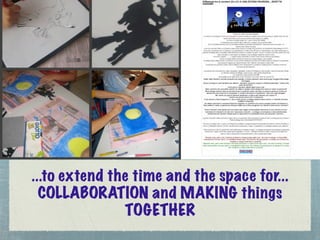
...to extend the time and the space for...
  COLLABORATION and MAKING things
               TOGETHER
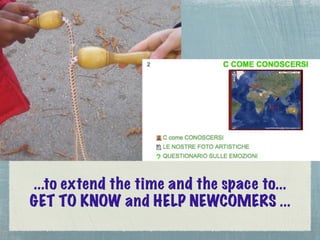
...to extend the time and the space to...
GET TO KNOW and HELP NEWCOMERS ...
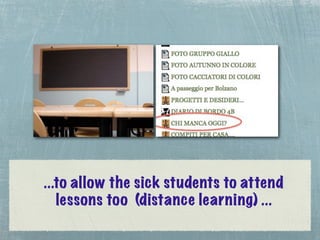
...to allow the sick students to attend
   lessons too (distance learning) ...
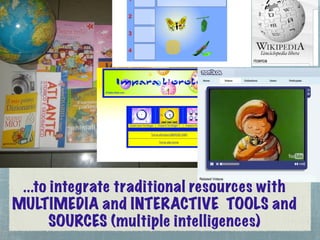
...to integrate traditional resources with
MULTIMEDIA and INTERACTIVE TOOLS and
       SOURCES (multiple intelligences)
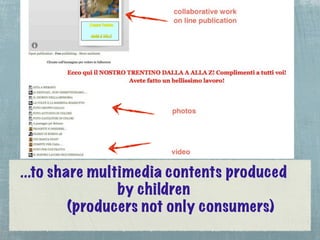
...to share multimedia contents produced
                by children
         (producers not only consumers)
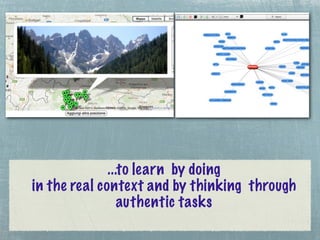
...to learn by doing
in the real context and by thinking through
                 authentic tasks
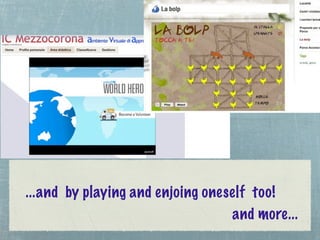
...and by playing and enjoing oneself too!
                                  and more...
and more...
...to involve actively parents in the learning path (fathers as
well)

...to go to school with less anxiety and fear, always finding a
teacher who listens to you

...to become aware users of Internet

...to support cultural development of the family, that becomes
an input for research, exploration, both in the network and in
the real context

...to personalize learning path for children with special needs

...to use technology in proactive and creative way
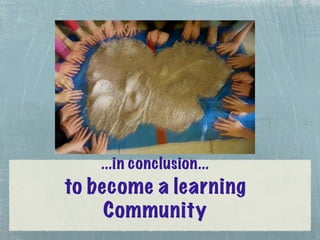
...in conclusion...
to become a learning
     Community
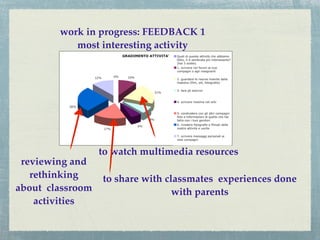
work in progress: FEEDBACK 1
           most interesting activity


                  to watch multimedia resources
 reviewing and
   rethinking     to share with classmates experiences done
about classroom                   with parents
    activities
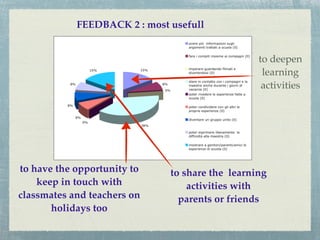
FEEDBACK 2 : most usefull


                                                 to deepen
                                                  learning
                                                  activities


to have the opportunity to    to share the learning
    keep in touch with            activities with
classmates and teachers on      parents or friends
       holidays too
What should the theacher do? ...some
suggestions of mine...

to pay attention to the design of the v.e. (simple and welcoming
atmosphere)

to arrange the resources and activities clearly

to be really present in v.e.(responding, supporting, providing
scaffolding, monitoring, helping...)

to pay attention to the communicative aspects (emoticons or
graphic features)

to document all of the physical classroom’s experiences (photo,
video...) and share them in v.e.
Some critical aspects...
 teachers need some (simple) digital skills

 teacher should extend their teaching time beyond the school
 time

 teachers should change their teaching method, from the
 transmission of content to the organization of research and
 relationships for the construction of knowledge

 Internet connection is required

 Confidence and cooperation of parents are required
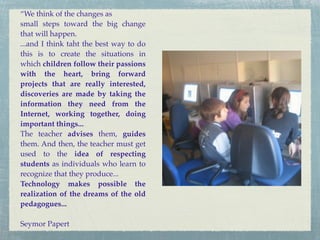
“We think of the changes as
small steps toward the big change
that will happen.
...and I think taht the best way to do
this is to create the situations in
which children follow their passions
with the heart, bring forward
projects that are really interested,
discoveries are made by taking the
information they need from the
Internet, working together, doing
important things...
The teacher advises them, guides
them. And then, the teacher must get
used to the idea of respecting
students as individuals who learn to
recognize that they produce...
Technology makes possible the
realization of the dreams of the old
pedagogues...

Seymor Papert
T E NT ION . . .
                   R YO U R AT
      T HA NK FO
                                      Questions?
                              francescaravanelli@yahoo.it


                                      Comments...
                          http://francescaframes.blogspot.com


                                         Sharing
                               http://www.slideshare.net/
                                      francescashare

                               http://www.slideshare.net/
                                     francescaframes

Conference Diverse2012, 4 luglio 2012, Leuven Be

Blended learning in Primary School

  • 1.
    Blended learning inprimary school a case of a learning process between the physical classroom and online environments by Francesca Ravanelli, PhD University Bolzano
  • 2.
    something about me... Ilive in Mezzocorona, a village in North-Italy, amongst mountains and vinyeards.
  • 3.
    I have beena teacher in primary school for several years. I will introduce you to my class, 20 children from different countries of the world (1 from Sri-Lanka, 1 from Brazil, 2 from Romania, 1 from Togo). I have been a teacher in this class for 5 years.
  • 4.
    I have alwaysupdated my teaching(knowledge and practices) in the last years to make them more suitable to the needs of new students and new society. 2006-I attended higher education courses on teaching and learning with the help of technology; 2010-I graduated in “Theories and methodologies of e-learning and Media-education”, at the University of Padua; 2012-I have started a PhD at the University of Bolzano;
  • 5.
    An experience ofintegrated learning environment: classroom + Moodle Platform in order to enrich learning process (increasing times/spaces/involvement/motivation/collaboration...)
  • 6.
    Where? In aprimary class When e How long? From 2007 to 2012. It has been a five years long project Who? My students and their parents, any other colleague and obviously myself Why? I wanted to take advantage of the opportunities that digital tools give in order to enrich learning processes and to break down the boundaries between school and home, expanding times and spaces of learning, taking the school at home and in the family.
  • 7.
    The questions... How canwe enhance and extend learning in order to bring the school into the life of students? How can we adapt Multimedia to enhance human learning? How can technologies help build learning communities?
  • 8.
    The theoretical premisisof this work Our Students : Digital Natives Collaborative construction of knowledge The significance of metacognition The multiple intelligences Learning enviroments and learning communities Multimedia learning Emotional Intelligence
  • 9.
    IV ES LN AT DIG ITA Marc Prensky calls young people “digital natives”, as they have developed specific and different ways of learning and communicating. Derrick de Kerkhove calls young people “Google generation”, since they can multitask and use multimedia as an electronic pen.
  • 10.
    COLLAB ORATIV ECONSTRUCT ION OF KNOWLEDGE According to Vygotskij, learning is an act distributed amongst people, tools and rules in context. It is also an act mediated by the collaborative ways and by the interactions with the community. (social origins of higher mental processes, cultural mediation, zone of proximal development)
  • 11.
    MULTIP LE INTELLIGENCES Inthe 90s, H. Gardner developed his theory of the 7 forms of human intelligence. Knowledge can be acquired through multiple ways and channels (language, logical-mathematical analysis, spatial representation, musical thinking, body use...)
  • 12.
    RN I NG “Multimedia learning” refers specifically I AL EA to dual code, or dual channel learning IM ED (Mayer). M U LT Cognitive psycology explains the multimedia learning as a process of acquisition and integration of stimuli that are acquired through two different sensory channels: the visual channel for pictures and words, and the auditory canal for narratives and non verbal language sounds (Paivio) Mayer’s studies show that it is necessary to follow some principles in the design of multimedia objects to avoid producing cognitive overload in students (7 principles) Learner-centered approach design
  • 13.
    LEA RN INGCOMMUN ITY Learning community is a group of people who share an interest, a problem or a passion for a topic... (Etienne Wenger) Community of practices give a solution to the conflicts, support common memory, help newcomers, create a welcoming atmosphere (Varisco B.M.).
  • 14.
    LEARNING ENVIROME NTS Learningenvironment is “a place where people can learn to work together and support each others as they use a variety of tools and information resources in their efforts to achieve the learning objectives and to solve problems“ (Wilson)
  • 15.
    EMOTIONAL INTELLIGENCE D. Golemandefines this kind of intelligence as “the ability to recognize our feelings and those of others from motivating ourselves and to manage our emotions positively, both internally and socially”.
  • 16.
    T H ESI G N IFICA NCE OF M ETACOG N IT ION Metacognition is an awarness that the student has about learning and about certain strategies available to solve problems.
  • 17.
    THE NEW CITIZENSHIPSKILLS defined by the European Union Communication in the mother tongue Communication in foreign languages Mathematical competences and basic competences in science and technology Digital competence Learning to learn Social and civic competence Sense of iniziative and entrepreneurship Cultural awarness and expression
  • 18.
    Digital competence Digitalcompetence is a complex skill in which these four dimensions overlap Tecnology Meta-cognitive to use tools for finding info to select and evaluate sources DIGITAL COMPETENCE Ethics Social-partecipatory to follow rules and to relate constructivly,negotiate, respect people collaborate...
  • 19.
    ...in order tointegrate TECHNOLOGY IN THE LEARNING PROCESS Jonassen says “We think technology as a cognitive tool” This tool can help interconnect people and knowledge, individuals with the groups, the specific discipline with the complexity of thought This tool can also help students to achieve a “well built mind”, advocated by Edgar Morin
  • 20.
    ON LINE CLASS -every child has an Internet connection, - every family accepts this experience, - every student receives username and password to connect to the platform, - Children and parents were taught some simple steps in order to work with Moodle
  • 21.
    We (teachers, childrenand parents) called the on-line space”Community in progress” because “this space will serve to build our community...brick by brick...yours with mine...” This is the macro-goal of our work
  • 22.
    sub-goals to learn touse technology in a safe environment to expand times and spaces of learning to create an archive of documents about activities in the classroom (photos, films...) to give voice to all children and their parents (forums, questionnaires, surveys...) to mediate the relationship between the students and Internet (in order to develop critical thinking) to increase the relationship between pupils and teachers (chat, messaging, forums) to increase the time of cooperative learning (wiki) to integrate the educational resources with multimedia and interactive sources to allow the sick students to attend lessons too (blended learning)
  • 23.
    AN ON-LINE CLASS HAS ALLOWED...
  • 24.
    ...to extend thetime and the space of COMMUNICATION (with classmates and teachers)
  • 25.
    ...to extend thetime and the space for... COLLABORATION and MAKING things TOGETHER
  • 26.
    ...to extend thetime and the space to... GET TO KNOW and HELP NEWCOMERS ...
  • 27.
    ...to allow thesick students to attend lessons too (distance learning) ...
  • 28.
    ...to integrate traditionalresources with MULTIMEDIA and INTERACTIVE TOOLS and SOURCES (multiple intelligences)
  • 29.
    ...to share multimediacontents produced by children (producers not only consumers)
  • 30.
    ...to learn bydoing in the real context and by thinking through authentic tasks
  • 31.
    ...and by playingand enjoing oneself too! and more...
  • 32.
    and more... ...to involveactively parents in the learning path (fathers as well) ...to go to school with less anxiety and fear, always finding a teacher who listens to you ...to become aware users of Internet ...to support cultural development of the family, that becomes an input for research, exploration, both in the network and in the real context ...to personalize learning path for children with special needs ...to use technology in proactive and creative way
  • 33.
    ...in conclusion... to becomea learning Community
  • 34.
    work in progress:FEEDBACK 1 most interesting activity to watch multimedia resources reviewing and rethinking to share with classmates experiences done about classroom with parents activities
  • 35.
    FEEDBACK 2 :most usefull to deepen learning activities to have the opportunity to to share the learning keep in touch with activities with classmates and teachers on parents or friends holidays too
  • 36.
    What should thetheacher do? ...some suggestions of mine... to pay attention to the design of the v.e. (simple and welcoming atmosphere) to arrange the resources and activities clearly to be really present in v.e.(responding, supporting, providing scaffolding, monitoring, helping...) to pay attention to the communicative aspects (emoticons or graphic features) to document all of the physical classroom’s experiences (photo, video...) and share them in v.e.
  • 37.
    Some critical aspects... teachers need some (simple) digital skills teacher should extend their teaching time beyond the school time teachers should change their teaching method, from the transmission of content to the organization of research and relationships for the construction of knowledge Internet connection is required Confidence and cooperation of parents are required
  • 38.
    “We think ofthe changes as small steps toward the big change that will happen. ...and I think taht the best way to do this is to create the situations in which children follow their passions with the heart, bring forward projects that are really interested, discoveries are made by taking the information they need from the Internet, working together, doing important things... The teacher advises them, guides them. And then, the teacher must get used to the idea of respecting students as individuals who learn to recognize that they produce... Technology makes possible the realization of the dreams of the old pedagogues... Seymor Papert
  • 39.
    T E NTION . . . R YO U R AT T HA NK FO Questions? francescaravanelli@yahoo.it Comments... http://francescaframes.blogspot.com Sharing http://www.slideshare.net/ francescashare http://www.slideshare.net/ francescaframes Conference Diverse2012, 4 luglio 2012, Leuven Be