Designing Learning for the 21st Century | 21CLD | 15/7/2013
Designing Learning for
the 21st Century
21CLD
1
1Saturday, 13 July 13
Designing Learning for the 21st Century | 21CLD | 15/7/2013
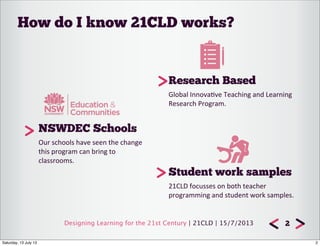
How do I know 21CLD works?
2
Our	
  schools	
  have	
  seen	
  the	
  change	
  
this	
  program	
  can	
  bring	
  to	
  
classrooms.
NSWDEC Schools
Research Based
Student work samples
Global	
  Innova7ve	
  Teaching	
  and	
  Learning	
  
Research	
  Program.	
  
21CLD	
  focusses	
  on	
  both	
  teacher	
  
programming	
  and	
  student	
  work	
  samples.
2Saturday, 13 July 13
Designing Learning for the 21st Century | 21CLD | 15/7/2013
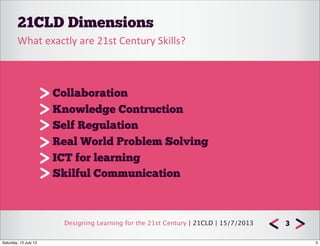
21CLD Dimensions
3
Collaboration
Knowledge Contruction
Self Regulation
Real World Problem Solving
ICT for learning
Skilful Communication	
  
What	
  exactly	
  are	
  21st	
  Century	
  Skills?	
  
3Saturday, 13 July 13
Designing Learning for the 21st Century | 21CLD | 15/7/2013
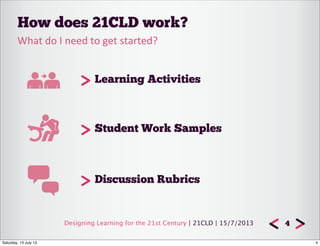
How does 21CLD work?
4
What	
  do	
  I	
  need	
  to	
  get	
  started?	
  
Student Work Samples
Learning Activities
Discussion Rubrics
4Saturday, 13 July 13
Designing Learning for the 21st Century | 21CLD | 15/7/2013 5
{
Effective collaboration
occurs when learners work
together to achieve results
or outcomes that are too
complex to do on their own,
or that they could not do as
well on their own. }
Collaboration
5Saturday, 13 July 13
Designing Learning for the 21st Century | 21CLD | 15/7/2013
Collaboration
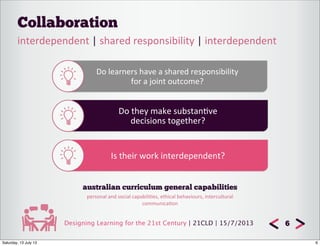
6
Do	
  learners	
  have	
  a	
  shared	
  responsibility	
  
for	
  a	
  joint	
  outcome?
Do	
  they	
  make	
  substan7ve	
  
decisions	
  together?
Is	
  their	
  work	
  interdependent?
interdependent	
  |	
  shared	
  responsibility	
  |	
  interdependent
australian curriculum general capabilities
personal	
  and	
  social	
  capabili8es,	
  ethical	
  behaviours,	
  intercultural	
  
communica8on
6Saturday, 13 July 13
Designing Learning for the 21st Century | 21CLD | 15/7/2013
Collaboration
7
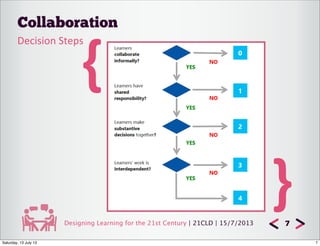
Decision	
  Steps
{
}
7Saturday, 13 July 13
Designing Learning for the 21st Century | 21CLD | 15/7/2013 8
{ Knowledge construction
activities require students
to generate ideas and
understandings that are
new to them. Students can
do this through
interpretation, analysis,
synthesis, or evaluation.
}
Knowledge Construction
8Saturday, 13 July 13
Designing Learning for the 21st Century | 21CLD | 15/7/2013
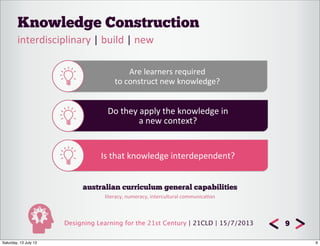
Knowledge Construction
9
interdisciplinary	
  |	
  build	
  |	
  new
Are	
  learners	
  required	
  
to	
  construct	
  new	
  knowledge?
Do	
  they	
  apply	
  the	
  knowledge	
  in
a	
  new	
  context?
Is	
  that	
  knowledge	
  interdependent?
australian curriculum general capabilities
literacy,	
  numeracy,	
  intercultural	
  communica8on
9Saturday, 13 July 13
Designing Learning for the 21st Century | 21CLD | 15/7/2013
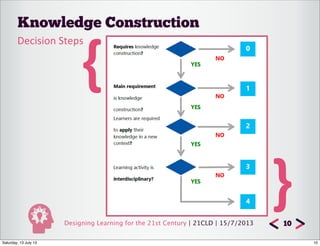
Knowledge Construction
10
Decision	
  Steps
{
}
10Saturday, 13 July 13
Designing Learning for the 21st Century | 21CLD | 15/7/2013 11
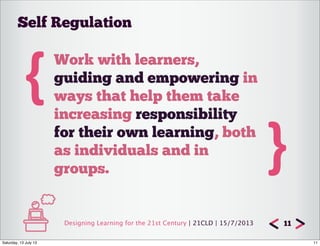
{Work with learners,
guiding and empowering in
ways that help them take
increasing responsibility
for their own learning, both
as individuals and in
groups.
}
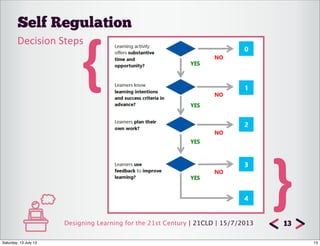
Self Regulation
11Saturday, 13 July 13
Designing Learning for the 21st Century | 21CLD | 15/7/2013
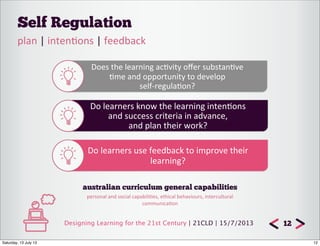
Self Regulation
12
plan	
  |	
  inten7ons	
  |	
  feedback
Does	
  the	
  learning	
  ac8vity	
  offer	
  substan8ve
8me	
  and	
  opportunity	
  to	
  develop
self-­‐regula8on?
Do	
  learners	
  know	
  the	
  learning	
  inten7ons
and	
  success	
  criteria	
  in	
  advance,	
  
and	
  plan	
  their	
  work?
Do	
  learners	
  use	
  feedback	
  to	
  improve	
  their	
  
learning?
australian curriculum general capabilities
personal	
  and	
  social	
  capabili8es,	
  ethical	
  behaviours,	
  intercultural	
  
communica8on
12Saturday, 13 July 13
Designing Learning for the 21st Century | 21CLD | 15/7/2013
Self Regulation
13
Decision	
  Steps
{
}
13Saturday, 13 July 13
Designing Learning for the 21st Century | 21CLD | 15/7/2013 14
{ Real-world problems are
authentic situations and
needs that exist outside an
academic context.
Innovation requires putting
students’ ideas or solutions
into practice in the real
world. }
Real World Problem Solving and
Innovation
14Saturday, 13 July 13
Designing Learning for the 21st Century | 21CLD | 15/7/2013
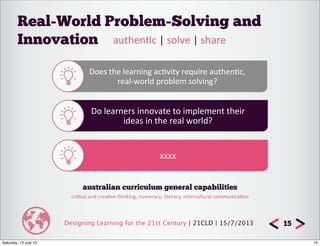
Real-World Problem-Solving and
Innovation
15
authen7c	
  |	
  solve	
  |	
  share
Does	
  the	
  learning	
  ac8vity	
  require	
  authen8c,
real-­‐world	
  problem	
  solving?
Do	
  learners	
  innovate	
  to	
  implement	
  their
ideas	
  in	
  the	
  real	
  world?
xxxx
australian curriculum general capabilities
cri8cal	
  and	
  crea8ve	
  thinking,	
  numeracy,	
  literacy,	
  intercultural	
  communica8on
15Saturday, 13 July 13
Designing Learning for the 21st Century | 21CLD | 15/7/2013
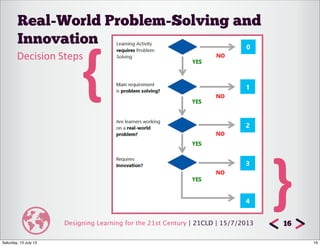
Real-World Problem-Solving and
Innovation
16
Decision	
  Steps
{
}
16Saturday, 13 July 13
Designing Learning for the 21st Century | 21CLD | 15/7/2013 17
{ Learners use ICT to design
and create new knowledge,
understandings, solutions,
ideas or products for
authentic audiences and
users.
}
ICT for learning
17Saturday, 13 July 13
Designing Learning for the 21st Century | 21CLD | 15/7/2013
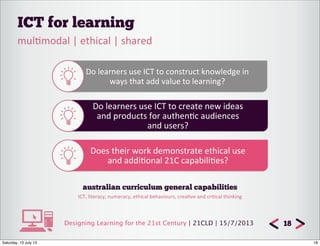
ICT for learning
18
mul7modal	
  |	
  ethical	
  |	
  shared
Do	
  learners	
  use	
  ICT	
  to	
  construct	
  knowledge	
  in
ways	
  that	
  add	
  value	
  to	
  learning?
Do	
  learners	
  use	
  ICT	
  to	
  create	
  new	
  ideas
and	
  products	
  for	
  authen7c	
  audiences
and	
  users?
Does	
  their	
  work	
  demonstrate	
  ethical	
  use
and	
  addi7onal	
  21C	
  capabili7es?
australian curriculum general capabilities
ICT,	
  literacy,	
  numeracy,	
  ethical	
  behaviours,	
  crea8ve	
  and	
  cri8cal	
  thinking
18Saturday, 13 July 13
Designing Learning for the 21st Century | 21CLD | 15/7/2013
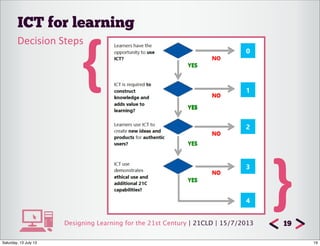
ICT for learning
19
Decision	
  Steps
{
}
19Saturday, 13 July 13
Designing Learning for the 21st Century | 21CLD | 15/7/2013 20
{
Connected and coherent
thought is evident in a
range of communication
modes, whether it achieves
an authentic purpose for a
particular audience, and
whether the
communication is
substantive and multi-
modal in nature.
}
Skilful Communication
20Saturday, 13 July 13
Designing Learning for the 21st Century | 21CLD | 15/7/2013
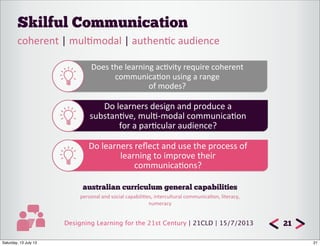
Skilful Communication
21
coherent	
  |	
  mul7modal	
  |	
  authen7c	
  audience
Does	
  the	
  learning	
  ac8vity	
  require	
  coherent
communica8on	
  using	
  a	
  range
of	
  modes?
Do	
  learners	
  design	
  and	
  produce	
  a
substan7ve,	
  mul7-­‐modal	
  communica7on	
  
for	
  a	
  par7cular	
  audience?
Do	
  learners	
  reflect	
  and	
  use	
  the	
  process	
  of
learning	
  to	
  improve	
  their
communica7ons?
australian curriculum general capabilities
personal	
  and	
  social	
  capabili8es,	
  intercultural	
  communica8on,	
  literacy,	
  
numeracy
21Saturday, 13 July 13
Designing Learning for the 21st Century | 21CLD | 15/7/2013
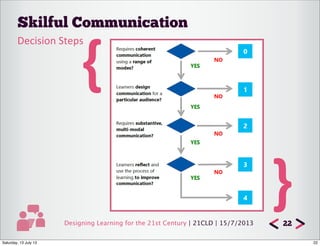
Skilful Communication
22
Decision	
  Steps
{
}
22Saturday, 13 July 13
Designing Learning for the 21st Century | 21CLD | 15/7/2013
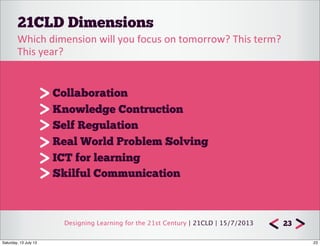
21CLD Dimensions
23
Collaboration
Knowledge Contruction
Self Regulation
Real World Problem Solving
ICT for learning
Skilful Communication	
  
Which	
  dimension	
  will	
  you	
  focus	
  on	
  tomorrow?	
  This	
  term?	
  
This	
  year?
23Saturday, 13 July 13
Designing Learning for the 21st Century | 21CLD | 15/7/2013
21CLD LINKS
24
•Merrylands	
  East	
  Public	
  School
•Campbelltown	
  Performing	
  Arts	
  High	
  School
•Tuggerah	
  Lakes	
  Secondary	
  College	
  -­‐	


Tumbi	
  Umbi	
  Campus
Where	
  can	
  I	
  find	
  more	
  informa7on?	
  
NSWDEC Schools
21CLD Community
Partners	
  in	
  Learning	
  Network	
  21CLD	
  info
hTp://www.pil-­‐network.com/pd/21CLD/
Overview	
  
This presentation
NSWDEC Contacts
ITL Research
hTp://bit.ly/mhs1507	
  
Pip	
  Cleaves:	
  phillippa.cleaves@det.nsw.edu.au
Laurens	
  Derks:	
  laurens.derks@det.nsw.edu.au	
  
Joachim	
  Cohen:	
  joachim.cohen@det.nsw.edu.au	
  
hTp://www.itlresearch.com/
24Saturday, 13 July 13

21st Century Learning Design - T3 SDD, Merrylands Community of Schools.

  • 1.
    Designing Learning forthe 21st Century | 21CLD | 15/7/2013 Designing Learning for the 21st Century 21CLD 1 1Saturday, 13 July 13
  • 2.
    Designing Learning forthe 21st Century | 21CLD | 15/7/2013 How do I know 21CLD works? 2 Our  schools  have  seen  the  change   this  program  can  bring  to   classrooms. NSWDEC Schools Research Based Student work samples Global  Innova7ve  Teaching  and  Learning   Research  Program.   21CLD  focusses  on  both  teacher   programming  and  student  work  samples. 2Saturday, 13 July 13
  • 3.
    Designing Learning forthe 21st Century | 21CLD | 15/7/2013 21CLD Dimensions 3 Collaboration Knowledge Contruction Self Regulation Real World Problem Solving ICT for learning Skilful Communication   What  exactly  are  21st  Century  Skills?   3Saturday, 13 July 13
  • 4.
    Designing Learning forthe 21st Century | 21CLD | 15/7/2013 How does 21CLD work? 4 What  do  I  need  to  get  started?   Student Work Samples Learning Activities Discussion Rubrics 4Saturday, 13 July 13
  • 5.
    Designing Learning forthe 21st Century | 21CLD | 15/7/2013 5 { Effective collaboration occurs when learners work together to achieve results or outcomes that are too complex to do on their own, or that they could not do as well on their own. } Collaboration 5Saturday, 13 July 13
  • 6.
    Designing Learning forthe 21st Century | 21CLD | 15/7/2013 Collaboration 6 Do  learners  have  a  shared  responsibility   for  a  joint  outcome? Do  they  make  substan7ve   decisions  together? Is  their  work  interdependent? interdependent  |  shared  responsibility  |  interdependent australian curriculum general capabilities personal  and  social  capabili8es,  ethical  behaviours,  intercultural   communica8on 6Saturday, 13 July 13
  • 7.
    Designing Learning forthe 21st Century | 21CLD | 15/7/2013 Collaboration 7 Decision  Steps { } 7Saturday, 13 July 13
  • 8.
    Designing Learning forthe 21st Century | 21CLD | 15/7/2013 8 { Knowledge construction activities require students to generate ideas and understandings that are new to them. Students can do this through interpretation, analysis, synthesis, or evaluation. } Knowledge Construction 8Saturday, 13 July 13
  • 9.
    Designing Learning forthe 21st Century | 21CLD | 15/7/2013 Knowledge Construction 9 interdisciplinary  |  build  |  new Are  learners  required   to  construct  new  knowledge? Do  they  apply  the  knowledge  in a  new  context? Is  that  knowledge  interdependent? australian curriculum general capabilities literacy,  numeracy,  intercultural  communica8on 9Saturday, 13 July 13
  • 10.
    Designing Learning forthe 21st Century | 21CLD | 15/7/2013 Knowledge Construction 10 Decision  Steps { } 10Saturday, 13 July 13
  • 11.
    Designing Learning forthe 21st Century | 21CLD | 15/7/2013 11 {Work with learners, guiding and empowering in ways that help them take increasing responsibility for their own learning, both as individuals and in groups. } Self Regulation 11Saturday, 13 July 13
  • 12.
    Designing Learning forthe 21st Century | 21CLD | 15/7/2013 Self Regulation 12 plan  |  inten7ons  |  feedback Does  the  learning  ac8vity  offer  substan8ve 8me  and  opportunity  to  develop self-­‐regula8on? Do  learners  know  the  learning  inten7ons and  success  criteria  in  advance,   and  plan  their  work? Do  learners  use  feedback  to  improve  their   learning? australian curriculum general capabilities personal  and  social  capabili8es,  ethical  behaviours,  intercultural   communica8on 12Saturday, 13 July 13
  • 13.
    Designing Learning forthe 21st Century | 21CLD | 15/7/2013 Self Regulation 13 Decision  Steps { } 13Saturday, 13 July 13
  • 14.
    Designing Learning forthe 21st Century | 21CLD | 15/7/2013 14 { Real-world problems are authentic situations and needs that exist outside an academic context. Innovation requires putting students’ ideas or solutions into practice in the real world. } Real World Problem Solving and Innovation 14Saturday, 13 July 13
  • 15.
    Designing Learning forthe 21st Century | 21CLD | 15/7/2013 Real-World Problem-Solving and Innovation 15 authen7c  |  solve  |  share Does  the  learning  ac8vity  require  authen8c, real-­‐world  problem  solving? Do  learners  innovate  to  implement  their ideas  in  the  real  world? xxxx australian curriculum general capabilities cri8cal  and  crea8ve  thinking,  numeracy,  literacy,  intercultural  communica8on 15Saturday, 13 July 13
  • 16.
    Designing Learning forthe 21st Century | 21CLD | 15/7/2013 Real-World Problem-Solving and Innovation 16 Decision  Steps { } 16Saturday, 13 July 13
  • 17.
    Designing Learning forthe 21st Century | 21CLD | 15/7/2013 17 { Learners use ICT to design and create new knowledge, understandings, solutions, ideas or products for authentic audiences and users. } ICT for learning 17Saturday, 13 July 13
  • 18.
    Designing Learning forthe 21st Century | 21CLD | 15/7/2013 ICT for learning 18 mul7modal  |  ethical  |  shared Do  learners  use  ICT  to  construct  knowledge  in ways  that  add  value  to  learning? Do  learners  use  ICT  to  create  new  ideas and  products  for  authen7c  audiences and  users? Does  their  work  demonstrate  ethical  use and  addi7onal  21C  capabili7es? australian curriculum general capabilities ICT,  literacy,  numeracy,  ethical  behaviours,  crea8ve  and  cri8cal  thinking 18Saturday, 13 July 13
  • 19.
    Designing Learning forthe 21st Century | 21CLD | 15/7/2013 ICT for learning 19 Decision  Steps { } 19Saturday, 13 July 13
  • 20.
    Designing Learning forthe 21st Century | 21CLD | 15/7/2013 20 { Connected and coherent thought is evident in a range of communication modes, whether it achieves an authentic purpose for a particular audience, and whether the communication is substantive and multi- modal in nature. } Skilful Communication 20Saturday, 13 July 13
  • 21.
    Designing Learning forthe 21st Century | 21CLD | 15/7/2013 Skilful Communication 21 coherent  |  mul7modal  |  authen7c  audience Does  the  learning  ac8vity  require  coherent communica8on  using  a  range of  modes? Do  learners  design  and  produce  a substan7ve,  mul7-­‐modal  communica7on   for  a  par7cular  audience? Do  learners  reflect  and  use  the  process  of learning  to  improve  their communica7ons? australian curriculum general capabilities personal  and  social  capabili8es,  intercultural  communica8on,  literacy,   numeracy 21Saturday, 13 July 13
  • 22.
    Designing Learning forthe 21st Century | 21CLD | 15/7/2013 Skilful Communication 22 Decision  Steps { } 22Saturday, 13 July 13
  • 23.
    Designing Learning forthe 21st Century | 21CLD | 15/7/2013 21CLD Dimensions 23 Collaboration Knowledge Contruction Self Regulation Real World Problem Solving ICT for learning Skilful Communication   Which  dimension  will  you  focus  on  tomorrow?  This  term?   This  year? 23Saturday, 13 July 13
  • 24.
    Designing Learning forthe 21st Century | 21CLD | 15/7/2013 21CLD LINKS 24 •Merrylands  East  Public  School •Campbelltown  Performing  Arts  High  School •Tuggerah  Lakes  Secondary  College  -­‐       Tumbi  Umbi  Campus Where  can  I  find  more  informa7on?   NSWDEC Schools 21CLD Community Partners  in  Learning  Network  21CLD  info hTp://www.pil-­‐network.com/pd/21CLD/ Overview   This presentation NSWDEC Contacts ITL Research hTp://bit.ly/mhs1507   Pip  Cleaves:  phillippa.cleaves@det.nsw.edu.au Laurens  Derks:  laurens.derks@det.nsw.edu.au   Joachim  Cohen:  joachim.cohen@det.nsw.edu.au   hTp://www.itlresearch.com/ 24Saturday, 13 July 13