ļ‚–
Arguments for Analyzing Contemporary Life in order to get
suggestions for Educational Objectives.
1.- Contemporary Life is so complex and life is continually
changing...do not waste time in learning things 50 years ago
important.
2.- The belief in transfer of training : using ā€œtrained mindā€ to
the conditions.
CONTEMPORARY LIFE
OUTSIDE THE SCHOOL
ļ‚–
Today there are commonly used arguments for analyzing
contemporary life:
 The first is that because contemporary life is so complex and also
because the life is continually changing, it is necessary to focus
educational efforts upon the critical aspects of this complex life.
 The second argument for the study of contemporary life grows out
of the findings relating to transfer of training.
 The students was given practices in seeking illustrations in his life
outside school for the application of things learned in school.
LIFE & LEARNING
SITUATIONS
ļ‚–
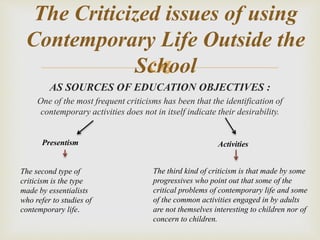
AS SOURCES OF EDUCATION OBJECTIVES :
One of the most frequent criticisms has been that the identification of
contemporary activities does not in itself indicate their desirability.
The Criticized issues of using
Contemporary Life Outside the
School
ActivitiesPresentism
The second type of
criticism is the type
made by essentialists
who refer to studies of
contemporary life.
The third kind of criticism is that made by some
progressives who point out that some of the
critical problems of contemporary life and some
of the common activities engaged in by adults
are not themselves interesting to children nor of
concern to children.
ļ‚–
Most common used in typical schools and colleges.
ļ‚™ Subject Specialists’ propose are too technical, too
specialized; inappropriate for a large number of the school
students.
ļ‚™ Too specialized for the layman.
ļ‚™ Too Specialized in objectives lead to the deeper conceptions
of the subject fields.
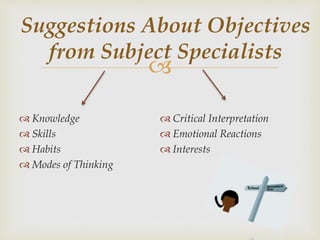
Suggestions About Objectives
from Subject Specialists
ļ‚–
ļ‚™ Knowledge
ļ‚™ Skills
ļ‚™ Habits
ļ‚™ Modes of Thinking
ļ‚™ Critical Interpretation
ļ‚™ Emotional Reactions
ļ‚™ Interests
Suggestions About Objectives
from Subject Specialists
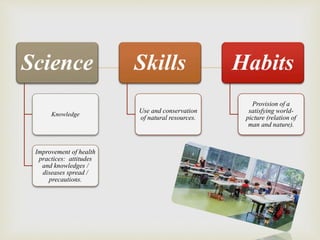
ļ‚–Science
Knowledge
Improvement of health
practices: attitudes
and knowledges /
diseases spread /
precautions.
Skills
Use and conservation
of natural resources.
Habits
Provision of a
satisfying world-
picture (relation of
man and nature).
ļ‚–
We came to the conclusion that every curriculum no matter what the
school is tries to answer these four main questions in different ways:
ļ‚™ 1. What educational
purposes should the school
seek to attain?
ļ‚™ 2. What educational
experiences can be provided
that are likely to attain these
purposes?
ļ‚™ 3. How can these
educational experiences be
effectively organized?
ļ‚™ 4. How can we determine
whether these purposes are
being obtained?
ļ‚™ Some schools design their
curriculum around situations that
students experience every day;.
ļ‚™ Other curriculums are centered
around preparing students for
situations they will encounter in
the future.
ļ‚™ Others are centered around values;
others are centered around
community needs, and yet others
are centered in subject areas like
family, school, health, religion and
so on.
ļ‚–
ļ‚™ Today there are two commonly used arguments for
analyzing contemporary life in order to get suggestions for
educational objectives.
ļ‚™ In making studies of life outside the school as un studying
the learner, it is necessary to divide life into various
phases in order to have manageable areas for
investigation.
CONCLUSIONS

Contemporary life-outside-the-school

  • 1.
    ļ‚– Arguments for AnalyzingContemporary Life in order to get suggestions for Educational Objectives. 1.- Contemporary Life is so complex and life is continually changing...do not waste time in learning things 50 years ago important. 2.- The belief in transfer of training : using ā€œtrained mindā€ to the conditions. CONTEMPORARY LIFE OUTSIDE THE SCHOOL
  • 2.
    ļ‚– Today there arecommonly used arguments for analyzing contemporary life:  The first is that because contemporary life is so complex and also because the life is continually changing, it is necessary to focus educational efforts upon the critical aspects of this complex life.  The second argument for the study of contemporary life grows out of the findings relating to transfer of training.  The students was given practices in seeking illustrations in his life outside school for the application of things learned in school. LIFE & LEARNING SITUATIONS
  • 3.
    ļ‚– AS SOURCES OFEDUCATION OBJECTIVES : One of the most frequent criticisms has been that the identification of contemporary activities does not in itself indicate their desirability. The Criticized issues of using Contemporary Life Outside the School ActivitiesPresentism The second type of criticism is the type made by essentialists who refer to studies of contemporary life. The third kind of criticism is that made by some progressives who point out that some of the critical problems of contemporary life and some of the common activities engaged in by adults are not themselves interesting to children nor of concern to children.
  • 4.
    ļ‚– Most common usedin typical schools and colleges. ļ‚™ Subject Specialists’ propose are too technical, too specialized; inappropriate for a large number of the school students. ļ‚™ Too specialized for the layman. ļ‚™ Too Specialized in objectives lead to the deeper conceptions of the subject fields. Suggestions About Objectives from Subject Specialists
  • 5.
    ļ‚– ļ‚™ Knowledge ļ‚™ Skills ļ‚™Habits ļ‚™ Modes of Thinking ļ‚™ Critical Interpretation ļ‚™ Emotional Reactions ļ‚™ Interests Suggestions About Objectives from Subject Specialists
  • 6.
    ļ‚–Science Knowledge Improvement of health practices:attitudes and knowledges / diseases spread / precautions. Skills Use and conservation of natural resources. Habits Provision of a satisfying world- picture (relation of man and nature).
  • 7.
    ļ‚– We came tothe conclusion that every curriculum no matter what the school is tries to answer these four main questions in different ways: ļ‚™ 1. What educational purposes should the school seek to attain? ļ‚™ 2. What educational experiences can be provided that are likely to attain these purposes? ļ‚™ 3. How can these educational experiences be effectively organized? ļ‚™ 4. How can we determine whether these purposes are being obtained? ļ‚™ Some schools design their curriculum around situations that students experience every day;. ļ‚™ Other curriculums are centered around preparing students for situations they will encounter in the future. ļ‚™ Others are centered around values; others are centered around community needs, and yet others are centered in subject areas like family, school, health, religion and so on.
  • 8.
    ļ‚– ļ‚™ Today thereare two commonly used arguments for analyzing contemporary life in order to get suggestions for educational objectives. ļ‚™ In making studies of life outside the school as un studying the learner, it is necessary to divide life into various phases in order to have manageable areas for investigation. CONCLUSIONS