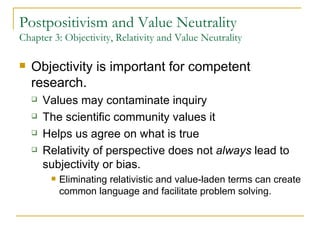
Postpositivism and Value Neutrality Chapter 3: Objectivity, Relativity and Value Neutrality Objectivity is important for competent research. Values may contaminate inquiry The scientific community values it Helps us agree on what is true Relativity of perspective does not  always  lead to subjectivity or bias. Eliminating relativistic and value-laden terms can create common language and facilitate problem solving.
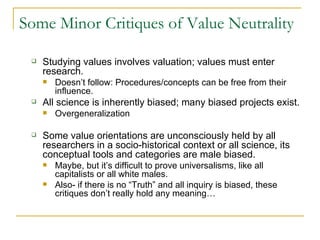
Some Minor Critiques of Value Neutrality Studying values involves valuation; values must enter research. Doesn’t follow: Procedures/concepts can be free from their influence.  All science is inherently biased; many biased projects exist. Overgeneralization Some value orientations are unconsciously held by all researchers in a socio-historical context or all science, its conceptual tools and categories are male biased. Maybe, but it’s difficult to prove universalisms, like all capitalists or all white males. Also- if there is no “Truth” and all inquiry is biased, these critiques don’t really hold any meaning…
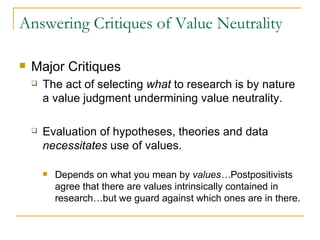
Answering Critiques of Value Neutrality Major Critiques The act of selecting  what  to research is by nature a value judgment undermining value neutrality. Evaluation of hypotheses, theories and data  necessitates  use of values. Depends on what you mean by  values… Postpositivists agree that there are values intrinsically contained in research…but we guard against which ones are in there.
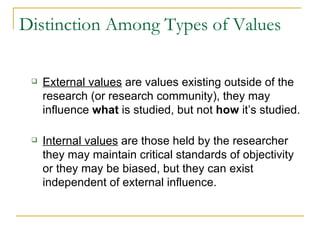
Distinction Among Types of Values External values  are values existing outside of the research (or research community), they may influence  what  is studied, but not  how  it’s studied. Internal values  are those held by the researcher they may maintain critical standards of objectivity or they may be biased, but they can exist independent of external influence.
Another Distinction More importantly though, some values are Epistemologically Relevant : When a researcher allows beliefs that are not related to his or her field of study to influence the interpretation of results. Epistemologically Irrelevant : When a researcher is influenced by and actively employs beliefs that encourage objective, scientifically valid research and advance the epistemic concern of science.  These are also known as  cognitive values .
Detecting Bias and Influence of Values There really is no foolproof way to insulate against these values creeping into research. Science as a community does this… Peer review and critique,  Freedom of research,  Valuing replication, Open dialogue Enfranchisement of the marginalized Sandra Harding: Calls for more opportunity for those outside the dominant group to participate. those on the outside of the community are more able to see problems and challenge dominant beliefs.

Postpositivism and educational research final

  • 1.
    Postpositivism and ValueNeutrality Chapter 3: Objectivity, Relativity and Value Neutrality Objectivity is important for competent research. Values may contaminate inquiry The scientific community values it Helps us agree on what is true Relativity of perspective does not always lead to subjectivity or bias. Eliminating relativistic and value-laden terms can create common language and facilitate problem solving.
  • 2.
    Some Minor Critiquesof Value Neutrality Studying values involves valuation; values must enter research. Doesn’t follow: Procedures/concepts can be free from their influence. All science is inherently biased; many biased projects exist. Overgeneralization Some value orientations are unconsciously held by all researchers in a socio-historical context or all science, its conceptual tools and categories are male biased. Maybe, but it’s difficult to prove universalisms, like all capitalists or all white males. Also- if there is no “Truth” and all inquiry is biased, these critiques don’t really hold any meaning…
  • 3.
    Answering Critiques ofValue Neutrality Major Critiques The act of selecting what to research is by nature a value judgment undermining value neutrality. Evaluation of hypotheses, theories and data necessitates use of values. Depends on what you mean by values… Postpositivists agree that there are values intrinsically contained in research…but we guard against which ones are in there.
  • 4.
    Distinction Among Typesof Values External values are values existing outside of the research (or research community), they may influence what is studied, but not how it’s studied. Internal values are those held by the researcher they may maintain critical standards of objectivity or they may be biased, but they can exist independent of external influence.
  • 5.
    Another Distinction Moreimportantly though, some values are Epistemologically Relevant : When a researcher allows beliefs that are not related to his or her field of study to influence the interpretation of results. Epistemologically Irrelevant : When a researcher is influenced by and actively employs beliefs that encourage objective, scientifically valid research and advance the epistemic concern of science. These are also known as cognitive values .
  • 6.
    Detecting Bias andInfluence of Values There really is no foolproof way to insulate against these values creeping into research. Science as a community does this… Peer review and critique, Freedom of research, Valuing replication, Open dialogue Enfranchisement of the marginalized Sandra Harding: Calls for more opportunity for those outside the dominant group to participate. those on the outside of the community are more able to see problems and challenge dominant beliefs.