Philosophizing about ethics Analyzing the terms used in ethical discourse Unpacking the structure of ethical theory Metaethics
The theory that value statements can be defined in terms of factual statements. Fact:  What is signified by empirically verifiable statements. Value:  What is signified by an evaluation of a sentence. Reference:  http://en.wikipedia.org/wiki/Ethical_naturalism
The theory that moral facts exist but are not natural. Moral facts are discovered by intuition. The task for philosophers is to define the terms used and the source of the definition of the terms in philosophizing.
This theory holds that moral judgments do not have truth values. Moral judgments are expressions of our attitudes. These judgments express our feelings and help us to persuade others to act as we desire.
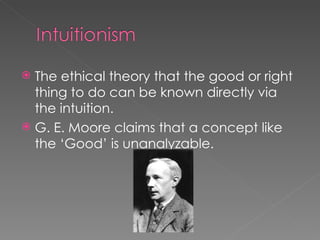
The ethical theory that the good or right thing to do can be known directly via the intuition. G. E. Moore claims that a concept like the ‘Good’ is unanalyzable.
The Humean Thesis:  Ought statements cannot be derived from ‘is’ statements. The Platonic Thesis:  Basic value terms refer to nonnatural properties. The Cognitive Thesis:  Moral statements are either true or false, which can be known. The Intuition Thesis:  Moral truths are discovered by intuition and are self-evident upon reflection.
Value judgments do not have truth values, they are more than mere expression of attitudes. Moral judgments are universal prescriptions. Moral judgments are given to guide actions.
A dependency relationship between properties or facts of one type with properties or facts of another type. In metaethics, supervenience is the idea that moral properties supervene or emerge out of natural ones. For example, badness comes out of pain or goodness comes out of happiness.
This principle states that if some act is wrong (or right) for one person in a situation, then it is wrong (or right) for any relevantly similar person in that kind of situation. It is a principle of consistency that aims to eliminate irrelevant considerations from ethical assessments.
Principles are central to moral reasoning. Principles serve as major premises in our moral arguments. We acquire or learn a basic set of principles. Then we learn when to use or when to subordinate those principles. We choose when, where, and why to apply our specific principles.

Chapter 11: Metaethics

  • 1.
    Philosophizing about ethicsAnalyzing the terms used in ethical discourse Unpacking the structure of ethical theory Metaethics
  • 2.
    The theory thatvalue statements can be defined in terms of factual statements. Fact: What is signified by empirically verifiable statements. Value: What is signified by an evaluation of a sentence. Reference: http://en.wikipedia.org/wiki/Ethical_naturalism
  • 3.
    The theory thatmoral facts exist but are not natural. Moral facts are discovered by intuition. The task for philosophers is to define the terms used and the source of the definition of the terms in philosophizing.
  • 4.
    This theory holdsthat moral judgments do not have truth values. Moral judgments are expressions of our attitudes. These judgments express our feelings and help us to persuade others to act as we desire.
  • 5.
    The ethical theorythat the good or right thing to do can be known directly via the intuition. G. E. Moore claims that a concept like the ‘Good’ is unanalyzable.
  • 6.
    The Humean Thesis: Ought statements cannot be derived from ‘is’ statements. The Platonic Thesis: Basic value terms refer to nonnatural properties. The Cognitive Thesis: Moral statements are either true or false, which can be known. The Intuition Thesis: Moral truths are discovered by intuition and are self-evident upon reflection.
  • 7.
    Value judgments donot have truth values, they are more than mere expression of attitudes. Moral judgments are universal prescriptions. Moral judgments are given to guide actions.
  • 8.
    A dependency relationshipbetween properties or facts of one type with properties or facts of another type. In metaethics, supervenience is the idea that moral properties supervene or emerge out of natural ones. For example, badness comes out of pain or goodness comes out of happiness.
  • 9.
    This principle statesthat if some act is wrong (or right) for one person in a situation, then it is wrong (or right) for any relevantly similar person in that kind of situation. It is a principle of consistency that aims to eliminate irrelevant considerations from ethical assessments.
  • 10.
    Principles are centralto moral reasoning. Principles serve as major premises in our moral arguments. We acquire or learn a basic set of principles. Then we learn when to use or when to subordinate those principles. We choose when, where, and why to apply our specific principles.