Methods of
Philosophizing
QUARTER 1 –MODULE 2.1
Learning Objectives
1. Identify the meaning, importance, and
source of knowledge.
2. Describe, the steps/processes of acquiring
knowledge.
3. Explain how validating one’s knowledge
leads to truth.
4. Compare/contrast different theories of truth.
Activity
How do I know is under what
branch of Philosophy?
Do you believe in the idea that,
Love is Blind?
 According to philosophy if you want to know
the truth you have to use, not emotions, but
thinking.
 To think however is an act of choice which is
not always done properly. Sometimes we need
guidance to straighten our thoughts.
This is what Module 2 provides.
Welcome to the province of epistemology.
 Knowledge literally enabled mankind to
survive and reach the present level of our
civilization.
 It is the recognition of the supreme
importance of the knowledge that gave rise
to the branch of philosophy known as
epistemology.
WHAT IS EPISTEMOLOGY?
“Epistemology is a science devoted to
the discovery of the proper method of
acquiring and validating knowledge”
(Rand 1990).
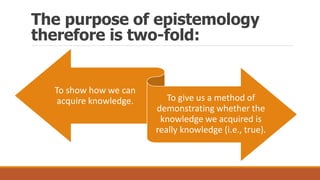
The purpose of epistemology
therefore is two-fold:
To show how we can
acquire knowledge. To give us a method of
demonstrating whether the
knowledge we acquired is
really knowledge (i.e., true).
THE NATURE OF KNOWLEDGE
 According to Ayn Rand knowledge is a “mental grasp
of reality reached either by perceptual observation or
by a process of reason based on perceptual
observation” (Rand 1990).
 When you know something (be it the behavior of
your friend, the movement of the planets, or the origin
of civilizations) you understand its nature. You identify
what it is. And it stays with you. Knowledge is a
retained form of awareness (Binswanger 2014).
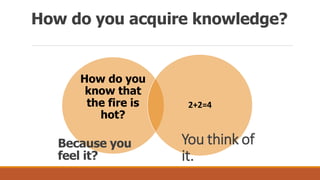
How do you acquire knowledge?
How do you
know that
the fire is
hot?
2+2=4
Because you
feel it?
You think of
it.
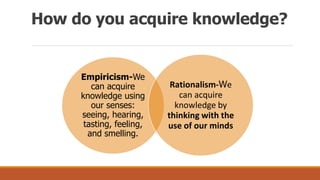
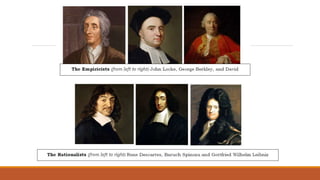
How do you acquire knowledge?
Empiricism-We
can acquire
knowledge using
our senses:
seeing, hearing,
tasting, feeling,
and smelling.
Rationalism-We
can acquire
knowledge by
thinking with the
use of our minds
Let us now explore the first part of epistemology:
the process of acquiring knowledge.
1.Reality
2. Perception
3. Concept
4. Proposition
5. Inference
ACQUIRING KNOWLEDGE
.
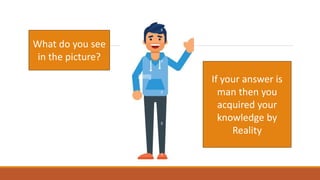
What do you see
in the picture?
If your answer is
man then you
acquired your
knowledge by
Reality
1. Reality
Existence is everything there is.It includes
everything we perceive (animals, plants,
human beings, inanimate objects) and
everything inside our heads (e.g., our
thoughts and emotions) which represents
our inner world.
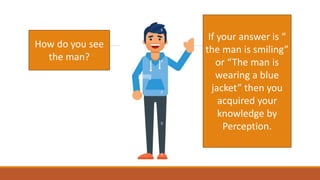
How do you see
the man?
If your answer is “
the man is smiling”
or “The man is
wearing a blue
jacket” then you
acquired your
knowledge by
Perception.
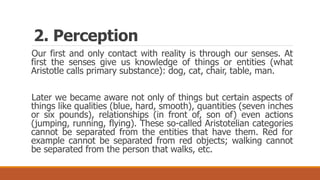
Our first and only contact with reality is through our senses. At
first the senses give us knowledge of things or entities (what
Aristotle calls primary substance): dog, cat, chair, table, man.
Later we became aware not only of things but certain aspects of
things like qualities (blue, hard, smooth), quantities (seven inches
or six pounds), relationships (in front of, son of) even actions
(jumping, running, flying). These so-called Aristotelian categories
cannot be separated from the entities that have them. Red for
example cannot be separated from red objects; walking cannot
be separated from the person that walks, etc.
2. Perception
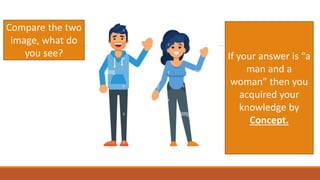
Compare the two
image, what do
you see? If your answer is “a
man and a
woman” then you
acquired your
knowledge by
Concept.
3. Concept
After we perceive things, we began to notice that some of
the things we perceive are similar to other things.
For example, we see three individuals let’s call them Juan,
Pablo, and Pedro who may have nothing in common at
first glance. But when we compare them with another
entity, a dog for example, suddenly their differences
become insignificant. Their big difference in a dog
highlights their similarity to one another (Binswanger
2014)
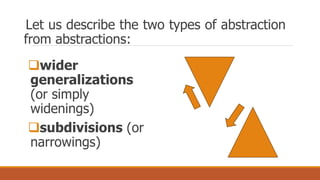
Let us describe the two types of abstraction
from abstractions:
wider
generalizations
(or simply
widenings)
subdivisions (or
narrowings)
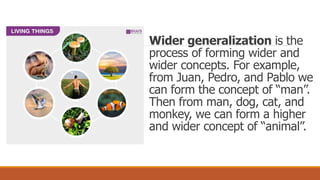
Wider generalization is the
process of forming wider and
wider concepts. For example,
from Juan, Pedro, and Pablo we
can form the concept of “man”.
Then from man, dog, cat, and
monkey, we can form a higher
and wider concept of “animal”.
Subdivisions consist of identifying
finer and finer distinctions. For
example, “man” is a first level concept
that we can subdivide according to
profession (doctor, entertainer, fireman,
teacher), or race (Asian, Caucasian
[white], black), or gender (man,
woman, lesbian, gay), or nationality
(Filipino, Chinese, American) among
other things.
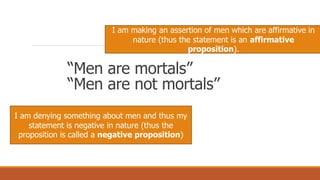
“Men are mortals”
“Men are not mortals”
I am making an assertion of men which are affirmative in
nature (thus the statement is an affirmative
proposition).
I am denying something about men and thus my
statement is negative in nature (thus the
proposition is called a negative proposition)
4. Proposition
When we use concepts in order to classify or
describe an “existent” (a particular that exist be it
an object, a person, an action or event, etc) (Rand
1990) we use what philosophers call a proposition
(Binswanger 2014).
A proposition is a statement that expresses either
an assertion or a denial (Copi, 2002) that an existent
belongs to a class or possess certain attribute
5. Inference
How do we demonstrate that the statement is true?
By providing an argument.
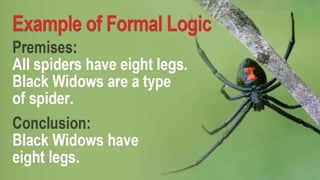
According to Hurley an argument “is a group of
statements, one or more of which (the premises)
are claimed to provide support for, or reason to
believe one of the others (the conclusion) (Hurley
2011). To clarify this definition let’s give an example
using the famous Socratic argument:
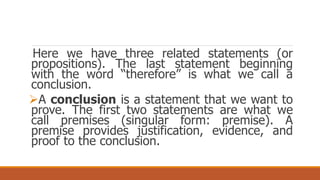
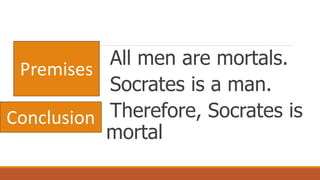
Here we have three related statements (or
propositions). The last statement beginning
with the word “therefore” is what we call a
conclusion.
A conclusion is a statement that we want to
prove. The first two statements are what we
call premises (singular form: premise). A
premise provides justification, evidence, and
proof to the conclusion.
All men are mortals.
Socrates is a man.
Therefore, Socrates is
mortal
Premises
Conclusion
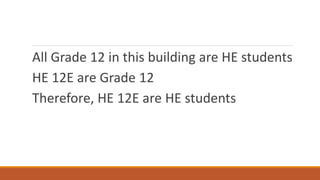
All Grade 12 in this building are HE students
HE 12E are Grade 12
Therefore, HE 12E are HE students
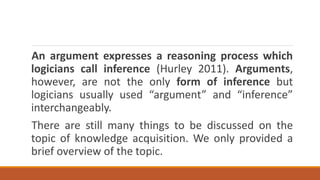
An argument expresses a reasoning process which
logicians call inference (Hurley 2011). Arguments,
however, are not the only form of inference but
logicians usually used “argument” and “inference”
interchangeably.
There are still many things to be discussed on the
topic of knowledge acquisition. We only provided a
brief overview of the topic.
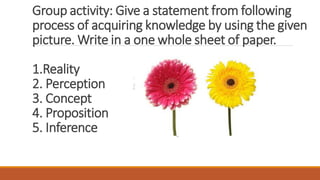
Group activity: Give a statement from following
process of acquiring knowledge by using the given
picture. Write in a one whole sheet of paper.
1.Reality
2. Perception
3. Concept
4. Proposition
5. Inference
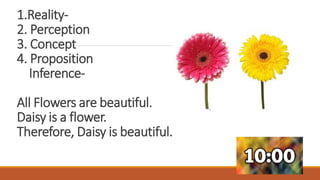
1.Reality-
2. Perception
3. Concept
4. Proposition
Inference-
All Flowers are beautiful.
Daisy is a flower.
Therefore, Daisy is beautiful.
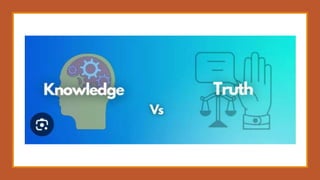
Knowledge
It is the theoretical or practical understanding of a topic. It is
the understanding of a concept or idea; however, it may or may
not be true
Truth
The truth is considered as a fact and something verifiable. It is
real and authentic.
For example, in other times it was believed that the Earth was
flat and if a navigator came to the end, it would fall from it.
This was common knowledge, but it was not the truth. Truth
will continue to be true, even if it is not known; while the
knowledge one has may prove to be true or not.
Jose Rizal is the Philippines’ National
Hero.
Ang mundo ay flat.
THE NATURE OF TRUTH
Now that we know how we know, it’s
time to see whether the knowledge we
acquired is “really” knowledge i.e., is
true. This is the second part of
epistemology: validating one’s
knowledge.
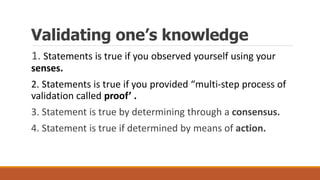
Validating one’s knowledge
1. Statements is true if you observed yourself using your
senses.
2. Statements is true if you provided “multi-step process of
validation called proof’ .
3. Statement is true by determining through a consensus.
4. Statement is true if determined by means of action.
Group activity-explain the example of steps in
validating knowledge assigned to your group
explain to your groupmates.
Write the example on the board and each
member should be ready for sharing in front
of the class. (15 points)
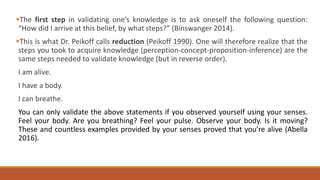
The first step in validating one’s knowledge is to ask oneself the following question:
“How did I arrive at this belief, by what steps?” (Binswanger 2014).
This is what Dr. Peikoff calls reduction (Peikoff 1990). One will therefore realize that the
steps you took to acquire knowledge (perception-concept-proposition-inference) are the
same steps needed to validate knowledge (but in reverse order).
I am alive.
I have a body.
I can breathe.
You can only validate the above statements if you observed yourself using your senses.
Feel your body. Are you breathing? Feel your pulse. Observe your body. Is it moving?
These and countless examples provided by your senses proved that you’re alive (Abella
2016).
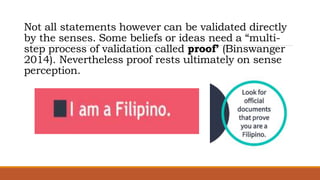
Not all statements however can be validated directly
by the senses. Some beliefs or ideas need a “multi-
step process of validation called proof’ (Binswanger
2014). Nevertheless proof rests ultimately on sense
perception.
A third way to determine if the statement is true is
through a consensus (Abella 2016). If the majority
agrees that a statement is true then it is true.
For example the vast majority of Germans during the
time of Adolph Hitler believed that Jews are racially
inferior. The result of this false consensus is the
extermination of millions of Jews in many parts of
Europe.
A fourth way to determine whether a
statement is true is to test it by means of
action (Abella 2016).
For example you want to know if a person
is friendly. Well the best way to find out is
to approach the person.
TRUTH VS OPINION
Identifying truth however can sometimes
be tricky. The reason is that there are
times when we strongly held an idea that
we feel “deep down” to be true.
For example:
Religious people strongly believed that
there is life after death.
Some people who embraced democracy
may passionately embraced the idea that
the majority is always right.
However we must not confused strongly held
beliefs with truth. Truth is knowledge validated
and when we say validated we mean they are
based on the facts of reality.
You must understand dear student that the facts
of reality are independent of your thoughts,
feelings or preferences
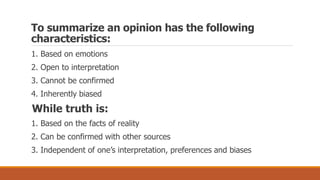
To summarize an opinion has the following
characteristics:
1. Based on emotions
2. Open to interpretation
3. Cannot be confirmed
4. Inherently biased
While truth is:
1. Based on the facts of reality
2. Can be confirmed with other sources
3. Independent of one’s interpretation, preferences and biases
THEORIES OF TRUTH
THEORY
- it is a formal idea or set of ideas that is
intended to explain something.
- a set of principles on which the practice is
based on.
- an idea used to account for a situation or
justify a course of action.
 A fact is some set of circumstances in the
world. A fact cannot be either true or false
because it simply the way the world is.
 Belief is an opinion about what those facts
are. It is capable of being true or false
because it may or may not accurately
describe the world.
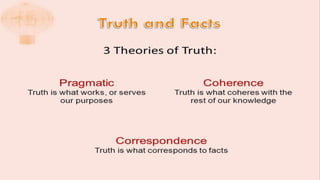
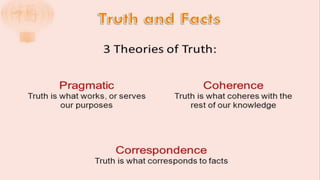
1. The Correspondence theory of Truth
assumes that a belief is true when we are able to confirm it with
reality.
For example:
 If I say, “The sky is blue” then I looked outside and saw that
it is indeed blue, then my statement is true.
 On the other hand, if I say, “Pigs have wings” and then I
checked a pig and it does not have wings, then my
statement is false.
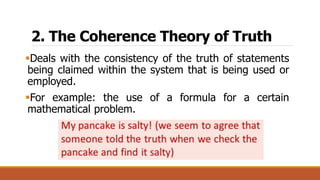
2. The Coherence Theory of Truth
Deals with the consistency of the truth of statements
being claimed within the system that is being used or
employed.
For example: the use of a formula for a certain
mathematical problem.
Consequently, by using this method, we establish
that the statement “coheres” with the larger system.
In a sense, the Coherence Theory is similar to the
Correspondence Theory since both evaluates
statements based on their agreement with reality.
The difference lies in the method where the former
involves a larger system while the latter relies on a
single evidence of fact.
3. The Pragmatist Theory of Truth:
The Pragmatic Theory of Truth states that a
belief/statement is true if it has a useful (pragmatic)
application in the world.
Example:
There are some people who think that there are
“ghosts” or “vampires” because they find it useful in
explaining unusual phenomena and in dealing with
fears (Mabaquiao, 2016).
2.1-Methods-of-Philosophizing-1-1-60.pdf

2.1-Methods-of-Philosophizing-1-1-60.pdf

  • 1.
  • 2.
    Learning Objectives 1. Identifythe meaning, importance, and source of knowledge. 2. Describe, the steps/processes of acquiring knowledge. 3. Explain how validating one’s knowledge leads to truth. 4. Compare/contrast different theories of truth.
  • 3.
    Activity How do Iknow is under what branch of Philosophy?
  • 4.
    Do you believein the idea that, Love is Blind?
  • 5.
     According tophilosophy if you want to know the truth you have to use, not emotions, but thinking.  To think however is an act of choice which is not always done properly. Sometimes we need guidance to straighten our thoughts. This is what Module 2 provides. Welcome to the province of epistemology.
  • 6.
     Knowledge literallyenabled mankind to survive and reach the present level of our civilization.  It is the recognition of the supreme importance of the knowledge that gave rise to the branch of philosophy known as epistemology.
  • 7.
    WHAT IS EPISTEMOLOGY? “Epistemologyis a science devoted to the discovery of the proper method of acquiring and validating knowledge” (Rand 1990).
  • 8.
    The purpose ofepistemology therefore is two-fold: To show how we can acquire knowledge. To give us a method of demonstrating whether the knowledge we acquired is really knowledge (i.e., true).
  • 9.
    THE NATURE OFKNOWLEDGE  According to Ayn Rand knowledge is a “mental grasp of reality reached either by perceptual observation or by a process of reason based on perceptual observation” (Rand 1990).  When you know something (be it the behavior of your friend, the movement of the planets, or the origin of civilizations) you understand its nature. You identify what it is. And it stays with you. Knowledge is a retained form of awareness (Binswanger 2014).
  • 10.
    How do youacquire knowledge? How do you know that the fire is hot? 2+2=4 Because you feel it? You think of it.
  • 11.
    How do youacquire knowledge? Empiricism-We can acquire knowledge using our senses: seeing, hearing, tasting, feeling, and smelling. Rationalism-We can acquire knowledge by thinking with the use of our minds
  • 13.
    Let us nowexplore the first part of epistemology: the process of acquiring knowledge. 1.Reality 2. Perception 3. Concept 4. Proposition 5. Inference ACQUIRING KNOWLEDGE .
  • 14.
    What do yousee in the picture? If your answer is man then you acquired your knowledge by Reality
  • 15.
    1. Reality Existence iseverything there is.It includes everything we perceive (animals, plants, human beings, inanimate objects) and everything inside our heads (e.g., our thoughts and emotions) which represents our inner world.
  • 16.
    How do yousee the man? If your answer is “ the man is smiling” or “The man is wearing a blue jacket” then you acquired your knowledge by Perception.
  • 17.
    Our first andonly contact with reality is through our senses. At first the senses give us knowledge of things or entities (what Aristotle calls primary substance): dog, cat, chair, table, man. Later we became aware not only of things but certain aspects of things like qualities (blue, hard, smooth), quantities (seven inches or six pounds), relationships (in front of, son of) even actions (jumping, running, flying). These so-called Aristotelian categories cannot be separated from the entities that have them. Red for example cannot be separated from red objects; walking cannot be separated from the person that walks, etc. 2. Perception
  • 18.
    Compare the two image,what do you see? If your answer is “a man and a woman” then you acquired your knowledge by Concept.
  • 19.
    3. Concept After weperceive things, we began to notice that some of the things we perceive are similar to other things. For example, we see three individuals let’s call them Juan, Pablo, and Pedro who may have nothing in common at first glance. But when we compare them with another entity, a dog for example, suddenly their differences become insignificant. Their big difference in a dog highlights their similarity to one another (Binswanger 2014)
  • 20.
    Let us describethe two types of abstraction from abstractions: wider generalizations (or simply widenings) subdivisions (or narrowings)
  • 21.
    Wider generalization isthe process of forming wider and wider concepts. For example, from Juan, Pedro, and Pablo we can form the concept of “man”. Then from man, dog, cat, and monkey, we can form a higher and wider concept of “animal”.
  • 22.
    Subdivisions consist ofidentifying finer and finer distinctions. For example, “man” is a first level concept that we can subdivide according to profession (doctor, entertainer, fireman, teacher), or race (Asian, Caucasian [white], black), or gender (man, woman, lesbian, gay), or nationality (Filipino, Chinese, American) among other things.
  • 23.
    “Men are mortals” “Menare not mortals” I am making an assertion of men which are affirmative in nature (thus the statement is an affirmative proposition). I am denying something about men and thus my statement is negative in nature (thus the proposition is called a negative proposition)
  • 24.
    4. Proposition When weuse concepts in order to classify or describe an “existent” (a particular that exist be it an object, a person, an action or event, etc) (Rand 1990) we use what philosophers call a proposition (Binswanger 2014). A proposition is a statement that expresses either an assertion or a denial (Copi, 2002) that an existent belongs to a class or possess certain attribute
  • 25.
    5. Inference How dowe demonstrate that the statement is true? By providing an argument. According to Hurley an argument “is a group of statements, one or more of which (the premises) are claimed to provide support for, or reason to believe one of the others (the conclusion) (Hurley 2011). To clarify this definition let’s give an example using the famous Socratic argument:
  • 26.
    Here we havethree related statements (or propositions). The last statement beginning with the word “therefore” is what we call a conclusion. A conclusion is a statement that we want to prove. The first two statements are what we call premises (singular form: premise). A premise provides justification, evidence, and proof to the conclusion.
  • 27.
    All men aremortals. Socrates is a man. Therefore, Socrates is mortal Premises Conclusion
  • 29.
    All Grade 12in this building are HE students HE 12E are Grade 12 Therefore, HE 12E are HE students
  • 30.
    An argument expressesa reasoning process which logicians call inference (Hurley 2011). Arguments, however, are not the only form of inference but logicians usually used “argument” and “inference” interchangeably. There are still many things to be discussed on the topic of knowledge acquisition. We only provided a brief overview of the topic.
  • 31.
    Group activity: Givea statement from following process of acquiring knowledge by using the given picture. Write in a one whole sheet of paper. 1.Reality 2. Perception 3. Concept 4. Proposition 5. Inference
  • 32.
    1.Reality- 2. Perception 3. Concept 4.Proposition Inference- All Flowers are beautiful. Daisy is a flower. Therefore, Daisy is beautiful.
  • 35.
    Knowledge It is thetheoretical or practical understanding of a topic. It is the understanding of a concept or idea; however, it may or may not be true Truth The truth is considered as a fact and something verifiable. It is real and authentic.
  • 36.
    For example, inother times it was believed that the Earth was flat and if a navigator came to the end, it would fall from it. This was common knowledge, but it was not the truth. Truth will continue to be true, even if it is not known; while the knowledge one has may prove to be true or not.
  • 39.
    Jose Rizal isthe Philippines’ National Hero.
  • 40.
  • 41.
    THE NATURE OFTRUTH Now that we know how we know, it’s time to see whether the knowledge we acquired is “really” knowledge i.e., is true. This is the second part of epistemology: validating one’s knowledge.
  • 42.
    Validating one’s knowledge 1.Statements is true if you observed yourself using your senses. 2. Statements is true if you provided “multi-step process of validation called proof’ . 3. Statement is true by determining through a consensus. 4. Statement is true if determined by means of action.
  • 43.
    Group activity-explain theexample of steps in validating knowledge assigned to your group explain to your groupmates. Write the example on the board and each member should be ready for sharing in front of the class. (15 points)
  • 44.
    The first stepin validating one’s knowledge is to ask oneself the following question: “How did I arrive at this belief, by what steps?” (Binswanger 2014). This is what Dr. Peikoff calls reduction (Peikoff 1990). One will therefore realize that the steps you took to acquire knowledge (perception-concept-proposition-inference) are the same steps needed to validate knowledge (but in reverse order). I am alive. I have a body. I can breathe. You can only validate the above statements if you observed yourself using your senses. Feel your body. Are you breathing? Feel your pulse. Observe your body. Is it moving? These and countless examples provided by your senses proved that you’re alive (Abella 2016).
  • 45.
    Not all statementshowever can be validated directly by the senses. Some beliefs or ideas need a “multi- step process of validation called proof’ (Binswanger 2014). Nevertheless proof rests ultimately on sense perception.
  • 46.
    A third wayto determine if the statement is true is through a consensus (Abella 2016). If the majority agrees that a statement is true then it is true. For example the vast majority of Germans during the time of Adolph Hitler believed that Jews are racially inferior. The result of this false consensus is the extermination of millions of Jews in many parts of Europe.
  • 47.
    A fourth wayto determine whether a statement is true is to test it by means of action (Abella 2016). For example you want to know if a person is friendly. Well the best way to find out is to approach the person.
  • 49.
    TRUTH VS OPINION Identifyingtruth however can sometimes be tricky. The reason is that there are times when we strongly held an idea that we feel “deep down” to be true. For example: Religious people strongly believed that there is life after death. Some people who embraced democracy may passionately embraced the idea that the majority is always right.
  • 50.
    However we mustnot confused strongly held beliefs with truth. Truth is knowledge validated and when we say validated we mean they are based on the facts of reality. You must understand dear student that the facts of reality are independent of your thoughts, feelings or preferences
  • 51.
    To summarize anopinion has the following characteristics: 1. Based on emotions 2. Open to interpretation 3. Cannot be confirmed 4. Inherently biased While truth is: 1. Based on the facts of reality 2. Can be confirmed with other sources 3. Independent of one’s interpretation, preferences and biases
  • 52.
  • 54.
    THEORY - it isa formal idea or set of ideas that is intended to explain something. - a set of principles on which the practice is based on. - an idea used to account for a situation or justify a course of action.
  • 55.
     A factis some set of circumstances in the world. A fact cannot be either true or false because it simply the way the world is.  Belief is an opinion about what those facts are. It is capable of being true or false because it may or may not accurately describe the world.
  • 56.
    1. The Correspondencetheory of Truth assumes that a belief is true when we are able to confirm it with reality. For example:  If I say, “The sky is blue” then I looked outside and saw that it is indeed blue, then my statement is true.  On the other hand, if I say, “Pigs have wings” and then I checked a pig and it does not have wings, then my statement is false.
  • 57.
    2. The CoherenceTheory of Truth Deals with the consistency of the truth of statements being claimed within the system that is being used or employed. For example: the use of a formula for a certain mathematical problem.
  • 58.
    Consequently, by usingthis method, we establish that the statement “coheres” with the larger system. In a sense, the Coherence Theory is similar to the Correspondence Theory since both evaluates statements based on their agreement with reality. The difference lies in the method where the former involves a larger system while the latter relies on a single evidence of fact.
  • 59.
    3. The PragmatistTheory of Truth: The Pragmatic Theory of Truth states that a belief/statement is true if it has a useful (pragmatic) application in the world. Example: There are some people who think that there are “ghosts” or “vampires” because they find it useful in explaining unusual phenomena and in dealing with fears (Mabaquiao, 2016).