21 Century Logistics
  st
Logistics
♦The process of planning,
 implementing, and controlling the
 efficient, effective flow and storage
 of goods, services, and related
 information from the point of origin
 to the point of consumption for the
 purpose of conforming to customer
 requirement
What is Supply-Chain Management?
Defined
♦ Supply-chain is a term that describes how
  organizations (suppliers, manufacturers,
  distributors, and customers) are linked
  together

♦ Supply-chain management is a total system
 approach to managing the entire flow of
 information, materials, and services from
 raw-material suppliers through factories and
 warehouses to the end customer.
♦ Supply chain management is the
 paradigm that is changing business and
 business relationships. It reflects the
 realization that the product pipeline for a
 business extends from the vendor right
 through to delivery to the customer. This
 makes managing such a supply chain a
 joint effort of suppliers and customers to
 develop and exploit the savings, service
 and benefits of SCM.
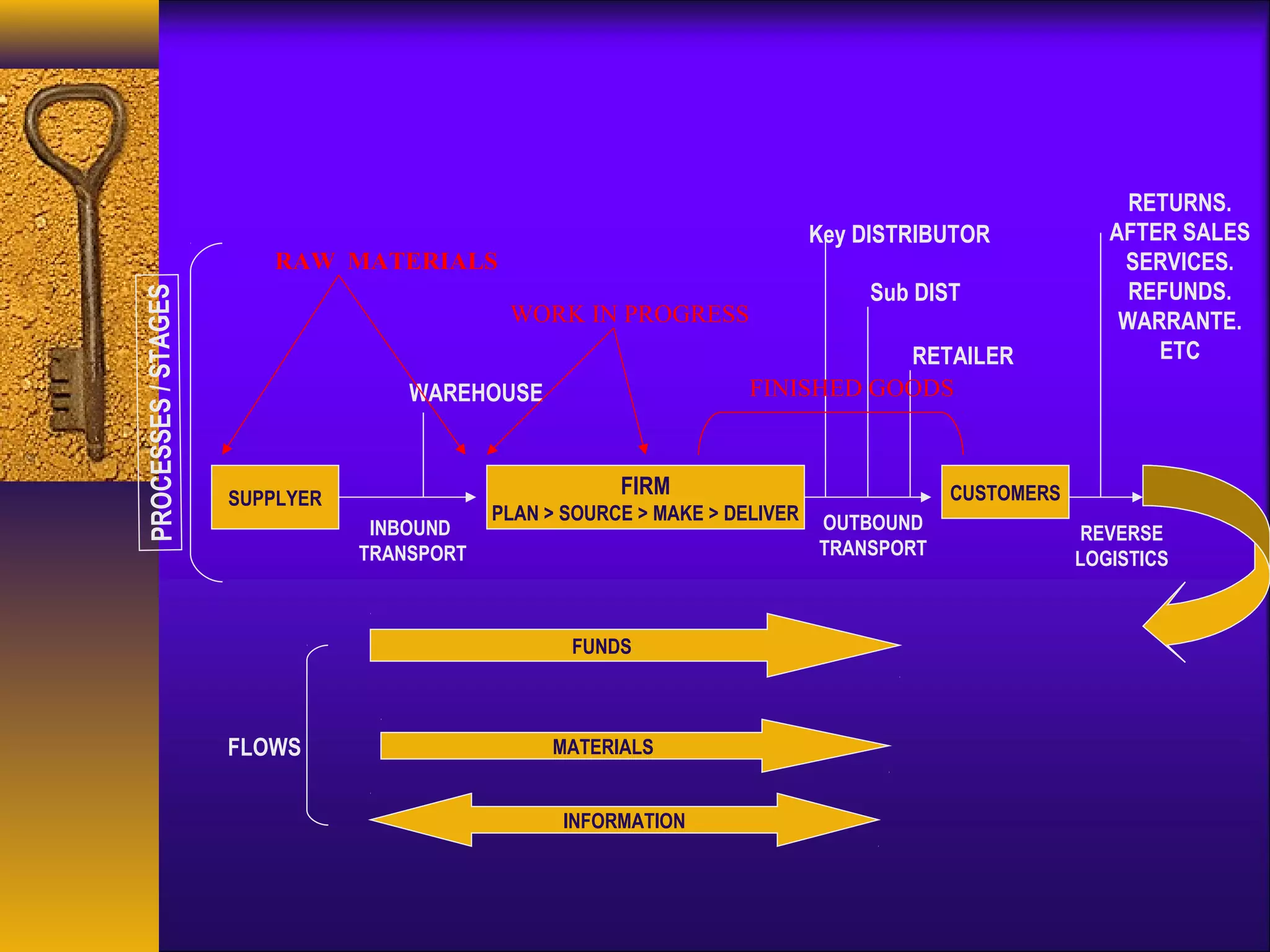
RETURNS.
                                                                             Key DISTRIBUTOR            AFTER SALES
                        RAW MATERIALS                                                                    SERVICES.
                                                                                  Sub DIST                REFUNDS.
PROCESSES / STAGES


                                             WORK IN PROGRESS                                            WARRANTE.
                                                                                RETAILER                    ETC
                                    WAREHOUSE                        FINISHED GOODS


                     SUPPLYER
                                                        FIRM                             CUSTOMERS
                                            PLAN > SOURCE > MAKE > DELIVER   OUTBOUND
                                 INBOUND                                                              REVERSE
                                TRANSPORT                                    TRANSPORT               LOGISTICS


                                                   FUNDS


                     FLOWS                       MATERIALS


                                                  INFORMATION
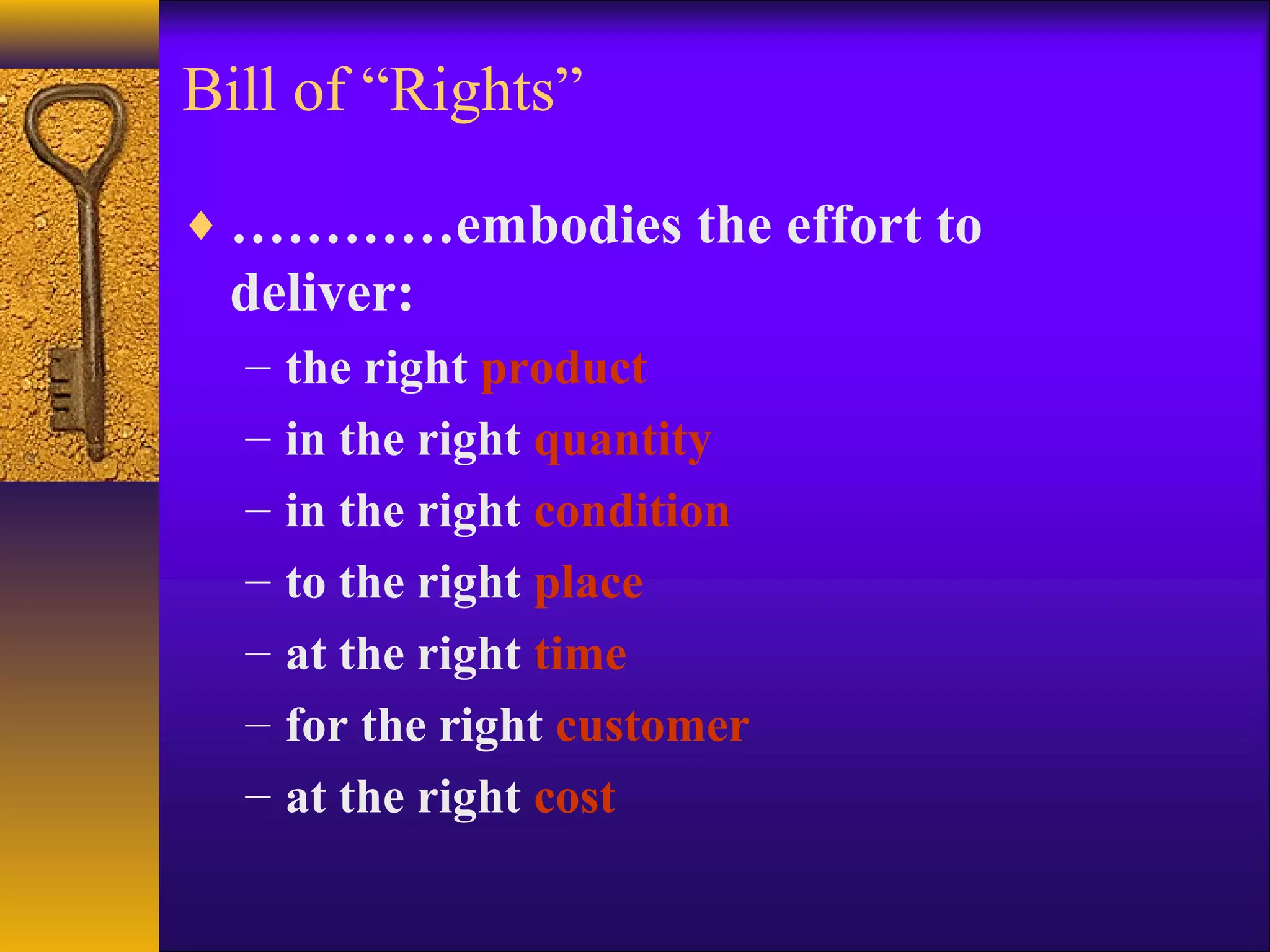
Bill of “Rights”

♦ …………embodies the effort to
 deliver:
  –   the right product
  –   in the right quantity
  –   in the right condition
  –   to the right place
  –   at the right time
  –   for the right customer
  –   at the right cost
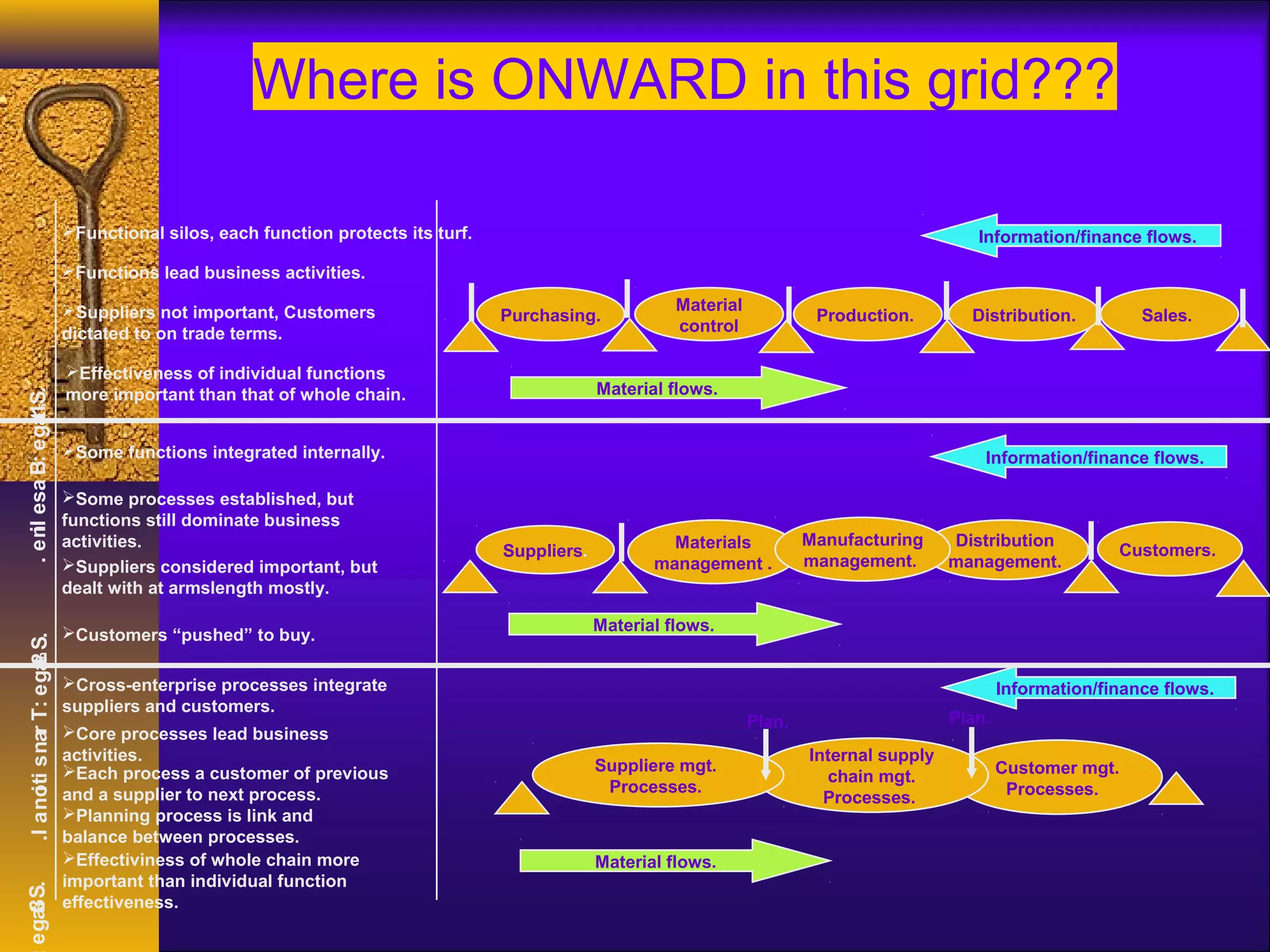
Where is ONWARD in this grid???

                               Functional silos, each function protects its turf.                                                                  Information/finance flows.
                               Functions lead business activities.

                               Suppliers not important, Customers                                          Material
                                                                                     Purchasing.                                Production.        Distribution.          Sales.
                               dictated to on trade terms.                                                  control

                               Effectiveness of individual functions
                               more important than that of whole chain.                           Material flows.
. e nl esa B: e gat1S.
                  ts


                               Some functions integrated internally.                                                                                Information/finance flows.

                               Some processes established, but
                               functions still dominate business
     i


                               activities.                                                                 Materials           Manufacturing     Distribution
                                                                                     Suppliers.                                                                        Customers.
                               Suppliers considered important, but                                      management .          management.       management.
                               dealt with at armslength mostly.

                               Customers “pushed” to buy.                                        Material flows.
 .l a noti s nar T: e gan S.
                       d2
                        t


                               Cross-enterprise processes integrate                                                                                     Information/finance flows.
                               suppliers and customers.
                                                                                                                       Plan.                     Plan.
                               Core processes lead business
                               activities.                                                                                     Internal supply
                               Each process a customer of previous                               Suppliere mgt.                                         Customer mgt.
                                                                                                                                 chain mgt.
                               and a supplier to next process.                                     Processes.                                             Processes.
       i


                                                                                                                                 Processes.
                               Planning process is link and
                               balance between processes.
                               Effectiviness of whole chain more                                 Material flows.
                               important than individual function
e ga3S.


                               effectiveness.
    tr
    d
♦ SCM therefore: (1) takes into consideration every
  facility that has an impact on cost and plays a role
  in making the product conform to customer
  requirements from supplier through to consumer.
♦ (2) SCM should be efficient and cost effective
  across the entire system. The approach should be a
  system wide approach and not just minimizing
  cost.
♦ (3) SCM revolves armed efficient ingemination of
  all stakeholders; it therefore encourages all the
  firms activities,firm strategic-Tactical-
  Operational levels.
♦    STRATEGIC LEVEL: Deals with decisions that have a long lasting
    effect on the firm i.e. decisions regarding the number, location, and
    capacity of warehouses and manufacturing plants and the flow of
    material through the logistics network.
♦
♦ TACTICAL LEVEL: Includes decisions which are typically updated
    anywhere believes once every quarter and once every year i.e.
    purchasing and production decisions inventory polices and
    transportation strategies including the frequency with which customers
    are visited.

♦ OPERATIONAL LEVEL: Refers to day to day decisions such as
    scheduling lend time quotations routing and trust loading.
KEY DECISION ISSUE IN SUPPLY CHAIN
MANAGEMENT IS


♦   (a)
      Distribution network contribution
♦   (b)Inventory control
♦   (c)
      Distribution strategies
♦   (d)SC integration and strategic partnering
♦   (e)
      Product design
♦   (f)
      Information technology and decision- support
      system
♦ (g) Customer value
♦
SCM Challenges
♦ SCM integration is difficult for two main reason
   – (a) Different facilities in the SC may have different conflicting objectives.
   – (b) The SC is a dynamic system that evolves over time.
♦
♦ If some firms have improved SC performance by focusing on some SC
  techniques, what inhabits other firm from adopting the same techniques
  to improve their SC performance?
♦ (a) The SC is a complex network
♦ (b) Matching supply and demand is a major challenge.
♦ (c) System variations over time

♦ (d) Many supply chain problems are new
Benefits of Supply Chain
Management
♦ Mitigates bullwhip effect
♦ Improved customer service (internal &
  external)
♦ Eliminate redundant processes
♦ One point concept
♦ Reduces wastages
♦ Reduces inventory level
♦ Impacts positively on the bottom line
THANK YOU FOR LISTENING

21 st century logitics

  • 1.
  • 2.
    Logistics ♦The process ofplanning, implementing, and controlling the efficient, effective flow and storage of goods, services, and related information from the point of origin to the point of consumption for the purpose of conforming to customer requirement
  • 3.
    What is Supply-ChainManagement? Defined ♦ Supply-chain is a term that describes how organizations (suppliers, manufacturers, distributors, and customers) are linked together ♦ Supply-chain management is a total system approach to managing the entire flow of information, materials, and services from raw-material suppliers through factories and warehouses to the end customer.
  • 4.
    ♦ Supply chainmanagement is the paradigm that is changing business and business relationships. It reflects the realization that the product pipeline for a business extends from the vendor right through to delivery to the customer. This makes managing such a supply chain a joint effort of suppliers and customers to develop and exploit the savings, service and benefits of SCM.
  • 5.
    RETURNS. Key DISTRIBUTOR AFTER SALES RAW MATERIALS SERVICES. Sub DIST REFUNDS. PROCESSES / STAGES WORK IN PROGRESS WARRANTE. RETAILER ETC WAREHOUSE FINISHED GOODS SUPPLYER FIRM CUSTOMERS PLAN > SOURCE > MAKE > DELIVER OUTBOUND INBOUND REVERSE TRANSPORT TRANSPORT LOGISTICS FUNDS FLOWS MATERIALS INFORMATION
  • 6.
    Bill of “Rights” ♦…………embodies the effort to deliver: – the right product – in the right quantity – in the right condition – to the right place – at the right time – for the right customer – at the right cost
  • 7.
    Where is ONWARDin this grid??? Functional silos, each function protects its turf. Information/finance flows. Functions lead business activities. Suppliers not important, Customers Material Purchasing. Production. Distribution. Sales. dictated to on trade terms. control Effectiveness of individual functions more important than that of whole chain. Material flows. . e nl esa B: e gat1S. ts Some functions integrated internally. Information/finance flows. Some processes established, but functions still dominate business i activities. Materials Manufacturing Distribution Suppliers. Customers. Suppliers considered important, but management . management. management. dealt with at armslength mostly. Customers “pushed” to buy. Material flows. .l a noti s nar T: e gan S. d2 t Cross-enterprise processes integrate Information/finance flows. suppliers and customers. Plan. Plan. Core processes lead business activities. Internal supply Each process a customer of previous Suppliere mgt. Customer mgt. chain mgt. and a supplier to next process. Processes. Processes. i Processes. Planning process is link and balance between processes. Effectiviness of whole chain more Material flows. important than individual function e ga3S. effectiveness. tr d
  • 8.
    ♦ SCM therefore:(1) takes into consideration every facility that has an impact on cost and plays a role in making the product conform to customer requirements from supplier through to consumer. ♦ (2) SCM should be efficient and cost effective across the entire system. The approach should be a system wide approach and not just minimizing cost. ♦ (3) SCM revolves armed efficient ingemination of all stakeholders; it therefore encourages all the firms activities,firm strategic-Tactical- Operational levels.
  • 9.
    STRATEGIC LEVEL: Deals with decisions that have a long lasting effect on the firm i.e. decisions regarding the number, location, and capacity of warehouses and manufacturing plants and the flow of material through the logistics network. ♦ ♦ TACTICAL LEVEL: Includes decisions which are typically updated anywhere believes once every quarter and once every year i.e. purchasing and production decisions inventory polices and transportation strategies including the frequency with which customers are visited. ♦ OPERATIONAL LEVEL: Refers to day to day decisions such as scheduling lend time quotations routing and trust loading.
  • 10.
    KEY DECISION ISSUEIN SUPPLY CHAIN MANAGEMENT IS ♦ (a) Distribution network contribution ♦ (b)Inventory control ♦ (c) Distribution strategies ♦ (d)SC integration and strategic partnering ♦ (e) Product design ♦ (f) Information technology and decision- support system ♦ (g) Customer value ♦
  • 11.
    SCM Challenges ♦ SCMintegration is difficult for two main reason – (a) Different facilities in the SC may have different conflicting objectives. – (b) The SC is a dynamic system that evolves over time. ♦ ♦ If some firms have improved SC performance by focusing on some SC techniques, what inhabits other firm from adopting the same techniques to improve their SC performance? ♦ (a) The SC is a complex network ♦ (b) Matching supply and demand is a major challenge. ♦ (c) System variations over time ♦ (d) Many supply chain problems are new
  • 12.
    Benefits of SupplyChain Management ♦ Mitigates bullwhip effect ♦ Improved customer service (internal & external) ♦ Eliminate redundant processes ♦ One point concept ♦ Reduces wastages ♦ Reduces inventory level ♦ Impacts positively on the bottom line
  • 13.
    THANK YOU FORLISTENING