Corporate
Governance
Today’s Objectives
 Corporate Governance
 The Role of Board of Directors
 Financial Reporting And The Audit Committee
 Case Study
What is Corporate Governance?
Corporate Governance broadly refers to the mechanisms, processes
and relations by which corporations are controlled and directed.
Governance Structure
Governance structures identify the distribution of rights and
responsibilities among different participants in the corporation and
includes the rules and procedures for making decisions in corporate
affairs.
Governance Mechanism
 Monitoring the actions
 Monitoring the policies
 Decisions of corporation and their agents
The Role Of Boards Of Directors
The original purpose of a board of directors was to have a group,
independent from management, looking out for the interests of
shareholders who were not involved in the day-to-day management of
the organization.
The Role Of Boards Of Directors
However, it didn’t always work that way. Board members often
enjoyed a cozy relationship with managers in which each took care of
the other.
The Role Of Boards Of Directors
The “quid pro quo” arrangement has changed.
The Sarbanes-Oxley Act puts greater demands on board members of
publicly traded companies in the United States to do what they were
empowered and expected to do.
To help boards do this better, researchers at the Corporate
Governance Center at Kennesaw State University developed 13
governance principles for U.S. public companies.
Financial Reporting And The Audit
Committee
In addition to expanding the role of boards of directors, the Sarbanes-
Oxley Act also called for more disclosure and transparency of
corporate financial information.
Financial Reporting And The Audit
Committee
Senior managers in the United States are now required to certify their
companies’ financial results.
Such changes have led to better information—
that is, information that is more accurate and reflective of a company’s
financial condition.
In fulfilling their financial reporting responsibilities, managers might want to
follow the principles also developed by the researchers at the Corporate
Governance Center at Kennesaw State University.
Case Study
Royal Bank of Canada
Royal Bank of Canada - Origin
1864
Merchants Bank
Head Quarter
Halifax, Nova Scotia
Royal Bank of Canada
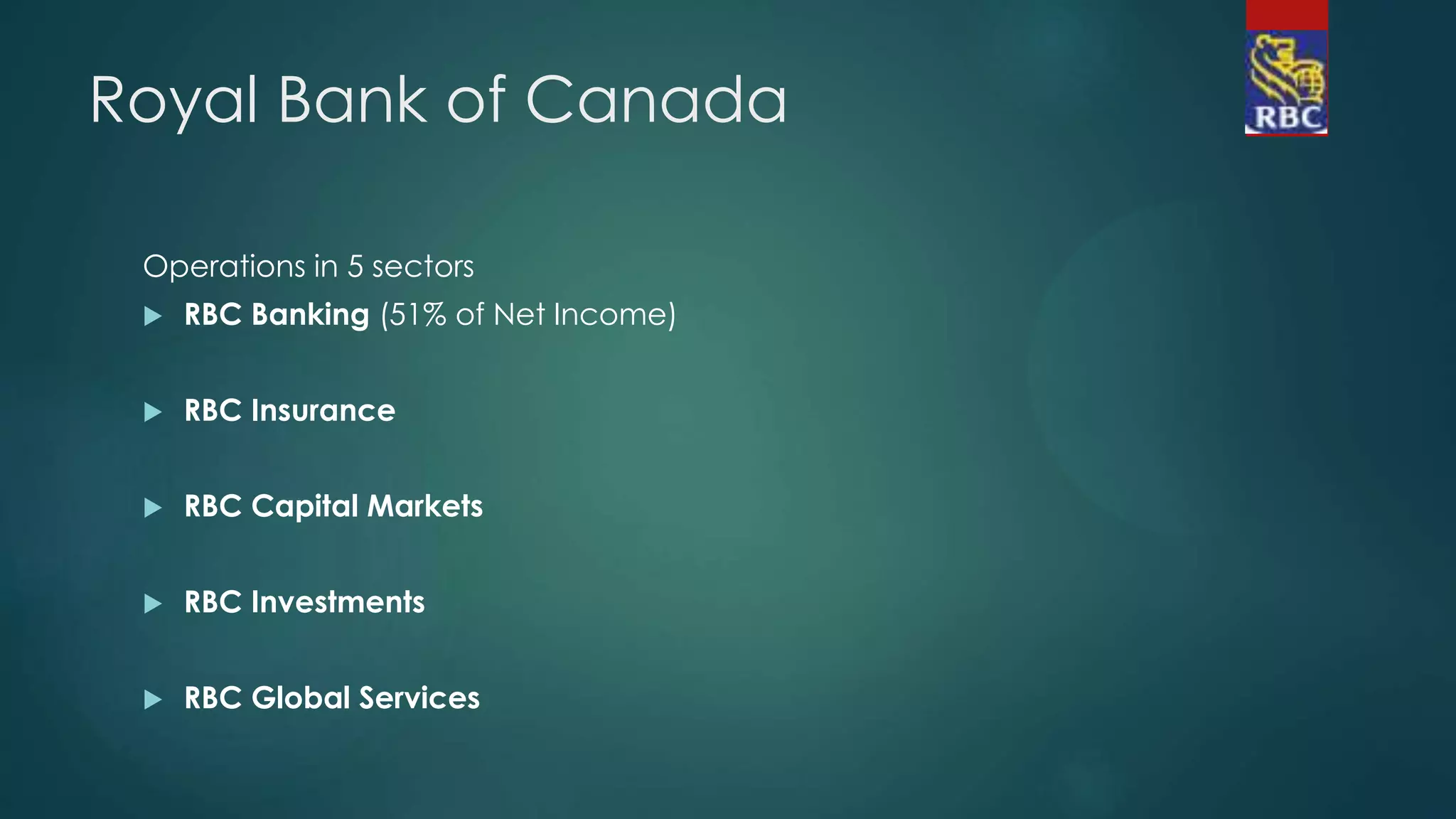
Operations in 5 sectors
 RBC Banking (51% of Net Income)
 RBC Insurance
 RBC Capital Markets
 RBC Investments
 RBC Global Services
Royal Bank of Canada
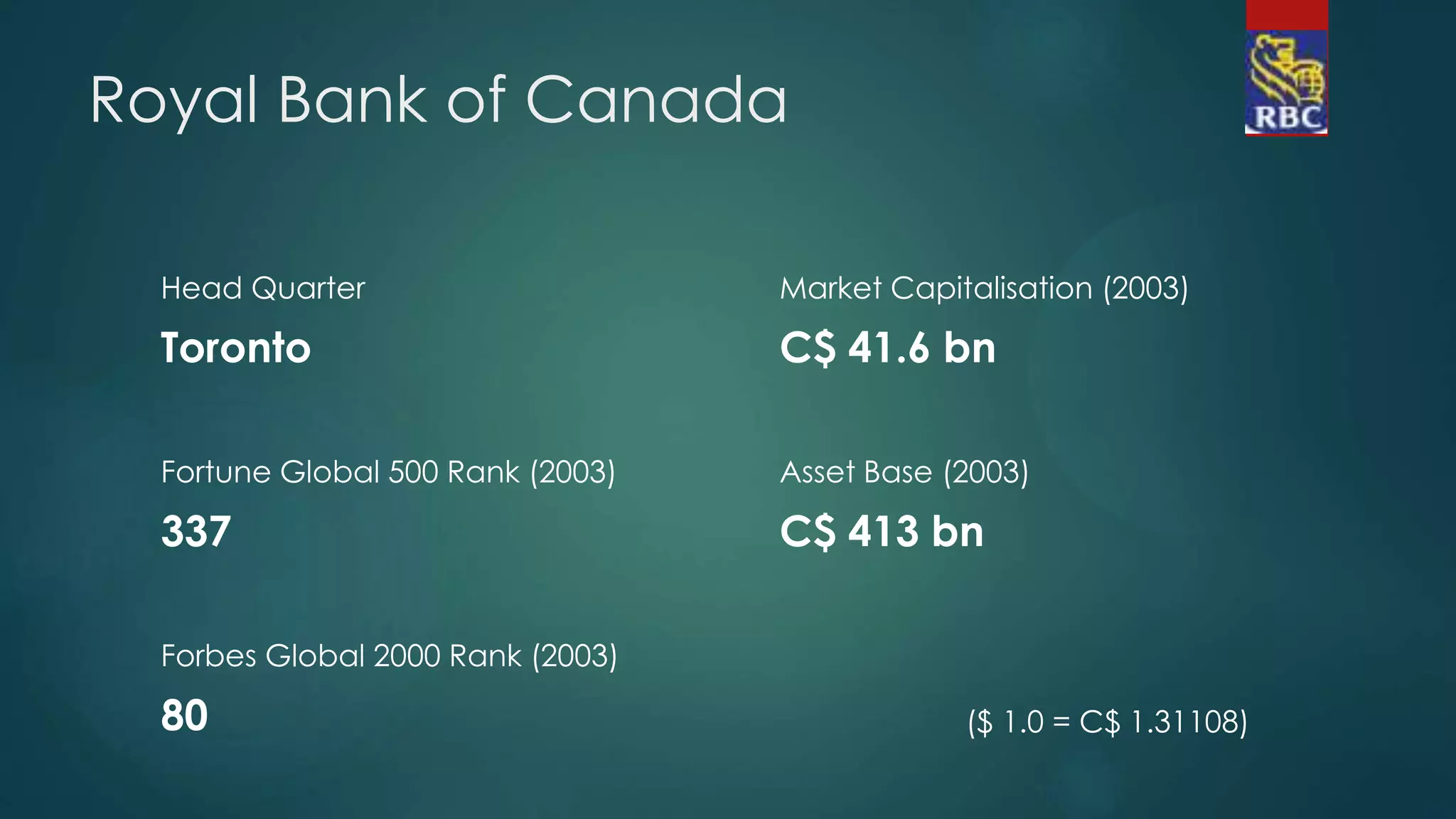
Market Capitalisation (2003)
C$ 41.6 bn
Asset Base (2003)
C$ 413 bn
($ 1.0 = C$ 1.31108)
Head Quarter
Toronto
Fortune Global 500 Rank (2003)
337
Forbes Global 2000 Rank (2003)
80
Royal Bank of Canada
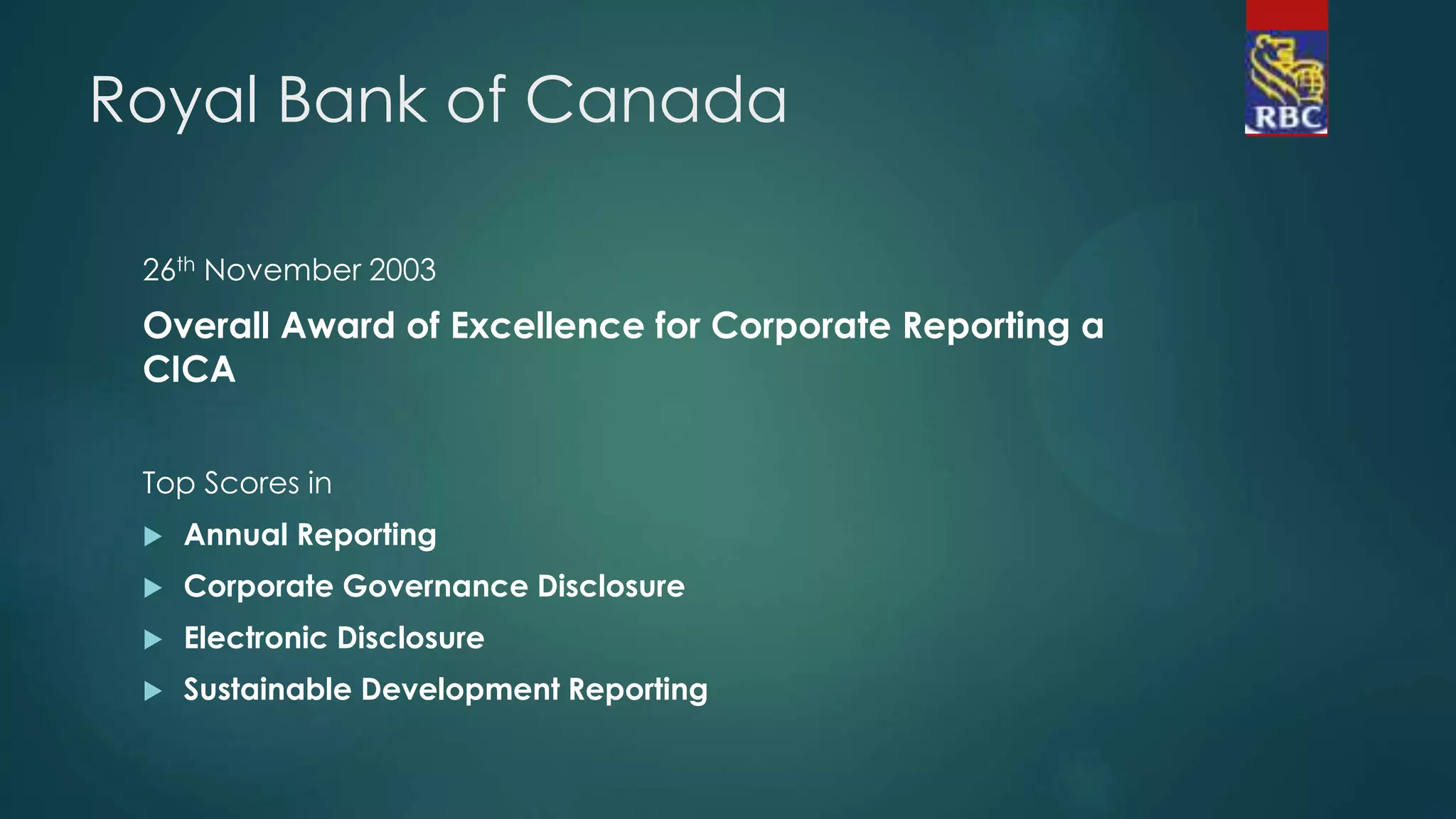
26th November 2003
Overall Award of Excellence for Corporate Reporting a
CICA
Top Scores in
 Annual Reporting
 Corporate Governance Disclosure
 Electronic Disclosure
 Sustainable Development Reporting
Royal Bank of Canada
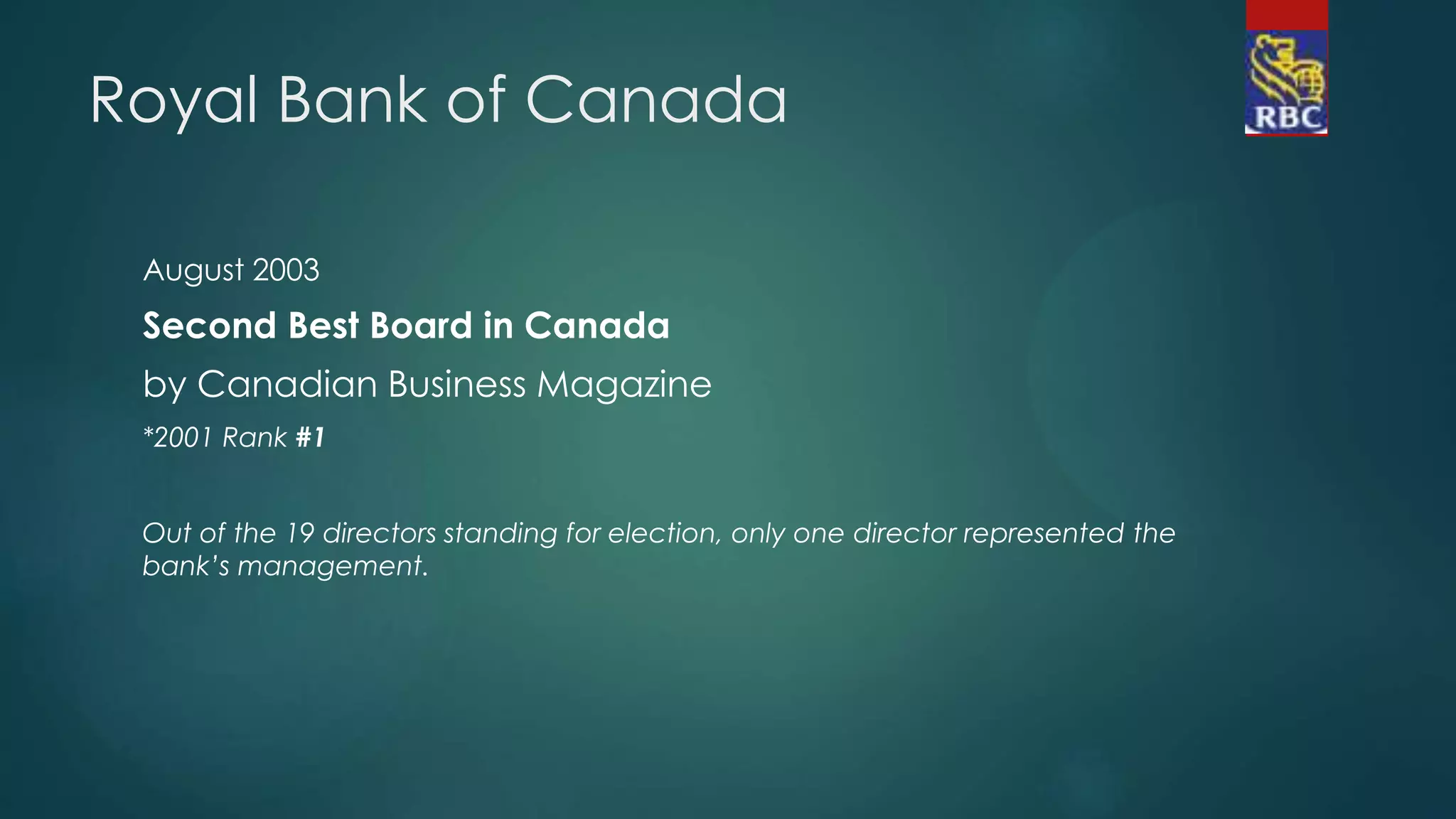
August 2003
Second Best Board in Canada
by Canadian Business Magazine
*2001 Rank #1
Out of the 19 directors standing for election, only one director represented the
bank’s management.
Royal Bank of Canada
2001
RBC launched a Subsidiary Governance Office (SGO) in order to
enhance governance practices in its subsidiaries.
It installed sophisticated software that allowed quick and easy access
to up-to-date information on all parts of its global network.
Royal Bank of Canada
RBC’s directors had to hold at least $100,000 in stock and had to stand
for re-election every year.
Any re-pricing of the stock options was not approved
The Board published the attendance of each director at the Board and
Committee meetings.
The Bank also scored high grades on the independence of its directors.
Royal Bank of Canada –
Board of Directors
1 Independent Chairman
2 Executive Directors
16 Independent Directors
4 Committees (consisting only of independent directors)
The Corporate Governance and Public Policy Committee (CGPC) had
developed standards of independence with respect to US’s NYSE Corporate
Governance listing Standards.
Royal Bank of Canada –
Board Composition
RBC did not permit more than two Board members from the
management.
The President and Chief Executive Officer (CEO) of the bank
The Bank complied with provisions of the Canadian Bank Act and the TSX
Guidelines in election of directors
The CGPC recommended the candidates suitable for nomination to the Board
and continuously reviewed the composition and mandates of all the
committees.
Royal Bank of Canada –
Board Responsibilities
 Succession
 Evaluation of Management Performance
 Review and execution of major business decisions
 Review and approval of corporate financial goals and operational plans
 Identification of risks
 Supervision of communications and public disclosure
 Assessment of the effectiveness of the internal controls and management information system
Royal Bank of Canada –
Board Committees
Committees of the Board consisted solely of independent and unrelated
directors.
The Board delegated specific tasks to two committees:
 Audit Committee
1 Chairman
5 independent directors
 Conduct Review and Risk Policy Committee (CRPC)
1 Chairman
5 Members – reviewed the credits to the directors
Any Query?
Thank You 

Corporate Governance with a Case Study of Royal Bank of Canada

  • 1.
  • 2.
    Today’s Objectives  CorporateGovernance  The Role of Board of Directors  Financial Reporting And The Audit Committee  Case Study
  • 3.
    What is CorporateGovernance? Corporate Governance broadly refers to the mechanisms, processes and relations by which corporations are controlled and directed.
  • 4.
    Governance Structure Governance structuresidentify the distribution of rights and responsibilities among different participants in the corporation and includes the rules and procedures for making decisions in corporate affairs.
  • 5.
    Governance Mechanism  Monitoringthe actions  Monitoring the policies  Decisions of corporation and their agents
  • 6.
    The Role OfBoards Of Directors The original purpose of a board of directors was to have a group, independent from management, looking out for the interests of shareholders who were not involved in the day-to-day management of the organization.
  • 7.
    The Role OfBoards Of Directors However, it didn’t always work that way. Board members often enjoyed a cozy relationship with managers in which each took care of the other.
  • 8.
    The Role OfBoards Of Directors The “quid pro quo” arrangement has changed. The Sarbanes-Oxley Act puts greater demands on board members of publicly traded companies in the United States to do what they were empowered and expected to do. To help boards do this better, researchers at the Corporate Governance Center at Kennesaw State University developed 13 governance principles for U.S. public companies.
  • 9.
    Financial Reporting AndThe Audit Committee In addition to expanding the role of boards of directors, the Sarbanes- Oxley Act also called for more disclosure and transparency of corporate financial information.
  • 10.
    Financial Reporting AndThe Audit Committee Senior managers in the United States are now required to certify their companies’ financial results. Such changes have led to better information— that is, information that is more accurate and reflective of a company’s financial condition. In fulfilling their financial reporting responsibilities, managers might want to follow the principles also developed by the researchers at the Corporate Governance Center at Kennesaw State University.
  • 11.
  • 12.
    Royal Bank ofCanada - Origin 1864 Merchants Bank Head Quarter Halifax, Nova Scotia
  • 13.
    Royal Bank ofCanada Operations in 5 sectors  RBC Banking (51% of Net Income)  RBC Insurance  RBC Capital Markets  RBC Investments  RBC Global Services
  • 14.
    Royal Bank ofCanada Market Capitalisation (2003) C$ 41.6 bn Asset Base (2003) C$ 413 bn ($ 1.0 = C$ 1.31108) Head Quarter Toronto Fortune Global 500 Rank (2003) 337 Forbes Global 2000 Rank (2003) 80
  • 15.
    Royal Bank ofCanada 26th November 2003 Overall Award of Excellence for Corporate Reporting a CICA Top Scores in  Annual Reporting  Corporate Governance Disclosure  Electronic Disclosure  Sustainable Development Reporting
  • 16.
    Royal Bank ofCanada August 2003 Second Best Board in Canada by Canadian Business Magazine *2001 Rank #1 Out of the 19 directors standing for election, only one director represented the bank’s management.
  • 17.
    Royal Bank ofCanada 2001 RBC launched a Subsidiary Governance Office (SGO) in order to enhance governance practices in its subsidiaries. It installed sophisticated software that allowed quick and easy access to up-to-date information on all parts of its global network.
  • 18.
    Royal Bank ofCanada RBC’s directors had to hold at least $100,000 in stock and had to stand for re-election every year. Any re-pricing of the stock options was not approved The Board published the attendance of each director at the Board and Committee meetings. The Bank also scored high grades on the independence of its directors.
  • 19.
    Royal Bank ofCanada – Board of Directors 1 Independent Chairman 2 Executive Directors 16 Independent Directors 4 Committees (consisting only of independent directors) The Corporate Governance and Public Policy Committee (CGPC) had developed standards of independence with respect to US’s NYSE Corporate Governance listing Standards.
  • 20.
    Royal Bank ofCanada – Board Composition RBC did not permit more than two Board members from the management. The President and Chief Executive Officer (CEO) of the bank The Bank complied with provisions of the Canadian Bank Act and the TSX Guidelines in election of directors The CGPC recommended the candidates suitable for nomination to the Board and continuously reviewed the composition and mandates of all the committees.
  • 21.
    Royal Bank ofCanada – Board Responsibilities  Succession  Evaluation of Management Performance  Review and execution of major business decisions  Review and approval of corporate financial goals and operational plans  Identification of risks  Supervision of communications and public disclosure  Assessment of the effectiveness of the internal controls and management information system
  • 22.
    Royal Bank ofCanada – Board Committees Committees of the Board consisted solely of independent and unrelated directors. The Board delegated specific tasks to two committees:  Audit Committee 1 Chairman 5 independent directors  Conduct Review and Risk Policy Committee (CRPC) 1 Chairman 5 Members – reviewed the credits to the directors
  • 23.
  • 24.