Chapter 4 Foundations of Decision Making
Learning Outcomes Describe the steps in the decision-making process Identify the assumptions of the rational decision-making model Explain the limits to rationality Define certainty, risk, and uncertainty as they relate to decision making Describe the actions of the bounded-rational decision maker   (continued)
Learning Outcomes (continued) Identify the two types of decision problems and the two types of decisions that are used to solve them Define  heuristics  and explain how they affect the decision-making process Identify four decision-making styles Describe the advantages and disadvantages of group decisions Explain three techniques for improving group decision making
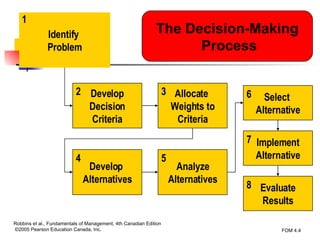
Identify  Problem The Decision-Making Process Select  Alternative Implement Alternative Evaluate Results 1 Develop  Alternatives Analyze Alternatives Develop Decision Criteria Allocate  Weights to Criteria 2 3 4 5 6 7   8
Step 1: Identify a Problem The difference between what is and what it ought to be
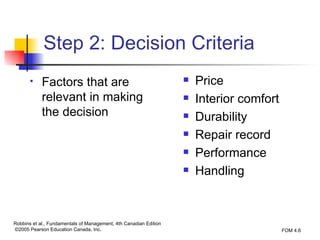
Step 2: Decision Criteria Factors that are relevant in making the decision Price Interior comfort Durability Repair record Performance Handling
Determining the relative priority of each of the criteria Step 3: Allocating Weights
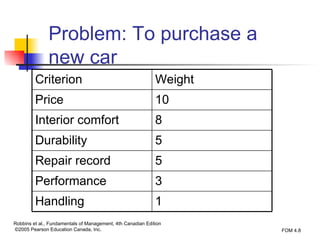
Problem: To purchase a new car 1 Handling 3 Performance 5 Repair record 5 Durability 8 Interior comfort 10 Price Weight Criterion
Step 4: Alternatives Generate a list of possible  vehicle manufacturers
Assessing the value of each alternative by making a value judgment of the feature Step 5: Analyzing Alternatives
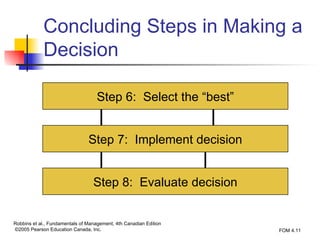
Concluding Steps in Making a Decision Step 6:  Select the “best” Step 7:  Implement decision Step 8:  Evaluate decision
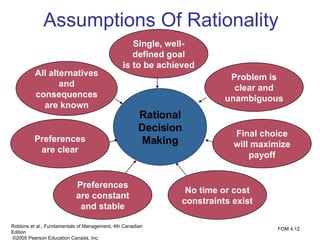
Assumptions Of Rationality Rational Decision Making Problem is clear and unambiguous Single, well- defined goal is to be achieved All alternatives and consequences are known Preferences are clear Preferences are constant and stable No time or cost constraints exist Final choice will maximize payoff © Prentice Hall, 2002 Robbins et al., Fundamentals of Management, 4th Canadian Edition ©2005 Pearson Education Canada, Inc. FOM 4.12
Creativity and Decision Making Creativity is the ability to produce novel and useful ideas Important to decision making as it allows the decision-maker to “see” problems that others can’t It helps identify more viable alternatives
Unleashing Creative Potential “Thinking out of the box” Using the right side of your brain Three-component model of creativity Expertise Creative-thinking skills Intrinsic task motivation
Bounded Rationality Uncertainty Risk Satisfying Focusing on highly visible choices
Errors in Decision-Making Process Heuristics Availability Representative Escalation of commitment
Well-Structured vs. Ill-Structured Problems Straightforward Familiar Easily-defined New or unusual Ambiguous information Incomplete information
Categories of Decisions Programmed Non-programmed
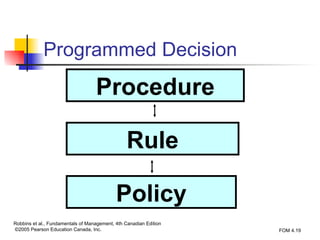
Programmed Decision Procedure Rule Policy
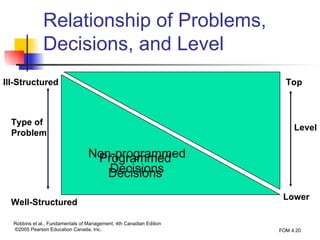
Relationship of Problems, Decisions, and Level Programmed Decisions Non-programmed Decisions Type of Problem Level Ill-Structured Well-Structured Top Lower
Decision-making and Technology Information technology can help support decision-making Types of software include Expert systems Neural networks Groupware
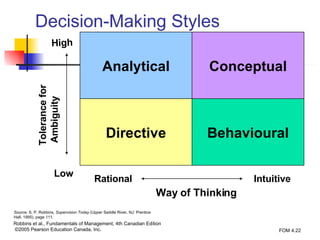
Decision-Making Styles Analytical Behavioural Directive Conceptual Rational Intuitive Way of Thinking Low High Tolerance for Ambiguity Source:  S. P. Robbins,  Supervision Today  (Upper Saddle River, NJ: Prentice Hall, 1995), page 111.
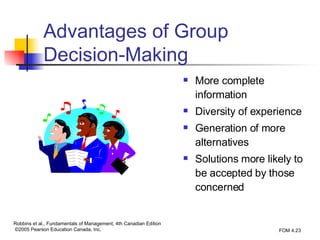
Advantages of Group Decision-Making More complete information Diversity of experience Generation of more alternatives Solutions more likely to be accepted by those concerned
Disadvantages of Group Decision-Making Time-consuming Domination by a few Pressure to conform
When are Groups More Effective When accuracy is important When creativity is important When buy-in is important When size of group is 5-7 people
Ways to Improve Group Decision-Making Brainstorming Nominal group technique Electronic meetings
Decision-Making and National Culture Differs from one country to another Need to recognize what is acceptable Managers can expect high payoff if they can accommodate the diversity

foundation of decision making

  • 1.
    Chapter 4 Foundationsof Decision Making
  • 2.
    Learning Outcomes Describethe steps in the decision-making process Identify the assumptions of the rational decision-making model Explain the limits to rationality Define certainty, risk, and uncertainty as they relate to decision making Describe the actions of the bounded-rational decision maker (continued)
  • 3.
    Learning Outcomes (continued)Identify the two types of decision problems and the two types of decisions that are used to solve them Define heuristics and explain how they affect the decision-making process Identify four decision-making styles Describe the advantages and disadvantages of group decisions Explain three techniques for improving group decision making
  • 4.
    Identify ProblemThe Decision-Making Process Select Alternative Implement Alternative Evaluate Results 1 Develop Alternatives Analyze Alternatives Develop Decision Criteria Allocate Weights to Criteria 2 3 4 5 6 7 8
  • 5.
    Step 1: Identifya Problem The difference between what is and what it ought to be
  • 6.
    Step 2: DecisionCriteria Factors that are relevant in making the decision Price Interior comfort Durability Repair record Performance Handling
  • 7.
    Determining the relativepriority of each of the criteria Step 3: Allocating Weights
  • 8.
    Problem: To purchasea new car 1 Handling 3 Performance 5 Repair record 5 Durability 8 Interior comfort 10 Price Weight Criterion
  • 9.
    Step 4: AlternativesGenerate a list of possible vehicle manufacturers
  • 10.
    Assessing the valueof each alternative by making a value judgment of the feature Step 5: Analyzing Alternatives
  • 11.
    Concluding Steps inMaking a Decision Step 6: Select the “best” Step 7: Implement decision Step 8: Evaluate decision
  • 12.
    Assumptions Of RationalityRational Decision Making Problem is clear and unambiguous Single, well- defined goal is to be achieved All alternatives and consequences are known Preferences are clear Preferences are constant and stable No time or cost constraints exist Final choice will maximize payoff © Prentice Hall, 2002 Robbins et al., Fundamentals of Management, 4th Canadian Edition ©2005 Pearson Education Canada, Inc. FOM 4.12
  • 13.
    Creativity and DecisionMaking Creativity is the ability to produce novel and useful ideas Important to decision making as it allows the decision-maker to “see” problems that others can’t It helps identify more viable alternatives
  • 14.
    Unleashing Creative Potential“Thinking out of the box” Using the right side of your brain Three-component model of creativity Expertise Creative-thinking skills Intrinsic task motivation
  • 15.
    Bounded Rationality UncertaintyRisk Satisfying Focusing on highly visible choices
  • 16.
    Errors in Decision-MakingProcess Heuristics Availability Representative Escalation of commitment
  • 17.
    Well-Structured vs. Ill-StructuredProblems Straightforward Familiar Easily-defined New or unusual Ambiguous information Incomplete information
  • 18.
    Categories of DecisionsProgrammed Non-programmed
  • 19.
  • 20.
    Relationship of Problems,Decisions, and Level Programmed Decisions Non-programmed Decisions Type of Problem Level Ill-Structured Well-Structured Top Lower
  • 21.
    Decision-making and TechnologyInformation technology can help support decision-making Types of software include Expert systems Neural networks Groupware
  • 22.
    Decision-Making Styles AnalyticalBehavioural Directive Conceptual Rational Intuitive Way of Thinking Low High Tolerance for Ambiguity Source: S. P. Robbins, Supervision Today (Upper Saddle River, NJ: Prentice Hall, 1995), page 111.
  • 23.
    Advantages of GroupDecision-Making More complete information Diversity of experience Generation of more alternatives Solutions more likely to be accepted by those concerned
  • 24.
    Disadvantages of GroupDecision-Making Time-consuming Domination by a few Pressure to conform
  • 25.
    When are GroupsMore Effective When accuracy is important When creativity is important When buy-in is important When size of group is 5-7 people
  • 26.
    Ways to ImproveGroup Decision-Making Brainstorming Nominal group technique Electronic meetings
  • 27.
    Decision-Making and NationalCulture Differs from one country to another Need to recognize what is acceptable Managers can expect high payoff if they can accommodate the diversity

Editor's Notes