Electric Motor Efficiency
White Paper overview
Hydraulic Institute 2005 Spring Meeting
June 2-5, 2005
Major Topics
Motor Types
Factors Affecting Efficiency
Measuring and Testing Efficiency
Minimum Efficiency Standards
Efficiency and Motor Repairs
Motor Efficiency & Pumping Systems
Emerging Motor Technologies
Marketplace Initiatives and Programs
Types of AC Motors
There are many types of AC motors.
Many types are synchronous, meaning the rotor
turns at exactly the rotating speed of the stator
magnetic field.
One asynchronous type, the induction motor is
by far the most common.
The 3-phase AC induction motor has been
called the workhorse of industry.
White paper focuses on the 3-phase AC
induction motor
AC Induction Motor
This is the most commonplace motor. It has a
rotating stator field. The rotor has imbedded
electroconductive bars resembling a pet rodent
exercise wheel, which inspired the name, “squirrel
cage”. The rotating stator field induces current in the
cage creating a magnetic field which causes the rotor
to follow the stator field.
First Induction
Motor, 1888
Inventor Nikola
Tesla
1894 Induction
Motor. World’s
largest when
new. 65 HP
Opportunity
In U.S. Industry, electric motors consume:
– ~680 billion kWh/year
– ~63% of all industrial electricity consumption
– ~23% of all U.S. consumption
These percentages are typically higher in
developing countries, while the motors are
typically less efficient
Use of only “Premium Efficiency” motors
could save ~20 billion kWh/year in the U.S.
What is Efficiency?
Efficiency =Output / Input
Efficiency = (Input - Losses) / Input
Efficiency = Output / (Output +
Losses)
They’re all mathematically equivalent.
How is power lost in a motor?
Mechanical (friction and windage) losses
– friction in bearings and seals and power consumed by
the motor cooling fan
Magnetic (core) losses
– hysteresis and eddy current losses in steel
laminations of the stator and rotor
Electrical (I2R) losses*
– Stator winding losses
– Rotor conductor bar losses)
Stray losses*
– miscellaneous losses associated mainly with
electromagnetic radiation
*These losses vary as load varies – proportional to (load)2
What’s in an efficient motor?
Same components; just more and better
materials and closer tolerances.
Larger wire gage – Lower stator winding
loss
Longer rotor and stator – Lower core
loss
Lower rotor bar resistance – Lower rotor
loss
Smaller fan – Lower windage loss
Optimized air gap size – Lower stray
load loss
Better steel with thinner laminations --
Lower core loss
Optimum bearing seal/shield – Lower
friction loss
Are they...
More or less reliable?
– Not necessarily correlated. But some manufacturers
offer premium lines that combine high efficiency with
other premium features like better mounting
tolerances.
More fragile?
– No. Nothing in their design is inherently more or less
tough.
Bigger?
– No. The same standard frame sizes are available.
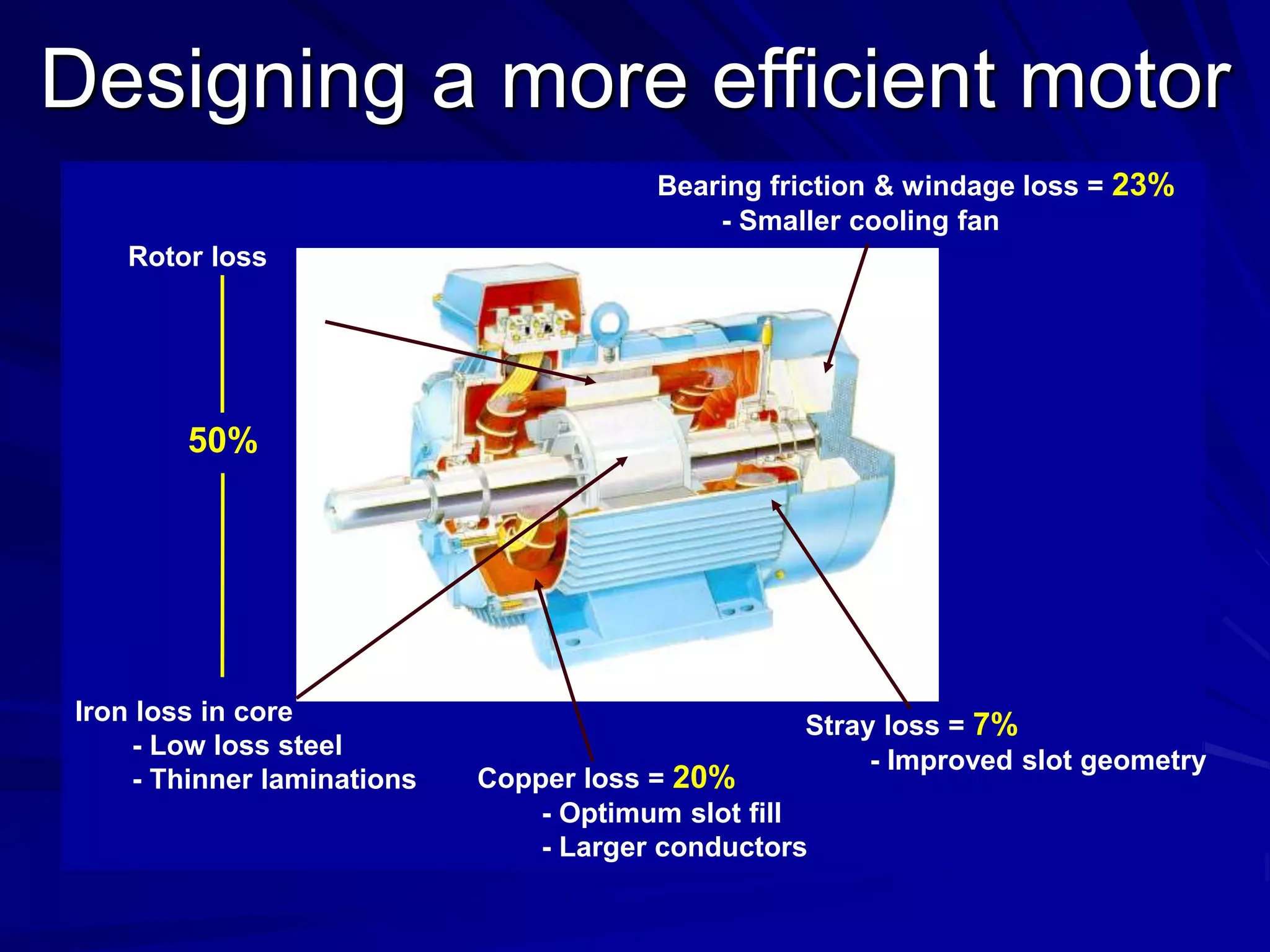
Iron loss in core
- Low loss steel
- Thinner laminations
Bearing friction & windage loss = 23%
- Smaller cooling fan
Rotor loss
Copper loss = 20%
- Optimum slot fill
- Larger conductors
Stray loss = 7%
- Improved slot geometry
50%
Designing a more efficient motor
How is efficiency determined?
IEEE 112-B (United States)
IEC IEC60034.2 (International
Electrotechnical Commission)
JEC-37 (Japanese Electrotechnical
Committee)
C-390 (Canadian Standards Association)
There are different standards in use
around the world for the
determination of motor efficiency.
They yield slightly different results.
How is efficiency determined?
The following table of results from three different
testing standards was prepared by the Copper
Development Centre of Southeast Asia.
Test Method 15 HP 75 HP 800 HP 1500 HP
IEEE 112 B 87.4 90.0 95.9 95.9
IEC 34-2 89.2 92.7 95.6 96.0
JEC 37 90.1 93.1 95.9 96.8
National Standards Organizations
International Standards Organizations
Electric Industry Organizations
Government
Professional Societies
Who Sets Motor Efficiency
Standards?
Industry: NEMA
– Sets labeling standard for “Energy Efficient” and “Premium™
Efficient” motors from 1 to 500 HP and medium voltage
motors from 250 to 500 HP.
United States Government: EPACT
– Sets minimum efficiency standard for certain new 3-phase
motors from 1 to 200 HP. Levels identical to NEMA’s “Energy
Efficient” classification.
International Electrotechnical Commission
– Sets standard for EFF1 and EFF2 efficiency levels.
IEEE
– Sets efficiency standard for severe duty motors use in the
petrochemical industry. (IEEE 841 motors)
Who Sets Motor Efficiency Standards?
Motor Efficiency Comparison –
US and EU
75
80
85
90
95
1.1 2.2 5.5 15 22 45 75
US Minimal
EU eff1
voluntary eff std
EU eff2
minimal eff std
Eff: %
Size: KW
NEMA Definitions
“Energy Efficient”
– Covers 3-phase induction motors with efficiencies equal to or
exceeding that in table 12-10 of NEMA’s MG 1 standard.
– For low voltage (<600V) motors from 2-poles to 8-poles and 1-
500 hp.
“NEMA Premium™ Efficient”
– Covers 3-phase induction motors from 2-poles to 6-poles. It
pertains to low voltage motors from 1-500 hp and medium
voltage (>600 & <5000V).
– = ~3.5% better than “Energy Efficient” on 1 hp motors.
– = ~1% better than “Energy Efficient” on 200 hp motors
– http://www.nema.org/premiummotors/
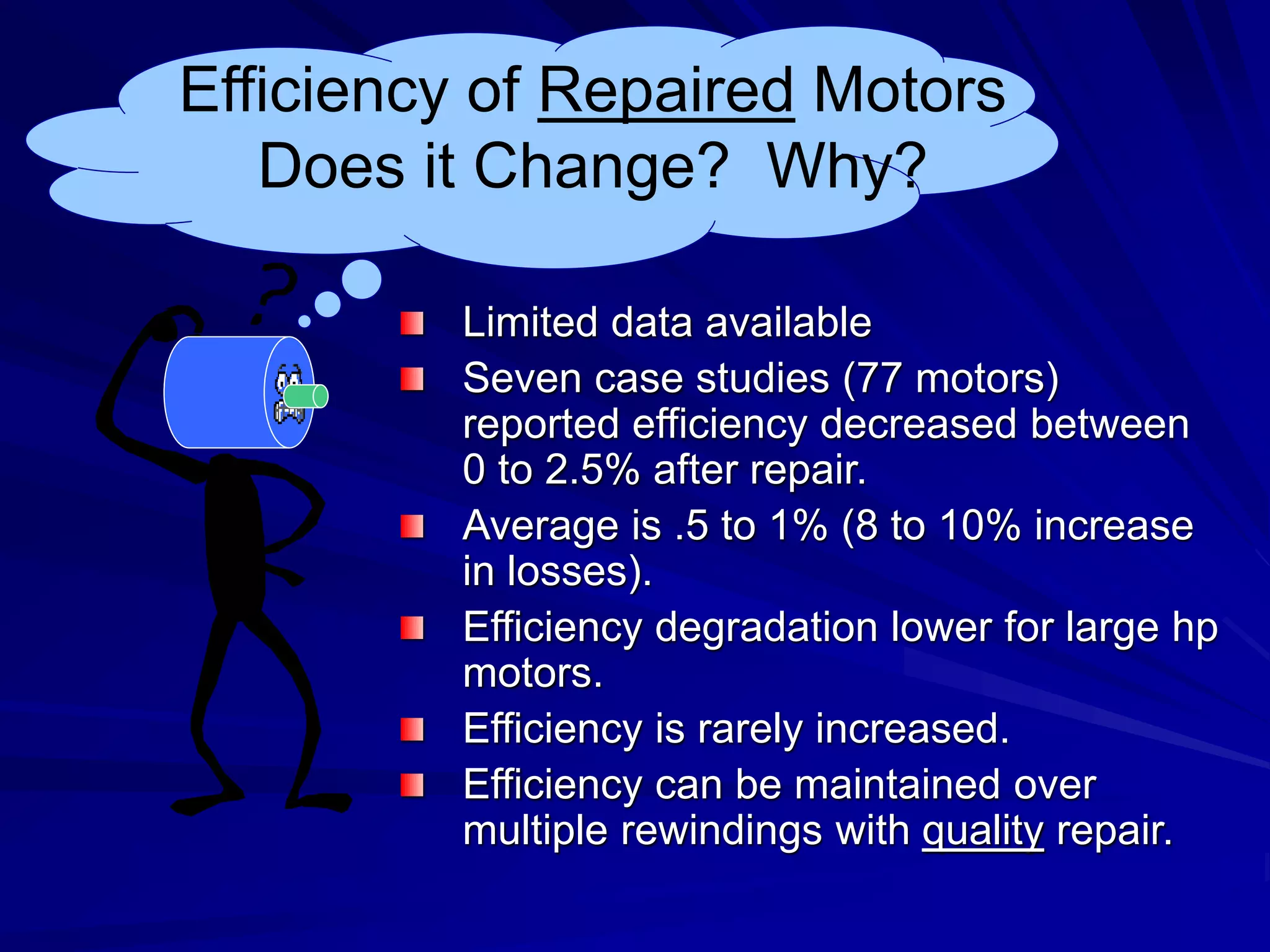
Efficiency of Repaired Motors
Does it Change? Why?
Limited data available
Seven case studies (77 motors)
reported efficiency decreased between
0 to 2.5% after repair.
Average is .5 to 1% (8 to 10% increase
in losses).
Efficiency degradation lower for large hp
motors.
Efficiency is rarely increased.
Efficiency can be maintained over
multiple rewindings with quality repair.
Resources Pertaining to Motor
Repair and Rewinding
EASA
www.easa.com
white papers and
informative booklets
seminars
Variables Beyond the Motor
Load factor
–Efficiency ratings are for 100% load
–Efficiency varies as load decreases
 Take a look at the next 2 slides
Motor efficiencies for 100 hp (75 kW) motors -
typical performance curves over normal load range
96
95
94
93
92
91
90
Efficiency,
%
100
75
50
25
Load, % of rated
6-pole
Motor efficiencies for 10 hp (7.5 kW) motors -
typical performance curves over normal load range
92
91
90
89
88
87
86
85
Efficiency,
%
100
75
50
25
Load, % of rated
2-pole
8-pole
4-pole
Other Variables
Enclosure types
– See HI Enclosures white paper
– ODP, TEFC most common, covered by EPAct
– Older ODP slightly higher eff. than TEFC
– But little difference for Premium Efficiency
Voltage variation
– Low voltage (>10% decrease) can affect
efficiency
– Voltage phase unbalance affects efficiency
Other Motors
Fractional hp motors
– Not included in standards
Large hp motors
– EPAct stops at 200 hp
– NEMA Premium stops at 500 hp
– EU stops at 75 kW
Vertical motors
– Not covered by EPAct
– But any meeting “NEMA Premium” values can
use the label
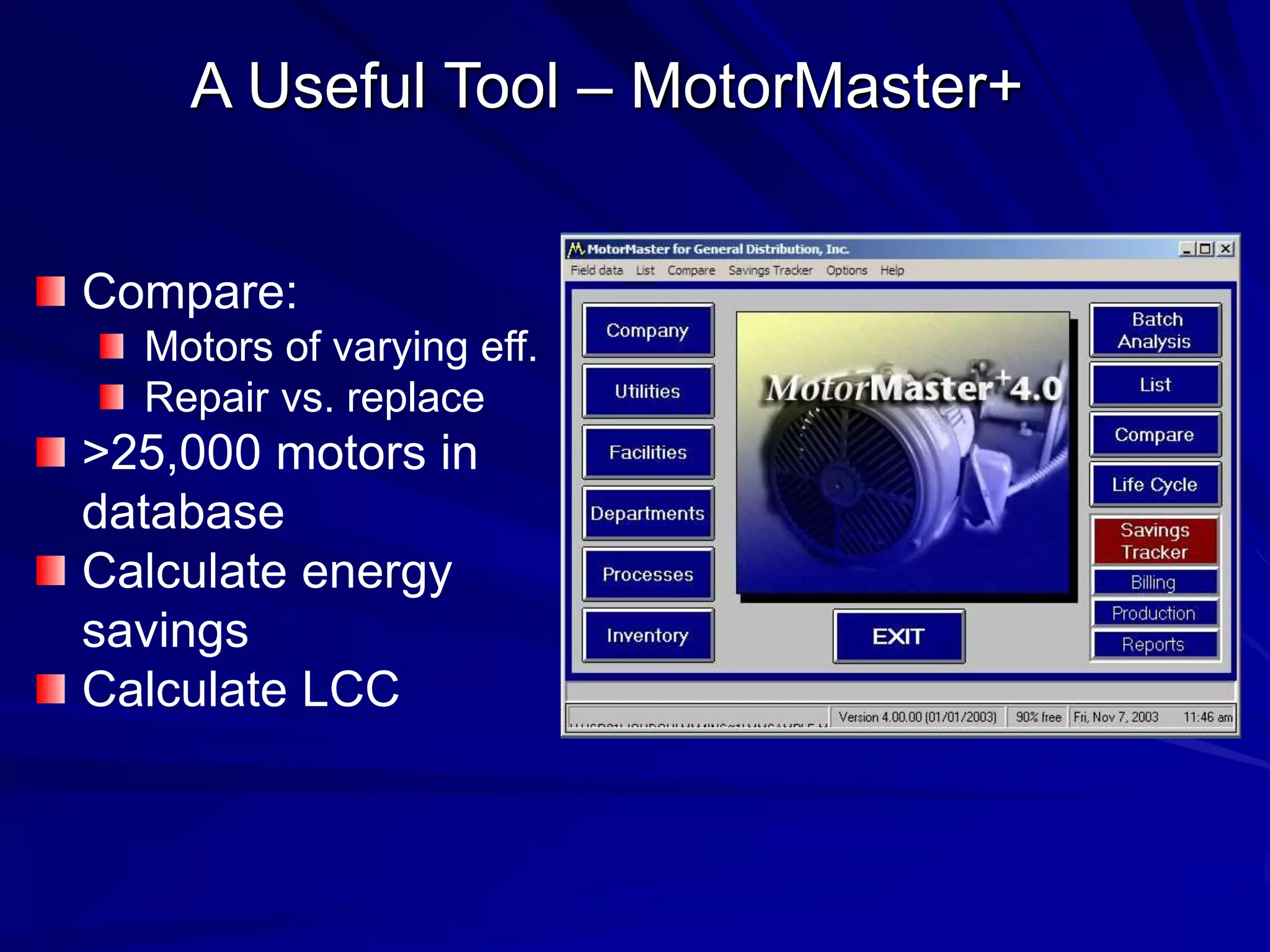
A Useful Tool – MotorMaster+
Compare:
Motors of varying eff.
Repair vs. replace
>25,000 motors in
database
Calculate energy
savings
Calculate LCC
A New Tool – MotorMaster+ International
Includes IEC motors
English, Spanish, &
French modes
Accomodates several
currencies
What’s New?
Copper rotor motor
– Substituting copper for aluminum in rotor conductor
bars
– Development needed to affordably die-cast copper
Electronically commutated permanent-
magnet motor
– a.k.a. Brushless DC motor
– Uses multiple permanent magnets bonded to the rotor
– Available up to 60 hp now
– Attractive for precise speed control; high power factor
Continued
What’s New? (cont’d)
Switched-reluctance
– Also electronically commutated, brushless
– Precise speed control
– Currently popular in fractional hp market
Written-pole motors
– Single phase, up to 60 hp
– Market is areas lacking 3-phase power (e.g.
very rural areas)
Questions or comments?
Vestal Tutterow
Alliance to Save Energy
Phone: (202) 530-2241
Fax: (202) 331-9588
E-mail: vtutterow@ase.org

electric_motor_efficiency.ppt

  • 1.
    Electric Motor Efficiency WhitePaper overview Hydraulic Institute 2005 Spring Meeting June 2-5, 2005
  • 2.
    Major Topics Motor Types FactorsAffecting Efficiency Measuring and Testing Efficiency Minimum Efficiency Standards Efficiency and Motor Repairs Motor Efficiency & Pumping Systems Emerging Motor Technologies Marketplace Initiatives and Programs
  • 3.
    Types of ACMotors There are many types of AC motors. Many types are synchronous, meaning the rotor turns at exactly the rotating speed of the stator magnetic field. One asynchronous type, the induction motor is by far the most common. The 3-phase AC induction motor has been called the workhorse of industry. White paper focuses on the 3-phase AC induction motor
  • 4.
    AC Induction Motor Thisis the most commonplace motor. It has a rotating stator field. The rotor has imbedded electroconductive bars resembling a pet rodent exercise wheel, which inspired the name, “squirrel cage”. The rotating stator field induces current in the cage creating a magnetic field which causes the rotor to follow the stator field. First Induction Motor, 1888 Inventor Nikola Tesla 1894 Induction Motor. World’s largest when new. 65 HP
  • 5.
    Opportunity In U.S. Industry,electric motors consume: – ~680 billion kWh/year – ~63% of all industrial electricity consumption – ~23% of all U.S. consumption These percentages are typically higher in developing countries, while the motors are typically less efficient Use of only “Premium Efficiency” motors could save ~20 billion kWh/year in the U.S.
  • 6.
    What is Efficiency? Efficiency=Output / Input Efficiency = (Input - Losses) / Input Efficiency = Output / (Output + Losses) They’re all mathematically equivalent.
  • 7.
    How is powerlost in a motor? Mechanical (friction and windage) losses – friction in bearings and seals and power consumed by the motor cooling fan Magnetic (core) losses – hysteresis and eddy current losses in steel laminations of the stator and rotor Electrical (I2R) losses* – Stator winding losses – Rotor conductor bar losses) Stray losses* – miscellaneous losses associated mainly with electromagnetic radiation *These losses vary as load varies – proportional to (load)2
  • 8.
    What’s in anefficient motor? Same components; just more and better materials and closer tolerances. Larger wire gage – Lower stator winding loss Longer rotor and stator – Lower core loss Lower rotor bar resistance – Lower rotor loss Smaller fan – Lower windage loss Optimized air gap size – Lower stray load loss Better steel with thinner laminations -- Lower core loss Optimum bearing seal/shield – Lower friction loss
  • 9.
    Are they... More orless reliable? – Not necessarily correlated. But some manufacturers offer premium lines that combine high efficiency with other premium features like better mounting tolerances. More fragile? – No. Nothing in their design is inherently more or less tough. Bigger? – No. The same standard frame sizes are available.
  • 10.
    Iron loss incore - Low loss steel - Thinner laminations Bearing friction & windage loss = 23% - Smaller cooling fan Rotor loss Copper loss = 20% - Optimum slot fill - Larger conductors Stray loss = 7% - Improved slot geometry 50% Designing a more efficient motor
  • 11.
    How is efficiencydetermined? IEEE 112-B (United States) IEC IEC60034.2 (International Electrotechnical Commission) JEC-37 (Japanese Electrotechnical Committee) C-390 (Canadian Standards Association) There are different standards in use around the world for the determination of motor efficiency. They yield slightly different results.
  • 12.
    How is efficiencydetermined? The following table of results from three different testing standards was prepared by the Copper Development Centre of Southeast Asia. Test Method 15 HP 75 HP 800 HP 1500 HP IEEE 112 B 87.4 90.0 95.9 95.9 IEC 34-2 89.2 92.7 95.6 96.0 JEC 37 90.1 93.1 95.9 96.8
  • 13.
    National Standards Organizations InternationalStandards Organizations Electric Industry Organizations Government Professional Societies Who Sets Motor Efficiency Standards?
  • 14.
    Industry: NEMA – Setslabeling standard for “Energy Efficient” and “Premium™ Efficient” motors from 1 to 500 HP and medium voltage motors from 250 to 500 HP. United States Government: EPACT – Sets minimum efficiency standard for certain new 3-phase motors from 1 to 200 HP. Levels identical to NEMA’s “Energy Efficient” classification. International Electrotechnical Commission – Sets standard for EFF1 and EFF2 efficiency levels. IEEE – Sets efficiency standard for severe duty motors use in the petrochemical industry. (IEEE 841 motors) Who Sets Motor Efficiency Standards?
  • 15.
    Motor Efficiency Comparison– US and EU 75 80 85 90 95 1.1 2.2 5.5 15 22 45 75 US Minimal EU eff1 voluntary eff std EU eff2 minimal eff std Eff: % Size: KW
  • 16.
    NEMA Definitions “Energy Efficient” –Covers 3-phase induction motors with efficiencies equal to or exceeding that in table 12-10 of NEMA’s MG 1 standard. – For low voltage (<600V) motors from 2-poles to 8-poles and 1- 500 hp. “NEMA Premium™ Efficient” – Covers 3-phase induction motors from 2-poles to 6-poles. It pertains to low voltage motors from 1-500 hp and medium voltage (>600 & <5000V). – = ~3.5% better than “Energy Efficient” on 1 hp motors. – = ~1% better than “Energy Efficient” on 200 hp motors – http://www.nema.org/premiummotors/
  • 17.
    Efficiency of RepairedMotors Does it Change? Why? Limited data available Seven case studies (77 motors) reported efficiency decreased between 0 to 2.5% after repair. Average is .5 to 1% (8 to 10% increase in losses). Efficiency degradation lower for large hp motors. Efficiency is rarely increased. Efficiency can be maintained over multiple rewindings with quality repair.
  • 18.
    Resources Pertaining toMotor Repair and Rewinding EASA www.easa.com white papers and informative booklets seminars
  • 19.
    Variables Beyond theMotor Load factor –Efficiency ratings are for 100% load –Efficiency varies as load decreases  Take a look at the next 2 slides
  • 20.
    Motor efficiencies for100 hp (75 kW) motors - typical performance curves over normal load range 96 95 94 93 92 91 90 Efficiency, % 100 75 50 25 Load, % of rated 6-pole
  • 21.
    Motor efficiencies for10 hp (7.5 kW) motors - typical performance curves over normal load range 92 91 90 89 88 87 86 85 Efficiency, % 100 75 50 25 Load, % of rated 2-pole 8-pole 4-pole
  • 22.
    Other Variables Enclosure types –See HI Enclosures white paper – ODP, TEFC most common, covered by EPAct – Older ODP slightly higher eff. than TEFC – But little difference for Premium Efficiency Voltage variation – Low voltage (>10% decrease) can affect efficiency – Voltage phase unbalance affects efficiency
  • 23.
    Other Motors Fractional hpmotors – Not included in standards Large hp motors – EPAct stops at 200 hp – NEMA Premium stops at 500 hp – EU stops at 75 kW Vertical motors – Not covered by EPAct – But any meeting “NEMA Premium” values can use the label
  • 24.
    A Useful Tool– MotorMaster+ Compare: Motors of varying eff. Repair vs. replace >25,000 motors in database Calculate energy savings Calculate LCC
  • 25.
    A New Tool– MotorMaster+ International Includes IEC motors English, Spanish, & French modes Accomodates several currencies
  • 26.
    What’s New? Copper rotormotor – Substituting copper for aluminum in rotor conductor bars – Development needed to affordably die-cast copper Electronically commutated permanent- magnet motor – a.k.a. Brushless DC motor – Uses multiple permanent magnets bonded to the rotor – Available up to 60 hp now – Attractive for precise speed control; high power factor Continued
  • 27.
    What’s New? (cont’d) Switched-reluctance –Also electronically commutated, brushless – Precise speed control – Currently popular in fractional hp market Written-pole motors – Single phase, up to 60 hp – Market is areas lacking 3-phase power (e.g. very rural areas)
  • 28.
    Questions or comments? VestalTutterow Alliance to Save Energy Phone: (202) 530-2241 Fax: (202) 331-9588 E-mail: vtutterow@ase.org