Graph Neural Networks
Dr. Taysir Hassan
Alzhraa Yousef
• Abstract
• Introduction
• Foundations
• Frontiers
• Applications
Agenda
• Deep Learning has become one of the most dominant approaches in Artifcial
Intelligence research today.
• Although conventional deep learning techniques such as recurrent neural
networks and convolutional neural networks have achieved huge successes
on Euclidean data such as images, or sequence data such as text, there are
many applications that are naturally or best represented with a graph
structure.
Abstract
• In a rich variety of scientific fields, many important real-world objects and
problems can be naturally or best expressed along with a complex structure,
e.g., graph or manifold structure, such as social networks, recommendation
systems, drug discovery and natural language processing .
• One challenge with graph-structured data is that it does not show as much
spatial locality and structure as image or text data does. Thus, graph-
structured data is not naturally suitable for highly regularized neural
structures such as convolutional and recurrent neural networks.
Introduction
• Conceptually, we can categorize the fundamental learning tasks of GNNs
into five different directions:
• i) Graph Neural Networks Methods;
• ii) Theoretical understanding of Graph Neural Networks;
• iii) Scalability of Graph Neural Networks;
• iv) Interpretability of Graph Neural Networks;
• v) Adversarial robustness of Graph Neural Networks.
Foundations
• Graph Neural Networks are specifically designed neural architectures operated on graph -
structure data.
• The goal of GNNs is to iteratively update the node representations by aggregating the
representations of node neighbours and their own representation in the previous iteration.
• There are a variety of GNNs which can be further categorized into supervised GNNs and
unsupervised GNNs.
• Once the node representations are learnt, a fundamental task on graphs is node
classification that tries to classify the nodes into a few predefined classes.
• Despite the huge successes that various GNNs have achieved, a severe issue on training
deep graph neural networks has been observed to yield inferior results, namely, over -
smoothing problem, where all the nodes have similar representations.
Graph Neural Networks Methods
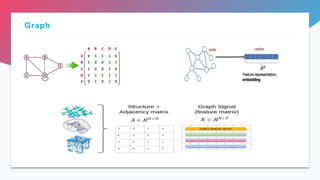
Graph
• Rapid algorithmic developments of GNNs have aroused a significant amount
of interests in theoretical analysis on the expressive power of GNNs.
• In particular, much efforts have been made in order to characterize the
expressive power of GNNs when compared with the traditional graph
algorithms (e.g. graph kernel-based methods) and how to build more
powerful GNNs so as to overcome several limitations in GNNs.
• Specifcally, Xu et al (2019d) showed that current GNN methods are able to
achieve the expressive power of the 1-dimensional Weisfeiler-Lehman test, a
widely used method in traditional graph kernel community.
Theoretical understanding of Graph Neural Networks
• The increasing popularity of GNNs have attracted many attempts to apply
various GNN methods on real-world applications, where the graph sizes are
often about having one hundred million nodes and one billion edges.
• Unfortunately, most of the GNN methods cannot directly be applied on these
large-scale graph-structured data due to large memory requirements.
• In order to address these issues, many recent works have been proposed
with various sampling strategies such as node-wise sampling, layer-wise
sampling, and graph-wise sampling.
Scalability of Graph Neural Networks
• Explainable artificial intelligence are becoming increasingly popular in
providing interpretable results on machine learning process, especially due
to the black-box issue of deep learning techniques. As a result, there is a
surge of interests in improving the interpretability of GNNs.
• Generally speaking, explanation results on GNNs could be important nodes,
important edges, or important features of nodes or edges.
Interpretability of Graph Neural Networks
• Technically, white-box approximation based methods utilize the information
inside the model inducing gradients, intermediate features, and model
parameters to provide the explanation.
• In contrast, the black-box approximation based methods abandon the
utilization of internal information of complex models but instead leverage the
intrinsically interpretable simple models (e.g. linear regression and decision
trees) to fit the complex models.
• To this end, many recent efforts have been made in order to develop more
efficient approaches without compromising the explanation accuracy.
Interpretability of Graph Neural Networks
• Trustworthy machine learning has recently attracted a significant amount of
attention since the existing studies have shown that deep learning models
could be deliberately fooled, evaded, misled, and stolen .
• Technically, the standard approach (via adversarial examples) for studying
the robustness of GNNs is to construct a small change of the input graph
data and then to observe if it leads to a large change of the prediction
results.
Adversarial robustness of Graph Neural Networks
These frontiers that are either long-standing graph learning problems with new
GNN solutions or recently emerging learning problems with GNNs.
• Graph Classification and Link Prediction.
• Graph Generation and Graph Transformation.
• Graph Matching and Graph Structure Learning.
• Dynamic Graph Neural Networks and Heterogeneous Graph Neural Networks.
• AutoML and Self-supervised Learning.
Frontiers
Graph classification
• Graph pooling layers are needed to further compute graph-level
representation, which summarizes the key characteristics of input graph-
structure, is the critical component for the graph classifcation.
• These methods can be generally categorized into four groups: [ simple flat -
pooling, attention-based pooling, cluster-based pooling , and other type of
pooling ].
Graph Classification and Link Prediction.
Link prediction
• Aims to predict missing or future links between any pair of nodes.
• The learning types of link prediction: node-based methods and subgraph-
based methods.
Graph Classification and Link Prediction.
Graph Generation
• There are three representative GNN based learning paradigms for graph
generation including:[ GraphVAE approaches , GraphGAN approaches and
Deep Autoregressive methods].
Graph Transformation
• Aims to learn a translation mapping between the input source graph and the
output target graph. This problem can be generally grouped into four
categories:[including node-level transformation, edge-level transformation ,
node-edge co-transformation , and graph-involved transformation].
Graph Generation and Graph Transformation.
Graph matching
• Aims to measure the similarity between two graph structures without
changing them.
Graph structure learning
• Aims to produce an optimized graph structure by jointly learning implicit
graph structure and graph node representation
Graph Matching and Graph Structure Learning
Dynamic Graph Neural Networks
• In real-world applications, the graph nodes (entities) and the graph edges
(relations) are often evolving over time.
• Various GNNs cannot be directly applied to the dynamic graphs.
• A simple approach is converting dynamic graphs into static graphs, leading
to potential loss of information.
• There are two major categories of GNN based methods:[ GNNs for discrete -
time dynamic graphs and GNNs for continue-time dynamic graphs].
Dynamic Graph Neural Networks and Heterogeneous Graph
Neural Networks
Heterogeneous Graph Neural Networks
• That consist of different types of graph nodes and edges.
• Different GNNs for homogeneous graphs are not applicable in
Heterogeneous Graph .
• A new line of research has been devoted to developing various
heterogeneous graph neural networks :[ message passing based methods,
encoder-decoder based methods , and adversarial based methods].
Dynamic Graph Neural Networks and Heterogeneous Graph
Neural Networks
Graph Neural Networks: AutoML and Self-supervised Learning
• Automated machine learning (AutoML) has recently drawn a significant amount of
attention in both research and industrial communities.
• The research efforts in automatically identifying an optimized GNN model
architecture and training hyperparameters.
• Most of the existing research focuses on either architecture search space or
training hyper parameter search space.
GNN Applications
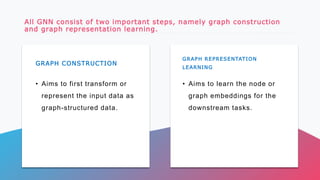
GRAPH CONSTRUCTION
GRAPH REPRESENTATION
LEARNING
All GNN consist of two important steps, namely graph construction
and graph representation learning.
• Aims to first transform or
represent the input data as
graph-structured data.
• Aims to learn the node or
graph embeddings for the
downstream tasks.
• Input Data with Explicit Graph Structures.
• Some applications naturally have the structure inside the data without
pre-defined nodes and the edges/relationships among them.
• In the task of protein function prediction and interaction, the graph can
also easily fit into a protein, where each amino-acid refers to a node and
each edge refers to the interaction among amino-acids.
Graph construction
• Input Data with Implicit Graph Structures.
• For many tasks that do not naturally involve a structured data, graph
construction becomes very challenging.
• For example, in computer vision (CV) tasks, there are three kinds of
graph construction.
• In the natural language processing (NLP) tasks, the graph construction
from the text data can be categorized into five categories: text graphs,
syntactic graphs, semantic graphs, knowledge graphs, and hybrid graphs.
Graph construction
• After getting the graph expression of the input data, the next step is applying
GNNs for learning the graph representations. Some works directly utilize the
typical GNNs, such as GCN, GAT, GGNN and GraphSage, which can be
generalized to different application tasks.
• While some special tasks needs an additional design on the GNN
architecture to better handle the specific problem [PinSage, KGCN, KGAT].
Graph Representation Learning
Thank you

Chapter 3.pptx

  • 1.
    Graph Neural Networks Dr.Taysir Hassan Alzhraa Yousef
  • 2.
    • Abstract • Introduction •Foundations • Frontiers • Applications Agenda
  • 3.
    • Deep Learninghas become one of the most dominant approaches in Artifcial Intelligence research today. • Although conventional deep learning techniques such as recurrent neural networks and convolutional neural networks have achieved huge successes on Euclidean data such as images, or sequence data such as text, there are many applications that are naturally or best represented with a graph structure. Abstract
  • 4.
    • In arich variety of scientific fields, many important real-world objects and problems can be naturally or best expressed along with a complex structure, e.g., graph or manifold structure, such as social networks, recommendation systems, drug discovery and natural language processing . • One challenge with graph-structured data is that it does not show as much spatial locality and structure as image or text data does. Thus, graph- structured data is not naturally suitable for highly regularized neural structures such as convolutional and recurrent neural networks. Introduction
  • 5.
    • Conceptually, wecan categorize the fundamental learning tasks of GNNs into five different directions: • i) Graph Neural Networks Methods; • ii) Theoretical understanding of Graph Neural Networks; • iii) Scalability of Graph Neural Networks; • iv) Interpretability of Graph Neural Networks; • v) Adversarial robustness of Graph Neural Networks. Foundations
  • 6.
    • Graph NeuralNetworks are specifically designed neural architectures operated on graph - structure data. • The goal of GNNs is to iteratively update the node representations by aggregating the representations of node neighbours and their own representation in the previous iteration. • There are a variety of GNNs which can be further categorized into supervised GNNs and unsupervised GNNs. • Once the node representations are learnt, a fundamental task on graphs is node classification that tries to classify the nodes into a few predefined classes. • Despite the huge successes that various GNNs have achieved, a severe issue on training deep graph neural networks has been observed to yield inferior results, namely, over - smoothing problem, where all the nodes have similar representations. Graph Neural Networks Methods
  • 7.
  • 8.
    • Rapid algorithmicdevelopments of GNNs have aroused a significant amount of interests in theoretical analysis on the expressive power of GNNs. • In particular, much efforts have been made in order to characterize the expressive power of GNNs when compared with the traditional graph algorithms (e.g. graph kernel-based methods) and how to build more powerful GNNs so as to overcome several limitations in GNNs. • Specifcally, Xu et al (2019d) showed that current GNN methods are able to achieve the expressive power of the 1-dimensional Weisfeiler-Lehman test, a widely used method in traditional graph kernel community. Theoretical understanding of Graph Neural Networks
  • 9.
    • The increasingpopularity of GNNs have attracted many attempts to apply various GNN methods on real-world applications, where the graph sizes are often about having one hundred million nodes and one billion edges. • Unfortunately, most of the GNN methods cannot directly be applied on these large-scale graph-structured data due to large memory requirements. • In order to address these issues, many recent works have been proposed with various sampling strategies such as node-wise sampling, layer-wise sampling, and graph-wise sampling. Scalability of Graph Neural Networks
  • 10.
    • Explainable artificialintelligence are becoming increasingly popular in providing interpretable results on machine learning process, especially due to the black-box issue of deep learning techniques. As a result, there is a surge of interests in improving the interpretability of GNNs. • Generally speaking, explanation results on GNNs could be important nodes, important edges, or important features of nodes or edges. Interpretability of Graph Neural Networks
  • 11.
    • Technically, white-boxapproximation based methods utilize the information inside the model inducing gradients, intermediate features, and model parameters to provide the explanation. • In contrast, the black-box approximation based methods abandon the utilization of internal information of complex models but instead leverage the intrinsically interpretable simple models (e.g. linear regression and decision trees) to fit the complex models. • To this end, many recent efforts have been made in order to develop more efficient approaches without compromising the explanation accuracy. Interpretability of Graph Neural Networks
  • 12.
    • Trustworthy machinelearning has recently attracted a significant amount of attention since the existing studies have shown that deep learning models could be deliberately fooled, evaded, misled, and stolen . • Technically, the standard approach (via adversarial examples) for studying the robustness of GNNs is to construct a small change of the input graph data and then to observe if it leads to a large change of the prediction results. Adversarial robustness of Graph Neural Networks
  • 13.
    These frontiers thatare either long-standing graph learning problems with new GNN solutions or recently emerging learning problems with GNNs. • Graph Classification and Link Prediction. • Graph Generation and Graph Transformation. • Graph Matching and Graph Structure Learning. • Dynamic Graph Neural Networks and Heterogeneous Graph Neural Networks. • AutoML and Self-supervised Learning. Frontiers
  • 14.
    Graph classification • Graphpooling layers are needed to further compute graph-level representation, which summarizes the key characteristics of input graph- structure, is the critical component for the graph classifcation. • These methods can be generally categorized into four groups: [ simple flat - pooling, attention-based pooling, cluster-based pooling , and other type of pooling ]. Graph Classification and Link Prediction.
  • 15.
    Link prediction • Aimsto predict missing or future links between any pair of nodes. • The learning types of link prediction: node-based methods and subgraph- based methods. Graph Classification and Link Prediction.
  • 16.
    Graph Generation • Thereare three representative GNN based learning paradigms for graph generation including:[ GraphVAE approaches , GraphGAN approaches and Deep Autoregressive methods]. Graph Transformation • Aims to learn a translation mapping between the input source graph and the output target graph. This problem can be generally grouped into four categories:[including node-level transformation, edge-level transformation , node-edge co-transformation , and graph-involved transformation]. Graph Generation and Graph Transformation.
  • 17.
    Graph matching • Aimsto measure the similarity between two graph structures without changing them. Graph structure learning • Aims to produce an optimized graph structure by jointly learning implicit graph structure and graph node representation Graph Matching and Graph Structure Learning
  • 18.
    Dynamic Graph NeuralNetworks • In real-world applications, the graph nodes (entities) and the graph edges (relations) are often evolving over time. • Various GNNs cannot be directly applied to the dynamic graphs. • A simple approach is converting dynamic graphs into static graphs, leading to potential loss of information. • There are two major categories of GNN based methods:[ GNNs for discrete - time dynamic graphs and GNNs for continue-time dynamic graphs]. Dynamic Graph Neural Networks and Heterogeneous Graph Neural Networks
  • 19.
    Heterogeneous Graph NeuralNetworks • That consist of different types of graph nodes and edges. • Different GNNs for homogeneous graphs are not applicable in Heterogeneous Graph . • A new line of research has been devoted to developing various heterogeneous graph neural networks :[ message passing based methods, encoder-decoder based methods , and adversarial based methods]. Dynamic Graph Neural Networks and Heterogeneous Graph Neural Networks
  • 20.
    Graph Neural Networks:AutoML and Self-supervised Learning • Automated machine learning (AutoML) has recently drawn a significant amount of attention in both research and industrial communities. • The research efforts in automatically identifying an optimized GNN model architecture and training hyperparameters. • Most of the existing research focuses on either architecture search space or training hyper parameter search space.
  • 21.
  • 22.
    GRAPH CONSTRUCTION GRAPH REPRESENTATION LEARNING AllGNN consist of two important steps, namely graph construction and graph representation learning. • Aims to first transform or represent the input data as graph-structured data. • Aims to learn the node or graph embeddings for the downstream tasks.
  • 23.
    • Input Datawith Explicit Graph Structures. • Some applications naturally have the structure inside the data without pre-defined nodes and the edges/relationships among them. • In the task of protein function prediction and interaction, the graph can also easily fit into a protein, where each amino-acid refers to a node and each edge refers to the interaction among amino-acids. Graph construction
  • 24.
    • Input Datawith Implicit Graph Structures. • For many tasks that do not naturally involve a structured data, graph construction becomes very challenging. • For example, in computer vision (CV) tasks, there are three kinds of graph construction. • In the natural language processing (NLP) tasks, the graph construction from the text data can be categorized into five categories: text graphs, syntactic graphs, semantic graphs, knowledge graphs, and hybrid graphs. Graph construction
  • 25.
    • After gettingthe graph expression of the input data, the next step is applying GNNs for learning the graph representations. Some works directly utilize the typical GNNs, such as GCN, GAT, GGNN and GraphSage, which can be generalized to different application tasks. • While some special tasks needs an additional design on the GNN architecture to better handle the specific problem [PinSage, KGCN, KGAT]. Graph Representation Learning
  • 26.