Gao Huang
Assistant Professor
Department of Automation, Tsinghua University
Neural Architectures for Efficient Inference
OUTLINE
1. Macro-architecture innovations in ConvNets
2. Micro-architecture innovations in ConvNets
3. From static network to dynamic network
PART 1
MACRO-ARCH INNOVATIONS IN CNN
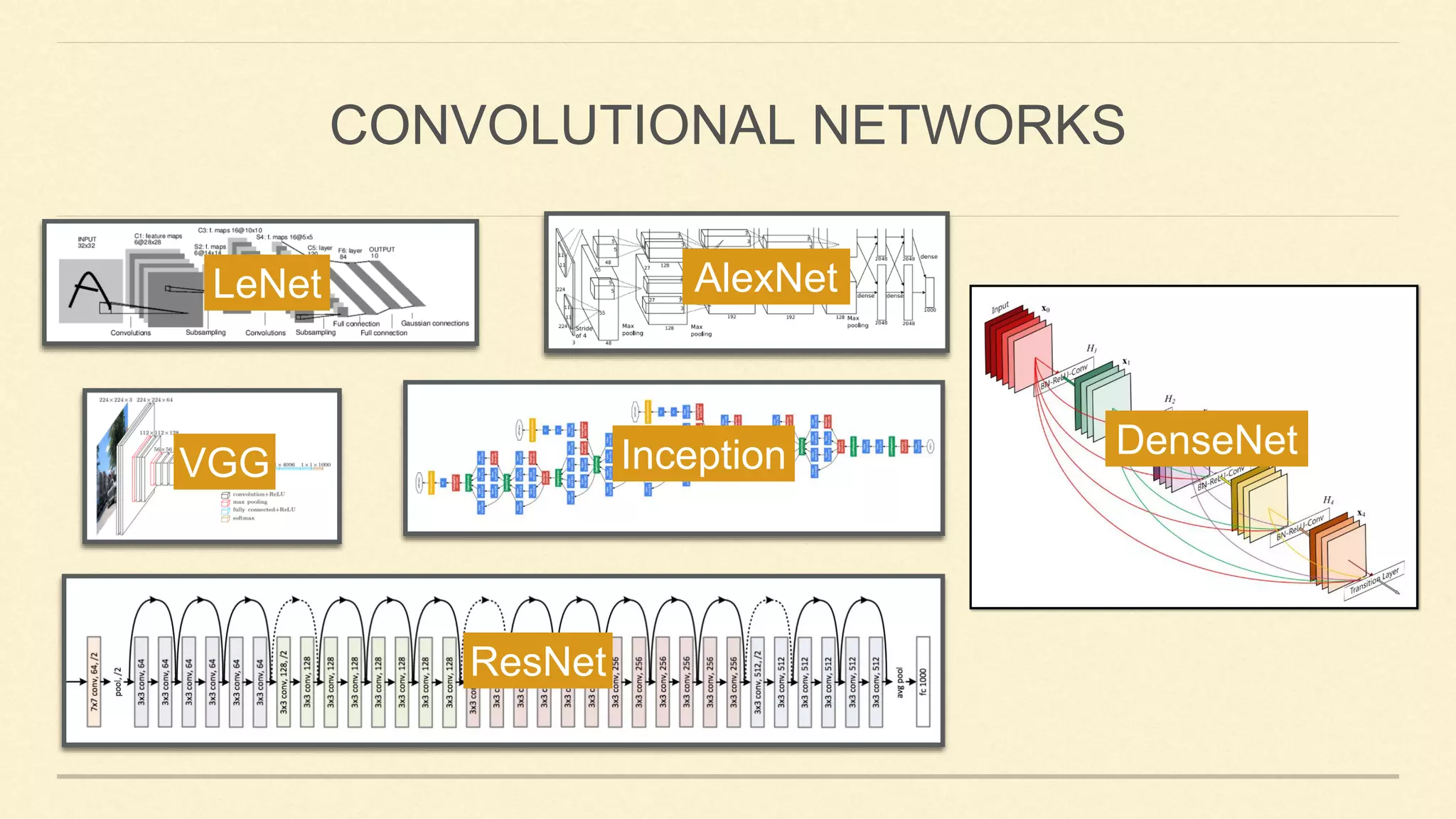
CONVOLUTIONAL NETWORKS
LeNet AlexNet
VGG Inception
ResNet
DenseNet
Main Ideas:
✓ Convolution, local receptive fields, shared weights
✓ Spatial subsampling
LENET [LECUN ET AL. 1998]
Main Ideas:
✓ ReLU (Rectified Linear Unit)
✓ Dropout
✓ Local Response Normalization, Overlapping Pooling
✓ Data Augmentation, Multiple GPUs
ALEXNET [KRIZHEVSKY ET AL. 2012]
Main Idea:
✓ Skip connection: promotes gradient propagation
RESNET [HE ET AL. 2016]
Identity mappings promote gradient propagation.
: Element-wise addition
Main Idea:
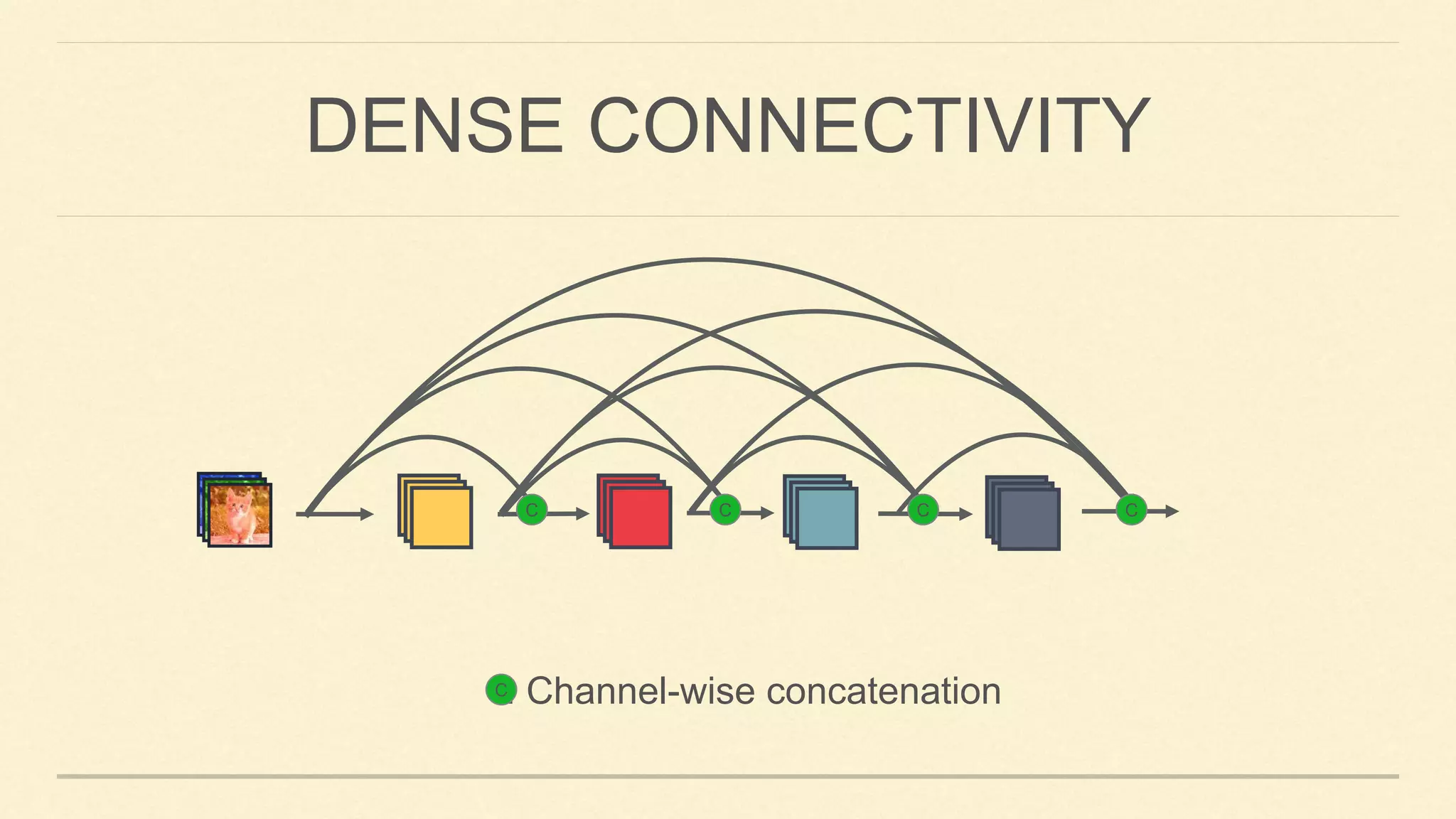
✓ Dense connectivity: creates short path in the network and encourages feature reuse.
ResNet
GoogleNet
FractalNet
DENSENET [HUANG ET AL. 2017]
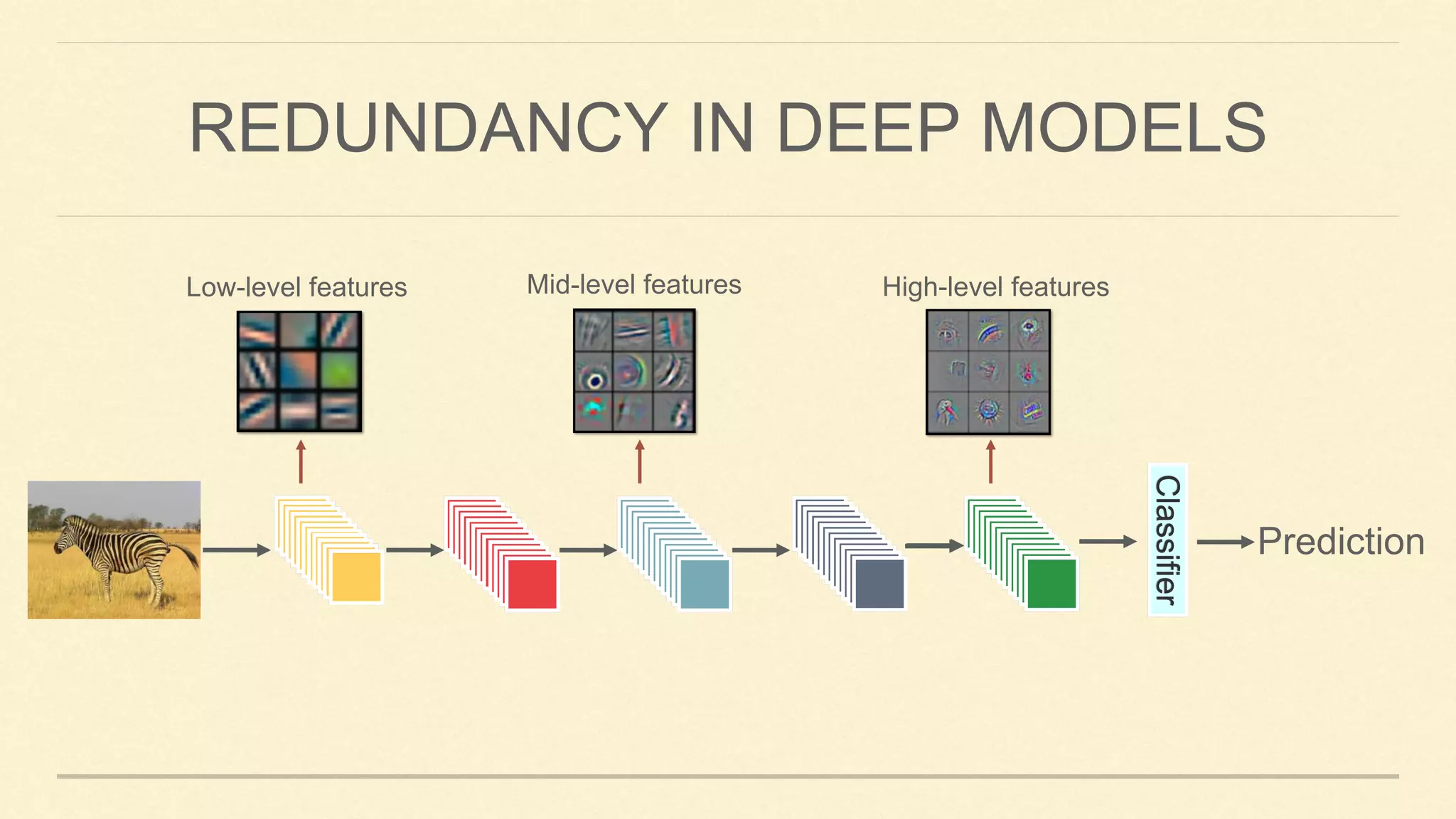
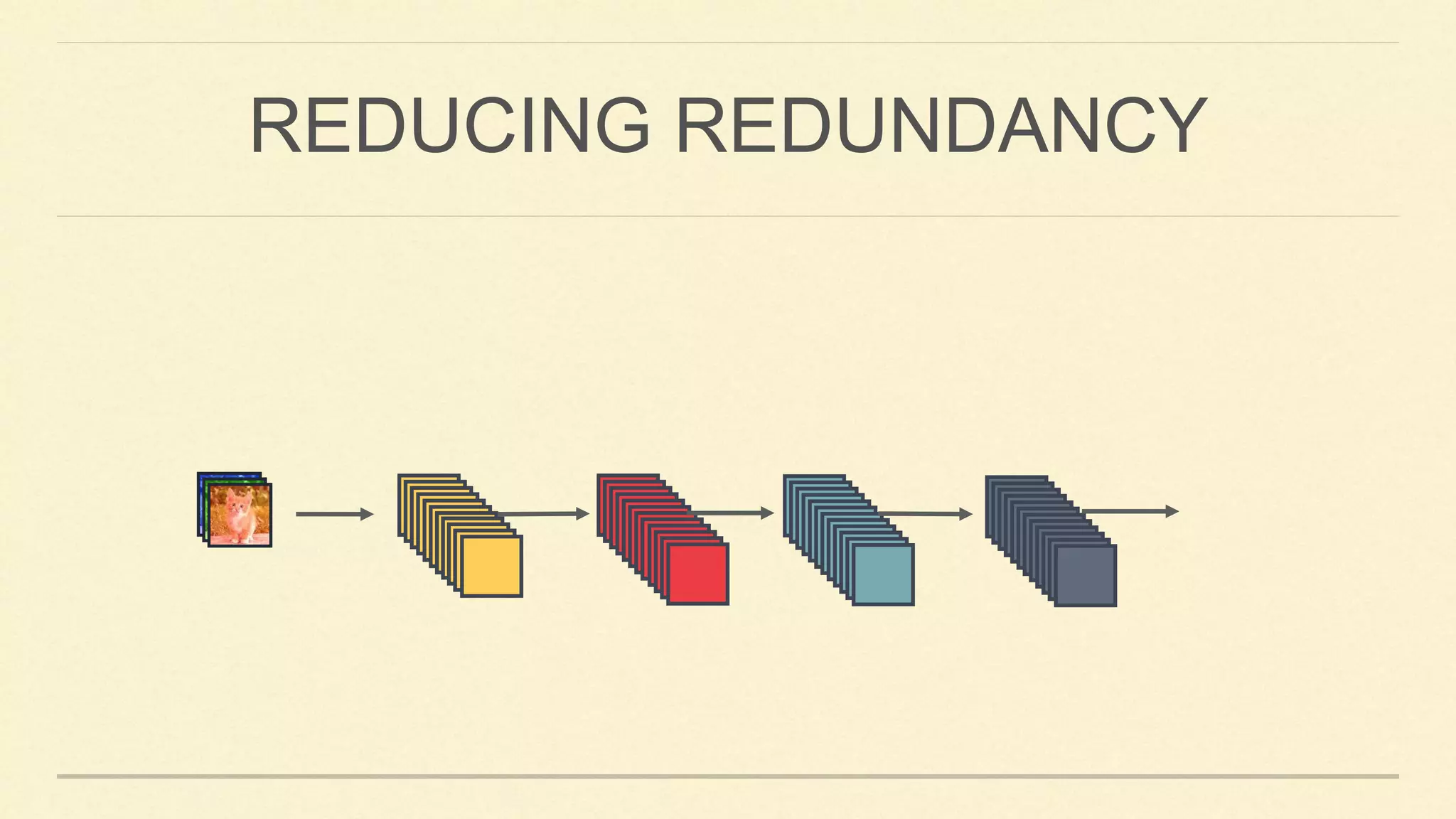
REDUNDANCY IN DEEP MODELS
Classifier
Input Prediction
Low-level features Mid-level features High-level features
Classifier
REDUCING REDUNDANCY
DENSE CONNECTIVITY
C C C C
: Channel-wise concatenationC
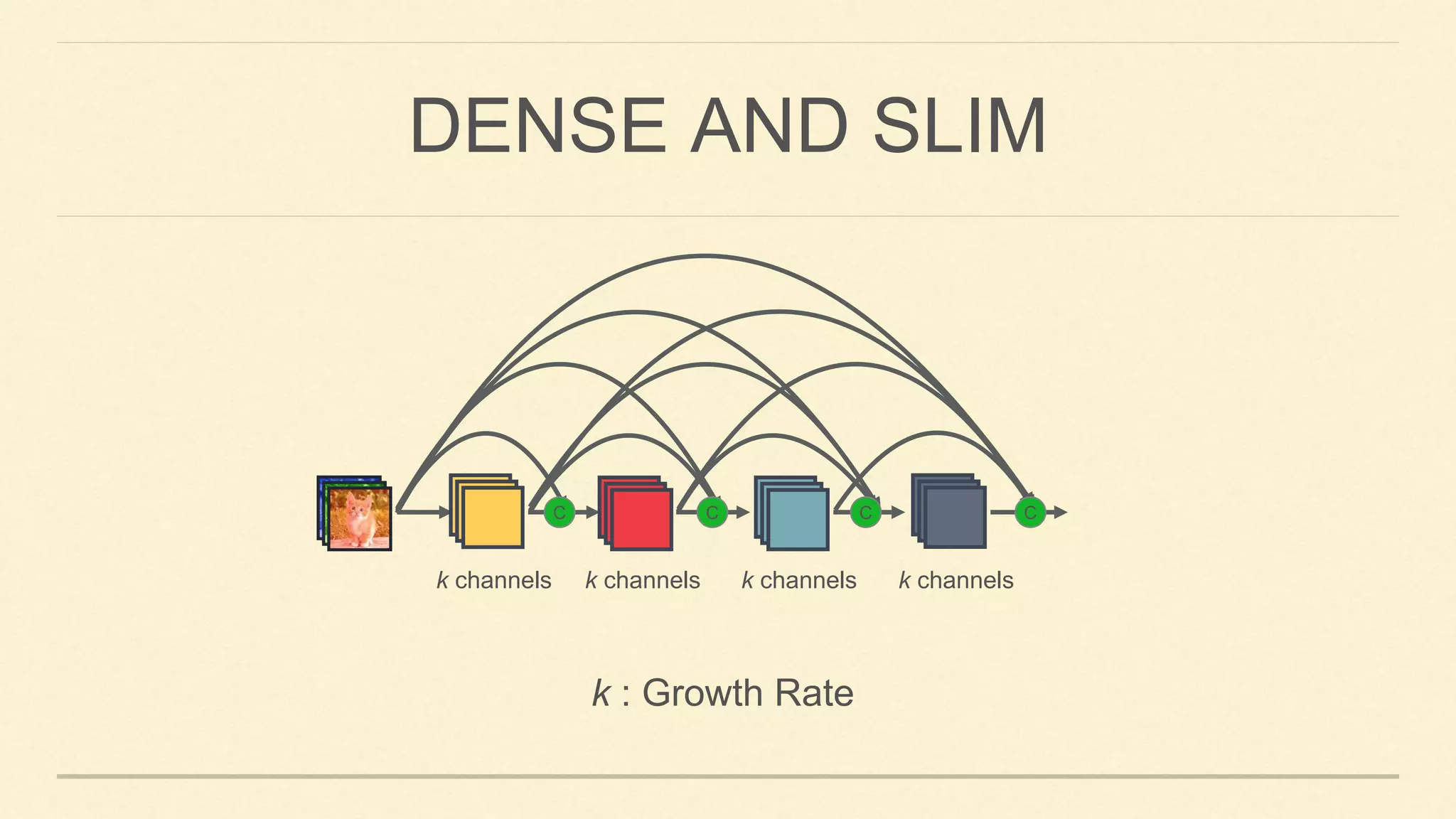
DENSE AND SLIM
k channels k channels k channels k channels
k : Growth Rate
C C C C
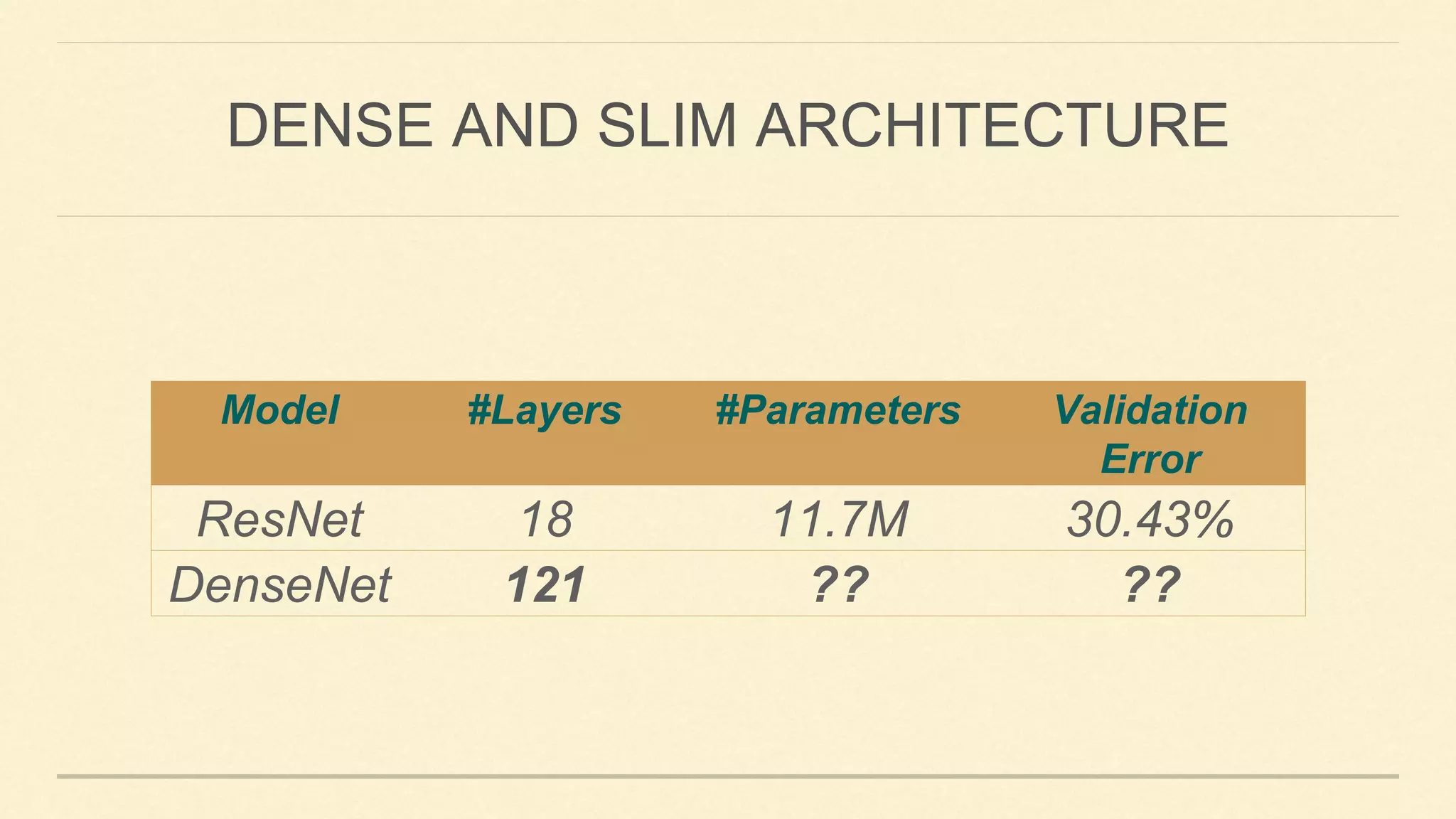
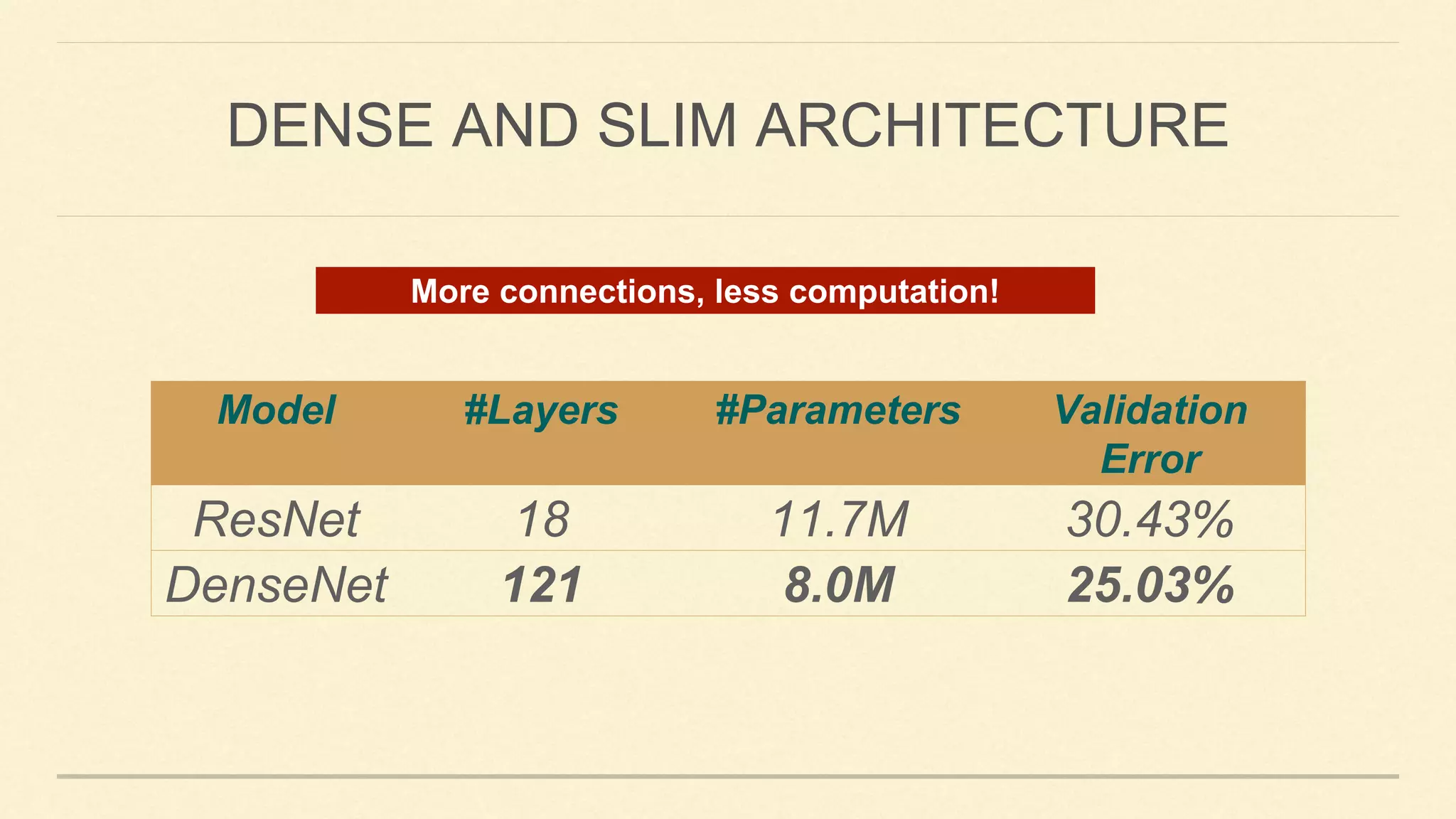
Model #Layers #Parameters Validation
Error
ResNet 18 11.7M 30.43%
DenseNet 121 ?? ??
DENSE AND SLIM ARCHITECTURE
Model #Layers #Parameters Validation
Error
ResNet 18 11.7M 30.43%
DenseNet 121 8.0M 25.03%
DENSE AND SLIM ARCHITECTURE
More connections, less computation!
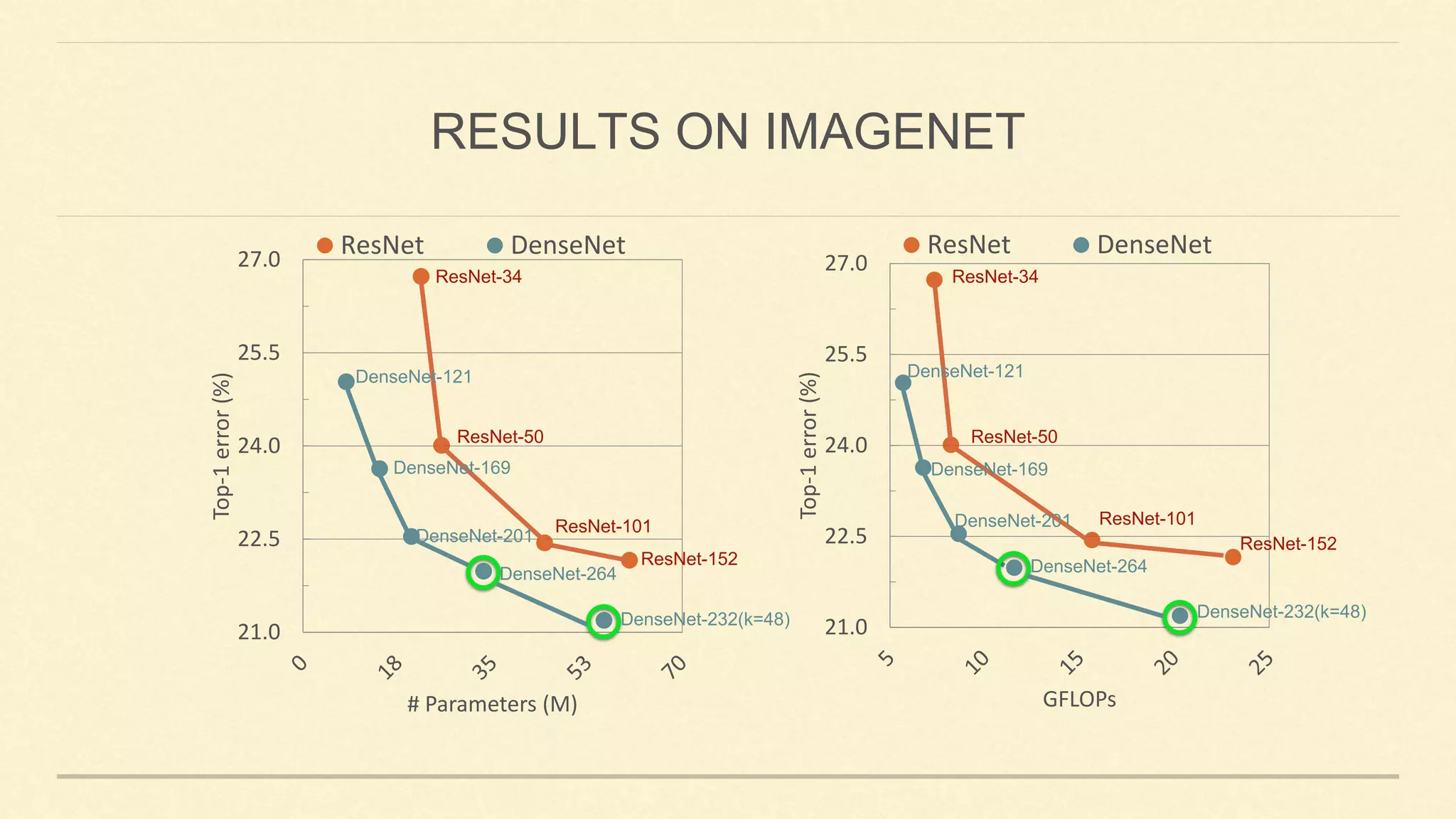
21.0
22.5
24.0
25.5
27.0
Top-1error(%)
GFLOPs
ResNet DenseNet
21.0
22.5
24.0
25.5
27.0
Top-1error(%)
# Parameters (M)
ResNet DenseNet
ResNet-152
ResNet-101
ResNet-50
ResNet-34
ResNet-152
ResNet-101
ResNet-50
ResNet-34
DenseNet-232(k=48)
DenseNet-264
DenseNet-201
DenseNet-169
DenseNet-121 DenseNet-121
DenseNet-169
DenseNet-201
DenseNet-264
DenseNet-232(k=48)
RESULTS ON IMAGENET
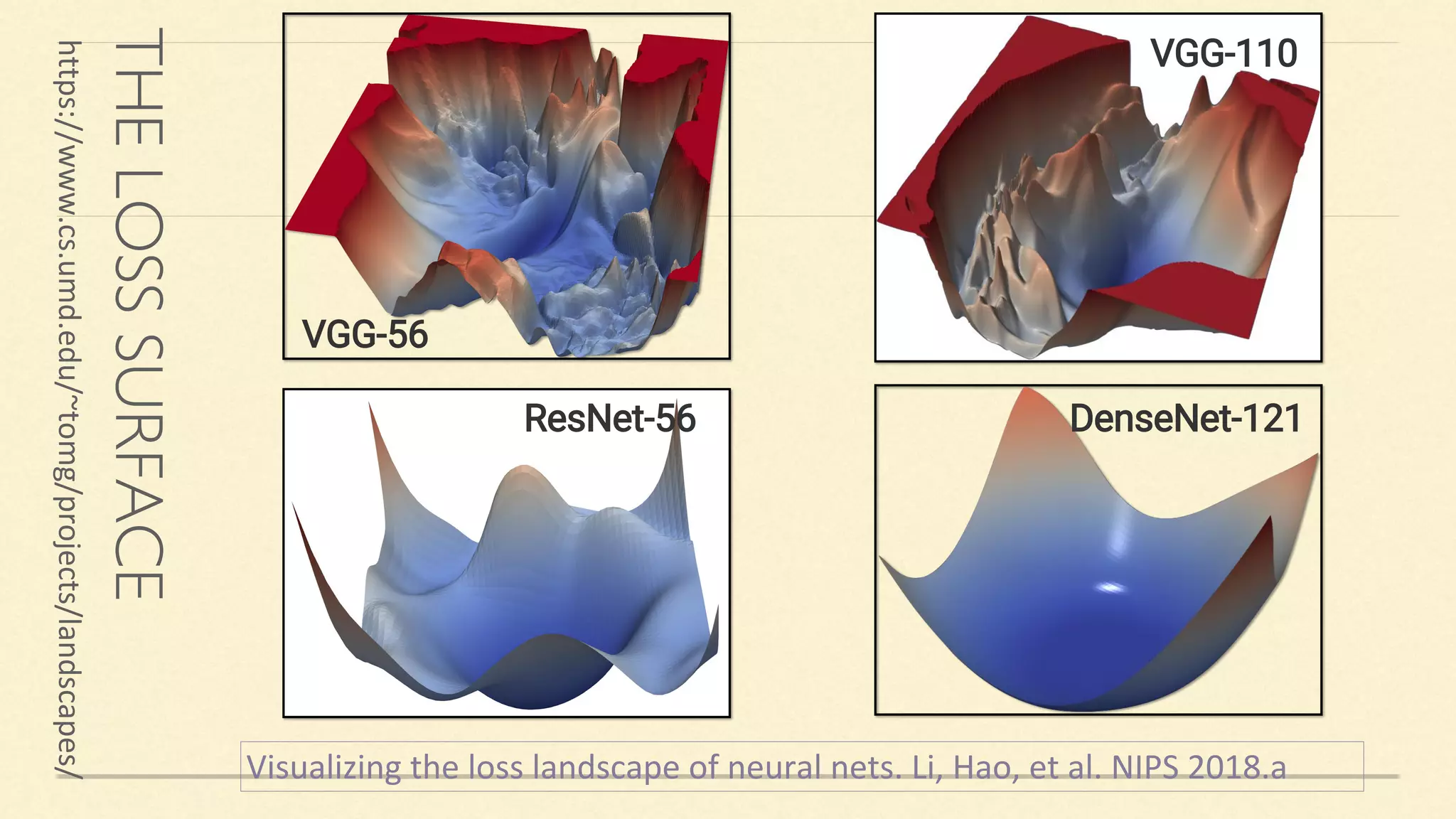
THELOSSSURFACE
https://www.cs.umd.edu/~tomg/projects/landscapes/
VGG-56
VGG-110
DenseNet-121ResNet-56
Visualizing the loss landscape of neural nets. Li, Hao, et al. NIPS 2018.a
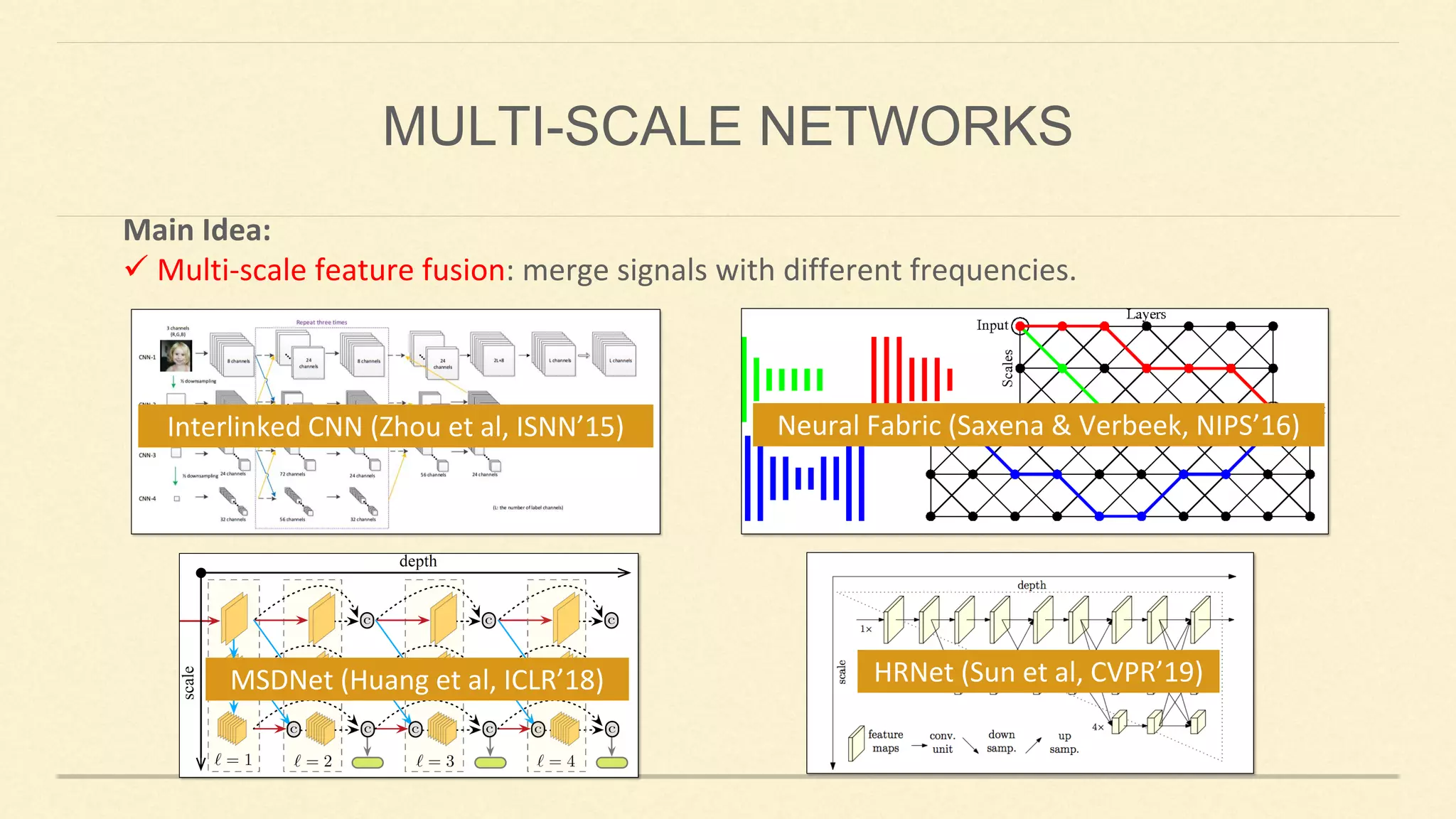
Main Idea:
✓ Multi-scale feature fusion: merge signals with different frequencies.
Interlinked CNN (Zhou et al, ISNN’15) Neural Fabric (Saxena & Verbeek, NIPS’16)
MSDNet (Huang et al, ICLR’18) HRNet (Sun et al, CVPR’19)
MULTI-SCALE NETWORKS
Main Idea:
✓ Automatic architecture search using reinforcement learning, genetic/evolutional
algorithms or differentiable approaches.
AutoML is a very active research field, see www.automl.org
Neural Architecture Search [Zoph and Le, 2017 and many]
PART 2
MICRO-ARCH INNOVATIONS IN CNN
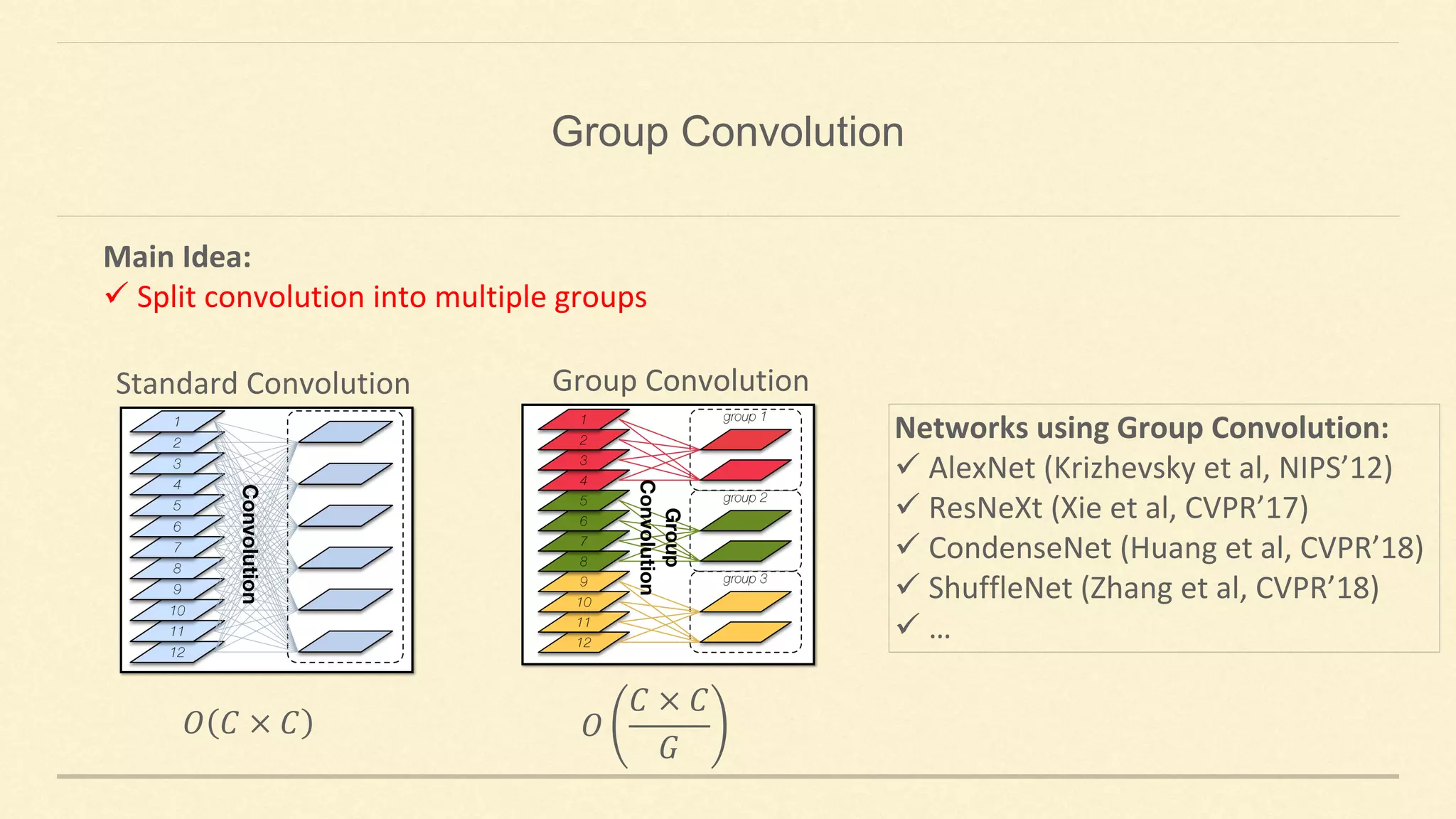
Main Idea:
✓ Split convolution into multiple groups
Standard Convolution Group Convolution
𝑂
𝐶 × 𝐶
𝐺
𝑂 𝐶 × 𝐶
Networks using Group Convolution:
✓ AlexNet (Krizhevsky et al, NIPS’12)
✓ ResNeXt (Xie et al, CVPR’17)
✓ CondenseNet (Huang et al, CVPR’18)
✓ ShuffleNet (Zhang et al, CVPR’18)
✓ …
Group Convolution
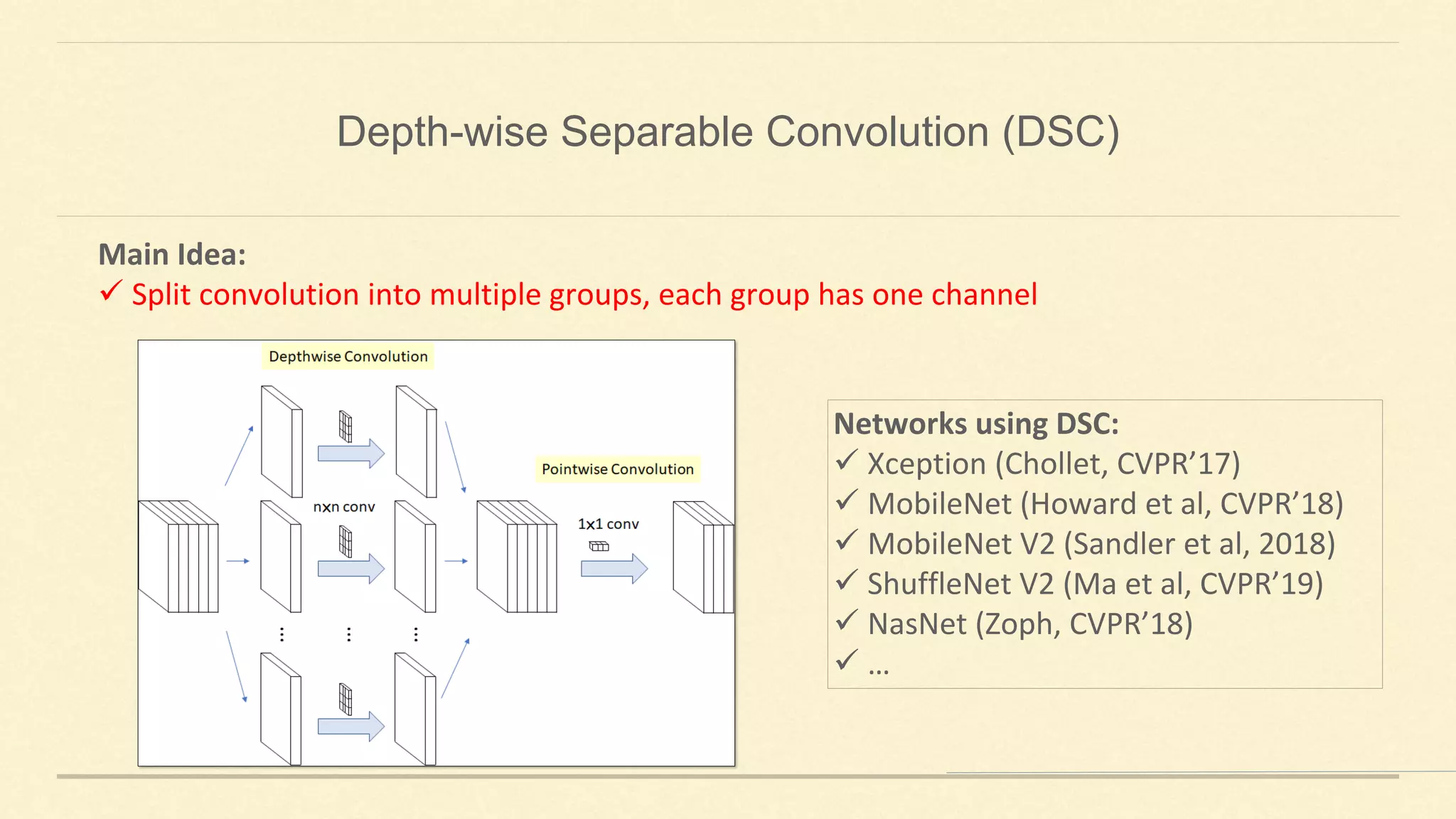
Main Idea:
✓ Split convolution into multiple groups, each group has one channel
Networks using DSC:
✓ Xception (Chollet, CVPR’17)
✓ MobileNet (Howard et al, CVPR’18)
✓ MobileNet V2 (Sandler et al, 2018)
✓ ShuffleNet V2 (Ma et al, CVPR’19)
✓ NasNet (Zoph, CVPR’18)
✓ …
Depth-wise Separable Convolution (DSC)
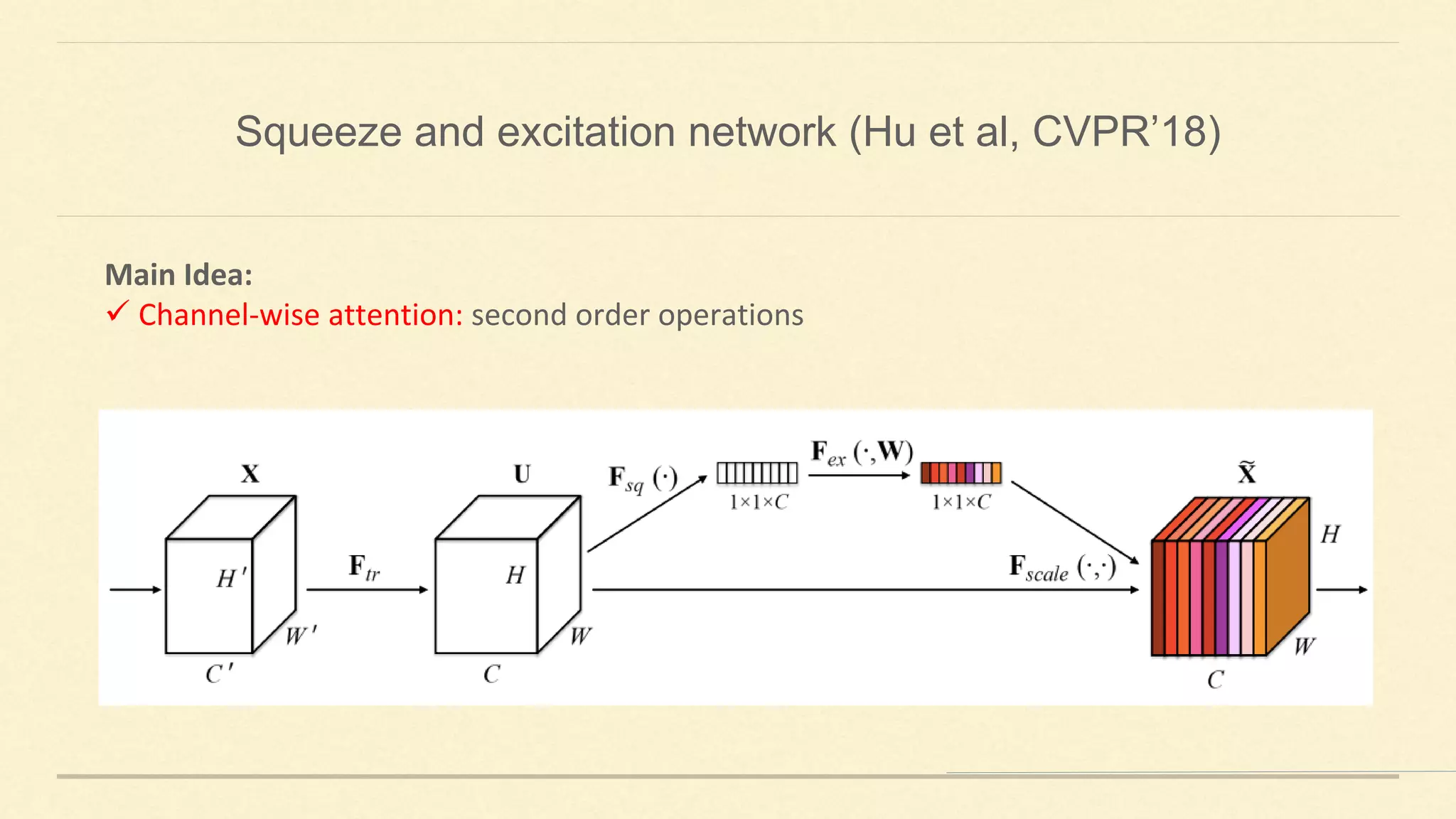
Main Idea:
✓ Channel-wise attention: second order operations
Squeeze and excitation network (Hu et al, CVPR’18)
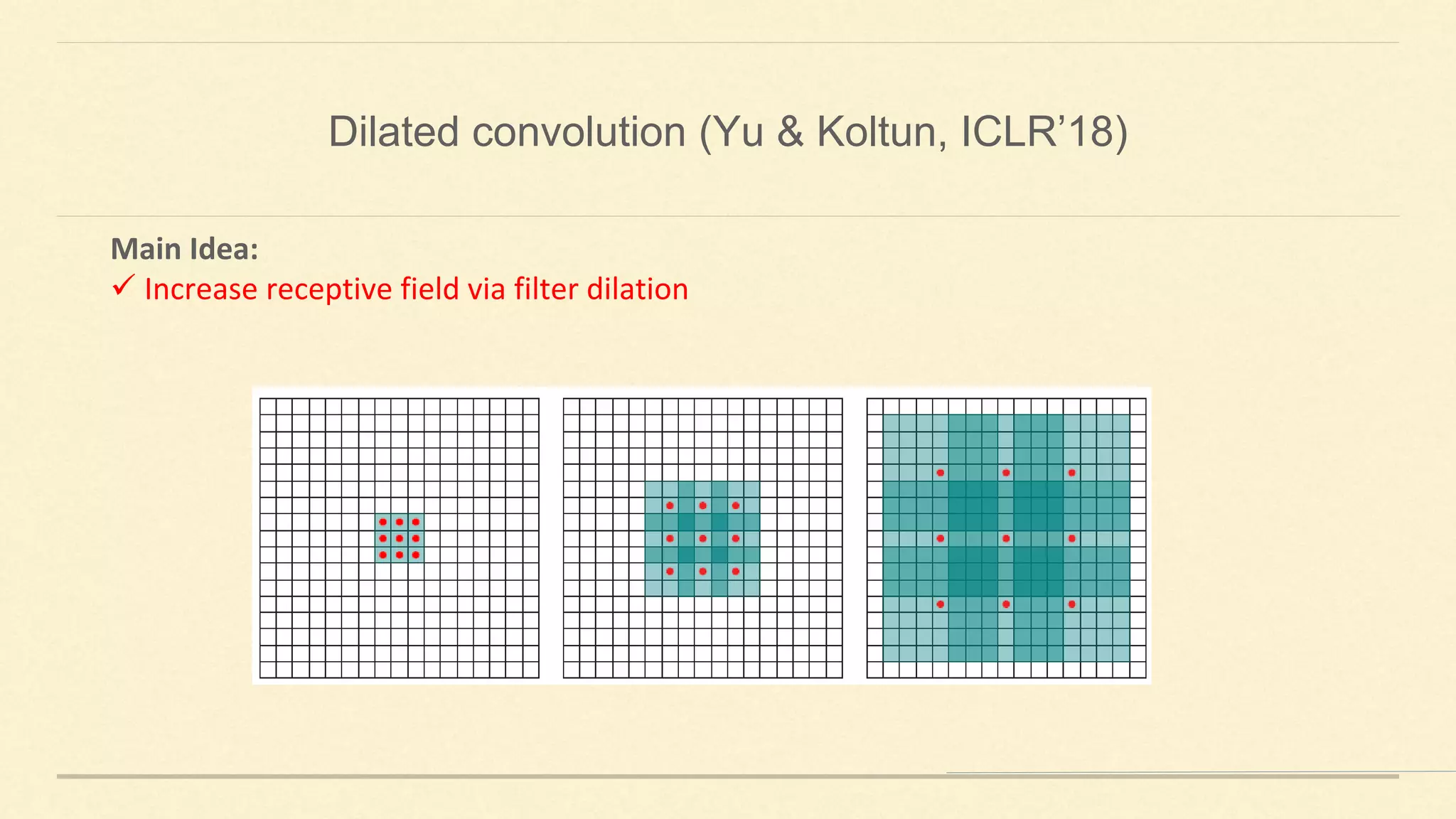
Main Idea:
✓ Increase receptive field via filter dilation
Dilated convolution (Yu & Koltun, ICLR’18)
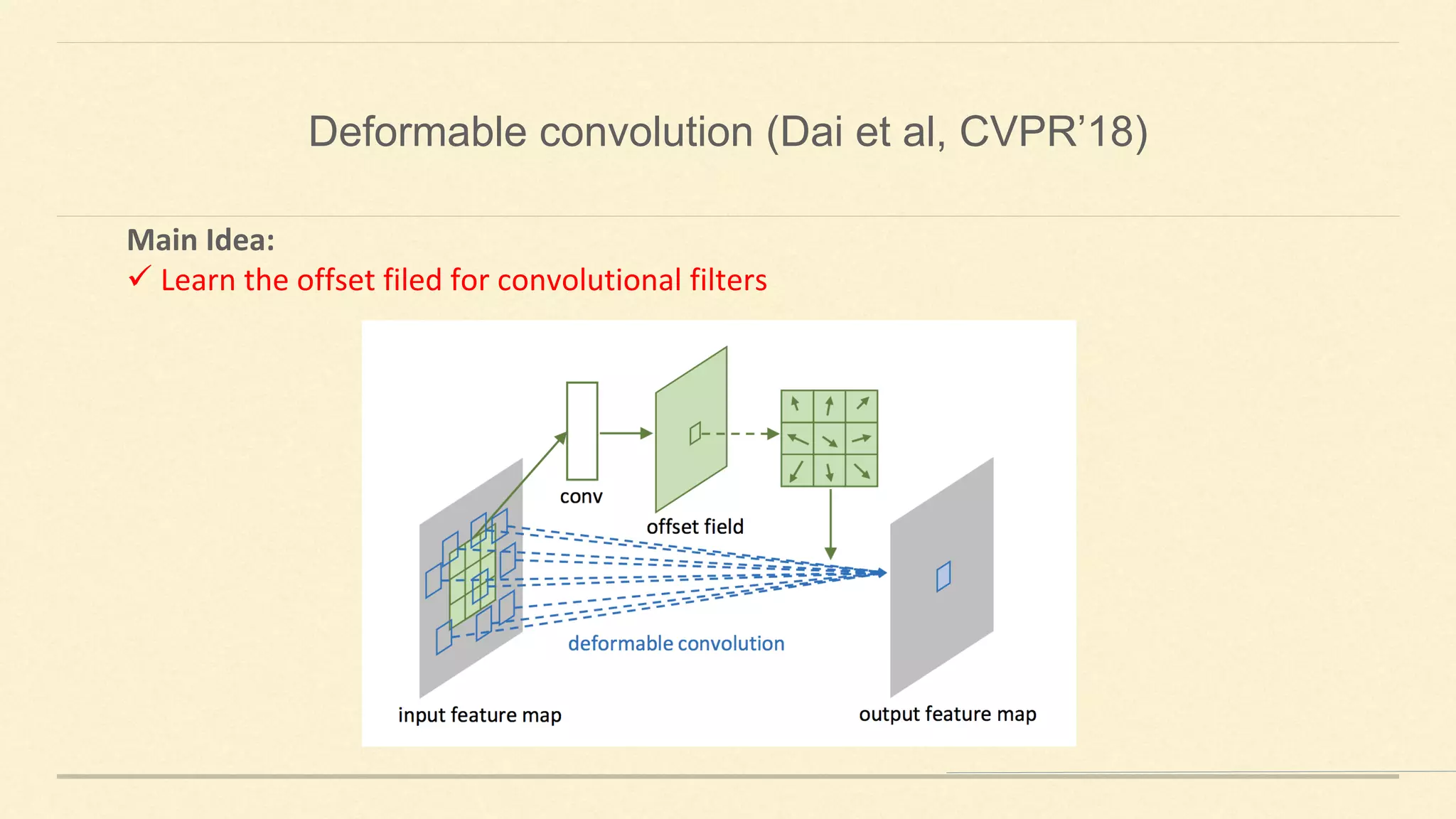
Main Idea:
✓ Learn the offset filed for convolutional filters
Deformable convolution (Dai et al, CVPR’18)
PART 3
DYNAMIC NETWORKS
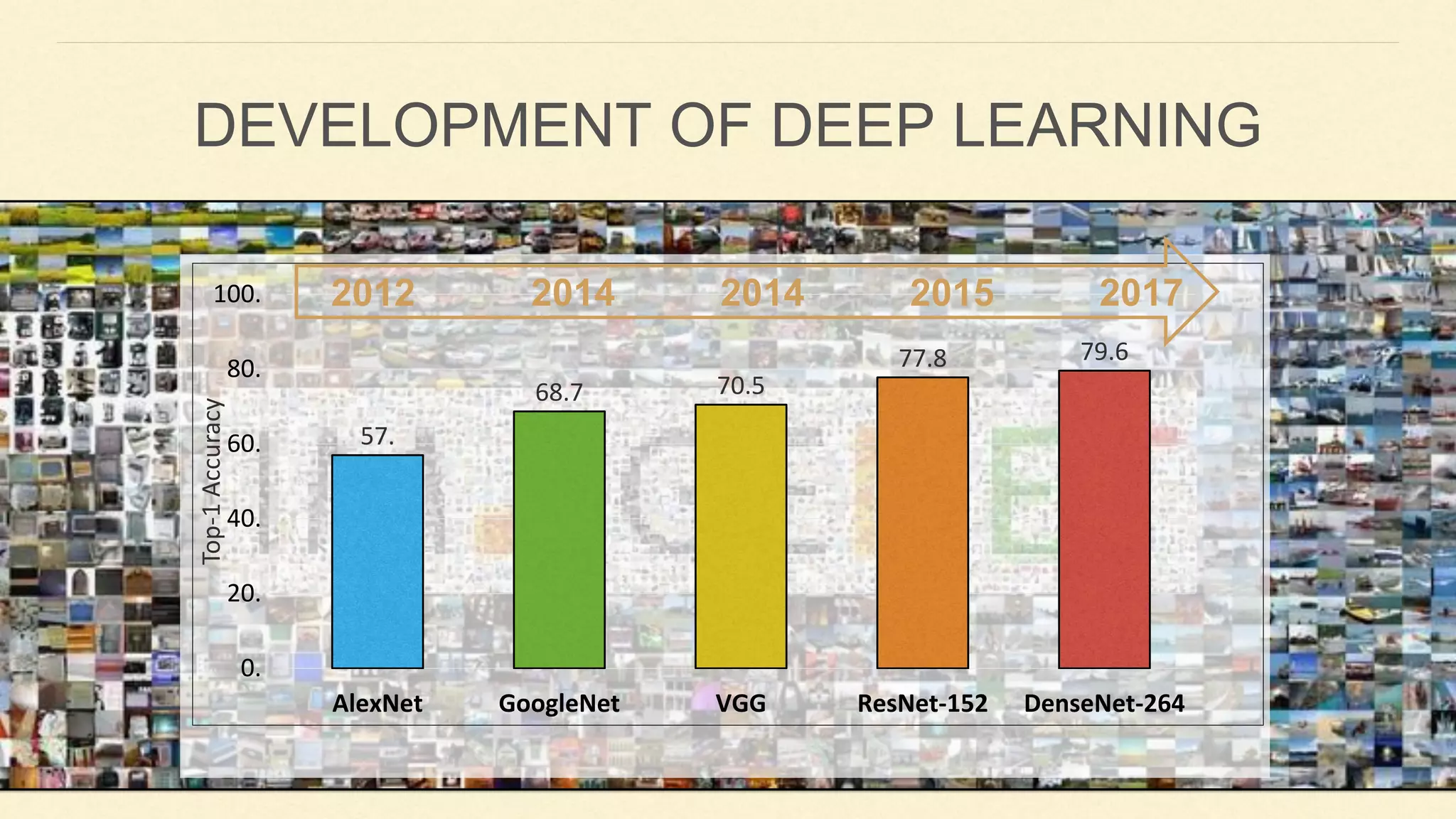
57.
68.7 70.5
77.8 79.6
0.
20.
40.
60.
80.
100.
AlexNet GoogleNet VGG ResNet-152 DenseNet-264
Top-1Accuracy
DEVELOPMENT OF DEEP LEARNING
2012 2014 2014 2015 2017
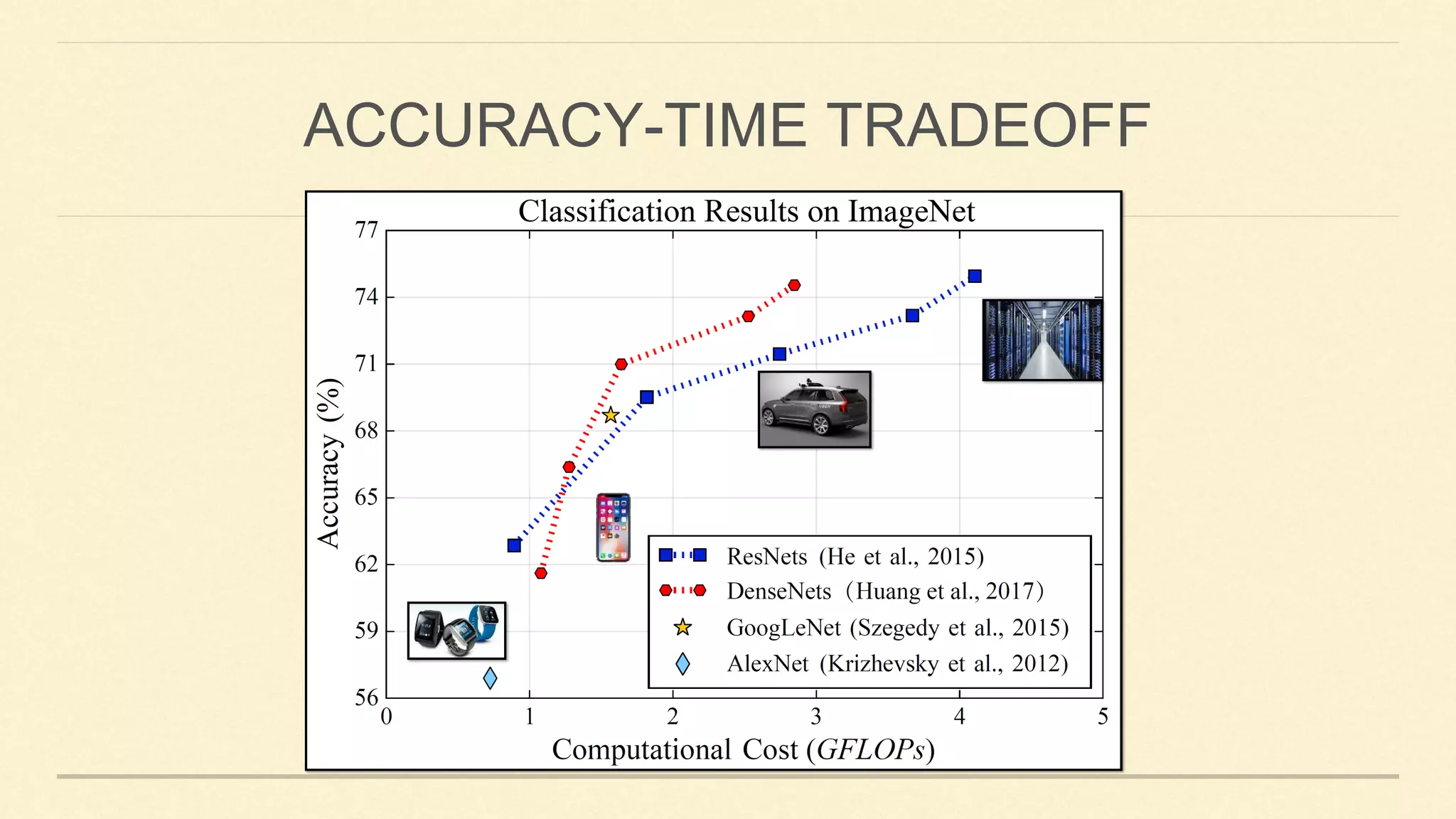
ACCURACY-TIME TRADEOFF
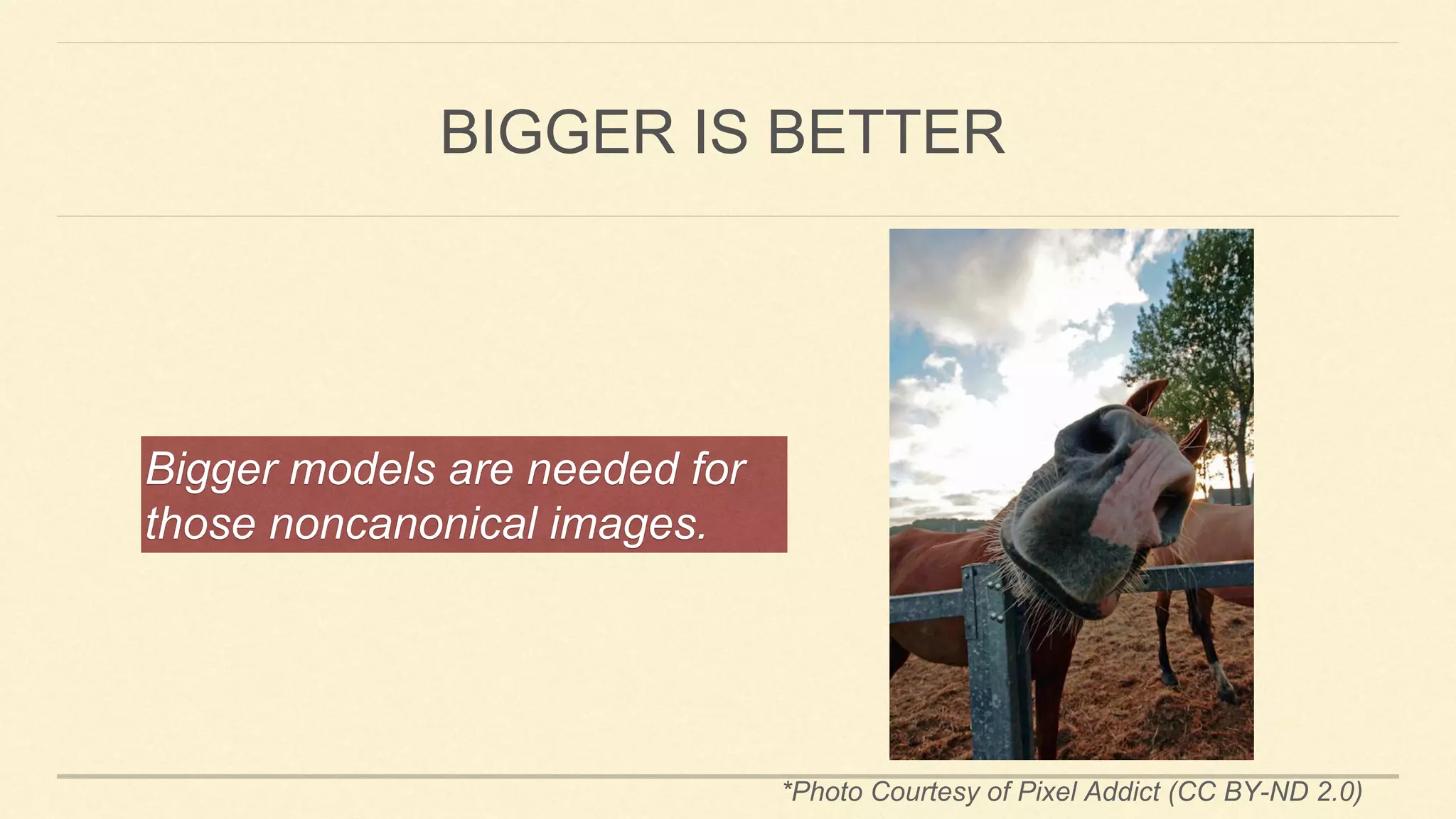
*Photo Courtesy of Pixel Addict (CC BY-ND 2.0)
BIGGER IS BETTER
Bigger models are needed for
those noncanonical images.
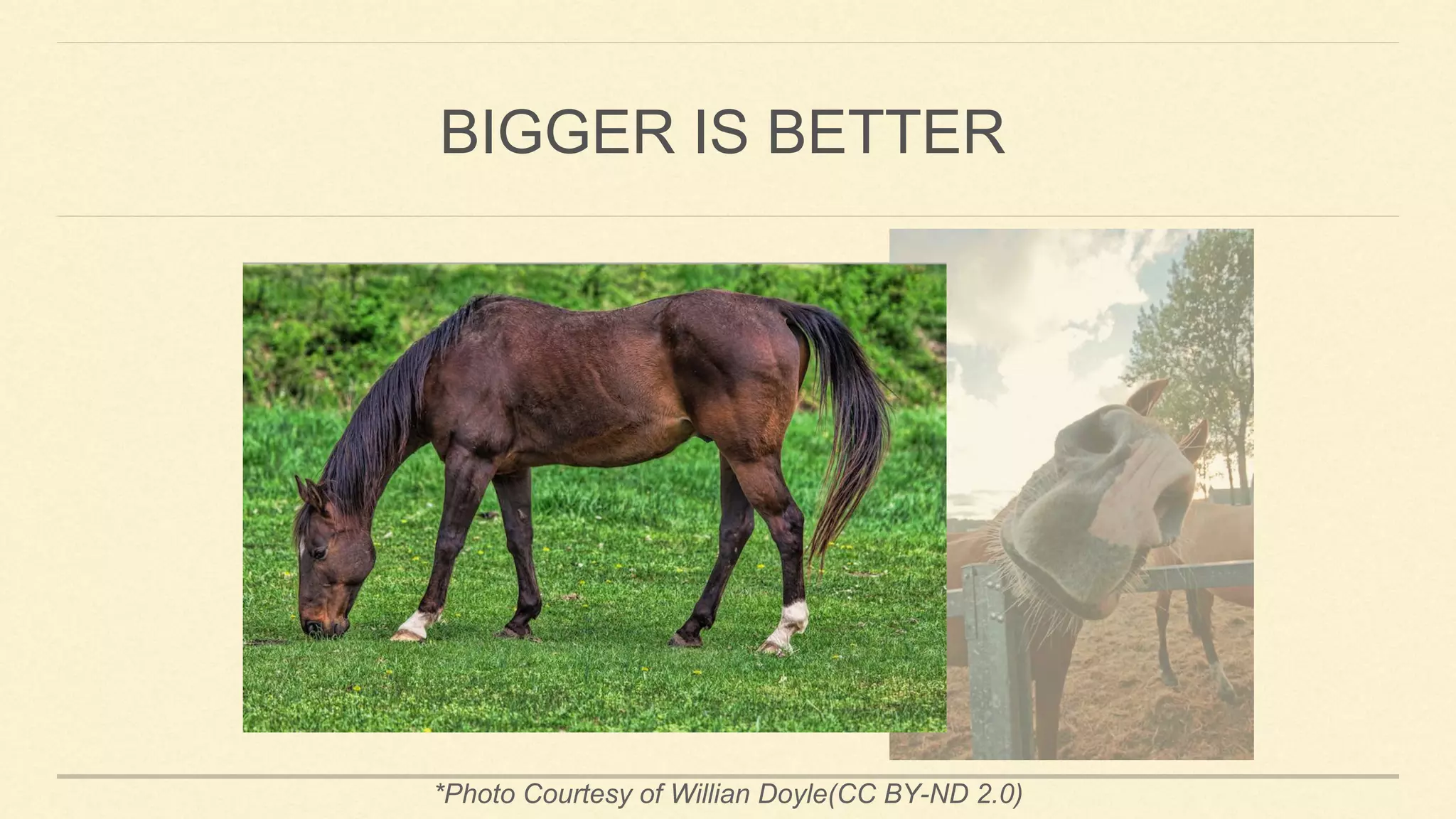
*Photo Courtesy of Willian Doyle(CC BY-ND 2.0)
BIGGER IS BETTER
Why do we use the same
expensive model for all images?
Can we use small&cheap models for easy images;
big&expensive models for hard ones?
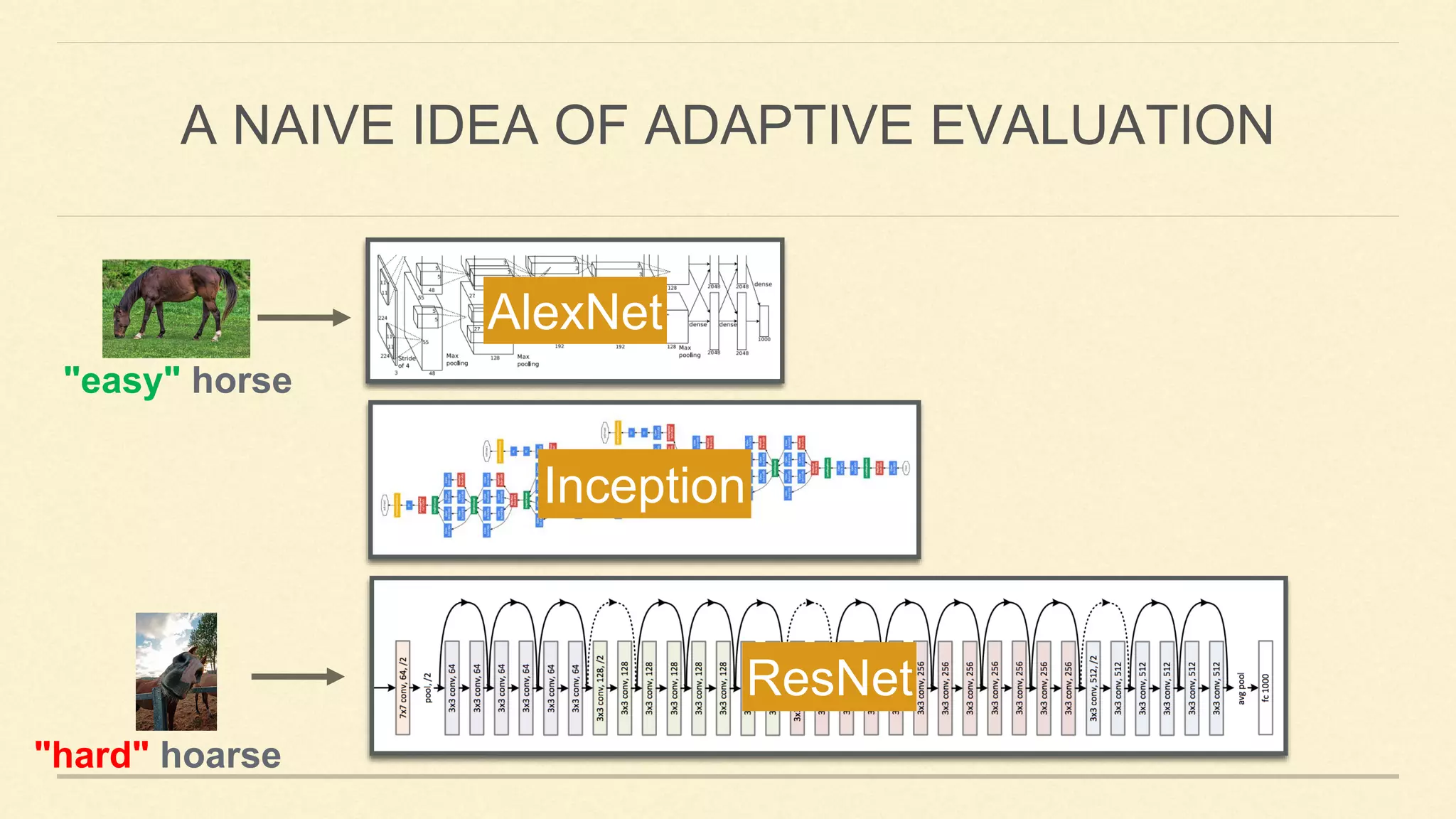
A NAIVE IDEA OF ADAPTIVE EVALUATION
AlexNet
Inception
ResNet
"easy" horse
"hard" hoarse
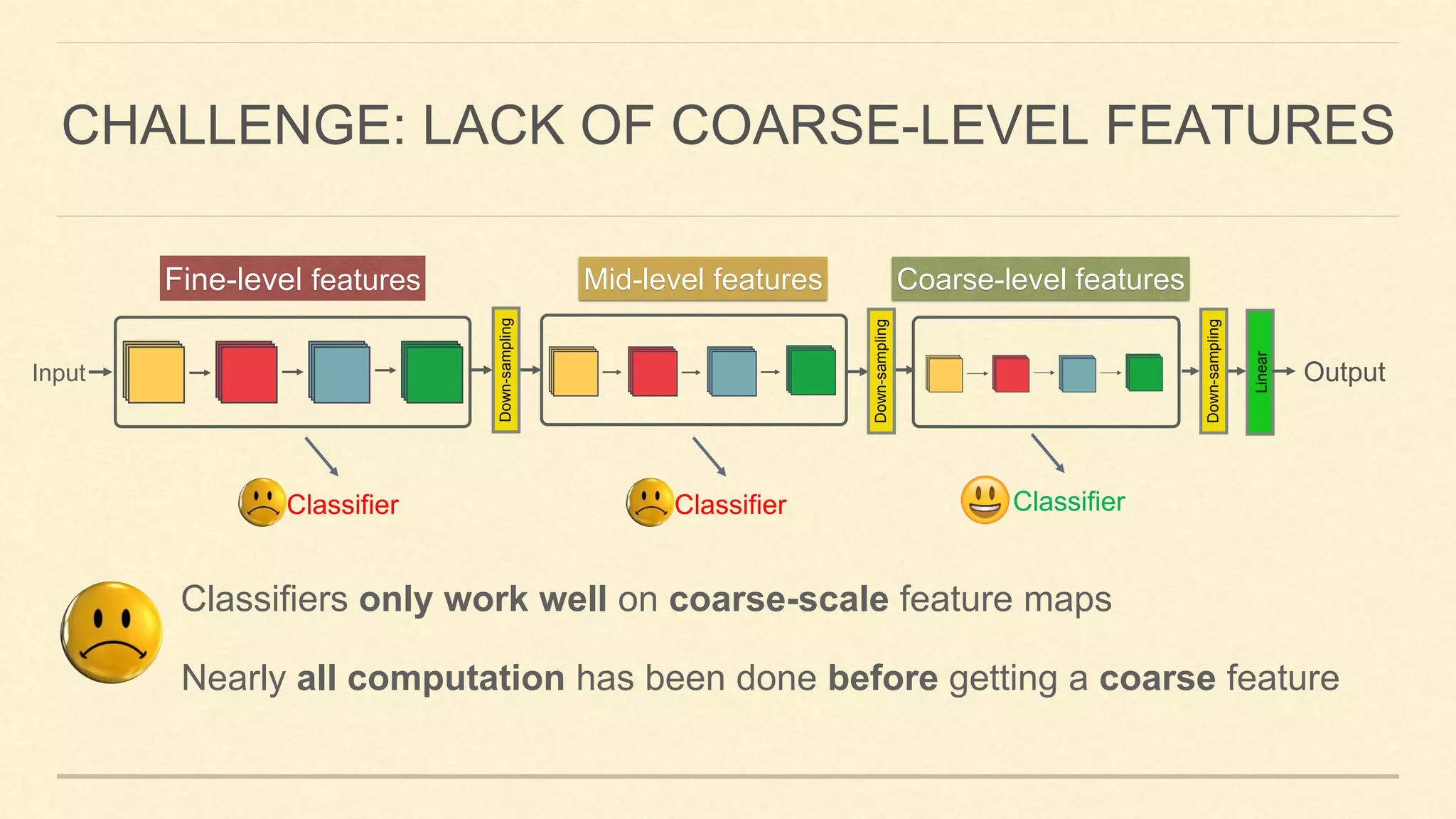
CHALLENGE: LACK OF COARSE-LEVEL FEATURES
Down-sampling
Linear
Output
Classifiers only work well on coarse-scale feature maps
Nearly all computation has been done before getting a coarse feature
Fine-level features Mid-level features Coarse-level features
Down-sampling
Down-sampling
Input
Classifier Classifier Classifier
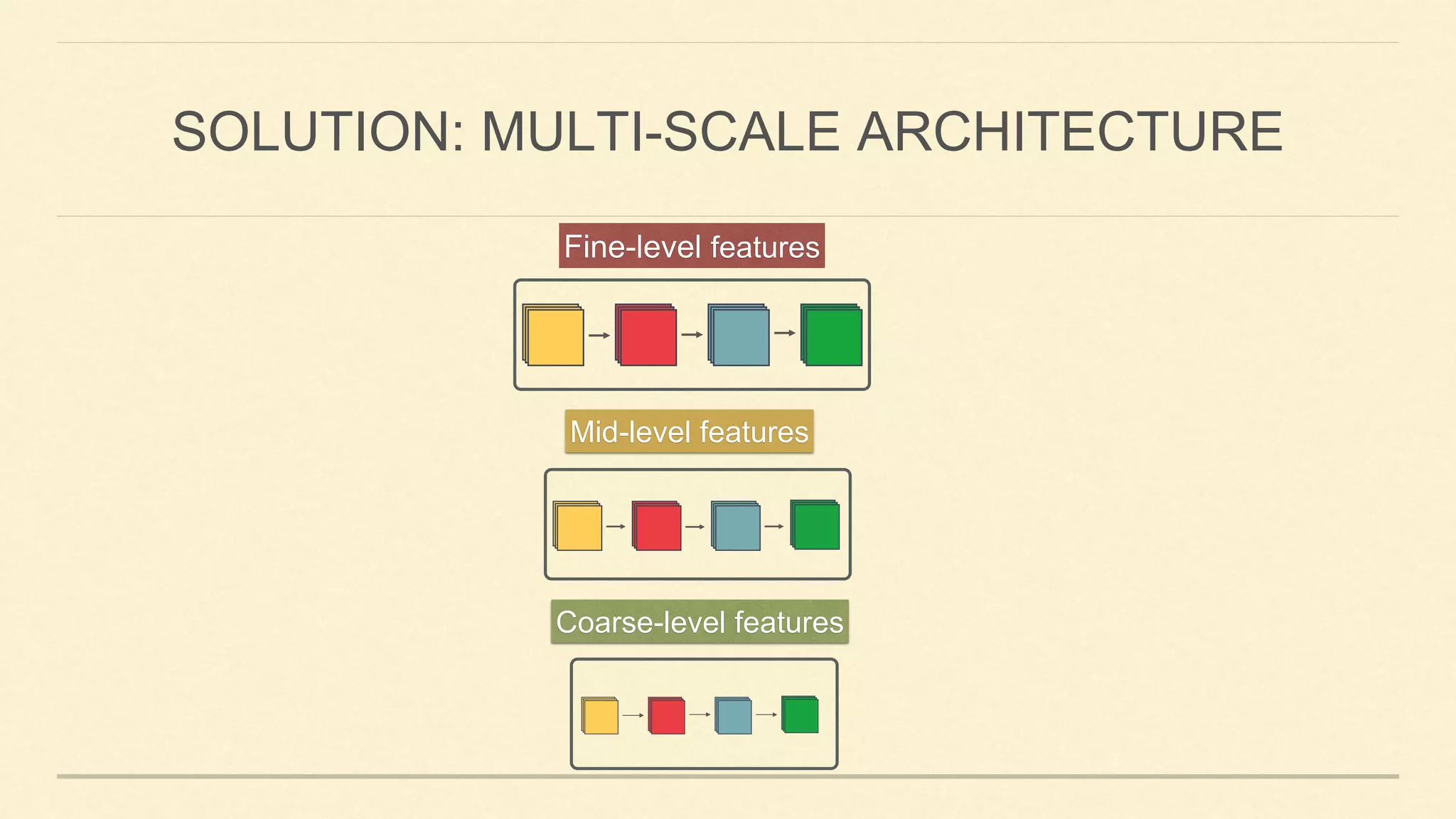
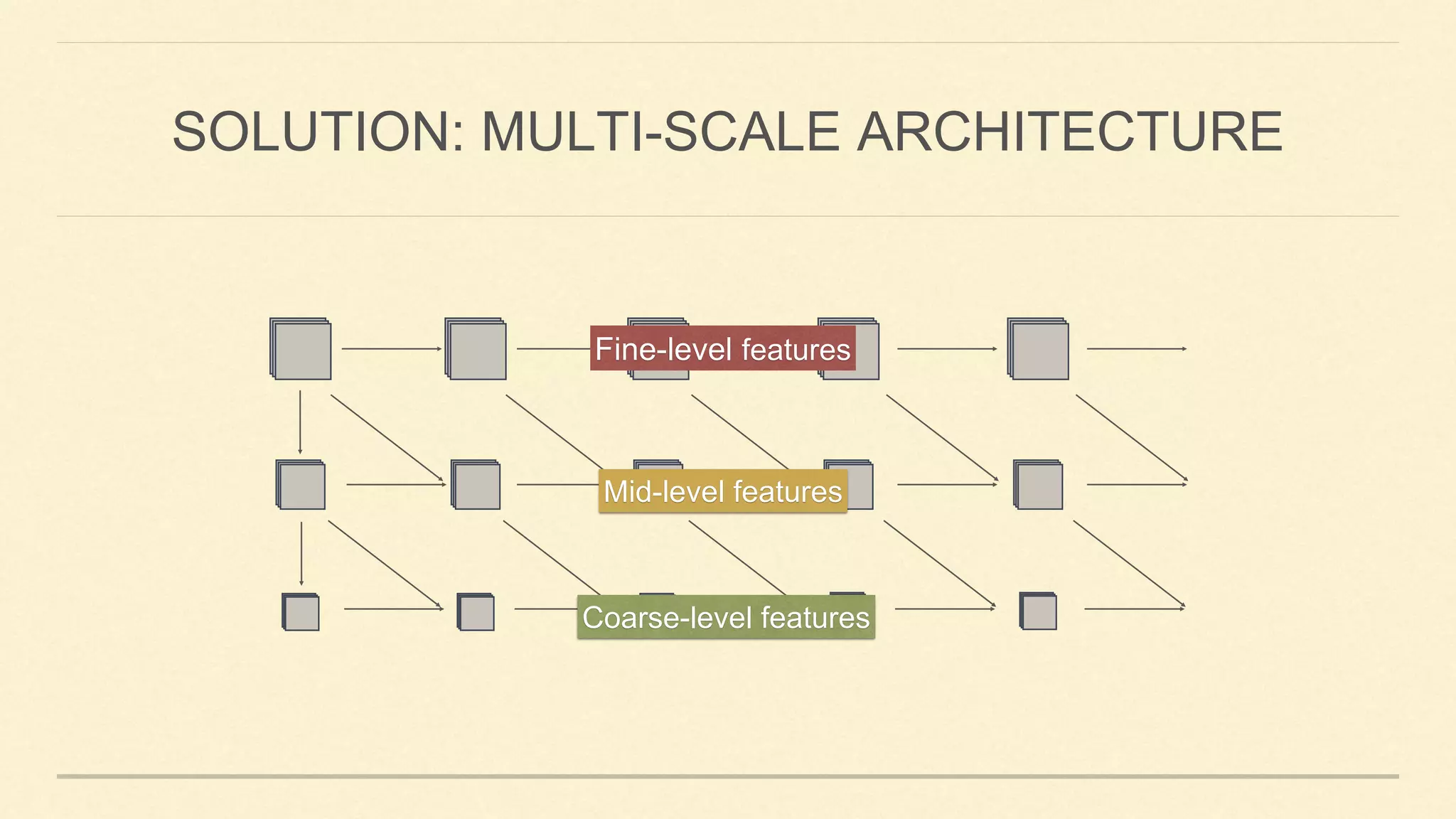
SOLUTION: MULTI-SCALE ARCHITECTURE
Fine-level features
Mid-level features
Coarse-level features
Fine-level features
Mid-level features
Coarse-level features
SOLUTION: MULTI-SCALE ARCHITECTURE
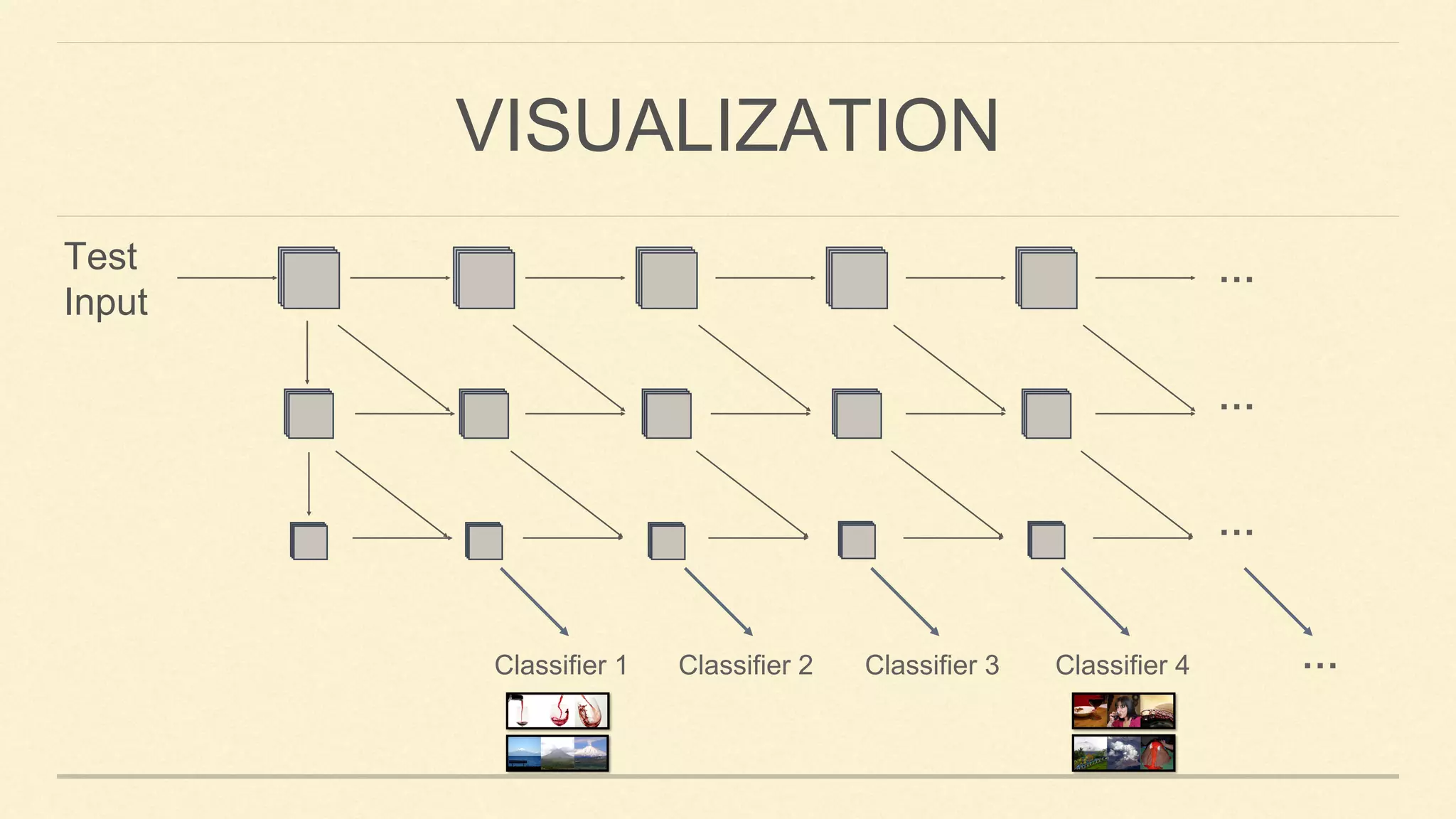
Classifier 4Classifier 2 Classifier 3Classifier 1
…
…
…
Test
Input
…
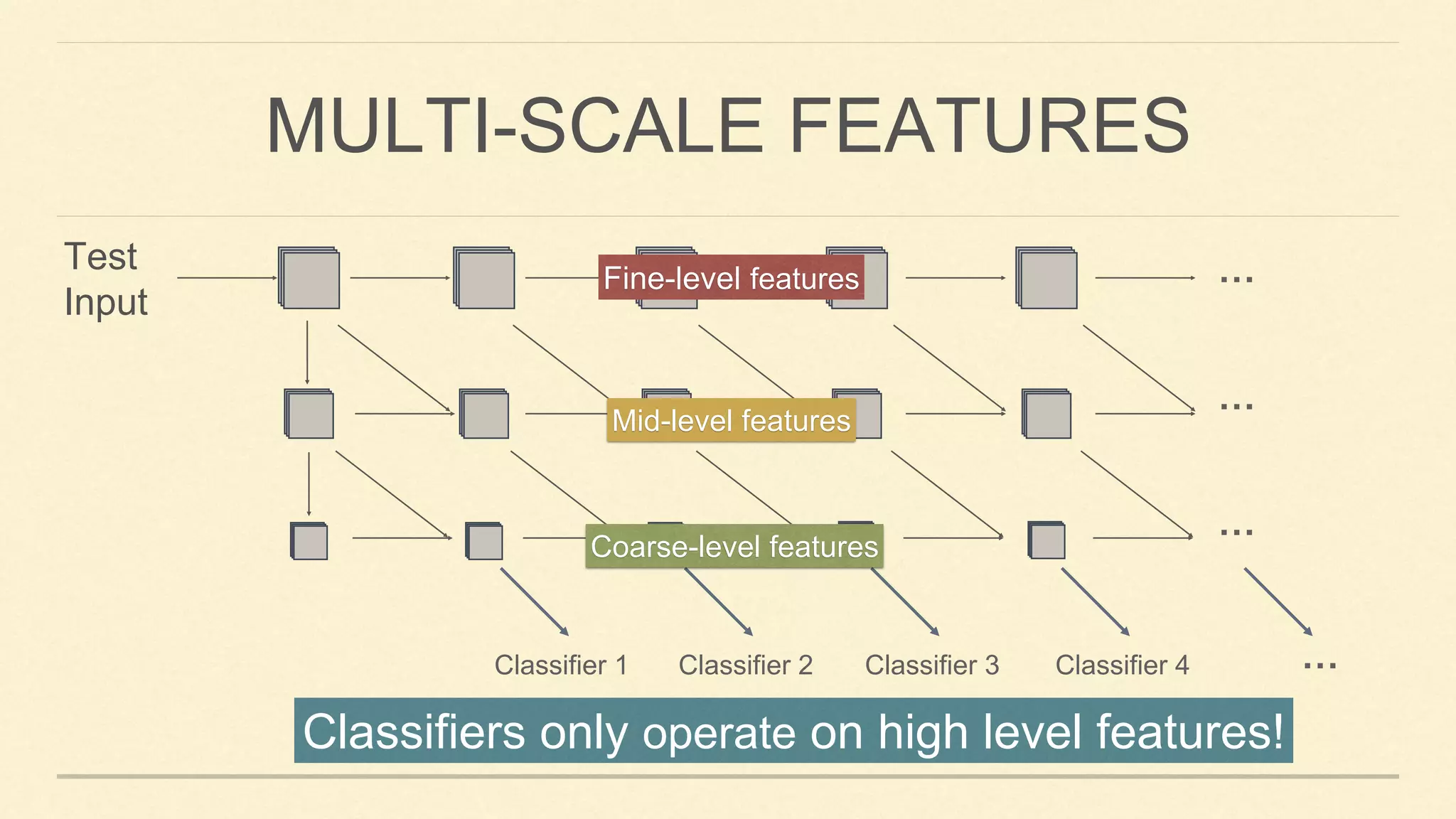
MULTI-SCALE FEATURES
Classifiers only operate on high level features!
Fine-level features
Mid-level features
Coarse-level features
Classifier 4Classifier 2 Classifier 3Classifier 1
…
…
…
Test
Input
…
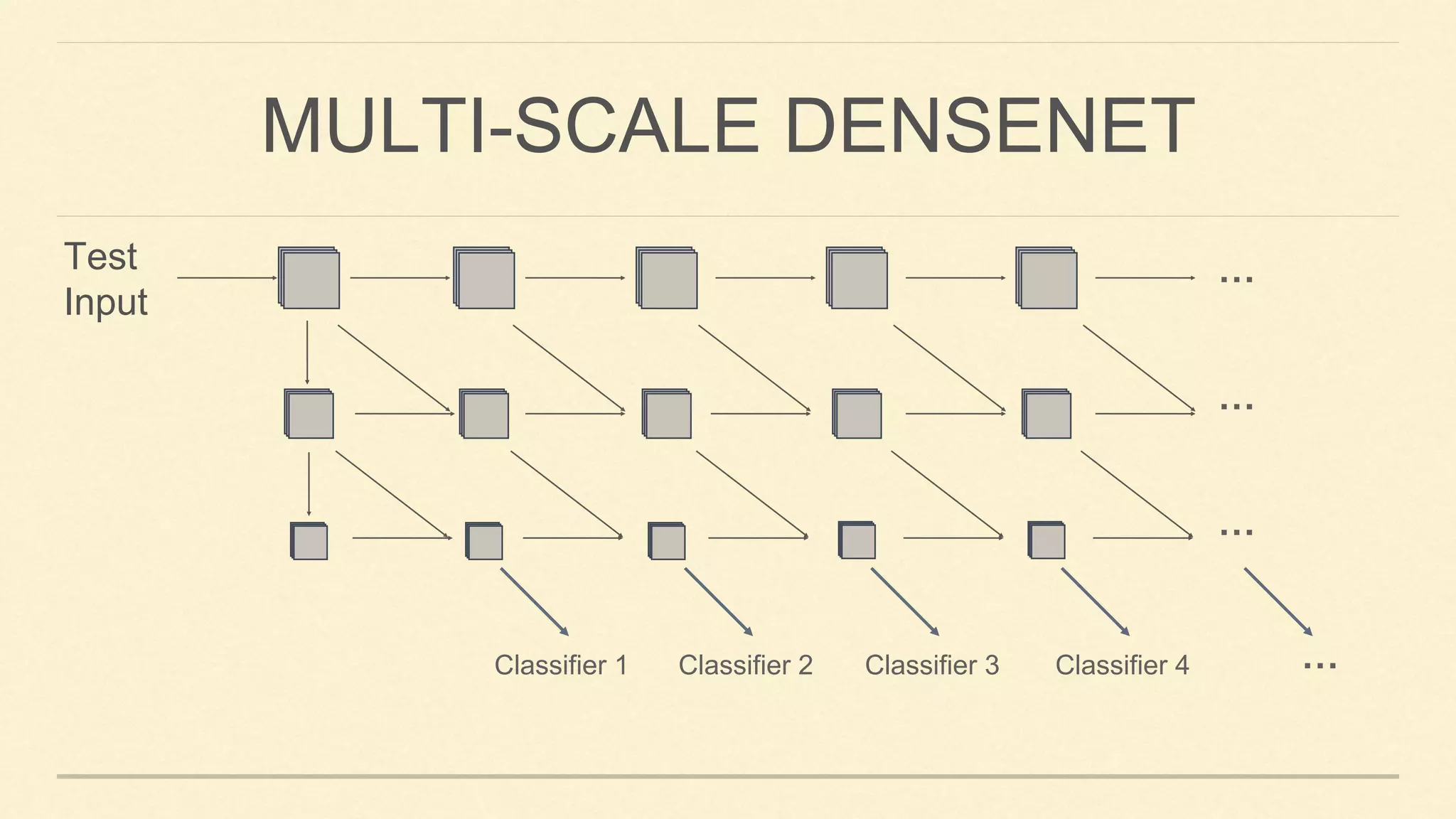
MULTI-SCALE DENSENET
Classifier 4Classifier 2 Classifier 3Classifier 1
…
…
…
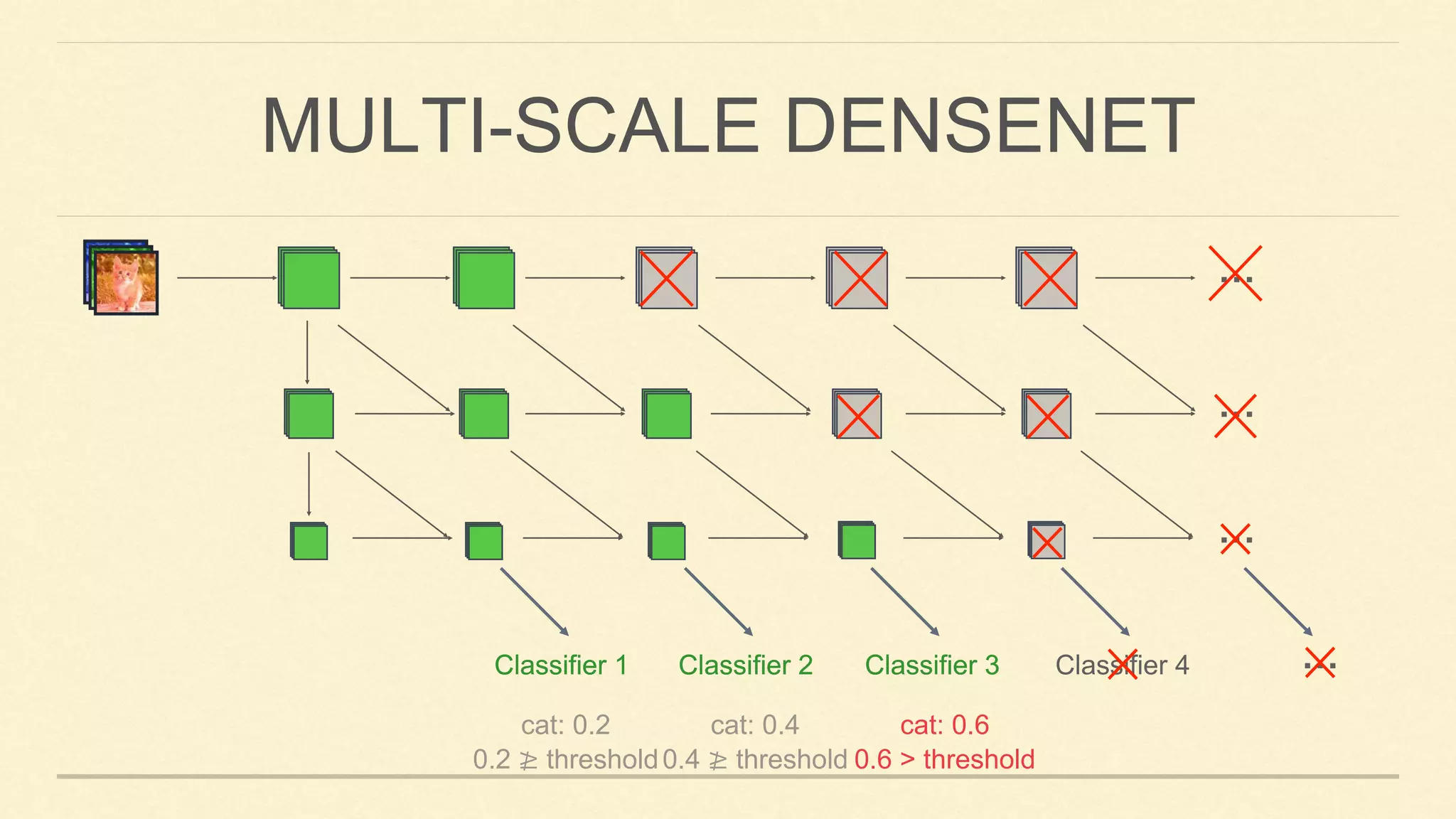
…Classifier 2 Classifier 3Classifier 1
cat: 0.2
0.2 ≱ threshold
cat: 0.4
0.4 ≱ threshold
cat: 0.6
0.6 > threshold
MULTI-SCALE DENSENET
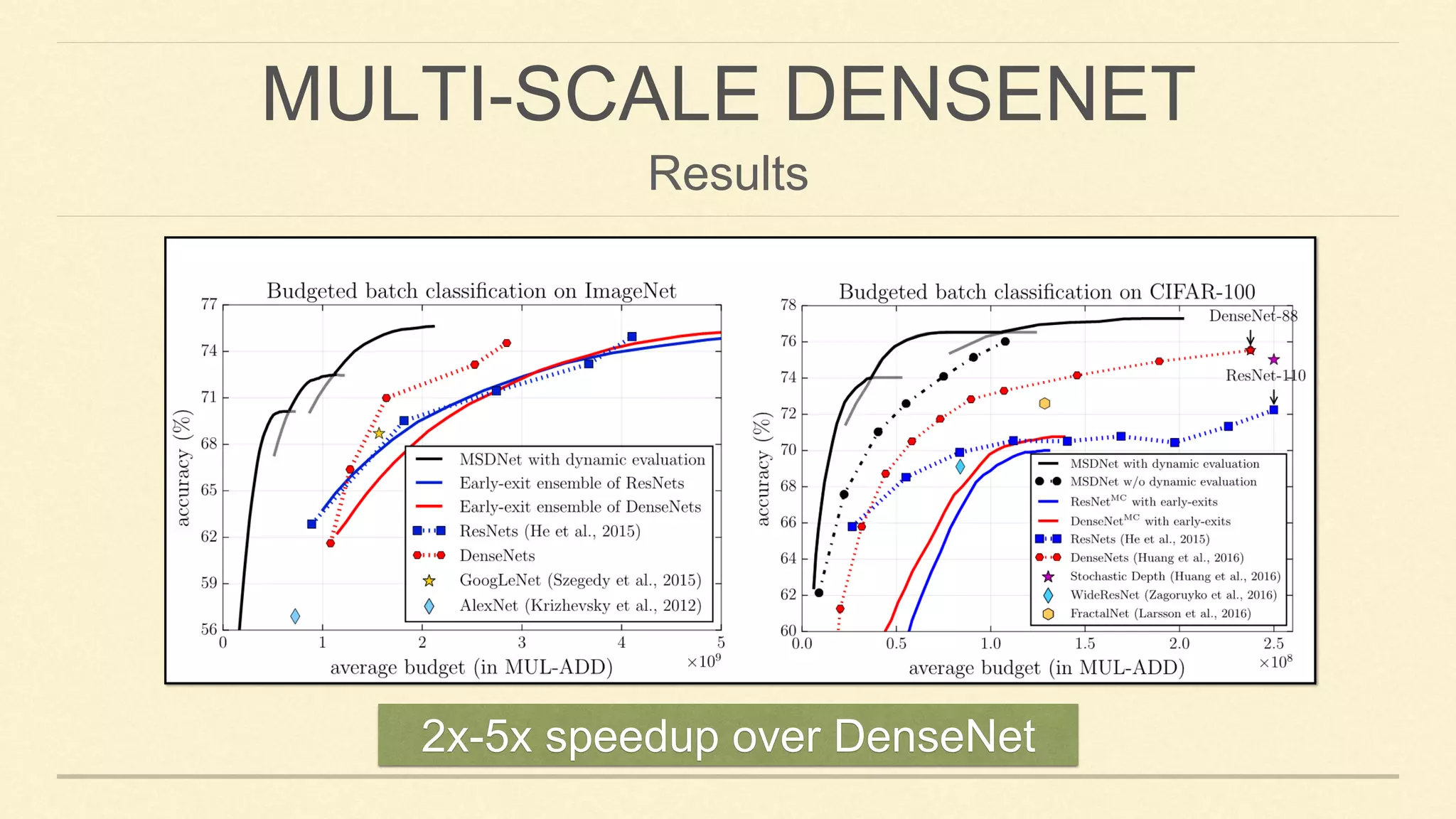
Results
2x-5x speedup over DenseNet
Classifier 4Classifier 2 Classifier 3Classifier 1
…
…
…
Test
Input
…
VISUALIZATION
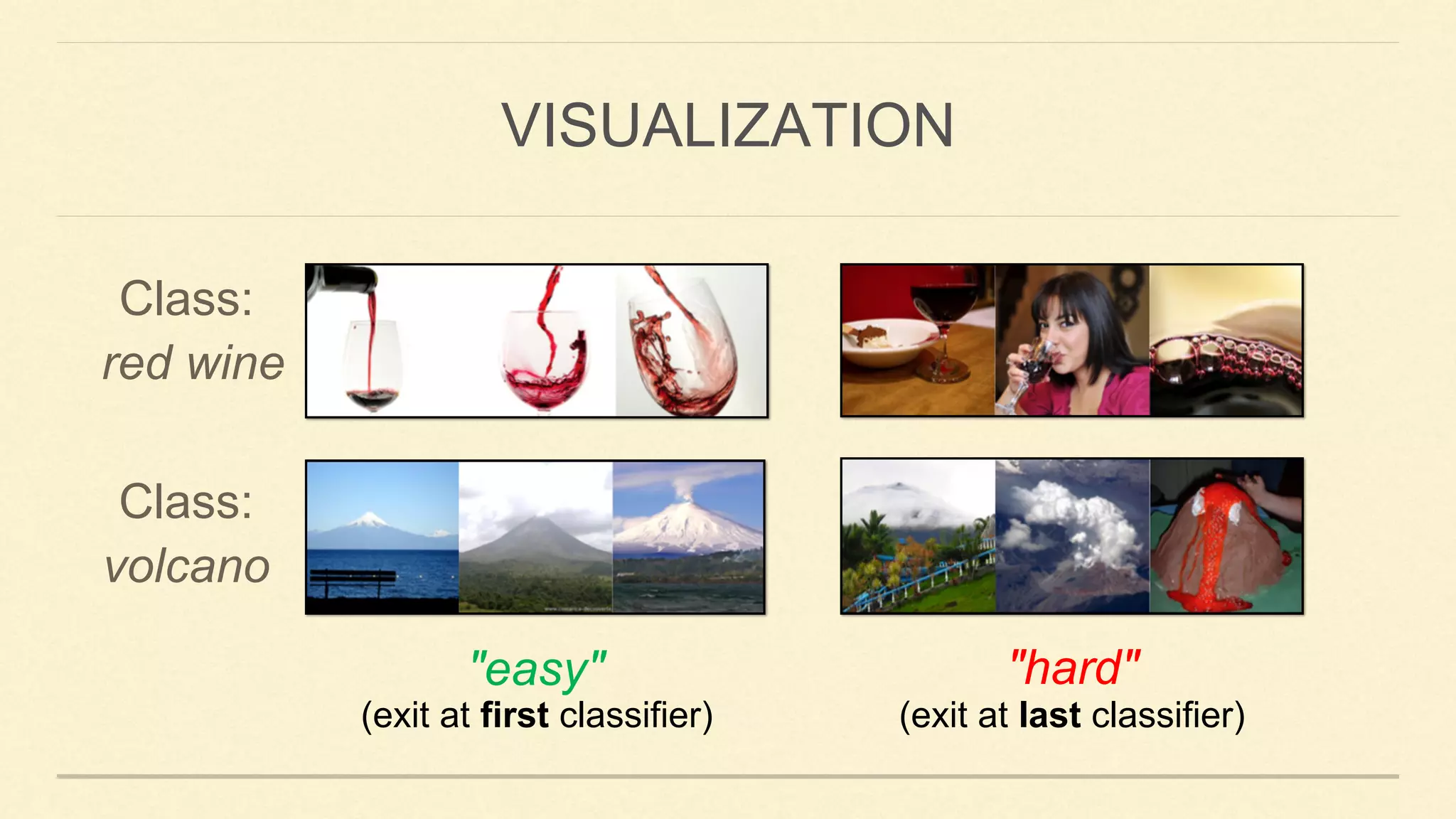
Class:
red wine
Class:
volcano
"easy" "hard"
VISUALIZATION
(exit at first classifier) (exit at last classifier)
MORE RESULTS AND DISCUSSIONS
Please refer to
Multi-scale dense network for efficient image classification, ICLR Oral,
2018 (Acceptance rate 2.2%, Rank 4/935)
ADAPTIVE INFERENCE IS A CHALLENGING PROBLEM
How to design proper network architectures?
How to effectively training dynamic networks?
How to efficiently perform dynamic evaluation?
Adaptive inference for object detection and segmentation?
Spatial adaptive and temporal adaptive?
THANK YOU !

Architecture Design for Deep Neural Networks I