1
DaeJin Kim
2019.07
2019.07 - AutoML and
Neural Architecture Search
: EfficientNet, RandomWire
2
Contents
• AutoML
• NAS (A brief introduction)
• EfficientNet: Rethinking Model Scaling for Convolutional Neural Networks
• Exploring Randomly Wired Neural Networks for Image Recognition
3
AutoML
• Machine Learning for designing machine learning models
• Feature Engineering
• Deep Feature Synthesis
• One button machine
• R2n (Feature Learning From Relational Databases)
• Architecture Search
• NAS
• NasNet
• mNasNet
• DARTS
• Hyperparameter Optimization
• Auto-keras
• hyperopt
4
NAS
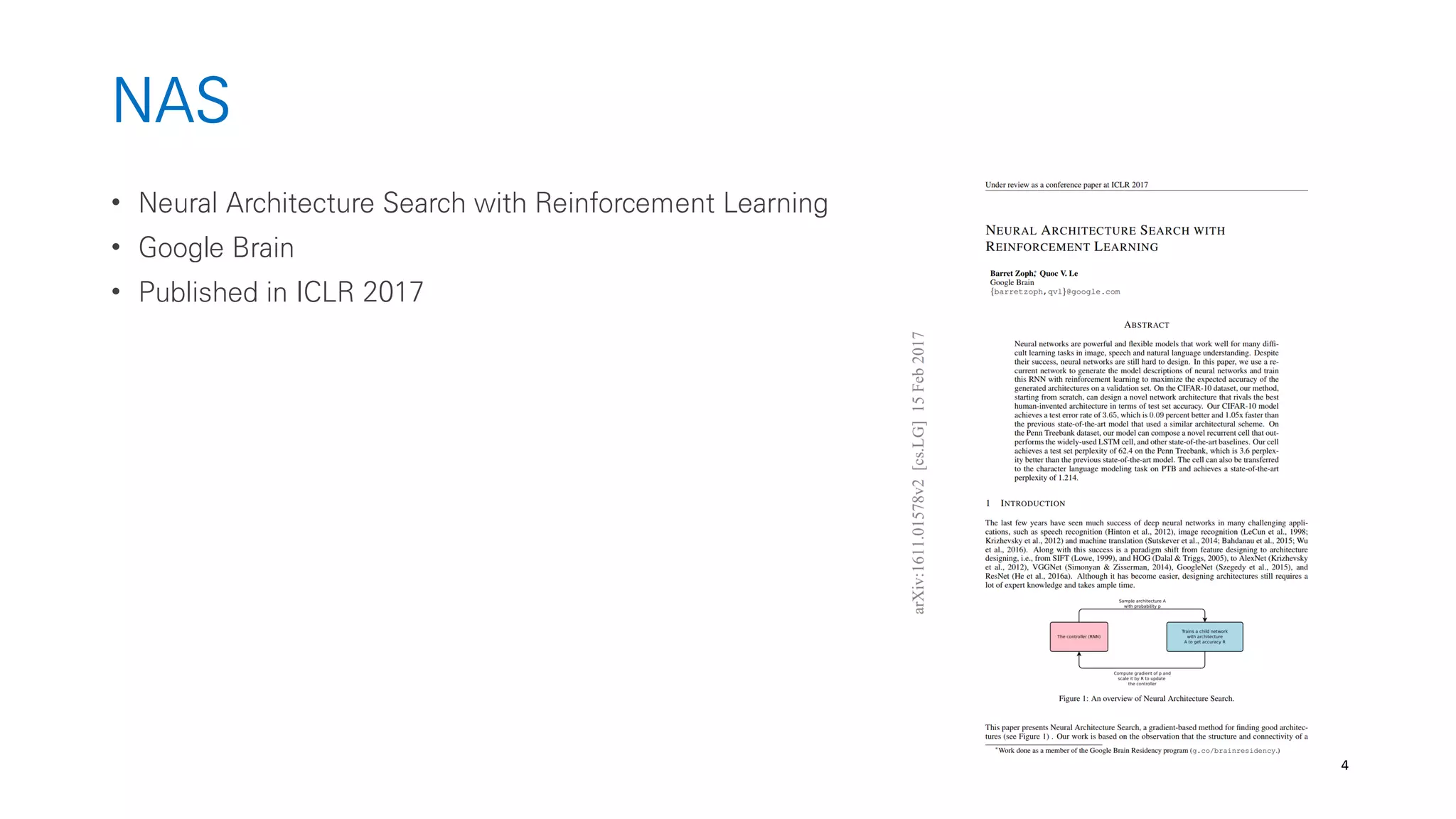
• Neural Architecture Search with Reinforcement Learning
• Google Brain
• Published in ICLR 2017
5
NAS
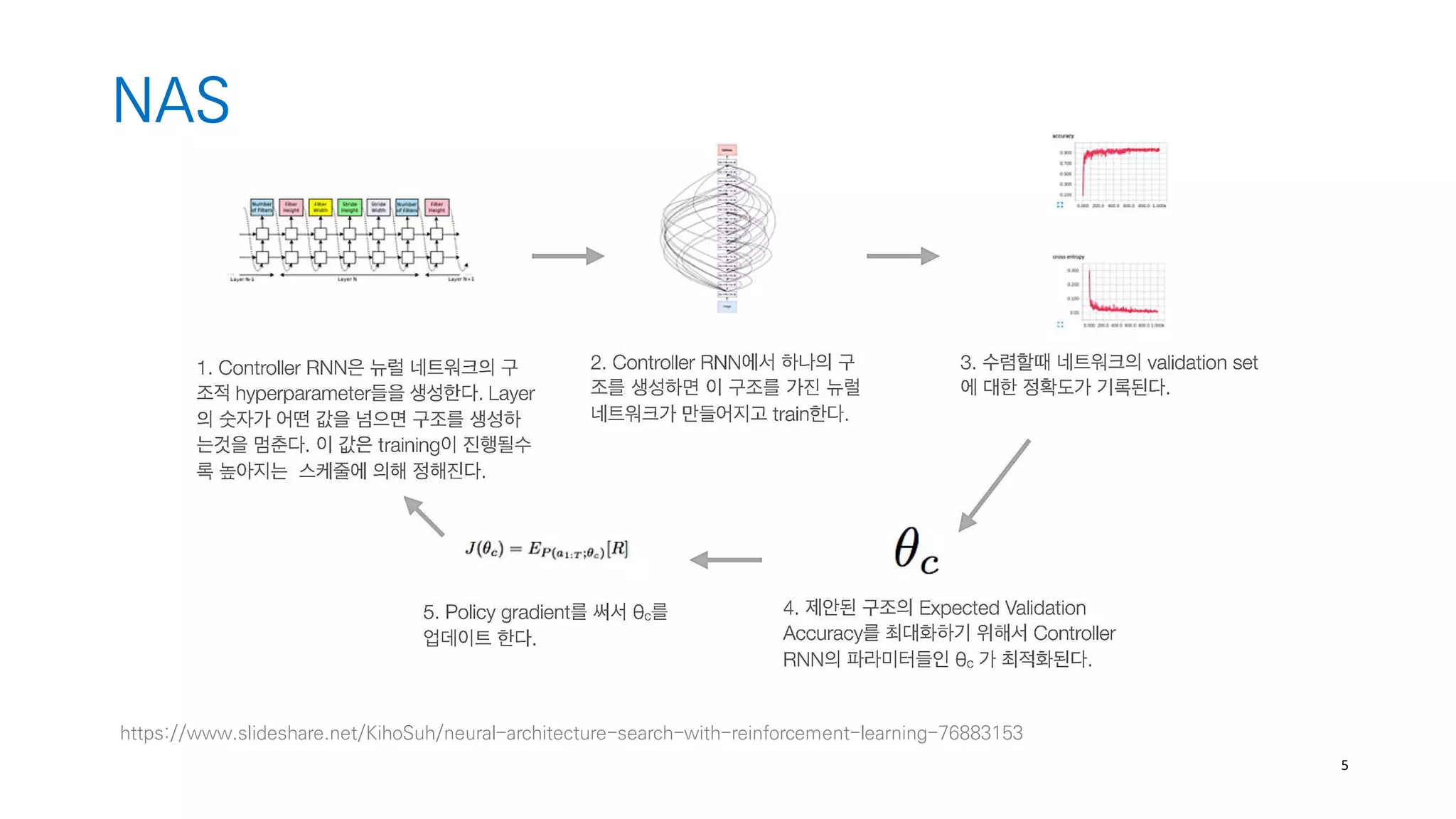
https://www.slideshare.net/KihoSuh/neural-architecture-search-with-reinforcement-learning-76883153
6
Concept
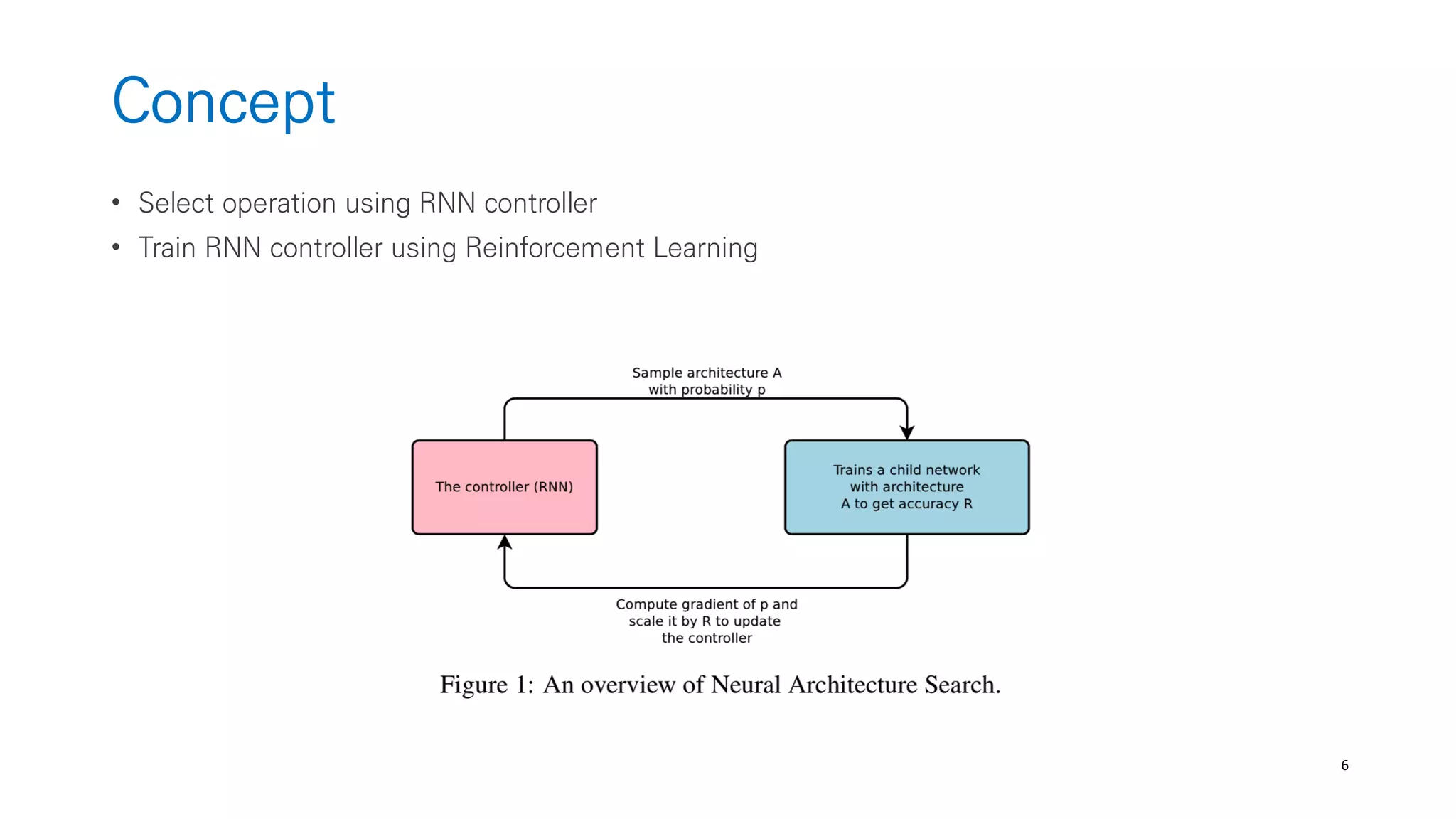
• Select operation using RNN controller
• Train RNN controller using Reinforcement Learning
7
Experiment - CNN
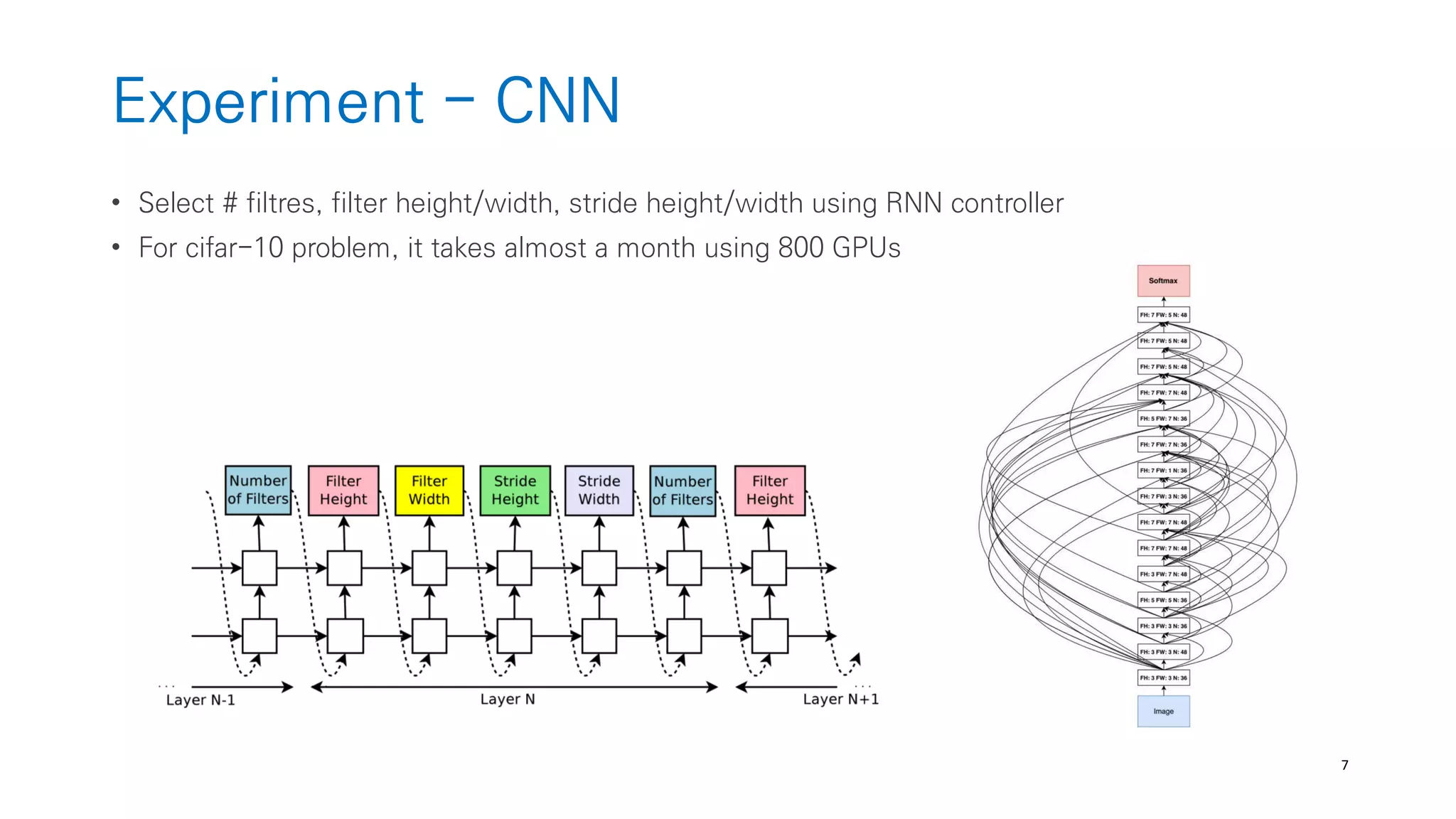
• Select # filtres, filter height/width, stride height/width using RNN controller
• For cifar-10 problem, it takes almost a month using 800 GPUs
8
Experiment - RNN
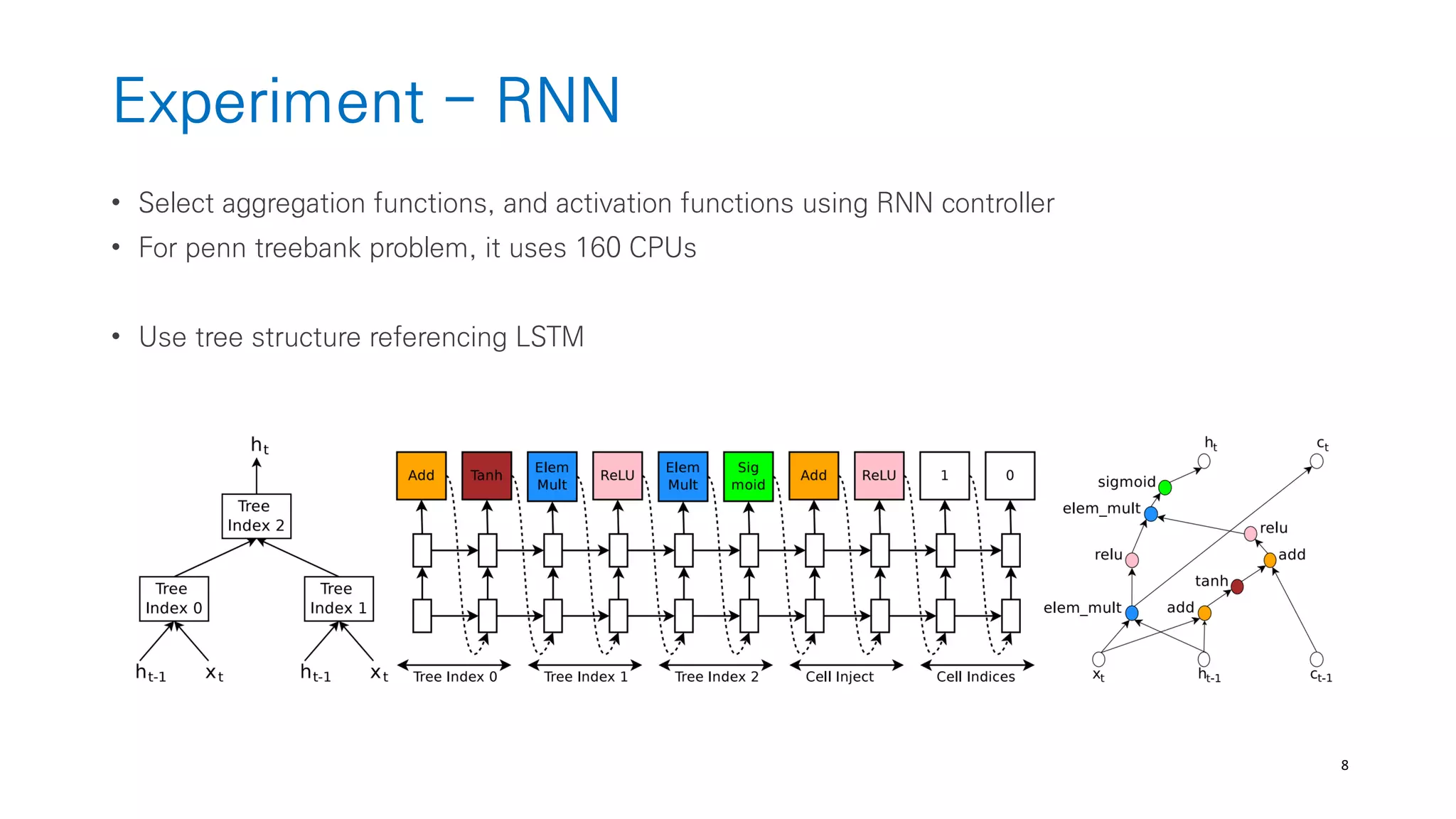
• Select aggregation functions, and activation functions using RNN controller
• For penn treebank problem, it uses 160 CPUs
• Use tree structure referencing LSTM
9
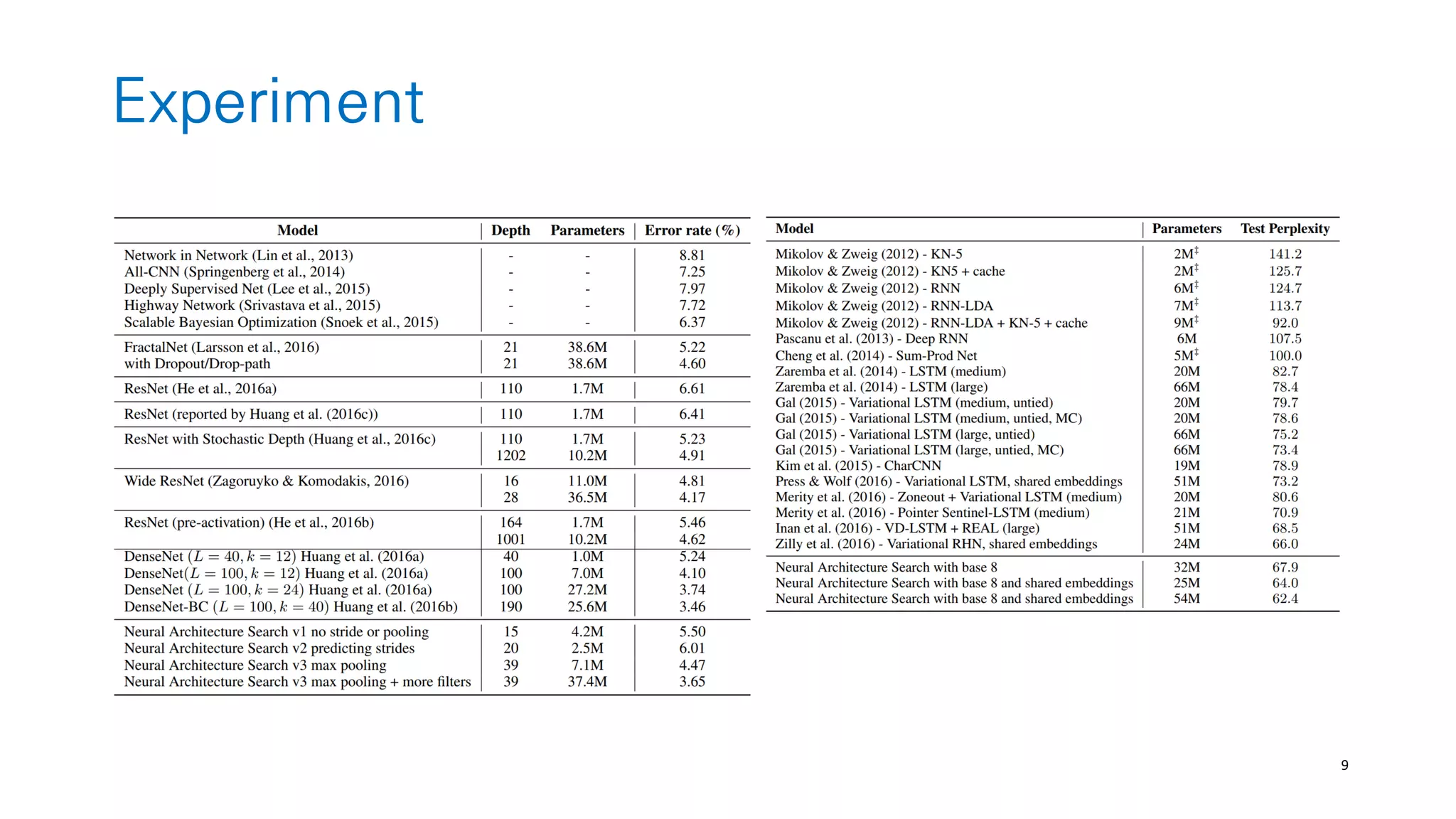
Experiment
10
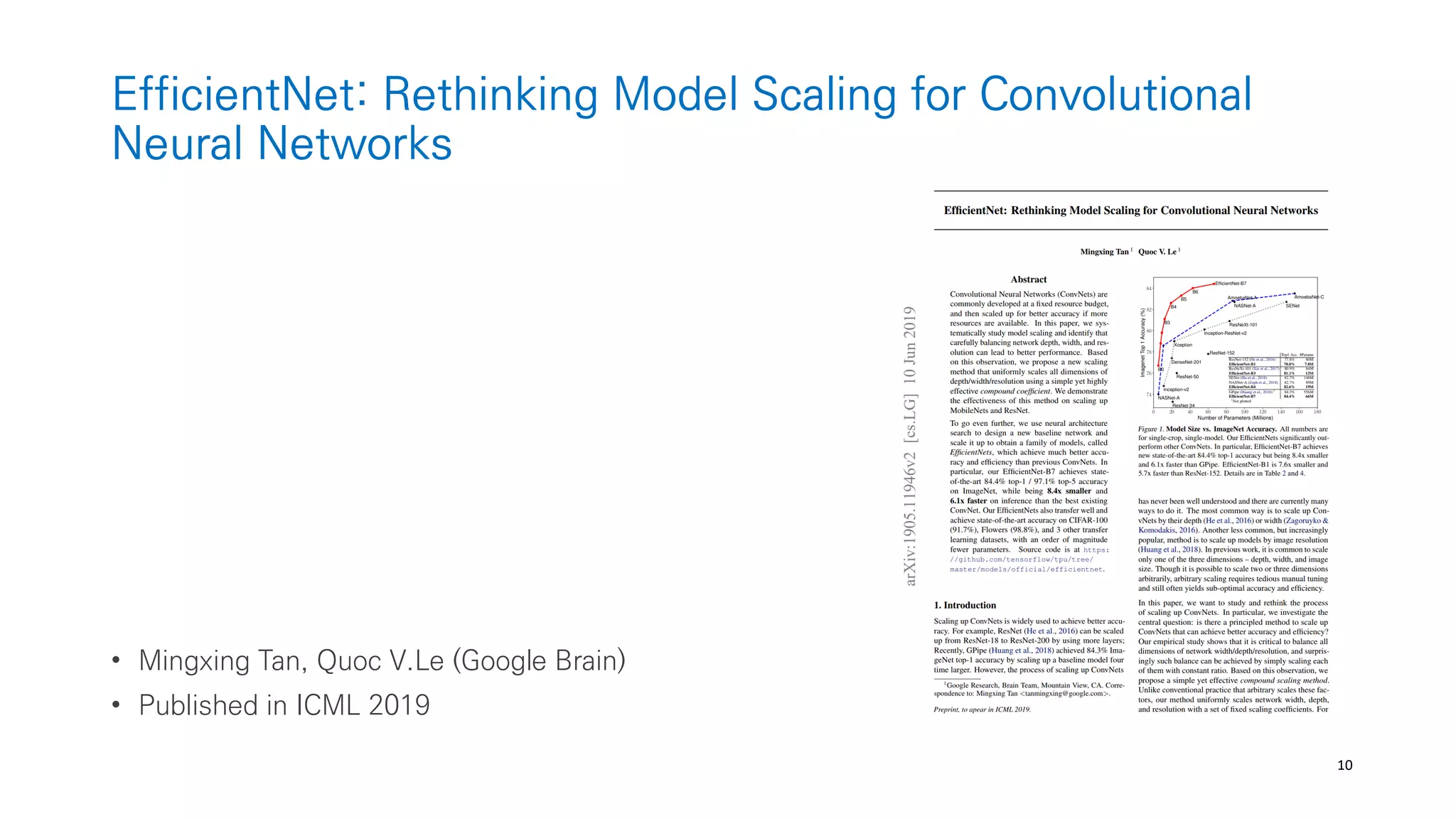
EfficientNet: Rethinking Model Scaling for Convolutional
Neural Networks
• Mingxing Tan, Quoc V.Le (Google Brain)
• Published in ICML 2019
11
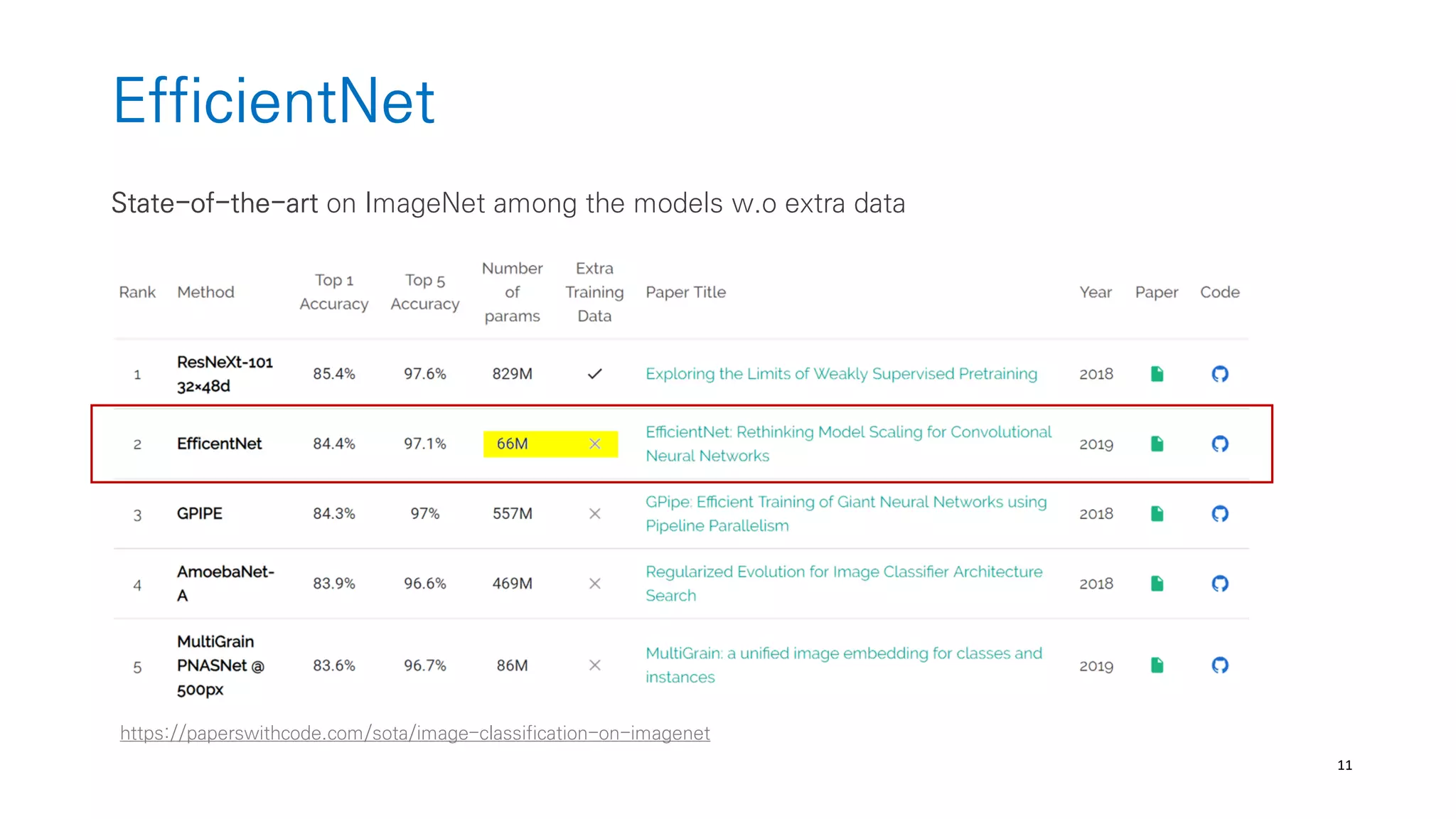
EfficientNet
State-of-the-art on ImageNet among the models w.o extra data
https://paperswithcode.com/sota/image-classification-on-imagenet
12
Motivation
• “Although higher accuracy is critical for many applications,
we have already hit the hardware memory limit”
• Architecture Search for larger models requires much larger design space and much more
expensive tuning cost.
• How to do scaling without tedious manual tuning?
13
Model Scaling - Dimensions
• Depth (# layers): Deeper ConvNet can capture richer and more complex features, and generalize
well on new tasks
• Width (# channels): Wider networks tend to be able to capture more find-grained features and are
easier to train / Difficulties in capturing higher level features
• Resolution (image sizes): ConvNets can potentially capture more fine-grained patterns
14
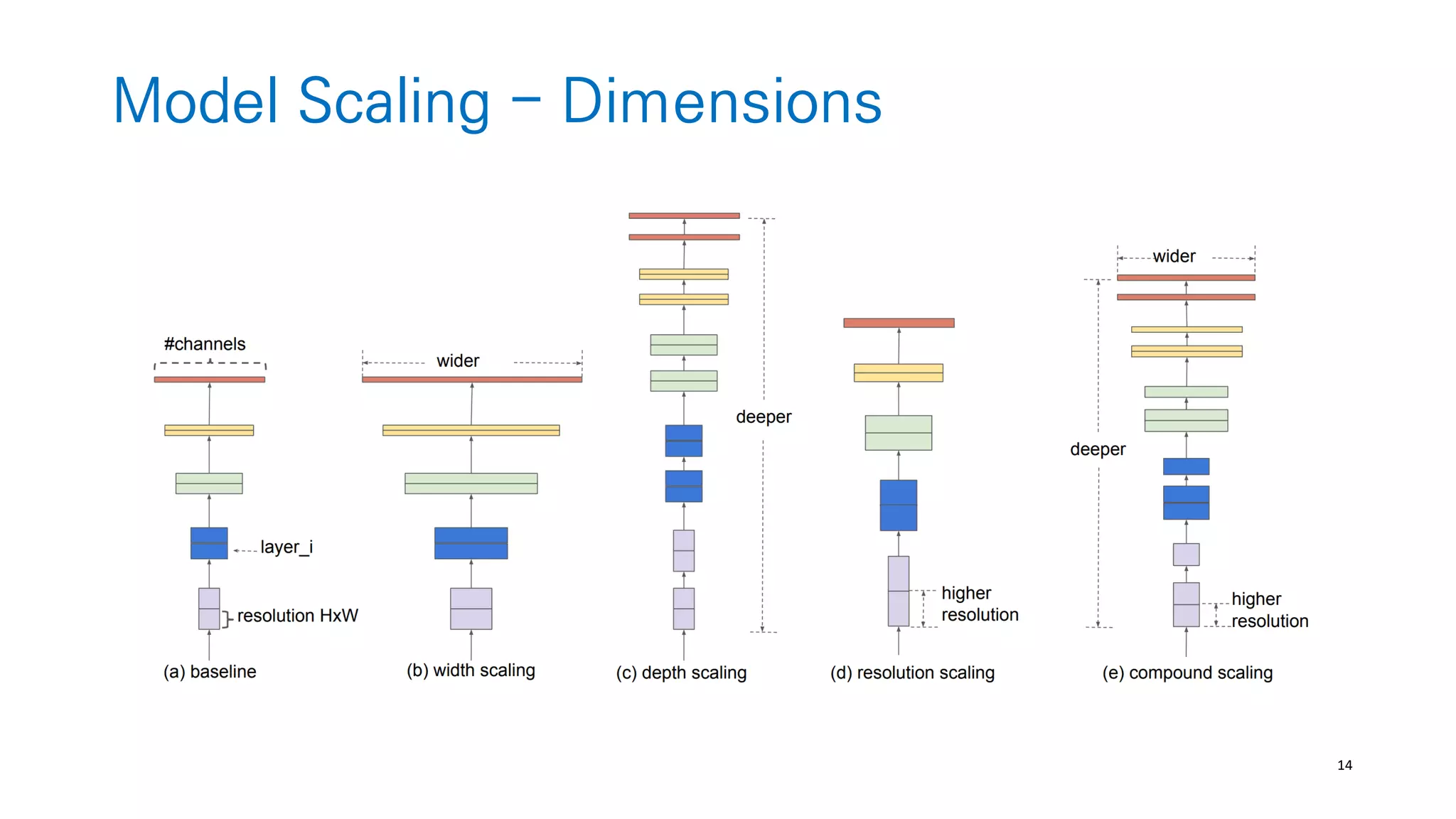
Model Scaling - Dimensions
15
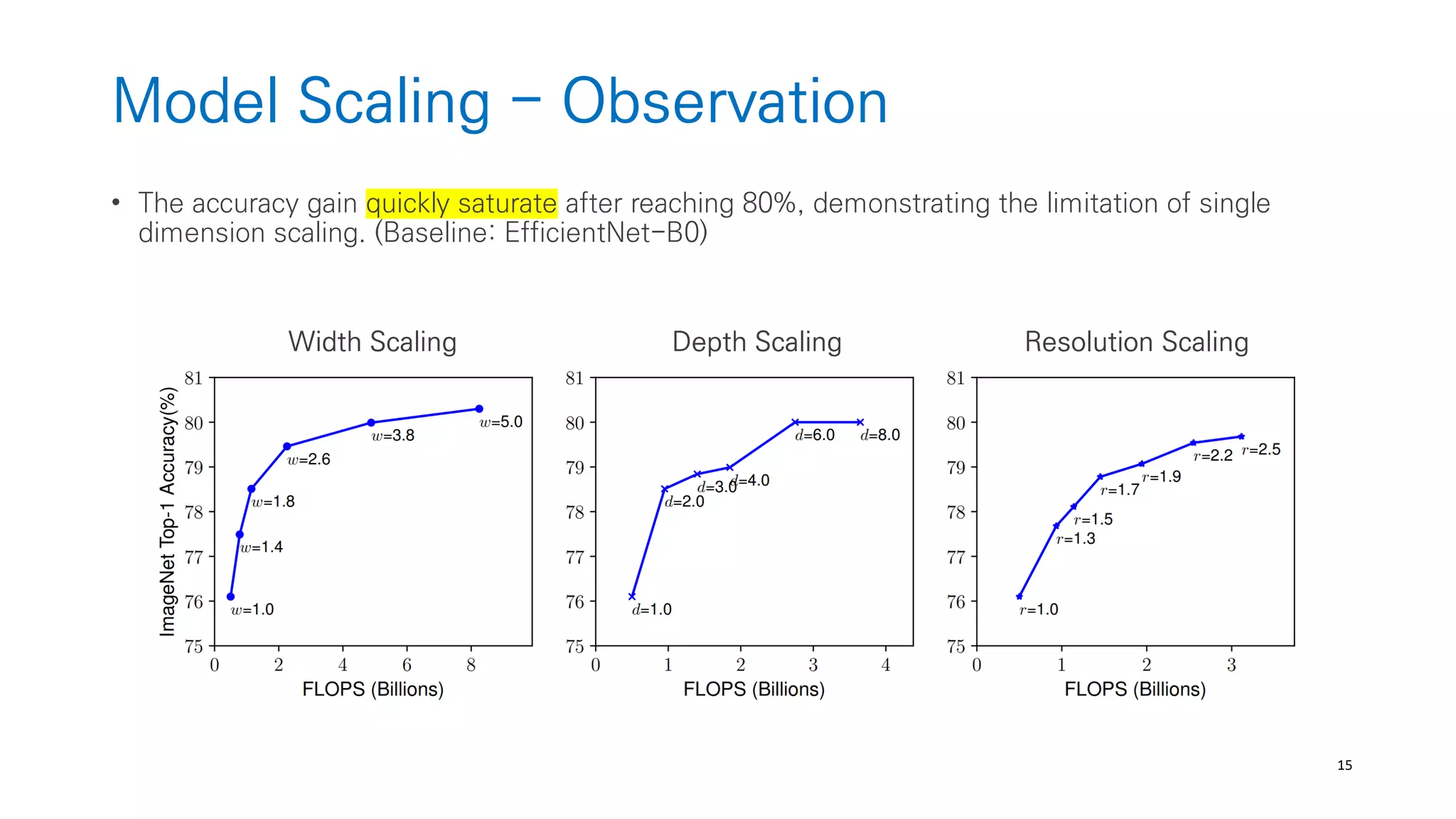
Model Scaling - Observation
• The accuracy gain quickly saturate after reaching 80%, demonstrating the limitation of single
dimension scaling. (Baseline: EfficientNet-B0)
Width Scaling Depth Scaling Resolution Scaling
16
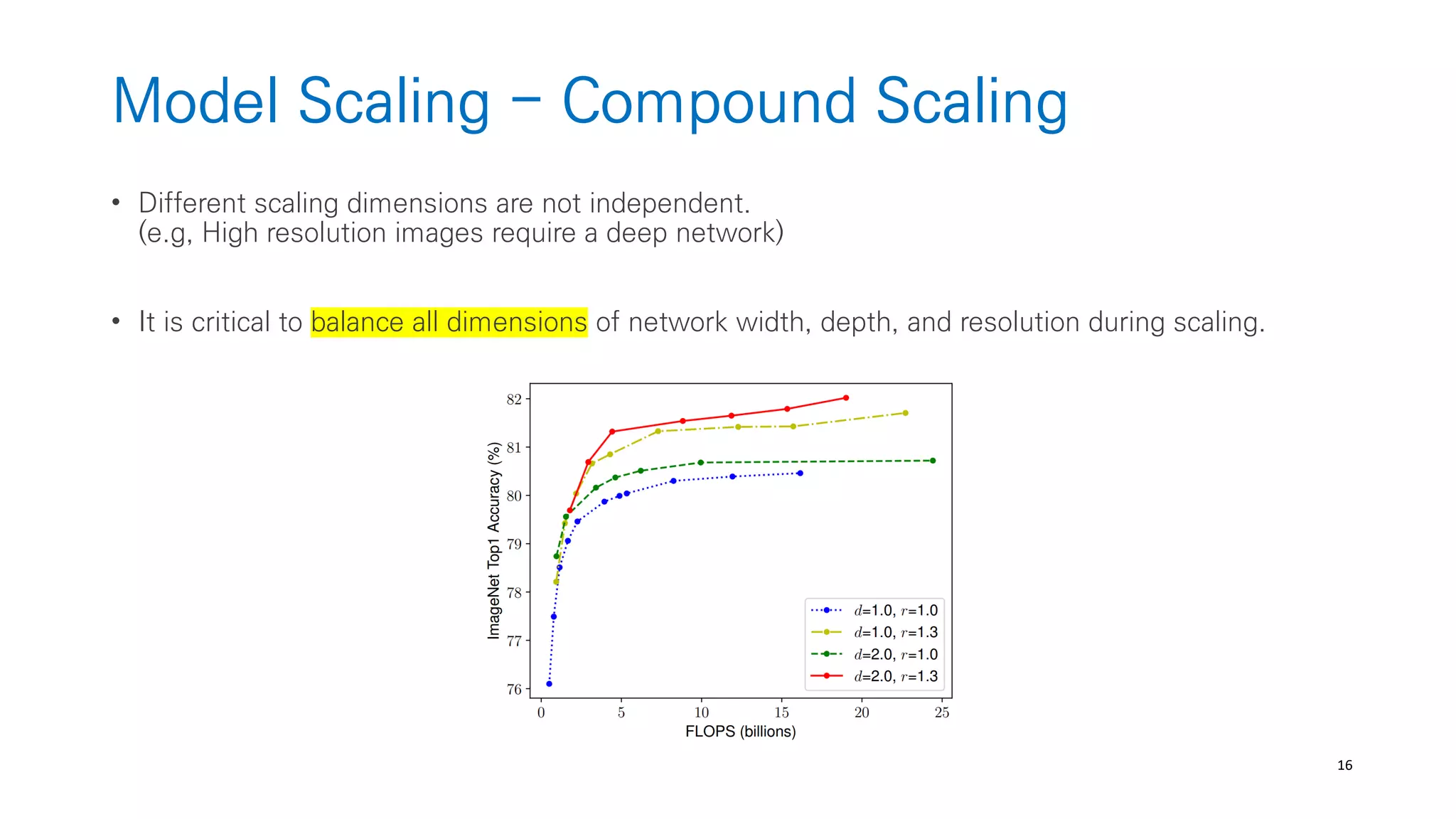
Model Scaling - Compound Scaling
• Different scaling dimensions are not independent.
(e.g, High resolution images require a deep network)
• It is critical to balance all dimensions of network width, depth, and resolution during scaling.
17
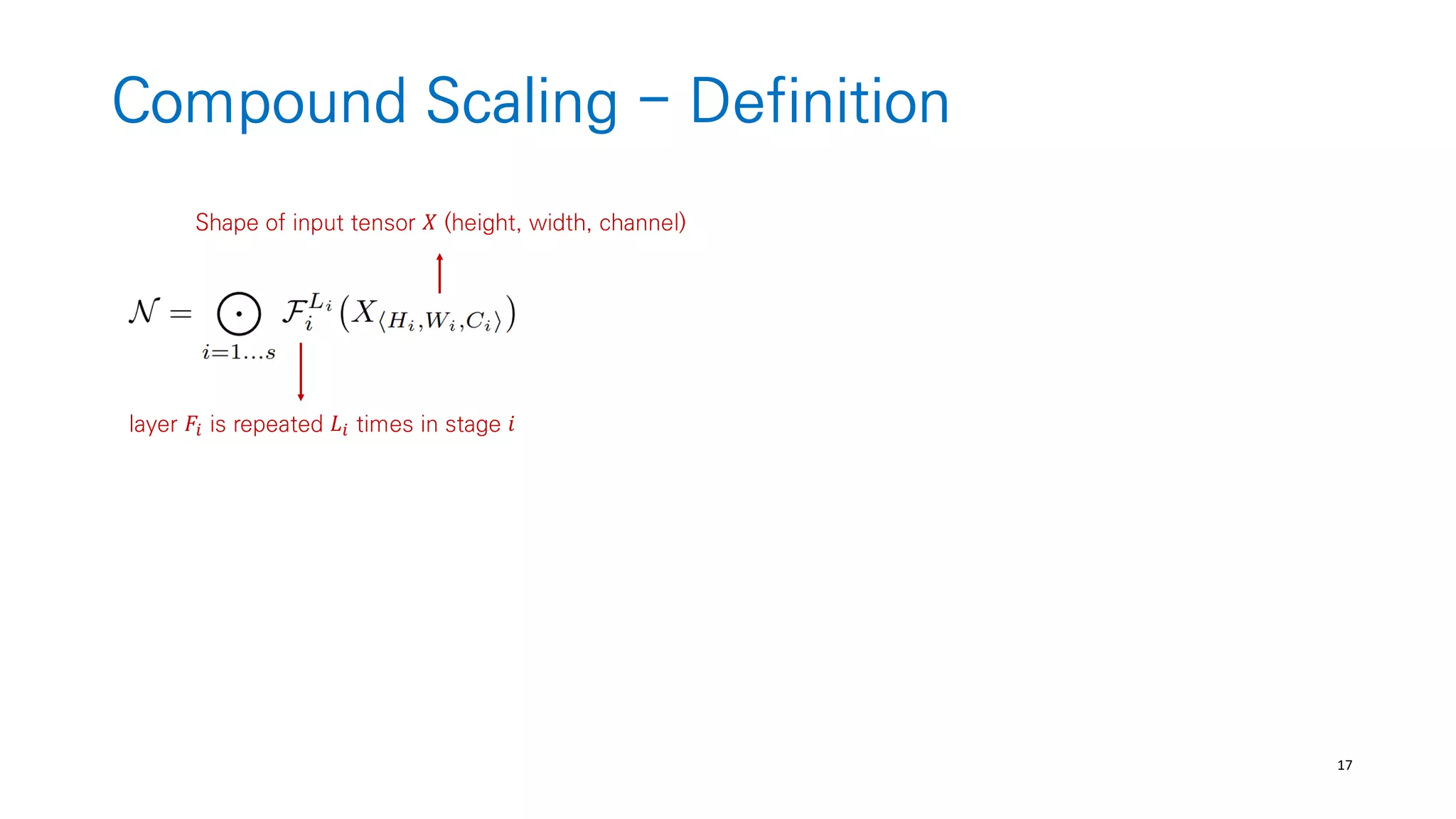
layer 𝐹𝑖 is repeated 𝐿𝑖 times in stage 𝑖
Shape of input tensor 𝑋 (height, width, channel)
Compound Scaling - Definition
18
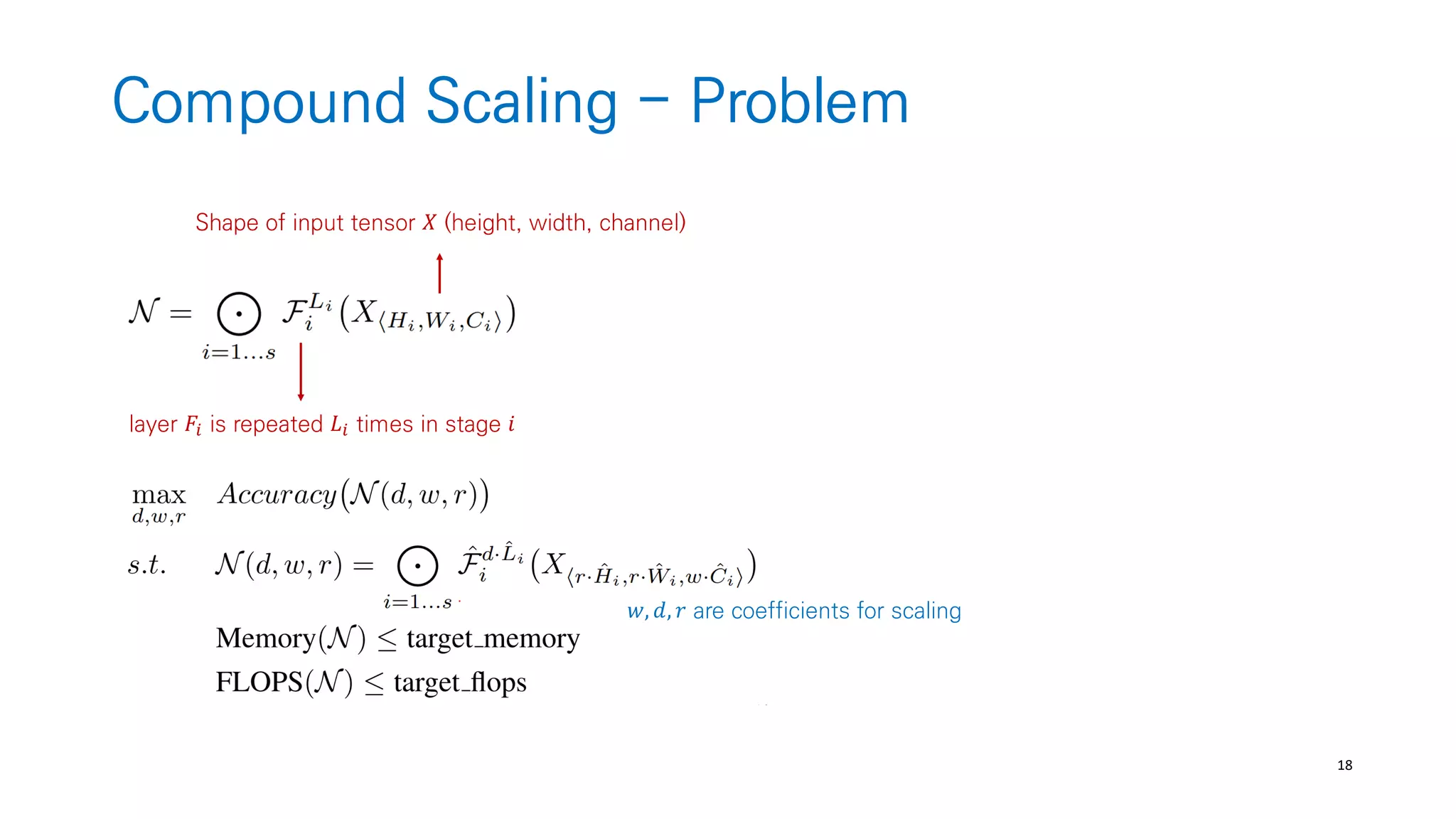
Compound Scaling - Problem
𝑤, 𝑑, 𝑟 are coefficients for scaling
layer 𝐹𝑖 is repeated 𝐿𝑖 times in stage 𝑖
Shape of input tensor 𝑋 (height, width, channel)
19
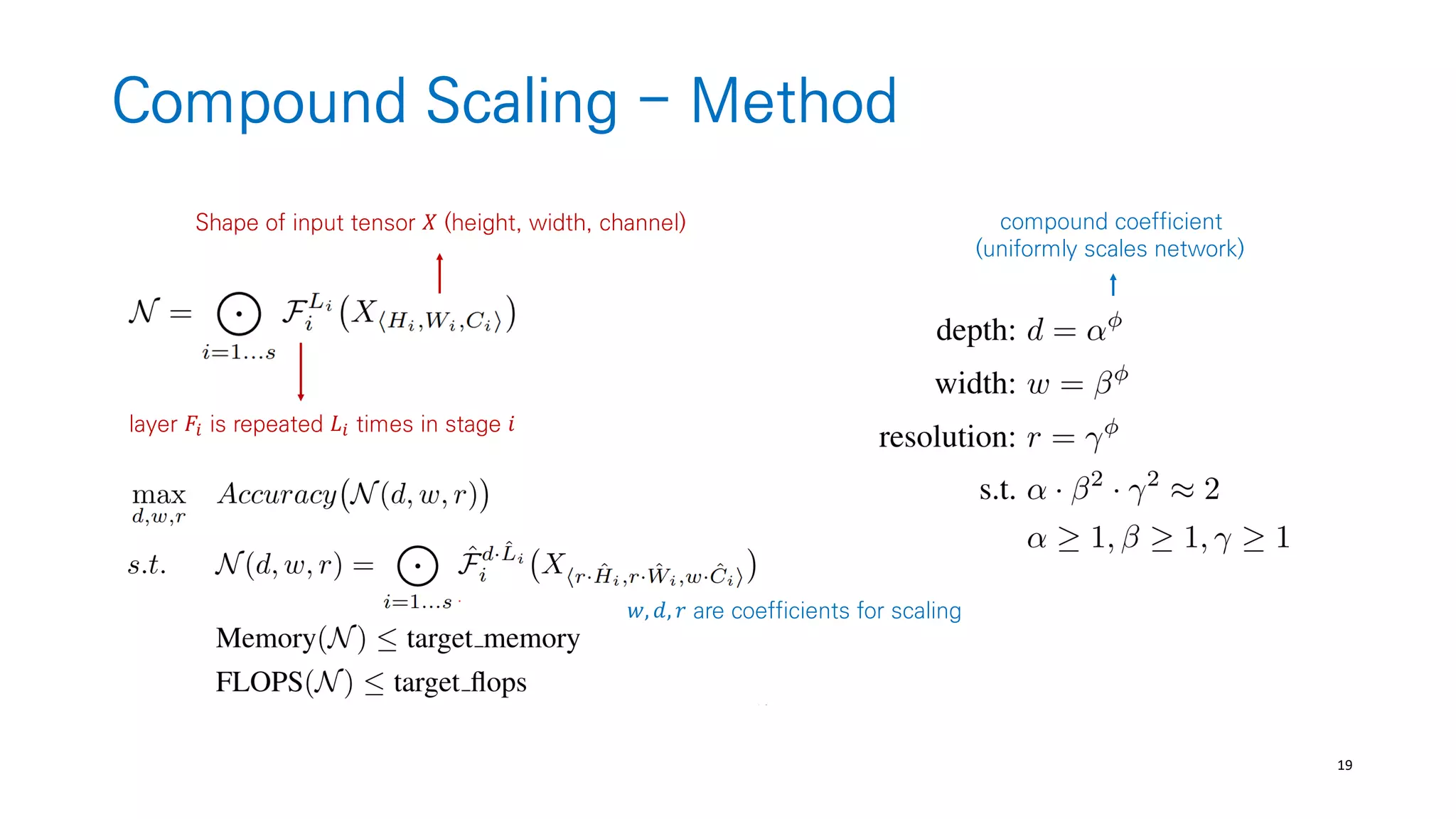
Compound Scaling - Method
𝑤, 𝑑, 𝑟 are coefficients for scaling
layer 𝐹𝑖 is repeated 𝐿𝑖 times in stage 𝑖
Shape of input tensor 𝑋 (height, width, channel) compound coefficient
(uniformly scales network)
20
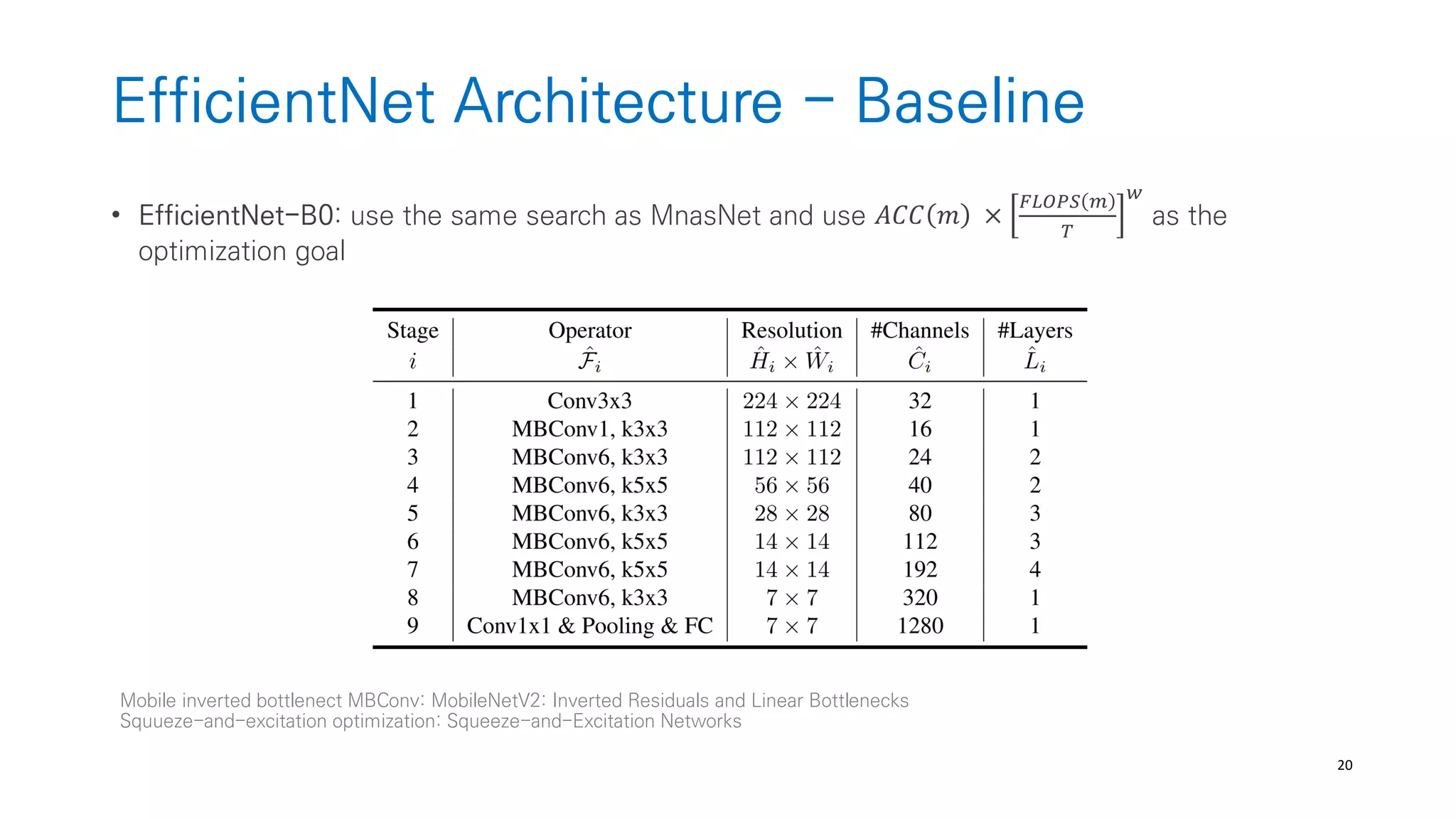
EfficientNet Architecture - Baseline
• EfficientNet-B0: use the same search as MnasNet and use 𝐴𝐶𝐶 𝑚 ×
𝐹𝐿𝑂𝑃𝑆 𝑚
𝑇
𝑤
as the
optimization goal
Mobile inverted bottlenect MBConv: MobileNetV2: Inverted Residuals and Linear Bottlenecks
Squueze-and-excitation optimization: Squeeze-and-Excitation Networks
21
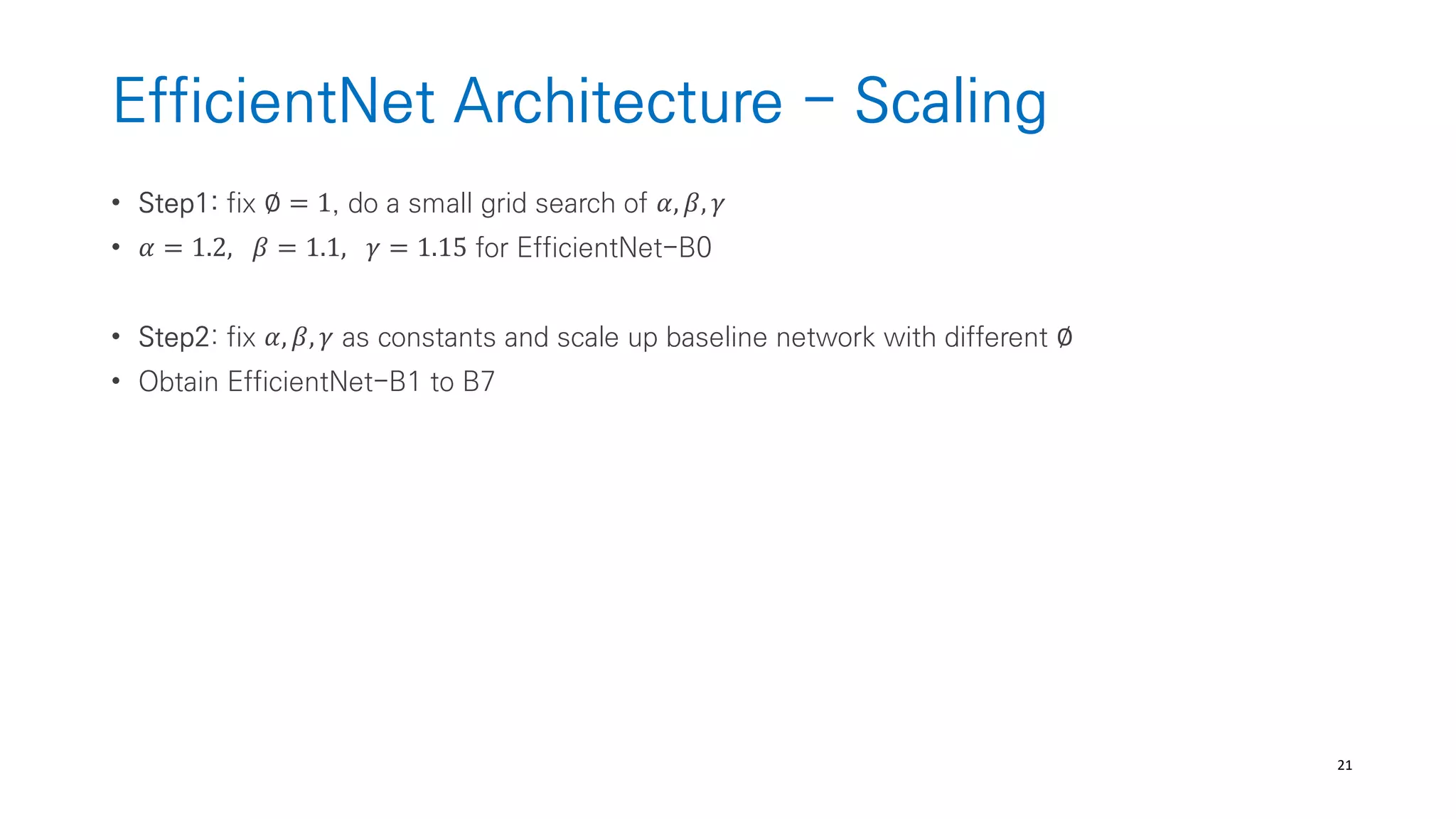
EfficientNet Architecture - Scaling
• Step1: fix ∅ = 1, do a small grid search of 𝛼, 𝛽, 𝛾
• 𝛼 = 1.2, 𝛽 = 1.1, 𝛾 = 1.15 for EfficientNet-B0
• Step2: fix 𝛼, 𝛽, 𝛾 as constants and scale up baseline network with different ∅
• Obtain EfficientNet-B1 to B7
22
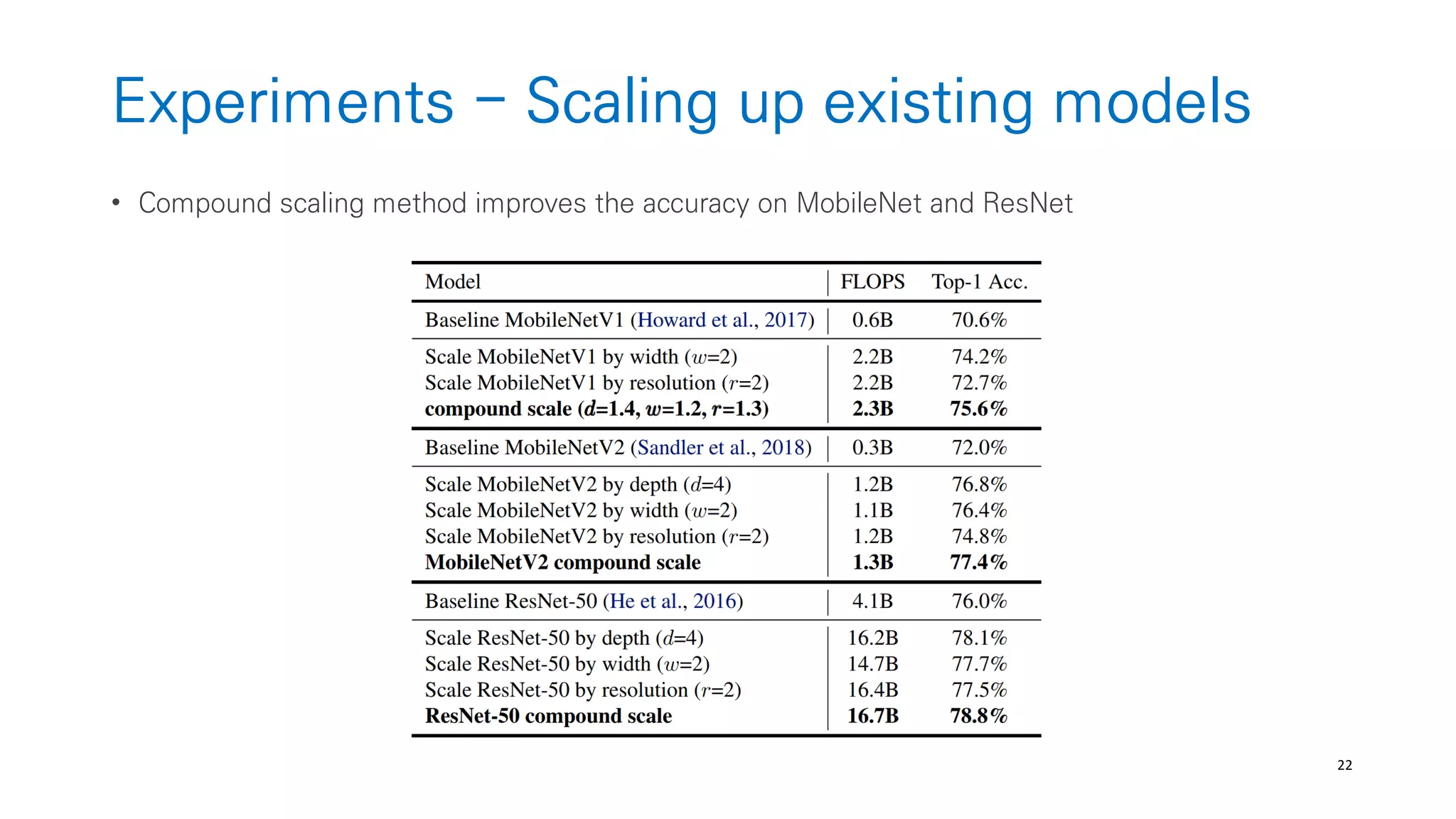
Experiments - Scaling up existing models
• Compound scaling method improves the accuracy on MobileNet and ResNet
23
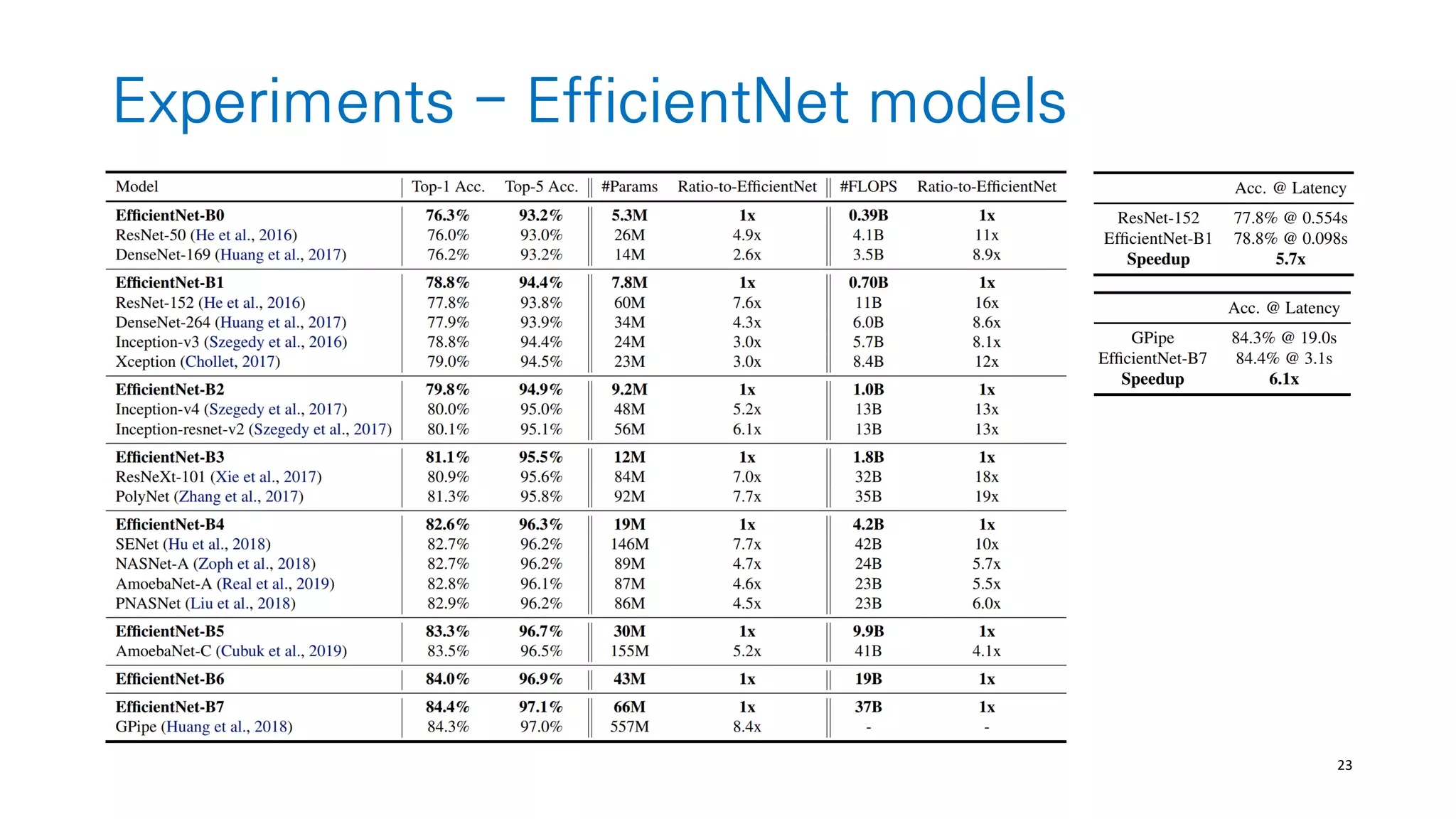
Experiments - EfficientNet models
24
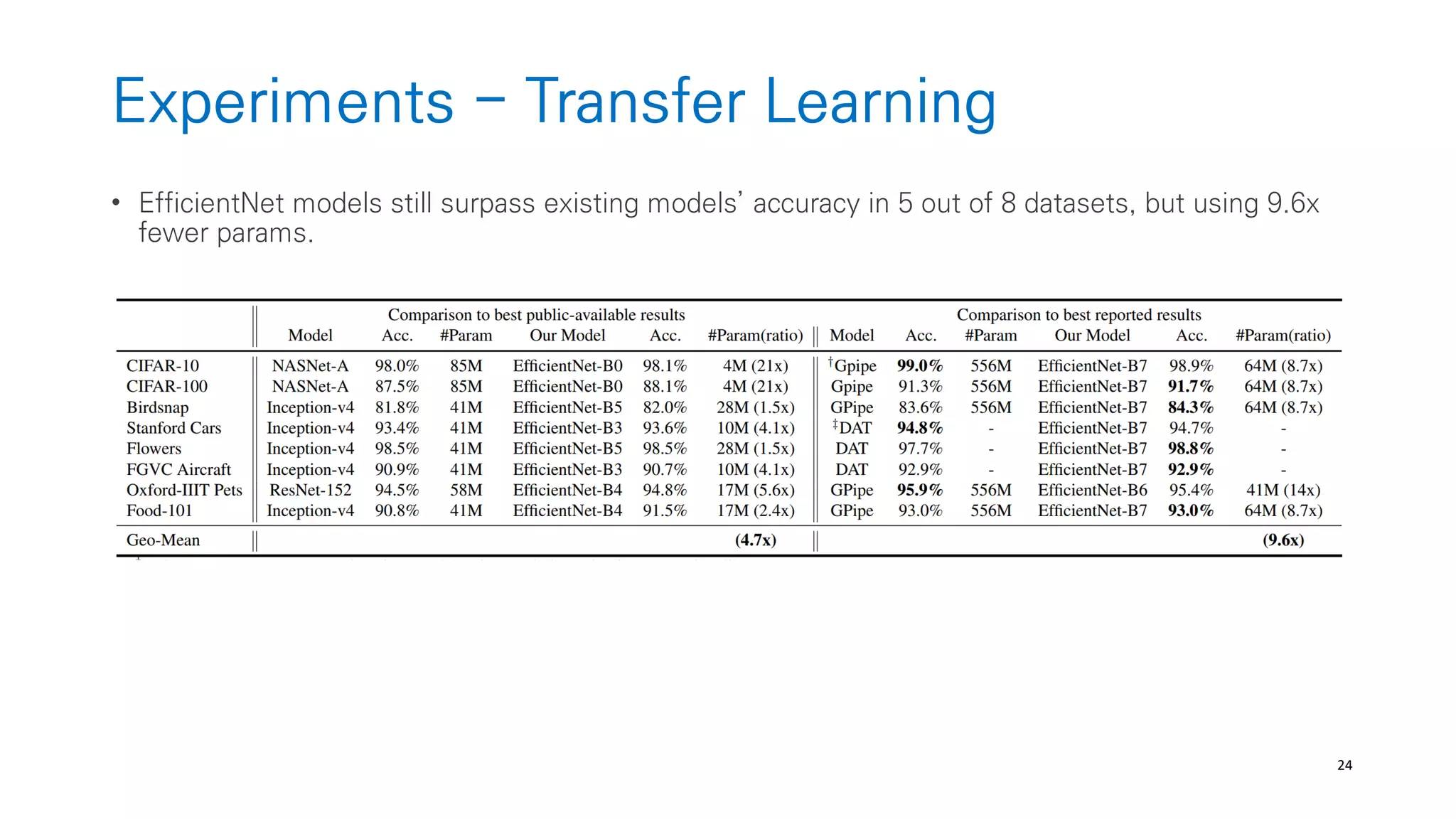
Experiments - Transfer Learning
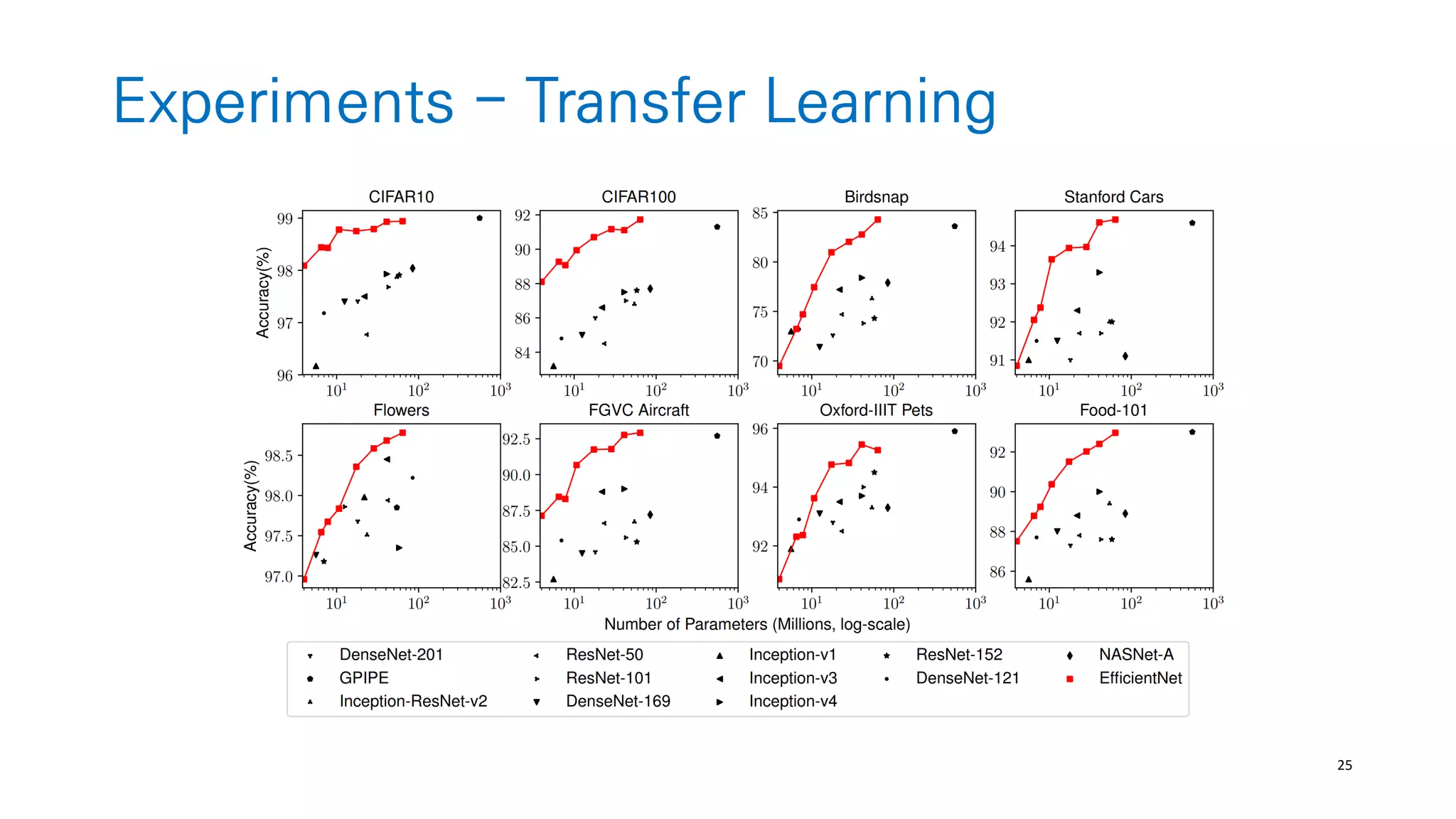
• EfficientNet models still surpass existing models’ accuracy in 5 out of 8 datasets, but using 9.6x
fewer params.
25
Experiments - Transfer Learning
26
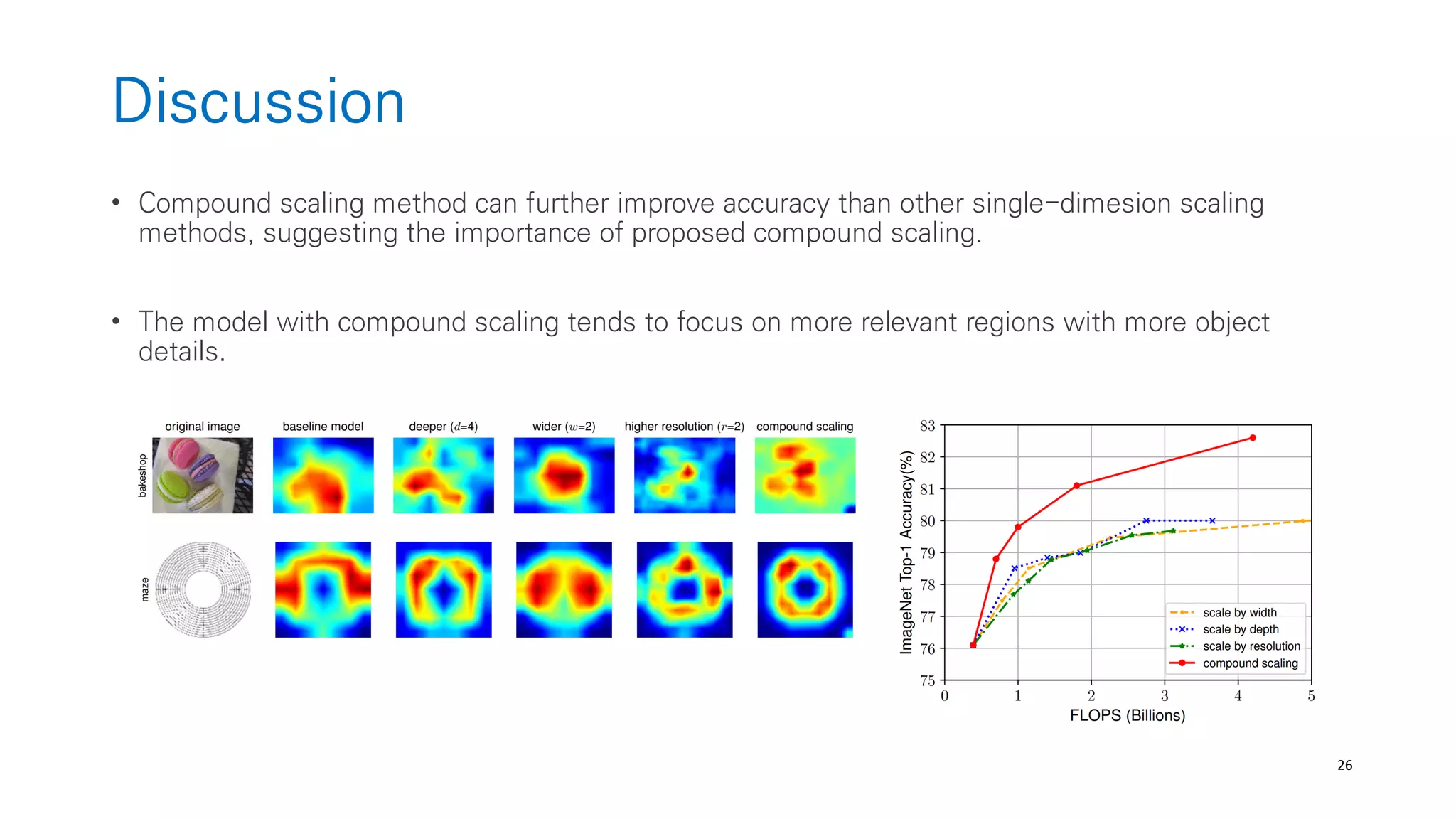
Discussion
• Compound scaling method can further improve accuracy than other single-dimesion scaling
methods, suggesting the importance of proposed compound scaling.
• The model with compound scaling tends to focus on more relevant regions with more object
details.
27
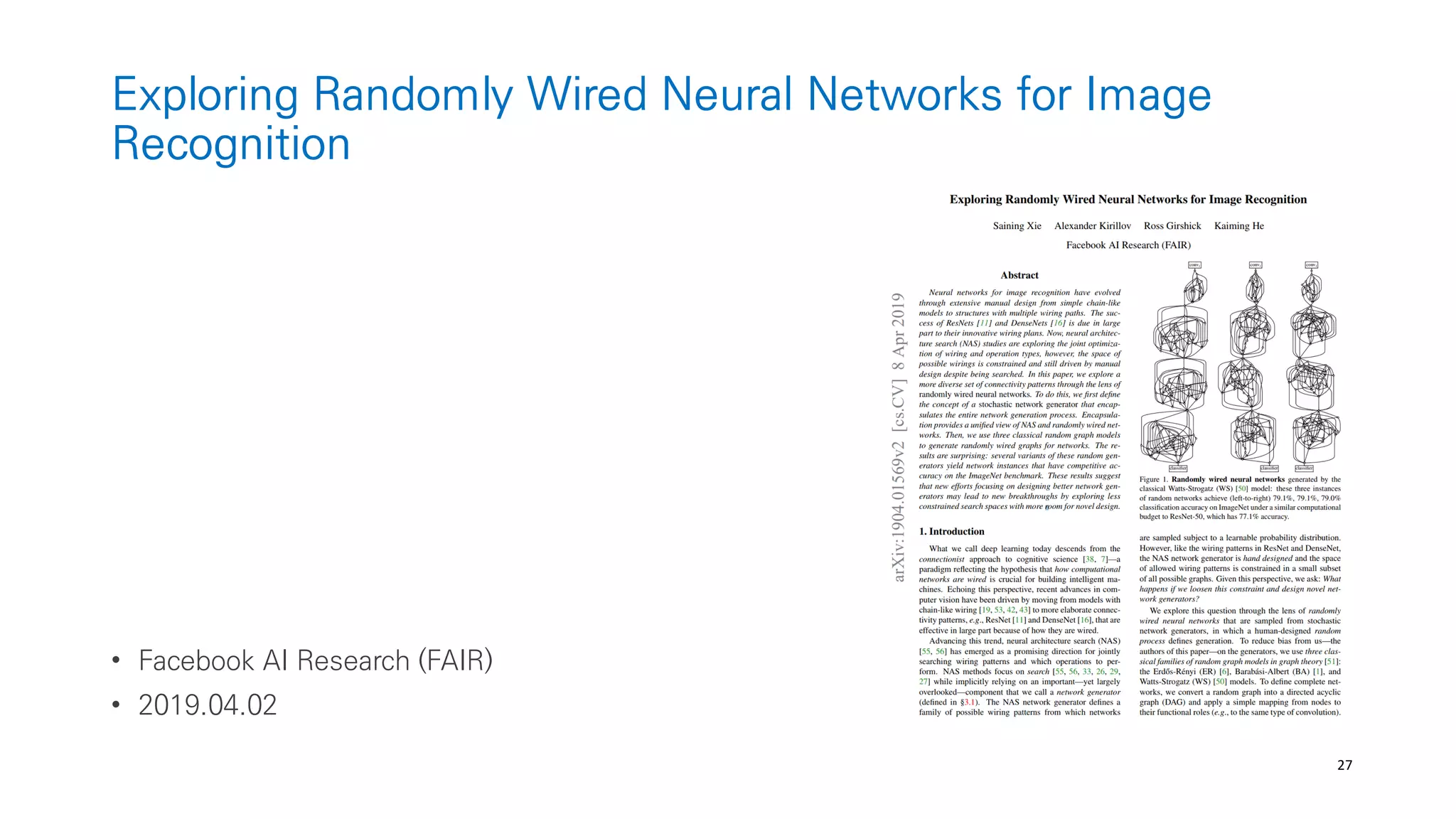
Exploring Randomly Wired Neural Networks for Image
Recognition
• Facebook AI Research (FAIR)
• 2019.04.02
28
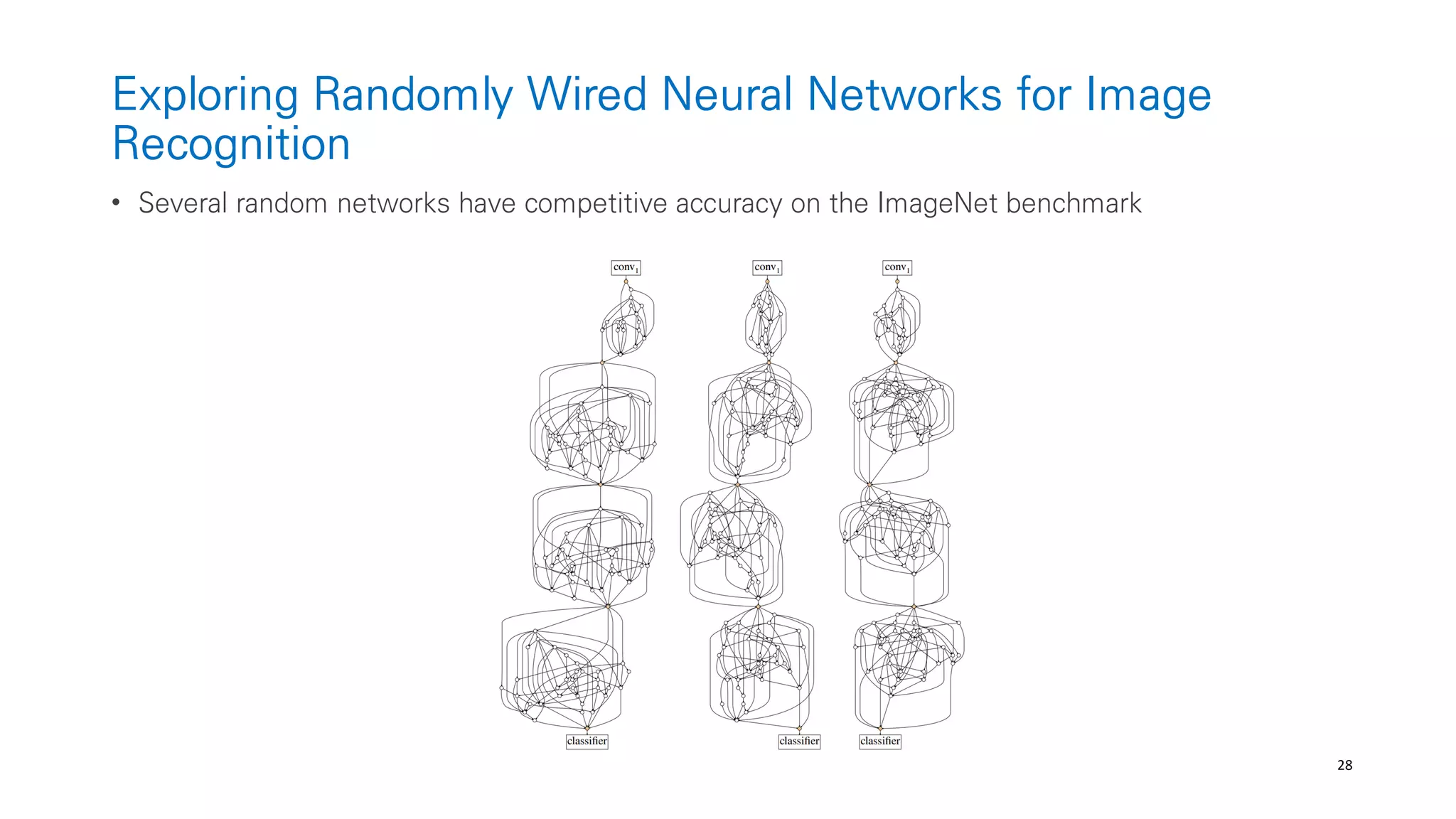
Exploring Randomly Wired Neural Networks for Image
Recognition
• Several random networks have competitive accuracy on the ImageNet benchmark
29
Motivation
• How computational networks are wired is crucial for building intelligent machines.
(connectionist approach, e.g., ResNet, DenseNet…)
• NAS network generator is hand designed and the space of allowed wiring patterns is constrained
in a small subset of all possible graphs
• What happens if we lossen this constraint and design novel network generators?
30
Network Generators
• Define a network generator as a mapping 𝑔 from a parameter space 𝜃 to a space of neural
network architectures 𝒩, 𝑔: 𝜃 ↦ 𝒩
• Generator 𝑔 determines how the computational graph is wired
• The parameters 𝜃 specify the instantiated network and many contain diverse information.
• Ex) ResNet
𝑔: produces a stack of blocks that compute 𝑥 + ℱ(𝑥)
𝜃: specify # stages, # residual blocks for each stages, depth/width/filter sizes, activation types…
31
Stochastic Network Generators
• 𝑔 𝜃 performs a deterministic mapping
• Add a seed of a pseudo-random number 𝑠
• Stochastic network generators 𝑔(𝜃, 𝑠) can construct a (pseudo) random family of networks.
32
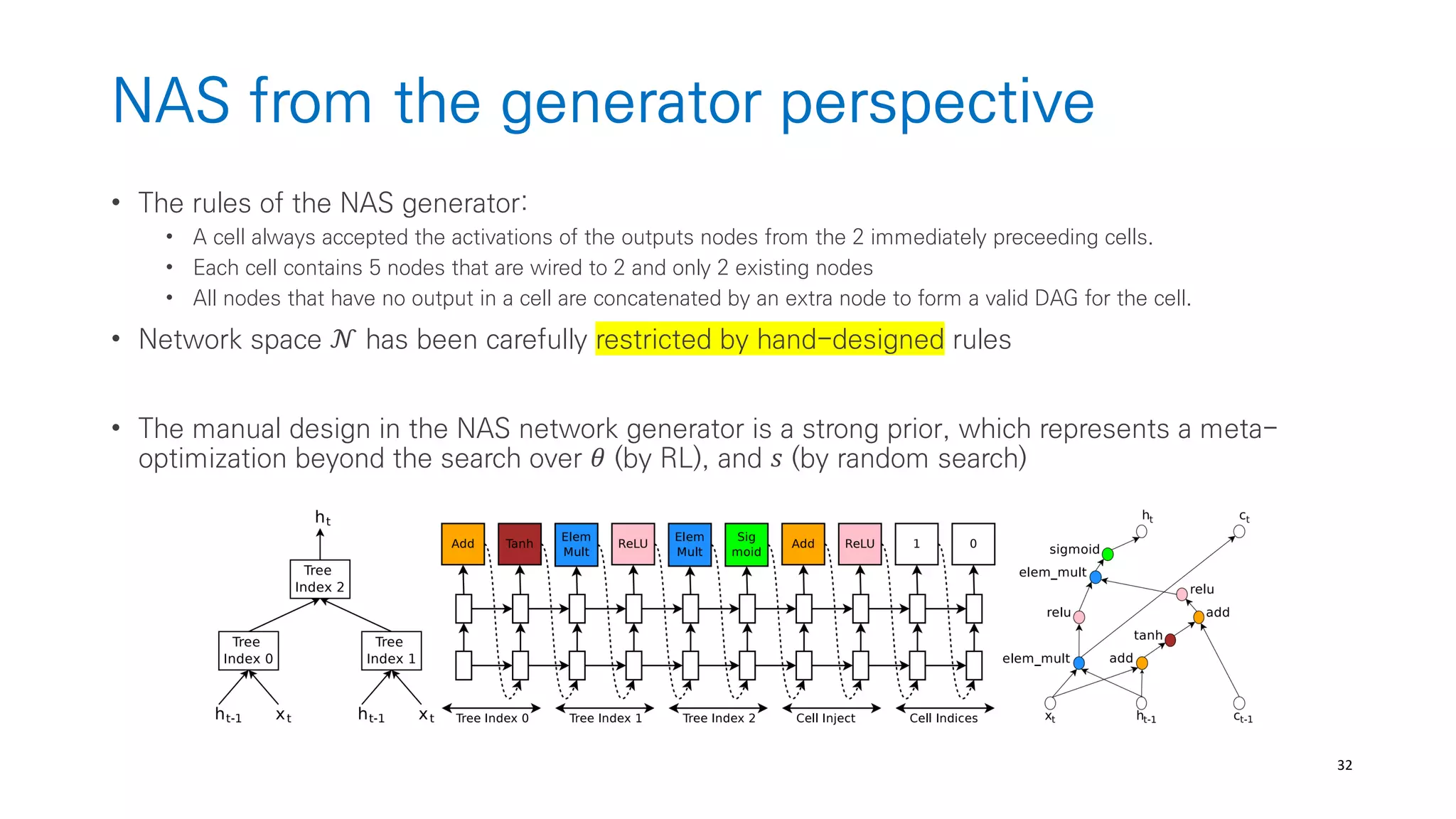
NAS from the generator perspective
• The rules of the NAS generator:
• A cell always accepted the activations of the outputs nodes from the 2 immediately preceeding cells.
• Each cell contains 5 nodes that are wired to 2 and only 2 existing nodes
• All nodes that have no output in a cell are concatenated by an extra node to form a valid DAG for the cell.
• Network space 𝒩 has been carefully restricted by hand-designed rules
• The manual design in the NAS network generator is a strong prior, which represents a meta-
optimization beyond the search over 𝜃 (by RL), and 𝑠 (by random search)
33
Randomly Wired Neural Networks
• Generate a general graphs w.o restricting how the graphs correspond to neural-networks
(from graph theory like ER, BA, WS)
• The edges are data flow (send data from one node to another node)
• Node operation
Aggregation: The input data are combied via a weighted sum; The weights are positive
Transformation: The aggregated data is processed by [ReLU-convolution-BN]
All nodes have same type of convolution!
Distribtuion: The same copy of the transformed data is sent out to other nodes.
34
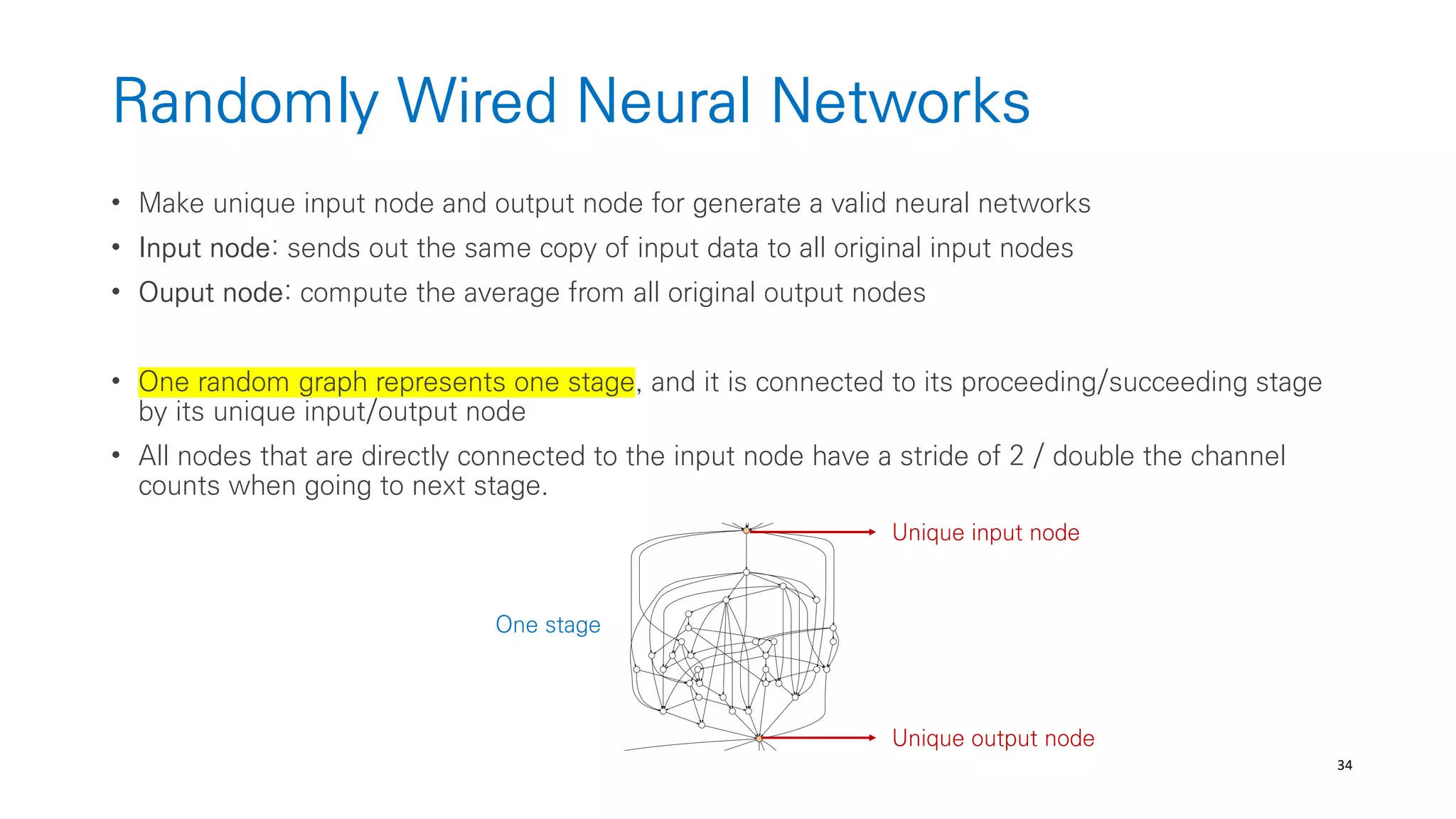
Randomly Wired Neural Networks
• Make unique input node and output node for generate a valid neural networks
• Input node: sends out the same copy of input data to all original input nodes
• Ouput node: compute the average from all original output nodes
• One random graph represents one stage, and it is connected to its proceeding/succeeding stage
by its unique input/output node
• All nodes that are directly connected to the input node have a stride of 2 / double the channel
counts when going to next stage.
Unique input node
Unique output node
One stage
35
Operation Properties
• Maintains the same number of output channels as input channels
• Transformed data can be combined with the data from any other nodes
• FLOPS and params count of a graph are roughly proportional to the number of nodes
• Differences in task performance are therefore reflective of the properties of the wiring patterns
36
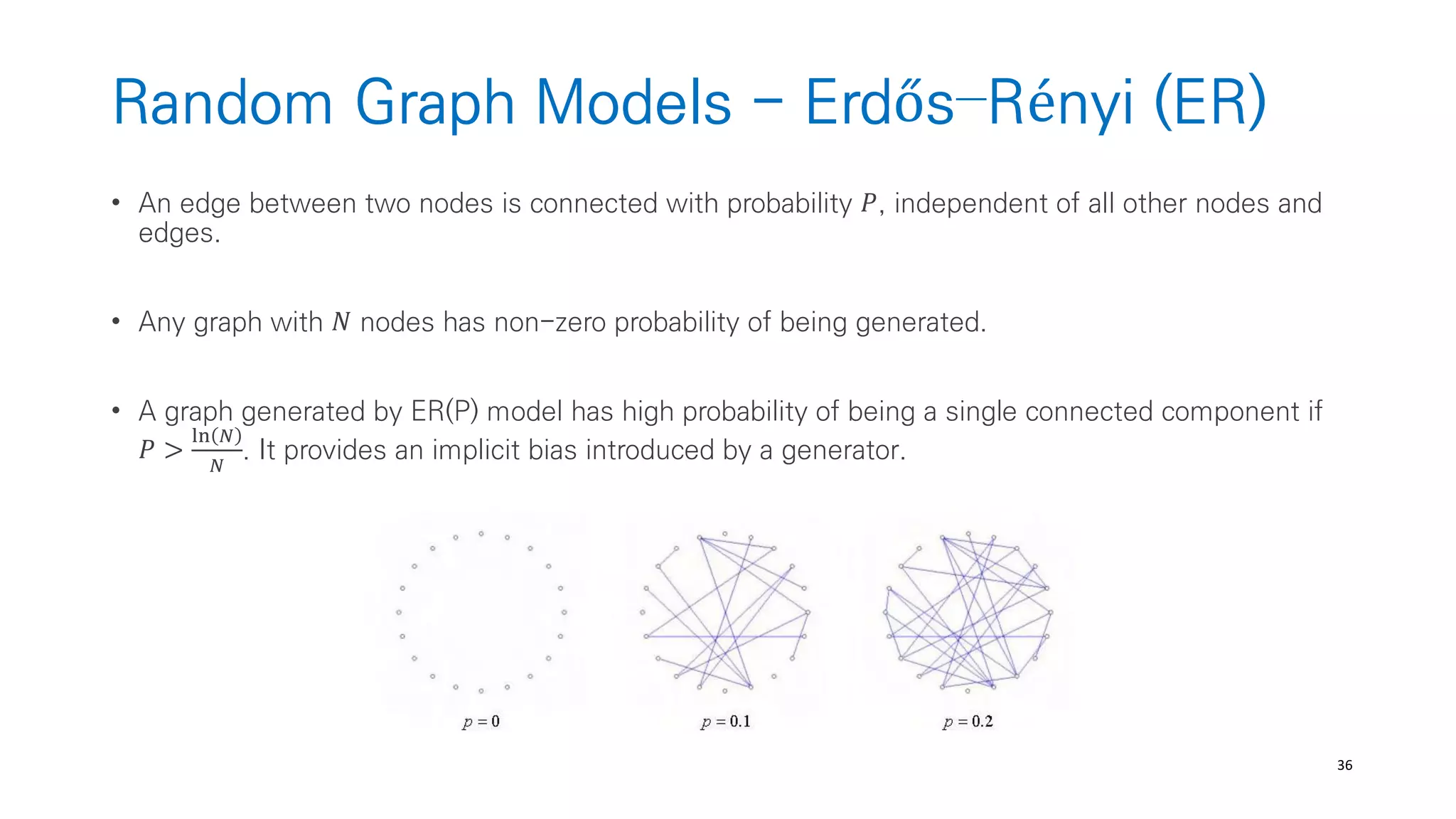
Random Graph Models - Erdős–Rényi (ER)
• An edge between two nodes is connected with probability 𝑃, independent of all other nodes and
edges.
• Any graph with 𝑁 nodes has non-zero probability of being generated.
• A graph generated by ER(P) model has high probability of being a single connected component if
𝑃 >
ln 𝑁
𝑁
. It provides an implicit bias introduced by a generator.
37
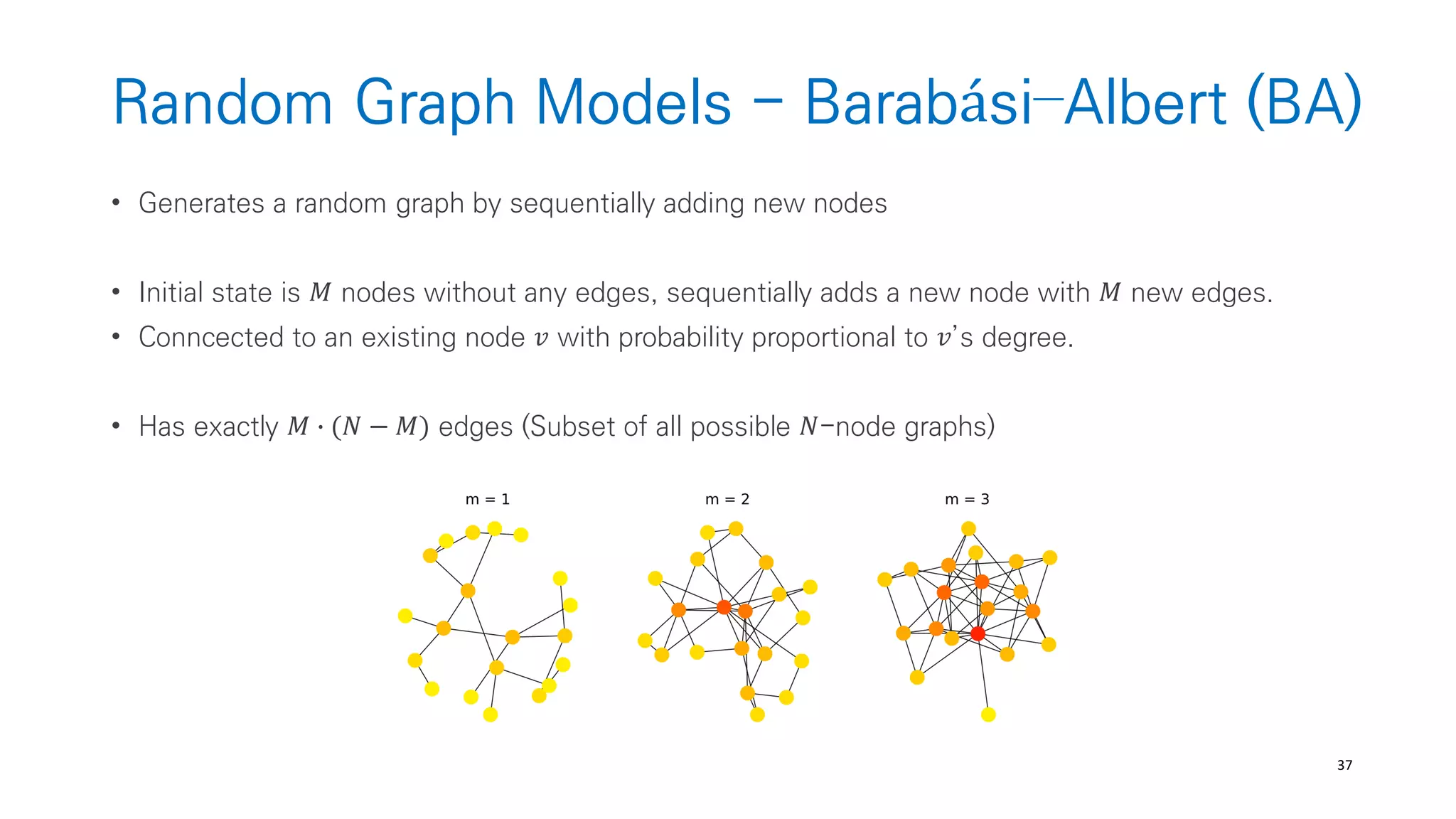
Random Graph Models - Barabási–Albert (BA)
• Generates a random graph by sequentially adding new nodes
• Initial state is 𝑀 nodes without any edges, sequentially adds a new node with 𝑀 new edges.
• Conncected to an existing node 𝑣 with probability proportional to 𝑣’s degree.
• Has exactly 𝑀 ∙ (𝑁 − 𝑀) edges (Subset of all possible 𝑁-node graphs)
38
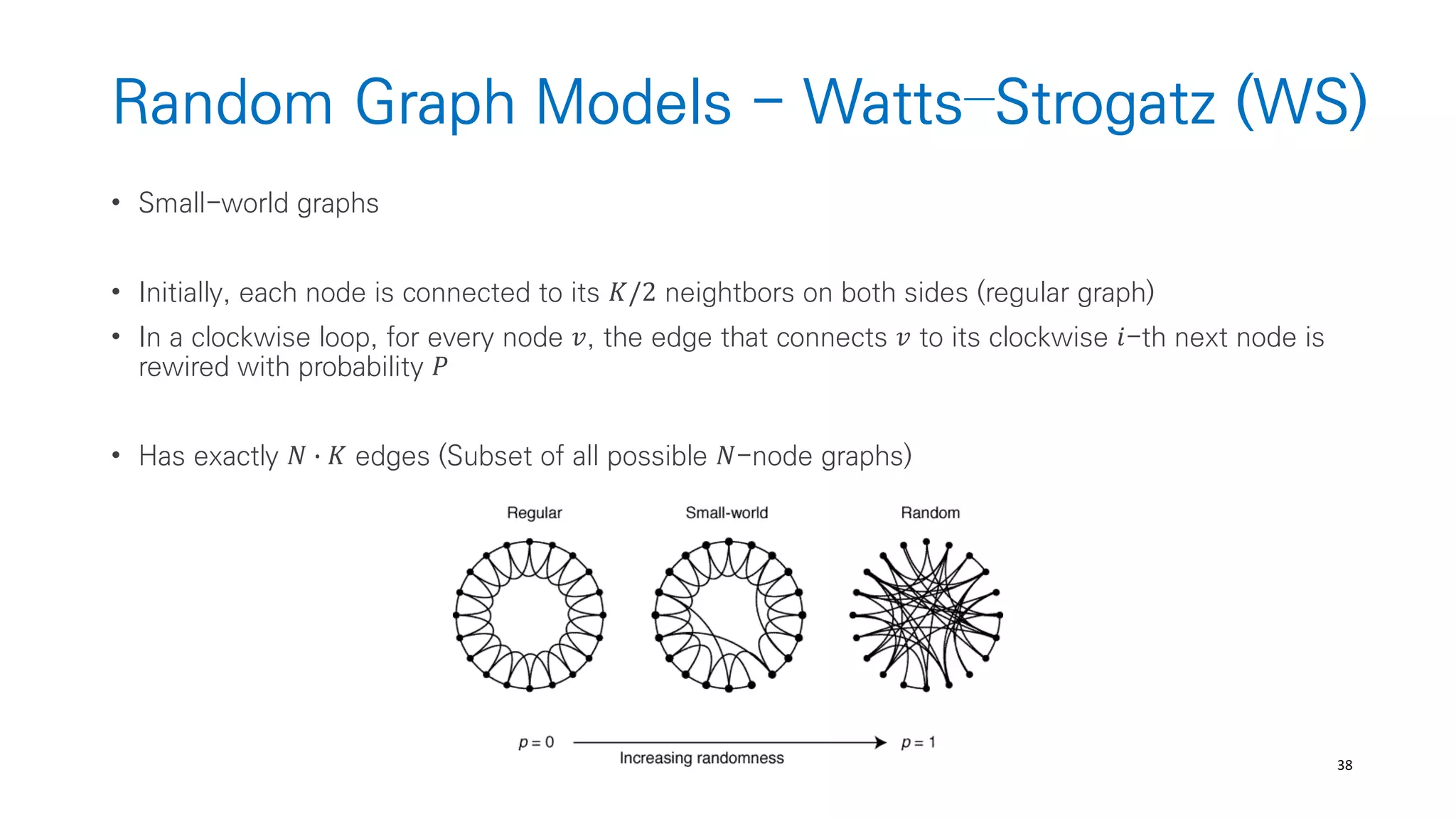
Random Graph Models - Watts–Strogatz (WS)
• Small-world graphs
• Initially, each node is connected to its 𝐾/2 neightbors on both sides (regular graph)
• In a clockwise loop, for every node 𝑣, the edge that connects 𝑣 to its clockwise 𝑖-th next node is
rewired with probability 𝑃
• Has exactly 𝑁 ∙ 𝐾 edges (Subset of all possible 𝑁-node graphs)
39
Convert to DAGs
• Assign indcies to all nodes in a graph
• Set the direction of every edge as pointing from the smaller-index node to the larger-index one
• ER: indices are assigned in a random order
• BA: the initial 𝑀 nodes are assigned indices 1 to 𝑀, and all other nodes are indexed following their
order of adding to the graph
• WS: indices are assigned sequentially in the clockwise order
40
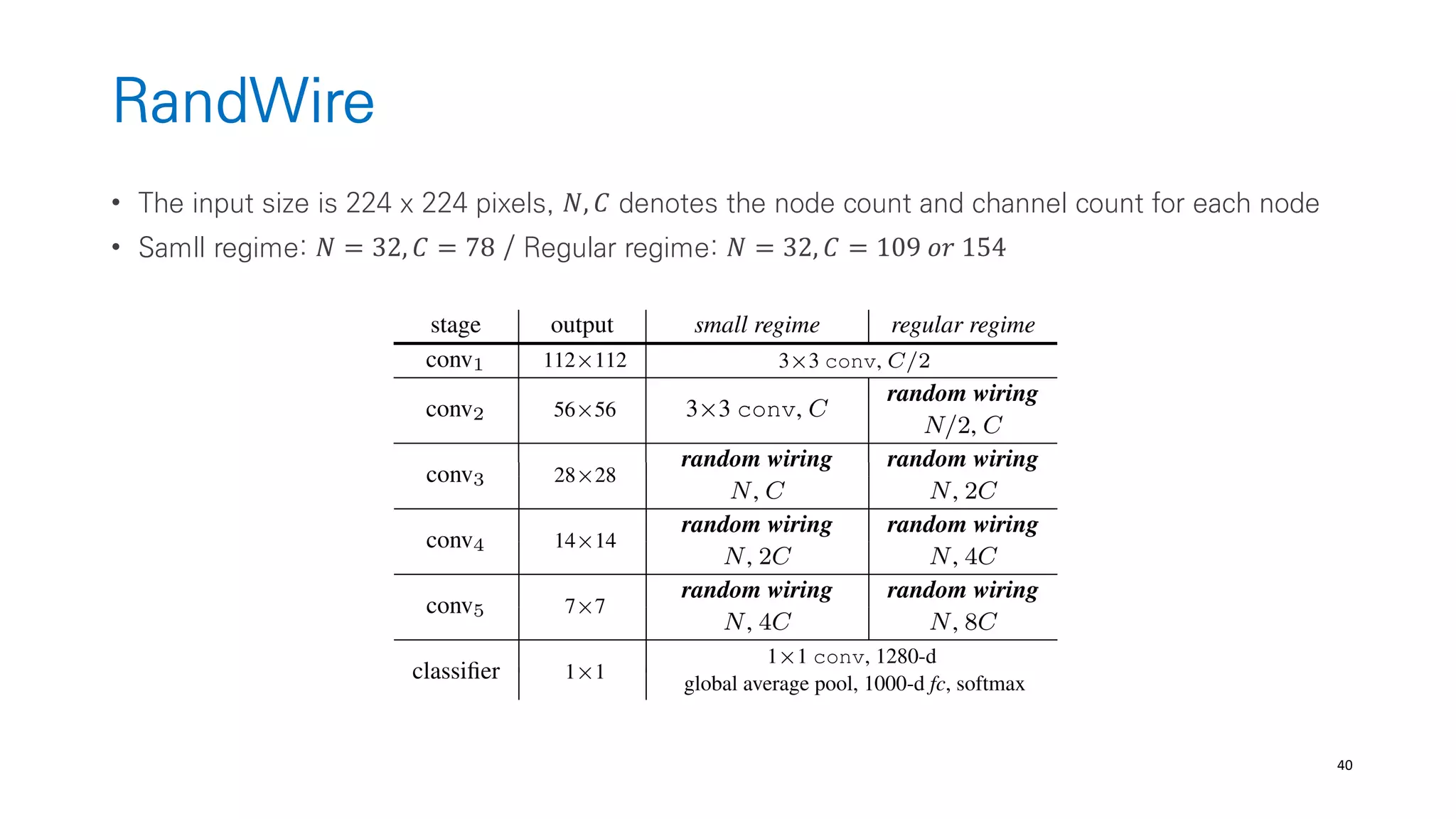
RandWire
• The input size is 224 x 224 pixels, 𝑁, 𝐶 denotes the node count and channel count for each node
• Samll regime: 𝑁 = 32, 𝐶 = 78 / Regular regime: 𝑁 = 32, 𝐶 = 109 𝑜𝑟 154
41
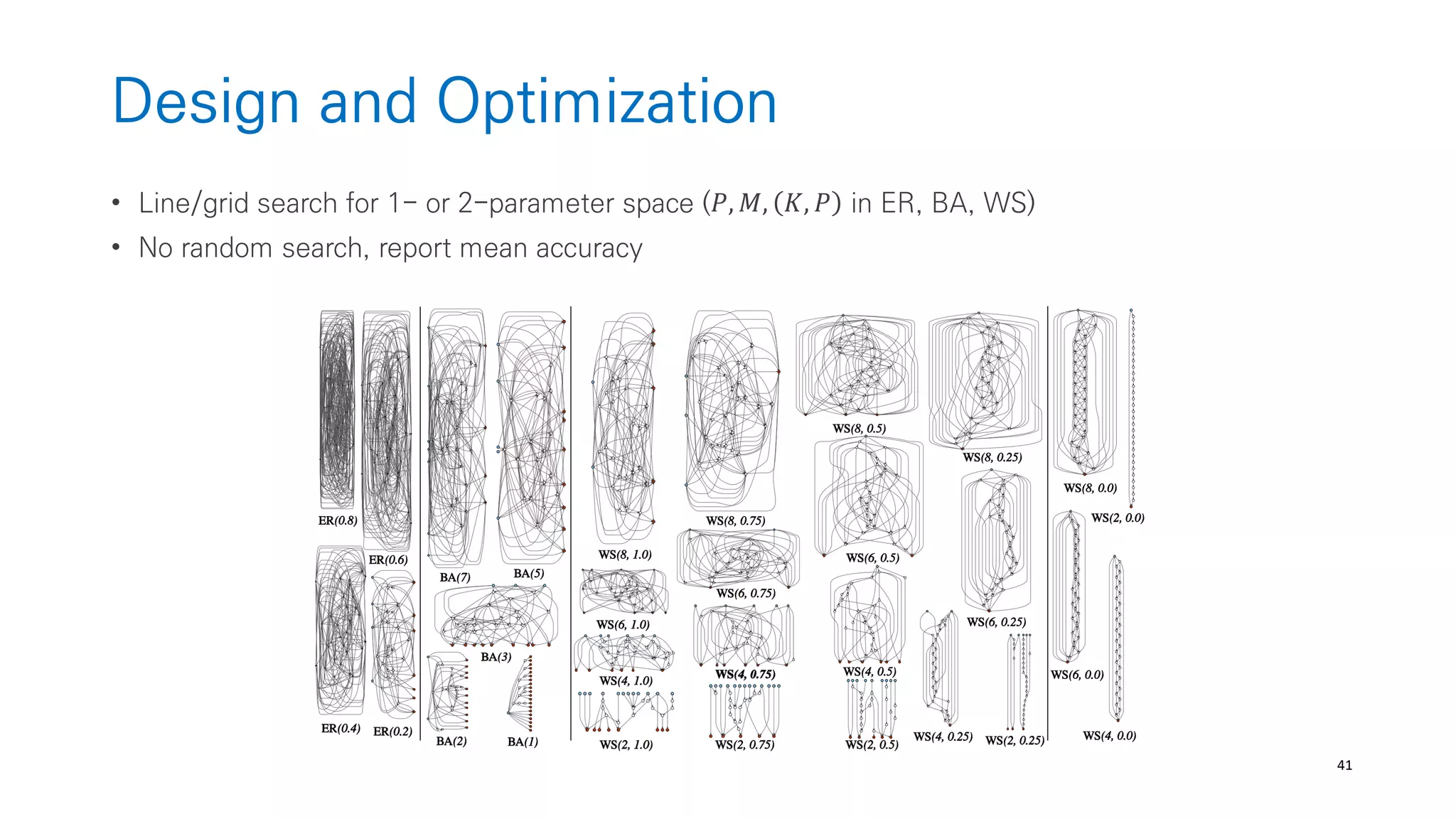
Design and Optimization
• Line/grid search for 1- or 2-parameter space (𝑃, 𝑀, 𝐾, 𝑃 in ER, BA, WS)
• No random search, report mean accuracy
42
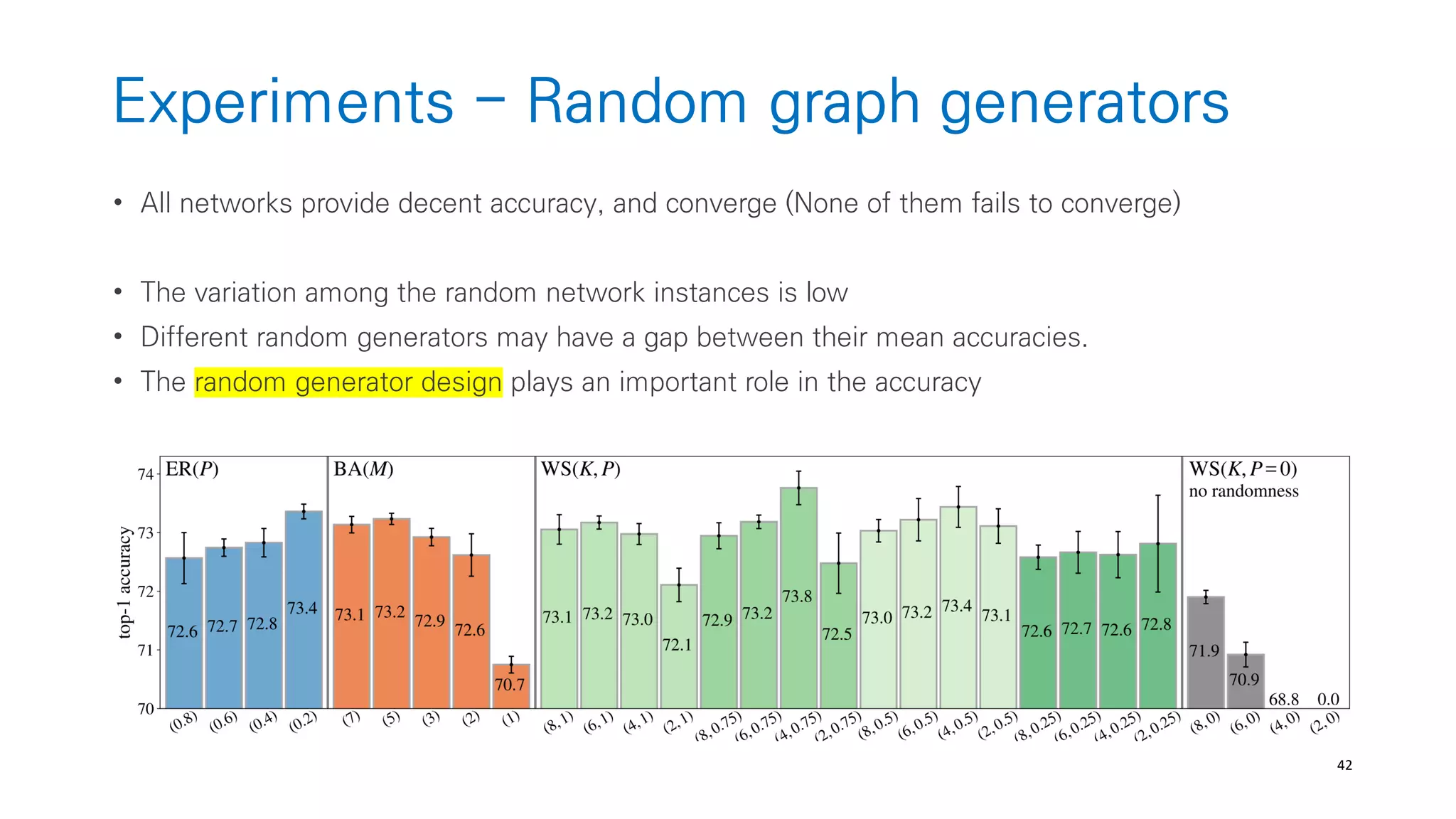
Experiments - Random graph generators
• All networks provide decent accuracy, and converge (None of them fails to converge)
• The variation among the random network instances is low
• Different random generators may have a gap between their mean accuracies.
• The random generator design plays an important role in the accuracy
43
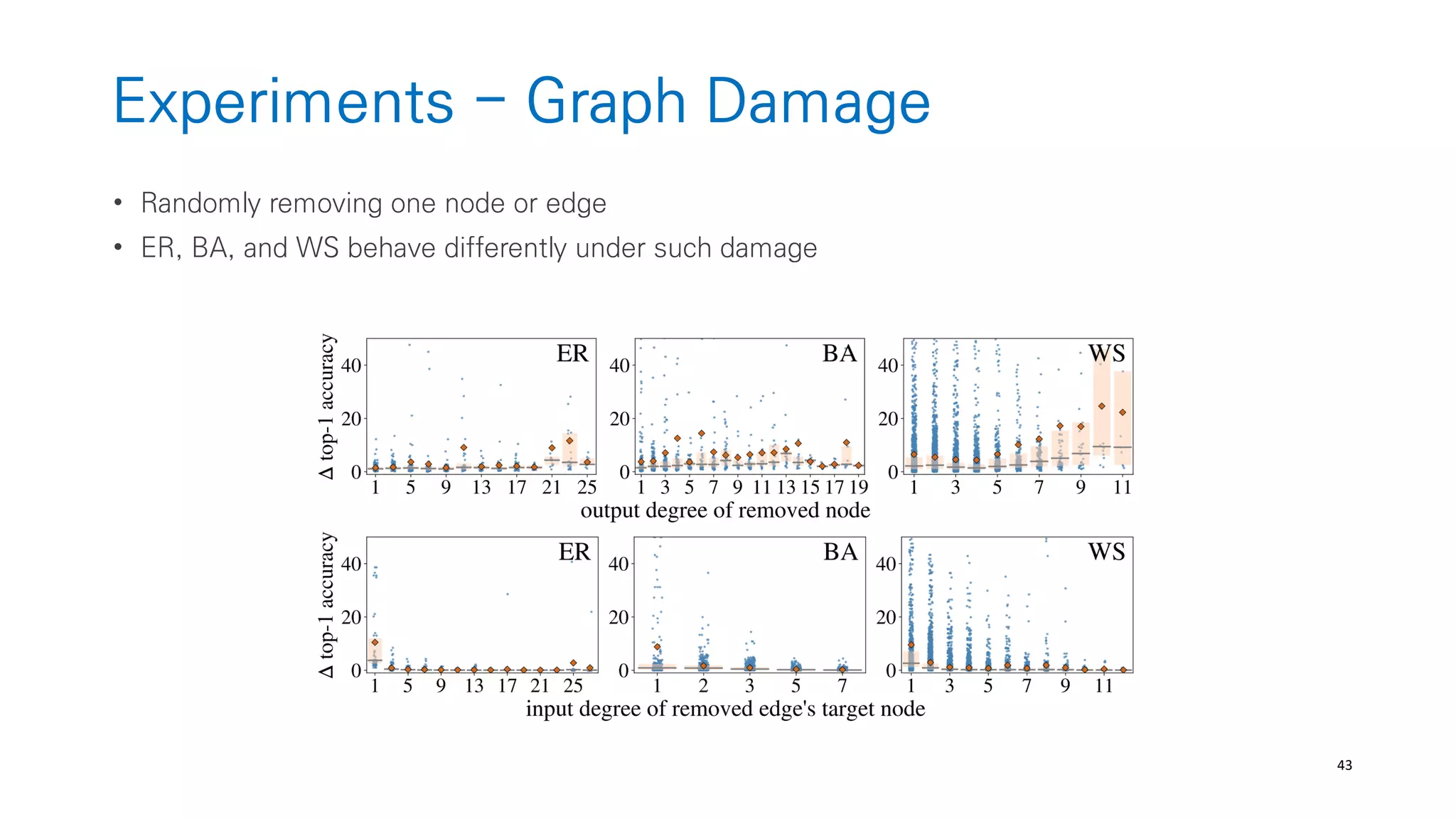
Experiments - Graph Damage
• Randomly removing one node or edge
• ER, BA, and WS behave differently under such damage
44
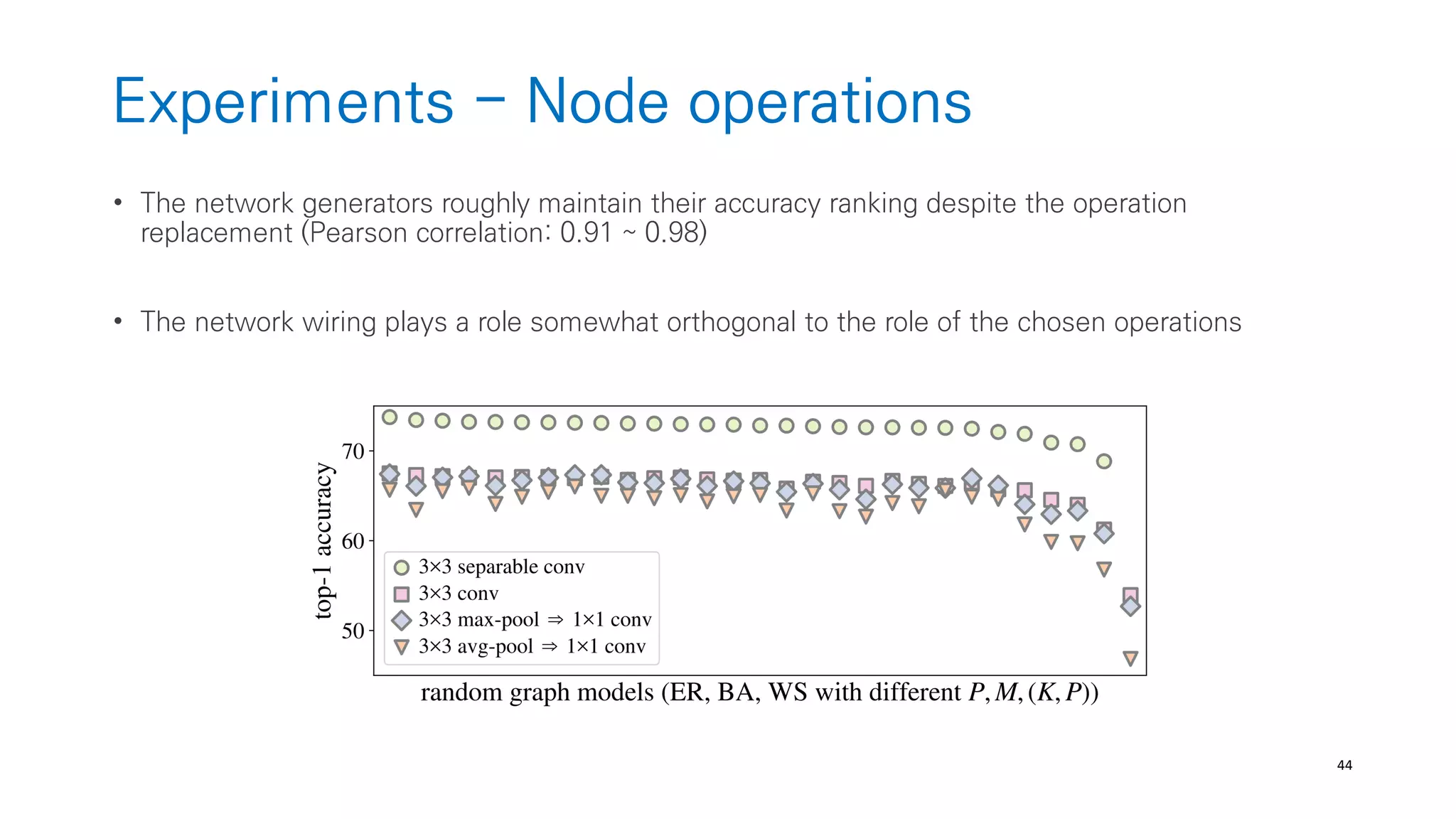
Experiments - Node operations
• The network generators roughly maintain their accuracy ranking despite the operation
replacement (Pearson correlation: 0.91 ~ 0.98)
• The network wiring plays a role somewhat orthogonal to the role of the chosen operations
45
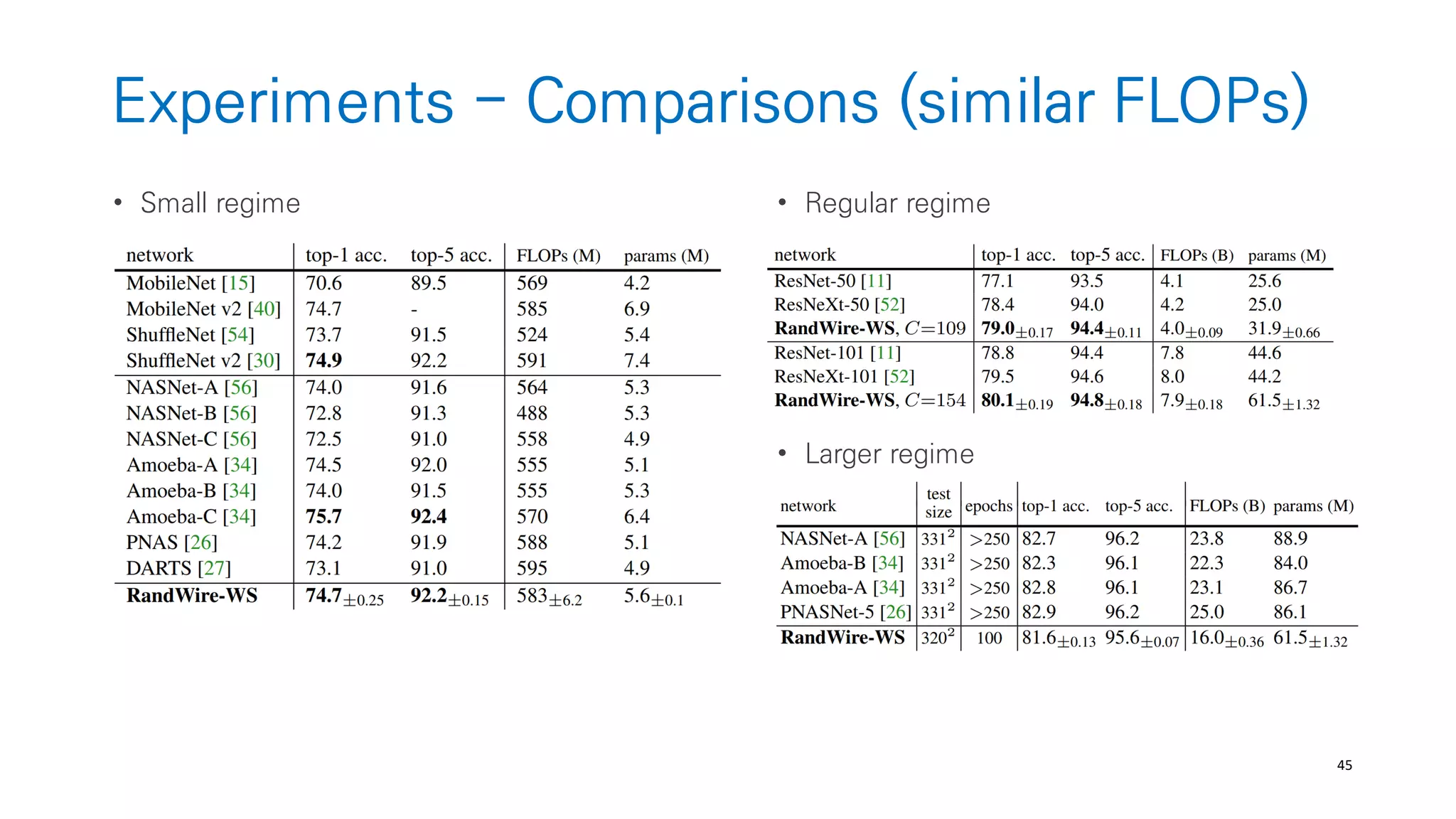
Experiments - Comparisons (similar FLOPs)
• Small regime • Regular regime
• Larger regime
46
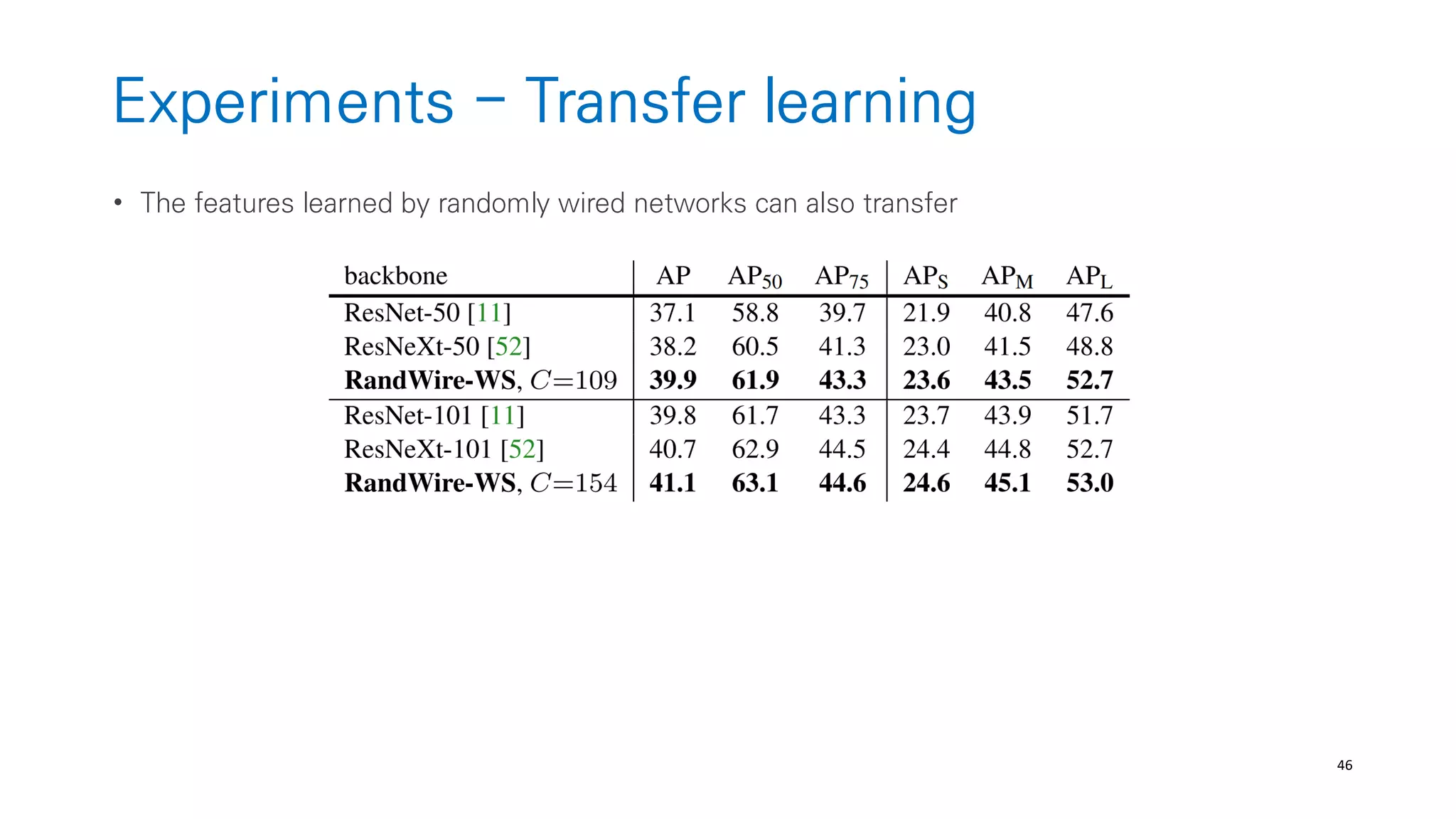
Experiments - Transfer learning
• The features learned by randomly wired networks can also transfer
47
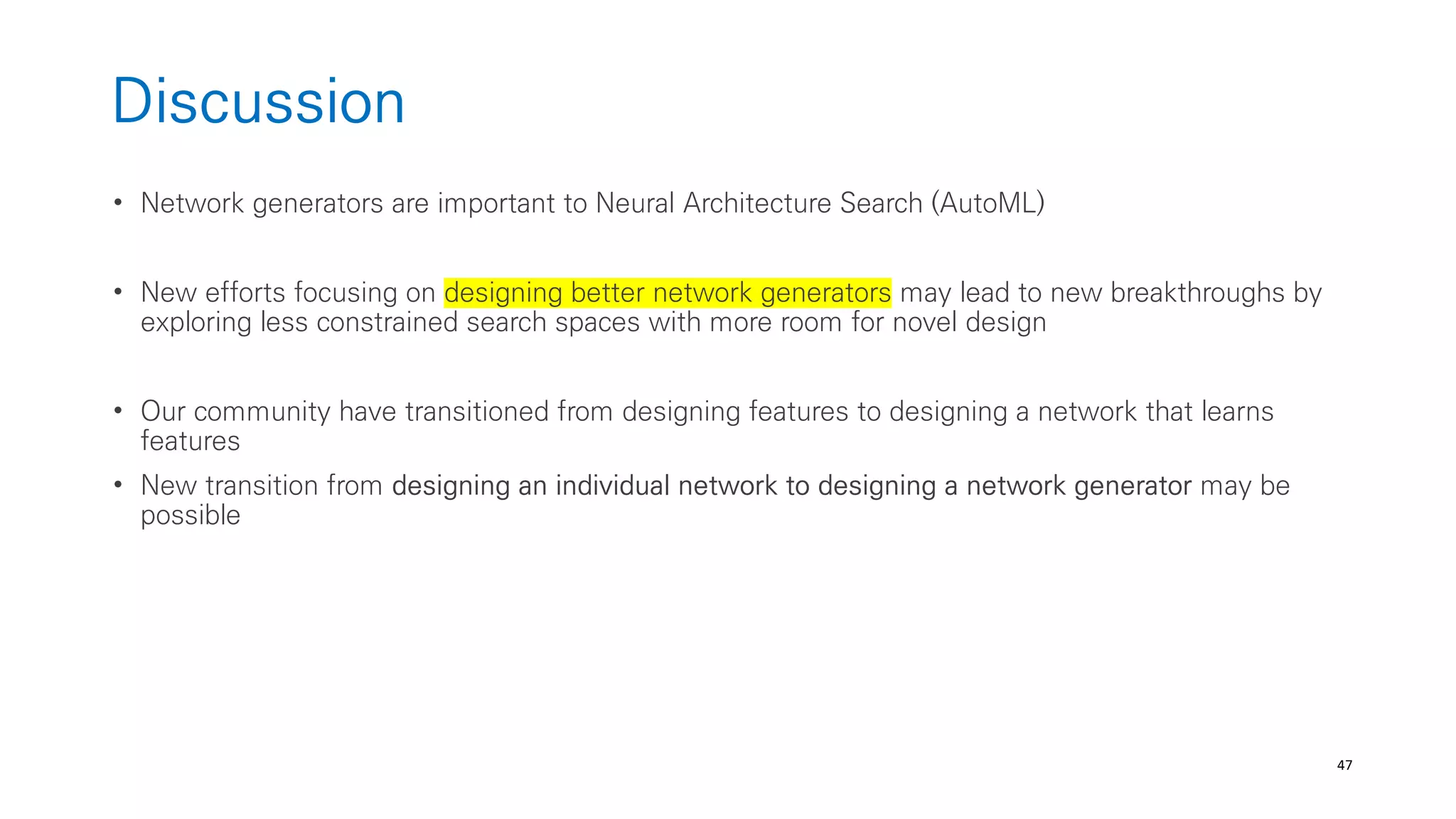
Discussion
• Network generators are important to Neural Architecture Search (AutoML)
• New efforts focusing on designing better network generators may lead to new breakthroughs by
exploring less constrained search spaces with more room for novel design
• Our community have transitioned from designing features to designing a network that learns
features
• New transition from designing an individual network to designing a network generator may be
possible

201907 AutoML and Neural Architecture Search

  • 1.
    1 DaeJin Kim 2019.07 2019.07 -AutoML and Neural Architecture Search : EfficientNet, RandomWire
  • 2.
    2 Contents • AutoML • NAS(A brief introduction) • EfficientNet: Rethinking Model Scaling for Convolutional Neural Networks • Exploring Randomly Wired Neural Networks for Image Recognition
  • 3.
    3 AutoML • Machine Learningfor designing machine learning models • Feature Engineering • Deep Feature Synthesis • One button machine • R2n (Feature Learning From Relational Databases) • Architecture Search • NAS • NasNet • mNasNet • DARTS • Hyperparameter Optimization • Auto-keras • hyperopt
  • 4.
    4 NAS • Neural ArchitectureSearch with Reinforcement Learning • Google Brain • Published in ICLR 2017
  • 5.
  • 6.
    6 Concept • Select operationusing RNN controller • Train RNN controller using Reinforcement Learning
  • 7.
    7 Experiment - CNN •Select # filtres, filter height/width, stride height/width using RNN controller • For cifar-10 problem, it takes almost a month using 800 GPUs
  • 8.
    8 Experiment - RNN •Select aggregation functions, and activation functions using RNN controller • For penn treebank problem, it uses 160 CPUs • Use tree structure referencing LSTM
  • 9.
  • 10.
    10 EfficientNet: Rethinking ModelScaling for Convolutional Neural Networks • Mingxing Tan, Quoc V.Le (Google Brain) • Published in ICML 2019
  • 11.
    11 EfficientNet State-of-the-art on ImageNetamong the models w.o extra data https://paperswithcode.com/sota/image-classification-on-imagenet
  • 12.
    12 Motivation • “Although higheraccuracy is critical for many applications, we have already hit the hardware memory limit” • Architecture Search for larger models requires much larger design space and much more expensive tuning cost. • How to do scaling without tedious manual tuning?
  • 13.
    13 Model Scaling -Dimensions • Depth (# layers): Deeper ConvNet can capture richer and more complex features, and generalize well on new tasks • Width (# channels): Wider networks tend to be able to capture more find-grained features and are easier to train / Difficulties in capturing higher level features • Resolution (image sizes): ConvNets can potentially capture more fine-grained patterns
  • 14.
  • 15.
    15 Model Scaling -Observation • The accuracy gain quickly saturate after reaching 80%, demonstrating the limitation of single dimension scaling. (Baseline: EfficientNet-B0) Width Scaling Depth Scaling Resolution Scaling
  • 16.
    16 Model Scaling -Compound Scaling • Different scaling dimensions are not independent. (e.g, High resolution images require a deep network) • It is critical to balance all dimensions of network width, depth, and resolution during scaling.
  • 17.
    17 layer 𝐹𝑖 isrepeated 𝐿𝑖 times in stage 𝑖 Shape of input tensor 𝑋 (height, width, channel) Compound Scaling - Definition
  • 18.
    18 Compound Scaling -Problem 𝑤, 𝑑, 𝑟 are coefficients for scaling layer 𝐹𝑖 is repeated 𝐿𝑖 times in stage 𝑖 Shape of input tensor 𝑋 (height, width, channel)
  • 19.
    19 Compound Scaling -Method 𝑤, 𝑑, 𝑟 are coefficients for scaling layer 𝐹𝑖 is repeated 𝐿𝑖 times in stage 𝑖 Shape of input tensor 𝑋 (height, width, channel) compound coefficient (uniformly scales network)
  • 20.
    20 EfficientNet Architecture -Baseline • EfficientNet-B0: use the same search as MnasNet and use 𝐴𝐶𝐶 𝑚 × 𝐹𝐿𝑂𝑃𝑆 𝑚 𝑇 𝑤 as the optimization goal Mobile inverted bottlenect MBConv: MobileNetV2: Inverted Residuals and Linear Bottlenecks Squueze-and-excitation optimization: Squeeze-and-Excitation Networks
  • 21.
    21 EfficientNet Architecture -Scaling • Step1: fix ∅ = 1, do a small grid search of 𝛼, 𝛽, 𝛾 • 𝛼 = 1.2, 𝛽 = 1.1, 𝛾 = 1.15 for EfficientNet-B0 • Step2: fix 𝛼, 𝛽, 𝛾 as constants and scale up baseline network with different ∅ • Obtain EfficientNet-B1 to B7
  • 22.
    22 Experiments - Scalingup existing models • Compound scaling method improves the accuracy on MobileNet and ResNet
  • 23.
  • 24.
    24 Experiments - TransferLearning • EfficientNet models still surpass existing models’ accuracy in 5 out of 8 datasets, but using 9.6x fewer params.
  • 25.
  • 26.
    26 Discussion • Compound scalingmethod can further improve accuracy than other single-dimesion scaling methods, suggesting the importance of proposed compound scaling. • The model with compound scaling tends to focus on more relevant regions with more object details.
  • 27.
    27 Exploring Randomly WiredNeural Networks for Image Recognition • Facebook AI Research (FAIR) • 2019.04.02
  • 28.
    28 Exploring Randomly WiredNeural Networks for Image Recognition • Several random networks have competitive accuracy on the ImageNet benchmark
  • 29.
    29 Motivation • How computationalnetworks are wired is crucial for building intelligent machines. (connectionist approach, e.g., ResNet, DenseNet…) • NAS network generator is hand designed and the space of allowed wiring patterns is constrained in a small subset of all possible graphs • What happens if we lossen this constraint and design novel network generators?
  • 30.
    30 Network Generators • Definea network generator as a mapping 𝑔 from a parameter space 𝜃 to a space of neural network architectures 𝒩, 𝑔: 𝜃 ↦ 𝒩 • Generator 𝑔 determines how the computational graph is wired • The parameters 𝜃 specify the instantiated network and many contain diverse information. • Ex) ResNet 𝑔: produces a stack of blocks that compute 𝑥 + ℱ(𝑥) 𝜃: specify # stages, # residual blocks for each stages, depth/width/filter sizes, activation types…
  • 31.
    31 Stochastic Network Generators •𝑔 𝜃 performs a deterministic mapping • Add a seed of a pseudo-random number 𝑠 • Stochastic network generators 𝑔(𝜃, 𝑠) can construct a (pseudo) random family of networks.
  • 32.
    32 NAS from thegenerator perspective • The rules of the NAS generator: • A cell always accepted the activations of the outputs nodes from the 2 immediately preceeding cells. • Each cell contains 5 nodes that are wired to 2 and only 2 existing nodes • All nodes that have no output in a cell are concatenated by an extra node to form a valid DAG for the cell. • Network space 𝒩 has been carefully restricted by hand-designed rules • The manual design in the NAS network generator is a strong prior, which represents a meta- optimization beyond the search over 𝜃 (by RL), and 𝑠 (by random search)
  • 33.
    33 Randomly Wired NeuralNetworks • Generate a general graphs w.o restricting how the graphs correspond to neural-networks (from graph theory like ER, BA, WS) • The edges are data flow (send data from one node to another node) • Node operation Aggregation: The input data are combied via a weighted sum; The weights are positive Transformation: The aggregated data is processed by [ReLU-convolution-BN] All nodes have same type of convolution! Distribtuion: The same copy of the transformed data is sent out to other nodes.
  • 34.
    34 Randomly Wired NeuralNetworks • Make unique input node and output node for generate a valid neural networks • Input node: sends out the same copy of input data to all original input nodes • Ouput node: compute the average from all original output nodes • One random graph represents one stage, and it is connected to its proceeding/succeeding stage by its unique input/output node • All nodes that are directly connected to the input node have a stride of 2 / double the channel counts when going to next stage. Unique input node Unique output node One stage
  • 35.
    35 Operation Properties • Maintainsthe same number of output channels as input channels • Transformed data can be combined with the data from any other nodes • FLOPS and params count of a graph are roughly proportional to the number of nodes • Differences in task performance are therefore reflective of the properties of the wiring patterns
  • 36.
    36 Random Graph Models- Erdős–Rényi (ER) • An edge between two nodes is connected with probability 𝑃, independent of all other nodes and edges. • Any graph with 𝑁 nodes has non-zero probability of being generated. • A graph generated by ER(P) model has high probability of being a single connected component if 𝑃 > ln 𝑁 𝑁 . It provides an implicit bias introduced by a generator.
  • 37.
    37 Random Graph Models- Barabási–Albert (BA) • Generates a random graph by sequentially adding new nodes • Initial state is 𝑀 nodes without any edges, sequentially adds a new node with 𝑀 new edges. • Conncected to an existing node 𝑣 with probability proportional to 𝑣’s degree. • Has exactly 𝑀 ∙ (𝑁 − 𝑀) edges (Subset of all possible 𝑁-node graphs)
  • 38.
    38 Random Graph Models- Watts–Strogatz (WS) • Small-world graphs • Initially, each node is connected to its 𝐾/2 neightbors on both sides (regular graph) • In a clockwise loop, for every node 𝑣, the edge that connects 𝑣 to its clockwise 𝑖-th next node is rewired with probability 𝑃 • Has exactly 𝑁 ∙ 𝐾 edges (Subset of all possible 𝑁-node graphs)
  • 39.
    39 Convert to DAGs •Assign indcies to all nodes in a graph • Set the direction of every edge as pointing from the smaller-index node to the larger-index one • ER: indices are assigned in a random order • BA: the initial 𝑀 nodes are assigned indices 1 to 𝑀, and all other nodes are indexed following their order of adding to the graph • WS: indices are assigned sequentially in the clockwise order
  • 40.
    40 RandWire • The inputsize is 224 x 224 pixels, 𝑁, 𝐶 denotes the node count and channel count for each node • Samll regime: 𝑁 = 32, 𝐶 = 78 / Regular regime: 𝑁 = 32, 𝐶 = 109 𝑜𝑟 154
  • 41.
    41 Design and Optimization •Line/grid search for 1- or 2-parameter space (𝑃, 𝑀, 𝐾, 𝑃 in ER, BA, WS) • No random search, report mean accuracy
  • 42.
    42 Experiments - Randomgraph generators • All networks provide decent accuracy, and converge (None of them fails to converge) • The variation among the random network instances is low • Different random generators may have a gap between their mean accuracies. • The random generator design plays an important role in the accuracy
  • 43.
    43 Experiments - GraphDamage • Randomly removing one node or edge • ER, BA, and WS behave differently under such damage
  • 44.
    44 Experiments - Nodeoperations • The network generators roughly maintain their accuracy ranking despite the operation replacement (Pearson correlation: 0.91 ~ 0.98) • The network wiring plays a role somewhat orthogonal to the role of the chosen operations
  • 45.
    45 Experiments - Comparisons(similar FLOPs) • Small regime • Regular regime • Larger regime
  • 46.
    46 Experiments - Transferlearning • The features learned by randomly wired networks can also transfer
  • 47.
    47 Discussion • Network generatorsare important to Neural Architecture Search (AutoML) • New efforts focusing on designing better network generators may lead to new breakthroughs by exploring less constrained search spaces with more room for novel design • Our community have transitioned from designing features to designing a network that learns features • New transition from designing an individual network to designing a network generator may be possible