Voxelベースの手法 (1/2)
[Maturana2015]Maturana,D., & Scherer, S. (2015).VoxNet:
A 3D Covolutional Neural Network for Real-Time Object
Recognition. In International Conference on Intelligent Robots
and Systems.
[Li2017]Li, B. (2017). 3D fully convolutional network for
vehicle detection in point cloud. IEEE International
Conference on Intelligent Robots and Systems
[Zeng2015]Zeng Wang, D., & Posner, I. (2015).Voting for
Voting in Online Point Cloud Object Detection. Robotics:
Science and Systems XI.
6.
Voxelベースの手法 (2/2)
[Engelcke2017]Engelcke,M., Rao, D.,Wang, D. Z.,Tong, C.
H., & Posner, I. (2017).Vote3Deep: Fast object detection in
3D point clouds using efficient convolutional neural
networks. IEEE International Conference on Robotics and
Automation, (September),
[Zhou2018]Zhou,Y., & Tuzel, O. (2018).VoxelNet: End-to-
End Learning for Point Cloud Based 3D Object Detection.
In Conference on ComputerVision and Pattern Recognition.
[Yan2018]Yan,Y., Mao,Y., & Li, B. (2018). SECOND: Sparsely
Embedded Convolutional Detection. Sensors, 18(10)
[Zeng2015]Voting for Voting(1/2)
入力点群(+反射率)を
Voxel化し、3D Sliding
Windowで物体検出
各VoxelごとにHand-Crafted
特徴量(Grid内に点が存在
するか、反射率平均、反射
率分散、3種のShape Factor*
の計6種)を算出し、Sliding
Window内でそれらを結合し、
線形SVMで判別
N個の向きに対して演算
入力点群 Voxel化
Voxel特徴ベクトル
3D Sliding Window
*C.-F.Westin, S. Peled, H. Gudbjartsson, R. Kikinis, and F.
A. Jolesz,“Geometrical Diffusion Measures for MRI
fromTensor Basis Analysis,” in ISMRM ’97,Vancouver
Canada,April 1997, p. 1742.
9.
[Zeng2015]Voting for Voting(2/2)
SlidingWindow + 線形SVMは畳み込み演算とみなせ、入
力が疎な場合、投票で高速処理
a. 赤、緑、水色の個所にのみ点群が存在する場合、Window
のアンカー(青)上のスコアはこれらの重み付き線形和であ
らわされる
b. データの存在する個所(赤)は青位置のアンカーに投票する
Bird’s Eye Viewベースの手法
[Yang2018]Yang, B., Luo,W., & Urtasun, R. (2018). PIXOR: Real-time
3D Object Detection from Point Clouds. In IEEE conference on
ComputerVision and Pattern Recognition
[Luo2018]Luo,W.,Yang, B., & Urtasun, R. (2018). Fast and Furious: Real
Time End-to-End 3D Detection,Tracking and Motion Forecasting
with a Single Convolutional Net. In Conference on ComputerVision
and Pattern Recognition.
[Ren2018]Ren, M., Pokrovsky,A.,Yang, B., & Urtasun, R. (2018). SBNet:
Sparse Blocks Network for Fast Inference. In IEEE Conference on
ComputerVision and Pattern Recognition (pp. 8711–8720).
[Yang2018_2]Yang, B., Liang, M., & Urtasun, R. (2018). HDNET :
Exploiting HD Maps for 3D Object Detection. In Conference on Robot
Learning (pp. 1–10).
[Simon2018]Simon, M., Milz, S.,Amende, K., & Gross, H. (2018).
Complex-YOLO:An Euler-Region-Proposal for Real-time 3D Object
Detection on Point Clouds.ArXiv, arXiv:1803.
その他の手法
[Li2016]Li, B.,Zhang,T., & Xia,T. (2016).Vehicle Detection
from 3D Lidar Using Fully Convolutional Network.
Robotics Science and Systems.
[Kunisada2018]Kunisada,Y.,Yamashita,T., & Fujiyoshi, H.
(2018). Pedestrian-Detection Method based on 1D-CNN
during LiDAR Rotation. In International Conference on
IntelligentTransportation Systems (ITSC).
実験と評価
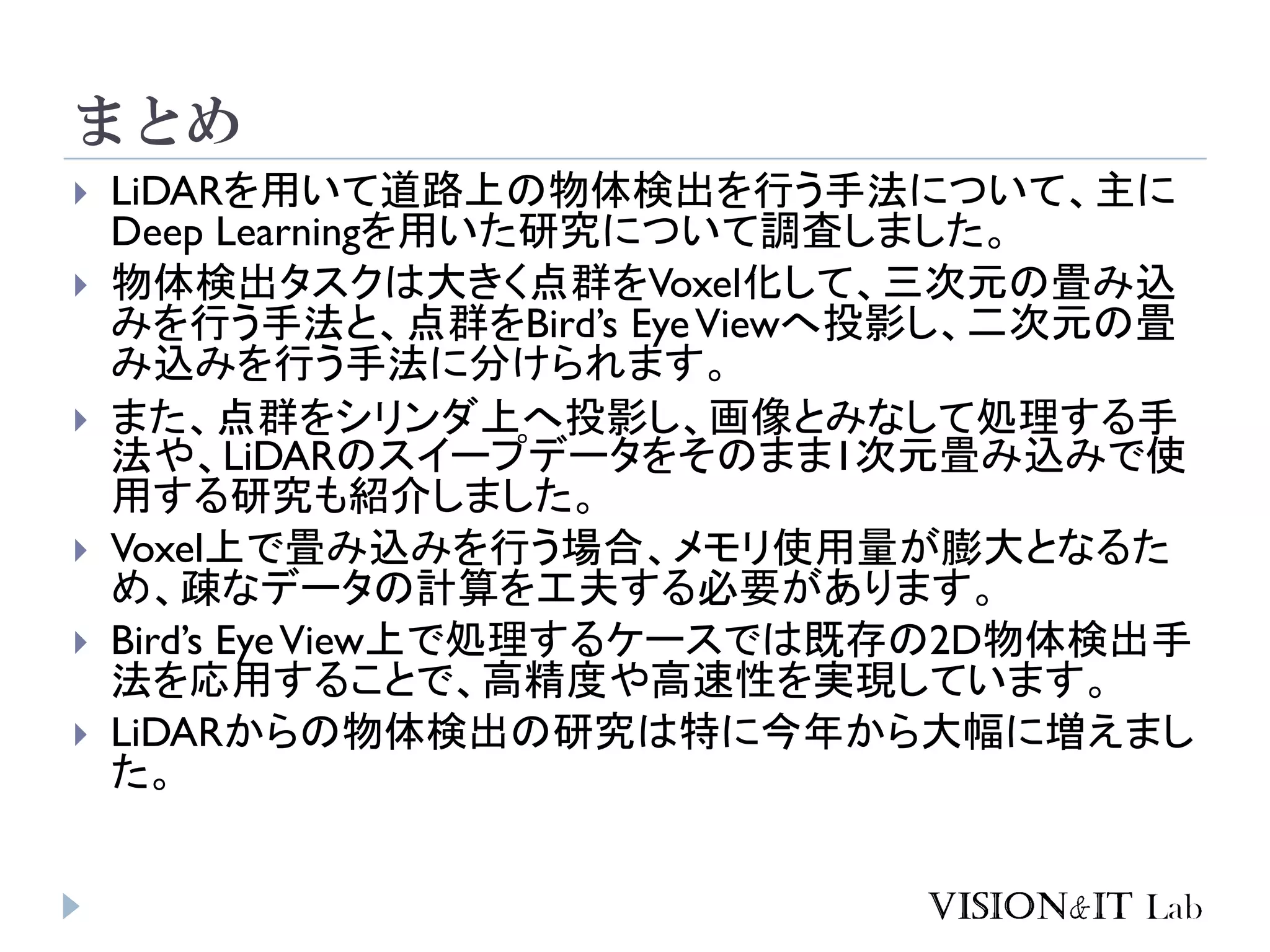
ここで紹介した各論文についてKITTI Benchmark上で評
価された結果を記載します。
http://www.cvlibs.net/datasets/kitti
評価は3D、2D、Bird’sEyeViewそれぞれの物体検出タスクに
ついて行いました。
比較のために、カメラとLiDAR両方を使用した物体検出
手法であるF-PointNet*の結果も記載しました。
ここで紹介できなかった研究についても、上記サイトに記
載があり、かつ論文が入手可能なものについては記載し
ました。
番号の降られた手法が紹介しきれなった研究にあたります
ベンチマーク中の巻末の「紹介しきれなかった研究」の番号と
対応してます
*Qi, C. R., Liu,W.,Wu, C., Su, H., & Guibas, L. J. (2018). Frustum PointNets for 3D Object Detection from RGB-D Data.
In Conference on ComputerVision and Pattern Recognition.
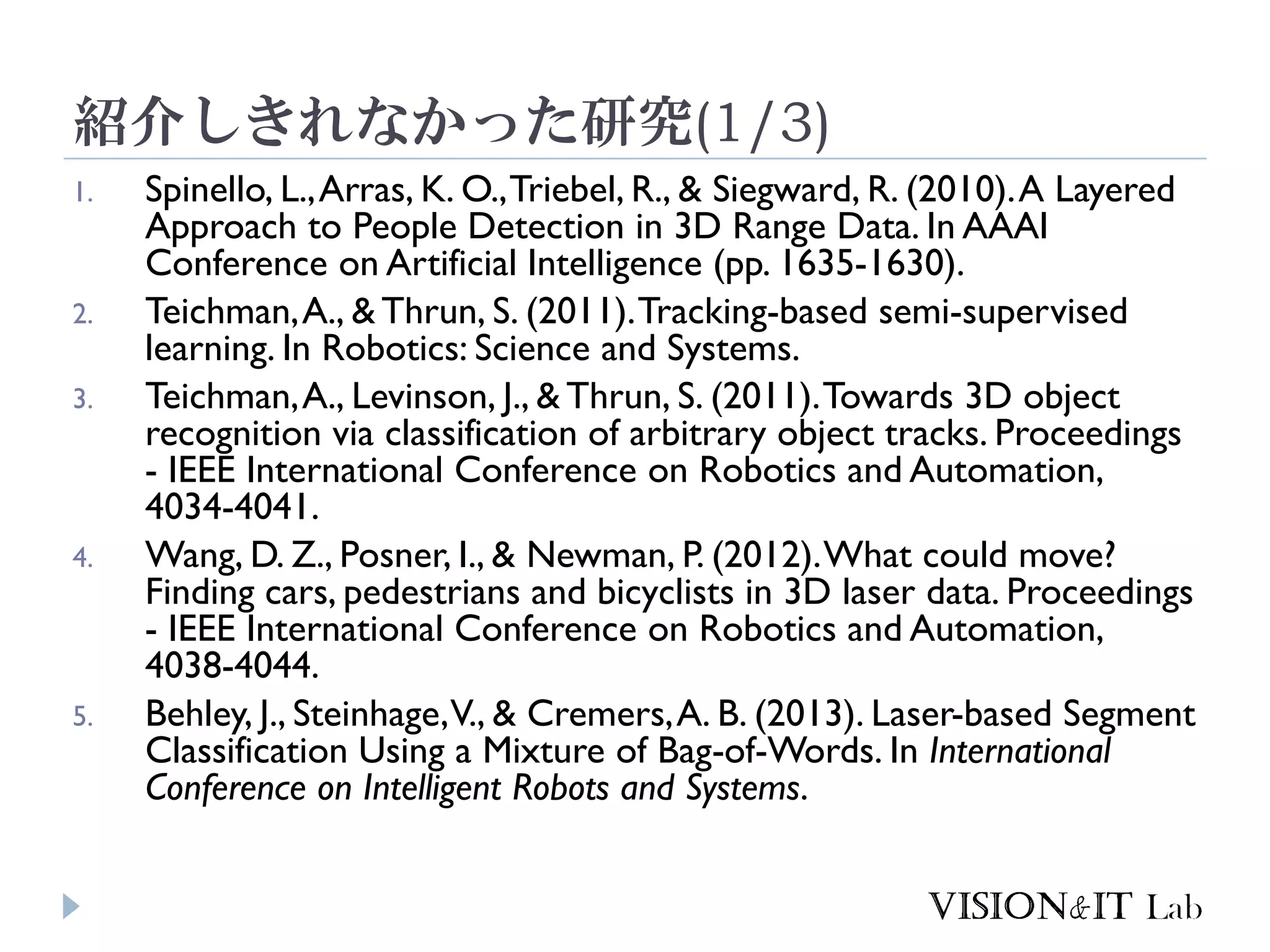
紹介しきれなかった研究(1/3)
1. Spinello, L.,Arras,K. O.,Triebel, R., & Siegward, R. (2010).A Layered
Approach to People Detection in 3D Range Data. In AAAI
Conference on Artificial Intelligence (pp. 1635-1630).
2. Teichman,A., & Thrun, S. (2011).Tracking-based semi-supervised
learning. In Robotics: Science and Systems.
3. Teichman,A., Levinson, J., & Thrun, S. (2011).Towards 3D object
recognition via classification of arbitrary object tracks. Proceedings
- IEEE International Conference on Robotics and Automation,
4034-4041.
4. Wang, D. Z., Posner, I., & Newman, P. (2012).What could move?
Finding cars, pedestrians and bicyclists in 3D laser data. Proceedings
- IEEE International Conference on Robotics and Automation,
4038-4044.
5. Behley, J., Steinhage,V., & Cremers,A. B. (2013). Laser-based Segment
Classification Using a Mixture of Bag-of-Words. In International
Conference on Intelligent Robots and Systems.
46.
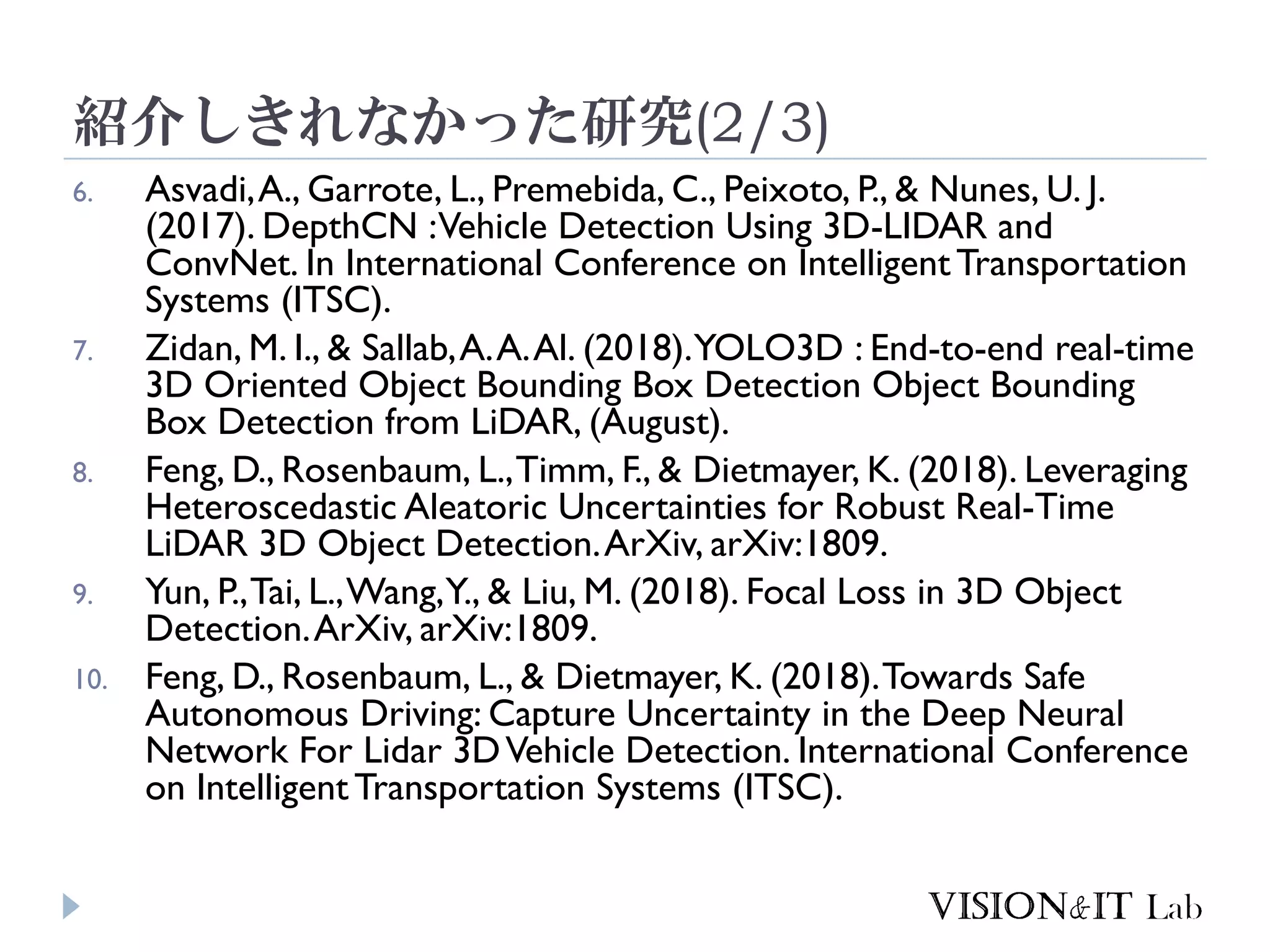
紹介しきれなかった研究(2/3)
6. Asvadi,A., Garrote,L., Premebida, C., Peixoto, P., & Nunes, U. J.
(2017). DepthCN :Vehicle Detection Using 3D-LIDAR and
ConvNet. In International Conference on IntelligentTransportation
Systems (ITSC).
7. Zidan, M. I., & Sallab,A.A.Al. (2018).YOLO3D : End-to-end real-time
3D Oriented Object Bounding Box Detection Object Bounding
Box Detection from LiDAR, (August).
8. Feng, D., Rosenbaum, L.,Timm, F., & Dietmayer, K. (2018). Leveraging
Heteroscedastic Aleatoric Uncertainties for Robust Real-Time
LiDAR 3D Object Detection.ArXiv, arXiv:1809.
9. Yun, P.,Tai, L.,Wang,Y., & Liu, M. (2018). Focal Loss in 3D Object
Detection.ArXiv, arXiv:1809.
10. Feng, D., Rosenbaum, L., & Dietmayer, K. (2018).Towards Safe
Autonomous Driving: Capture Uncertainty in the Deep Neural
Network For Lidar 3DVehicle Detection. International Conference
on IntelligentTransportation Systems (ITSC).
47.
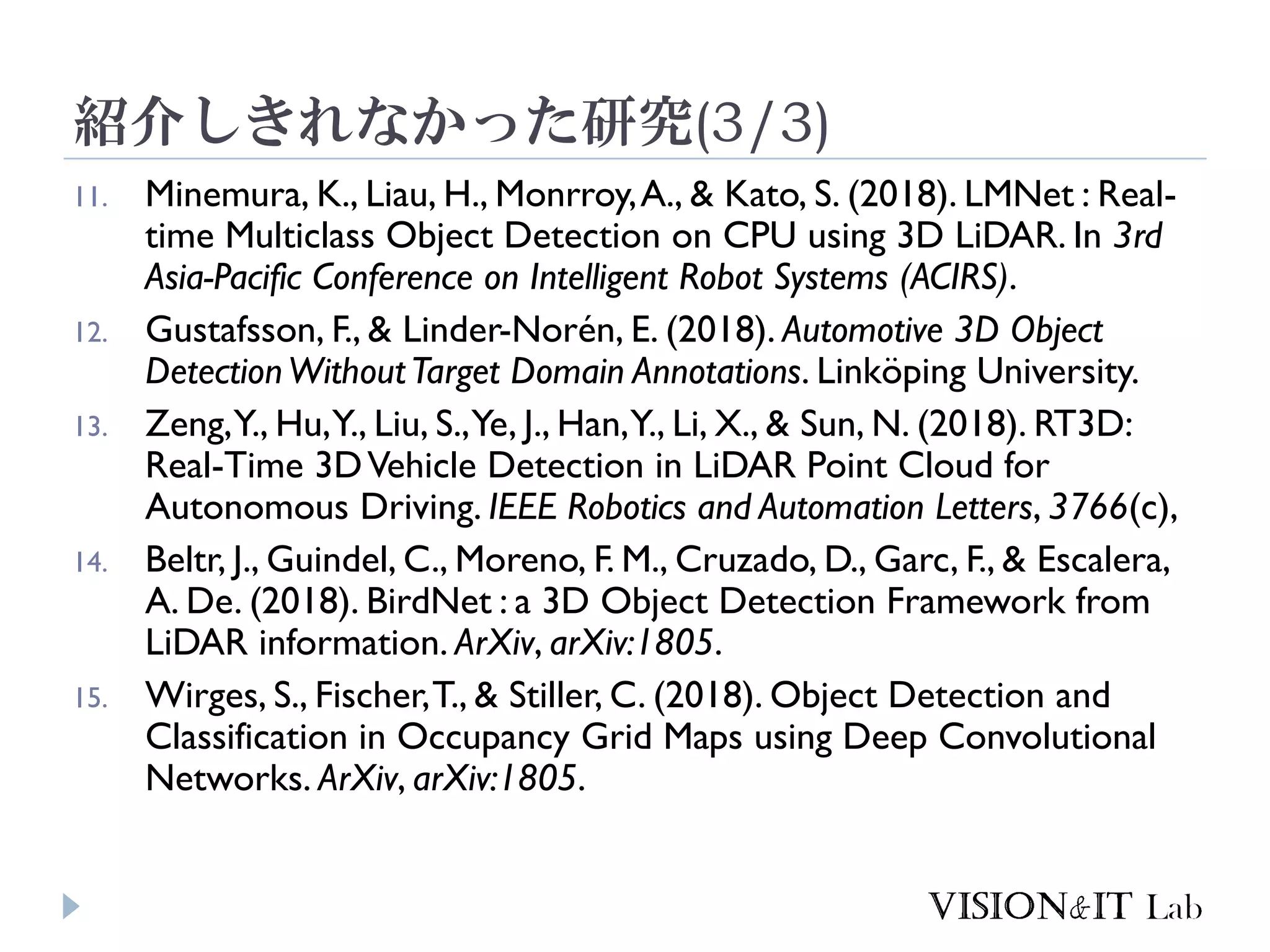
紹介しきれなかった研究(3/3)
11. Minemura, K.,Liau, H., Monrroy,A., & Kato, S. (2018). LMNet : Real-
time Multiclass Object Detection on CPU using 3D LiDAR. In 3rd
Asia-Pacific Conference on Intelligent Robot Systems (ACIRS).
12. Gustafsson, F., & Linder-Norén, E. (2018). Automotive 3D Object
DetectionWithoutTarget Domain Annotations. Linköping University.
13. Zeng,Y., Hu,Y., Liu, S.,Ye, J., Han,Y., Li, X., & Sun, N. (2018). RT3D:
Real-Time 3DVehicle Detection in LiDAR Point Cloud for
Autonomous Driving. IEEE Robotics and Automation Letters, 3766(c),
14. Beltr, J., Guindel, C., Moreno, F. M., Cruzado, D., Garc, F., & Escalera,
A. De. (2018). BirdNet : a 3D Object Detection Framework from
LiDAR information. ArXiv, arXiv:1805.
15. Wirges, S., Fischer,T., & Stiller, C. (2018). Object Detection and
Classification in Occupancy Grid Maps using Deep Convolutional
Networks. ArXiv, arXiv:1805.

![Voxelベースの手法 (1/2)
[Maturana2015]Maturana, D., & Scherer, S. (2015).VoxNet:
A 3D Covolutional Neural Network for Real-Time Object
Recognition. In International Conference on Intelligent Robots
and Systems.
[Li2017]Li, B. (2017). 3D fully convolutional network for
vehicle detection in point cloud. IEEE International
Conference on Intelligent Robots and Systems
[Zeng2015]Zeng Wang, D., & Posner, I. (2015).Voting for
Voting in Online Point Cloud Object Detection. Robotics:
Science and Systems XI.](https://image.slidesharecdn.com/20181130lidarobjectdetectionsurvey-181206045542/75/20181130-lidar-object-detection-survey-5-2048.jpg)
![Voxelベースの手法 (2/2)
[Engelcke2017]Engelcke, M., Rao, D.,Wang, D. Z.,Tong, C.
H., & Posner, I. (2017).Vote3Deep: Fast object detection in
3D point clouds using efficient convolutional neural
networks. IEEE International Conference on Robotics and
Automation, (September),
[Zhou2018]Zhou,Y., & Tuzel, O. (2018).VoxelNet: End-to-
End Learning for Point Cloud Based 3D Object Detection.
In Conference on ComputerVision and Pattern Recognition.
[Yan2018]Yan,Y., Mao,Y., & Li, B. (2018). SECOND: Sparsely
Embedded Convolutional Detection. Sensors, 18(10)](https://image.slidesharecdn.com/20181130lidarobjectdetectionsurvey-181206045542/75/20181130-lidar-object-detection-survey-6-2048.jpg)
![[Maturana2015]VoxNet
LiDARおよびRGBD点群に対して
3D CNNを用いて物体検出を行う
手法を提案
入力は点群の中のセグメンテーション
された物体部分、またはSliding Box
点群をOccupancy Gridへ変換
2層の3D Convと1層のPooling、2層の
Fully Connect層で物体識別
Sydney Urban Objects Dataset、
ModelNet、NYUv2など異なる種類の
物体を対象としたベンチマークで
state-of-the-art
コード
https://github.com/dimatura/voxnet](https://image.slidesharecdn.com/20181130lidarobjectdetectionsurvey-181206045542/75/20181130-lidar-object-detection-survey-7-2048.jpg)
![[Zeng2015]Voting for Voting (1/2)
入力点群(+反射率)を
Voxel化し、3D Sliding
Windowで物体検出
各VoxelごとにHand-Crafted
特徴量(Grid内に点が存在
するか、反射率平均、反射
率分散、3種のShape Factor*
の計6種)を算出し、Sliding
Window内でそれらを結合し、
線形SVMで判別
N個の向きに対して演算
入力点群 Voxel化
Voxel特徴ベクトル
3D Sliding Window
*C.-F.Westin, S. Peled, H. Gudbjartsson, R. Kikinis, and F.
A. Jolesz,“Geometrical Diffusion Measures for MRI
fromTensor Basis Analysis,” in ISMRM ’97,Vancouver
Canada,April 1997, p. 1742.](https://image.slidesharecdn.com/20181130lidarobjectdetectionsurvey-181206045542/75/20181130-lidar-object-detection-survey-8-2048.jpg)
![[Zeng2015]Voting for Voting (2/2)
SlidingWindow + 線形SVMは畳み込み演算とみなせ、入
力が疎な場合、投票で高速処理
a. 赤、緑、水色の個所にのみ点群が存在する場合、Window
のアンカー(青)上のスコアはこれらの重み付き線形和であ
らわされる
b. データの存在する個所(赤)は青位置のアンカーに投票する](https://image.slidesharecdn.com/20181130lidarobjectdetectionsurvey-181206045542/75/20181130-lidar-object-detection-survey-9-2048.jpg)
![[Engelcke2017]Vote3Deep
Voting forVoting[Zeng2015]のSVMを最大3層のCNNに
置き換え、疎な入力に対して投票による畳み込み演算を
行う
畳み込みによって上位の層にいくほど疎性は失われる
が、それをReLUによって閾値処理することで抑える
損失関数はL1正則化によるヒンジ損失を使用し、フィル
タも疎となるように学習](https://image.slidesharecdn.com/20181130lidarobjectdetectionsurvey-181206045542/75/20181130-lidar-object-detection-survey-10-2048.jpg)
![[Li2017]3D FCN
Fully Convolutional Network (FCN)を3次元に拡張し、
End-to-endで物体検出を行う手法を提案
シーン全体を表す点群をVolumetric Gridに変換し、3D
CNNを用いてObject Proposalと3D Bounding Box算出す
ることで、性能を大幅に向上](https://image.slidesharecdn.com/20181130lidarobjectdetectionsurvey-181206045542/75/20181130-lidar-object-detection-survey-11-2048.jpg)
![[Zhou2018]VoxelNet (1/2)
Voxelに分割してVoxelごとに特徴ベクトルを算出し、Region
Proposal Networkにより物体検出
End-to-Endで学習
疎なVoxel表現を効率的に演算
Voxel分割 最大T個ま
で減らす 点ごとに特徴
ベクトル算出
Voxel特徴ベ
クトル算出
3次元畳み
込み
Bounding
Box検出](https://image.slidesharecdn.com/20181130lidarobjectdetectionsurvey-181206045542/75/20181130-lidar-object-detection-survey-12-2048.jpg)
![[Zhou2018]VoxelNet (2/2)
Voxel Feature Encoding Layer
Voxel内の点をランダムサンプリングで最大T個まで減らす
各Voxel内の重心を算出し、各点を絶対座標と重心からの相
対座標、およびReflectanceの7つの値で表現
各点をFully Connected層で特徴抽出し、Voxel内でMax Pooling
した特徴を結合
点ごと、Voxelごとに特徴量を求めるため並列計算可能](https://image.slidesharecdn.com/20181130lidarobjectdetectionsurvey-181206045542/75/20181130-lidar-object-detection-survey-13-2048.jpg)
![[Yan2018]SECOND (1/2)
Voxelベースの物体検出の欠点であった、低速性と向きの精度の低
さを改善
VoxelNet[Zhou2018]と同様の方法でVoxelごとに特徴量を算出し、
Sparse Conv Layersにより疎なデータから高速に特徴マップを算出
RPNにより物体の識別、Bounding Boxの位置とサイズ、向きを算出
向きの学習にSine-Error Lossを使用
コード:
https://github.com/traveller59/second.pytorch](https://image.slidesharecdn.com/20181130lidarobjectdetectionsurvey-181206045542/75/20181130-lidar-object-detection-survey-14-2048.jpg)
![[Yan2018]SECOND (2/2)
Sparse Conv Layer
疎な入力から密な入力を作成し、カーネルの要素との積を算
出後、再度疎な出力へ展開
疎密間変換ルール(テーブル)を別途作成](https://image.slidesharecdn.com/20181130lidarobjectdetectionsurvey-181206045542/75/20181130-lidar-object-detection-survey-15-2048.jpg)
![[Yan2018]SECOND (2/2)
Sparse Conv Layer
疎な入力から密な入力を作成し、カーネルの要素との積を算
出後、再度疎な出力へ展開
疎密間変換ルール(テーブル)を別途作成
Voxel座標
Kernel要素0にお
ける入力Indexと
出力座標
Kernel要素1にお
ける入力Indexと
出力座標
ユニークな出力
座標に対しIndex
を付与
Kernel要素、入
力Index、出力
Indexの表](https://image.slidesharecdn.com/20181130lidarobjectdetectionsurvey-181206045542/75/20181130-lidar-object-detection-survey-16-2048.jpg)
![Bird’s Eye Viewベースの手法
[Yang2018]Yang, B., Luo,W., & Urtasun, R. (2018). PIXOR: Real-time
3D Object Detection from Point Clouds. In IEEE conference on
ComputerVision and Pattern Recognition
[Luo2018]Luo,W.,Yang, B., & Urtasun, R. (2018). Fast and Furious: Real
Time End-to-End 3D Detection,Tracking and Motion Forecasting
with a Single Convolutional Net. In Conference on ComputerVision
and Pattern Recognition.
[Ren2018]Ren, M., Pokrovsky,A.,Yang, B., & Urtasun, R. (2018). SBNet:
Sparse Blocks Network for Fast Inference. In IEEE Conference on
ComputerVision and Pattern Recognition (pp. 8711–8720).
[Yang2018_2]Yang, B., Liang, M., & Urtasun, R. (2018). HDNET :
Exploiting HD Maps for 3D Object Detection. In Conference on Robot
Learning (pp. 1–10).
[Simon2018]Simon, M., Milz, S.,Amende, K., & Gross, H. (2018).
Complex-YOLO:An Euler-Region-Proposal for Real-time 3D Object
Detection on Point Clouds.ArXiv, arXiv:1803.](https://image.slidesharecdn.com/20181130lidarobjectdetectionsurvey-181206045542/75/20181130-lidar-object-detection-survey-17-2048.jpg)
![[Yang2018]PIXOR
10fpsで動作可能なBird’s EyeView物体検出手法(Titan
Xp + CPU)
入力LiDAR点群を地面と平行にスライス(23枚)したもの
を画像のチャネルとみたててCNNへの入力とする
Fully Convolutional Networkにより、各場所における車
両の有無、サイズ、および向きを出力](https://image.slidesharecdn.com/20181130lidarobjectdetectionsurvey-181206045542/75/20181130-lidar-object-detection-survey-18-2048.jpg)
![[Luo2018]Fast and Furious (1/3)
物体検出、追跡、予測を1つのネットワークで実現
1フレーム30msで処理(Titan XP Server)
SSD、SqueezeNet、MobileNetと比較し、SOTA
現在と過去n枚のフレーム情
報から現在と未来nフレームの
Bounding Boxを推定
各フレーム群から求めた予
測を統合してTracklet生成](https://image.slidesharecdn.com/20181130lidarobjectdetectionsurvey-181206045542/75/20181130-lidar-object-detection-survey-19-2048.jpg)
![[Luo2018]Fast and Furious (2/3)
点群をVoxel化し、地面と平行にスライ
スして各スライスをチャネルとみなすこ
とで、通常の2D CNNで処理
現在と過去計n枚のフレーム情報を統合して特徴マップ
を生成する方法として、Early Fusion(高速省メモリ)と
Later Fusion(高精度)の2つを検証。
畳み込み
カーネル](https://image.slidesharecdn.com/20181130lidarobjectdetectionsurvey-181206045542/75/20181130-lidar-object-detection-survey-20-2048.jpg)
![[Luo2018]Fast and Furious (3/3)
Early FusionまたはLater Fusionで生成した特徴マップから、
現在と未来nフレームの物体のBounding Boxを推定
SSDと同じ要領で、あらかじめ定義した複数のaspect ratioの
Bounding Boxのスコアを各位置で算出
車両の向きをRegressionで推定
過去のフレームから予測した現在のフレームの物体位置
と現在のフレームから予測した物体位置のオーバーラッ
プがある場合、同じ物体と判断しTracklet生成](https://image.slidesharecdn.com/20181130lidarobjectdetectionsurvey-181206045542/75/20181130-lidar-object-detection-survey-21-2048.jpg)
![[Ren2018]SBNet
疎なデータに対してマスクをかけることで畳み込み演算を高速化
マスクをブロックに分割し、ブロックをチャネルとして束ねて(Gather)、畳
み込み(Convolution)
出力テンソルの各対応チャネルを元の入力位置に戻す(Scatter)
ATG4DやKITTI2017 BEVなどSparseなLiDARデータで有効性確認
コード
https://github.com/uber/sbnet](https://image.slidesharecdn.com/20181130lidarobjectdetectionsurvey-181206045542/75/20181130-lidar-object-detection-survey-22-2048.jpg)
![[Yang2018_2] HDNET (1/2)
自動運転では地図情報(HD Map)の利用が想定されるた
め、地図を前提知識として利用することで物体検出の性
能を向上させる
入力は点群(a)
地図情報を用いて坂道などを補正(b)
Voxel化し、地面から垂直方向(Z方向)はチャネルとみなすこ
とで2D CNNで扱えるようにする(c)
物体検出時に地図上の道路領域を事前知識として使用(d)
KITTI BEV Car detectionで1位(発表時)](https://image.slidesharecdn.com/20181130lidarobjectdetectionsurvey-181206045542/75/20181130-lidar-object-detection-survey-23-2048.jpg)
![[Yang2018_2] HDNET (2/2)
地図の利用が不可能な個所ではLiDARデータから地面
の高さと道路領域をそれぞれCNNで推定して利用
Detection Networkが道路領域に対して過学習するのを
防ぐため、学習時にランダムで道路領域を空にする](https://image.slidesharecdn.com/20181130lidarobjectdetectionsurvey-181206045542/75/20181130-lidar-object-detection-survey-24-2048.jpg)
![[Simon2018]Complex-YOLO
YOLOv2を3Dに拡張し、50fps(TitanX)で動作
点群をBird’s EyeViewへ投影し、Height, Intensity, Density (RGB)画像
を作成し、Yoloへの入力とする
Yoloで作成した特徴マップをE-RPN層へ入力し、各グリッドごとに5つ
の物体カテゴリそれぞれのProbability、位置、Bounding Boxサイズ、
向きを推定する
コード
https://github.com/AI-liu/Complex-YOLO](https://image.slidesharecdn.com/20181130lidarobjectdetectionsurvey-181206045542/75/20181130-lidar-object-detection-survey-25-2048.jpg)
![その他の手法
[Li2016]Li, B., Zhang,T., & Xia,T. (2016).Vehicle Detection
from 3D Lidar Using Fully Convolutional Network.
Robotics Science and Systems.
[Kunisada2018]Kunisada,Y.,Yamashita,T., & Fujiyoshi, H.
(2018). Pedestrian-Detection Method based on 1D-CNN
during LiDAR Rotation. In International Conference on
IntelligentTransportation Systems (ITSC).](https://image.slidesharecdn.com/20181130lidarobjectdetectionsurvey-181206045542/75/20181130-lidar-object-detection-survey-26-2048.jpg)
![[Li2016]VeloFCN
点群をシリンダー形状へ投影し、深度dと高さhの2チャネ
ルの画像を入力とする(point map)
Fully Convolutional Network (FCN)によりダウンサンプ
ルとアップサンプルを行い、point mapに対応する各位置
におけるObjectnessと3D Bounding Boxを推定](https://image.slidesharecdn.com/20181130lidarobjectdetectionsurvey-181206045542/75/20181130-lidar-object-detection-survey-27-2048.jpg)
![[Kunisada2018]1D-CNN during LiDAR
rotation
全方位LiDARの回転から得られる各レーザーの距離情報を1次元
の波形として扱い、1次元CNNによってレーザーごとに歩行者検出
歩行者とラベル付けされた点群をクラスタリングして歩行者領域検
出
LiDARから点群全体を生成せず、直接レーザーから、高速に検出可
能](https://image.slidesharecdn.com/20181130lidarobjectdetectionsurvey-181206045542/75/20181130-lidar-object-detection-survey-28-2048.jpg)
![KITTI 3D Object Detection Evaluation
Car
Method Moderate Easy Hard Runtime Environment
SECOND 73.66 % 83.13 % 66.20 % 0.05 s
4 cores @ 3.5 Ghz
(C/C++)
F-PointNet* 70.39 % 81.20 % 62.19 % 0.17 s
GPU @ 3.0 Ghz
(Python)
VoxelNet 65.11% 77.47% 57.73% 225ms
Titan X GPU +
1.7Ghz CPU
Complex-YOLO 64.00 % 67.72 % 63.01 % 19.84 ms Titan X GPU
A3DODWTDA[12] 56.81 % 59.35 % 50.51 % 0.08 s
GPU @ 3.0 Ghz
(Python)
MV3D (LIDAR) 52.73 % 66.77 % 51.31 % 0.24 s
GPU @ 2.5 Ghz
(Python + C/C++)
BirdNet[14] 13.44 % 14.75 % 12.04 % 0.11 s Titan Xp GPU
TopNet-HighRes[15] 12.58 % 15.29 % 12.25 % 101ms
NVIDIA GeForce
1080 Ti (tensorflow-
gpu)](https://image.slidesharecdn.com/20181130lidarobjectdetectionsurvey-181206045542/75/20181130-lidar-object-detection-survey-31-2048.jpg)
![KITTI 3D Object Detection Evaluation
Pedestrian
Method Moderate Easy Hard Runtime Environment
F-PointNet* 44.89 % 51.21 % 40.23 % 0.17 s
GPU @ 3.0 Ghz
(Python)
SECOND 42.56 % 51.07 % 37.29 % 0.05 s
4 cores @ 3.5 Ghz
(C/C++)
Complex-YOLO 39.70 % 41.79 % 35.92 % 19.84 ms Titan X GPU
VoxelNet 33.69 % 39.48 % 31.51 % 225ms
Titan X GPU +
1.7Ghz CPU
BirdNet[14] 11.80 % 14.31 % 10.55 % 0.11 s Titan Xp GPU
TopNet-HighRes[15] 9.66 % 13.45 % 9.64 % 101ms
NVIDIA GeForce
1080 Ti (tensorflow-
gpu)](https://image.slidesharecdn.com/20181130lidarobjectdetectionsurvey-181206045542/75/20181130-lidar-object-detection-survey-32-2048.jpg)
![KITTI 3D Object Detection Evaluation
Cyclist
Method Moderate Easy Hard Runtime Environment
F-PointNet* 56.77 % 71.96 % 50.39 % 0.17 s
GPU @ 3.0 Ghz
(Python)
Complex-YOLO 58.32 % 68.17 % 54.30 % 19.84 ms Titan X GPU
SECOND 53.85 % 70.51 % 46.90 % 0.05 s
4 cores @ 3.5 Ghz
(C/C++)
VoxelNet 48.36 % 61.22 % 44.37 % 225ms
Titan X GPU +
1.7Ghz CPU
BirdNet[14] 12.43 % 18.35 % 11.88 % 0.11 s Titan Xp GPU
TopNet-HighRes[15] 5.98 % 4.48 % 6.18 % 101ms
NVIDIA GeForce
1080 Ti (tensorflow-
gpu)](https://image.slidesharecdn.com/20181130lidarobjectdetectionsurvey-181206045542/75/20181130-lidar-object-detection-survey-33-2048.jpg)
![KITTI Object Detection 2012 Evaluation
Car
Method Moderate Easy Hard Runtime Environment
F-PointNet* 90.00 % 90.78 % 80.80 % 0.17 s
GPU @ 3.0 Ghz
(Python)
SECOND 88.40 % 90.40 % 80.21 % 0.05 s
4 cores @ 3.5 Ghz
(C/C++)
MV3D (LIDAR) 79.76 % 89.80 % 78.61 % 0.24 s
GPU @ 2.5 Ghz
(Python + C/C++)
3D FCN 75.83 % 85.54 % 68.30 % >5 s
1 core @ 2.5 Ghz
(C/C++)
A3DODWTCA
[12]
74.71 % 78.21 % 66.70 % 0.08 s
GPU @ 3.0 Ghz
(Python)
Vote3Deep 68.39 % 76.95 % 63.22 % 1.5s 4 core @ 2.5 Ghz
BirdNet[14] 57.47 % 78.18 % 56.66 % 0.11 s Titan Xp GPU
VeloFCN 53.45 % 70.68 % 46.90 % 1 s
GPU @ 2.5 Ghz
(Python + C/C++)
TopNet-
HighRes[15]
48.87 % 59.77 % 43.15 % 101ms
NVIDIA GeForce 1080
Ti (tensorflow-gpu)
Voting forVoting 48.05 % 56.66 % 42.64 % 0.5s 4 core @ 2.8 Ghz](https://image.slidesharecdn.com/20181130lidarobjectdetectionsurvey-181206045542/75/20181130-lidar-object-detection-survey-35-2048.jpg)
![KITTI Object Detection 2012 Evaluation
Car (続き)
Method Moderate Easy Hard Runtime Environment
RT3D[13] 39.71 % 49.96 % 41.47 % 0.09 s GPU @ 1.8Ghz
mBoW[5] 23.76 % 37.63 % 18.44 % 10 s
1 core @ 2.5 Ghz
(C/C++)
DepthCN[6] 23.21 % 37.59 % 18.00 % 2.3 s
GPU @ 3.5 Ghz
(Matlab)
TopNet-
DecayRate[15]
0.04 % 0.04 % 0.04 % 92 ms
NVIDIA GeForce 1080
Ti (tensorflow-gpu)](https://image.slidesharecdn.com/20181130lidarobjectdetectionsurvey-181206045542/75/20181130-lidar-object-detection-survey-36-2048.jpg)
![KITTI Object Detection 2012 Evaluation
Pedestrian
Method Moderate Easy Hard Runtime Environment
F-PointNet* 77.25 % 87.81 % 74.46 % 0.17 s GPU @ 3.0 Ghz (Python)
SECOND 55.74 % 65.73 % 49.08 % 0.05 s
4 cores @ 3.5 Ghz
(C/C++)
Vote3Deep 55.38 % 67.94 % 52.62 % 1.5 s
4 cores @ 2.5 Ghz
(C/C++)
Vote forVoting 35.74 % 44.47 % 33.72 % 0.5 s
4 cores @ 2.8 Ghz
(C/C++)
mBoW[5] 31.37 % 44.36 % 30.62 % 10 s 1 core @ 2.5 Ghz (C/C++)
BirdNet[14] 30.90 % 36.83 % 29.93 % 0.11 s Titan Xp GPU
TopNet-
HighRes[15]
17.57 % 22.98 % 17.35 % 101ms
NVIDIA GeForce 1080Ti
(tensorflow-gpu)
TopNet-
DecayRate[15]
0.04 % 0.02 % 0.05 % 92 ms
NVIDIA GeForce 1080Ti
(tensorflow-gpu)](https://image.slidesharecdn.com/20181130lidarobjectdetectionsurvey-181206045542/75/20181130-lidar-object-detection-survey-37-2048.jpg)
![KITTI Object Detection 2012 Evaluation
Cyclist
Method Moderate Easy Hard Runtime Environment
F-PointNet* 72.25 % 84.90 % 65.14 % 0.17 s GPU @ 3.0 Ghz (Python)
Vote3Deep 67.96 % 76.49 % 62.88 % 1.5 s
4 cores @ 2.5 Ghz
(C/C++)
SECOND 58.94 % 81.96 % 57.20 % 0.05 s
4 cores @ 3.5 Ghz
(C/C++)
BirdNet[14] 49.04 % 64.88 % 46.61 % 0.11 s Titan Xp GPU
Vote forVoting 31.24 % 41.45 % 28.60 % 0.5 s
4 cores @ 2.8 Ghz
(C/C++)
mBoW[5] 21.62 % 28.19 % 20.93 % 10 s 1 core @ 2.5 Ghz (C/C++)
TopNet-
HighRes[15]
19.15 % 29.34 % 19.69 % 101ms
NVIDIA GeForce 1080Ti
(tensorflow-gpu)
TopNet-
DecayRate[15]
1.01 % 0.04 % 1.01 % 92 ms
NVIDIA GeForce 1080Ti
(tensorflow-gpu)](https://image.slidesharecdn.com/20181130lidarobjectdetectionsurvey-181206045542/75/20181130-lidar-object-detection-survey-38-2048.jpg)
![KITTI Bird’s Eye View Evaluation 2017
Car
Method Moderate Easy Hard Runtime Environment
HDNET 86.57 % 89.14 % 78.32 % 0.05 s
GPU @ 2.5 Ghz
(Python)
F-PointNet* 84.00 % 88.70 % 75.33 % 0.17 s
GPU @ 3.0 Ghz
(Python)
PIXOR++ 83.70 % 89.38 % 77.97 % 0.035 s
GPU @ 2.5 Ghz
(Python)
SECOND 79.37 % 88.07 % 77.95 % 0.05 s
4 cores @ 3.5 Ghz
(C/C++)
VoxelNet 79.26 % 89.35 % 77.39 % 225ms
Titan X GPU + 1.7Ghz
CPU
Complex-YOLO 77.40 % 85.89 % 77.33 % 19.84 ms Titan X GPU
PIXOR 77.05 % 81.70 % 72.95 % 0.035 s TITAN Xp (Python)
MV3D(LiDAR) 77.00 % 85.82 % 68.94 % 0.24 s
GPU @ 2.5 Ghz (Python +
C/C++)
A3DODWTCA
[12]
72.86 % 76.65 % 64.51 % 0.08 s
GPU @ 3.0 Ghz
(Python)](https://image.slidesharecdn.com/20181130lidarobjectdetectionsurvey-181206045542/75/20181130-lidar-object-detection-survey-40-2048.jpg)
![KITTI Bird’s Eye View Evaluation 2017
Car (続き)
Method Moderate Easy Hard Runtime Environment
TopNet-
DecayRate[15]
64.12 % 79.76 % 56.48 % 92 ms
NVIDIA GeForce 1080
Ti (tensorflow-gpu)
3D FCN 62.54 % 69.94 % 55.94 % >5 s
1 core @ 2.5 Ghz
(C/C++)
TopNet-
HighRes[15]
53.71 % 67.53 % 46.54 % 101ms
NVIDIA GeForce 1080
Ti (tensorflow-gpu)
BirdNet[14] 50.81 % 75.52 % 50.00 % 0.11 s Titan Xp GPU
RT3D[13] 42.10 % 54.68 % 44.05 % 0.09 s GPU @ 1.8Ghz
VeloFCN 0.33 % 0.15 % 0.47 % 1 s
GPU @ 2.5 Ghz
(Python + C/C++)
mBoW[5] 0.00 % 0.00 % 0.00 % 10 s
1 core @ 2.5 Ghz
(C/C++)](https://image.slidesharecdn.com/20181130lidarobjectdetectionsurvey-181206045542/75/20181130-lidar-object-detection-survey-41-2048.jpg)
![KITTI Bird’s Eye View Evaluation 2017
Pedestrian
Method Moderate Easy Hard Runtime Environment
F-PointNet* 50.22 % 58.09 % 47.20 % 0.17 s GPU @ 3.0 Ghz (Python)
SECOND 46.27 % 55.10 % 44.76 % 0.05 s
4 cores @ 3.5 Ghz
(C/C++)
Complex-YOLO 45.90 % 46.08 % 44.20 % 19.84 ms Titan X GPU
VoxelNet 40.74 % 46.13 % 38.11 % 225ms
Titan X GPU + 1.7Ghz
CPU
BirdNet[14] 21.35 % 26.07 % 19.96 % 0.11 s Titan Xp GPU
TopNet-
HighRes[15]
19.08 % 24.30 % 18.46 % 101ms
NVIDIA GeForce 1080Ti
(tensorflow-gpu)
TopNet-
DecayRate[15]
12.59 % 15.09 % 12.23 % 92 ms
NVIDIA GeForce 1080Ti
(tensorflow-gpu)
mBoW[5] 0.01 % 0.01 % 0.01 % 10 s 1 core @ 2.5 Ghz (C/C++)](https://image.slidesharecdn.com/20181130lidarobjectdetectionsurvey-181206045542/75/20181130-lidar-object-detection-survey-42-2048.jpg)
![KITTI Bird’s Eye View Evaluation 2017
Cyclist
Method Moderate Easy Hard Runtime Environment
Complex-YOLO 63.36 % 72.37 % 60.27 % 19.84 ms Titan X GPU
F-PointNet* 61.96 % 75.38 % 54.68 % 0.17 s GPU @ 3.0 Ghz (Python)
SECOND 56.04 % 73.67 % 48.78 % 0.05 s
4 cores @ 3.5 Ghz
(C/C++)
VoxelNet 54.76 % 66.70 % 50.55 % 225ms
Titan X GPU + 1.7Ghz
CPU
BirdNet[14] 27.18 % 38.93 % 25.51 % 0.11 s Titan Xp GPU
TopNet-
DecayRate[15]
19.92 % 28.06 % 19.13 % 92 ms
NVIDIA GeForce 1080Ti
(tensorflow-gpu)
TopNet-
HighRes[15]
12.45 % 15.70 % 12.76 % 101ms
NVIDIA GeForce 1080Ti
(tensorflow-gpu)
mBoW[5] 0.00 % 0.00 % 0.00 % 10 s 1 core @ 2.5 Ghz (C/C++)](https://image.slidesharecdn.com/20181130lidarobjectdetectionsurvey-181206045542/75/20181130-lidar-object-detection-survey-43-2048.jpg)


![SSII2022 [SS2] 少ないデータやラベルを効率的に活用する機械学習技術 〜 足りない情報をどのように補うか?〜](https://cdn.slidesharecdn.com/ss_thumbnails/ss2ssii2022-220607054716-2760bd30-thumbnail.jpg?width=640&height=640&fit=bounds)

![[DL輪読会]YOLOv4: Optimal Speed and Accuracy of Object Detection](https://cdn.slidesharecdn.com/ss_thumbnails/200515dlseminar-200515082345-thumbnail.jpg?width=640&height=640&fit=bounds)


![SSII2022 [SS1] ニューラル3D表現の最新動向〜 ニューラルネットでなんでも表せる?? 〜](https://cdn.slidesharecdn.com/ss_thumbnails/ss1ssii2022hkatoneural3drepresentationhiroharukato-220607054619-fadc6480-thumbnail.jpg?width=640&height=640&fit=bounds)


![[DL輪読会]Pyramid Stereo Matching Network](https://cdn.slidesharecdn.com/ss_thumbnails/2019-05-31psmnetpyramidstereomatchingnetwork-hiroakisugisaki-190531000258-thumbnail.jpg?width=640&height=640&fit=bounds)


![SSII2022 [TS2] 自律移動ロボットのためのロボットビジョン〜 オープンソースの自動運転ソフトAutowareを解説 〜](https://cdn.slidesharecdn.com/ss_thumbnails/ts2ssii2022r4-220607054405-1c6b5fc2-thumbnail.jpg?width=640&height=640&fit=bounds)


