ARL Assessment Conference
Lead Users: A Predictive Framework
“The future is already here.
It’s just not evenly distributed.”
- William Gibson
Context on How Libraries
(and Georgia Tech’s Libraries)
are changing.
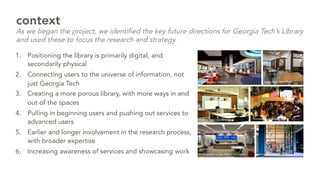
1.  Positioning the library is primarily digital, and
secondarily physical
2.  Connecting users to the universe of information, not
just Georgia Tech
3.  Creating a more porous library, with more ways in and
out of the spaces
4.  Pulling in beginning users and pushing out services to
advanced users
5.  Earlier and longer involvement in the research process,
with broader expertise
6.  Increasing awareness of services and showcasing work
context
As we began the project, we identified the key future directions for Georgia Tech’s Library
and used these to focus the research and strategy.
5Georgia Tech Library | brightspot 2016 ARL Assessment Conference
Library Vision
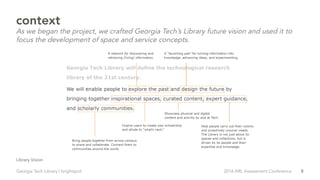
context
As we began the project, we crafted Georgia Tech’s Library future vision and used it to
focus the development of space and service concepts.
6Georgia Tech Library | brightspot 2016 ARL Assessment Conference
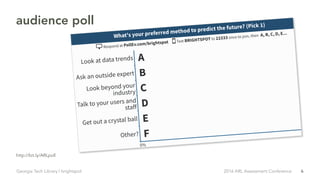
http://bit.ly/ARLpoll
audience poll
7Georgia Tech Library | brightspot 2016 ARL Assessment Conference
Our hypothesis and methodology:
Research and engage lead users to
predict future space and service
needs.
8Georgia Tech Library | brightspot 2016 ARL Assessment Conference
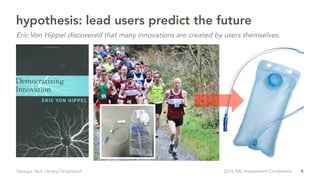
Eric Von Hippel discovered that many innovations are created by users themselves.
hypothesis: lead users predict the future
9Georgia Tech Library | brightspot 2016 ARL Assessment Conference
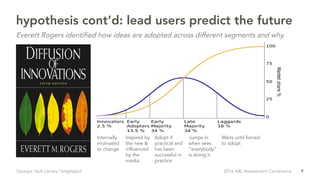
hypothesis cont’d: lead users predict the future
Everett Rogers identified how ideas are adopted across different segments and why.
Internally
motivated
to change
Inspired by
the new &
influenced
by the
media
Adopt if
practical and
has been
successful in
practice
Jumps in
when sees
“everybody”
is doing it
Waits until forced
to adopt
10Georgia Tech Library | brightspot 2016 ARL Assessment Conference
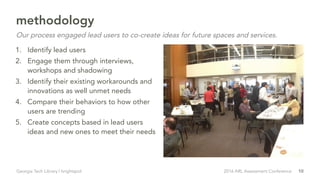
1.  Identify lead users
2.  Engage them through interviews,
workshops and shadowing
3.  Identify their existing workarounds and
innovations as well unmet needs
4.  Compare their behaviors to how other
users are trending
5.  Create concepts based in lead users
ideas and new ones to meet their needs
methodology
Our process engaged lead users to co-create ideas for future spaces and services.
How we applied this on the
Library Renewal Project
12Georgia Tech Library | brightspot 2016 ARL Assessment Conference
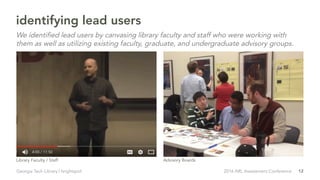
Library Faculty / Staff Advisory Boards
identifying lead users
We identified lead users by canvasing library faculty and staff who were working with
them as well as utilizing existing faculty, graduate, and undergraduate advisory groups.
13Georgia Tech Library | brightspot 2016 ARL Assessment Conference
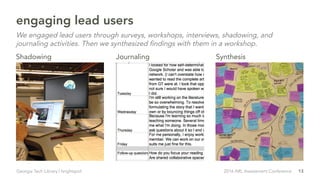
Shadowing Journaling Synthesis
engaging lead users
We engaged lead users through surveys, workshops, interviews, shadowing, and
journaling activities. Then we synthesized findings with them in a workshop.
14Georgia Tech Library | brightspot 2016 ARL Assessment Conference
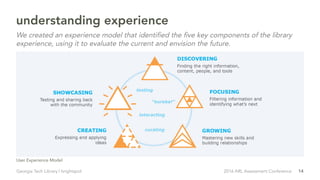
User Experience Model
understanding experience
We created an experience model that identified the five key components of the library
experience, using it to evaluate the current and envision the future.
What we found.
(awesome stuff)
16Georgia Tech Library | brightspot 2016 ARL Assessment Conference
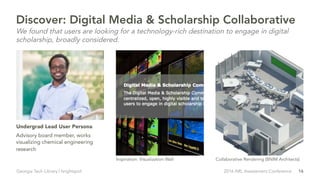
Advisory board member, works
visualizing chemical engineering
research
Undergrad Lead User Persona
Inspiration: Visualization Wall Collaborative Rendering (BNIM Architects)
Discover: Digital Media & Scholarship Collaborative
We found that users are looking for a technology-rich destination to engage in digital
scholarship, broadly considered.
17Georgia Tech Library | brightspot 2016 ARL Assessment Conference
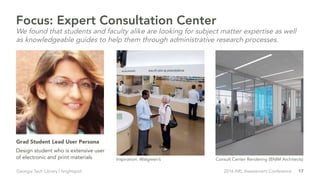
Design student who is extensive user
of electronic and print materials Inspiration: Walgreen’s Consult Center Rendering (BNIM Architects)
Focus: Expert Consultation Center
We found that students and faculty alike are looking for subject matter expertise as well
as knowledgeable guides to help them through administrative research processes.
Grad Student Lead User Persona
18Georgia Tech Library | brightspot 2016 ARL Assessment Conference
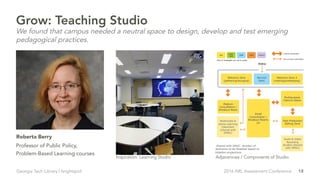
Professor of Public Policy,
Problem-Based Learning courses
Roberta Berry
Inspiration: Learning Studio Adjacencies / Components of Studio
Grow: Teaching Studio
We found that campus needed a neutral space to design, develop and test emerging
pedagogical practices.
19Georgia Tech Library | brightspot 2016 ARL Assessment Conference
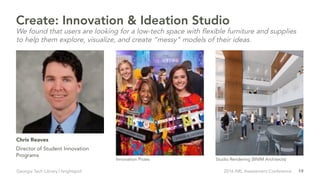
Director of Student Innovation
Programs
Innovation Prizes Studio Rendering (BNIM Architects)
Create: Innovation & Ideation Studio
We found that users are looking for a low-tech space with flexible furniture and supplies
to help them explore, visualize, and create “messy” models of their ideas.
Chris Reaves
20Georgia Tech Library | brightspot 2016 ARL Assessment Conference
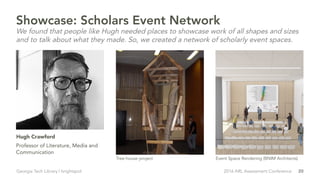
Tree house project Event Space Rendering (BNIM Architects)
Showcase: Scholars Event Network
We found that people like Hugh needed places to showcase work of all shapes and sizes
and to talk about what they made. So, we created a network of scholarly event spaces.
Professor of Literature, Media and
Communication
Hugh Crawford
Questions?
Thank you!
Further questions?
elliot@brightspotstrategy.com
ameet.doshi@library.gatech.edu

Library Assessment Conference: Lead Users

  • 1.
    ARL Assessment Conference LeadUsers: A Predictive Framework
  • 2.
    “The future isalready here. It’s just not evenly distributed.” - William Gibson
  • 3.
    Context on HowLibraries (and Georgia Tech’s Libraries) are changing.
  • 4.
    1.  Positioning thelibrary is primarily digital, and secondarily physical 2.  Connecting users to the universe of information, not just Georgia Tech 3.  Creating a more porous library, with more ways in and out of the spaces 4.  Pulling in beginning users and pushing out services to advanced users 5.  Earlier and longer involvement in the research process, with broader expertise 6.  Increasing awareness of services and showcasing work context As we began the project, we identified the key future directions for Georgia Tech’s Library and used these to focus the research and strategy.
  • 5.
    5Georgia Tech Library| brightspot 2016 ARL Assessment Conference Library Vision context As we began the project, we crafted Georgia Tech’s Library future vision and used it to focus the development of space and service concepts.
  • 6.
    6Georgia Tech Library| brightspot 2016 ARL Assessment Conference http://bit.ly/ARLpoll audience poll
  • 7.
    7Georgia Tech Library| brightspot 2016 ARL Assessment Conference Our hypothesis and methodology: Research and engage lead users to predict future space and service needs.
  • 8.
    8Georgia Tech Library| brightspot 2016 ARL Assessment Conference Eric Von Hippel discovered that many innovations are created by users themselves. hypothesis: lead users predict the future
  • 9.
    9Georgia Tech Library| brightspot 2016 ARL Assessment Conference hypothesis cont’d: lead users predict the future Everett Rogers identified how ideas are adopted across different segments and why. Internally motivated to change Inspired by the new & influenced by the media Adopt if practical and has been successful in practice Jumps in when sees “everybody” is doing it Waits until forced to adopt
  • 10.
    10Georgia Tech Library| brightspot 2016 ARL Assessment Conference 1.  Identify lead users 2.  Engage them through interviews, workshops and shadowing 3.  Identify their existing workarounds and innovations as well unmet needs 4.  Compare their behaviors to how other users are trending 5.  Create concepts based in lead users ideas and new ones to meet their needs methodology Our process engaged lead users to co-create ideas for future spaces and services.
  • 11.
    How we appliedthis on the Library Renewal Project
  • 12.
    12Georgia Tech Library| brightspot 2016 ARL Assessment Conference Library Faculty / Staff Advisory Boards identifying lead users We identified lead users by canvasing library faculty and staff who were working with them as well as utilizing existing faculty, graduate, and undergraduate advisory groups.
  • 13.
    13Georgia Tech Library| brightspot 2016 ARL Assessment Conference Shadowing Journaling Synthesis engaging lead users We engaged lead users through surveys, workshops, interviews, shadowing, and journaling activities. Then we synthesized findings with them in a workshop.
  • 14.
    14Georgia Tech Library| brightspot 2016 ARL Assessment Conference User Experience Model understanding experience We created an experience model that identified the five key components of the library experience, using it to evaluate the current and envision the future.
  • 15.
  • 16.
    16Georgia Tech Library| brightspot 2016 ARL Assessment Conference Advisory board member, works visualizing chemical engineering research Undergrad Lead User Persona Inspiration: Visualization Wall Collaborative Rendering (BNIM Architects) Discover: Digital Media & Scholarship Collaborative We found that users are looking for a technology-rich destination to engage in digital scholarship, broadly considered.
  • 17.
    17Georgia Tech Library| brightspot 2016 ARL Assessment Conference Design student who is extensive user of electronic and print materials Inspiration: Walgreen’s Consult Center Rendering (BNIM Architects) Focus: Expert Consultation Center We found that students and faculty alike are looking for subject matter expertise as well as knowledgeable guides to help them through administrative research processes. Grad Student Lead User Persona
  • 18.
    18Georgia Tech Library| brightspot 2016 ARL Assessment Conference Professor of Public Policy, Problem-Based Learning courses Roberta Berry Inspiration: Learning Studio Adjacencies / Components of Studio Grow: Teaching Studio We found that campus needed a neutral space to design, develop and test emerging pedagogical practices.
  • 19.
    19Georgia Tech Library| brightspot 2016 ARL Assessment Conference Director of Student Innovation Programs Innovation Prizes Studio Rendering (BNIM Architects) Create: Innovation & Ideation Studio We found that users are looking for a low-tech space with flexible furniture and supplies to help them explore, visualize, and create “messy” models of their ideas. Chris Reaves
  • 20.
    20Georgia Tech Library| brightspot 2016 ARL Assessment Conference Tree house project Event Space Rendering (BNIM Architects) Showcase: Scholars Event Network We found that people like Hugh needed places to showcase work of all shapes and sizes and to talk about what they made. So, we created a network of scholarly event spaces. Professor of Literature, Media and Communication Hugh Crawford
  • 21.
  • 22.