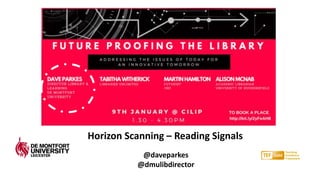
Horizon Scanning – Reading Signals
@daveparkes
@dmulibdirector
6
https://www.flickr.com/photos/thomashawk/419107007/in/photostream/
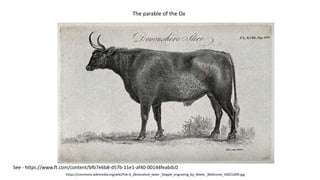
https://commons.wikimedia.org/wiki/File:A_Devonshire_steer._Stipple_engraving_by_Neele._Wellcome_V0021699.jpg
See - https://www.ft.com/content/bfb7e6b8-d57b-11e1-af40-00144feabdc0
The parable of the Ox
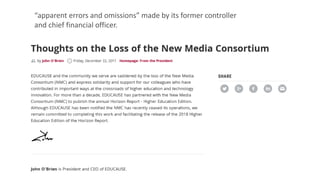
“apparent errors and omissions” made by its former controller
and chief financial officer.
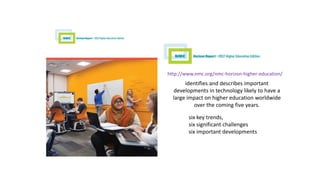
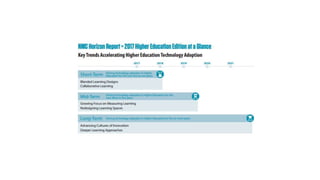
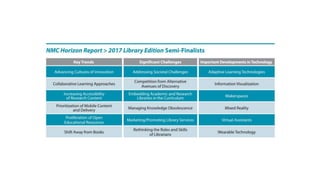
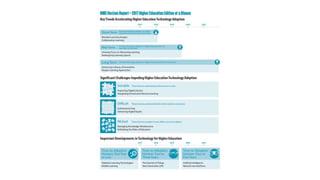
http://www.nmc.org/nmc-horizon-higher-education/
identifies and describes important
developments in technology likely to have a
large impact on higher education worldwide
over the coming five years.
six key trends,
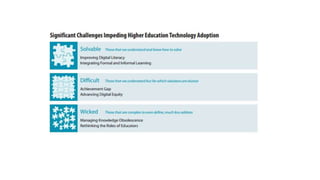
six significant challenges
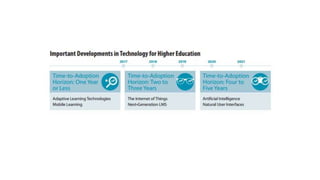
six important developments
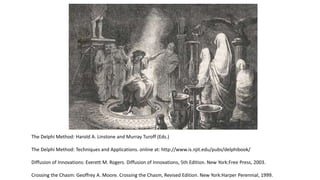
The Delphi Method: Harold A. Linstone and Murray Turoff (Eds.)
The Delphi Method: Techniques and Applications. online at: http://www.is.njit.edu/pubs/delphibook/
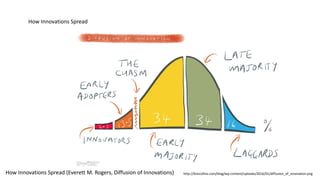
Diffusion of Innovations: Everett M. Rogers. Diffusion of Innovations, 5th Edition. New York:Free Press, 2003.
Crossing the Chasm: Geoffrey A. Moore. Crossing the Chasm, Revised Edition. New York:Harper Perennial, 1999.
The Delphi Method
Bring in the panel
Aggregate the results
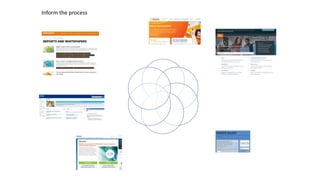
Inform the process
http://kimcofino.com/blog/wp-
content/uploads/2016/01/diffusion_of_innovation
.png
http://kimcofino.com/blog/wp-content/uploads/2016/01/diffusion_of_innovation.pngHow Innovations Spread (Everett M. Rogers, Diffusion of Innovations)
How Innovations Spread
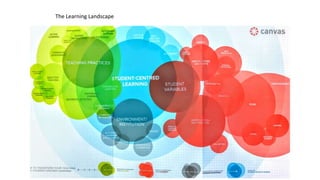
The Learning Landscape
Research Questions:
Space
What types of learning and teaching spaces do students enjoy?
popular and what is missing? How can we look beyond current
create a vision for the future?
Innovation and Inspiration
The shape and purpose of the Academic Library is changing. What
innovative activities, services and spaces should the future library
to ensure a stimulating, motivating and original experience for
Community and Culture
Every university is a community. Is the notion of identity relevant to
population, who are they and how is the idea of community
we use this to create space with a strong sense of belonging?
Identity
The academic heart of every campus. As libraries continue to
perception of them also alters. What does the notion of the Library
students and how can we use this to create spaces that project an
identity and sense of place?
Methodology:
Photo Survey – pre-planned shooting script, places,
spaces, objects
Behavioural Mapping – cataloguing student behavior in
situ
Formal interviews – with staff
Soft Interviews – students, conversational - desires, needs
Concept Mapping – 3 days exploring innovation,
priorities, ideas
Creative Workshops – visioning workshops for staff and
students
Digital – social media, blog, twitter etc
Field Work – observation, data
Historical Contextual Review – review of similar projects
Literature Review – new learning spaces
Site Visits – similar projects across UK
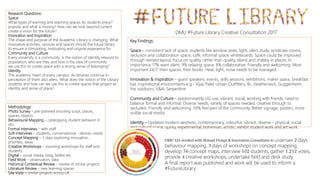
Key Findings:
Space – consistent lack of space, students like window seats, light, silent study, syndicate rooms,
seclusion and collaboration space, café, informal space, whiteboards. Space could be improved
through revised layout, focus on quality rather than quality, bland and shabby in places. In
importance 17% want silent, 9% relaxing space, 8% collaborative. Friendly and welcoming. Most
important 24/7, then spaces, then books. Heat, light, noise needs to be managed.
Innovation & Inspiration – guest speakers, events, skills sessions, exhibitions, maker space, breakfast
bar, inspirational environments e.g.- Vijay Patel, Urban Outfitters, BL, Heatherwick, Guggenheim,
the outdoors, V&A, Serpentine.
Community and Culture – predominantly UG use, vibrant, social, working with friends, need to
balance formal and informal. Diverse needs, variety of spaces needed, creative through to
secluded. Friendly and welcoming. 59% feel part of the community. Better signage, posters, more
visible social media.
Identity – Updated modern aesthetic, contemporary, colourful, vibrant, diverse - physical, social
and cultural space, quirky, experimental, bohemian, artistic, exhibit student work and art work.
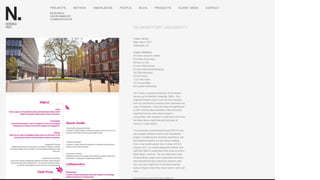
DMU LLS worked with Nomad Design & Innovation Consultants to undertake 2 days
behaviour mapping, 3 days of workshops on concept mapping,
develop 76 concept maps, interview 102 students, gather 1,212 votes,
provide 4 creative workshops, undertake field and desk study.
A final report was published and work will be used to inform a
#FutureLibrary
DMU #Future Library Creative Consultation 2017
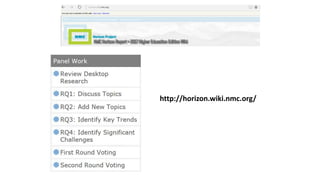
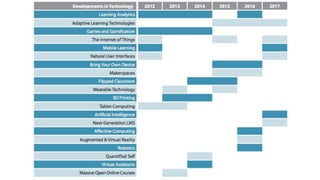
http://horizon.wiki.nmc.org/
3D Video
Electronic
Publishing
Mobile Apps
Quantified Self
Tablet
Computing
Telepresence
Wearable
Technology
BYOD
Flipped
Classroom
Games and
Gamification
Location
Intelligence
Makerspaces
Preservation
and
Conservation
Technologies
Cloud
Computing
The Internet of
Things
Real-Time
Translation
Semantic
Applications
Single Sign-On
Syndication
Tools
Badges/Microcr
edit
Learning
Analytics
Mobile Learning
MOOCs
Online Learning Open Content
Open Licensing
Personal
Learning
Environments
Virtual and
Remote
Laboratories
Collaborative
Environments
Collective
Intelligence
Crowdfunding
Crowdsourcing Digital Identity
Social Networks
Tacit
Intelligence
3D
Printing/Rapid
Prototyping
Augmented
Reality
Information
Visualization
Visual Data
Analysis
Volumetric and
Holographic
Displays
Affective
Computing
Cellular
Networks
Electrovibration
Flexible Displays
Geolocation
Location-Based
Services
Machine
Learning
Mobile
Broadband
Natural User
Interfaces
Near Field
Communication
Next-
Generation
Batteries
Open Hardware
Speech-to-
Speech
Translation
Statistical
Machine
Translation
Virtual
Assistants
Wireless Power
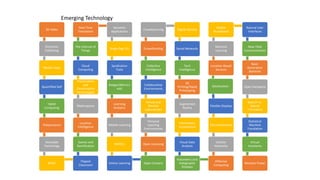
Emerging Technology
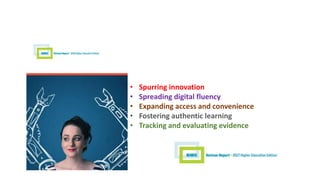
• Spurring innovation
• Spreading digital fluency
• Expanding access and convenience
• Fostering authentic learning
• Tracking and evaluating evidence
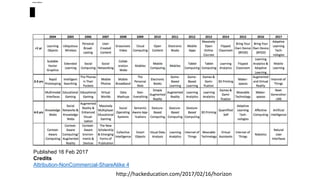
http://hackeducation.com/2017/02/16/horizon
Audrey Watters
Published 16 Feb 2017
Credits
Attribution-NonCommercial-ShareAlike 4
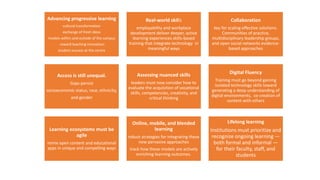
Advancing progressive learning
cultural transformation
exchange of fresh ideas
models within and outside of the campus
reward teaching innovation
student success at the centre
Real-world skills
employability and workplace
development deliver deeper, active
learning experiences skills-based
training that integrate technology in
meaningful ways
Collaboration
key for scaling effective solutions.
Communities of practice,
multidisciplinary leadership groups,
and open social networks evidence-
based approaches
Access is still unequal.
Gaps persist
socioeconomic status, race, ethnicity,
and gender
Assessing nuanced skills
leaders must now consider how to
evaluate the acquisition of vocational
skills, competencies, creativity, and
critical thinking
Digital Fluency
Training must go beyond gaining
isolated technology skills toward
generating a deep understanding of
digital environments, co-creation of
content with others
Learning ecosystems must be
agile
remix open content and educational
apps in unique and compelling ways
Online, mobile, and blended
learning
robust strategies for integrating these
now pervasive approaches
track how these models are actively
enriching learning outcomes.
Lifelong learning
Institutions must prioritize and
recognize ongoing learning —
both formal and informal —
for their faculty, staff, and
students
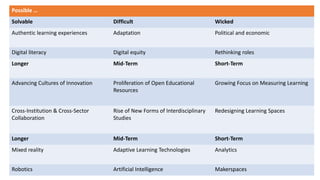
Possible …
Solvable Difficult Wicked
Authentic learning experiences Adaptation Political and economic
Digital literacy Digital equity Rethinking roles
Longer Mid-Term Short-Term
Advancing Cultures of Innovation Proliferation of Open Educational
Resources
Growing Focus on Measuring Learning
Cross-Institution & Cross-Sector
Collaboration
Rise of New Forms of Interdisciplinary
Studies
Redesigning Learning Spaces
Longer Mid-Term Short-Term
Mixed reality Adaptive Learning Technologies Analytics
Robotics Artificial Intelligence Makerspaces
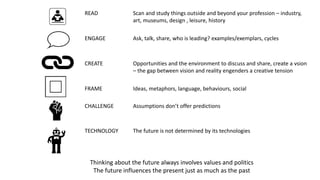
READ Scan and study things outside and beyond your profession – industry,
art, museums, design , leisure, history
ENGAGE Ask, talk, share, who is leading? examples/exemplars, cycles
CREATE Opportunities and the environment to discuss and share, create a vsion
– the gap between vision and reality engenders a creative tension
FRAME Ideas, metaphors, language, behaviours, social
CHALLENGE Assumptions don’t offer predictions
TECHNOLOGY The future is not determined by its technologies
Thinking about the future always involves values and politics
The future influences the present just as much as the past
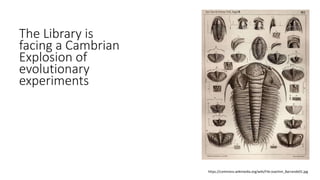
The Library is
facing a Cambrian
Explosion of
evolutionary
experiments
https://commons.wikimedia.org/wiki/File:Joachim_Barrande01.jpg
Horizon Scanning – Reading Signals
@daveparkes
@dmulibdirector

Horizon Scanning - Reading Signals

  • 1.
    Horizon Scanning –Reading Signals @daveparkes @dmulibdirector
  • 6.
  • 10.
  • 11.
  • 12.
    “apparent errors andomissions” made by its former controller and chief financial officer.
  • 13.
    http://www.nmc.org/nmc-horizon-higher-education/ identifies and describesimportant developments in technology likely to have a large impact on higher education worldwide over the coming five years. six key trends, six significant challenges six important developments
  • 15.
    The Delphi Method:Harold A. Linstone and Murray Turoff (Eds.) The Delphi Method: Techniques and Applications. online at: http://www.is.njit.edu/pubs/delphibook/ Diffusion of Innovations: Everett M. Rogers. Diffusion of Innovations, 5th Edition. New York:Free Press, 2003. Crossing the Chasm: Geoffrey A. Moore. Crossing the Chasm, Revised Edition. New York:Harper Perennial, 1999.
  • 16.
  • 17.
  • 18.
  • 19.
  • 20.
  • 21.
  • 22.
    Research Questions: Space What typesof learning and teaching spaces do students enjoy? popular and what is missing? How can we look beyond current create a vision for the future? Innovation and Inspiration The shape and purpose of the Academic Library is changing. What innovative activities, services and spaces should the future library to ensure a stimulating, motivating and original experience for Community and Culture Every university is a community. Is the notion of identity relevant to population, who are they and how is the idea of community we use this to create space with a strong sense of belonging? Identity The academic heart of every campus. As libraries continue to perception of them also alters. What does the notion of the Library students and how can we use this to create spaces that project an identity and sense of place? Methodology: Photo Survey – pre-planned shooting script, places, spaces, objects Behavioural Mapping – cataloguing student behavior in situ Formal interviews – with staff Soft Interviews – students, conversational - desires, needs Concept Mapping – 3 days exploring innovation, priorities, ideas Creative Workshops – visioning workshops for staff and students Digital – social media, blog, twitter etc Field Work – observation, data Historical Contextual Review – review of similar projects Literature Review – new learning spaces Site Visits – similar projects across UK Key Findings: Space – consistent lack of space, students like window seats, light, silent study, syndicate rooms, seclusion and collaboration space, café, informal space, whiteboards. Space could be improved through revised layout, focus on quality rather than quality, bland and shabby in places. In importance 17% want silent, 9% relaxing space, 8% collaborative. Friendly and welcoming. Most important 24/7, then spaces, then books. Heat, light, noise needs to be managed. Innovation & Inspiration – guest speakers, events, skills sessions, exhibitions, maker space, breakfast bar, inspirational environments e.g.- Vijay Patel, Urban Outfitters, BL, Heatherwick, Guggenheim, the outdoors, V&A, Serpentine. Community and Culture – predominantly UG use, vibrant, social, working with friends, need to balance formal and informal. Diverse needs, variety of spaces needed, creative through to secluded. Friendly and welcoming. 59% feel part of the community. Better signage, posters, more visible social media. Identity – Updated modern aesthetic, contemporary, colourful, vibrant, diverse - physical, social and cultural space, quirky, experimental, bohemian, artistic, exhibit student work and art work. DMU LLS worked with Nomad Design & Innovation Consultants to undertake 2 days behaviour mapping, 3 days of workshops on concept mapping, develop 76 concept maps, interview 102 students, gather 1,212 votes, provide 4 creative workshops, undertake field and desk study. A final report was published and work will be used to inform a #FutureLibrary DMU #Future Library Creative Consultation 2017
  • 24.
  • 25.
    3D Video Electronic Publishing Mobile Apps QuantifiedSelf Tablet Computing Telepresence Wearable Technology BYOD Flipped Classroom Games and Gamification Location Intelligence Makerspaces Preservation and Conservation Technologies Cloud Computing The Internet of Things Real-Time Translation Semantic Applications Single Sign-On Syndication Tools Badges/Microcr edit Learning Analytics Mobile Learning MOOCs Online Learning Open Content Open Licensing Personal Learning Environments Virtual and Remote Laboratories Collaborative Environments Collective Intelligence Crowdfunding Crowdsourcing Digital Identity Social Networks Tacit Intelligence 3D Printing/Rapid Prototyping Augmented Reality Information Visualization Visual Data Analysis Volumetric and Holographic Displays Affective Computing Cellular Networks Electrovibration Flexible Displays Geolocation Location-Based Services Machine Learning Mobile Broadband Natural User Interfaces Near Field Communication Next- Generation Batteries Open Hardware Speech-to- Speech Translation Statistical Machine Translation Virtual Assistants Wireless Power Emerging Technology
  • 26.
    • Spurring innovation •Spreading digital fluency • Expanding access and convenience • Fostering authentic learning • Tracking and evaluating evidence
  • 31.
    http://hackeducation.com/2017/02/16/horizon Audrey Watters Published 16Feb 2017 Credits Attribution-NonCommercial-ShareAlike 4
  • 35.
    Advancing progressive learning culturaltransformation exchange of fresh ideas models within and outside of the campus reward teaching innovation student success at the centre Real-world skills employability and workplace development deliver deeper, active learning experiences skills-based training that integrate technology in meaningful ways Collaboration key for scaling effective solutions. Communities of practice, multidisciplinary leadership groups, and open social networks evidence- based approaches Access is still unequal. Gaps persist socioeconomic status, race, ethnicity, and gender Assessing nuanced skills leaders must now consider how to evaluate the acquisition of vocational skills, competencies, creativity, and critical thinking Digital Fluency Training must go beyond gaining isolated technology skills toward generating a deep understanding of digital environments, co-creation of content with others Learning ecosystems must be agile remix open content and educational apps in unique and compelling ways Online, mobile, and blended learning robust strategies for integrating these now pervasive approaches track how these models are actively enriching learning outcomes. Lifelong learning Institutions must prioritize and recognize ongoing learning — both formal and informal — for their faculty, staff, and students
  • 36.
    Possible … Solvable DifficultWicked Authentic learning experiences Adaptation Political and economic Digital literacy Digital equity Rethinking roles Longer Mid-Term Short-Term Advancing Cultures of Innovation Proliferation of Open Educational Resources Growing Focus on Measuring Learning Cross-Institution & Cross-Sector Collaboration Rise of New Forms of Interdisciplinary Studies Redesigning Learning Spaces Longer Mid-Term Short-Term Mixed reality Adaptive Learning Technologies Analytics Robotics Artificial Intelligence Makerspaces
  • 37.
    READ Scan andstudy things outside and beyond your profession – industry, art, museums, design , leisure, history ENGAGE Ask, talk, share, who is leading? examples/exemplars, cycles CREATE Opportunities and the environment to discuss and share, create a vsion – the gap between vision and reality engenders a creative tension FRAME Ideas, metaphors, language, behaviours, social CHALLENGE Assumptions don’t offer predictions TECHNOLOGY The future is not determined by its technologies Thinking about the future always involves values and politics The future influences the present just as much as the past
  • 38.
    The Library is facinga Cambrian Explosion of evolutionary experiments https://commons.wikimedia.org/wiki/File:Joachim_Barrande01.jpg
  • 40.
    Horizon Scanning –Reading Signals @daveparkes @dmulibdirector