2014 OECD ECONOMIC 
SURVEY OF SPAIN 
ON THE ROAD TO RECOVERY 
8 September 2014, Madrid, Spain 
www.oecd.org/eco/surveys/economic-survey-spain.htm
Main Findings 
Structural reforms (labour market, banking, fiscal) have put the economy 
on the road to recovery. 
1. Reforms have improved labour market performance even though 
unemployment rate is still too high. 
2. Innovation, especially by business is too low, and talent is under-utilised. 
3. In spite of recent competitiveness gains, barriers to entrepreneurship 
remain high. 
4. The banking sector has improved but credit is too low and firms need 
access to other sources of financing.
Key Recommendations 
1. Strengthen job search assistance and vocational training and improve 
the tax mix. 
2. Raise living standards by increasing innovation and enhancing skills. 
3. Streamline regulations and reduce barriers to start and grow firms. 
4. Improve insolvency procedures and promote diversified financing 
sources.
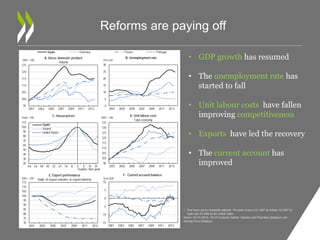
Reforms are paying off 
• GDP growth has resumed 
• The unemployment rate has 
started to fall 
• Unit labour costs have fallen 
improving competitiveness 
• Exports have led the recovery 
• The current account has 
improved 
1. Real house prices seasonally adjusted. The peak occurs in Q1 2007 for Ireland, Q3 2007 for 
Spain and Q4 2006 for the United States. 
Source: OECD (2014), OECD Economic Outlook: Statistics and Projections (database) and 
Housing Prices Database. 
2001 = 100 
125 
120 
115 
110 
105 
100 
Peak = 100 
110 
100 
90 
80 
70 
60 
50 
40 
30 
2001 = 100 
115 
110 
105 
100 
95 
90 
85 
80 
75 
70 
Spain Germany 
A. Gross domestic product 
Volume 
E. Export performance 
Ratio of export volumes to export markets 
2001 2003 2005 2007 2009 2011 2013 
Per cent 
30 
25 
20 
15 
10 
5 
2001 = 100 
135 
130 
125 
120 
115 
110 
105 
100 
95 
France Portugal 
B. Unemployment rate 
D. Unit labour cost 
Total economy 
2001 2003 2005 2007 2009 2011 2013 
20 
-64 -56 -48 -40 -32 -24 -16 -8 0 8 16 24 
Quarters from peak 
C. House prices1 
Spain 
Ireland 
United States 
95 
2001 2003 2005 2007 2009 2011 2013 
0 
2001 2003 2005 2007 2009 2011 2013 
% of GDP 
10 
5 
0 
-5 
-10 
-15 
F. Current account balance 
2001 2003 2005 2007 2009 2011 2013
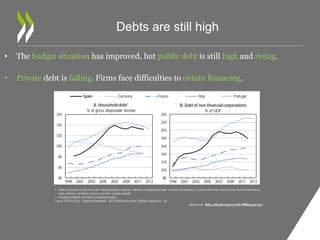
Debts are still high 
• The budget situation has improved, but public debt is still high and rising. 
• Private debt is falling. Firms face difficulties to obtain financing. 
160 
140 
120 
100 
80 
60 
Spain Germany France 
A. Household debt2 
% of gross disposable income 
240 
220 
200 
180 
160 
140 
120 
100 
Italy Portugal 
B. Debt of non-financial corporations 
% of GDP 
1. Debt is calculated as the sum of the following liability categories, whenever available/applicable: currency and deposits, securities other than shares (except financial derivatives), 
loans, insurance technical reserves and other accounts payable. 
2. Including non-profit institutions serving households. 
Source: OECD (2014), “Financial Dashboard”, OECD National Accounts Statistics (database), July. 
1 http://dx.doi.org/10.1787/888933127947 
40 
1999 2001 2003 2005 2007 2009 2011 2013 
80 
1999 2001 2003 2005 2007 2009 2011 2013
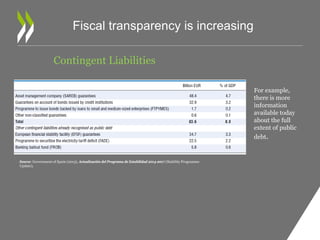
Fiscal transparency is increasing 
Contingent Liabilities 
Source: Government of Spain (2013), Actualización del Programa de Estabilidad 2014-2017 (Stability Programme 
Update). 
For example, 
there is more 
information 
available today 
about the full 
extent of public 
debt.
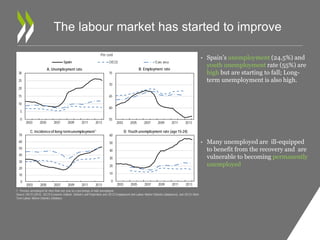
The labour market has started to improve 
• Spain’s unemployment (24.5%) and 
youth unemployment rate (55%) are 
high but are starting to fall; Long-term 
unemployment is also high. 
• Many unemployed are ill-equipped 
to benefit from the recovery and are 
vulnerable to becoming permanently 
unemployed 
Per cent 
30 
25 
20 
15 
10 
5 
0 
Spain OECD Euro area 
A. Unemployment rate 
2003 2005 2007 2009 2011 2013 
75 
70 
65 
60 
55 
B. Employment rate 
2003 2005 2007 2009 2011 2013 
60 
50 
40 
30 
20 
10 
0 
D. Youth unemployment rate (age 15-24) 
2003 2005 2007 2009 2011 2013 
70 
60 
50 
40 
30 
20 
10 
0 
C. Incidence of long-term unemployment1 
2003 2005 2007 2009 2011 2013 
1. Persons unemployed for more than one year as a percentage of total unemployed.. 
Source: OECD (2014), OECD Economic Outlook: Statistics and Projections and OECD Employment and Labour Market Statistics (databases), and OECD Short- 
Term Labour Market Statistics Database.
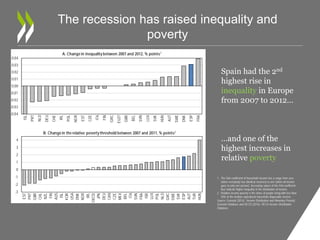
The recession has raised inequality and 
poverty 
Spain had the 2nd 
highest rise in 
inequality in Europe 
from 2007 to 2012… 
…and one of the 
highest increases in 
relative poverty 
1. The Gini coefficient of household income has a range from zero 
(when everybody has identical incomes) to one (when all income 
goes to only one person). Increasing values of the Gini coefficient 
thus indicate higher inequality in the distribution of income. 2008-12 
for France, 2007-11 for Austria and United Kingdom. 
2. Relative income poverty is the share of people living with less than 
50% of the median equivalised household disposable income. 
Source: Eurostat (2014), “Income Distribution and Monetary Poverty”, 
Eurostat Database and OECD (2014), OECD Income Distribution 
Database. 
0.04 
0.03 
0.02 
0.01 
0.00 
-0.01 
-0.02 
-0.03 
-0.04 
ISL 
PRT 
NLD 
DEU 
CHE 
IRL 
POL 
NOR 
EST 
CZE 
ITA 
FIN 
GRC 
EU27 
AUT 
BEL 
GBR 
SVN 
LUX 
FRA 
SVK 
HUN 
SWE 
DNK 
ESP 
A. Change in inequality between 2007 and 2012, % points1 
4 
3 
2 
1 
0 
-1 
-2 
-3 
B. Change in the relative poverty threshold between 2007 and 2011, % points2 
EST 
PRT 
GBR 
CHL 
NZL 
FIN 
AUS 
ISL 
KOR 
USA 
DNK 
NOR 
IRL 
OECD 
JPN 
DEU 
CAN 
CZE 
MEX 
BEL 
ITA 
SVN 
FRA 
ISR 
LUX 
POL 
NLD 
GRC 
SWE 
SVK 
ESP 
AUT 
TUR 
HUN
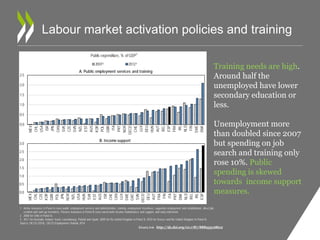
Labour market activation policies and training 
2.5 
2.0 
1.5 
1.0 
0.5 
2007² 2012³ 
3.0 
2.5 
2.0 
1.5 
1.0 
0.5 
1. Active measures in Panel A cover public employment services and administration, training, employment incentives, supported employment and rehabilitation, direct job 
creation and start-up incentives. Passive measures in Panel B cover out-of-work income maintenance and support, and early retirement. 
2. 2008 for Chile in Panel A. 
3. 2011 for Australia, Ireland, Israel, Luxembourg, Poland and Spain; 2009 for the United Kingdom in Panel A; 2010 for Greece and the United Kingdom in Panel B. 
Source: OECD (2014), OECD Employment Outlook 2014. 
Training needs are high. 
Around half the 
unemployed have lower 
secondary education or 
less. 
Unemployment more 
than doubled since 2007 
but spending on job 
search and training only 
rose 10%. Public 
spending is skewed 
towards income support 
measures. 
1 http://dx.doi.org/10.1787/888933128612 
Public expenditure, % of GDP1 
0.0 
MEX 
CHL 
USA 
ISR 
JPN 
CAN 
SVK 
CZE 
SVN 
NZL 
EST 
AUS 
KOR 
POL 
GBR 
ITA 
PRT 
NOR 
OECD 
CHE 
LUX 
DEU 
HUN 
AUT 
BEL 
ESP 
FRA 
IRL 
NLD 
FIN 
SWE 
DNK 
A. Public employment services and training 
0.0 
MEX 
CHL 
CZE 
KOR 
GBR 
POL 
JPN 
NOR 
NZL 
USA 
HUN 
SVK 
EST 
AUS 
ISR 
CHE 
CAN 
LUX 
SWE 
GRC 
SVN 
OECD 
DEU 
AUT 
FRA 
FIN 
ITA 
PRT 
DNK 
NLD 
BEL 
IRL 
ESP 
B. Income support
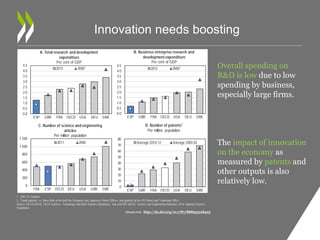
Innovation needs boosting 
4.5 
4.0 
3.5 
3.0 
2.5 
2.0 
1.5 
1.0 
0.5 
A. Total research and development 
expenditure 
Per cent of GDP 
2012 2000¹ 
4.5 
4.0 
3.5 
3.0 
2.5 
2.0 
1.5 
1.0 
0.5 
B. Business enterprise research and 
development expenditure 
Per cent of GDP 
2012 2000¹ 
1 200 
1 000 
800 
600 
400 
200 
C. Number of science and engineering 
articles 
Per million population 
2011 2000 
80 
70 
60 
50 
40 
30 
20 
10 
D. Number of patents2 
Per million population 
Average 2010-12 Average 2000-02 
1. 2001 for Sweden. 
2. Triadic patents, i.e. those filed at the both the European and Japanese Patent Offices, and granted by the US Patent and Trademark Office. 
Source: OECD (2014), OECD Science, Technology and R&D Statistics (database), July and NSF (2014), Science and Engineering Indicators 2014, National Science 
Foundation. 
1 http://dx.doi.org/10.1787/888933128403 
Overall spending on 
R&D is low due to low 
spending by business, 
especially large firms. 
The impact of innovation 
on the economy as 
measured by patents and 
other outputs is also 
relatively low. 
0.0 
ESP GBR FRA OECD USA DEU SWE 
0.0 
ESP GBR FRA OECD USA DEU SWE 
0 
FRA ESP OECD DEU USA GBR SWE 
0 
ESP GBR FRA OECD USA DEU SWE
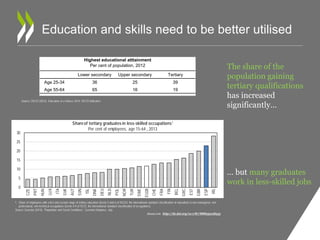
Education and skills need to be better utilised 
30 
25 
20 
15 
10 
5 
Highest educational atttainment 
Per cent of population, 2012 
Lower secondary Upper secondary Tertiary 
Age 25-34 36 25 39 
Age 55-64 65 16 19 
Share of tertiary graduates in less-skilled occupations1 
Per cent of employees, age 15-64 , 2013 
1. Share of employees with a first and second stage of tertiary education (levels 5 and 6 of ISCED, the international standard classification of education) in non-managerial, non-professional, 
non-technical occupations (levels 4-9 of ISCO, the international standard classification of occupations). 
Source: Eurostat (2014), "Population and Social Conditions", Eurostat Database, July. 
1 http://dx.doi.org/10.1787/888933128555 
The share of the 
population gaining 
tertiary qualifications 
has increased 
significantly… 
… but many graduates 
work in less-skilled jobs 
Source: OECD (2014), Education at a Glance 2014: OECD Indicators. 
0 
CZE 
PRT 
HUN 
LUX 
ITA 
SVK 
AUT 
SVN 
ISL 
DNK 
DEU 
NLD 
POL 
NOR 
TUR 
SWE 
EU28 
CHE 
FRA 
FIN 
BEL 
GRC 
EST 
GBR 
ESP 
IRL
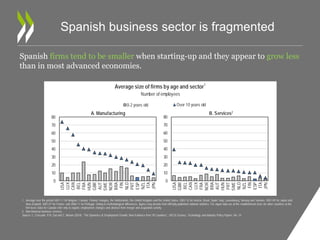
Spanish business sector is fragmented 
Spanish firms tend to be smaller when starting-up and they appear to grow less 
than in most advanced economies. 
Average size of firms by age and sector1 
Number of employees 
80 
70 
60 
50 
40 
30 
20 
10 
0 
A. Manufacturing 
0-2 years old 
USA 
LUX 
CAN 
BEL 
FRA 
HUN 
GBR 
AUT 
SWE 
NOR 
BRA 
FIN 
NLD 
PRT 
ESP 
NZL 
ITA 
JPN 
80 
70 
60 
50 
40 
30 
20 
10 
0 
B. Services2 
Over 10 years old 
USA 
GBR 
BEL 
CAN 
LUX 
FRA 
NOR 
BRA 
AUT 
HUN 
PRT 
SWE 
NLD 
NZL 
FIN 
ESP 
ITA 
JPN 
1. Average over the period 2001-11 for Belgium, Canada, Finland, Hungary, the Netherlands, the United Kingdom and the United States; 2001-10 for Austria, Brazil, Spain, Italy, Luxembourg, Norway and Sweden; 2001-09 for Japan and 
New Zealand; 2001-07 for France; and 2006-11 for Portugal. Owing to methodological differences, figures may deviate from officially published national statistics. For Japan data are at the establishment level, for other countries at the 
firm level. Data for Canada refer only to organic employment changes and abstract from merger and acquisition activity. 
2. Non-financial business services. 
Source: C. Criscuolo, P.N. Gal and C. Menon (2014), “The Dynamics of Employment Growth: New Evidence from 18 Countries”, OECD Science, Technology and Industry Policy Papers, No. 14.
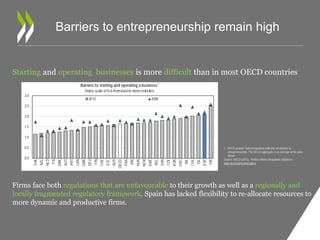
Barriers to entrepreneurship remain high 
Starting and operating businesses is more difficult than in most OECD countries 
Barriers to starting and operating a business1 
Index scale of 0-6 from least to most restrictive 
3.0 
2.5 
2.0 
1.5 
1.0 
0.5 
0.0 
2013 2008 
SVK 
NZL 
NLD 
ITA 
DNK 
AUT 
PRT 
CAN 
GBR 
DEU 
FIN 
CHE 
EST 
AUS 
OECD 
FRA 
JPN 
HUN 
NOR 
SWE 
BEL 
SVN 
CZE 
KOR 
GRC 
IRL 
CHL 
ISL 
ESP 
ISR 
1. OECD product market regulation indicator on barriers to 
entrepreneurship. The OECD aggregate is an average of the data 
shown. 
Source: OECD (2013), Product Market Regulation Database, 
www.oecd.org/economy/pmr. 
Firms face both regulations that are unfavourable to their growth as well as a regionally and 
locally fragmented regulatory framework. Spain has lacked flexibility to re-allocate resources to 
more dynamic and productive firms.
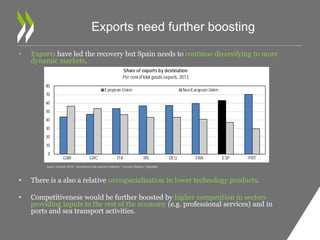
Exports need further boosting 
• Exports have led the recovery but Spain needs to continue diversifying to more 
dynamic markets. 
Share of exports by destination 
Per cent of total goods exports, 2013 
80 
70 
60 
50 
40 
30 
20 
10 
0 
European Union Non-European Union 
GBR GRC ITA IRL DEU FRA ESP PRT 
Source: Eurostat (2014), "International trade long-term indicators", Eurostat Database, September. 
• There is a also a relative overspecialisation in lower technology products. 
• Competitiveness would be further boosted by higher competition in sectors 
providing inputs to the rest of the economy (e.g. professional services) and in 
ports and sea transport activities.
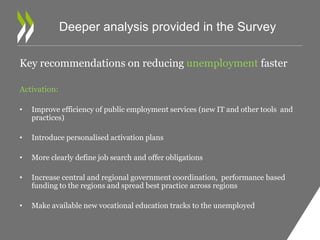
Deeper analysis provided in the Survey 
Key recommendations on reducing unemployment faster 
Activation: 
• Improve efficiency of public employment services (new IT and other tools and 
practices) 
• Introduce personalised activation plans 
• More clearly define job search and offer obligations 
• Increase central and regional government coordination, performance based 
funding to the regions and spread best practice across regions 
• Make available new vocational education tracks to the unemployed
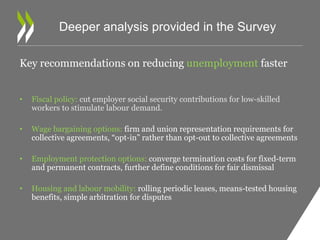
Deeper analysis provided in the Survey 
Key recommendations on reducing unemployment faster 
• Fiscal policy: cut employer social security contributions for low-skilled 
workers to stimulate labour demand. 
• Wage bargaining options: firm and union representation requirements for 
collective agreements, “opt-in” rather than opt-out to collective agreements 
• Employment protection options: converge termination costs for fixed-term 
and permanent contracts, further define conditions for fair dismissal 
• Housing and labour mobility: rolling periodic leases, means-tested housing 
benefits, simple arbitration for disputes
Deeper analysis provided in the Survey 
Key recommendations on harnessing innovation to 
sustainably boost growth 
• increase stability of government innovation funding 
• greater specialisation and scale of universities and research 
technology organisations 
• more peer review and performance base funding 
• streamlining certification for R&D tax credits 
• wider career opportunities for researchers 
• industrial PhDs 
• predictable and low-cost support to low carbon technologies
Deeper analysis provided in the Survey 
Key recommendations on skills and talent to sustainably 
boost growth 
• prevent drop-outs using new assessment and education paths 
• strengthen vocational training 
• increase information to students about jobs outcomes from tertiary 
education 
• improve career guidance
Deeper analysis provided in the Survey 
Key recommendations on business sector performance 
Facilitating start-ups and business growth: 
• revamp the licence system and reduce regulatory fragmentation by 
implementing the market unity law 
• broaden the corporate tax base, lower the rate and review firm size-dependent 
policies and regulations
Deeper analysis provided in the Survey 
Key recommendations on business sector performance 
Fostering internationalisation and strengthening competition: 
• integrate internationalisation and innovation policies 
• strengthen port and electricity regulators; open access to stevedoring 
activities 
• reduce numbers of professions for which membership of the professional 
body is required 
• reduce vertical integration in the electricity market 
• pursue efforts to increase judicial efficiency
Deeper analysis provided in the Survey 
Key recommendations on business sector performance 
Tackling over-indebtedness and improving firms financing: 
• increase incentives for the use of out-of-court and in-court insolvency 
procedures by SMEs 
• introduce a new out-of-court negotiated personal insolvency regime 
• continue to promote diversified financing sources 
• make further use of mutual guarantee schemes 
• establish a comprehensive credit registry for SMEs
OECD Economic Surveys: Spain 2014 
• Read this publication 
• Website with additional information 
Compare your country data visualization tool 
Follow us on twitter: 
Follow us on: 
OECD Economics 
OECD 
OCDE en Español

OECD Economic Survey of Spain 2014

  • 1.
    2014 OECD ECONOMIC SURVEY OF SPAIN ON THE ROAD TO RECOVERY 8 September 2014, Madrid, Spain www.oecd.org/eco/surveys/economic-survey-spain.htm
  • 2.
    Main Findings Structuralreforms (labour market, banking, fiscal) have put the economy on the road to recovery. 1. Reforms have improved labour market performance even though unemployment rate is still too high. 2. Innovation, especially by business is too low, and talent is under-utilised. 3. In spite of recent competitiveness gains, barriers to entrepreneurship remain high. 4. The banking sector has improved but credit is too low and firms need access to other sources of financing.
  • 3.
    Key Recommendations 1.Strengthen job search assistance and vocational training and improve the tax mix. 2. Raise living standards by increasing innovation and enhancing skills. 3. Streamline regulations and reduce barriers to start and grow firms. 4. Improve insolvency procedures and promote diversified financing sources.
  • 4.
    Reforms are payingoff • GDP growth has resumed • The unemployment rate has started to fall • Unit labour costs have fallen improving competitiveness • Exports have led the recovery • The current account has improved 1. Real house prices seasonally adjusted. The peak occurs in Q1 2007 for Ireland, Q3 2007 for Spain and Q4 2006 for the United States. Source: OECD (2014), OECD Economic Outlook: Statistics and Projections (database) and Housing Prices Database. 2001 = 100 125 120 115 110 105 100 Peak = 100 110 100 90 80 70 60 50 40 30 2001 = 100 115 110 105 100 95 90 85 80 75 70 Spain Germany A. Gross domestic product Volume E. Export performance Ratio of export volumes to export markets 2001 2003 2005 2007 2009 2011 2013 Per cent 30 25 20 15 10 5 2001 = 100 135 130 125 120 115 110 105 100 95 France Portugal B. Unemployment rate D. Unit labour cost Total economy 2001 2003 2005 2007 2009 2011 2013 20 -64 -56 -48 -40 -32 -24 -16 -8 0 8 16 24 Quarters from peak C. House prices1 Spain Ireland United States 95 2001 2003 2005 2007 2009 2011 2013 0 2001 2003 2005 2007 2009 2011 2013 % of GDP 10 5 0 -5 -10 -15 F. Current account balance 2001 2003 2005 2007 2009 2011 2013
  • 5.
    Debts are stillhigh • The budget situation has improved, but public debt is still high and rising. • Private debt is falling. Firms face difficulties to obtain financing. 160 140 120 100 80 60 Spain Germany France A. Household debt2 % of gross disposable income 240 220 200 180 160 140 120 100 Italy Portugal B. Debt of non-financial corporations % of GDP 1. Debt is calculated as the sum of the following liability categories, whenever available/applicable: currency and deposits, securities other than shares (except financial derivatives), loans, insurance technical reserves and other accounts payable. 2. Including non-profit institutions serving households. Source: OECD (2014), “Financial Dashboard”, OECD National Accounts Statistics (database), July. 1 http://dx.doi.org/10.1787/888933127947 40 1999 2001 2003 2005 2007 2009 2011 2013 80 1999 2001 2003 2005 2007 2009 2011 2013
  • 6.
    Fiscal transparency isincreasing Contingent Liabilities Source: Government of Spain (2013), Actualización del Programa de Estabilidad 2014-2017 (Stability Programme Update). For example, there is more information available today about the full extent of public debt.
  • 7.
    The labour markethas started to improve • Spain’s unemployment (24.5%) and youth unemployment rate (55%) are high but are starting to fall; Long-term unemployment is also high. • Many unemployed are ill-equipped to benefit from the recovery and are vulnerable to becoming permanently unemployed Per cent 30 25 20 15 10 5 0 Spain OECD Euro area A. Unemployment rate 2003 2005 2007 2009 2011 2013 75 70 65 60 55 B. Employment rate 2003 2005 2007 2009 2011 2013 60 50 40 30 20 10 0 D. Youth unemployment rate (age 15-24) 2003 2005 2007 2009 2011 2013 70 60 50 40 30 20 10 0 C. Incidence of long-term unemployment1 2003 2005 2007 2009 2011 2013 1. Persons unemployed for more than one year as a percentage of total unemployed.. Source: OECD (2014), OECD Economic Outlook: Statistics and Projections and OECD Employment and Labour Market Statistics (databases), and OECD Short- Term Labour Market Statistics Database.
  • 8.
    The recession hasraised inequality and poverty Spain had the 2nd highest rise in inequality in Europe from 2007 to 2012… …and one of the highest increases in relative poverty 1. The Gini coefficient of household income has a range from zero (when everybody has identical incomes) to one (when all income goes to only one person). Increasing values of the Gini coefficient thus indicate higher inequality in the distribution of income. 2008-12 for France, 2007-11 for Austria and United Kingdom. 2. Relative income poverty is the share of people living with less than 50% of the median equivalised household disposable income. Source: Eurostat (2014), “Income Distribution and Monetary Poverty”, Eurostat Database and OECD (2014), OECD Income Distribution Database. 0.04 0.03 0.02 0.01 0.00 -0.01 -0.02 -0.03 -0.04 ISL PRT NLD DEU CHE IRL POL NOR EST CZE ITA FIN GRC EU27 AUT BEL GBR SVN LUX FRA SVK HUN SWE DNK ESP A. Change in inequality between 2007 and 2012, % points1 4 3 2 1 0 -1 -2 -3 B. Change in the relative poverty threshold between 2007 and 2011, % points2 EST PRT GBR CHL NZL FIN AUS ISL KOR USA DNK NOR IRL OECD JPN DEU CAN CZE MEX BEL ITA SVN FRA ISR LUX POL NLD GRC SWE SVK ESP AUT TUR HUN
  • 9.
    Labour market activationpolicies and training 2.5 2.0 1.5 1.0 0.5 2007² 2012³ 3.0 2.5 2.0 1.5 1.0 0.5 1. Active measures in Panel A cover public employment services and administration, training, employment incentives, supported employment and rehabilitation, direct job creation and start-up incentives. Passive measures in Panel B cover out-of-work income maintenance and support, and early retirement. 2. 2008 for Chile in Panel A. 3. 2011 for Australia, Ireland, Israel, Luxembourg, Poland and Spain; 2009 for the United Kingdom in Panel A; 2010 for Greece and the United Kingdom in Panel B. Source: OECD (2014), OECD Employment Outlook 2014. Training needs are high. Around half the unemployed have lower secondary education or less. Unemployment more than doubled since 2007 but spending on job search and training only rose 10%. Public spending is skewed towards income support measures. 1 http://dx.doi.org/10.1787/888933128612 Public expenditure, % of GDP1 0.0 MEX CHL USA ISR JPN CAN SVK CZE SVN NZL EST AUS KOR POL GBR ITA PRT NOR OECD CHE LUX DEU HUN AUT BEL ESP FRA IRL NLD FIN SWE DNK A. Public employment services and training 0.0 MEX CHL CZE KOR GBR POL JPN NOR NZL USA HUN SVK EST AUS ISR CHE CAN LUX SWE GRC SVN OECD DEU AUT FRA FIN ITA PRT DNK NLD BEL IRL ESP B. Income support
  • 10.
    Innovation needs boosting 4.5 4.0 3.5 3.0 2.5 2.0 1.5 1.0 0.5 A. Total research and development expenditure Per cent of GDP 2012 2000¹ 4.5 4.0 3.5 3.0 2.5 2.0 1.5 1.0 0.5 B. Business enterprise research and development expenditure Per cent of GDP 2012 2000¹ 1 200 1 000 800 600 400 200 C. Number of science and engineering articles Per million population 2011 2000 80 70 60 50 40 30 20 10 D. Number of patents2 Per million population Average 2010-12 Average 2000-02 1. 2001 for Sweden. 2. Triadic patents, i.e. those filed at the both the European and Japanese Patent Offices, and granted by the US Patent and Trademark Office. Source: OECD (2014), OECD Science, Technology and R&D Statistics (database), July and NSF (2014), Science and Engineering Indicators 2014, National Science Foundation. 1 http://dx.doi.org/10.1787/888933128403 Overall spending on R&D is low due to low spending by business, especially large firms. The impact of innovation on the economy as measured by patents and other outputs is also relatively low. 0.0 ESP GBR FRA OECD USA DEU SWE 0.0 ESP GBR FRA OECD USA DEU SWE 0 FRA ESP OECD DEU USA GBR SWE 0 ESP GBR FRA OECD USA DEU SWE
  • 11.
    Education and skillsneed to be better utilised 30 25 20 15 10 5 Highest educational atttainment Per cent of population, 2012 Lower secondary Upper secondary Tertiary Age 25-34 36 25 39 Age 55-64 65 16 19 Share of tertiary graduates in less-skilled occupations1 Per cent of employees, age 15-64 , 2013 1. Share of employees with a first and second stage of tertiary education (levels 5 and 6 of ISCED, the international standard classification of education) in non-managerial, non-professional, non-technical occupations (levels 4-9 of ISCO, the international standard classification of occupations). Source: Eurostat (2014), "Population and Social Conditions", Eurostat Database, July. 1 http://dx.doi.org/10.1787/888933128555 The share of the population gaining tertiary qualifications has increased significantly… … but many graduates work in less-skilled jobs Source: OECD (2014), Education at a Glance 2014: OECD Indicators. 0 CZE PRT HUN LUX ITA SVK AUT SVN ISL DNK DEU NLD POL NOR TUR SWE EU28 CHE FRA FIN BEL GRC EST GBR ESP IRL
  • 12.
    Spanish business sectoris fragmented Spanish firms tend to be smaller when starting-up and they appear to grow less than in most advanced economies. Average size of firms by age and sector1 Number of employees 80 70 60 50 40 30 20 10 0 A. Manufacturing 0-2 years old USA LUX CAN BEL FRA HUN GBR AUT SWE NOR BRA FIN NLD PRT ESP NZL ITA JPN 80 70 60 50 40 30 20 10 0 B. Services2 Over 10 years old USA GBR BEL CAN LUX FRA NOR BRA AUT HUN PRT SWE NLD NZL FIN ESP ITA JPN 1. Average over the period 2001-11 for Belgium, Canada, Finland, Hungary, the Netherlands, the United Kingdom and the United States; 2001-10 for Austria, Brazil, Spain, Italy, Luxembourg, Norway and Sweden; 2001-09 for Japan and New Zealand; 2001-07 for France; and 2006-11 for Portugal. Owing to methodological differences, figures may deviate from officially published national statistics. For Japan data are at the establishment level, for other countries at the firm level. Data for Canada refer only to organic employment changes and abstract from merger and acquisition activity. 2. Non-financial business services. Source: C. Criscuolo, P.N. Gal and C. Menon (2014), “The Dynamics of Employment Growth: New Evidence from 18 Countries”, OECD Science, Technology and Industry Policy Papers, No. 14.
  • 13.
    Barriers to entrepreneurshipremain high Starting and operating businesses is more difficult than in most OECD countries Barriers to starting and operating a business1 Index scale of 0-6 from least to most restrictive 3.0 2.5 2.0 1.5 1.0 0.5 0.0 2013 2008 SVK NZL NLD ITA DNK AUT PRT CAN GBR DEU FIN CHE EST AUS OECD FRA JPN HUN NOR SWE BEL SVN CZE KOR GRC IRL CHL ISL ESP ISR 1. OECD product market regulation indicator on barriers to entrepreneurship. The OECD aggregate is an average of the data shown. Source: OECD (2013), Product Market Regulation Database, www.oecd.org/economy/pmr. Firms face both regulations that are unfavourable to their growth as well as a regionally and locally fragmented regulatory framework. Spain has lacked flexibility to re-allocate resources to more dynamic and productive firms.
  • 14.
    Exports need furtherboosting • Exports have led the recovery but Spain needs to continue diversifying to more dynamic markets. Share of exports by destination Per cent of total goods exports, 2013 80 70 60 50 40 30 20 10 0 European Union Non-European Union GBR GRC ITA IRL DEU FRA ESP PRT Source: Eurostat (2014), "International trade long-term indicators", Eurostat Database, September. • There is a also a relative overspecialisation in lower technology products. • Competitiveness would be further boosted by higher competition in sectors providing inputs to the rest of the economy (e.g. professional services) and in ports and sea transport activities.
  • 15.
    Deeper analysis providedin the Survey Key recommendations on reducing unemployment faster Activation: • Improve efficiency of public employment services (new IT and other tools and practices) • Introduce personalised activation plans • More clearly define job search and offer obligations • Increase central and regional government coordination, performance based funding to the regions and spread best practice across regions • Make available new vocational education tracks to the unemployed
  • 16.
    Deeper analysis providedin the Survey Key recommendations on reducing unemployment faster • Fiscal policy: cut employer social security contributions for low-skilled workers to stimulate labour demand. • Wage bargaining options: firm and union representation requirements for collective agreements, “opt-in” rather than opt-out to collective agreements • Employment protection options: converge termination costs for fixed-term and permanent contracts, further define conditions for fair dismissal • Housing and labour mobility: rolling periodic leases, means-tested housing benefits, simple arbitration for disputes
  • 17.
    Deeper analysis providedin the Survey Key recommendations on harnessing innovation to sustainably boost growth • increase stability of government innovation funding • greater specialisation and scale of universities and research technology organisations • more peer review and performance base funding • streamlining certification for R&D tax credits • wider career opportunities for researchers • industrial PhDs • predictable and low-cost support to low carbon technologies
  • 18.
    Deeper analysis providedin the Survey Key recommendations on skills and talent to sustainably boost growth • prevent drop-outs using new assessment and education paths • strengthen vocational training • increase information to students about jobs outcomes from tertiary education • improve career guidance
  • 19.
    Deeper analysis providedin the Survey Key recommendations on business sector performance Facilitating start-ups and business growth: • revamp the licence system and reduce regulatory fragmentation by implementing the market unity law • broaden the corporate tax base, lower the rate and review firm size-dependent policies and regulations
  • 20.
    Deeper analysis providedin the Survey Key recommendations on business sector performance Fostering internationalisation and strengthening competition: • integrate internationalisation and innovation policies • strengthen port and electricity regulators; open access to stevedoring activities • reduce numbers of professions for which membership of the professional body is required • reduce vertical integration in the electricity market • pursue efforts to increase judicial efficiency
  • 21.
    Deeper analysis providedin the Survey Key recommendations on business sector performance Tackling over-indebtedness and improving firms financing: • increase incentives for the use of out-of-court and in-court insolvency procedures by SMEs • introduce a new out-of-court negotiated personal insolvency regime • continue to promote diversified financing sources • make further use of mutual guarantee schemes • establish a comprehensive credit registry for SMEs
  • 22.
    OECD Economic Surveys:Spain 2014 • Read this publication • Website with additional information Compare your country data visualization tool Follow us on twitter: Follow us on: OECD Economics OECD OCDE en Español

Editor's Notes

  • #2 Slide 1: I crafted all the bullet points by combining the titles of key recommendations to make sentences.