RECENT LABOUR MARKET
DEVELOPMENTS AND REFORMS
IN OECD COUNTRIES
The Rockwool Foundation Conference
February 2018
Stefano Scarpetta
Director
Directorate for Employment, Labour
and Social Affairs
OECD
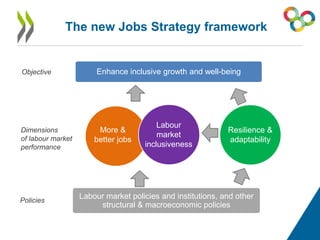
The new Jobs Strategy framework
Objective
Dimensions
of labour market
performance
Policies
Enhance inclusive growth and well-being
More &
better jobs
Labour
market
inclusiveness
Resilience &
adaptability
Labour market policies and institutions, and other
structural & macroeconomic policies
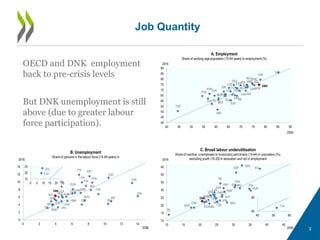
OECD and DNK employment
back to pre-crisis levels
But DNK unemployment is still
above (due to greater labour
force participation).
3
Job Quantity
ISL
CHE
SWE
NZL
DNK
NLD
DEU
NOR
JPN GBR
CAN
AUS
ESTCZE
AUT
USAFIN
LVAISR
HUN
KOR
SVNLUX
PRT
SVK
IRLFRA
POL
BEL
CHL MEX ESP
ITA
GRC
TUR
40
45
50
55
60
65
70
75
80
85
90
40 45 50 55 60 65 70 75 80 85 90
2016
2006
A. Employment
Share of working-age population (15-64 years) in employment (%)
ISL
CHE
SWE
NZL
DNK
NLD
DEU
NOR
JPN
GBR
CAN
AUS
EST
CZE
AUT
USA
FIN
LVA
ISRHUN
KOR
SVN
LUX
PRT
SVK
IRL
FRA
POL
BEL
CHL
MEX
ITA
TUR
0
2
4
6
8
10
12
14
0 2 4 6 8 10 12 14
2016
2006
B. Unemployment
Share of persons in the labour force (15-64 years) in
ESP
GRC
15
20
25
0 5 10 15 20 25
ISL
CHE
SWE
NZL
DNK
NLD
DEU
NOR
JPN
GBR
CAN
AUS
EST
CZE
AUT
USA FIN
LVA
HUNSVN
LUX
PRT SVK
IRL
FRA
POLBEL
ESP ITA
GRC
10
15
20
25
30
35
40
45
10 15 20 25 30 35 40 45
2016
2006
C. Broad labour underutilisation
Share of inactive, unemployed or involuntary part-timers (15-64) in population (%),
excluding youth (15-29) in education and not in employment
TUR
40
60
40 50 60
4
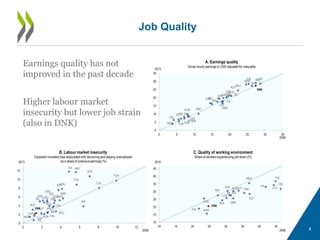
Job Quality
ISL
CHE
SWE
NZL
DNK
NLD
DEU
NOR
JPN
GBR
CAN
AUS
EST
CZE
AUT
USA
FIN
ISR
HUN
KOR
LUX
PRT
SVK
IRL
FRA
POL
BEL
CHL
MEX
ESP
ITA
GRC
TUR
0
5
10
15
20
25
30
35
0 5 10 15 20 25 30 35
2013
2006
A. Earnings quality
Gross hourly earnings in USD adjusted for inequality
ISL
CHE
SWE
NZL
DNK
NLD
DEU
NOR
JPN
GBR
CAN
AUS
EST
CZE
AUT
USA
FIN
ISR
HUN
KOR
SVN
LUX
PRT
SVK
IRL FRA
POL
BEL
CHL
MEX
ITA
TUR
0
2
4
6
8
10
12
0 2 4 6 8 10 12
2013
2006
B. Labour market insecurity
Expected monetary loss associated with becoming and staying unemployed
as a share of previous earnings (%)
SWE
NZL
DNK
NLD
NOR
GBR
AUS
EST
AUTUSA
FIN
LVA
ISR
LUX
IRL
FRA
POL
BEL
MEX
ITA
10
15
20
25
30
35
40
45
10 15 20 25 30 35 40 45
2016
2006
C. Quality of working environment
Share of workers experiencing job strain (%)
Earnings quality has not
improved in the past decade
Higher labour market
insecurity but lower job strain
(also in DNK)
5
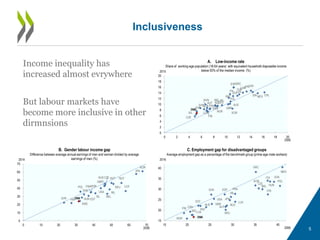
Inclusiveness
ISL
SWE
NZL
DNK
NLD
DEU
NOR
JPN
GBR
CAN
AUS
EST
CZE
AUT
USA
FIN
LVA
ISR
HUN
KOR
SVN
LUX
PRT
SVK
IRL
FRA
POLBEL
CHLMEX
ESP
ITA
GRC
TUR
0
2
4
6
8
10
12
14
16
18
20
0 2 4 6 8 10 12 14 16 18 20
2015
2006
A. Low-income rate
Share of working-age population (18-64 years) with equivalent household disposable income
below 50% of the median income (%)
ISL
SWE
DNK
NLD
DEUNOR
JPN
GBR
AUS
EST
CZE AUT
USA
FIN HUN
KOR
SVN
LUX
SVK
IRL
FRAPOL
BEL
0
10
20
30
40
50
60
70
0 10 20 30 40 50 60 70
2014
2006
B. Gender labour income gap
Difference between average annual earnings of men and women divided by average
earnings of men (%)
NZL
DNK
NLD
DEU
NOR
JPN
GBR
CAN
AUS
EST
CZE
AUT
USA
FIN
LVA
HUN
KOR
SVN
LUX
PRT
SVK
IRL
FRA
POL
BEL
CHL
MEX
ESP
ITA
GRC
15
20
25
30
35
40
15 20 25 30 35 40
2016
2006
C. Employment gap for disadvantaged groups
Average employment gap as a percentage of the benchmark group (prime-age male workers)
Income inequality has
increased almost evrywhere
But labour markets have
become more inclusive in other
dirmnsions
6
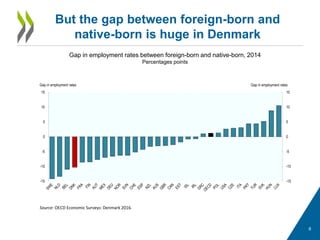
But the gap between foreign-born and
native-born is huge in Denmark
-15
-10
-5
0
5
10
15
-15
-10
-5
0
5
10
15
Gap in employment ratesGap in employment rates
Gap in employment rates between foreign-born and native-born, 2014
Percentages points
Source: OECD Economic Surveys: Denmark 2016.
7
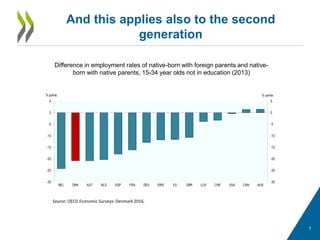
And this applies also to the second
generation
Difference in employment rates of native-born with foreign parents and native-
born with native parents, 15-34 year olds not in education (2013)
-30
-25
-20
-15
-10
-5
0
5
-30
-25
-20
-15
-10
-5
0
5
BEL DNK AUT NLD ESP FRA DEU SWE EU GBR LUX CHE USA CAN AUS
% points% points
Source: OECD Economic Surveys: Denmark 2016.
8
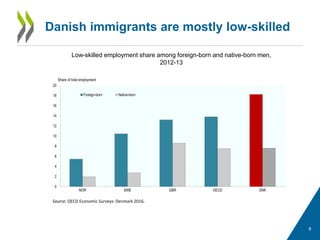
Danish immigrants are mostly low-skilled
Low-skilled employment share among foreign-born and native-born men,
2012-13
Source: OECD Economic Surveys: Denmark 2016.
0
2
4
6
8
10
12
14
16
18
20
NOR SWE GBR OECD DNK
Foreign-born Native-born
Share of total employment
9
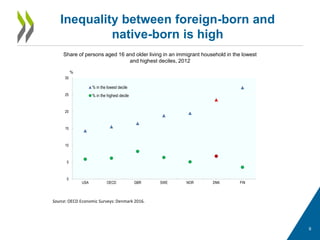
Inequality between foreign-born and
native-born is high
Source: OECD Economic Surveys: Denmark 2016.
0
5
10
15
20
25
30
USA OECD GBR SWE NOR DNK FIN
% in the lowest decile
% in the highest decile
%
Share of persons aged 16 and older living in an immigrant household in the lowest
and highest deciles, 2012
10
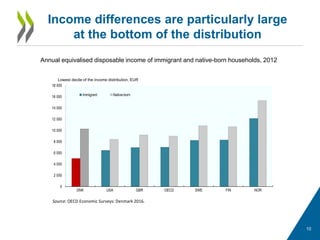
Income differences are particularly large
at the bottom of the distribution
Source: OECD Economic Surveys: Denmark 2016.
0
2 000
4 000
6 000
8 000
10 000
12 000
14 000
16 000
18 000
DNK USA GBR OECD SWE FIN NOR
Immigrant Native-born
Lowest decile of the income distribution, EUR
Annual equivalised disposable income of immigrant and native-born households, 2012
11
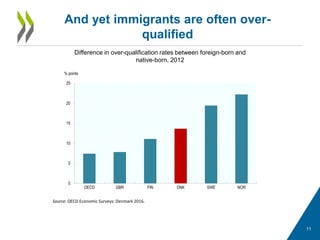
And yet immigrants are often over-
qualified
Source: OECD Economic Surveys: Denmark 2016.
0
5
10
15
20
25
OECD GBR FIN DNK SWE NOR
% points
Difference in over-qualification rates between foreign-born and
native-born, 2012
12
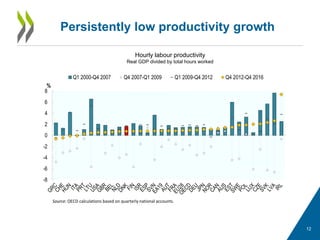
Persistently low productivity growth
Source: OECD calculations based on quarterly national accounts.
-8
-6
-4
-2
0
2
4
6
8
%
Q1 2000-Q4 2007 Q4 2007-Q1 2009 Q1 2009-Q4 2012 Q4 2012-Q4 2016
Hourly labour productivity
Real GDP divided by total hours worked
LABOUR MARKET REFORMS IN
EUROPE IN THE PAST DECADE
14
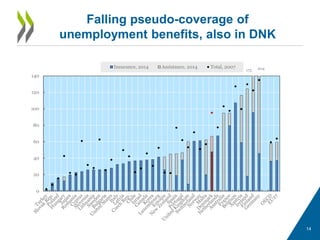
Falling pseudo-coverage of
unemployment benefits, also in DNK
175 204
0
20
40
60
80
100
120
140
Insurance, 2014 Assistance, 2014 Total, 2007
15
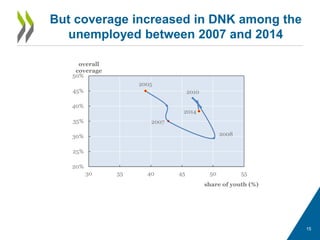
But coverage increased in DNK among the
unemployed between 2007 and 2014
2005
2007
2008
2010
2014
20%
25%
30%
35%
40%
45%
50%
30 35 40 45 50 55
overall
coverage
share of youth (%)
16
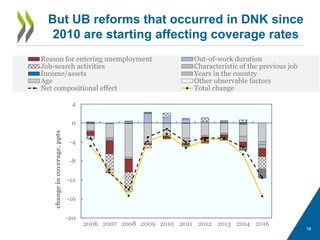
But UB reforms that occurred in DNK since
2010 are starting affecting coverage rates
-50
0
50
2007 2008 2009 2010 2011 2012 2013 2014 2015 2016
chang
ein
covera
ge,
ppts
Reason for entering unemployment Out-of-work duration
Job-search activities Characteristic of the previous job
Income/assets Years in the country
Age Other observable factors
Net compositional effect Total change
-20
-16
-12
-8
-4
0
4
2006 2007 2008 2009 2010 2011 2012 2013 2014 2016
changeincoverage,ppts
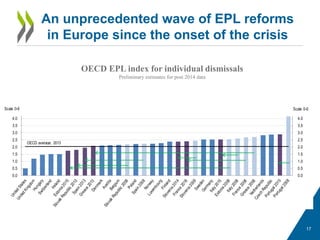
An unprecedented wave of EPL reforms
in Europe since the onset of the crisis
17
OECD EPL index for individual dismissals
Preliminary estimates for post 2014 data
0.0
0.5
1.0
1.5
2.0
2.5
3.0
3.5
4.0
0.0
0.5
1.0
1.5
2.0
2.5
3.0
3.5
4.0
Scale 0-6Scale 0-6
OECD average, 2013
18
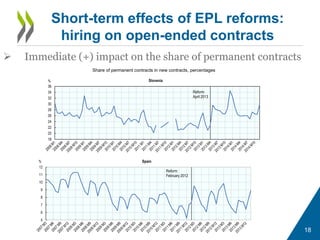
Short-term effects of EPL reforms:
hiring on open-ended contracts
 Immediate (+) impact on the share of permanent contracts
Share of permanent contracts in new contracts, percentages
18
20
22
24
26
28
30
32
34
36
% Slovenia
Reform:
April 2013
5
6
7
8
9
10
11
12
% Spain
Reform:
February 2012
19
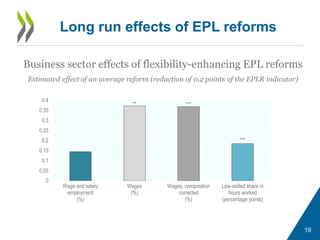
Long run effects of EPL reforms
** ***
***
0
0.05
0.1
0.15
0.2
0.25
0.3
0.35
0.4
Wage and salary
employment
(%)
Wages
(%)
Wages, composition
corrected
(%)
Low-skilled share in
hours worked
(percentage points)
Business sector effects of flexibility-enhancing EPL reforms
Estimated effect of an average reform (reduction of 0.2 points of the EPLR indicator)
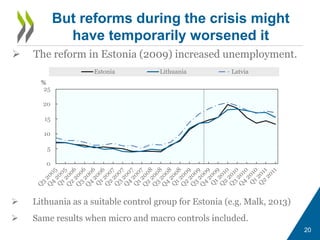
 The reform in Estonia (2009) increased unemployment.
20
But reforms during the crisis might
have temporarily worsened it
0
5
10
15
20
25
%
Estonia Lithuania Latvia
 Lithuania as a suitable control group for Estonia (e.g. Malk, 2013)
 Same results when micro and macro controls included.
21
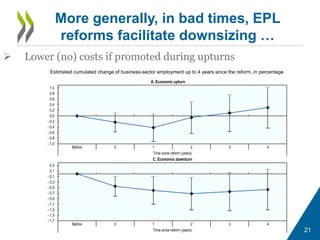
More generally, in bad times, EPL
reforms facilitate downsizing …
 Lower (no) costs if promoted during upturns
Estimated cumulated change of business-sector employment up to 4 years since the reform, in percentage
- 1.0
- 0.8
- 0.6
- 0.4
- 0.2
0.0
0.2
0.4
0.6
0.8
1.0
Before 0 1 2 3 4
Time since reform (years)
A. Economic upturn
- 1.7
- 1.5
- 1.3
- 1.1
- 0.9
- 0.7
- 0.5
- 0.3
- 0.1
0.1
0.3
Before 0 1 2 3 4
Time since reform (years)
C. Economic downturn
22
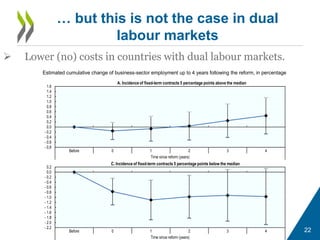
… but this is not the case in dual
labour markets
 Lower (no) costs in countries with dual labour markets.
Estimated cumulative change of business-sector employment up to 4 years following the reform, in percentage
- 0.8
- 0.6
- 0.4
- 0.2
0.0
0.2
0.4
0.6
0.8
1.0
1.2
1.4
1.6
Before 0 1 2 3 4
Time since reform (years)
A. Incidence of fixed-term contracts 5 percentage points above the median
- 2.2
- 2.0
- 1.8
- 1.6
- 1.4
- 1.2
- 1.0
- 0.8
- 0.6
- 0.4
- 0.2
0.0
0.2
Before 0 1 2 3 4
Time since reform (years)
C. Incidence of fixed-term contracts 5 percentage points below the median
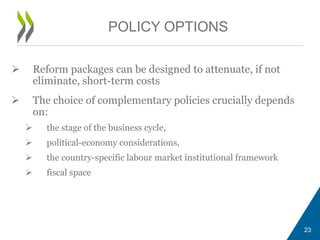
 Reform packages can be designed to attenuate, if not
eliminate, short-term costs
 The choice of complementary policies crucially depends
on:
 the stage of the business cycle,
 political-economy considerations,
 the country-specific labour market institutional framework
 fiscal space
23
POLICY OPTIONS
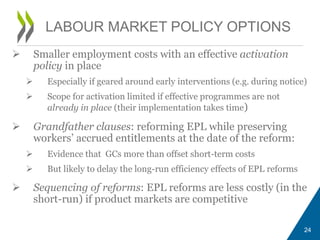
 Smaller employment costs with an effective activation
policy in place
 Especially if geared around early interventions (e.g. during notice)
 Scope for activation limited if effective programmes are not
already in place (their implementation takes time)
 Grandfather clauses: reforming EPL while preserving
workers’ accrued entitlements at the date of the reform:
 Evidence that GCs more than offset short-term costs
 But likely to delay the long-run efficiency effects of EPL reforms
 Sequencing of reforms: EPL reforms are less costly (in the
short-run) if product markets are competitive
24
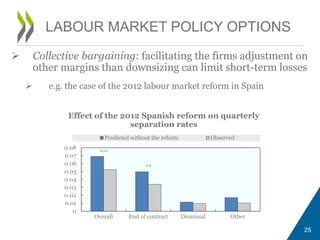
LABOUR MARKET POLICY OPTIONS
 Collective bargaining: facilitating the firms adjustment on
other margins than downsizing can limit short-term losses
 e.g. the case of the 2012 labour market reform in Spain
25
LABOUR MARKET POLICY OPTIONS
***
**
0
0.01
0.02
0.03
0.04
0.05
0.06
0.07
0.08
Overall End of contract Dismissal Other
Predicted without the reform Observed
Effect of the 2012 Spanish reform on quarterly
separation rates
26
Thank you
Contact: Stefano.Scarpetta@oecd.org
OECD Directorate for Employment, Labour and Social Affairs, via www.oecd.org/els
Follow us on Twitter, via @OECD_Social
OECD Employment Outlook, via www.oecd.org/employment/outlook
OECD Employment database, via www.oecd.org/employment/database

Recent labour market developments and reforms in OECD countries

  • 1.
    RECENT LABOUR MARKET DEVELOPMENTSAND REFORMS IN OECD COUNTRIES The Rockwool Foundation Conference February 2018 Stefano Scarpetta Director Directorate for Employment, Labour and Social Affairs OECD
  • 2.
    The new JobsStrategy framework Objective Dimensions of labour market performance Policies Enhance inclusive growth and well-being More & better jobs Labour market inclusiveness Resilience & adaptability Labour market policies and institutions, and other structural & macroeconomic policies
  • 3.
    OECD and DNKemployment back to pre-crisis levels But DNK unemployment is still above (due to greater labour force participation). 3 Job Quantity ISL CHE SWE NZL DNK NLD DEU NOR JPN GBR CAN AUS ESTCZE AUT USAFIN LVAISR HUN KOR SVNLUX PRT SVK IRLFRA POL BEL CHL MEX ESP ITA GRC TUR 40 45 50 55 60 65 70 75 80 85 90 40 45 50 55 60 65 70 75 80 85 90 2016 2006 A. Employment Share of working-age population (15-64 years) in employment (%) ISL CHE SWE NZL DNK NLD DEU NOR JPN GBR CAN AUS EST CZE AUT USA FIN LVA ISRHUN KOR SVN LUX PRT SVK IRL FRA POL BEL CHL MEX ITA TUR 0 2 4 6 8 10 12 14 0 2 4 6 8 10 12 14 2016 2006 B. Unemployment Share of persons in the labour force (15-64 years) in ESP GRC 15 20 25 0 5 10 15 20 25 ISL CHE SWE NZL DNK NLD DEU NOR JPN GBR CAN AUS EST CZE AUT USA FIN LVA HUNSVN LUX PRT SVK IRL FRA POLBEL ESP ITA GRC 10 15 20 25 30 35 40 45 10 15 20 25 30 35 40 45 2016 2006 C. Broad labour underutilisation Share of inactive, unemployed or involuntary part-timers (15-64) in population (%), excluding youth (15-29) in education and not in employment TUR 40 60 40 50 60
  • 4.
    4 Job Quality ISL CHE SWE NZL DNK NLD DEU NOR JPN GBR CAN AUS EST CZE AUT USA FIN ISR HUN KOR LUX PRT SVK IRL FRA POL BEL CHL MEX ESP ITA GRC TUR 0 5 10 15 20 25 30 35 0 510 15 20 25 30 35 2013 2006 A. Earnings quality Gross hourly earnings in USD adjusted for inequality ISL CHE SWE NZL DNK NLD DEU NOR JPN GBR CAN AUS EST CZE AUT USA FIN ISR HUN KOR SVN LUX PRT SVK IRL FRA POL BEL CHL MEX ITA TUR 0 2 4 6 8 10 12 0 2 4 6 8 10 12 2013 2006 B. Labour market insecurity Expected monetary loss associated with becoming and staying unemployed as a share of previous earnings (%) SWE NZL DNK NLD NOR GBR AUS EST AUTUSA FIN LVA ISR LUX IRL FRA POL BEL MEX ITA 10 15 20 25 30 35 40 45 10 15 20 25 30 35 40 45 2016 2006 C. Quality of working environment Share of workers experiencing job strain (%) Earnings quality has not improved in the past decade Higher labour market insecurity but lower job strain (also in DNK)
  • 5.
    5 Inclusiveness ISL SWE NZL DNK NLD DEU NOR JPN GBR CAN AUS EST CZE AUT USA FIN LVA ISR HUN KOR SVN LUX PRT SVK IRL FRA POLBEL CHLMEX ESP ITA GRC TUR 0 2 4 6 8 10 12 14 16 18 20 0 2 46 8 10 12 14 16 18 20 2015 2006 A. Low-income rate Share of working-age population (18-64 years) with equivalent household disposable income below 50% of the median income (%) ISL SWE DNK NLD DEUNOR JPN GBR AUS EST CZE AUT USA FIN HUN KOR SVN LUX SVK IRL FRAPOL BEL 0 10 20 30 40 50 60 70 0 10 20 30 40 50 60 70 2014 2006 B. Gender labour income gap Difference between average annual earnings of men and women divided by average earnings of men (%) NZL DNK NLD DEU NOR JPN GBR CAN AUS EST CZE AUT USA FIN LVA HUN KOR SVN LUX PRT SVK IRL FRA POL BEL CHL MEX ESP ITA GRC 15 20 25 30 35 40 15 20 25 30 35 40 2016 2006 C. Employment gap for disadvantaged groups Average employment gap as a percentage of the benchmark group (prime-age male workers) Income inequality has increased almost evrywhere But labour markets have become more inclusive in other dirmnsions
  • 6.
    6 But the gapbetween foreign-born and native-born is huge in Denmark -15 -10 -5 0 5 10 15 -15 -10 -5 0 5 10 15 Gap in employment ratesGap in employment rates Gap in employment rates between foreign-born and native-born, 2014 Percentages points Source: OECD Economic Surveys: Denmark 2016.
  • 7.
    7 And this appliesalso to the second generation Difference in employment rates of native-born with foreign parents and native- born with native parents, 15-34 year olds not in education (2013) -30 -25 -20 -15 -10 -5 0 5 -30 -25 -20 -15 -10 -5 0 5 BEL DNK AUT NLD ESP FRA DEU SWE EU GBR LUX CHE USA CAN AUS % points% points Source: OECD Economic Surveys: Denmark 2016.
  • 8.
    8 Danish immigrants aremostly low-skilled Low-skilled employment share among foreign-born and native-born men, 2012-13 Source: OECD Economic Surveys: Denmark 2016. 0 2 4 6 8 10 12 14 16 18 20 NOR SWE GBR OECD DNK Foreign-born Native-born Share of total employment
  • 9.
    9 Inequality between foreign-bornand native-born is high Source: OECD Economic Surveys: Denmark 2016. 0 5 10 15 20 25 30 USA OECD GBR SWE NOR DNK FIN % in the lowest decile % in the highest decile % Share of persons aged 16 and older living in an immigrant household in the lowest and highest deciles, 2012
  • 10.
    10 Income differences areparticularly large at the bottom of the distribution Source: OECD Economic Surveys: Denmark 2016. 0 2 000 4 000 6 000 8 000 10 000 12 000 14 000 16 000 18 000 DNK USA GBR OECD SWE FIN NOR Immigrant Native-born Lowest decile of the income distribution, EUR Annual equivalised disposable income of immigrant and native-born households, 2012
  • 11.
    11 And yet immigrantsare often over- qualified Source: OECD Economic Surveys: Denmark 2016. 0 5 10 15 20 25 OECD GBR FIN DNK SWE NOR % points Difference in over-qualification rates between foreign-born and native-born, 2012
  • 12.
    12 Persistently low productivitygrowth Source: OECD calculations based on quarterly national accounts. -8 -6 -4 -2 0 2 4 6 8 % Q1 2000-Q4 2007 Q4 2007-Q1 2009 Q1 2009-Q4 2012 Q4 2012-Q4 2016 Hourly labour productivity Real GDP divided by total hours worked
  • 13.
    LABOUR MARKET REFORMSIN EUROPE IN THE PAST DECADE
  • 14.
    14 Falling pseudo-coverage of unemploymentbenefits, also in DNK 175 204 0 20 40 60 80 100 120 140 Insurance, 2014 Assistance, 2014 Total, 2007
  • 15.
    15 But coverage increasedin DNK among the unemployed between 2007 and 2014 2005 2007 2008 2010 2014 20% 25% 30% 35% 40% 45% 50% 30 35 40 45 50 55 overall coverage share of youth (%)
  • 16.
    16 But UB reformsthat occurred in DNK since 2010 are starting affecting coverage rates -50 0 50 2007 2008 2009 2010 2011 2012 2013 2014 2015 2016 chang ein covera ge, ppts Reason for entering unemployment Out-of-work duration Job-search activities Characteristic of the previous job Income/assets Years in the country Age Other observable factors Net compositional effect Total change -20 -16 -12 -8 -4 0 4 2006 2007 2008 2009 2010 2011 2012 2013 2014 2016 changeincoverage,ppts
  • 17.
    An unprecedented waveof EPL reforms in Europe since the onset of the crisis 17 OECD EPL index for individual dismissals Preliminary estimates for post 2014 data 0.0 0.5 1.0 1.5 2.0 2.5 3.0 3.5 4.0 0.0 0.5 1.0 1.5 2.0 2.5 3.0 3.5 4.0 Scale 0-6Scale 0-6 OECD average, 2013
  • 18.
    18 Short-term effects ofEPL reforms: hiring on open-ended contracts  Immediate (+) impact on the share of permanent contracts Share of permanent contracts in new contracts, percentages 18 20 22 24 26 28 30 32 34 36 % Slovenia Reform: April 2013 5 6 7 8 9 10 11 12 % Spain Reform: February 2012
  • 19.
    19 Long run effectsof EPL reforms ** *** *** 0 0.05 0.1 0.15 0.2 0.25 0.3 0.35 0.4 Wage and salary employment (%) Wages (%) Wages, composition corrected (%) Low-skilled share in hours worked (percentage points) Business sector effects of flexibility-enhancing EPL reforms Estimated effect of an average reform (reduction of 0.2 points of the EPLR indicator)
  • 20.
     The reformin Estonia (2009) increased unemployment. 20 But reforms during the crisis might have temporarily worsened it 0 5 10 15 20 25 % Estonia Lithuania Latvia  Lithuania as a suitable control group for Estonia (e.g. Malk, 2013)  Same results when micro and macro controls included.
  • 21.
    21 More generally, inbad times, EPL reforms facilitate downsizing …  Lower (no) costs if promoted during upturns Estimated cumulated change of business-sector employment up to 4 years since the reform, in percentage - 1.0 - 0.8 - 0.6 - 0.4 - 0.2 0.0 0.2 0.4 0.6 0.8 1.0 Before 0 1 2 3 4 Time since reform (years) A. Economic upturn - 1.7 - 1.5 - 1.3 - 1.1 - 0.9 - 0.7 - 0.5 - 0.3 - 0.1 0.1 0.3 Before 0 1 2 3 4 Time since reform (years) C. Economic downturn
  • 22.
    22 … but thisis not the case in dual labour markets  Lower (no) costs in countries with dual labour markets. Estimated cumulative change of business-sector employment up to 4 years following the reform, in percentage - 0.8 - 0.6 - 0.4 - 0.2 0.0 0.2 0.4 0.6 0.8 1.0 1.2 1.4 1.6 Before 0 1 2 3 4 Time since reform (years) A. Incidence of fixed-term contracts 5 percentage points above the median - 2.2 - 2.0 - 1.8 - 1.6 - 1.4 - 1.2 - 1.0 - 0.8 - 0.6 - 0.4 - 0.2 0.0 0.2 Before 0 1 2 3 4 Time since reform (years) C. Incidence of fixed-term contracts 5 percentage points below the median
  • 23.
     Reform packagescan be designed to attenuate, if not eliminate, short-term costs  The choice of complementary policies crucially depends on:  the stage of the business cycle,  political-economy considerations,  the country-specific labour market institutional framework  fiscal space 23 POLICY OPTIONS
  • 24.
     Smaller employmentcosts with an effective activation policy in place  Especially if geared around early interventions (e.g. during notice)  Scope for activation limited if effective programmes are not already in place (their implementation takes time)  Grandfather clauses: reforming EPL while preserving workers’ accrued entitlements at the date of the reform:  Evidence that GCs more than offset short-term costs  But likely to delay the long-run efficiency effects of EPL reforms  Sequencing of reforms: EPL reforms are less costly (in the short-run) if product markets are competitive 24 LABOUR MARKET POLICY OPTIONS
  • 25.
     Collective bargaining:facilitating the firms adjustment on other margins than downsizing can limit short-term losses  e.g. the case of the 2012 labour market reform in Spain 25 LABOUR MARKET POLICY OPTIONS *** ** 0 0.01 0.02 0.03 0.04 0.05 0.06 0.07 0.08 Overall End of contract Dismissal Other Predicted without the reform Observed Effect of the 2012 Spanish reform on quarterly separation rates
  • 26.
    26 Thank you Contact: Stefano.Scarpetta@oecd.org OECDDirectorate for Employment, Labour and Social Affairs, via www.oecd.org/els Follow us on Twitter, via @OECD_Social OECD Employment Outlook, via www.oecd.org/employment/outlook OECD Employment database, via www.oecd.org/employment/database