Welcome
       to
the presentation
Monetary Policy
Group Name : E
What is Monetary Policy….???
   Monetary Policy is the process by
which the monetary authority of a
country controls the supply of money,
often targeting the interest rate for the
purpose of promoting economic growth
and stability .


      According to Harry G.
     Johnson
       “Monetary policy employing the
  central bank’s control of supply of
  money as an instrument for
  achieving the objectives of general
  economic policy.”
Nature of Monetary Policy….
 Monetary   policy uses a variety of
  tools (interest rate) to control
  influence outcome like(economic
  growth , inflation, exchange rate
  with other currencies and
  unemployment).
 It controls the supply of money
 Monetary policy works through
  expansion or contraction of
  investment and consumption
  expenditure.
Objectives of Monetary Policy….

  There are basically three major
  objectives of
monetary Policy. Which are:-
 To ensure price stability.
 To encourage economic growth.
 To ensure stability of exchange rate of
  money.
Scope of Monetary Policy….

      Monetary decisions today take into account a widen
range of factors such :
 Short term interest rates,
 Long term interest rates,
 Exchange rates,
 Credit quality,
 Bonds & equities (corporate ownership & debt)
 Govt. vs. Private sector spending/savings,
 International capital flows of money on large scale,
Importance of Monetary
Policy……

 Regulates currencies and reserves.
 Manages the monetary and the
    credit system.
   Maintains the par value of domestic
    currencies.
   Promotes and maintains a high level
    of production , employment and
    economic growth.
   Ensures balance of equilibrium.
   Creates full employment.
   Regulates neutrality of money.
   Ensures equal income distribution.


                                          8
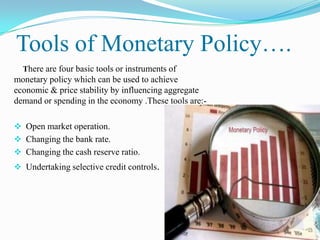
Tools of Monetary Policy….
  There are four basic tools or instruments of
monetary policy which can be used to achieve
economic & price stability by influencing aggregate
demand or spending in the economy .These tools are:-

 Open market operation.
 Changing the bank rate.
 Changing the cash reserve ratio.
 Undertaking selective credit controls.
Expansionary Monetary Policy…
The following three monetary policy
measures are adopted as a part of an
expansionary monetary policy to cure
recession & to establish the
equilibrium of national income at
full employment level of output.

 The central bank undertakes open market
  operation
 The central may lower the bank rate
 The central bank may reduce cash reserve
  ratio
Tight Monetary Policy…
The following monetary measures
generally adopted as tight monetary
policy to control inflation

 The central bank sells the Government
  securities
 The central bank may raise bank rate
 The central may raise statutory cash reserve
  ratio
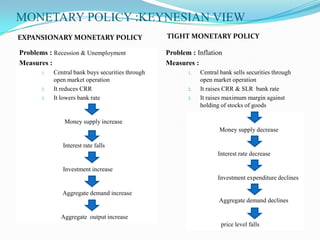
MONETARY POLICY :KEYNESIAN VIEW
EXPANSIONARY MONETARY POLICY                       TIGHT MONETARY POLICY

Problems : Recession & Unemployment                Problem : Inflation
Measures :                                         Measures :
       1.   Central bank buys securities through          1.   Central bank sells securities through
            open market operation                              open market operation
       2.   It reduces CRR                                2.   It raises CRR & SLR bank rate
       3.   It lowers bank rate                           3.   It raises maximum margin against
                                                               holding of stocks of goods

                Money supply increase
                                                                      Money supply decrease

               Interest rate falls
                                                                      Interest rate decrease

               Investment increase
                                                                      Investment expenditure declines

               Aggregate demand increase
                                                                      Aggregate demand declines

              Aggregate output increase
                                                                       price level falls
Role of Monetary Policy in Economic
            Growth….
    Economic growth can be speeded up by
 accelerating the rate of savings and investment in
 the economy. This requires the following steps :

  Increase in the aggregate rate of savings,
  Mobilization of these savings so that they are made
   for the purpose of investment and production,
  Increase in the rate of investment,
  Allocation of investment funds for productive
   purposes and priority sectors of the economy.
Monetary Policy in Bangladesh……
As stated in Bangladesh Bank order 1972,the
  principal objectives of country’s monetary
  policy are:-

 To regulate currency & reserves,
 To manage the monetary and credit system,
 To reserve the par value of domestic
  currency,
 To promote and maintain a high level of
  production , employment and real income,
 To foster growth & development of the
  country’s productive resources in the best
  national interest.
Limitations of Monetary Policy in
    developing Countries

In developing countries monetary policy suffers from
   the following limitations :
 In under developing countries, the role of monetary
   policy is not compulsive but permissive.
 In under developed society where liquidity trap is in
   existence can’t work efficiently . Here administrative
   honesty & firmness are not very rigorous in less
   regular countries which reduce the efficiency of
   monetary policy a lot.
 Lastly the lag between the decision about a
   particular policy & implementation also hinders the
   monetary policy in success.
THANK YOU

Monetary policy (theoritical)

  • 1.
    Welcome to the presentation
  • 2.
  • 3.
  • 4.
    What is MonetaryPolicy….??? Monetary Policy is the process by which the monetary authority of a country controls the supply of money, often targeting the interest rate for the purpose of promoting economic growth and stability .  According to Harry G. Johnson “Monetary policy employing the central bank’s control of supply of money as an instrument for achieving the objectives of general economic policy.”
  • 5.
    Nature of MonetaryPolicy….  Monetary policy uses a variety of tools (interest rate) to control influence outcome like(economic growth , inflation, exchange rate with other currencies and unemployment).  It controls the supply of money  Monetary policy works through expansion or contraction of investment and consumption expenditure.
  • 6.
    Objectives of MonetaryPolicy…. There are basically three major objectives of monetary Policy. Which are:-  To ensure price stability.  To encourage economic growth.  To ensure stability of exchange rate of money.
  • 7.
    Scope of MonetaryPolicy…. Monetary decisions today take into account a widen range of factors such :  Short term interest rates,  Long term interest rates,  Exchange rates,  Credit quality,  Bonds & equities (corporate ownership & debt)  Govt. vs. Private sector spending/savings,  International capital flows of money on large scale,
  • 8.
    Importance of Monetary Policy…… Regulates currencies and reserves.  Manages the monetary and the credit system.  Maintains the par value of domestic currencies.  Promotes and maintains a high level of production , employment and economic growth.  Ensures balance of equilibrium.  Creates full employment.  Regulates neutrality of money.  Ensures equal income distribution. 8
  • 9.
    Tools of MonetaryPolicy…. There are four basic tools or instruments of monetary policy which can be used to achieve economic & price stability by influencing aggregate demand or spending in the economy .These tools are:-  Open market operation.  Changing the bank rate.  Changing the cash reserve ratio.  Undertaking selective credit controls.
  • 10.
    Expansionary Monetary Policy… Thefollowing three monetary policy measures are adopted as a part of an expansionary monetary policy to cure recession & to establish the equilibrium of national income at full employment level of output.  The central bank undertakes open market operation  The central may lower the bank rate  The central bank may reduce cash reserve ratio
  • 11.
    Tight Monetary Policy… Thefollowing monetary measures generally adopted as tight monetary policy to control inflation  The central bank sells the Government securities  The central bank may raise bank rate  The central may raise statutory cash reserve ratio
  • 12.
    MONETARY POLICY :KEYNESIANVIEW EXPANSIONARY MONETARY POLICY TIGHT MONETARY POLICY Problems : Recession & Unemployment Problem : Inflation Measures : Measures : 1. Central bank buys securities through 1. Central bank sells securities through open market operation open market operation 2. It reduces CRR 2. It raises CRR & SLR bank rate 3. It lowers bank rate 3. It raises maximum margin against holding of stocks of goods Money supply increase Money supply decrease Interest rate falls Interest rate decrease Investment increase Investment expenditure declines Aggregate demand increase Aggregate demand declines Aggregate output increase price level falls
  • 13.
    Role of MonetaryPolicy in Economic Growth…. Economic growth can be speeded up by accelerating the rate of savings and investment in the economy. This requires the following steps :  Increase in the aggregate rate of savings,  Mobilization of these savings so that they are made for the purpose of investment and production,  Increase in the rate of investment,  Allocation of investment funds for productive purposes and priority sectors of the economy.
  • 14.
    Monetary Policy inBangladesh…… As stated in Bangladesh Bank order 1972,the principal objectives of country’s monetary policy are:-  To regulate currency & reserves,  To manage the monetary and credit system,  To reserve the par value of domestic currency,  To promote and maintain a high level of production , employment and real income,  To foster growth & development of the country’s productive resources in the best national interest.
  • 15.
    Limitations of MonetaryPolicy in developing Countries In developing countries monetary policy suffers from the following limitations :  In under developing countries, the role of monetary policy is not compulsive but permissive.  In under developed society where liquidity trap is in existence can’t work efficiently . Here administrative honesty & firmness are not very rigorous in less regular countries which reduce the efficiency of monetary policy a lot.  Lastly the lag between the decision about a particular policy & implementation also hinders the monetary policy in success.
  • 16.